16
Academic Staff Development in the Area of
Technology Enhanced Learning in UK HEIs
Timos Almpanis
Abstract
This paper reports on a study on staff development in the area of technology enhanced learning in UK Higher Education Institutions (HEIs) that took place in November 2011. Data for this study were gathered via an online survey emailed to the Heads of e-Learning Forum (HeLF) which is a network comprised of one senior member of staff per UK institution leading the enhancement of learning and teaching through the use of technology. Prior to the survey, desk-based research on some universities’ publicly available websites gathered similar information about staff development in the area of technology enhanced learning. The online survey received 27 responses, approaching a quarter of all UK HEIs subscribed to the Heads of e-Learning forum list (118 is the total number). Both pre-1992 (16 in number) and post-pre-1992 Universities (11 in number) were represented in the survey and findings indicate the way this sample UK HEIs are approaching staff development in the area of TEL. The survey’s main research question was ‘what provision do UK HEIs make for academic staff development in the area of technology enhanced learning’. Twelve questions, both closed and open-ended, were devised in order to gather enough information about how staff development needs in the area of technology enhanced learning are addressed by different UK institutions. Following the justification of the adopted research methodology, the findings from the online survey are analyzed and discussed and conclusions are drawn.
Keywords: staff development, technology enhanced learning, training, e-learning
This paper is a reprint from eLearning Papers Issue 30 published on 25 Sep 2012.
http://elearningpapers.eu
Introduction – Background
17
enhanced by the use of technology that goes beyond distance e-learning. In the same report, the term Technology Enhanced Learning (TEL) has been promoted by HEFCE as an inclusive term that encompasses not only blended and distance learning practices but also classroom-based activities assisted by technology such as the use of interactive whiteboards and electronic voting systems in the classroom to engage students in their learning.
This study is focused on the staff development provision that UK HEIs make in the area of technology enhanced learning. The biannual survey of technology enhanced learning for higher education in the UK (Browne et al., 2010) administered by the universities and colleges information systems association (UCISA) and funded by the Joint Information Systems Committee (JISC) - hereinafter UCISA Survey - offers a representative picture on institutional developments in this area in a much wider context. It includes provision on IT systems, staffing issues, prospective developments, as well as the anticipated challenges that these developments may pose in the near future and possible ways these challenges could be addressed. This study is focused solely on the staff development activities currently on offer by Higher Education Institutions (HEIs) in the UK aiming to encapsulate detailed information on both technical and pedagogical training in the area of TEL, as well as examples of good practice in the form of case studies and continuing professional development (CPD) activities offered to academic staff in this area.
Learning platforms used to support online learning such as Virtual Learning Environments (VLEs) have been implemented and utilized by the vast majority of universities and colleges in the UK; according to the UCISA Survey on technology enhanced learning (Browne et al., 2010), 90% of the HEIs that participated in the survey reported having at least one main VLE in use. Furthermore, centrally supported use of plagiarism prevention and detection software, e-submission and e-assessment tools is now pervasive across the sector, according to the same survey. E-assessment, multimedia support and lecture capture are identified as the leading new demands on institutional support. There is clear evidence in the report of the fact that, while VLE implementation was a central focus for most institutions approximately ten years ago, their provision for learning technologies has expanded rapidly to include other systems such as e-portfolios, e-assessment tools, web conferencing tools and other tools that facilitate teaching, learning and assessment.
18
staff development needs of the academic staff, UK HEIs have employed professionals with various job titles – learning technologists, e-learning officers, e-learning advisers, e-learning staff developers - whose job role includes staff development in the effective use of educational technologies. Fifty-four (54) out of ninety-one (91) institutions (63%) participating in the UCISA survey reported having a learning technology support unit, while 56 (65%) had an educational development unit. On top of that, TEL support was commonly provided by Information Technology support units (in 80% of cases), while local, departmental support was also provided in two thirds of the cases (66%) (Browne et al, 2010). These figures show the prevalence of TEL-related expertise and support provided by UK HEIs.
Learning technologists in particular are at the centre of these developments in the area of TEL and are a diverse group of professionals whose remit and consequent activities range from staff development to research, management and technical support (Oliver, 2002). In some universities learning technologists – or e-learning staff developers - are part of a centre for excellence in teaching and learning (CETL), in others they undertake educational research on the potential of technology to enhance learning and may inform university-wide strategies in the adoption of learning technologies. According to the UCISA survey (Browne et al, 2010), approximately 11 members of learning technology staff are appointed on average by each of the institutions who participated in the survey; most of them (9) residing in the learning technology support units while the rest are divided in local departmental support, educational development units or other places such as generic IT support units.
The following section describes the results of some initial desk-based research that aimed to explore the forms of TEL-related staff development activities offered by various HEIs in the UK.
Desk-based research on staff development on TEL
19
University of Surrey
The Centre for Educational and Academic Development (CEAD) offers staff development opportunities in many aspects of learning and teaching, including technology related half-day workshops on aspects such as the use of e-portfolios, Turnitin, Electronic voting systems and using online media in learning (University of Surrey, 2012).
London School of Economics
The Centre for Learning Technology (CLT) delivers a wide range of training sessions (1,5 hours long) including Moodle VLE training, blogs, wikis and social media and video conferencing; they also deliver a series of lunchtime webinars on web tools to support research. Furthermore, they have developed a digital literacy programme with various short training courses that include blogging, google docs, facebook, twitter, social bookmarking sites as well as ways to organize research with RSS (Really Simple Syndication) and RSS feed readers that allow user-friendly web syndication of content (London School of Economics, 2012).
University of the West of England
The Electronic Development Unit offers advice, training and support to a wide range of elearning activities such as delivery of materials, supporting students and assessment in distance, blended and face-to-face courses and programmes. Furthermore, an innovative masters‟ level course (MA) in Education in Virtual Worlds is to be delivered in Second Life, subject to validation (University of the West of England, 2012). The University of the West of England (UWE) also provides an Online Learning Course (OLL) that runs over six weeks.
University of Cambridge
Access was disallowed to the Learning Technology Service webpages. The Centre for Applied Research in Educational Technologies (CARET), offers advice on different ways technology can be used to support academic work and „shares some of the latest and best solutions from around the world‟ (University of Cambridge, 2012).
Edge Hill University
20
Learning and skills network professional framework for e-learning. Underpinning activities and resources include ICT skills training required for competent use of e-learning technology, guides and toolkits, briefings and overviews of institution-wide changes to e-learning infrastructure and practices as well as participation and consultancy offered by learning technologists and academic librarians to new academic team approaches to curriculum developments. The Framework on TEL PD is part of the wider PD Framework for teaching staff at Edge Hill and recognizes the importance of securing „buy in‟ from management. It makes provision for a course based TEL PD Pathway, which offers a variety of events from workshops to modules of the PGCert in Teaching and Learning and MA in eLearning modules; it also makes provision for a practice-based TEL PD whose basic activities may include attendance at the annual internal conference seminars and symposia, open days, peer observation, membership of e-learning special interest groups (SIGs) and social networks, while the more advanced activities include facilitating internal workshops and seminars, presenting at the internal conference and extend to presentations to national and international conferences, peer-reviewed publications and leading projects on TEL (Edge Hill University, 2012).
Methodology
21
emerging research approaches in the field of learning technology are already putting pressure on the traditional paradigmatic divide (Jones and Kennedy, 2011).
Findings
Hands-on training
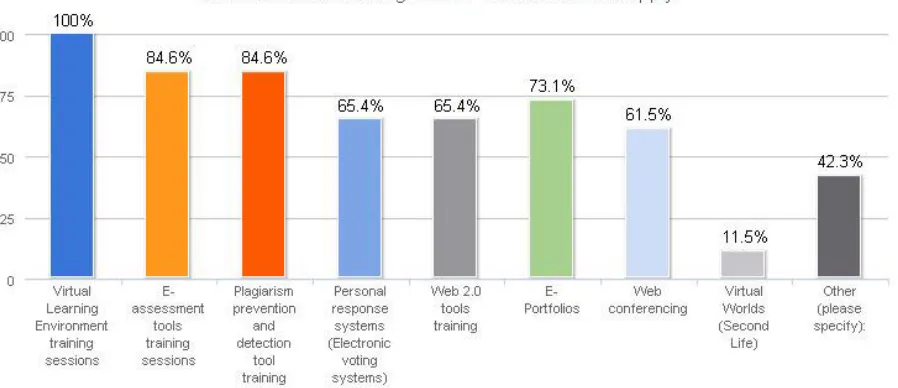
The vast majority of the Heads of E-Learning that completed the survey reported that their universities offer a wide variety of staff development sessions/events for their academic staff. Regarding hands-on training, sessions on how to use the institutional virtual learning environment (VLE) were the most popular across the 26 responses to this question (26 out of 26), followed by sessions on e-assessment (22 out of 26), plagiarism prevention and detection (22 out of 26) and e-portfolios (19 out of 26). Web 2.0 tools (17 out of 26), personal response systems (17 out of 26) and web conferencing sessions (16 out of 26) were also very popular among participating institutions. The only one option offered that proved to be less popular among training sessions on offer was Second Life (3 out of 26) (see Figure 1 in the
Appendix). Other sessions offered included: lecture capture (3), online media (4), audiovisual
equipment (2), office tools (1), podcasting (1), iTunes (1) and screencasting (1).
The duration, frequency and uptake of the training sessions varied widely. These are summarized below.
Duration
Eleven of the comments included some information on the duration of the hands-on training sessions. Duration varied between 30 minute taster sessions and 3 hour long workshops; in the majority of cases (7), training sessions lasted between 1 and 2 hours. The remaining cases were divided between shorter – 30 and 45 minutes respectively – and longer sessions – between 2 to 3 hours and 3 hours long sessions.
Frequency
22
Uptake
Twelve (12) of the comments covered some aspects of the uptake of the sessions; three responses indicated between 4 and 10 attendees, while others described attendance as „variable‟, „small uptake‟, „little uptake‟, „limited uptake for the timetabled sessions‟ and „mediocre uptake‟. A „take five‟ approach was used by another institution where 5 members of staff request specific/bespoke training. In one case where sessions were offered twice a week, it was reported that „about half the timetabled sessions run‟ while in another case attendance was described as „generally good; falls off after first batch of sessions‟.
Pedagogical staff development approaches to TEL via workshops/ seminars/ internal events
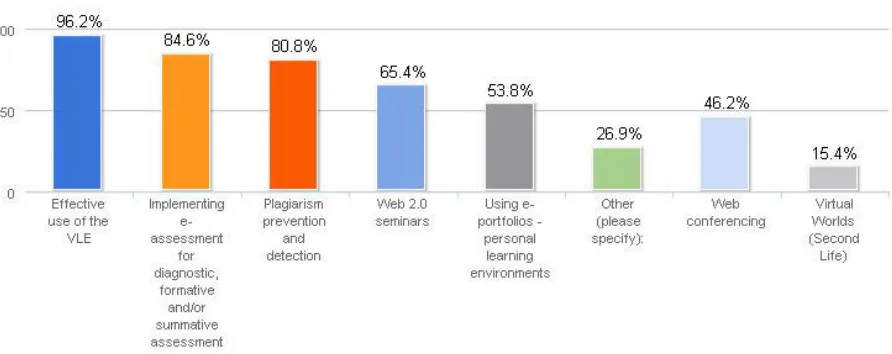
In terms of staff development events such as workshops/ seminars on the pedagogic use of various learning technologies, 25 out of 26 respondents indicated they offer such events in the „effective use of the VLE‟, 22 respondents ticked the „implementing e-assessment for diagnostic, formative and/or summative assessment‟ option, while 21 of them ticked the „plagiarism prevention and detection‟ option. Web 2.0 seminars were provided in approximately two thirds of the participating institutions as 17 out of the 26 offered them. Around half of the institutions – 14 out of 26 – offered seminars on „using e-portfolios – personal learning environments‟; web conferencing was not far behind with 12 responses. Seminars on virtual worlds were run by 4 institutions (see Figure 2). Other workshops/seminars included: lecture capture (2), podcasting (2), online media (1), video (1), screencasting (1).
These workshops/seminars/internal events or conferences on the pedagogically effective use of learning technologies were in some cases less frequent than the hands-on training sessions and varied from annual or bi-annual events to monthly thematic school-specific events and to fortnightly sessions on a specific pedagogy. In eight cases – out of a total 25 - both pedagogy and hands-on training were integrated in the same sessions. Workshops and seminars were reported to be both scheduled and tailor-made, on-demand sessions. In two cases it was reported that these sessions are run by a different team to the learning technology team – an academic enhancement and academic development unit respectively.
Online TEL-related case studies
23
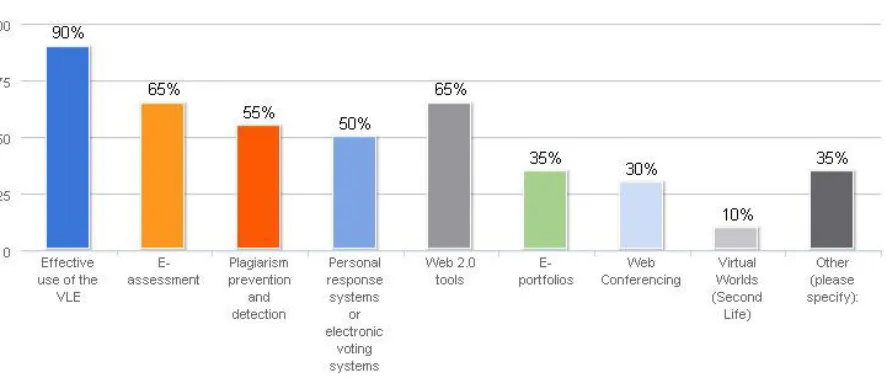
academic staff interested in TEL practice. This question was answered by 20 respondents and percentages shown below are out of 20 (see Figure 3). Other responses included: Online media (2), screencasting (1), anything that staff is willing to share (1), offered as a service by Epigeum (1), we are currently working on this (1).
TEL as part of the postgraduate certificate in learning and teaching
In almost half of the cases – 13 out of 27 – technology enhanced learning was reported to be the focus of one of the modules of the Postgraduate Certificate in Learning and Teaching in Higher Education (PGCert in LT in HE). Four of the remaining 14 informants stated that they did not know whether TEL was offered as a module of the aforementioned course while 10 gave a negative answer (see Figure 4). Apart from those who stated that TEL was the main focus of a PGCert module, all the rest but one mentioned that some aspects of TEL were embedded in this course.
TEL continuing professional development activities
Various CPD activities in the area of TEL were provided by a number of institutions including e-moderating/e-facilitating short courses that were 3 to 5 weeks long, e-facilitation courses certified by the staff and educational development association (SEDA), application and portfolio development towards certified membership of the association for learning technology (CMALT) for academic staff, a module on the PGCert course and other Masters‟ level modules with an emphasis on e-learning that could also be taken as stand-alone modules. Furthermore, one university reported that they have academic staff registered for PhDs in the area of TEL. Other provision in the area of TEL includes faculty sponsored workshops, invited external speakers, on demand training as well as experiential training in new technologies in a „learning hub‟, tailor-made training for individual subject areas, departments, or faculties and one-to-one advice and consultation.
TEL as a prerequisite for blended and fully online courses
24
In the remaining 8 cases there were some requirements; three respondents reported that new academic staff were expected to undertake VLE training as part of their induction. In one case, the first module of the MA in Academic Practice was a requirement for staff and in two other cases it was mentioned that distance learning programmes had their own training initiatives and academic staff involved in these undergo a formal induction process focusing on tutoring techniques and other competencies related to TEL. In another case staff involved in fully online courses were required to complete a 10 credit module offered to new lecturers, while another one reported that there were no formal requirements for blended courses but for fully online courses staff have to go through formal induction due to the increased standard of development and delivery in online courses.
Discussion
Most universities represented in the survey offer a wide variety of staff development sessions/events for their academic staff; this includes hands-on training sessions, seminars on the pedagogically effective use of various learning technologies, online case studies, peer support via internal workshops/ conferences and, in some cases other CPD activities in the area of Technology Enhanced Learning such as e-moderating online short courses, Staff and Educational Development Association (SEDA) certified e-facilitation courses and postgraduate modules. Training sessions on how to use the VLE, e-assessment tools, plagiarism prevention and detection tools as well as e-portfolios were the most popular sessions offered. Web 2.0 tools, personal response systems and web conferencing systems were also very popular among participating institutions. The only one option offered that proved to be less popular among training sessions on offer was Second Life.
The duration, frequency and uptake of the training sessions varied widely; some institutions offered training sessions at regular intervals to suit the academic timetable, others 3 to 4 times a year. However, most institutions would deliver tailored sessions on request for specific departments or course teams and there seems to be a shift towards small group training and one-to-one training on request.
25
embedded in the Postgraduate Certificate in teaching and learning in HE either as a module of study or as an integral part of the course.
Although in more than half of the cases there were no strict requirements for staff to undertake training/development before they get involved in blended learning, training opportunities were available and staff were strongly encouraged to participate; a few of the participants mentioned that for online courses in particular, staff would be expected to participate in some TEL-related personal development and also that staff development needs would have to be addressed during the course validation process.
Among the 27 responses received in total, 16 were from Pre 1992 and 11 from Post 1992 universities. Overall, there were no apparent differences in the way the samples from these two groups approach staff development around TEL. However, there was a small difference worthy of exploration in a further study: while post-1992 universities represented in the survey were offering more hands-on training sessions in the area of TEL, participating pre-1992 reported higher numbers in embedding TEL in the teaching and learning practice through the Postgraduate Certificate course.
Conclusions – Summary
This paper focuses on the provision made by UK HEIs for staff development in the area of TEL. This study is informed by three sources: the UCISA survey that took place in 2010, a desk-based research on UK universities‟ websites and an online survey that was delivered to the Heads of eLearning in November 2011. Findings from all three sources indicate that the implementation of learning technologies may well be widespread across the sector and that many UK HEIs now offer ample opportunities for staff development in this area.
26
Furthermore, in the samples studied, TEL is seemingly no longer treated as something extra, but gets embedded in standard academic practice as shown by its integration with the Postgraduate Certificate in teaching and learning in HE, but also from its integration with various workshops, seminars and other events where the focus is on good pedagogic practice.
References
ALMPANIS, T., S. PATRICK, R. MCLELLAN, , C. DINSMORE, , A. FAUSTINO, & W., BASUKI, 2010. Proposing a Framework for Blended and Flexible Course Design. In KINSHUK, D. SAMPSON, M. SPECTOR, P. ISAIAS, D. IFENTHALER & R. VASIU, (Eds) Cognition and Exploratory Learning in a Digital Age: 7th International
Conference, CELDA2010. Held 15 -17 October 2010, University of Timisoara, Romania, 263 - 267
BROWNE, T., R. HEWITT, M. JENKINS, J. VOCE, R. WALKER & H. YIP, 2010, Survey of Technology Enhanced Learning for higher education in the UK, Universities and Colleges Information Systems Association (UCISA), retrieved Oct 23, 2011 from
http://www.ucisa.ac.uk/groups/ssg/~/media/groups/ssg/surveys/TEL%20survey%202010_FINAL.ashx
BURKE JOHNSON, R. & A.J. ONWUEGBUZIE, 2004, „Mixed Methods Research: A Research Paradigm Whose Time Has Come‟, in Educational Researcher, 33 (7), 14-26.
EDGE HILL UNIVERSITY, 2009, Solstice and TEL Roadmap, retrieved Feb 14, 2012 from
http://www.edgehill.ac.uk/solstice/files/2011/10/Roadmap-2009.pdf
HEFCE (2009) Enhancing learning and teaching through the use of technology: A revised approach to HEFCE’s strategy for e-learning, retrieved Jun 21, 2012 from
http://webarchive.nationalarchives.gov.uk/20100202100434/http://www.hefce.ac.uk/pubs/hefce/200
9/09_12/09_12.pdf
JONES, C. & G. KENNEDY, 2011, Stepping beyond the paradigm wars: pluralist methods for research in learning technology. In HAWKRIDGE, D., K. NG & S. VERJANS, (Eds.) Thriving in a colder and more challenging climate. THE ASSOCIATION FOR LEARNING TECHNOLOGY, The 18th annual conference of the
27
LONDON SCHOOL OF ECONOMICS, 2012, Centre for Learning Technology, retrieved Feb 13, 2012 from
http://clt.lse.ac.uk/
MAYES, T., D. MORRISON, H. MELLAR, P. BULLEN & M. OLIVER, 2009, Transforming Higher Education through Technology-Enhanced Learning, retrieved Jun 22, 2012 from
http://www.heacademy.ac.uk/assets/documents/learningandtech/Transforming.pdf
OLIVER, M. 2002 „What do Learning Technologist do?‟ in Innovations inEducation and Training International, 39 (4), 245-252.
UNIVERSITY OF SURREY, 2012, CEAD - Technologies for Learning, retrieved Feb 16, 2012 from
http://www.surrey.ac.uk/cead/telt/technologies/index.htm
UNIVERSITY OF WEST OF ENGLAND, 2012, E-learning Development – MA Education in Virtual Worlds,
retrieved Oct 29, 2011 from
http://www.uwe.ac.uk/elearning/virtualWorldsMA/index.shtml
UNIVERSITY OF CAMBRIDGE, 2012, Centre for Applied Research in Educational Technologies, retrieved Oct 27, 2011 from
http://www.caret.cam.ac.uk/page/what-we-can-do-for-you
Contact
Timos Almpanis Associate Professor
Learning Technologies, LIS
28
Appendix - Figures
29
30
31