pp. 41-60
ISSN: 1309-2448 www.berjournal.com
Young Consumers’ Perspectives of Website Visualization:
A Gender Perspective
Erkan Ozdemira Serkan Kilicb
Abstract Abstract Abstract
Abstract: The purpose of this paper is to investigate whether there exist differences in website visualization according to the gender of the respondents as young consumers. For the main purpose, a questionnaire was designed from the literature review, and data were collected from 252 undergraduate students. Analyses of chi-square and t-tests were conducted for hypotheses testing. The results show that six website visualization characteristics are different by young consumers’ gender. These gender-based differences include different color preferences, not using a derogatory statement about rivals, using rounded lines and shapes, 4-6 colors in typeface, female figures in photos and expert language in the websites. The findings of this study reveal how e-marketing executives can harmonize the visualization of websites based on the gender of the targeted young consumers. The main value of this paper is the empirical analysis of the website visualization from a gender perspective. The study explicates to what extent website visualization is important in online purchasing decisions of the young consumers by gender and provides useful information for e-marketing executives. Better understanding of young consumers’ perspectives of website visualization by gender is critical for designing and managing effective websites that can help businesses attract and retain online young customers.
Key Key Key
Keywordswordswordswords: Website Visualization, Gender, Young Consumers, E-marketing, Turkey, Internet
JEL JEL JEL
JEL ClassificationClassificationClassification: M31, M37 Classification
1. Introduction 1. Introduction 1. Introduction 1. Introduction
The Internet has become an important strategic tool in the current competitive business environment (Simeon, 2001) and business websites present a variety of communications to prospective consumers (Virtsonis and Harridge-March, 2008). The Internet which is a strategic technology for use in communicating business image, providing product information and building brand identity (Adam et al., 2002), brings about a great deal of important changes to all business functions, especially marketing. While some businesses make use of the Internet in order to support their traditional marketing activities, others carry out all of their transactions on the Internet (Krishnamurthy, 2006). Factors such as technological advances, executives’ changing perceptions of the Internet, and changing consumer lifestyles have played a great role in the development of the Internet market (Donthu and Garcia, 1999). Therefore, business is moving online as a matter of necessity rather than choice. The Internet has seriously changed the consumer-dealer relationship. Interactive features such as
a Assist. Prof., Uludag University, Faculty of Economics and Administrative Sciences, Department of
Business Administration, Bursa, Turkey, [email protected] b
personalization, consumer-oriented contents, and virtual groups have caused the balance of power to change in favor of consumers (Feinberg and Kadam, 2002). Potential consumers can compare the websites of a large variety of businesses with regard to finding information or purchasing products or services (Harridge-March, 2004). With the development of the e-commerce, people do more online shopping (Zhang and Prybutok, 2002). Therefore, in order to attract consumers through the Internet, businesses need to make their website as uncomplicated and appealing to use as possible (Taylor and England, 2006). Additionally, businesses need to improve the appeal of their websites because of the increased online competition (Karayanni and Baltas, 2003).
The changes in business life are not only limited to technology and the Internet. In recent years, females have begun taking a more active role in business life. Furthermore, females have started to receive more education, increasing their chance of financial independence and giving them greater freedom in their purchases (Ahlström et al., 2001). This situation constitutes one of the most important reasons that marketers now perceive females as the target market. The other reason why females are targeted is that they also play a dominant role in purchases made for their households in addition to themselves. All of these factors require marketers to target females as well as males, and also requires businesses utilizing the Internet to become fully aware of the characteristics and features of websites that connect them with their consumers. Therefore, it is important for e-marketing executives to know whether website visualization makes a differences based on gender, and if so, which features make the difference.
The purpose of this study is to determine whether there are differences in assessments concerning website visualization by young consumers’ gender, explicate where these differences exist, and offer suggestions to e-marketing executives about website visualization based on the gender of targeted young consumers. The potential contribution of the present study is that while past website visualization researches have focused on the perspectives of website designers by gender, the present study targets online young consumers. In this era of intense competition and customer responsiveness, online consumers are major stakeholders and consumers’ perspectives of website visualization by gender should not be ignored in e-marketing. Website visualization is an important component of e-marketing strategies. E-marketing executives should be interested in such issues as how web visualization influences their website traffic and how it determines the success of e-marketing strategies by gender of online young consumers. Because online market is a place where marketing and web design interact, the web designers and e-marketers need to corporate to increase the likelihood of the success of e-marketing. Therefore, e-marketing executives should focus on the visual attractiveness of their websites by gender as the primary method of increasing their consumer base. Thus, better understanding of young consumers’ perspectives of website visualization by gender is critical for designing and managing effective websites that can help businesses attract and retain online customers.
2. Literature 2. Literature 2. Literature
2. Literature RRRReview and eview and eview and eview and HHHHypothesesypothesesypothesesypotheses
2 2 2
2.1.1.1.1.... The The The A The AAttitudes of Attitudes of ttitudes of Cttitudes of Consumers towards CConsumers towards onsumers towards Oonsumers towards OOnline Online Snline nline SSShopping hopping hopping hopping
The Internet can be effective for consumers in the information search prior to making a purchase, and also serve as a channel for making a purchase (Moon, 2004). Consumers have multi-modal online shopping behaviors: examining a traditional store so they can see, touch or try on the merchandise before buying online or looking for product information and price alternatives online and then purchasing offline (Wolfinbarger and Gilly, 2001). For instance, Seock and Norton (2007) report that students make an information search on popular clothing websites before buying them from traditional stores.
Some factors can affect online purchasing behaviors. For instance, Shergill and Chen (2005), who study consumers’ attitudes to online shopping, find that website design, web reliability, website consumer services, and web security affect consumer perceptions towards online shopping. In a study of consumer attitudes towards Internet and online shopping, Teo (2002) states that one of the main reasons why online shopping is avoided is the consumer’s preference to examine products. According to Cho (2004) and Dittmar et al. (2004), females prefer and enjoy physical evaluation of products such as seeing and feeling the product. The other basic reasons are the necessity of owning a credit card and security concerns (Teo, 2002). Chiang and Dholakia (2003), study consumers’ intentions towards online shopping in the process of acquiring information, and determine three basic variables that influence consumer intentions: the convenience attribute of shopping channels, the characteristics of product type, and the perceived price of the product. According to the results of their study, convenience and product type have an affect on the consumer’s intention towards online shopping. In a study analyzing the relationship between consumer characteristics and attitudes toward online shopping, Wu (2003) find a significant relationship with the attitudes toward online shopping. According to this study, the mean attitude score for males is significantly higher than that for females.
2.2 2.2 2.2
2.2.... Gender Gender Gender D Gender DDifferences with regards to the Internet and Differences with regards to the Internet and ifferences with regards to the Internet and ifferences with regards to the Internet and OOnline OOnline nline nline SSShoppingShoppinghopping hopping
Gender is an important variable in attitudes towards the Internet and online shopping behavior. Some studies show that there are some gender differences in terms of access to Internet, Internet usage, attitudes towards the Internet, the frequency of Internet usage, self-assessment of Internet competency and confidence towards the Internet (Durndell and Haag, 2002; Halling and Tufte, 2002; Hargittai and Shafer, 2006; Joiner et al., 2005; Li and Kirkup, 2007; Peng et al., 2006; Tsai et al., 2001; Wu and Tsai, 2006). However, some other studies show that there is a change in the younger generation. These studies suggest that the gender gaps are narrowing or even disappearing (Ono and Zavodny, 2003; Lin and Yu, 2008; Rainer et al., 2003; Tsai and Lin, 2004; Tsai and Tsai, 2010; Volman et al., 2005; Wasserman and Richmond-Abbott, 2005). According to Park (2009), there are differences among generations regarding the gender gap. The gender difference is greater in the adult group than in the adolescent group in Internet usage.
stem from socio-economic and other factors. He also argues that those gaps will narrow in the long run, as differences in education and income between the genders will shrink. According to Teo and Lim (1997), males find the Internet more exciting and think about using it more than females. There are also some gender differences emerging during the Internet use. For instance, Dabholkar and Sheng (2009) study the perceived control in consumers’ reactions to download delays and the role of gender among the university students in the US. They find that young males demonstrate less tolerance towards Internet delays and focus on the speed more, but young females focus more on the control and confidence they fell while using the Internet. Jackson et al. (2001), and Shaw and Gant (2002), on the other hand, find that there are no gender differences in Internet use. According to these studies, the lack of differences is due to limiting research among young people, where gender gaps in Internet use are closed rapidly. As is seen in the literature review, gender gaps in Internet use among the young generation gradually closed and disappeared by the years of 2000s.
There are also some gender-based differences related to the purpose of Internet use. Since Internet enhances their work performance and productivity, and provides them with information that will help in decision-making, males regard the Internet more highly than the females (Teo and Lim, 1997). Heimrath and Goulding (2001) find that males use the Internet for games, work, competitions, and software updates; on the other hand, females use the Internet for shopping, banking, and searching for new and various types of information. Papastergiou and Solomonidou (2005), in a study with 340 high school students in Greece, report that young male students have higher Internet access opportunities outside of school, and they use the Internet for entertainment than young female students. According to Garbarino and Strahilevitz (2004), in comparison to males, females (38% in females, 27% in males) spend most of their Internet time sending/receiving e-mails to communicate with other people. Similarly, Jackson et al.
(2001) report that when compared to males, females use the Internet more for interpersonal communication via e-mails, and males use the Internet more for information searches. Kuhlemeier and Hemker (2007) also found similar results. They state that compared to males, females spend less time on the computer at home, search for information on the Internet less often, and use the computer less often for games and music; on the other hand, they use the Internet more often to e-mail and to chat. Females use the Internet for communication more than males. However, in a cross-cultural study on the differences between Chinese and English students’ attitudes towards the Internet and computers, Li and Kirkup (2007) find that young males in these countries use the Internet for communication purposes (e-mail and chat) more often than young females. On the other hand, Caspi et al. (2008) find different results that females prefer written communication more than males; nonetheless, virtual discussions are more advantageous for females, and the online environment is not attractive enough for either gender. The theoretical and empirical literature cited above is the basis for our proposition. Thus, the following hypothesis is proposed:
H1. H1. H1.
H1. There is a significant relationship between gender and the purpose of Internet usage.
in online shopping; for example, females may perceive shopping online to be riskier than males do (Garbarino and Strahilevitz, 2004). In other words, males have more confidence in online shopping than females (Rodgers and Harris, 2003). Other studies confirm these results regarding confidence in online shopping. For instance, in a study on Taiwanese high school pupils, Tsai et al. (2001) find that compared to females, males have more positive feelings towards Internet use, a lower level of anxiety, and a higher level of confidence. In a study on 8th grade students, in which they study the web-searching strategies of pupils, Tu et al. (2008) reveal that pupils with more web experience find the relevant information on research topics much easier than pupils with less web experience. This finding shows that people with more Internet experience will have an easier experience with online shopping. Therefore, we propose the following hypotheses:
H2 H2 H2
H2.... There is a significant relationship between gender and the Internet experience.
H3 H3 H3
H3.... There is a significant relationship between gender and online shopping.
Gender differences in online shopping have also been examined from other perspectives such as website usability and design (Cyr and Bonanni, 2005), and technology acceptance (Chen et al., 2002; Porter and Donthu, 2006).
2.3 2.3 2.3
2.3.... Website Website Website V Website VVVisualizaisualizaisualizaisualization and tion and Gtion and tion and GGender Gender ender ender DDDDifferences ifferences ifferences ifferences
Website content refers to the information, features, or services that are offered in the website, and website design refers to the way that content is made available for website visitors. The presentation style representing the visualization of a website includes the layout of website, colors, font style, size mix of text, and graphical information in sort, shape, and size (Huizingh, 2000; Misic and Johnson, 1999). Website characteristics such as layouts, design and content are important success factors in the effectiveness of business websites from the online consumers’ perspective (Li and Holeckova, 2005).
Website designers can ensure high site traffic and attract attention of consumers to the website by creating the best combination in terms of website content and visualization. In this sense, website traffic is one of the most important performance indicators for e-commerce practitioners. However, website traffic does not only represent the popularity of a website, it is also a prerequisite for making online purchases (Heijden, 2003). Therefore, e-marketing executives should be vigilant in differentiating their websites from their competitors and should engage online consumers to the extent that they return to their website and purchase something (Doren et al., 2000).
The content of a website affects the attitudes of consumers by gender. For instance, Simon and Peppas (2005) find that compared to females, males generally have more positive attitudes towards the content of a website. Chen and Lee (2005) reveal that the image of a website has an impact on the consumers’ purchasing behavior and intention. On the other hand, Teo and Lim (2000) find that females appear to view sound effects and background music to be more important than males do.
(Djamasbi et al., 2007). The perceived visual attraction of a website may have an impact on whether it is perceived to be beneficial, appealing or entertaining, and easy to navigate (Heijden, 2003). There are studies in which gender differences have been examined from website visualization point of view. For instance, Moss and Colman (2001) find that there are some significant gender differences with regard to graphic design. In their study, in which business cards of graphic designers are compared, they find that female designers prefer the non-standardized business cards more than male designers. On the other hand, they conclude that male designers design standardized business cards and prefer text on white background more than female designers. According to the results of the study, compared to males, female designers tend to design the cards more colorfully, less technically, less linearly, and less three-dimensionally. With regard to drawing human figures, both genders tend to draw the members of their own genders. Additionally, Moss and Colman (2001) state that males are interested in function more than aesthetics. In a similar study, Moss and Gunn (2007) examine gender differences in website design and find that the websites designed by females are different than the websites designed by males. For instance, in four out of five language features used in websites, some significant differences were found. Accordingly, compared to males, females have greater tendencies to use abbreviations, avoid using self denigration, and using informal language with no expert language. Moss et al. (2006, p. 334) and Moss and Gunn (2009, p. 451) explained these terms as follows: The use of abbreviations is understood as including all abbreviated grammatical forms and is construed as a barometer of informality; The self-denigration is understood as including the use of language or visuals that detract from the self-importance of the writer and is construed as a barometer of competitiveness. Expert language is defined as a language which is exclusive to a particular body of expertise, and formal rather than informal in character. Regarding visual features, on the other hand, males tend to use headings and both genders tend to depict their own gender. Females prefer using rounded shapes rather than linear shapes, and avoid straight shapes. Females also tend to use more colors in texts, prefer informal typography and colors such as white, yellow, pink, and mauve (Moss and Gunn, 2007).
number of colors used in drawings by 188 boys and girls in secondary school in Turkey (as well as how their preferences changed with age), Bilgin and Isler (2008) find that the number of the colors used by boys drop as they grow older, but that no change will occur in the girls’ use of colors.
In a study of the evaluating electronic marketing and potential contribution to marketing, Harridge-March (2004) suggests that when it comes to online advertising, pop-up ads and other forms of advertising could be perceived by customers as "irritating and annoying”. According to this argument, the website on which e-marketing efforts such as online advertising, pop-up ads and other forms of advertising are implicated, has a critical role in success of e-marketing. To decrease this irritation and annoyance, better understanding of consumers’ perspectives of website visualization by gender is critical for designing and managing effective websites that can help businesses attract and retain online customers.
Differences may exist in the visualization of websites based on the gender of website designers as well as the gender of young consumers using the websites. With this in mind, this study attempts to find these differences by young consumers. The differences likely to emerge require a consideration of gender-based differences while designing websites in order to ensure that e-marketing activities are designed accordingly.
Finally, a fourth hypothesis is proposed in order to analyze gender differences with regard to young consumers’ preferences for website visualization. The statements composed for this purpose is illustrated in Table 4, and the fourth hypothesis for each statement is as follows: H4a: In terms of the variables concerned, young consumers’ preferences for website visualization are not different by gender. H4b: In terms of the variables concerned, young consumers’ preferences for website visualization are different by gender.
3. Methodology 3. Methodology 3. Methodology 3. Methodology
3.1 3.1 3.1
3.1.... Participants Participants Participants Participants
Two hundred and fifty-two undergraduate students, 126 boys and 126 girls, aged 18–24, participated in the survey during 2008-2009. The sample corresponds to approximately 14% of the total number of the undergraduate students (1847 total) at the Business Administration Department of Uludag University in Bursa, one of the largest cities in Turkey.
3.2 3.2 3.2
3.2.... Instrument and Instrument and Instrument and P Instrument and PPProcedurerocedurerocedurerocedure
evaluate how well the questionnaire was understood. Two questions needed some kind of simplification, as the phrasing was inadequate. The items used in this study were validated by previous researches (Moss et al., 2006; Moss and Gunn, 2009). Besides, inter-item correlation matrix shows that the scale is valid (Appendix 1). Further analysis on the scales’ reliability was conducted by calculating Cronbach’s alpha. The Alpha coefficient was 0.72; indicating good reliability and no items were extracted from the scale. For the sampling procedure, convenience sampling was used. The survey was conducted during the period of April-June 2009.
3.3 3.3 3.3
3.3.... Data Data Data A Data AAAnalysisnalysisnalysisnalysis
The data were analyzed by descriptive statistics (frequencies and means). Independent-sample t-tests were performed in order to analyze gender differences in student preferences towards website visualization. Chi-Square analysis was used to identify relationships with the purpose of Internet usage, duration of Internet usage, and online shopping by gender. For the statistical analyses, SPSS version 13.0 was used. The level of significance was set at 0.05.
4. Results 4. Results 4. Results 4. Results
Chi-Square results regarding relationships with the purpose of Internet usage, duration of Internet usage, and online shopping according to gender are presented first, followed by t-test results concerning preferences of website visualization.
The results of Chi-Square tests for 2-sided sig. value indicate that there is a significant relationship between gender and purpose of Internet usage (χ2 = 13.1, p=0.02, p < 0.05). In other words, H1 is supported. Looking Table 1, young males are using the Internet intensively for searching and entertainment. On the other hand, young females are using the Internet intensively for communication
Ta Ta Ta
Table 1. The purpose of Internet usage by ble 1. The purpose of Internet usage by ble 1. The purpose of Internet usage by Gender ble 1. The purpose of Internet usage by Gender Gender Gender of Young Consumersof Young Consumersof Young Consumersof Young Consumers
WorkWork SearchWorkWork SearchSearchSearch EntertainmentEntertainmentEntertainment CommunicationEntertainment Communication PurchasingCommunicationCommunication PurchasingPurchasingPurchasing OtherOtherOtherOther TotalTotalTotalTotal
n n n
n 6 43 41 31 2 3 126
Male MaleMale Male
% % %
% 4.8 34.1 32.5 24.6 1.6 2.4 100
n n n
n 3 36 28 57 1 1 126
Female FemaleFemale Female
% % %
% 2.4 28.6 22.2 45.2 0.8 0.8 100
Chi ChiChi
Chi---- Square Tests Square Tests Square Tests Square Tests
Value Value Value
Value dfdf dfdf 2222----Sided SignificanceSided SignificanceSided Significance Sided Significance Pearson Chi
Pearson ChiPearson Chi
Pearson Chi---- Square Square Square Square 13.1 5 0.02
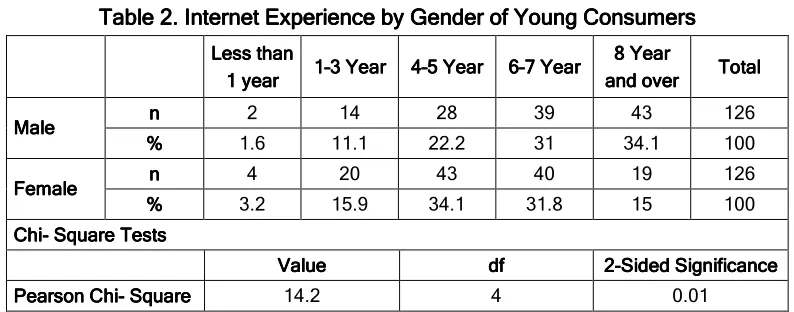
The results also support H2. There is a significant relationship between gender and Internet experience (χ2 = 14.20, p=0.01, p < 0.05). Young males are using the Internet longer than young females, as an indicator of Internet experience (see Table 2).
Table 2. Internet Experience by Gender Table 2. Internet Experience by Gender Table 2. Internet Experience by Gender
Table 2. Internet Experience by Gender of Young Consumersof Young Consumersof Young Consumersof Young Consumers
Less than Less than Less than Less than
1 year 1 year 1 year
1 year 111––––3 Year13 Year3 Year3 Year 44––––5 Yea445 Yea5 Yea5 Yearrrr 6666––––7 Year7 Year7 Year7 Year
8 Year 8 Year 8 Year 8 Year and over and over and over
and over TotalTotalTotalTotal
n nn
n 2 14 28 39 43 126
Male Male Male Male
% % %
% 1.6 11.1 22.2 31 34.1 100
n nn
n 4 20 43 40 19 126
Female Female Female Female
% % %
% 3.2 15.9 34.1 31.8 15 100
Chi Chi Chi
Chi---- Square Tests Square Tests Square Tests Square Tests
Value Value Value
Value dfdfdfdf 22----Sided Significance22Sided SignificanceSided SignificanceSided Significance Pearson Chi
Pearson Chi Pearson Chi
Pearson Chi---- Square Square Square Square 14.2 4 0.01
The third hypothesis focused on a relationship between gender and online shopping. According to Chi-Square results, H3 is also supported (χ2 = 8.86, p=0.00, p < 0.05). Table 3 shows that online young consumers are more heavily males. However, online shopping is not generally preferred more by young males and females.
Table 3. Online Table 3. Online Table 3. Online
Table 3. Online SSShopping by Gender Shopping by Gender hopping by Gender of Young Consumershopping by Gender of Young Consumersof Young Consumersof Young Consumers YesYes YesYes NoNo NoNo TotalTotalTotalTotal
n n n
n 51 75 126
Male MaleMale Male
% %%
% 40.5 59.5 100
n n n
n 29 97 126
Female FemaleFemale Female
% %%
% 23 77 100
Chi ChiChi
Chi---- Square Tests Square Tests Square Tests Square Tests
Value Value Value
Value dfdfdfdf 22----Sided Significance22Sided SignificanceSided SignificanceSided Significance Pearson Chi
Pearson ChiPearson Chi
Pearson Chi---- Square Square Square Square 8.9 1 0.00
Table 4. Websites Characteristics by Gender of Young Consumers Table 4. Websites Characteristics by Gender of Young ConsumersTable 4. Websites Characteristics by Gender of Young Consumers Table 4. Websites Characteristics by Gender of Young Consumers
Means MeansMeans Meansaa aa Websites Characteristics by Gender
Websites Characteristics by Gender Websites Characteristics by Gender Websites Characteristics by Gender
Male Male Male
Male FemaleFemaleFemaleFemale
Use different colors more 3.8 4.2
Use no abbreviations 3.3 3.5
Use no derogatory language about competitors 3.8 4.2
Use no expert language 3.4 4.0
Use no formal language 3.3 3.2
Include welcome message 3.2 3.4
2 D appearance 3.3 3.4
3 D appearance 3.9 4.0
2 D & 3 D appearance 3.6 3.7
Straight lines 3.6 3.5
Rounded lines 2.9 3.2
Both straight and rounded lines 3.3 3.5
One color in typeface 2.8 2.6
2-3 colors in typeface 3.1 3.4
4-6 colors in typeface 2.7 3.1
Black & white background/frame 2.9 2.8
Single-color background/frame 3.4 3.3
2+ colors in background/frame 3.5 3.1
Formal typography (regular letter spacing and height) 4.0 4.1
Formal images 3.5 3.5
Mix of formal and informal images 3.2 3.1
Mostly black or blue typeface 3.2 3.0
Mix of black/blue with other colors in typeface 3.2 3.5 Mostly pink, mauve, or yellow typeface 2.8 3.0
Static images 2.7 2.8
Dynamic (moving) images 3.8 3.7
Both static and dynamic images 3.6 3.5
Female figures in photos 3.3 2.8
Male figures in photos 2.9 3.0
Both female and male figures in photos 3.5 3.6 a 1. Strongly disagree, 2. Disagree, 3. Neutral, 4. Agree, 5. Strongly agree
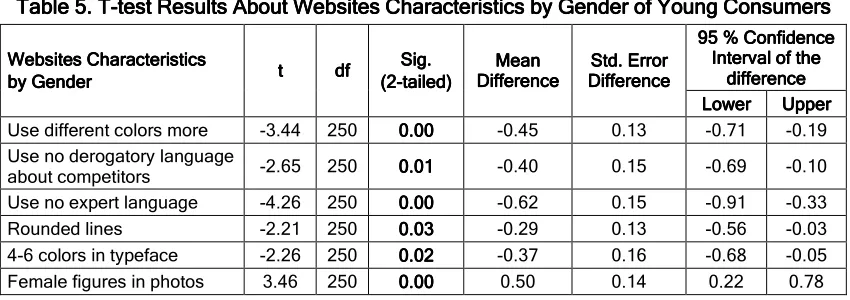
When the t-test analysis was applied to the hypothesis formed, the six features preferred in website visualization displayed differences in terms of gender. Looking Table 5, since 2-sided sig. values of these six features are <0.05, the H4b hypothesis
has been accepted. In other words, no significant gender-based differences amongst young consumers have been found in the other features apart from those of six.
Table 5. T Table 5. T Table 5. T
Table 5. T----tetetetest st st Rst RRResults esults Aesults esults AAbout About bout bout WWWWebsites ebsites Cebsites ebsites CCCharacteristics byharacteristics byharacteristics by Gharacteristics by G Gender of Gender of Yender of ender of YYYoung oung oung Coung CConsumersConsumersonsumersonsumers
95 % Confidence 95 % Confidence 95 % Confidence 95 % Confidence Interval of the Interval of the Interval of the Interval of the
difference difference difference difference Websites Characteristics
Websites Characteristics Websites Characteristics Websites Characteristics by Gender
by Genderby Gender
by Gender tttt dfdfdfdf
Sig. Sig.Sig. Sig. (2 (2(2 (2----tailed)tailed)tailed)tailed)
Mean Mean Mean Mean Difference DifferenceDifference Difference
Std. Error Std. Error Std. Error Std. Error Difference Difference Difference Difference
Lower LowerLower
Lower UpperUpper UpperUpper Use different colors more -3.44 250 0.000.000.000.00 -0.45 0.13 -0.71 -0.19 Use no derogatory language
about competitors -2.65 250 0.010.010.010.01 -0.40 0.15 -0.69 -0.10 Use no expert language -4.26 250 0.000.000.000.00 -0.62 0.15 -0.91 -0.33 Rounded lines -2.21 250 0.030.030.030.03 -0.29 0.13 -0.56 -0.03 4-6 colors in typeface -2.26 250 0.020.020.020.02 -0.37 0.16 -0.68 -0.05 Female figures in photos 3.46 250 0.000.000.000.00 0.50 0.14 0.22 0.78
5. Discussions and implications 5. Discussions and implications 5. Discussions and implications 5. Discussions and implications
The most important instrument in the presentation of products marketed on the Internet is the websites of the businesses. At this point, variety and detailed information about the products, which are the most important features of a website, should be presented to the consumers. It is because online consumers do not only assess the quality of a product based on its price and brand (Donthu and Garcia, 1999). Nowadays, the Internet has great power and potential in improving the image of a brand, ensuring its brand recognition and establishing its brand value. Therefore, interactive websites draw the attention and interest to products (Aldridge et al., 1997). At this point, in addition to the content of a website, it becomes important to analyze the visualization of a website by gender. However, it should be noted here that commercial websites appeal more to the aesthetics of males in terms of visualization (Moss et al., 2006). The main reason that commercial websites appeal to males stems from the fact that most website designers are male (Moss et al., 2007). However, a majority of consumers comprising website traffic is composed of females. Females have more financial independence due to greater participation in the work force, and they are the important decision-makers in purchases for themselves and their households; this requires that more attention is paid to female consumers. In order to ensure marketing success, it is important for arrangements regarding both the content and visualization of a website to be made in accordance to the gender of consumers.
The first difference related to website visualization in the present study is related with the female preference, as compared to males, for the use of different colors more. In their study, Dabholkar and Sheng (2009, p. 759) state that “websites that have a greater number of female users, online marketers could possibly incorporate richer web content, but also use soothing colors, relaxing music, or information on delays to make female online users comfortable”. In addition to using rich website content, soothing colors, relaxing music as stated by Dabholkar and Sheng (2009), e-marketing executives can also use different colors more in their websites.
and details of the advertising message, and pay more attention to details while processing information in the messages (Levy and Maheswaran, 1991). Based on differences between males and females in processing information, e-marketing executives should differentiate their websites by gender-based differences. For instance, when males are targeted as potential consumers, since the brain structure of males is appropriate in processing the visual illustrations in the right hemisphere, technical product information with graphical illustrations should be presented. On the other hand, when females are targeted as potential consumers, since they process information in the left hemisphere of the brain, the technical product information should be presented in non-graphic form (Rodgers and Harris, 2003). These results relating to gender, brain structure, and information processing are similar to the results of the present study.
females than in males. While recommendations from friends have a strong effect on females regarding online shopping, they do not have a similar effect on males. The significance of these findings for e-marketing executives underscores the need to encourage word-of-mouth communication in order to have a positive effect on females (Howard, 1989).
A fourth difference that emerged in the present study is the use of rounded lines in texts and graphs, and the fifth difference is the use of 4-6 colors in typeface. These findings support Moss and Gunn’s results (2007; 2009) that females prefer rounded lines in texts and graphs, avoid straight lines, informal images, more colors in texts, and have greater preferences for white, yellow, pink and mauve colors. Accordingly, e-marketing executives should pay attention to these points regarding website visualization when targeting female consumers. It follows that straight lines should be used in texts and graphs, and less color should be used in texts when targeting male consumers. The last difference related to website visualization is the use of female figures in photos. When this difference is analyzed, it can be shown that males prefer to see more female figures in photos on websites. This result differs from Moss and Colman (2001), who state that respondents tend to depict those of their gender. This difference may be attributable to the fact that both studies have been carried out in different countries and cultures.
6 6 6
6.... Conclusion Conclusion Conclusion Conclusion
The present study examines young consumers’ gender differences, an important segmentation variable in the field of e-marketing, according to evaluations of respondents regarding website visualizations, and also offers suggestions to e-marketing executives about website visualizations of their business based on young consumers’ gender. This study reveals the important website visualization perspectives in terms of gender in young consumers’ purchasing preferences, making a contribution to e-marketing literature. While previous studies of website visualization by gender (Moss and Colman, 2001; Moss et al., 2006; Moss and Gunn, 2007; 2009) are carried out via website designers, the present study is based on the gender of young consumers. The findings in the present study reveal many similarities to those of previous studies (Moss and Colman, 2001; Moss et al., 2006). Some of the similar findings include that males prefer straight lines, females and males have different preferences in colors, and males tend to use more expert language. Males also prefer seeing more female figures in photos on websites. This result differs from Moss and Colman (2001), who state that respondents tend to depict those of their gender.
Some limitations of the present research should be noted. Firstly, this research was conducted using student samples, which limits the generalizability of results. However, carrying out research on students was in line with the aim of the present study, since students use the Internet more intensively than older consumers. Furthermore, the use of student samples is widespread in e-commerce, Internet usage and online shopping behavior research (Aslanbay et al., 2009; Athiyaman, 2002; Chan and Fang, 2007; Cyr and Bonanni, 2005; Dittmar et al., 2004; Jackson et al., 2001; Mummalaneni and Meng, 2009; Sherman et al., 2000) and the patterns of findings in online shopping behavior are similar amongst student and non-student samples (Ahuja
et al., 2003). More recently, Hasan (2010) used student participants exploring the gender differences in online shopping attitude. Secondly, the findings of present study have been validated only in one country.
In the present study, the website visualization characteristics preferred by gender of the young consumers are revealed. This study also shows how e-marketing executives should deal with website visualization according to young consumers’ gender. The following suggestions are made for future research: studies should be conducted on website content and website visualization by consumers’ gender, the role of website design and content in consumer satisfaction and loyalty, and a cross-cultural comparison of consumer preferences regarding website visualization.
References References References References
Adam, S., Mulye, R., Deans, K.R. and Palihawadana, D. (2002). E-marketing in perspective: A three country comparison of business use of the Internet.
Marketing Intelligence and Planning, Vol. 20 No. 4, pp. 243-251.
Ahlström, S., Bloomfield, K. and Knibbe, R. (2001). Gender differences in drinking patterns in nine European countries: Descriptive findings. Substance Abuse, Vol. 22 No. 1, pp. 69-85.
Ahuja, M., Gupta, B. and Raman, P. (2003). An empirical investigation of online consumer purchasing behavior. Communications of The ACM, Vol. 46 No. 12, pp. 145-151.
Aldridge, A., Forcht, K. and Pierson, J. (1997). Get linked or get lost: Marketing strategy for the Internet. Internet Research: Electronic Networking Applications and Policy, Vol. 7 No.3, pp. 161-169.
Aslanbay, Y. Aslanbay, M. and Cobanoglu, E. (2009). Internet addiction among Turkish young consumers. Young Consumers: Insight and Ideas for Responsible Marketers, Vol. 10 No. 1, pp.60-70.
Athiyaman, A. (2002). Internet users’ intention to purchase air travel online: An empirical investigation. Marketing Intelligence & Planning, Vol. 20 No. 4, pp. 234-242.
Bilgin, A. and Isler, A. Ş. (2008). Color preferences of children in terms of gender differences. E-Journal of New World Sciences Academy, Vol. 3 No. 4, pp. 731-741.
Bimber, B. (2000). Measuring the gender gap on the Internet. Social Science Quarterly,
Vol. 81 No. 3, pp. 868-876.
Chan, K. and Fang, W. (2007). Use of the internet and traditional media among young people. Young Consumers: Insight and Ideas for Responsible Marketers, Vol. 8 No. 4, pp. 244-256.
Chen, L. D., Gillenson, M. L., and Sherrell, D. L. (2002). Enticing online consumers: An extended technology acceptance perspective. Information and Management, Vol. 39 No. 8, pp. 705–719.
Chen, W. and Lee, C. (2005). The impact of website image and consumer personality on consumer behavior. International Journal of Management, Vol. 22 No. 3, pp. 484-496.
Chiang, K. P. and Dholakia, R.R. (2003). Factors driving consumer intention to shop online: an empirical investigation. Journal of Consumer Psychology, Vol. 13 No. 1-2, pp. 177-183.
Cho, J. (2004). Likelihood to abort an online transaction: Influences from cognitive evaluations, attitudes, and behavioral variables. Information and Management, Vol. 41 No. 7, pp. 827–838.
Cyr, D., and Bonanni, C. (2005). Gender and website design in e-business.
International Journal of Electronic Business, Vol. 3 No. 6, pp. 565–582.
Dabholkar, P.A. and Sheng, X. (2009). The role of perceived control and gender in consumer reactions to download delays. Journal of Business Research, Vol. 62 No. 7, pp. 756-760.
Dittmar, H., Long, K., and Meek, R. (2004). Buying on the Internet: gender differences in online and conventional buying motivation. Sex Roles, Vol. 50 No. 5-6, pp. 423–444.
Djamasbi, S., Tullis, T., Hsu, J., Mazuera, E., Osberg, K. and Bosch, J. (2007). Gender preferences in web design: usability testing through eye tracking. Americas Conference on Information Systems, http://users.wpi.edu/~djamasbi/Gender %20Preferences%20in%20Web%20Design (AMCIS%202007).pdf, pp. 1-8.
Donthu, N. and Garcia, A. (1999). The Internet shopper. Journal of Advertising Research, Vol. 39 No. 3, pp. 52-58.
Doren, D.C.V., Fechner, D.L. and Adelsberger K.G. (2000). Promotional strategies on the world wide web. Journal of Marketing Communications, Vol. 6 No. 1, pp. 21–35.
Durndell, A. and Haag, Z. (2002). Computer self efficacy, computer anxiety, attitudes towards the Internet and reported experience with the Internet, by gender, in an east European sample. Computers in Human Behavior, Vol. 18 No. 5, pp. 521-535.
Feinberg, R. and Kadam, R. (2002). E-CRM web service attributes as determinants of customer satisfaction with retail websites. International Journal of Service Industry Management, Vol. 13 No. 5, pp. 432-451.
Garbarino, E. and Strahilevitz, M. (2004). Gender differences in the perceived risk of buying online and the effects of receiving a site recommendation. Journal of Business Research, Vol. 57 No. 7, pp. 768– 775.
Hargittai, E. and Shafer, S. (2006). Differences in actual and perceived online skills: The role of gender. Social Science Quarterly, Vol. 87 No. 2, pp. 432-448.
Harridge-March, S. (2004). Electronic marketing, the new kid on the block. Marketing Intelligence and Planning, Vol. 22 No. 3, pp. 297-309.
Hasan, B. (2010). Exploring gender differences in online shopping attitude. Computers in Human Behavior, Vol. 26 No. 4, pp. 597-601.
Heijden, V. D. H. (2003). Factors influencing the usage of websites: The case of a generic portal in the Netherlands. Information Management, Vol. 40 No. 6, pp. 541-549.
Heimrath, R. and Goulding, A. (2001). Internet perception and use: A gender perspective. Program: electronic library and information systems, Vol. 35 Vol. 2, pp. 119-134.
Holden, L. and Holden, A.C. (1998). Woman to women: Social marketing and idea to the new world. Psychology & Marketing, Vol. 15 No. 2, pp. 175-193.
Howard, J.A. (1989). Consumer behavior in marketing strategy, Prentice Hall, Englewood Cliffs, NJ.
Hui, T.K., and Wan, D. (2007). Factors affecting Internet shopping behaviour in Singapore: Gender and educational issues. International Journal of Consumer Studies, Vol. 31 No. 3, pp. 310–316.
Huizingh, E.K.R.E. (2000). The content and design of websites: An empirical study.
Information & Management, Vol. 37 Vol. 3, pp. 123-134.
Jackson, L.A., Ervin, K.S., Gardner, P.D. and Schmitt, N. (2001). Gender and the Internet: women communicating and men searching. Sex Roles, Vol. 44 No. 5/6, pp. 363-379.
Jayawardhena, C., Wright, L.T. and Masterson, R. (2003). An investigation of online consumer purchasing. Qualitative Market Research: An International Journal, Vol. 6 No. 1, pp. 58-65.
Joiner, R., Gavin, J., Duffield, J., Brosnan, M., Crook, C., et al. (2005). Gender, Internet identification, and Internet anxiety: Correlates of Internet use.
CyberPsychology & Behavior, Vol. 8 No. 4, pp. 371-378.
Karayanni, D.A. and Baltas, G.A. (2003). Website characteristics and business performance: Some evidence from international business-to-business organizations. Marketing Intelligence & Planning, Vol. 21 No. 2, pp. 105-114.
Krishnamurthy, S. (2006). Introducing markplan: A practical methodology to plan e-marketing activities. Business Horizons, Vol. 49, No. 1, pp. 51-60.
Kuhlemeier, H. and Hemker, B. (2007). The impact of computer use at home on students Internet skills. Computers & Education, Vol. 49 No. 2, pp. 460–480. Levy M. J. and Maheswaran, D. (1991). Exploring differences in males’ and females’
processing strategies. Journal of Consumer Research, Vol. 18 No. 1, pp. 63- 70.
Li, N. and Kirkup, G. (2007). Gender and cultural differences in Internet use: a study of China and the UK. Computers & Education, Vol. 48 No. 2, pp. 301-317.
Lin, C.H. and Yu, S.F. (2008). Adolescent Internet Usage in Taiwan: Exploring Gender Differences. Adolescence, Vol. 43 No. 170, pp. 317-331.
M.J. Taylor and D. England (2006). Internet marketing: Website navigational design issues. Marketing Intelligence & Planning, Vol. 24 No. 1, pp. 77-85.
Misic, M.M. and Johnson K., (1999). Benchmarking: A tool for website evaluation and improvement. Internet Research, Vol. 9 No. 5, pp. 383–392.
Moon B-J. (2004). Consumer adoption of the Internet as an information search and product purchase channel: Some research hypotheses. International Journal of Internet Marketing and Advertising, Vol. 1 No. 1, pp. 104-118.
Moss, G. and Colman, A.M. (2001). Choices and preferences: Experiments on gender differences. Journal of Brand Management, Vol. 9 No. 2, pp. 89-99.
Moss, G. and Gunn R. (2009). Gender differences in website production and preference aesthetics: Preliminary implications for ICT in education and beyond. Behaviour & Information Technology; Vol. 28 No. 5, pp. 447–460
Moss, G. and Gunn, R. (2007). Gender differences in website design: Implications for education. Proceedings of CITSA, pp. 35-40.
Moss, G., Gunn, R. and Heller, J. (2006). Some men like it black, some women like it pink: Consumer implications of differences in male and female website design. Journal of Consumer Behaviour, Vol. 5 No. 4, pp.328-341.
Moss, G., Horvath, G. and Gunn, R. (2007). Refining our understanding of men and women's design preferences. Law, E., Vermeeren, A., Hassenzahl, M. and Blythe, M. (Eds.), Towards a UX Manifesto COST294-MAUSE affiliated
workshop 3rd September 2007, Lancaster, UK,
http://141.115.28.2/cost294/upload/506.pdf #page=77, pp. 71-76.
Mummalaneni, V. and Meng, J. (2009). An exploratory study of young Chinese customers' online shopping behaviors and service quality perceptions. Young Consumers: Insight and Ideas for Responsible Marketers, Vol. 10 No. 2, pp.157-169.
Ono, H., and Zavodny, M. (2003). Gender and the Internet. Social Science Quarterly, Vol. 84 No. 1, pp. 111–121.
Papastergiou, M. and Solomonidou, C. (2005). Gender issues in Internet access and favourite Internet activities among greek high school pupils inside and outside school. Computers & Education, Vol. 44 No. 4, pp. 377–393.
Park, S. (2009). Concentration of Internet usage and its relation to exposure to negative content: Does the gender gap differ among adults and adolescents?.
Women's Studies International Forum, Vol. 32 No. 2, pp. 98-107.
Peng, H.Y., Tsai, C.C. and Wu, Y.T. (2006). University students’ self-efficacy and their attitudes toward the Internet: The role of students’ perceptions of the Internet.
Educational Studies, Vol. 32 No. 1, pp. 73-86.
Porter, C. E., and Donthu, N. (2006). Using the technology acceptance model to explain how attitudes determine Internet usage: The role of perceived access barriers and demographics. Journal of Business Research, Vol. 59 No. 9, pp. 999–1007.
Rainer, R.K., Laosethakul, K. and Astone, M.K. (2003). Are gender perceptions of computing changing over time?. Journal of Computer Information Systems,
Vol. 43 No. 4, pp. 108-114.
Rodgers, S. and Harris, M.A. (2003). Gender and e-commerce: An exploratory study.
Journal of Advertising Research, Vol. 43 No. 3, pp. 322-329.
Seock, Y. K. and Norton, M. (2007). Attitude toward Internet websites, online information search, and channel choices for purchasing. Journal of Fashion Marketing and Management, Vol. 11 No. 4, pp. 571-586.
Shaw, L.H. and Gant, L.M. (2002). Users divided? Exploring the gender gap in Internet use. Cyberpsychology & Behavior, Vol. 5 No. 6, pp. 517-527.
Shergill, G. S. and Chen, Z. (2005). Web-based shopping: Consumers’ attitudes towards online shopping in New Zealand. Journal of Electronic Commerce Research, Vol. 6 No. 2, pp. 79-94.
Sherman, R. C., End, C., Kraan, E., Cole, A., Campbell, J., Birchmeier, Z., et al. (2000). The Internet gender gap among college students: forgotten but not gone?.
Cyberpsychology & Behavior, Vol. 3 No. 5, pp. 885–894.
Simeon, R. (2001). Evaluating the branding potential of websites across borders.
Marketing Intelligence & Planning, Vol.19 No. 6 pp. 418-424.
Simon, S.J. and Peppas, S.C. (2005). Attitudes towards product website design: A study of the effects of gender. Journal of Marketing Communications, Vol. 11 No. 2, pp. 129-144.
Strauss, J. and El-Ansary, A.I. (2004). Integrating the ‘e’ in e-marketing. Journal of Business & Economics Research, Vol. 2 No. 8, pp. 69-80.
Teo, T.S.H. (2002). Attitudes toward online shopping and the Internet. Behaviour & Information Technology, Vol. 21 No. 4, pp. 259-271.
Teo, T.S.H. and Lim, V.K.G. (1997). Usage patterns and perceptions of the Internet: The gender gap. Equal Opportunities International, Vol. 16 No. 6/7, pp. 1-8.
Teo, T.S.H. and Lim, V.K.G. (2000). Gender differences in Internet usage and task preferences. Behaviour & Information Technology, Vol. 19 No. 4, pp. 283-295.
Tsai, C.C., and Lin, C.C. (2004). Taiwanese adolescents’ perceptions and attitudes regarding the Internet: exploring gender differences. Adolescence, Vol. 397 No. 156, pp. 725-734.
Tsai, C.C., Lin, S. S. J. and Tsai, M. J. (2001). Developing an Internet attitude scale for high school students. Computers & Education, Vol. 37 No. 1, pp. 41–51.
Tsai, M.J. and Tsai, C.C. (2010). Junior high school students’ Internet usage and self-efficacy: A re-examination of the gender gap. Computers & Education, Vol. 54 No. 4, pp. 1182-1192.
Tu, Y.W., Shih, M. and Tsai, C. C. (2008). Eighth graders’ web searching strategies and outcomes: The role of task types, web experiences and epistemological beliefs. Computers & Education, Vol. 51 No. 3, pp. 1142–1153.
Volman, M., Van Eck, E., Heemskerk, I., and Kuiper, E. (2005). New technologies, new differences: Gender and ethnic differences in pupils’ use of ICT in primary and secondary education. Computers & Education, Vol. 44 No. 1, pp. 35-55. Walker, T. (2001). Wooing female consumers reaps rewards for health plans. Managed
Healthcare Executive, Vol. 11 No. 3, pp. 42-45.
Wasserman, I. M., and Richmond-Abbott, M. (2005). Gender and the Internet: Causes of variation in access, level, and scope of use. Social Science Quarterly, Vol. 86 No. 1, pp. 252–270.
Wilson, M. (2004). A world of differences. Chain Store Age, Vol. 80 No. 9, p. 126. Wolfinbarger, M. and Gilly, M. C. (2001). Shopping online for freedom, control, and fun.
California Management Review, Vol. 43 No. 2, pp. 34-55.
Wu, S-I. (2003). The relationship between consumer characteristics and attitude toward online shopping. Marketing Intelligence & Planning, Vol. 21 No. 1, pp. 37-44.
Wu, Y.T., and Tsai, C.C. (2006). Developing an information commitment survey for assessing students’ web information searching strategies and evaluative standards for web materials. Educational Technology & Society, Vol. 10 No. 2, pp. 120-132.