Approximations for Binary Gaussian Process Classification
Hannes Nickisch [email protected]
Max Planck Institute for Biological Cybernetics Spemannstraße 38
72076 Tübingen, Germany
Carl Edward Rasmussen∗ [email protected]
Department of Engineering University of Cambridge Trumpington Street Cambridge, CB2 1PZ, UK
Editor: Carlos Guestrin
Abstract
We provide a comprehensive overview of many recent algorithms for approximate inference in Gaussian process models for probabilistic binary classification. The relationships between several approaches are elucidated theoretically, and the properties of the different algorithms are corrobo-rated by experimental results. We examine both 1) the quality of the predictive distributions and 2) the suitability of the different marginal likelihood approximations for model selection (selecting hyperparameters) and compare to a gold standard based on MCMC. Interestingly, some methods produce good predictive distributions although their marginal likelihood approximations are poor. Strong conclusions are drawn about the methods: The Expectation Propagation algorithm is almost always the method of choice unless the computational budget is very tight. We also extend existing methods in various ways, and provide unifying code implementing all approaches.
Keywords: Gaussian process priors, probabilistic classification, Laplaces’s approximation, ex-pectation propagation, variational bounding, mean field methods, marginal likelihood evidence, MCMC
1. Introduction
Gaussian processes (GPs) can conveniently be used to specify prior distributions for Bayesian infer-ence. In the case of regression with Gaussian noise, inference can be done simply in closed form, since the posterior is also a GP. For non-Gaussian likelihoods, such as e.g., in binary classification, exact inference is analytically intractable.
One prolific line of attack is based on approximating the non-Gaussian posterior with a tractable Gaussian distribution. One might think that finding such an approximating GP is a well-defined problem with a largely unique solution. However, we find no less than three different types of solu-tion in the recent literature: Laplace Approximasolu-tion (LA) (Williams and Barber, 1998), Expectasolu-tion Propagation (EP) (Minka, 2001a) and Kullback-Leibler divergence (KL) minimization (Opper and Archambeau, 2008) comprising Variational Bounding (VB) (Gibbs and MacKay, 2000) as a special
case. Another approach is based on a factorial approximation, rather than a Gaussian (Csató et al., 2000).
Practical applications reflect the richness of approximate inference methods: LA has been used for sequence annotation (Altun et al., 2004) and prostate cancer prediction (Chu et al., 2005), EP for affect recognition (Kapoor and Picard, 2005), VB for weld cracking prognosis (Gibbs and MacKay, 2000), Label Regression (LR) serves for object categorization (Kapoor et al., 2007) and MCMC sampling is applied to rheuma diagnosis (Schwaighofer et al., 2002). Brain computer interfaces (Zhong et al., 2008) even rely on several (LA, EP, VB) methods.
In this paper, we compare these different approximations and provide insights into the strengths and weaknesses of each method, extending the work of Kuss and Rasmussen (2005) in several di-rections: We cover many more approximation methods (VB,KL,FV,LR), put all of them in common framework and provide generic implementations dealing with both the logistic and the cumula-tive Gaussian likelihood functions and clarify the aspects of the problem causing difficulties for each method. We derive Newton’s method for KL and VB. We show how to accelerate MCMC simulations. We highlight numerical problems, comment on computational complexity and supply runtime measurements based on experiments under a wide range of conditions, including different likelihood and different covariance functions. We provide deeper insights into the methods behavior by systematically linking them to each other. Finally, we review the tight connections to methods from the literature on Statistical Physics, including the TAP approximation and TAPnaive.
The quantities of central importance are the quality of the probabilistic predictions and the suit-ability of the approximate marginal likelihood for selecting parameters of the covariance function (hyperparameters). The marginal likelihood for any Gaussian approximate posterior can be lower bounded using Jensen’s inequality, but the specific approximation schemes also come with their own marginal likelihood approximations.
We are able to draw clear conclusions. Whereas every method has good performance under some circumstances, only a single method gives consistently good results. We are able to theoreti-cally corroborate our experimental findings; together this provides solid evidence and guidelines for choosing an approximation method in practice.
2. Gaussian Processes for Binary Classification
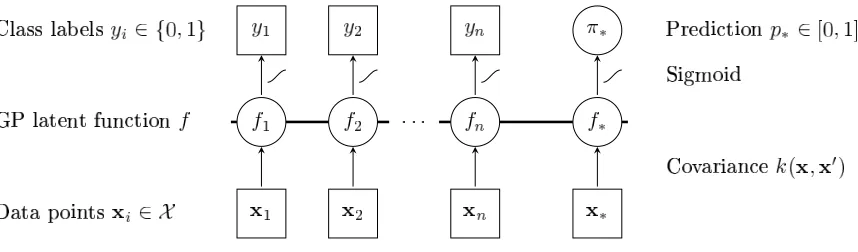
We describe probabilistic binary classification based on Gaussian processes in this section. For a graphical model representation see Figure 1 and for a 1d pictorial description consult Figure 2.
Given data points xi from a domain
X
with corresponding class labels yi∈ {−1,+1}, one wouldlike to predict the class membership probability for a test point x∗. This is achieved by using a
latent function f whose value is mapped into the unit interval by means of a sigmoid function
sig :R→[0,1]such that the class membership probabilityP(y= +1|x)can be written as sig(f(x)).
The class membership probability must normalize∑yP(y|x) =1, which leads toP(y= +1|x) =1−
P(y=−1|x). If the sigmoid function satisfies the point symmetry condition sig(t) =1−sig(−t),
the likelihood can be compactly written as
In this paper, two point symmetric sigmoids are considered
siglogit(t) := 1
1+e−t
sigprobit(t) :=
Z t
−∞
N
(τ|0,1)dτ.The two functions are very similar at the origin (showing locally linear behavior around sig(0) =
1/2 with slope 1/4 for siglogitand 1/√2πfor sigprobit) but differ in how fast they approach 0/1 when
t goes to infinity. For large negative values of t, we have the asymptotics
siglogit(t) ≈ exp(−t) and sigprobit(t) ≈ exp(−1
2t
2+0.158t
−1.78), for t0.
Linear decay of ln(siglogit) corresponds to a weaker penalty for wrongly classified examples than
the quadratic decay of ln(sigprobit).
For notational convenience, the following shorthands are used: The matrix X= [x1, . . . ,xn]of
size n×d collects the training points, the vector y= [y1, . . . ,yn]> of size n×1 collects the target
values and latent function values are summarized by f= [f1, . . . ,fn]>with fi=f(xi). Observed data
is written as
D
={(xi,yi)|i=1, . . . ,n}= (X,y). Quantities carrying an asterisk refer to test points,that is, f∗contains the latent function values for test points[x∗,1, . . . ,x∗,m] =X∗⊂
X
. Covariancesbetween latent values f and f∗ at data points x and x∗ follow the same notation, namely[K∗∗]i j=
k(x∗,i,x∗,j),[K∗]i j=k(xi,x∗,j),[k∗]i=k(xi,x∗) and k∗∗=k(x∗,x∗), where[A]i j denotes the entry
Ai j of the matrix A.
Given the latent function f , the class labels are assumed to be Bernoulli distributed and inde-pendent random variables, which gives rise to a factorial likelihood, factorizing over data points (see Figure 1)
P(y|f) = P(y|f) =
n
∏
i=1
P(yi|fi) = n
∏
i=1
sig(yifi). (1)
A GP (Rasmussen and Williams, 2006) is a stochastic process fully specified by a mean function
m(x) =E[f(x)]and a positive definite covariance function k(x,x0) =V[f(x),f(x0)]. This means
that a random variable f(x)is associated to every x∈
X
, such that for any set of inputs X⊂X
,the joint distribution P(f|X,θ) =
N
(f|m0,K) is Gaussian with mean vector m0 and covariancematrix K. The mean function and covariance functions may depend on additional hyperparameters
θ. For notational convenience we will assume m(x)≡0 throughout. Thus, the elements of K are
Ki j=k(xi,xj,θ).
By application of Bayes’ rule, one gets an expression for the posterior distribution over the latent values f
P(f|y,X,θ) = R P(y|f)P(f|X,θ)
P(y|f)P(f|X,θ)df =
N
(f|0,K)P(y|X,θ)
n
∏
i=1
sig(yifi), (2)
where Z=P(y|X,θ) =R
P(y|f)P(f|X,θ)df denotes the marginal likelihood or evidence for the
hy-perparameterθ. The joint prior over training and test latent values f and f∗given the corresponding
P(f∗,f|X∗,X,θ) =
N
ff∗
0,
K K∗
K>∗ K∗∗
.
When making predictions, we marginalize over the training set latent variables
P(f∗|X∗,y,X,θ) =
Z
P(f∗,f|X∗,y,X,θ)df=
Z
P(f∗|f,X∗,X,θ)P(f|y,X,θ)df, (3)
where the joint posterior is factored into the product of the posterior and the conditional prior
P(f∗|f,X∗,X,θ) =
N
f∗|K>∗K−1f,K∗∗−K>∗K−1K∗.Finally, the predictive class membership probability p∗:=P(y∗=1|x∗,y,X,θ)is obtained by
aver-aging out the test set latent variables
P(y∗|x∗,y,X,θ) =
Z
P(y∗|f∗)P(f∗|x∗,y,X,θ)d f∗ =
Z
sig(y∗f∗)P(f∗|x∗,y,X,θ)d f∗. (4)
The integral is analytically tractable for sigprobit(Rasmussen and Williams, 2006, Ch. 3.9) and can
be efficiently approximated for siglogit(Williams and Barber, 1998, App. A).
Figure 1: Graphical Model for binary Gaussian process classification: Circles represent unknown quantities, squares refer to observed variables. The horizontal thick line means fully
connected latent variables. An observed label yiis conditionally independent of all other
nodes given the corresponding latent variable fi. Labels yi and latent function values
fi are connected through the sigmoid likelihood; all latent function values fi are fully
connected, since they are drawn from the same GP. The labels yiare binary, whereas the
prediction p∗is a probability and can thus have values from the whole interval[0,1].
2.1 Stationary Covariance Functions
encountered in classification. Stationary covariances of the form k(x,x0,θ) =σ2
fg(|x−x0|/`)with
g :R→Ra monotonously decreasing function1 andθ={σf, `}are widely used. The following
section supplies a geometric intuition of that specific prior in the classification scenario by analyzing
the limiting behavior of the covariance matrix K as a function of the length scale`and the limiting
behavior of the likelihood as a function of the latent function scaleσf. A pictorial illustration of the
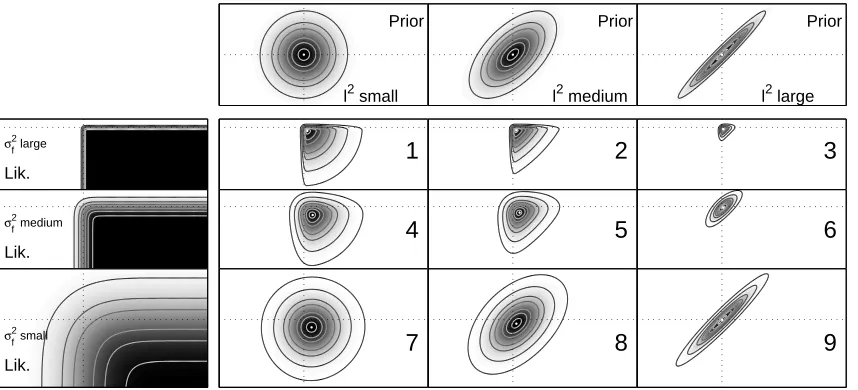
setting is given in Figure 3.
2.1.1 LENGTHSCALE
Two limiting cases of “ignorance with respect to the data” with marginal likelihood Z=2−ncan be
distinguished, where = [1, . . .1]>and I is the identity matrix (see Appendix B.1)
lim
`→0K = σ
2 fI,
lim
`→∞K = σ
2 f
>.
For very small length scales (`→0), the prior is simply isotropic as all points are deemed to be
far away from each other and the whole model factorizes. Thus, the (identical) posterior moments can be calculated dimension-wise. (See Figure 3, regimes 1, 4 and 7.)
For very long length scales (`→∞), the prior becomes degenerate as all datapoints are deemed
to be close to each other and takes the form of a cigar along the hyper-diagonal. (See Figure 3,
regimes 3, 6 and 9.) A 1d example of functions drawn from GP priors with different lengthscales`
is shown in Figure 2 on the left. The lengthscale has to be suited to the data; if chosen too small, we will overfit, if chosen too high underfitting will occur.
2.1.2 LATENTFUNCTIONSCALE
The sigmoid likelihood function sig(yifi)measures the agreement of the signs of the latent function
and the label in a smooth way, that is, values close to one if the signs of yiand fiare the same and|fi|
is large, and values close to zero if the signs are different and|fi|is large. The latent function scale
σf of the data can be moved into the likelihood ˜sigσf(t) =sig(σ
2
ft), thusσf models the steepness of
the likelihood and finally the smoothness of the agreement by interpolation between the two limiting cases “ignorant” and “hard cut”
lim
σf→0
sig(t) ≡ 1
2 “ignorant",
lim
σf→∞
sig(t) ≡ step(t):= 0,t<0; 12,t=0; 1,0<t “hard cut".
In the case of very small latent scales (σf →0), the likelihood is flat causing the posterior to
equal the prior. The marginal likelihood is again Z=2−n. (See Figure 3, regimes 7, 8 and 9.)
In the case of large latent scales (σf 1), the likelihood approaches the step function. (See
Figure 3, regimes 1, 2 and 3.) A further increase of the latent scale does not change the model
anymore. The model is effectively the same for allσf above a threshold.
0 2 4 6 8 10 −4
−2 0 2 4
a) Prior lengthscales
0 2 4 6 8 10
−4 −2 0 2 4
b) f~Prior
0 2 4 6 8 10
0 0.2 0.4 0.6 0.8 1
c) sig(f), f~Prior
0 2 4 6 8 10 −4
−2 0 2 4
d) f~Posterior, n=7
0 2 4 6 8 10 0
0.2 0.4 0.6 0.8 1
e) sig(f), n=7
0 2 4 6 8 10 −4
−2 0 2 4
f) f~Posterior, n=20
0 2 4 6 8 10 0
0.2 0.4 0.6 0.8 1
g) sig(f), n=20
Figure 2: Pictorial illustration of binary Gaussian process classification in 1d: Plot a) shows 3
sam-ple functions drawn from GPs with different lengthscales`. Then, three pairs of plots
show distributions over functions f :R→Rand sig(f):R→[0,1]occurring in GP
clas-sification. b+c) the prior, d+e) a posterior with n=7 observations and f+g) a posterior
with n=20 observations along with the n observations with binary labels. The thick black
line is the mean, the gray background is the±standard deviation and the thin lines are
sample functions. With more and more data points observed, the uncertainty is gradually shrunk. At the decision boundary the uncertainty is smallest.
2.2 Gaussian Approximations
Unfortunately, the posterior over the latent values (Equation 2) is not Gaussian due to the non-Gaussian likelihood (Equation 1). Therefore, the latent distribution (Equation 3), the predictive distribution (Equation 4) and the marginal likelihood Z cannot be written as analytical expressions. To obtain exact answers, one can resort to sampling algorithms (MCMC). However, if sig is con-cave in the logarithmic domain, the posterior can be shown to be unimodal motivating Gaussian approximations to the posterior. Five different Gaussian approximations corresponding to methods explained later onwards in the paper are depicted in Figure 4.
A quadratic approximation to the log likelihoodφ(fi):=lnP(yi|fi)at ˜fi
φ(fi) ≈ φ(f˜i) +φ0(f˜i)(fi−f˜i) +
1
2φ
00(f˜i)(fi−f˜i)2 =
−12wifi2+bifi+constfi
motivates the following approximate posteriorQ(f|y,X,θ)
lnP(f|y,X,θ) (2)= −1
2f
>K−1f+
∑
n i=1lnP(yi|fi) +constf
quad. approx.
≈ −12f>K−1f−1 2f
>Wf+b>f+const
f
m:=(K−1+W)−1b
= −1
2(f−m)
> K−1+W(f
−m) +constf
Prior
l2 small
Prior
l2 medium
Prior
l2 large
Lik. σf2
large
Lik. σf2 medium
Lik. σf2 small
1 2 3
4 5 6
7 8 9
Figure 3: Gaussian Process Classification: Prior, Likelihood and exact Posterior: Nine num-bered quadrants show posterior obtained by multiplication of different priors and
like-lihoods. The leftmost column illustrates the likelihood function for three different
steepness parameters σf and the upper row depicts the prior for three different length
scales `. Here, we use σf as a parameter of the likelihood. Alternatively, rows
cor-respond to “degree of Gaussianity” and columns stand for “degree of isotropy“. The
axes show the latent function values f1 = f(x1) and f2= f(x2). A simple toy
exam-ple employing the cumulative Gaussian likelihood and a squared exponential covariance
k(x,x0) =σ2
fexp(− kx−x0k 2
/2`2) with length scales ln`={0,1,2.5} and latent
func-tion scales lnσf ={−1.5,0,1.5} is used. Two data points x1 =
√
2, x2=−
√ 2 with
corresponding labels y1=1, y2=−1 form the data set.
where V−1=K−1+W and W denotes the precision of the effective likelihood (see Equation 7). It
turns out that the methods discussed in the following sections correspond to particular choices of m and V.
Let us assume, we have found such a Gaussian approximation to the posterior with mean m and (co)variance V. Consequently, the latent distribution for a test point becomes a tractable one-dimensional Gaussian P(f∗|x∗,y,X,θ) =
N
(f∗|µ∗,σ2∗) with the following moments (Rasmussen
and Williams, 2006, p. 44 and 56):
µ∗ = k>∗K−1m =k>∗α, α = K−1m, σ2
∗ = k∗∗−k>∗ K−1−K−1VK−1
k∗ = k∗∗−k>∗ K+W−1−1k∗. (6)
Since Gaussians are closed under multiplication, one can—given the Gaussian priorP(f|X,θ)
and the Gaussian approximation to the posteriorQ(f|y,X,θ)—deduce the Gaussian factorQ(y|f)
sub-best Gaussian posterior, KL=0.118
−5 0 5 10 −10
−5 0 5
LA posterior, KL=0.557
−5 0 5 10 −10
−5 0 5
EP posterior, KL=0.118
−5 0 5 10 −10
−5 0 5
VB posterior, KL=3.546
−5 0 5 10 −10
−5 0 5
KL posterior, KL=0.161
−5 0 5 10 −10
−5 0 5
Figure 4: Five Gaussian Approximations to the Posterior (exact Posterior and mode in gray): Dif-ferent Gaussian approximations to the exact posterior using the regime 2 setting of Figure 3 are shown. The exact posterior is represented in gray by a cross at the mode and a sin-gle equiprobability contour line. From left to right: The best Gaussian approximation (intractable) matches the moments of the true posterior, the Laplace approximation does a Taylor expansion around the mode, the EP approximation iteratively matches marginal moments, the variational method maximizes a lower bound on the marginal likelihood and the KL method minimizes the Kullback-Leibler to the exact posterior. The axes show the latent function values f1= f(x1)and f2= f(x2).
sequently in the paper, are depicted in Figure 5. By “dividing” the approximate Gaussian posterior (see Appendix B.2) by the true Gaussian prior we find the contribution of the effective likelihood
Q(y|f):
Q(y|f) ∝
N
(f|m,V)N
(f|0,K) ∝N
f|(KW)−1m+m,W−1. (7) We see (also from Equation 5) that W models the precision of the effective likelihood. In general, W
is a full matrix containing n2parameters.2However, all algorithms maintaining a Gaussian posterior
approximation work with a diagonal W to enforce the effective likelihood to factorize over examples (as the true likelihood does, see Figure 1) in order to reduce the number of parameters. We are not aware of work quantifying the error made by this assumption.
2.3 Log Marginal Likelihood
Prior knowledge over the latent function f is encoded in the choice of a covariance function k
con-taining hyperparametersθ. In principle, one can do inference jointly over f andθe.g., by sampling
techniques. Another approach to model selection is maximum likelihood type II also known as
the evidence framework (MacKay, 1992), where the hyperparameters θ are chosen to maximize
the marginal likelihood or evidenceP(y|X,θ). In other words, one maximizes the agreement
be-tween observed data and the model. Therefore, one has a strong motivation to estimate the marginal likelihood.
Geometrically, the marginal likelihood measures the volume of the prior times the likelihood. High volume implies a strong consensus between our initial belief and our observations. In GP
clas-sification, each data point xi gives rise to a dimension fiin latent space. The likelihood implements
a mechanism, for smoothly restricting the posterior along the axis of fi to the side corresponding
2. Numerical moment matching with K=
7 6
6 7
, y1=y2=1 and sigprobitleads to W=
0.142 −0.017
−0.017 0.142
best Gaussian likelihood
−5 0 5 10 −10
−5 0 5
LA likelihood
−5 0 5 10 −10
−5 0 5
EP likelihood
−5 0 5 10 −10
−5 0 5
VB likelihood
−5 0 5 10 −10
−5 0 5
KL likelihood
−5 0 5 10 −10
−5 0 5
Figure 5: Five Effective Likelihoods (exact Prior/Likelihood in gray): A Gaussian approximation to the posterior induces a Gaussian effective likelihood (Equation 7). Different effective likelihoods are shown; order and setting are the same as described in Figure 4. The axes
show the latent function values f1= f(x1)and f2= f(x2). The effective likelihood
re-places the non-Gaussian likelihood (indicated by three gray lines). A good replacement behaves like the exact likelihood in regions of high prior density (indicated by gray el-lipses). EP and KL yield a good coverage of that region. However LA and VB yield too concentrated replacements.
to the sign of yi . Thus, the latent spaceRnis softly cut down to the orthant given by the values in
y. The log marginal likelihood measures, what fraction of the prior lies in that orthant. Finally, the
value Z=2−ncorresponds to the case, where half of the prior lies on either side along each axis in
latent space. Consequently, successful inference is characterized by Z>2−n.
Some posterior approximations (Sections 3 and 4) provide an approximation to the marginal likelihood, other methods provide a lower bound (Sections 5 and 6). Any Gaussian approximation
Q(f|θ) =
N
(f|m,V) to the posteriorP(f|y,X,θ) gives rise to a lower bound ZB to the marginallikelihood Z by application of Jensen’s inequality. This bound has been used in the context of sparse approximations (Seeger, 2003).
ln Z=lnP(y|X,θ) = ln
Z
P(y|f)P(f|X,θ)df=ln Z
Q(f|θ)P(y|f)P(f|X,θ)
Q(f|θ) df
Jensen
≥ Z
Q(f|θ)lnP(y|f)P(f|X,θ)
Q(f|θ) df=: ln ZB. (8)
Some algebra (Appendix B.3) leads to the following expression for ln ZB:
n
∑
i=1
Z
N
(f|,0,1)ln sig yi √Viif+mi df
| {z }
1) data fit
+1
2[n−m
>K−1m | {z } 2) data fit
+lnVK−1−tr VK−1
| {z }
3) regularizer
]. (9)
Model selection means maximization of ln ZB. Term 1) is a sum of one-dimensional Gaussian
of the data-fit term in GP regression (Rasmussen and Williams, 2006, Ch. 5.4.1). Thus, the first
and the second term encourage fitting the data by favouring small variances Viiand large means mi
having the same sign as yi. The third term can be rewritten as−ln|I+KW| −tr (I+KW)−1
and
yields−∑n
i=1ln(1+λi) +1+1λi withλi≥0 being the eigenvalues of KW. Thus, term 3) keeps the
eigenvalues of KW small, thereby favouring a smaller class of functions—this can be seen as an instance of Occam’s razor.
Furthermore, the bound
ln ZB =
Z
Q(f|θ)lnP(f|y,X,θ)P(y|X)
Q(f|θ) df =ln Z−KL(Q(f|θ)kP(f|y,X,θ)) (10)
can be decomposed into the exact marginal likelihood minus the Kullback-Leibler (KL) diver-gence between the exact posterior and the approximate posterior. Thus by maximizing the lower
bound ln ZBon ln Z, we effectively minimize the KL-divergence betweenP(f|y,X,θ)andQ(f|θ) =
N
(f|m,V). The bound is tight if and only ifQ(f|θ) =P(f|y,X,θ).3. Laplace Approximation (LA)
A second order Taylor expansion around the posterior mode m leads to a natural way of constructing
a Gaussian approximation to the log-posteriorΨ(f) =lnP(f|y,X,θ) (Williams and Barber, 1998;
Rasmussen and Williams, 2006, Ch. 3). The mode m is taken as the mean of the approximate
Gaussian. Linear terms ofΨvanish because the gradient at the mode is zero. The quadratic term of
Ψis given by the negative Hessian W, which - due to the likelihood’s factorial structure - turns out
to be diagonal. The mode m is found by Newton’s method.
3.1 Posterior
P(f|y,X,θ) ≈
N
(f|m,V) =N
f|m, K−1+W−1,
m = argmax
f∈Rn
P(y|f)P(f|X,θ),
W = −∂
2lnP(y|f) ∂f∂f>
f=m
=−
"
∂2lnP(yi|fi) ∂fi2
fi=mi
#
ii .
3.2 Log Marginal Likelihood
The unnormalized posterior P(y|f)P(f|X,θ) has its maximum h=exp(Ψ(m)) at its mode m,
where the gradient vanishes. A Taylor expansion ofΨis then given byΨ(f)≈h−21(f−m)>(K−1+
W)(f−m). Consequently, the log marginal likelihood can be approximated by plugging in the
ap-proximation ofΨ(f).
ln Z=lnP(y|X,θ) = ln
Z
P(y|f)P(f|X,θ)df=ln Z
exp(Ψ(f))df
≈ ln h+ln Z
exp
−1
2(f−m)
> K−1+W(f−m)
df
= lnP(y|m)−1
2m
>K−1m+1
4. Expectation Propagation (EP)
EP (Minka, 2001b) is an iterative method to find approximations based on approximate marginal moments, which can be applied to Gaussian processes. See (Rasmussen and Williams, 2006, Ch. 3)
for details. The individual likelihood terms are replaced by site functions ti(fi)being unnormalized
Gaussians
P(yi|fi) ≈ti fi,µi,σ2i,Zi
:= ZiN fi|µi,σ2i
such that the approximate marginal moments of Q(fi):=R
N
(f|0,K)∏n j=1ZjN
fj|µj,σ2j
df¬i
agree with the marginals of R
N
(f|0,K)P(yi|fi)∏j6=iZj
N
fj|µj,σ2j
df¬i of the approximation
based on the exact likelihood term P(yj|fj). That means, there are 3n quantities µi, σ2i and Zi
to be iteratively optimized. Convergence of EP is not generally guaranteed, but there always exists a fixed-point for the EP updates in GP classification (Minka, 2001a). If the EP iterations converge, the solution obtained is a saddle point of a special energy function (Minka, 2001a). However, an EP update does not necessarily imply a decrease in energy. For our case of log-concave likelihood functions, we always observed convergence, but we are not aware of a formal proof.
4.1 Posterior
Based on these local approximations, the approximate posterior can be written as:
P(f|y,X,θ) ≈
N
(f|m,V) =N
f|m, K−1+W−1,
W = σ−i 2ii,
m = VWµ=hI−K K+W−1−1iKWµ,µ= (µ1, . . . ,µn)>.
4.2 Log Marginal Likelihood
>From the likelihood approximations, one can directly obtain an expression for the approximate log marginal likelihood
ln Z=lnP(y|X,θ) = ln
Z
P(y|f)P(f|X,θ)df
≈ ln
Z n
∏
i=1
t fi,µi,σ2i,ZiP(f|X,θ)df
=
n
∑
i=1
ln Zi−
1
2µ
> K+W−1−1µ−1
2ln
K+W−1−n
2ln 2π
=
n
∑
i=1
ln√Zi
2π−
1
2m
> K−1+K−1W−1K−1m−1
2ln
K+W−1=: ln ZEP.
The lower bound provided by Jensen’s inequality ZB(Equation 9) is known to be below the
approx-imation ZEP obtained by EP (Opper and Winther, 2005, page 2183). From ZEP≥ZBand Z≥ZBit
is not clear, which value one should use. In principle, ZEPcould be a bad approximation. However,
4.3 Thouless, Anderson & Palmer method (TAP)
Based on ideas rooted in Statistical Physics, one can approach the problem from a slightly different
angle (Opper and Winther, 2000). Individual Gaussian approximations
N
(fi|µ¬i,σ2¬i)are only madeto predictive distributionsP fi|xi,y\i,X\i,θ
for data points xithat have been previously removed
from the training set. Based on µ¬i andσ2¬i one can derive explicit expressions for(α,W
1 2), our
parameters of interest.
αi ≈
R ∂
∂fiP(yi|fi)
N
(fi|µ¬i,σ2 ¬i)d fi
R
P(yi|fi)
N
(fi|µ¬i,σ2¬i)d fi ,
W−1ii ≈ σ2¬i
1
αi[Kα]i−1
. (11)
In turn, the 2n parameters(µ¬i,σ2¬i)can be expressed as a function ofα, K and W
1 2.
σ2
¬i = 1/ h
K+W−1−1
i
ii−
W−1ii,
µ¬i = [Kα]i−σ2¬iαi. (12)
As a result, a system (Equations 11/12) of nonlinear equations in µ¬i and σ2¬i has to be solved
by iteration. Each step involves a matrix inversion of cubic complexity. A faster “naïve” variant updating only n parameters has also been proposed (Opper and Winther, 2000) but it does not lead to the same fixed point. As in the FV algorithm (Section 7), a formal complex transformation leads
to a simplified version by fixingσ2¬i=Kii, called (TAPnaive) in the sequel.
Finally, for prediction, the predictive posteriorP(f∗|x∗,y,X,θ)is approximated by a Gaussian
N
(f∗|µ∗,σ2∗)at a test point x∗based on the parameters(α,W
1
2)and according to equation (6).
A fixed-point of the TAP mean-field equations is also a fixed-point of the EP algorithm (Minka, 2001a). This theoretical result was confirmed in our numerical simulations. However, the EP algo-rithm is more practical and typically much faster. For this reason, we are not going to treat the TAP method as an independent algorithm in this paper.
5. KL-Divergence Minimization (KL)
In principle, we simply want to minimize a dissimilarity measure between the approximate posterior
Q(f|θ) =
N
(f|m,V) and the exact posteriorP(f|y,X,θ). One quantity to minimize is theKL-divergence
KL(P(f|y,X,θ)kQ(f|θ)) =
Z
P(f|y,X,θ)lnP(f|y,X,θ)
Q(f|θ) df.
Unfortunately, this expression is intractable. If instead, we measure the reverse KL-divergence, we regain tractability
KL(Q(f|θ)kP(f|y,X,θ)) =
Z
N
(f|m,V)lnN
(f|m,V)A similar approach has been followed for regression with Laplace or Cauchy noise (Opper and Archambeau, 2008). Finally, we minimize the following objective (see Appendix B.3) with respect to the variables m and V. Constant terms have been dropped from the expression:
KL(m,V)=c −
Z
N
(f)" n
∑
i=1
ln sig(√viiyif+miyi)
#
d f−1
2ln|V|+ 1
2m
>K−1m+1
2tr K
−1V.
We refer to the first term of KL(m,V)as a(m,V)to keep the expressions short. We calculate first
derivatives and equate them with zero to obtain necessary conditions that have to be fulfilled at a
local optimum(m∗,V∗)
∂KL
∂m =
∂a ∂m−K
−1m=0
⇒ K−1m= ∂a
∂m=α,
∂KL
∂V =
∂a ∂V+
1
2V
−1−1
2K
−1=0 ⇒ V=
K−1−2∂a
∂V
−1
= K−1−2Λ−1
which definesΛ. If the approximate posterior is parametrized by(m,V), there are in principle in
the order of n2parameters. But if the necessary conditions for a local minimum are fulfilled (i.e., the
derivatives∂KL/∂m and∂KL/∂V vanish), the problem can be re-parametrized in terms of(α,Λ).
Since Λ=∂a/∂V is a diagonal matrix (see Equation 17), the optimum is characterized 2n free
parameters. This fact was already pointed out by Manfred Opper (personal communication) and Matthias Seeger (Seeger, 1999, Ch. 5.21, Eq. 5.3). Thus, a minimization scheme based on Newton iterations on the joint vectorξ:= [α>,Λii]>takes
O
(8·n3)operations. Details about the derivatives∂KL/∂ξand∂2KL/∂ξ∂ξ> are provided in Appendix A.2.
5.1 Posterior
Based on these local approximations, the approximate posterior can be written as:
P(f|y,X,θ) ≈
N
(f|m,V) =N
f|m, K−1+W−1,
W = −2Λ,
m = Kα.
5.2 Log Marginal Likelihood
Since the method inherently maximizes a lower bound on the marginal likelihood, this bound (Equa-tion 9) is used as approxima(Equa-tion to the marginal likelihood.
6. Variational Bounds (VB)
general likelihoods. Individual likelihood bounds
P(yi|fi) ≥ exp aifi2+biyifi+ci
,∀fi∈R∀i
⇒P(y|f) ≥ expf>Af+ (by)>f+c> =:Q(y|f,A,b,c),∀f∈R
are defined in terms of coefficients ai,bi and ci, wheredenotes the element-wise product of two
vectors. This lower bound on the likelihood induces a lower bound on the marginal likelihood.
Z=
Z
P(f|X)P(y|f)df ≥ Z
P(f|X)Q(y|f,A,b,c)df=ZB.
Carrying out the Gaussian integral
ZB =
Z
N
(f|0,K)exp
f>Af+ (by)>f+c>
df
leads to (see Appendix B.4)
ln ZB = c> +
1
2(by)
> K−1
−2A−1(by)−1
2ln|I−2AK| (13)
which can now be maximized with respect to the coefficients ai,biand ci. In order to get an efficient
algorithm, one has to calculate the first and second derivatives∂ln ZB/∂ς,∂2ln ZB/∂ς∂ς> (as done
in Appendix A.1). Hyperparameters can be optimized using the gradient∂ln ZB/∂θ.
6.1 Logit Bound
Optimizing the logistic likelihood function (Gibbs and MacKay, 2000), we obtain the necessary conditions
Aς := −Λς,
bς :=
1
2 ,
cς,i := ς2iλ(ςi)−
1
2ςi+ln siglogit(ςi)
where we defineλ(ςi) = 2siglogit(ςi)−1/(4ςi)andΛς = [λ(ςi)]ii. This shows, that we only have
to optimize with respect to n parametersς. We apply Newton’s method for this purpose. The bound
is symmetric and tight at f=±ς.
6.2 Probit Bound
For reasons of completeness, we derive similar expressions (Appendix B.5) for the cumulative
Gaus-sian likelihood sigprobit(fi)with necessary conditions
aς := −
1
2 , (14)
bς,i := ςi+
N
(ςi)
sigprobit(ςi),
cς,i := ςi
2 −bi
ςi+ln sigprobit(ςi)
which again depend only on a single vector of parameters we optimize using Newton’s method. The
6.3 Posterior
Based on these local approximations, the approximate posterior can be written as
P(f|y,X,θ) ≈
N
(f|m,V) =N
f|m, K−1+W−1,W = −2Aς,
m = V(ybς) = K−1−2Aς
−1
(ybς),
where we have expressed the posterior parameters directly as a function of the coefficients. Finally,
we deal with an approximate posterior Q(f|θ) =
N
(f|mς,Vς) only depending on a vector ς ofn variational parameters and a mapping ς7→(mς,Vς). In the KL method, every combination of
values m and W is allowed, in the VB method, mς and Vς cannot be chosen independently, since
the have to be compatible with the bounding requirements. Therefore, the variational posterior is more constrained than the general Gaussian posterior and thus easier to optimize.
6.4 Log Marginal Likelihood
It turns out, that the approximation to the marginal likelihood (Equation 13) is often quite poor and the more general Jensen bound approach (Equation 9) is much tighter. In practice, one would have to evaluate both of them and keep the maximum value.
7. Factorial Variational Method (FV)
Instead of approximating the posteriorP(f|y,X,θ)by the closest Gaussian distribution, one can use
the closest factorial distributionQ(f|y,X,θ) =∏iQ(fi), also called ensemble learning (Csató et al.,
2000). Another kind of factorial approximationQ(f) =Q(f+)Q(f−)—a posterior factorizing over
classes—is used in multi-class classification (Girolami and Rogers, 2006).
7.1 Posterior
As a result of free-form minimization of the Kullback-Leibler divergence KL(Q(f|y,X,θ)kP(f|y,X,θ))
by equating its functional derivativeδKL/δQ(fi)with the zero function (Appendix B.6), one finds
the best approximation to be of the following form:
Q(fi) ∝
N
fi µi,σ2i
P(yi|fi),
µi = mi−σ2i K−1mi= [Kα]i−σ2iαi, σ2
i =
K−1−ii1,
mi =
Z
fiQ(fi)d fi. (15)
it is still possible that the model picks up the most important structure, since the expectations are coupled. Of course, at test time, it is essential that correlations are taken into account again using Equation 6, as it would otherwise be impossible to inject any knowledge into the predictive
dis-tribution. For predictions we use the Gaussian
N
(f|m,Dg(v))instead of Q(f). This is a furtherapproximation, but it allows to stay inside the Gaussian framework.
Parameters µi and mi are found by the following algorithm. Starting from m=0, iterate the
following until convergence; (1) compute µi, (2) update miby taking a step in the direction towards
mias given by Equation 15. Stepsizes are adapted.
7.2 Log Marginal Likelihood
Surprisingly, one can obtain a lower bound on the marginal likelihood (Csató et al., 2000):
ln Z ≥
n
∑
i=1
ln sig
yimi
σi
−1
2α
>K−Dg(σ2 1, . . . ,σ2n
>
)α−1
2ln|K|+
n
∑
i=1
lnσi.
8. Label Regression Method (LR)
Classification has also been treated using label regression or least squares classification (Rifkin and Klautau, 2004). In its simplest form, this method simply ignores the discreteness of the class labels at the cost of not being able to provide proper probabilistic predictions. However, we treat LR
as a heuristic way of choosingα and W, which allows us to think of it as yet another Gaussian
approximation to the posterior allowing for valid predictions of class probabilities.
8.1 Posterior
After inference, according to Equation 6, the moments of the (Gaussian approximation to the) pos-terior GP can be written as µ∗=k>∗αandσ2∗=k∗∗−k>∗ K+W−1−1k∗. Fixing
W−1=σ2nI and α= K+W−1−1 K+W−1α= K+W−1−1y,
we obtain GP regression from data points xi ∈
X
to real labels yi∈Rwith noise of varianceσ2nas a special case. In regression, the posterior moments are given by µ∗=k>∗ K+σ2
nI −1
y and
σ2
∗=k∗∗−k>∗ K+σ2nI −1
k∗(Rasmussen and Williams, 2006). The arbitrary scale of the discrete
y can be absorbed by the hyperparameters. There is an additional parameterσn, describing the width
of the effective likelihood. In experiments, we selectedσn∈[0.5,2]to maximise the log marginal
likelihood.
8.2 Log Marginal Likelihood
There are two ways of obtaining an estimate of the log marginal likelihood. One can simply ignore
the binary nature and use the regression marginal likelihood ln Zregas proxy for ln Z—an approach
we only mention but not use in the experiments
ln Zreg = −
1
2α
> K+σ2 nI
α−1
2ln
K+σ2nI−n
2ln 2π.
Alternatively, the Jensen bound (8) yields a lower bound ln Z≥ln ZB—which seems more in line
9. Relations Between the Methods
All considered approximations can be separated into local and global methods. Local methods exploit properties (such as derivatives) of the posterior at a special location only. Global methods
minimize the KL-divergence KL(Q||P) =R
Q(f)lnQ(f)/P(f)df between the posteriorP(f)and a
tractable family of distributionsQ(f). Often this methodology is also referred to as a variational
algorithm.
assumption relation conditions approx. posteriorQ(f) name
Q(f) =
N
(f|m,V) → m = argmaxfP(f)W = −∂2∂lnf∂Pf(>y|f)
N
(f|m,(K−1+W)−1) LA
Q(f) =∏iqi(fi) → δδqKL
i(fi)≡0 ∏i
N
(fi|µi,σ2
i)P(yi|fi) FV
&
fidq
i(fi)=
fidQ(f
i)
N
f|m,(K−1+W)−1 EP
%
Q(f) =
N
(f|m,V) → ∂KL∂V,m =0
N
f|m,(K−1+W)−1 KL
&
P(yi|fi)≥
N
(fi|µςi,σ2
ςi) →
∂KL
∂ς∗ =0
N
f|mς∗,(K−1+W
ς∗)−1
VB
P(yi|fi):=
N
(fi|yi,σ2n) → m= (I+σn2K−1)−1yN
(f|m,(K−1+σ−n2I)−1) LRThe only local method considered is the LA approximation matching curvature at the posterior mode. Common tractable distributions for global methods include factorial and Gaussian distri-butions. They have their direct correspondent in the FV method and the KL method. Individual likelihood bounds make the VB method a more constrained and easier-to-optimize version of the KL method. Interestingly, EP can be seen in some sense as a hybrid version of FV and KL, com-bining the advantages of both methods. Within the Expectation Consistence framework (Opper and Winther, 2005), EP can be thought of as an algorithm that implicitly works with two distributions—a
factorial and a Gaussian—having the same marginal momentsfid. By means of iterative updates,
one keeps these expectations consistent and produces a posterior approximation.
In the divergence measure and message passing framework (Minka, 2005), EP is cast as a mes-sage passing algorithm template: Iterative minimization of local divergences to a tractable family of distributions yields a small global divergence. From that viewpoint, FV and KL are considered
as special cases with divergence measure KL(Q||P)combined with factorial and Gaussian
distribu-tions.
There is also a link between local and global methods, namely from the KL to the LA method. The necessary conditions for the LA method do hold on average for the KL method (Opper and Archambeau, 2008).
10. Markov Chain Monte Carlo (MCMC)
The only way of getting a handle on the ground truth for the moments Z, m and V is by applying sampling techniques. In the limit of long runs, one is guaranteed to get the right answer. But in practice, these methods can be very slow, compared to analytic approximations discussed previ-ously. MCMC runs are rather supposed to provide a gold standard for the comparison of the other methods.
It turns out to be most challenging to obtain reliable marginal likelihood estimates as it is equiv-alent to solving the free energy problem in physics. We employ Annealed Importance Sampling (AIS) and thermodynamic integration to yield the desired marginal likelihoods. Instead of starting annealing from the prior distribution, we propose to directly start from an approximate posterior in order to speed up the sampling process.
Accurate estimates of the first and second moments can be obtained by sampling directly from the (unnormalized) posterior using Hybrid Monte Carlo methods (Neal, 1993).
10.1 Thermodynamic Integration
The goal is to calculate the marginal likelihood Z=R
P(y|f)P(f|X)df. AIS (Neal, 1993, 2001)
works with intermediate quantities Zt :=
R
P(y|f)τ(t)P(f|X)df. Here, τ:N⊃[0,T]→[0,1]⊂R
denotes an inverse temperature schedule with the propertiesτ(0) =0,τ(T) =1 andτ(t+1)≥τ(t)
leading to Z0=RP(f|X)df=1 and ZT=Z.
On the other hand, we have Z=ZT/Z0 =∏Tt=1Zt/Zt−1—an expanded fraction. Each factor
Zt/Zt−1can be approximated by importance sampling with samples fsfrom the “intermediate
pos-terior”P(f|y,X,t−1):=P(y|f)τ(t−1)P(f|X)/Zt−1at time t. Zt
Zt−1
=
R
P(y|f)τ(t)P(f|X)df
Zt−1
=
Z P(y|f)τ(t)
P(y|f)τ(t−1)
P(y|f)τ(t−1)P(f|X)
Zt−1
df
=
Z
P(y|f)∆τ(t)P(f|y,X,t−1)df
≈ 1S
S
∑
s=1
P(y|fs)∆τ(t), fs∼P(f|y,X,t−1).
This works fine for small temperature changes∆τ(t):=τ(t)−τ(t−1). In the limit, we smoothly
interpolate betweenP(y|f)0P(f|X)andP(y|f)1P(f|X), that is, we start by sampling from the prior and finally approach the posterior. Note that sampling is algorithmically possible even though the distribution is only known up to a constant factor.
10.2 Amelioration Using an Approximation to the Posterior
In practice, the posterior can be quite different from the prior. That means that individual fractions
Zt/Zt−1may be difficult to estimate. One can make these fractions more similar by increasing the
number of steps T or by “starting” from a distribution close to the posterior rather than from the prior. LetQ(f) =
N
(f|m,V)≈P(f|y,X,T) =P(y|f)P(f|X)/ZT denote an approximation to the posterior. SettingN
(f|m,V) =Q(y|f)P(f|X), one can calculate the effective likelihoodQ(y|f)by division (see Appendix B.2).For the integration we use Zt=RP(y|f)τ(t)Q(y|f)1−τ(t)P(f|X)df where Z0=RQ(y|f)P(f|X)df
can be computed analytically. Again, each factor Zt
by importance sampling from the modified intermediate posterior:
P(f|y,X,t−1) = P(y|f)τ(t−1)Q(y|f)1−τ(t−1)P(f|X)/Zt−1
=
P(y|f)
Q(y|f)
τ(t−1)
Q(y|f)P(f|X)/Zt−1,
Zt Zt−1
=
R
P(y|f)τ(t)Q(y|f)1−τ(t)P(f|X)df
Zt−1
=
Z P(y|f)τ(t)Q(y|f)1−τ(t)
P(y|f)τ(t−1)Q(y|f)1−τ(t−1)
P(y|f)τ(t−1)Q(y|f)1−τ(t−1)P(f|X)
Zt−1
df
=
Z P(y|f)
Q(y|f)
∆τ(t)
P(f|y,X,t−1)df
≈ 1S
S
∑
s=1
P(y|fs) Q(y|fs)
∆τ(t)
, fs∼P(f|y,X,t−1).
The choice ofQ(f)to be a good approximation to the true posterior makes the fractionP(y|f)/Q(y|f)
as constant as possible, which in turn reduces the error due to the finite step size in thermodynamical integration.
10.3 Algorithm
If only one sample ftis used per temperatureτ(t), the value of the entire fraction is obtained as
ln Zt
Zt−1
=∆τ(t) [lnP(y|ft)−lnQ(y|ft)]
which gives rise to the full estimate
ln Z≈
T
∑
t=1
ln Zt
Zt−1
=ln ZQ+
T
∑
t=1 ∆τ(t)
lnP(y|ft) +
1
2(ft−m˜)
>W(f t−m˜)
for a single run r. The finite temperature change bias can be removed by combining results Zrfrom
R different runs by their arithmetic mean 1R∑rZr(Neal, 2001)
ln Z=ln
Z
P(y|f)P(f|X)df≈ln 1
R R
∑
r=1 Zr
! .
Finally, the only primitive needed to obtain MCMC estimates of Z, m and V is an efficient
sampler for the “intermediate” posterior P(f|y,X,t−1). We use Hybrid Monte Carlo sampling
(Neal, 1993).
10.4 Results
(regimes 4-6), but is sufficiently different from the prior, then the method decreases variance and consequently improves runtimes of AIS. Different approximation methods lead also to differences in the improvement. Namely, the Laplace approximation performs worse than the approximation found by Expectation Propagation because Laplace’s method approximates around the mode which can be far away from the mean.
For our evaluations of the approximations to the marginal likelihood, however we started the algorithm from the prior. Otherwise, one might be worried of biasing the MCMC simulation towards the initial distribution in cases where the chain fails to mix properly.
11. Implementation
Implementations of all methods discussed are provided athttp://www.kyb.mpg.de/~hn/approxXX.
tar.gz. The code is designed as an extension to the Gaussian Processes for Machine Learning
(GPML) (Rasmussen and Williams, 2006) Matlab Code.3 Approximate inference for Gaussian
processes is done by the binaryGP.m function, which takes as arguments the covariance
func-tion, the likelihood function and the approximation method. The existing GPML package provides
approxLA.mfor Laplace’s method andapproxEP.mfor Expectation Propagation. These
implemen-tations are generic to the likelihood function. We providecumGauss.mandlogistic.mthat were
designed to avoid numerical problems. In the extension,approxKL.m,approxVB.m,approxFV.m
andapproxTAP.mare included, among others not discussed here, for example sparse and online
methods outside the scope of the current investigation. The implementations are straight-forward, although special care has been taken to avoid numerical problems e.g., situations where K is close
to singular. More concretely, we use the well-conditioned matrix4 B=W12KW
1
2+I=LL> and
its Cholesky decomposition to calculate V= K−1+W−1or k∗> K+W−1−1k∗. The posterior
mean is represented in terms ofαto avoid multiplications with K−1and facilitate predictions.
Especially LA and EP show a high level of robustness along the full spectrum of possible hyper-parameters. KL uses Gauss-Hermite quadrature; we did not notice problems stemming therefrom.
The FV and TAP methods work very reliably, although, we had to add a small (10−6) ridge for FV
to regularize K. As a general statement, we did not observe any numerical problems for a wide range of hyperparameters reaching from reasonable values to very extreme scales.
In addition to the code for the algorithms, we provide also a tarball containing all necessary scripts to reproduce the figures of the paper. We offer two versions: The first version contains only
the code for running the experiments and drawing the figures.5 The second version additionally
includes the results of the experiments.6
12. Experiments
The purpose of the experiments is to illustrate the strengths and weaknesses of the different approxi-mation methods. First of all, the quality of the approxiapproxi-mation itself in terms of posterior moments Z,
3. The package is available athttp://www.gaussianprocess.org/gpml/code. 4. All eigenvaluesλof B satisfy 1≤λ≤1+n
4maxi jKi j, thus B−1and|B|can be safely computed.
5. The code base (∼9Mb) can be obtained fromhttp://www.kyb.mpg.de/~hn/supplement_code.tar.gz. 6. The complete code base (∼400Mb) including all simulation results and scripts to generate figures is stored at
m and V is studied. At a second level, building on the “low-level” features, we compare predictive
performance in terms of the predictive probability p∗given by (Equations 4 and 6):
p∗:=P(y∗=1|x∗,y,X,θ) ≈
Z
sig(f∗)
N
f∗|µ∗,σ2∗d f∗. (16)On a third level, we assess higher order properties such as the information score, describing how much information the model managed to extract about the target labels, and the error rate—a binary measure of whether a test input is assigned the right class. Uncertainty predictions provided by the model are not captured by the error rate.
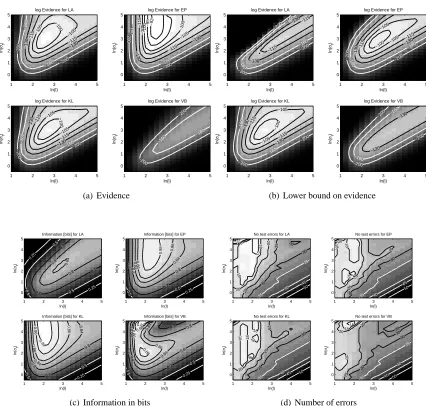
Accurate marginal likelihood estimates Z are a key to hyperparameter learning. In that respect,
Z can be seen as a high-level feature and as the “zeroth” posterior moment at the same time.
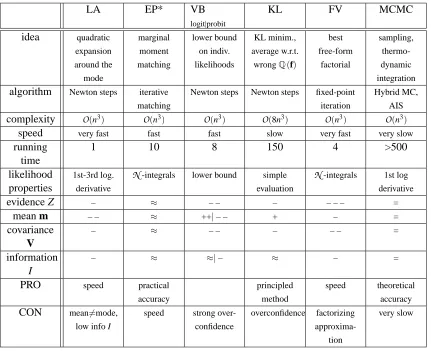
A summary of the whole section is provided in Table 1.
12.1 Data Sets
One main idea of the paper is to study the general behavior of approximate GP classification. Our results for the different approximation methods are not specific to a particular data set but apply to a wide range of application domains. This is reflected by the choice of our reference data sets, widely used in the machine learning literature. Due to limited space, we don’t include the full experiments on all data sets in this paper. However, we have verified that the same qualitative conclusions hold
for all the data sets considered. The full results are available via the web.7
Data set ntrain ntest d Brief description of problem domain
Breast 300 383 9 Breast cancer8
Crabs 100 100 6 Sex of Leptograpsus crabs9
Ionosphere 200 151 34 Classification of radar returns from the ionosphere10
Pima 350 418 8 Diabetes in Pima Indians11
Sonar 108 100 60 Sonar signals bounced by a metal or rock cylinder12
USPS 3 vs. 5 767 773 256 Binary sub-problem of the USPS handwritten digit data set13
12.2 Results
In the following, we report our experimental results covering posterior moments and predictive per-formance. Findings for all 5 methods are provided to make the methods as comparable as possible.
7. See links in Footnotes 5 and 6.
8. Data set athttp://mlearn.ics.uci.edu/databases/breast-cancer-wisconsin/.
9. Data set athttp://www.stats.ox.ac.uk/pub/PRNN/.
10. Data set athttp://mlearn.ics.uci.edu/databases/ionosphere/.
11. Data set athttp://mlearn.ics.uci.edu/databases/pima-indians-diabetes/.
12. Data set at ftp://ftp.ics.uci.edu/pub/machine-learning-databases/undocumented/
connectionist-bench/sonar/.
Training marginals
−200 0 200 −200
0 200
µ for LA
−200 0 200 −200
0 200
µ for EP
−200 0 200 −200
0 200
µ for VB
−200 0 200 −200
0 200
µ for KL
−200 0 200 −200
0 200
µ for FV
0 20 40 0
20 40
σ for LA
0 20 40 0
20 40
σ for EP
0 20 40 0
20 40
σ for VB
0 20 40 0
20 40
σ for KL
0 20 40 0
20 40
σ for FV
0 0.5 1 0
0.5 1
p for LA
0 0.5 1 0
0.5 1
p for EP
0 0.5 1 0
0.5 1
p for VB
0 0.5 1 0
0.5 1
p for KL
0 0.5 1 0
0.5 1
p for FV
Test marginals
−200 0 200 −200
0 200
µ for LA
−200 0 200 −200
0 200
µ for EP
−200 0 200 −200
0 200
µ for VB
−200 0 200 −200
0 200
µ for KL
−200 0 200 −200
0 200
µ for FV
0 20 40 0
20 40
σ for LA
0 20 40 0
20 40
σ for EP
0 20 40 0
20 40
σ for VB
0 20 40 0
20 40
σ for KL
0 20 40 0
20 40
σ for FV
0 0.5 1 0
0.5 1
p for LA
0 0.5 1 0
0.5 1
p for EP
0 0.5 1 0
0.5 1
p for VB
0 0.5 1 0
0.5 1
p for KL
0 0.5 1 0
0.5 1
p for FV
Figure 6: Marginals of USPS 3 vs. 5 for a highly non-Gaussian posterior: Each row consists of five plots showing MCMC ground truth on the x-axis and LA, EP, VB, KL and FV on the y-axis. Based on the logistic likelihood function and the squared exponential
covari-ance function with parameters ln`=2.25 and lnσf =4.25 we plot the marginal means,