Improving Syntax-Augmented Machine Translation by
Coarsening the Label Set
Greg Hanneman and Alon Lavie Language Technologies Institute
Carnegie Mellon University Pittsburgh, PA 15213 USA
{ghannema, alavie}@cs.cmu.edu
Abstract
We present a new variant of the Syntax-Augmented Machine Translation (SAMT) for-malism with a category-coarsening algorithm originally developed for tree-to-tree gram-mars. We induce bilingual labels into the SAMT grammar, use them for category coars-ening, then project back to monolingual la-beling as in standard SAMT. The result is a “collapsed” grammar with the same expres-sive power and format as the original, but many fewer nonterminal labels. We show that the smaller label set provides improved trans-lation scores by 1.14 BLEU on two Chinese– English test sets while reducing the occur-rence of sparsity and ambiguity problems common to large label sets.
1 Introduction
The formulation of statistical machine translation in terms of synchronous parsing has become both the-oretically and practically successful. In a parsing-based MT formalism, synchronous context-free grammar rules that match a source-language input can be hierarchically composed to produce a corre-sponding target-language output. SCFG translation grammars can be extracted automatically from data. While formally syntactic approaches with a single grammar nonterminal have often worked well (Chi-ang, 2007), the desire to exploit linguistic knowl-edge has motivated the use of translation grammars with richer, linguistically syntactic nonterminal in-ventories (Galley et al., 2004; Liu et al., 2006; Lavie et al., 2008; Liu et al., 2009).
Linguistically syntactic MT systems can derive their label sets, either monolingually or bilingually, from parallel corpora that have been annotated with source- and/or target-side parse trees provided by a statistical parser. The MT system may exactly adopt the parser’s label set or modify it in some way. Larger label sets are able to represent more precise, fine-grained categories. On the other hand, they also exacerbate a number of computational and modeling problems by increasing grammar size, derivational ambiguity, and data sparsity.
In this paper, we focus on the Syntax-Augmented MT formalism (Zollmann and Venugopal, 2006), a monolingually labeled version of Hiero that can cre-ate up to 4000 “extended” ccre-ategory labels based on pairs of parse nodes. We take a standard SAMT grammar with target-side labels and extend its label-ing to a billabel-ingual format (Zollmann, 2011). We then coarsen the bilingual labels following the “label col-lapsing” algorithm of Hanneman and Lavie (2011). This represents a novel extension of the tree-to-tree collapsing algorithm to the SAMT formalism. Af-ter removing the source-side labels, we obtain a new SAMT grammar with coarser target-side labels than the original.
Coarsened grammars provide improvement of up to 1.14 BLEU points over the baseline SAMT results on two Chinese–English test sets; they also outper-form a Hiero baseline by up to 0.60 BLEU on one of the sets. Aside from improved translation quality, in analysis we find significant reductions in deriva-tional ambiguity and rule sparsity, two problems that make large nonterminal sets difficult to work with.
Section 2 provides a survey of large syntax-based
MT label sets, their associated problems of deriva-tional ambiguity and rule sparsity, and previous at-tempts at addressing those problems. The section also summarizes the tree-to-tree label collapsing al-gorithm and the process of SAMT rule extraction. We then describe our method of label collapsing in SAMT grammars in Section 3. Experimental results are presented in Section 4 and analyzed in Section 5. Finally, Section 6 offers some conclusions and avenues for future work.
2 Background
2.1 Working with Large Label Sets
Aside from the SAMT method of grammar extrac-tion, which we treat more fully in Section 2.3, sev-eral other lines of work have explored increasing the nonterminal set for syntax-based MT. Huang and Knight (2006), for example, augmented the standard Penn Treebank labels for English by adding lexi-calization to certain types of nodes. Chiang (2010) and Zollmann (2011) worked with a bilingual exten-sion of SAMT that used its notion of “extended cat-egories” on both the source and target sides. Taking standard monolingual SAMT as a baseline, Baker et al. (2012) developed a tagger to augment syntactic labels with some semantically derived information. Ambati et al. (2009) extracted tree-to-tree rules with similar extensions for sibling nodes, resulting again in a large number of labels.
Extended categories allow for the extraction of a larger number of rules, increasing coverage and translation performance over systems that are lim-ited to exact constituent matches only. However, the gains in coverage come with a corresponding increase in computational and modeling complexity due to the larger label set involved.
Derivational ambiguity — the condition of hav-ing multiple derivations for the same output strhav-ing — is a particular problem for parsing-based MT sys-tems. The same phrase pair may be represented with a large number of different syntactic labels. Fur-ther, new hierarchical rules are created by abstract-ing smaller phrase pairs out of larger ones; each of these substitutions must also be marked by a label of some kind. Keeping variantly labeled copies of the same rules fragments probabilities during gram-mar scoring and creates redundant hypotheses in the
decoder at run time.
A complementary problem — when a desired rule application is impossible because its labels do not match — has been variously identified as “data spar-sity,” the “matching constraint,” and “rule sparsity” in the grammar. It arises from the definition of SCFG rule application: in order to compose two rules, the left-hand-side label of the smaller rule must match a right-hand-side label in the larger rule it is being plugged in to. With large label sets, it becomes less likely that two arbitrarily chosen rules can compose, making the grammar less flexible for representing new sentences.
Previous research has attempted to address both of these problems in different ways. Preference grammars (Venugopal et al., 2009) are a technique for reducing derivational ambiguity by summing scores over labeled variants of the same deriva-tion during decoding. Chiang (2010) addressed rule sparsity by introducing a soft matching constraint: the decoder may pay a learned label-pair-specific penalty for substituting a rule headed by one label into a substitution slot marked for another. Combin-ing properties of both of the above methods, Huang et al. (2010) modeled monolingual labels as distribu-tions over latent syntactic categories and calculated similarity scores between them for rule composition.
2.2 Label Collapsing in Tree-to-Tree Rules
Aiming to reduce both derivational ambiguity and rule sparsity, we previously presented a “label col-lapsing” algorithm for systems in which bilingual labels are used (Hanneman and Lavie, 2011). It coarsens the overall label set by clustering monolin-gual labels based on which labels they appear joined with in the other language.
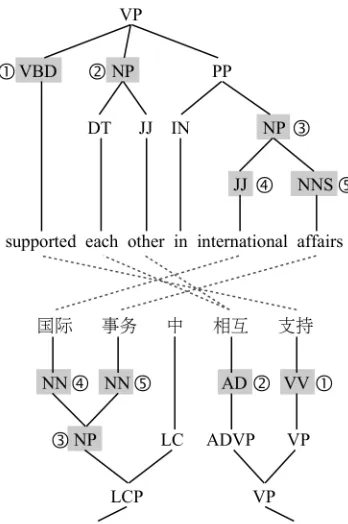
Figure 1: Sample extraction of bilingual nonterminals for label collapsing. Labels extracted from this tree pair in-clude VBD::VV and NP::AD.
such as VBD::VV and NP::AD, can be assembled by matching co-numbered nodes.
From the counts of the extracted rules, it is thus straightforward to compute for all values of s and tthe observed P(s|t)andP(t|s), the probability of one half of a joint nonterminal label appearing in the grammar given the other half. In the figure, for example, P(JJ|NN) = 0.5. The conditional probabilities accumulated over the whole grammar give rise to a simpleL1distance metric over any pair
of monolingual labels:
d(s1, s2) = X
t∈T
|P(t|s1)−P(t|s2)| (1)
d(t1, t2) = X
s∈S
|P(s|t1)−P(s|t2)| (2)
An agglomerative clustering algorithm then com-bines labels in a series of greedy iterations. At each step, the algorithm finds the pair of labels that is cur-rently the closest together according to the distance metrics of Equations (1) and (2), combines those two labels into a new one, and updates the set ofP(s|t)
andP(t|s)values appropriately. The choice of la-bel pair to collapse in each iteration can be expressed formally as
arg min
(si,sj)∈S2,(tk,t`)∈T2
{d(si, sj), d(tk, t`)} (3)
That is, either a source label pair or a target label pair may be chosen by the algorithm in each iteration.
2.3 SAMT Rule Extraction
SAMT grammars pose a challenge to the label col-lapsing algorithm described above because their la-bel sets are usually monolingual. The classic SAMT formulation (Zollmann and Venugopal, 2006) pro-duces a grammar labeled on the target side only. Nonterminal instances that exactly match a target-language syntactic constituent in a parallel sentence are given labels of the form t. Labels of the form t1+t2are assigned to nonterminals that span exactly
two contiguous parse nodes. Categorial grammar la-bels such ast1/t2 andt1\t2 are given to
nontermi-nals that span an incompletet1 constituent missing
at2 node to its right or left, respectively. Any
non-terminal that cannot be labeled by one of the above three schemes is assigned the default label X.
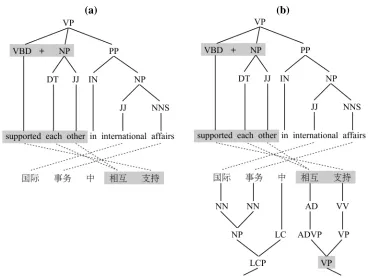
Figure 2(a) shows the extraction of a VP-level SAMT grammar rule from part of a parallel sen-tence. At the word level, the smaller English phrase
supported each other(and its Chinese equivalent) is being abstracted as a nonterminal within the larger phrasesupported each other in international affairs. The larger phrase corresponds to a parsed VP node on the target side; this will become the label of the extracted rule’s left-hand side. Since the ab-stracted sub-phrase does not correspond to a single constituent, the SAMT labeling conventions assign it the label VBD+NP. We can thus write the ex-tracted rule as:
(4)
While the SAMT label formats can be trivially converted into joint labels X::t, X::t1+t2, X::t1/t2,
X::t1\t2, and X::X, they cannot be usefully fed into
(a) (b)
Figure 2: Sample extraction of an SAMT grammar rule: (a) with monolingual syntax and (b) with bilingual syntax.
bilingual SAMT extension used by Chiang (2010) and Zollmann (2011). Both a source- and a target-side parse tree are used to extract rules from a par-allel sentence; two SAMT-style labels are worked out independently on each side for each nonterminal instance, then packed into a joint label. It is there-fore possible for a nonterminal instance to be labeled s::t,s1\s2::t,s1+s2::t1/t2, or various other
combi-nations depending on what parse nodes the nonter-minal spans in each tree.
Such a bilingually labeled rule is extracted in Fig-ure 2(b). The target-side labels from FigFig-ure 2(a) are now paired with source-side labels extracted from an added Chinese parse tree. In this case, the abstracted sub-phrase supported each other is given the joint label VP::VBD+NP, while the rule’s left-hand side becomes LCP+VP::VP.
We implement bilingual SAMT grammar extrac-tion by modifying Thrax (Weese et al., 2011), an open-source, Hadoop-based framework for extract-ing standard SAMT grammars. By default, Thrax can produce grammars labeled either on the source or target side, but not both. It also outputs rules that are already scored according to a user-specified
set of translation model features, meaning that the raw rule counts needed to compute the label condi-tional probabilitiesP(s|t) and P(t|s) are not di-rectly available. We implement a new subclass of grammar extractor with logic for independently la-beling both sides of an SAMT rule in order to get the necessary bilingual labels; an adaptation to the exist-ing Thrax “rarity” feature provides the rule counts.
3 Label Collapsing in SAMT Rules
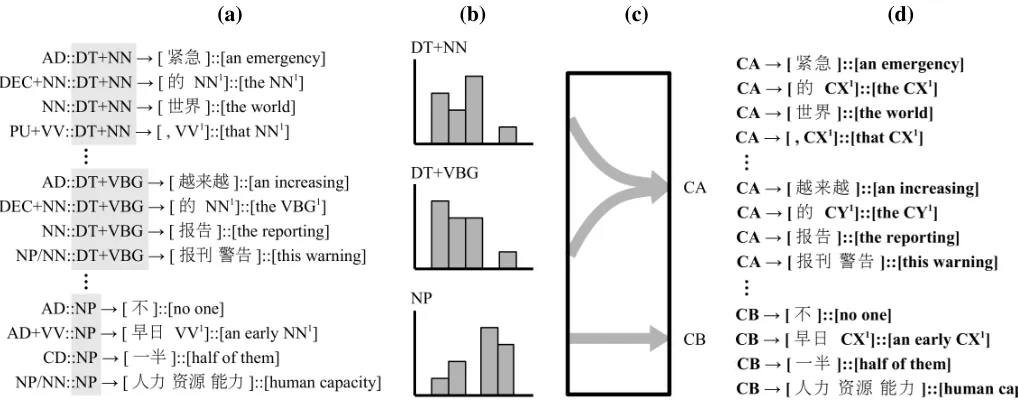
Our method of producing label-collapsed SAMT grammars is shown graphically in Figure 3.
We first obtain an SAMT grammar with bilingual labels, together with the frequency count for each rule, using the modified version of Thrax described in Section 2.3. The rules can be grouped according to the target-side label of their left-hand sides (Fig-ure 3(a)).
(a) (b) (c) (d)
Figure 3: Stages of preparing label-collapsed rules for SAMT grammars. (a) SAMT rules with bilingual nonterminals are extracted and collected based on their target left-hand sides. (b) ProbabiliitesP(t|s)andP(s|s)are computed. (c) Nonterminals are clustered according to the label collapsing algorithm. (d) Source sides of nonterminals are removed to create a standard SAMT grammar.
side, the source-given-target labeling probability is:
P(si|tj) =
#(si::tj)
P
t∈T #(si::t)
(5)
The computation for target given source is analo-gous. Each monolingual label can thus be repre-sented as a distribution over the labels it is aligned to in the opposite language (Figure 3(b)).
Such distributions over labels are the input to the label-collapsing algorithm, as described in Section 2.2. As shown in Figure 3(c), the algorithm results in the original target-side labels being combined into different groups, denoted in this case as new labels CA and CB. We run label collapsing for varying numbers of iterations to produce varying degrees of coarsened label sets.
Given a mapping from original target-side labels to collapsed groups, all nonterminals in the original SAMT grammar are overwritten accordingly. The source-side labels are dropped at this point: we use them only for the purpose of label collapsing, but not in assembling or scoring the final grammar. The re-sulting monolingual SAMT-style grammar with col-lapsed labels (Figure 3(d)) can now be scored and used for decoding in the usual way.
For constructing a baseline SAMT grammar with-out label collapsing, we merely extract a bilingual
grammar as in the first step of Figure 3, immediately remove the source-side labels from it, and proceed to grammar scoring.
All grammars are scored according to a set of eight features. For an SCFG rule with left-hand-side label t, source right-hand side f, and target right-hand sidee, they are:
• Standard maximum-likelihood phrasal transla-tion probabilitiesP(f|e)andP(e|f)
• Maximum-likelihood labeling probability P(t|f, e)
• Lexical translation probabilitiesPlex(f|e)and Plex(e|f), as calculated by Thrax
• Rarity score exp(
1
c)−1
exp(1)−1 for a rule with extracted
countc
• Binary indicator features that mark phrase pair (as opposed to hierarchical) rules and glue rules
System Labels Rules Per Sent.
SAMT 4181 69,401,006 48,444 Collapse 1 913 64,596,618 35,004 Collapse 2 131 60,526,479 24,510 Collapse 3 72 58,483,310 20,445
[image:6.612.78.296.53.139.2]Hiero 1 36,538,657 7,738
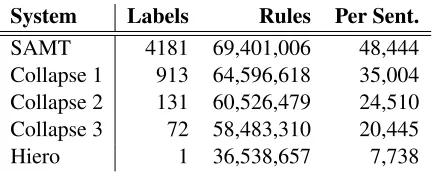
Table 1: Grammar statistics for different degrees of label collapsing: number of target-side labels, unique rules in the whole grammar, and average number of pruned rules after filtering to individual sentences.
size. One pruning pass keeps only the 80 most fre-quently observed target right-hand sides for each source right-hand side. A second pass globally re-moves hierarchical rules that were extracted fewer than six times in the training data.
4 Experiments
We conduct experiments on Chinese-to-English MT, using systems trained from the FBIS corpus of ap-proximately 302,000 parallel sentence pairs. We parse both sides of the training data with the Berke-ley parsers (Petrov and Klein, 2007) for Chinese and English. The English side is lowercased after parsing; the Chinese side is segmented beforehand. Unidirectional word alignments are obtained with GIZA++ (Och and Ney, 2003) and symmetrized, re-sulting in a parallel parsed corpus with Viterbi word alignments for each sentence pair. Our modified ver-sion of Thrax takes the parsed and aligned corpus as input and returns a list of rules, which can then be label-collapsed and scored as previously described.
In Thrax, we retain most of the default settings for Hiero- and SAMT-style grammars as specified in the extractor’s configuration file. Inheriting from Hiero, we require the right-hand side of all rules to con-tain at least one pair of aligned terminals, no more than two nonterminals, and no more than five termi-nals and nonterminal elements combined. Nonter-minals are not allowed to be adjacent on the source side, and they may not contain unaligned boundary words. Rules themselves are not extracted from any span in the training data longer than 10 tokens.
Our initial bilingual SAMT grammar uses 2699 unique source-side labels and 4181 unique target-side labels, leading to the appearance of 29,088 joint
bilingual labels in the rule set. We provide the joint labels (along with their counts) to the label collaps-ing algorithm, while we strip out the source-side labels to create the baseline SAMT grammar with 4181 unique target-side labels. Table 1 summarizes how the number of target labels, unique extracted rules, and the average number of pruned rules avail-able per sentence change as the initial grammar is label-collapsed to three progressively coarser de-grees. Once the collapsing process has occurred ex-haustively, the original SAMT grammar becomes a Hiero-format grammar with a single nonterminal.
Each of the five grammars in Table 1 is used to build an MT system. All systems are tuned and de-coded with cdec (Dyer et al., 2010), an open-source decoder for SCFG-based MT with arbitrary rule for-mats and nonterminal labels. We tune the systems on the 1664-sentence NIST Open MT 2006 data set, optimizing towards the BLEU metric. Our test sets are the NIST 2003 data set of 919 sentences and the NIST 2008 data set of 1357 sentences. The tun-ing set and both test sets all have four English ref-erences.
We evaluate systems on BLEU (Papineni et al., 2002), METEOR (Denkowski and Lavie, 2011), and TER (Snover et al., 2006), as calculated in all three cases by MultEval version 0.5.0.1 These scores for the MT ’03 test set are shown in Table 2, and those for the MT ’08 test set in Table 3, combined by Mult-Eval over three optimization runs on the tuning set.
MultEval also implements statistical significance testing between systems based on multiple optimizer runs and approximate randomization. This process (Clark et al., 2011) randomly swaps outputs between systems and estimates the probability that the ob-served score difference arose by chance. We report these results in the tables as well for three MERT runs and ap-value of 0.05. Systems that were judged statistically different from the SAMT baseline have triangles in the appropriate “Sig. SAMT?” columns; systems judged different from the Hiero baseline have triangles under the “Sig. Hiero?” columns. An up-triangle (N) indicates that the system was better, while a down-triangle (O) means that the baseline was better.
Metric Scores Sig. SAMT? Sig. Hiero?
System BLEU MET TER B M T B M T
SAMT 31.18 30.64 61.02 O O O
Collapse 1 31.42 31.31 60.95 N O O
[image:7.612.154.460.79.177.2]Collapse 2 31.90 31.73 60.98 N N O N O Collapse 3 32.32 31.75 60.54 N N N N O Hiero 32.30 31.42 60.10 N N N
Table 2: MT ’03 test set results. The first section gives automatic metric scores; the remaining sections indicate whether each system is statistically significantly better (N) or worse (O) than the SAMT and Hiero baselines.
Metric Scores Sig. SAMT? Sig. Hiero?
System BLEU MET TER B M T B M T
SAMT 22.10 24.94 63.78 O O O
[image:7.612.151.459.270.369.2]Collapse 1 23.01 26.03 63.35 N N N N Collapse 2 23.53 26.50 63.29 N N N N N Collapse 3 23.61 26.37 63.07 N N N N N N Hiero 23.01 25.72 63.53 N N N
Table 3: MT ’08 test set results. The first section gives automatic metric scores; the remaining sections indicate whether each system is statistically significantly better (N) or worse (O) than the SAMT and Hiero baselines.
[image:7.612.107.504.453.639.2]5 Analysis
Tables 2 and 3 show that the coarsened grammars significantly improve translation performance over the SAMT baseline. This is especially true for the “Collapse 3” setting of 72 labels, which scores 1.14 BLEU higher on MT ’03 and 1.51 BLEU higher on MT ’08 than the uncollapsed system.
On the easier MT ’03 set, label-collapsed systems do not generally outperform Hiero, although Col-lapse 3 achieves a statistical tie according to BLEU (+0.02) and a statistical improvement over Hiero ac-cording to METEOR (+0.33). MT ’08 appears as a significantly harder test set: metric scores for all systems are drastically lower, and we find approxi-mately 7% to 8% fewer phrase pair matches per sen-tence. In this case the label-collapsed systems per-form better, with all three of them achieving statisti-cal significance over Hiero in at least one metric and statistical ties in the other. The coarsened systems’ comparatively better performance on the harder test set suggests that the linguistic information encoded in multiple-nonterminal grammars helps the systems more accurately parse new types of input.
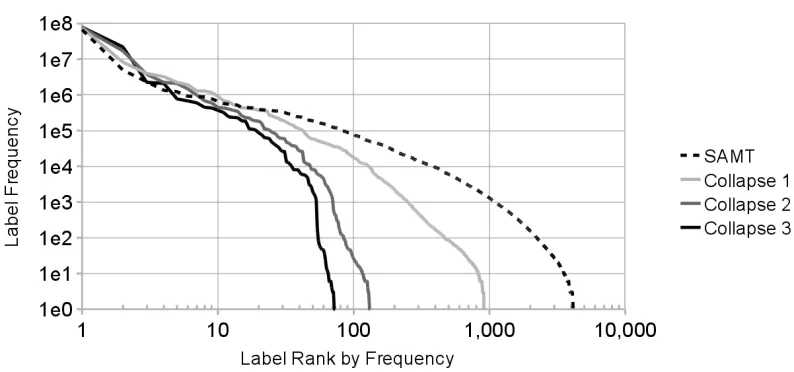
Table 1 already showed at a global scale the strong effect of label collapsing on reducing derivational ambiguity, as labeled variants of the same basic structural rule were progressively combined. Since category coarsening is purely a relabeling operation, any reordering pattern implemented in the original SAMT grammar still exists in the collapsed ver-sions; therefore, any reduction in the size of the grammar is a reduction in variant labelings. Figure 4 shows this process in more detail for the baseline SAMT grammar and the three collapsed grammars. For each grammar, labels are arranged in decreas-ing order of extracted frequency, and the frequency count of each label is plotted. The long tail of rare categories in the SAMT grammar (1950 labels seen fewer than 100 times each) is combined into a pro-gressively sharper distribution at each step. Not only are there fewer rare labels, but these hard-to-model categories consume a proportionally smaller fraction of the total label set: from 47% in the baseline gram-mar down to 26% in Collapse 3.
We find that label collapsing disproportionately affects frequently extracted and hierarchical rules over rarer rules and phrase pairs. The 15.7%
re-duction in total grammar size between the SAMT baseline and the Collapse 3 system affects 18.0% of the hierarchical rules, but only 1.6% of the phrase pairs. If rules are counted separately each time they match another source sentence, the average reduc-tion in size of a sentence-filtered grammar is 57.8%. Intuitively, hierarchical rules are more affected by label collapsing because phrase pairs do not have many variant left-hand-side labels to begin with, while the same hierarchical rule pattern may be in-stantiated in the grammar by a large number of vari-ant labelings. We can see this situation in more de-tail by counting variants of a particular set of rules. Labeled forms of the Hiero-style rule
X →[X1 X2] :: [theX2of X1] (6)
are among the most frequently used rules in all five of our systems. The way they are treated by label collapsing thus has a strong impact on the results of runtime decoding.
In the SAMT baseline, Rule (6) appears in the grammar with 221 different labels in the X1 nonter-minal slot, 53 labels for the X2slot, and 90 choices of left-hand side — a total of 1330 different label-ings all together. More than three-fourths of these variants were extracted three times or fewer from the training data; even if they can be used in a test sen-tence, statistical features for such low-count rules are poorly estimated. During label collapsing, the number of labeled variations of Rule (6) drops from 1330 to 325, to 96, and finally to 63 in the Collapse 3 grammar. There, the pattern is instantiated with 14 possible X1labels, five X2labels, and three different left-hand sides.
MT 2003 MT 2008
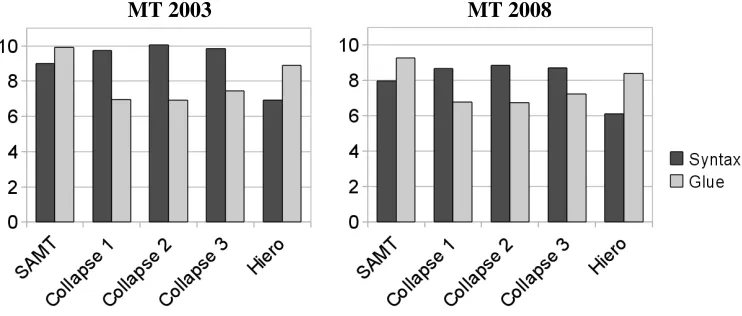
Figure 5: Average number of hierarchical rules (both syntactic and glue rules) applied per sentence on each test set.
glue rule columns, we note that label collapsing also promotes a shift away from generic glue rules, pos-sibly via the creation of more permissive — but still meaningfully labeled — syntactic rules.
6 Conclusion
We demonstrated a viable technique for reducing the label set size in SAMT grammars by temporarily in-ducing bilingual syntax and using it in an existing tree-to-tree category coarsening algorithm. In col-lapsing SAMT category labels, we were able to sig-nificantly improve translation quality while using a grammar less than half the size of the original. We believe it is also more robust to test-set or domain variation than a single-nonterminal Hiero grammar. Collapsed grammars confer practical benefits during both model estimation and runtime decoding. We showed that, in particular, they suffer less from rule sparsity and derivational ambiguity problems that are common to larger label sets.
We can highlight two areas for potential improve-ments in future work. In our current implementation of label collapsing, we indiscriminately allow either source labels or target labels to be collapsed at each iteration of the algorithm (see Equation 3). This is an intuitively sensible setting when collapsing bilin-gual labels, but it is perhaps less obviously so for a monolingually labeled system such as SAMT. An al-ternative would be to collapse target-side labels only, leaving the source-side labels alone since they do not appear in the final grammar anyway. In this case, the target labels would be represented and clustered as
distributions over a static set of latent categories. A larger area of future concern is the stopping point of the collapsing algorithm. In our previ-ous work (Hanneman and Lavie, 2011), we manu-ally identified iterations in our run of the algorithm where the L1 distance between the most recently
collapsed label pair was markedly lower than the L1 difference of the pair in the previous iteration.
Such an approach is more feasible in our previous runs of 120 iterations than in ours here of nearly 2100, where it is not likely that three manually cho-sen stopping points reprecho-sent the optimal collapsing results. In future work, we plan to work towards the development of an automatic stopping criterion, a more principled test for whether each successive it-eration of label collapsing provides some useful ben-efit to the underlying grammar.
Acknowledgments
This research work was supported in part by com-puting resources provided by the NSF-sponsored XSEDE program under grant TG-CCR110017. Thanks to Chris Dyer for providing the word-aligned and preprocessed corpus we used in our ex-periments. We also thank the anonymous reviewers for helpful comments and suggestions for analysis.
References
InProceedings of the 12th Machine Translation Sum-mit, pages 190–197, Ottawa, Canada, August.
Kathryn Baker, Michael Bloodgood, Bonnie J. Dorr, Chris Callison-Burch, Nathaniel W. Filardo, Christine Piatko, Lori Levin, and Scott Miller. 2012. Use of modality and negation in semantically-informed syn-tactic MT. Computational Linguistics, 38(2):411– 438.
David Chiang. 2007. Hierarchical phrase-based transla-tion. Computational Linguistics, 33(2):201–228. David Chiang. 2010. Learning to translate with source
and target syntax. InProceedings of the 48th Annual Meeting of the Association for Computational Linguis-tics, pages 1443–1452, Uppsala, Sweden, July. Jonathan H. Clark, Chris Dyer, Alon Lavie, and Noah A.
Smith. 2011. Better hypothesis testing for statistical machine translation: Crontrolling for optimizer insta-bility. InProceedings of the 49th Annual Meeting of the Association for Computational Linguistics: Short Papers, pages 176–181, Portland, OR, June.
Michael Denkowski and Alon Lavie. 2011. Meteor 1.3: Automatic metric for reliable optimization and evalu-ation of machine translevalu-ation systems. InProceedings of the Sixth Workshop on Statistical Machine Transla-tion, pages 85–91, Edinburgh, United Kingdom, July. Chris Dyer, Adam Lopez, Juri Ganitkevitch, Johnathan
Weese, Ferhan Ture, Phil Blunsom, Hendra Setiawan, Vladimir Eidelman, and Philip Resnik. 2010. cdec: A decoder, alignment, and learning framework for finite-state and context-free translation models. In Proceed-ings of the ACL 2010 System Demonstrations, pages 7–12, Uppsala, Sweden, July.
Michel Galley, Mark Hopkins, Kevin Knight, and Daniel Marcu. 2004. What’s in a translation rule? In
HLT-NAACL 2004: Main Proceedings, pages 273– 280, Boston, MA, May.
Greg Hanneman and Alon Lavie. 2011. Automatic cate-gory label coarsening for syntax-based machine trans-lation. InProceedings of SSST-5: Fifth Workshop on Syntax, Semantics, and Structure in Statistical Trans-lation, pages 98–106, Portland, OR, June.
Bryant Huang and Kevin Knight. 2006. Relabeling syn-tax trees to improve synsyn-tax-based machine translation quality. InProceedings of the Human Language Tech-nology Conference of the North American Chapter of the ACL, pages 240–247, New York, NY, June. Zhongqiang Huang, Martin Cmejrek, and Bowen Zhou.
2010. Soft syntactic constraints for hierarchical phrase-based translation using latent syntactic distri-butions. In Proceedings of the 2010 Conference on Empirical Methods in Natural Language Processing, pages 138–147, Cambridge, MA, October.
Alon Lavie, Alok Parlikar, and Vamshi Ambati. 2008. Syntax-driven learning of sub-sentential translation
equivalents and translation rules from parsed parallel corpora. In Proceedings of the Second ACL Work-shop on Syntax and Structure in Statistical Transla-tion, pages 87–95, Columbus, OH, June.
Yang Liu, Qun Liu, and Shouxun Lin. 2006. Tree-to-string alignment template for statistical machine trans-lation. InProceedings of the 21st International Con-ference on Computational Linguistics and 44th Annual Meeting of the ACL, pages 609–616, Sydney, Aus-tralia, July.
Yang Liu, Yajuan L¨u, and Qun Liu. 2009. Improving tree-to-tree translation with packed forests. In Pro-ceedings of the 47th Annual Meeting of the ACL and the Fourth IJCNLP of the AFNLP, pages 558–566, Suntec, Singapore, August.
Franz Josef Och and Hermann Ney. 2003. A system-atic comparison of various statistical alignment mod-els. Computational Linguistics, 29(1):19–51.
Kishore Papineni, Salim Roukos, Todd Ward, and Wei-Jing Zhu. 2002. BLEU: A method for automatic eva-lution of machine translation. InProceedings of the 40th Annual Meeting of the Association for Computa-tional Linguistics, pages 311–318, Philadelphia, PA, July.
Slav Petrov and Dan Klein. 2007. Improved inference for unlexicalized parsing. InProceedings of NAACL HLT 2007, pages 404–411, Rochester, NY, April. Matthew Snover, Bonnie Dorr, Richard Schwartz, Linnea
Micciulla, and John Makhoul. 2006. A study of trans-lation edit rate with targeted human annotation. In
Proceedings of the Seventh Conference of the Associ-ation for Machine TranslAssoci-ation in the Americas, pages 223–231, Cambridge, MA, August.
Ashish Venugopal, Andreas Zollmann, Noah A. Smith, and Stephan Vogel. 2009. Preference grammars: Soft-ening syntactic constraints to improve statistical ma-chine translation. InHuman Language Technologies: The 2009 Annual Conference of the North American Chapter of the ACL, pages 236–244, Boulder, CO, June.
Jonathan Weese, Juri Ganitkevitch, Chris Callison-Burch, Matt Post, and Adam Lopez. 2011. Joshua 3.0: Syntax-based machine translation with the Thrax grammar extractor. InProceedings of the Sixth Work-shop on Statistical Machine Translation, pages 478– 484, Edinburgh, United Kingdom, July.
Andreas Zollmann and Ashish Venugopal. 2006. Syntax augmented machine translation via chart parsing. In
Proceedings of the Workshop on Statistical Machine Translation, pages 138–141, New York, NY, June. Andreas Zollmann. 2011. Learning