Enhancing Security Levels at ISP Server Using Multiple Security
Techniques with Proposed Crypo Application
Suraj U. Rasal
1,*, Varsha S. Rasal
2, Shraddha T. Shelar
31 Department of Computer Engineering, Bharati Vidyapeeth Deemed to be University College of Engineering, Pune, India 2 Department of Computer Engineering, Sinhgad Academy of Engineering, Pune, India
3Department of Information technology, D Y Patil College of Engineering Akurdi, Pune, India
Received 18 April 2017; received in revised form 27 July 2017; accepted 08 January 2018
Abstract
The internet is widely used in computing. Security is an important aspect when the quality of service is evaluated and current security possesses high level encryption techniques. However, due to high data saturation and complexity, it is not enough for, only to rely on the common security techniques. In this paper, proposed application named Crypo is installed at both ends, including user and Internet Service Provider (ISP). User can connect to the public internet through providing credentials. Both ends work with same cryptographic techniques and logics. Crypo includes the existing security techniques with proposed logics. Attribute Based Encryption (ABE) is applied to user credentials. Cipher policy applies to data exchange between user and Internet Service Provider (ISP) to form a combined cipher data. Proposed logic is further applied to the binary formatted cipher data. According to proposed logic, the final encrypted binary formatted data are further applied with Advanced Encryption Standard (AES) to deliver it to the ISP. Decryption is done by the same logic applied to the sender side or vice versa. When data is retrieved by ISP from its end user, it is decrypted by the ISP after which is delivered to the public network in normal format. Four level security keeps the data and user credentials confidential. Intruders or hackers can’t reach to the
end user without decrypting the secured data at ISP. While delivering encrypted data, applied logic name is also delivered so that end users can decrypt data using the same logic. By using proposed application Crypo, a secure connection is established between the end user and the ISP. An outsider cannot cause threat to the ISP’s users. Proposed multilevel cryptographic approach enhances the security.
Keywords: attribute based encryption (ABE), advanced encryption standard (AES), american standard code for information interchange (ASCII), cipher policy, crypo - proposed application name, internet service provider (ISP).
1.
Introduction
The existing security techniques are applied to proposed ‘Crypo’ system and it also played a vital role in internet security.
Security techniques are used and implemented in different aspects and approaches. Logical part varies from the usage of security. Security techniques are upgraded according to its importance in recent cryptographic trends.
The existing security techniques are developed by using multiple cryptographic techniques and trends. These cryptographic techniques are applied directly or with different cryptographic techniques, for example, a Cipher policy with Attribute Based Encryption, and a cipher policy with multiple authorities or decentralized approach. Multiple combinations of
*Corresponding author. E-mail address [email protected]
cryptographic techniques enhance the level of security. The quality of security can be maintained by reducing the efficiency and performance of multiple processes. The proposed approach is applied to some cryptographic techniques like cipher policy, Attribute Based Encryption (ABE) and Advanced Encryption Standard (AES) with proposed cryptographic logic. Security of internet service provider is an important factor that the customers rely on. Proposed logic is applied between end user and ISP network to enhance the security level.
2.
Existing Security Techniques in Computing
The existing security techniques are invented to overcome the sensitive data loss problems. Traditional and current cryptographic trends rely on the update of cryptographic techniques and innovations in existing security techniques. Computing is upgraded in every domain like Internet of Things, cloud computing, and so on. These trends need high level security because computing is widely used by the society in daily life. Proposed paper shows how security level can be enhanced by applying own logic with existing cryptographic techniques.
2.1. Ciphertext policy
Ciphertext policy is the traditional approach to encrypt the secretdata by applying secrete logic. On recent cryptographic trends, cipher text policy is updated and high leveled logics are applied [1]. Cipher policy is one of the best cryptographic policies; the data can’t be decrypted without understanding the cipher logic applied behind the encryption process. Cipher
policy is not limited to the type of Unicode values like characters, symbols and others.
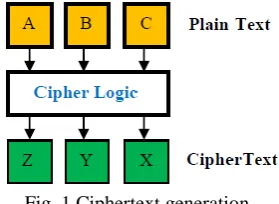
Fig. 1 Ciphertext generation
It can be applied to anything based on logic. For instance, if ‘A’ character is allocated with cipher value as ‘z’ or if set ‘A7B’ allocated to cipher value ‘$’ and so on [2]. As shown in Fig.1, the cipher logic block includes the logical part where
logic is set as, replace all alphabets with the reverse order of alphabets from A to Z. For A= Z, B=Y, C=X and so on. Cipher policy plays a vital role in the encryption of secrete or personal information exchange. Further cipher policy is combined with other cryptographic techniques like Attribute Based Encryption (ABE) and others.
2.2. Attribute based encryption
locality storage approach which doesn't require or use central authority. The database access structure is distributed among registered authorities with MAS. Therefore, even when any authority is damaged or attacked by an intruder, the database access structure won't be affected, and the important data is preserved. Important data is preserved. In the same approach, ABE is also applied to where the attributes are referred to access the data or values [5-6]. In current computing, efficiency is important to maintain the quality of service in information technology. Levels of encryption, decrease the efficiency problem due to high levels and complexity in algorithm solving. To overcome with the problem, Minimal Authorization Sets are used to decrease the cipher text which becomes linear with bilinear pairings in the decryption process [7]. All these ABE based on techniques are applied to the proposed approach with the additional logical approach.
2.3. Advanced encryption standard
Specific encryption is defined based on the cipher policy and a set of rules is applied to form Advanced Encryption Based standard (AES) data. A byte is the basic unit in AES, and each byte value represents a binary value. All American Standard
Code for Information Interchange (ASCII) character set is defined by some binary values. Element in ASCII set is considered as a character or a set of characteristics. For example, if 79 is the element, then the byte value is separate to ‘7’ and ‘9’ and its binary value is {00110111 00111001}. Bit pattern is defined by the type of applied level of the bits like 4bit, 8bit, 128bits,256bits and so on [8-9].
Fig.2 Element to byte conversion and combination [10]
Single value is referred with byte. Arrays of bytes are created to store the element values. Sub bytes are considered and allocated according to defined logic. New formed sub bytes array set is further applied to shifting rows and to generate the new array set table. While performing an action, elements of sub byte table are used. As shown in Fig. 2, bit values are selected according to the combined character value. While accessing bytes, decryption needs to be applied to get the required data [10].
2.4. Multiple authorities cipher policy ABE
In Cipher policy attribute based encryption, cipher policy with multi key sharing approach is applied to enhance the encryption level [11]. Cipher policy is applied to generate the encrypted data using security logic. Encrypted data are divided into multiple segments, and these segments are delivered to the multiple authorities. These authorities are unknown to other contributor authorities. Multiple authorities are registered in the security system. Without all participated authority’s key,
encrypted data cannot be decrypted. During the central authority, encryption process, trustworthy authorities are being selected randomly. In the Decentralized ABE scheme, attributes are randomly allocated to generate trusted authority keys. The main secret key is formed by using Trusted Authority keys. Central authority manages all cryptographic processes related to multiple authorities CP-ABE [12]. This system has a drawback as, failure to the central authority can down all systems. However, there's a drawback of the system, all systems may collapse due to the failure of the central authority.
2.5. Decentralized cipher policy ABE
invented to overcome the central authority failure. In this approach, if any, authority collapses, then randomly select another authority to do the job. Decryption is done with the help of all participated trusted authority keys [13]. As shown in Fig.3, A1,A2,A3,A4,…..,An are multiple authorities participated in decentralized environment and U1,U2,…,Un are respective users.
Fig. 3 Decentralized cipher policy attribute based encryption [14]
2.6. Decentralized cipher policy- attribute based encryption with a mediator
In DCP-ABE-M approach, the mediator is considering to participate in the encryption process. The Mediatoris allocated to the normal logic process, so as to manage the credential security and system access. After entering into DCP-ABE-M system, the mediator is randomly assigned to allocate authorities to complete the task. The assigned mediator in charge for the referee in the DCP-ABE-M system. System identified and understands to Mediator, rather than the actual user [14].
3.
Proposed System
Internet works with protocols, standards and technologies. The user directly or indirectly interacts with each other through the internet. Users depend on the service and product which were provided by the companies or organizations. All service providers and organizations try to maintain security. Quality of service depends on security, and the security depends on the levels and complexity of cryptographic algorithms. In previous proposed approaches, database access structure methods are applied with security techniques, including ABE with One Time Password (OTP) in various appliances, like internet banking [15]. In the proposed approach, new concept with existing cryptographic techniques is considered. Internet Service Provider (ISP) is the most important component in the internet access and usage. Algorithmic approaches and cryptographic techniques must be updated and be fine tuned to maintain the security. Further web browser and firewall of the user’s system plays vital role in the security aspects. Internet of Things (IoT) segregates almost all computing and multidisciplinary domains. Security
approaches and are applied to IoT access structure [16]. In the proposed approach, four level encryption is being applied to the web browser based application.
Fig.4 Proposed ‘Crypo’ application
Standard (AES) is considered in encryption and decryption process. Source code is loaded into a web browser, after the output is displayed and the required operations and actions are performed. Source code is considered as sensitive data to deliver. Proposed application named ‘Crypo’ whose logic based on ABE, Cipher policy and AES cryptographic techniques is been considered. ‘Crypo’ is installed at the two ends of the system. End users and ISP are the systems where ‘Crypo’ is installed , only by the system can the users access the public internet. As shown in Fig. 4, information is transferred through the ISP. Protocol conversion suite manages the internet standards of ‘Crypo’ between the users and the server.
For example, if the user wants to use the internet, they have to log in to ‘Crypo’ and only they can connect to ISP and the
public internet. Proposed cryptographic algorithms are applied to ‘Crypo’s logical and mathematical model to provide high level security.
3.1. Attribute Based Encryption in ‘Crypo’ application
User credentials are required to identify as a registereduser. While registering user towards ISP, attributes are randomly allocated. These attributes are referred further rather than referencing credentials directly. While traveling along the internet, the original message will be converted to encrypted format which can be decrypted by ‘Crypo’ only. Similar logics are applied for encryption and decryption.
Table1 ‘Crypo’ database table with ABE, Cipher & AES data Credentials Attributes
Stored
Message /
Data Cipher
AES
Key AES Data
surasal $AB_9X$ Hello there
X@!!*1
#Wq~+ surasal ¸Ž¼¹W¡-L8t)öˆuR›O¬• wÈ u♀@QNýq^X÷ÞÞ³‡¨äÏb• æ |jíP+
vrasal $DE_7Y$ Hello %$wwQ vrasal ¢œ 5úâ¼ ±ï½ ½ g
G&{• 3ãWh¢+¾ • ^\«Ð À (˜ pèSíc:© @tŸ Xþï• ê
sshelar $XX_1Z$ Hi *$ sshelar W*ô0&:ûXΪP'Ö?»ä:† (§~¸¯,{ïoYÀCQÉž Å ÌøÕ Ú (P+¾
: : : : : :
srasal $YX_97$ Hey %#@ srasal ÞÞ³£=?™ñ«´Q+¾ W—*ô0&:ûXΪP'Ö?»ä:† (§~¸¯,{. .
User credentials like user name, password and other details are stored according to Attribute Based Encryption (ABE). Table 1 includes credentials related to attributes allocation. While referring credentials, attributes are referred rather than actual values. This security level is applied to enhance the security level in database storage and access methods. Cipher policy with the proposed logical approach is further applied for data encryption.
3.2. Cipher Policy on ‘Crypo’ application
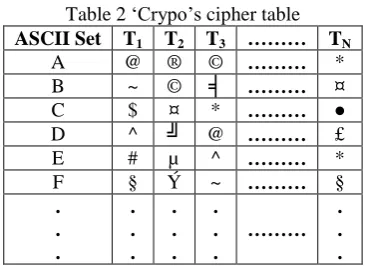
Table 2 ‘Crypo’s cipher table ASCII Set T1 T2 T3 ……… TN
A @ ® © ……… *
B ~ © ╡ ……… ¤
C $ ¤ * ……… ●
D ^ ╝ @ ……… £
E # µ ^ ……… *
F § Ý ~ ……… §
. . .
. . .
. . .
. . .
……… . . .
There is a cipher table in Crypo’s secured system, which all American Standard Code for Information Interchange
(ASCII) set values are allocated with special symbols. Randomly allocated symbols are cipher values. Table 2 includes all details of cipher values allocated. For more security approach, time constraint TX is been considered. Cipher values are
allocated according to TX, andonly. TX retrieves the value according to current time components, including hours, minute and
These components are read according to session functionality, for example, when a user is accessing the service. In Table 2, T1, T2, T3,….., TN are time constraints out of which single constraint is selected based on current time constraint components.
If T1 time constraint is selected, then cipher values from T1 column will be allocated to ASCII set. Like A will be replaced by
cipher value @, B by ~ , C by $ and so on. Binary value will be selected from Table 3.
Table3 ASCII to Cipher binary conversion ASCII
Set Binary Value
T1 Binary Value ………
A 01000001 @ 01000000 ………
B 01000010 ~ 01111110 ………
C 01000011 $ 00100100 ………
D 01000100 ^ 01011110 ………
E 01000101 # 00100011 ………
F 01000110 § 10100111 ………
. . .
. . .
. . .
. . .
………
3.3. Combined approach and binary value
Based on a time constraint, logic AL will be selected from Table 4; based on TX, AL is applied to the complete data CD.
Complete data are in the binary format. CD is binary formatted data of ABE and cipher values based data. All logics work and
behave in different manners, like A1 will generate different binary value than A2.
Table4 Logic (AL) selection with respect to time constraint (TX)
Time Constraint (TX) AL Logics set
T1 A1 A6 A8 A2 … AN
T2 A3 A2 A9 A7 … AN
T3 A7 A1 A2 A13 … AN
T4 AN A4 A3 A19 … AN
: : : : : : :
TN A2 AN A1 A24 … AN
Consider the example given in Table.4, User credentials is “surasal” and data DC is “Hello there”. Total data are
considered as DT with @ symbol so as to combine them.
TD = 19:08:21||24:04:2017
(1) TX = T5
DT = AD + @ + DC
DT = surasal@Hello there
Attributes are allocated as $AB_9X$ to the user credentials “surasal”. Attribute formed user credential data is AD. Time
constraint TX is selected based on current time and date. While accessing service through ‘Crypo’, the current time component
is 19:08:21 and date components is 24:04:2016. The total time of constraint data TD is, 19:08:21||24:04:2017. The time
constraint value T7 is selected based on time constraint data. Based on the selection, respective cipher values are allocated to
the ASCII values. DC is newly generated cipher data based on T7 from data “Hello there”. Total cipher data formed from
attributes and cipher policy is CD. Furthermore, CD is converted to binary format.
3.4. Proposed time based randomized selection function RZ
Randomized function RZis proposed and implemented to successfully select an element randomly from providing
elements set , but don't allow the user to input. In proposing research manuscript, the proposed randomized selection function
is applied to select AL and TX values randomly from their elements set. The following are the respective element sets with
TX = {T1, T2,T3, T4, … . ,TN} (2)
AL = {A1, A2, A3, A4,….., AN} (3)
TX 𝑹𝒁
→ TS (4)
AL 𝑹𝒁
→ AS (5)
Where TS and AS are time constraint and selected logic values, respectively. RZ is suitable to input the received AL from the
system or users. Array_rand ( ) function is used to select an element randomly from elements set or array set in PHP programming [17]. According to functional syntax, some input integer has to pass to the function. In proposing randomized function RZ, current time is considered with respect to time components as HOUR::MINUTE::SECOND. ‘SECOND’. Time
component SS is used as input required for array_rand ( ). If the current time is 07:58:14 then SS value will be 14. In this manner
input value for array_rand( ) is provided.
array_rand($array_name, $input); //syntax
$TD = date (“h:i:s”); // To select the current system time
$SS = date (“s”); // To select the second value only
Our array sets are AL and TX.
array_rand($TX, $SS ); //For array set TX selecting a value randomly
array_rand($AL, $SS ); //For array set AL selecting a value randomly
array_rand( ) will select TS and AS values randomly from TX and AL array sets respectively.
T5 and A14 are selected by applying array_rand( ) function.
AL 𝑹𝒁
→ A14 (6)
DT 𝑨𝑩𝑬+𝑪𝒊𝒑𝒉𝒆𝒓 𝒑𝒐𝒍𝒊𝒄𝒚→ CD (7)
CD = $AB_9X$@ X@!!*1#Wq~+ (8)
CD
𝑩𝒊𝒏𝒂𝒓𝒚 𝒗𝒂𝒍𝒖𝒆
→ 001001000100000101000010010111110011100101011000001001000100000000100000010
1100001000000001000010010000100101010001100010010001101010111011100010111111000101011 (9) 3.5. Proposed mathematical and logical approach
Table 5 Logical description
Logic Description Bits set
operations
A1
P1= Multiple of odd positioned bits in sequential order
P2= Remaining bits of P1 in sequential order
P=P1+P2
: : :
A14
P1= Multiple of 3 positioned bits in sequential order
P2= Remaining bits of P1 in sequential order
P=P1+P2
: : :
AN
P1= Multiples of 2 positioned bits in sequential order
P2= Remaining bits of P1 in sequential order
P=P2+P1
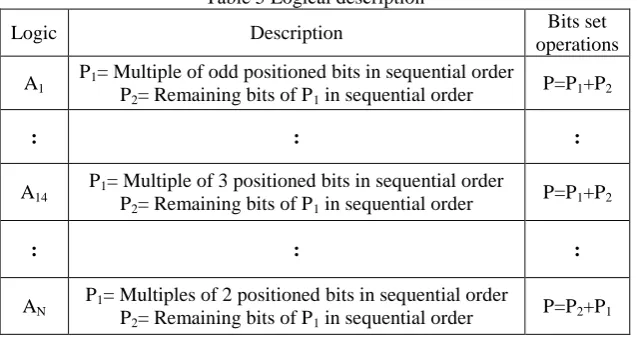
Based on TX, AL applies to the CD. Each time constraint (TX) contains the numbers of logics, like A1, A2, A3, A4,..., AN in
logics, setas A1, A4, A9,…., AN. In considered example, A9 is selected from T7 by applying RZ logic. According to A9,multiple
of 3 positioned bits in the sequential order are considered to be separated. All separated bits are gathered together as P1 in a
sequential order and the remaining bits are gathered together as P2 in a sequential order. Final encrypted bits set is considered
as P where P1 and P2 are added to form the final bits set. It will be considered as final encrypted user data. This final encrypted
data are further delivered by applying Advanced Encryption Standard (AES). Delivered encrypted data is EA.
Table6 Bits set generation and binary values
Bits set Binary value
CD
𝐵𝑖𝑛𝑎𝑟𝑦 𝑣𝑎𝑙𝑢𝑒 → T7 + A14
0010010001000001010000100101111100111001010110000010010001000000001000000101100001 000000001000010010000100101010001100010010001101010111011100010111 111000101011
P1 11000100010101101100000000000001100010011001110111001
P2
0000001000100001011111011010010000000010000010000111001000001000000001011000110000 0011100110110001111001101
P 1100010001010110110000000000000110001001100111011100100000010001000010111110110100 100000000100000100001110010000010000000010110001100000011100110110001111001101 A14 0100000100111001
ED
1100010001010110110000000000000110001001100111011100100000010001000010111110110100 1000000001000001000011100100000100000000101100011000000111001101100011110011010100 000100111001
EA
1011111010000001010111100101110010101011110100001100000000101000100110000111000011 1010000101001111101101011000110011101010101001010000000111010010011111010110001111 1110111011111001000011101010000110001000000010100010100111000011010111111010111000 1010111100101100011110111110111101101111010110011100000001000011010100011100100110 011110110001010001111111001100111110001101010111011010001010001010000 00101011
P = P1+P2 (10)
ED = {P, AL} (11)
ED = {P, A14} (12)
ASCII value of ED is,
ED = �V����� C�@,`sc�A14 (13)
ED ’s ASCII value is considered to apply AES with its key. In this approach, the key is considered as stored credentials. In
considered example, a credential is “surasal”. Hence “surasal” is the AES key to encrypt it again. For conversion, Electronic
Code Book (ECB) is considered. Table 6 shows the respective binary values.
EA =¸Ž¼¹W¡-L8t)öˆuR›O¬• wÈ u♀@QNýq^X÷ÞÞ³‡¨äÏbæ|jíP+ (14)
After applying AES, above ASCII text value is retrieved from an encrypted format of EA. Its binary value is finally delivered to
ISP. After retrieving the binary value, due to same logical approach towards both ends; ISP will automatically understand the
actual data behind the encrypted data. Logic will be upgraded timely due to the security reasons.
EA
𝑩𝒊𝒏𝒂𝒓𝒚 𝒗𝒂𝒍𝒖𝒆
→ (15)
1011111010000001010111100101110010101011110100001100000000101000100110000111000011101000010100111110 1101011000110011101010101001010000000111010010011111010110001111111011101111100100001110101000011000 1000000010100010100111000011010111111010111000101011110010110001111011111011110110111101011001110000 0001000011010100011100100110011110110
ED 𝑨𝑬𝑺
→ EA →ISP (16)
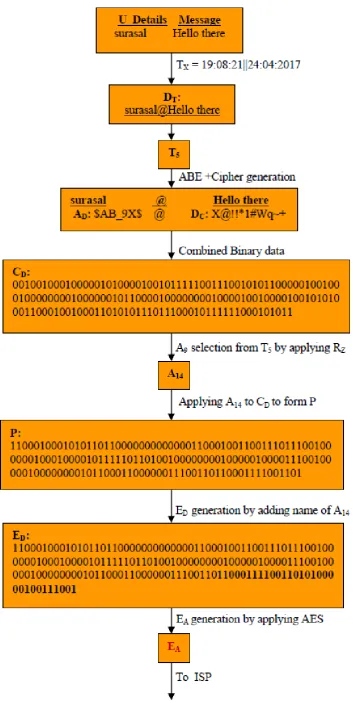
The same logic appliesto decrypt the data. Fig. 5 shows step by step approach to generate EA. While carrying encrypted data,
the applied logic AL is included in the delivered data. Unless the selected logic has been known, 'Crypo' can't decrypt it. While
selecting the logic, current time constraint components are selected.
3.6. Decryption in Crypos application
In this point decryption heading is given, but in actual way hash values are generated and be matched with the existing hash values, so as to confirm the applied logic. According to SHA standards, hash values can’t decrypt back to the original values. In considered example, generated hash value is used to check which logic (AS) and time constraints (TS) has been
selected. Based on a time constraint, respective hash value is generated and it is matched form crypo’s hash values table. At the other end, generated hash value is matched and respective logic is selected for generating the required decrypted data. Based on RZ, time constraints and logics are selected. These selected values are considered as single data SD. Selected logics are kept
inside round brackets, separated by ‘+’. On the whole (TS + AS) data, SHA-256 is applied to generate a hash value which is
considered as key SE [18].
SD = TS + AS (17)
TE and AE are hash values of TS and AS respectively which are generated using SHA-256.
TS 𝑺𝑯𝑨−𝟐𝟓𝟔→ (18)
AS
𝑺𝑯𝑨−𝟐𝟓𝟔 → AE
(19)
Hence final encrypted key will be delivered as SE.
SE = TE+surasal+AE (20)
Here, +surasal+ is separator used to separate two hash values of TS and AS. In executed example T5 and A14 are selected,
SD = T5 + A14 (21)
PHP Code to generate SHA-256 value:
<?php
$Te=hash('SHA256', 'T5');
$Ae=hash('SHA256', 'A14');
echo "<font color='blue' size='5'>Secrete key 'SE' is: </font>".$Te."<font color='red' size='3'>+surasal+</font>".$Ae."<br>";
?>
Output:
Secrete key 'SE'is:
020d01e5b92677a3996c6d0e9fde6322095a0b486b7fbee5252d5e4915317bf4+surasal+cc1e22142e7d545252f349a1d1dd841 00e4441043f7485de6eeeb2f9eaea9e14
T5
𝑺𝑯𝑨−𝟐𝟓𝟔
→ TE 020d01e5b92677a3996c6d0e9fde6322095a0b486b7fbee5252d5e4915317bf4
A14
𝑺𝑯𝑨−𝟐𝟓𝟔
SE=020d01e5b92677a3996c6d0e9fde6322095a0b486b7fbee5252d5e4915317bf4+surasal+
cc1e22142e7d545252f349a1d1dd84100e4441043f7485de6eeeb2f9eaea9e14
SE will be delivered after delivering encrypted data as a secret keyto understand which logic set is used from Table.4.
When SE is delivered, its two hash values TE and AE are separated by separator ‘+surasal+’. Those separated hash values are
been searched in the hash table of the end device.By matching their values, respective values of TS and AS are selected and
logics are applied to decrypt the data. Once respective logics are retrieved, ‘Crypo’ decrypts the encrypted data, using TS and
AS logics. In Table.7, received SHA-256 values are checked to retrieve the applied TS and AS values.
Table7 Hash values table
TS SHA-256 AS SHA-256
T1
1f93603db53bfad5c92390f735d0cbb8617b 4ab8214ae91c5664a3d1e9b009c8 A1
16a36e86f6fed5d465ff332511a0ce1a863b55 d364b25a7cdaa25db19abf9648 . . . . . . . . . . . . T5 020d01e5b92677a3996c6d0e9fde6322095a 0b486b7fbee5252d5e4915317bf4 A5
ea644b359f0b0abde72ab7dbdc03c7d630537 bdd0fd7ca1bbb99d41e7f446eea . . . . . . . . . . . . T14 7fe51a276aa44f3983c157d4a98f6b5aa257d ad74b5ab8f9253fb0798d19217e A14
cc1e22142e7d545252f349a1d1dd84100e444 1043f7485de6eeeb2f9eaea9e14 . . . . . . . . . . . . TN . .
. AN
. . .
When TS and AS values are selected, the decryption part can be done based on applied logic to encrypt it in reverse order.
In a similar way, other logics are applied when it gets selected, based on a time constraint and randomized selection algorithm. In the above examples, separator ‘+surasal+’ separates the T5 and A14 which will be matched with hash values table. After
matching hash values, TS and AS value has been applied will be confirmed. For decryption, same values will be applied to
decrypt the content. In Fig. 5 the flow chart shows that the working of Crypo’s algorithmic and mathematical approach can be understood. Flowchart shows how Crypo’s approach is applied step by step to generate the required output of considered an
example. Protocol conversion suite manages all protocols, standards and logics applied at both ends that are at the client and servers as ISP. Internet Service Providers are looking for high level security techniques. Compared to current internet saturation in the globe, even the proxy servers are not secured. ‘Crypo’ can support ISP’s to establish secure protocol between
their clients. Clients can access and connect to the internet through ISP. ISP can prevent internet attacks through proposed ‘Crypo’ based application. Same kind of proposed approach can be applied at multiple internet components like proxy servers,
routers, firewalls and others. The main aim behind the proposed ‘Crypo’ application is to establish the secure and personal, crypto-logic based system.
4.
Conclusion
timing through internet. Hence multiple security techniques and proposed logic improve the security of the Internet Service Provider due to which end users can access the public network safely and securely.
References
[1] V. Goyal, A. Jain, O. Pandey, and A. Sahai, “Bounded cipher text policy attribute based encryption,” Automata, Languages and Programming, pp. 579-591, 2008.
[2] A. A. Bruen and M. A. Forcinito, Cryptography, information theory, and error-correction: a handbook for the 21st Century, 1st ed. New Jersey: John Wiley & Sons, 2011.
[3] V. Goyal, O. Pandey, A. Sahai, and B. Waters, “Attribute-based encryption for fine-grained access control of encrypted data,” Proceedings of The 13th ACM Conference on Computer and Communications Security, Oct. 2006, pp. 89-98. [4] J. Bethencourt, A. Sahai, and B. Waters, “Ciphertext-policy attribute-based encryption in security and privacy,” IEEE
Symposium, May 2007, pp. 321-334.
[5] M. S. Rahman, A. Basu, and S. Kiyomoto, “Decentralized ciphertext-policy attribute-based encryption from learning with errors over rings,” Trustcom/BigDataSE/I SPA IEEE, Aug. 2016, pp. 1759-1764.
[6] J. Li, Q. Huang, X. Chen, S. S. Chow, D. S. Wong, and D. Xie, “Multi-authority ciphertext-policy attribute-based encryption with accountability,” Proceedings of The 6th ACM Symposium on Information, Computer and Communications Security, March 2011, pp. 386-390.
[7] Y. S. Rao and R. Dutta, “Decentralized ciphertext-policy attribute-based encryption scheme with fast decryption,” IFIP International Conference on Communications and Multimedia Security, Springer Berlin Heidelberg, Sept. 2013, pp. 66-81.
[8] A. J. Menezes, P. C. van Oorschot, and S. A. Vanstone, Handbook of applied cryptography, 1st ed. New York: CRC Press, 1996.
[9] C. P. Pfleeger and S. L. Pfleeger, Security in computing, 1st ed. New Jersey: Prentice Hall Professional, 2003. [10] C. P. Pfleeger, Security in computing, 5th ed. New Delhi: Pearson Education, 2006.
[11] B. Waters, “iphertext-policy attribute-based encryption: an expressive, efficient, and provably secure realization,” International Workshop on Public Key Cryptography, Springer Berlin Heidelberg, March 2011, pp. 53-70.
[12] J. Li, Q. Huang, X. Chen, S. S. M. Chow, D. S. Wong, and D. Xie, “ Multi-authority ciphertext-policy attribute-based encryption with accountability, ” Proceedings of the 6th ACM Symposium on Information, Computer and
Communications Security, ACM, 2011, pp. 386-390.
[13] A. Lewko and B. Waters, “Decentralizing attribute-based encryption, ” Annual International Conference on The Theory and Applications of Cryptographic Techniques, Springer Berlin Heidelberg, 2011, pp. 568-588.
[14] V. T. Mulik, K. Saritha, and S. U. Rasal, “Privacy preserving through mediator in decentralized ciphertext policy attribute based encryption, ” IJRET: International Journal of Research in Engineering and Technology, vol. 5, pp. 535-540, June 2016.
[15] S. U. Rasal, S. T. Shelar, and V. S. Rasal, “Securing internet banking using multiple attributes scheme and OTP,” The IIOAB Journal, vol. 7, pp. 26-30, Oct. 2016.
[16] S. U. Rasal, R. Agarwal, V. S Rasal, and S. T. Shelar, “IOT appliance access structure usingABE based OTP technique,” The IIOAB Journal, vol. 7, pp. 180-186, Sept. 2016.
[17] S. Prettyman, PHP arrays, 1st ed. New York: Apress, 2017.
[18] S. Holzner, PHP: the complete reference. New York: McGraw-Hill Education, 2007.
Copyright© by the authors. Licensee TAETI, Taiwan. This article is an open access article distributed under the terms and conditions of the Creative Commons Attribution (CC BY-NC) license
![Fig. 3 Decentralized cipher policy attribute based encryption [14]](https://thumb-us.123doks.com/thumbv2/123dok_us/9827539.1968824/4.595.156.446.573.735/fig-decentralized-cipher-policy-attribute-based-encryption.webp)