GENERAL PRECISION LIBRASCOPE GROUP
808 WESTERN AVENUE, GLENDALE 1, CALIFORNIA
LIBRASCOPE GROUP
RESEARCH AND SYSTEMS CENTER
Prepared by
Don W.- Warren
HIGH-SPEED, CONTENT SEARCH IN A
LARGE, ROTATING, MASS MEMORY
The Librascope L-1500 Series Inagnetic disc has 120 one-Inillion-bit data bands with individual, fixed, read/write heads. Transfer and various content-cOInparison operations can be carried out at speeds of over two Inillion bits per second, independently of the central cOITlputer.
THE LIBRASCOPE L-lSOO SERIES DISC MEMORY
Librascope's L-lS30 System is a "Search Memory" in the sense of the Symposium Nomenclature. It is "Content-Addressable", it is primarily serial, and it is fairly fast for a rotating memory - at least for one of multi-million-word capacity.
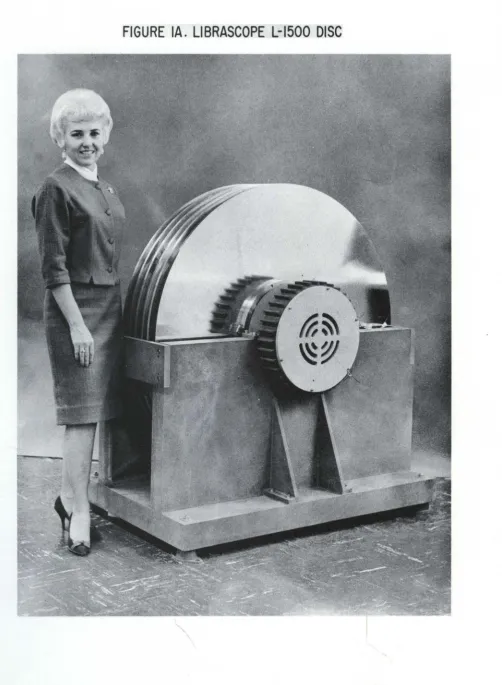
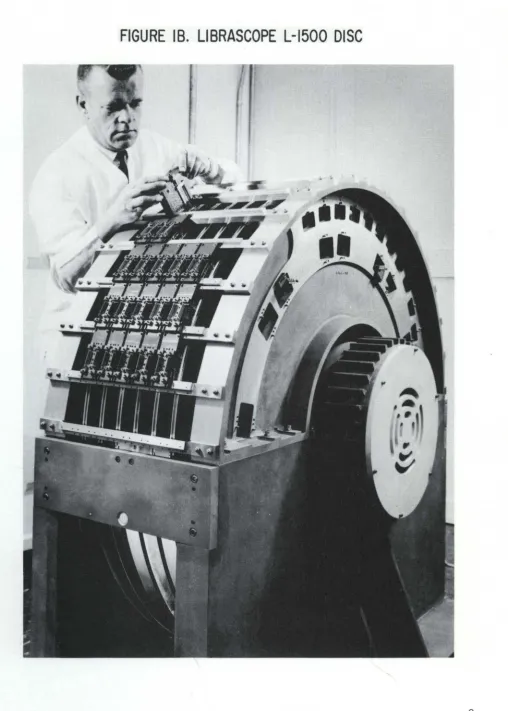
Physically, (See Fig. 1A and 1B) the disc is 48 inches in diameter, 1/2 inch thick, rotates at 900 RPM, and has a fixed-position read/write head for each data track. Six discs can be mounted in a single module sharing the same drive shaft and much of the logic circuitry. Further, as many as seven" slave" module s can be added to one "master" module without duplicating the search logic - for a total capacity of more than a billion character s.
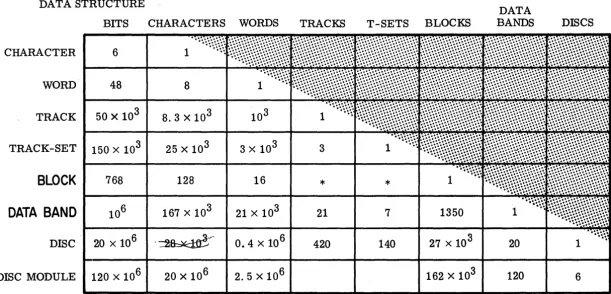
The vital statistics are given in Figure 2: those just mentioned toward the top, and several more in the table. The 420 data Tracks (one-dimensional, circular strings of bits) are grouped into Track Sets of three; i. e.: three radial bits are always read in parallel.
*
Two such triplets repre sent a character, eight character s a word, etc. The seman-tic organization stems from the definition of BLOCK AND DATA BAND.Ideally, the Data Band would correspond to a small File or Sub file , and the Block to an Entry or Record, though no great inefficiency is entailed so long as the correspondence can be maintained in multiples: e. g., 11 blocks per entry or 11 entries per block. The 21, OOO-word Data Band might be termed the "unit of search-area". Once the search criteria are
specified and the program directed to the desired Band, the search can be completed and all "response" Blocks delivered to core without further attention from the Central Processor - a parallel, asynchronous opera-tion which merely notifies the Central Control must step in to initiate action for each new Band, but this require s only a very few command executions.
The Block is the atomic unit of information within a Data Band. The search can only select or reject a complete Block; any finer, interior discriminations must be programmed in the Central Processor. However, the search operation itself can (for the purpose of selecting or rejecting the whole Block) refer to any specified bit~locations without re striction. This is accomplished by placing the appropriate Argument and Mask in special purpose registers in the Disc's high-speed core buffer.
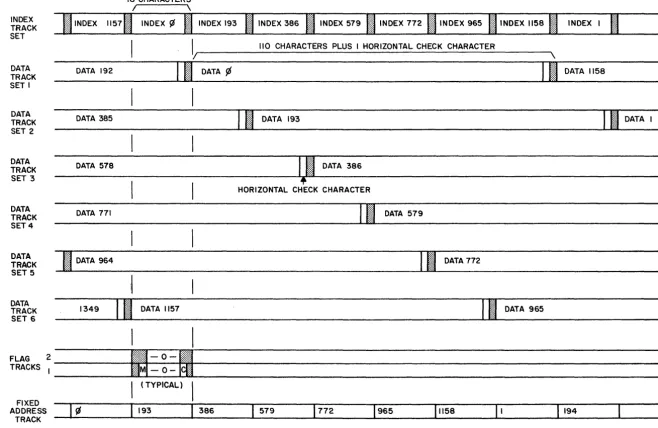
Two search modes are available. The fastest searches only a special set of "Tags", 18 Tag-characters to a block, which permits searching an entire million-bit Data Band in one 70 Ms revolution. The tags for all Blocks in a Band are stored in a single Track Set as shown in Figure 2.
The corresponding 110-character "data sections" of the Blocks are inter-leaved on the remaining six Track Sets of the Band. This interleaving technique staggers the data in such a way that when the Tag search yields a response, its data section can be read out immediately without requiring another revolution. There is a qualification, however. If two overlapping blocks "respond", only one can be read per revolution; the second is
"flagged" * and read out subsequently. The worst possible case is where six consecutive Blocks respond. One could be read on the first pass and the other flagged; then five more revolutions are required to read the re-maining bands. In any ordinary search, where the responses are less than 110 or so of the Blocks searched, this case is unlikely; but the system will handle it automatically, scheduling the necessary member of revolu-tions, whenever it might occur. This worst case defines the maximum
search time per Band: 7 revolutions at 15 rps, or about 1/2 second -which is also the time required to load or unload a million-bit Band.
If this search mode, relying solely upon Tags, proves inadequate, it is possible to apply the same Argument-and-Mask technique to the Data Sections of the Blocks. Due to the interleaved storage, this mode would usually require a full seven revolutions, but it permits search on any combination of the 768 bits in a Block or in any selected subsets of these bits. Conventional random-access is provided also. Given the Data Band
and Block number, the entire Block is retrieved in an average of one-half revolution (35M s) and a maximum of one revolution (70 Ms).
Search Types provided include most of the usual comparisons: Equal, Not Equal, Greater than, Less than, and Between upper and lower bounds.
The se comparisons can be applied to any selected field in the Block.
CORE PROGRAMMED CONTENT SEARCH
To search the content, strictly speaking, of a million-bit file in core storage is not impossible, but is rather inefficient. Consider a file of I, 000 entrie s of 20 words each, with each entry having fixed length and identical format so that the de sired attribute can be addre s sed directly. Now to search the file, even under these ideal conditions, and using a single key (attribute), require s 1, 000 comparisons. A comparison involving at least a couple of additions and a couple of memory accesses
-say 20 microseconds (~s) - would require 20 milliseconds (Ms). To search on the conjunction of 10 keys would thus take 200 Ms - about the same as the average for a comparable search on the Librascope Disc.
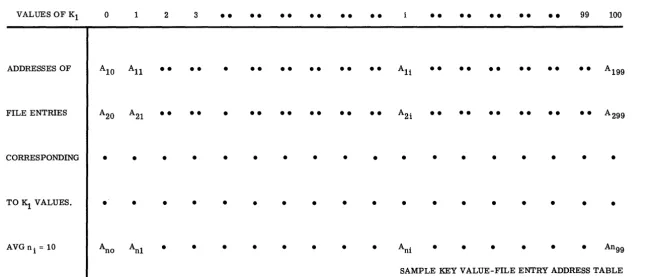
Of course, the core operation has a flexibility that allows search pro-grams to be tailored to special problems with much greater efficiency. (For example, the set of entries satisfying the first key can be retrieved and then that set searched on subsequent keys; but this procedure is effi-cient only if there is a known upper bound on the set resulting from any key that is small compared to the original file - otherwise, the storage requirements would double. )
-i.
e. , if, on the average an entry is associated with a single key value. But if, e. g., an entry is associated, on the average, with two key values, double the storage would be required. For ten keys (with 100 values each) and no redundancy, the storage required would be, for 1,000 la-bit ad-dresses, 105 bits (with perfect packing of bits into words) or at least 100;0added to the file store. With a redundancy factor of 2, the extra storage would double to 200;0. (In addition, program storage would add a percent or two to these requirements.) See Figure 4.
P ARALLE L SEAR CH MEMOR Y
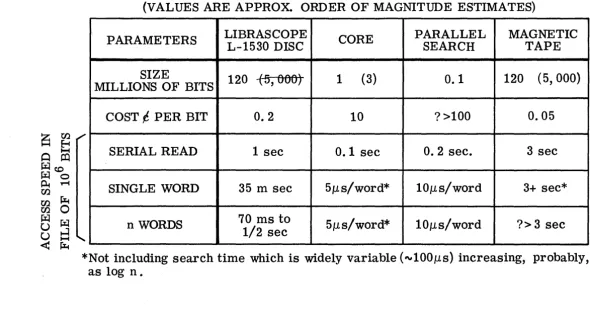
These memories are not yet on the market, but laboratory results are promising. It appears possible in these memories to simultaneously test the entire content of, perhaps, 2, 000 words for all "matches" (=, < , etc. ) with a given key word. There are many variants of this basic technique in various stages of development and no evaluation" will be attempted here beyond the following assumption: that such memories are feasible and will be available in the near future with approximately the parameters
shown in Figure 5.
The major limitation here, in addition to initial high cost, is the small capacity of about 105 bits. While there are many applications for such a powerful tool (in programming, indexing, etc.) its use for storing large files does not seem to be on the immediate horizon. Until its size can be increased by orders of magnitude, its use, other than on small files that must be searched very frequently, would have to be by reading in sections from a store of large capacity. But if an economical mass memory is used, two problems must be faced: fir st, the time lost in loading the search memory, and second, the problem of locating the required sec-tion of a large file which must be searched - with a file of only 106 bits, this requires selecting one out of ten sections.
MAGNETIC TAPE STORAGE
Magnetic Tape cannot, conventionally, be searched by content or any other means, except for one or two levels of "punctuation" marks that can be inse rted to divide the stored data into file sand subfile s. And these, of course, can be found only by counting serially along the tape. Tape can be used, however, in a content search procedure, where very large files are needed and extreme speed is not necessary. A fairly sim-ple procedure has been devised, for examsim-ple, for combining low-cost tape storage with the medium-cost Librascope Disc for moderate speed
searching.
Only one disc data-band (10
6
bits) is required. One tape might hold a file of 108 bits - 100 band-sized sections. Now if such a file can be con-veniently organized into 100 meaningful subfiles, in such a way that a majority of searche s can be carried out within a single one of the se files, a simple index table can be stored in core to select the desired sub-file. This subfile can then be located (by counting markers) and read onto the disc at continuous tape speeds. Searching the subfile can then proceed as a standard disc content- search (requiring I /1a
second or so). The total search, therefore, requires almost exactly the time to move the tape to the desired section.CATEGORIZATION OF FILE PROBLEMS
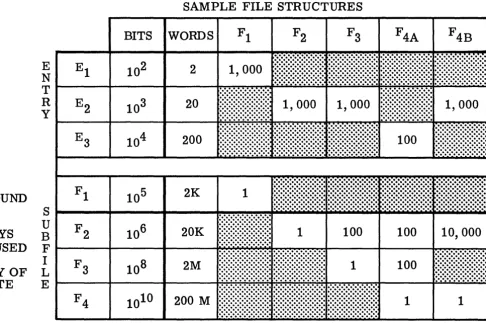
to discover even a procedure for categorizing files. (We usually mention their size and then give a sample forma.t.) Let me, therefore, suggest (Figure 6) some factors that might be useful in such categorization.
The list of "File Parameters" (Fig. 6) gives three "static" parameters exemplified in the table and three "dynamic" parameters concerning how the file is to be used. The table introduce s some sample file struc-ture s of various size s. The fir st three rows (E I, E2, E3) define alterna-tive 'entry' size s - an entry being the basic meaningful word set (element, unit, or record) defined for a given file. The last four rows (FI-F4) are some possible subfiles - a subfile being a set of entries or other sub-file s that are related by a significant semantic concept (e. g., a Military Equipment file might contain sub file s of Aircraft, Trucks, Ordnance, etc.). The ramifications of subfile structure deserve further investigation. For present purposes, however, the important aspect of structure is to allow most searches to be carried out within one subfile. Admittedly, this is a very" strong" and restrictive definition of 'subfile' but for a first rough cut at the problem, it adds great simplification.
The sizes chosen have no special significance other than to offer concrete examples within a reasonable range. The "F" columns define five file
structures ranging from small to large and with varied depth of structure - cf: F4A and F4B for two structure s in the same size file. Again,
there is no special significance in these particular files other than to offer a few varied sample s . ( They may, howeve r, sugge st some of the difficul-ties: Whether or not to call a file "deeply structured" without qualifica-tion as to size of file and size of entry, for instance).
The details of this little analysis are not worth belaboring beyond the point of emphasizing that there is a problem of File Categorization here worthy of further study and some such approach as this might serve as a
start.
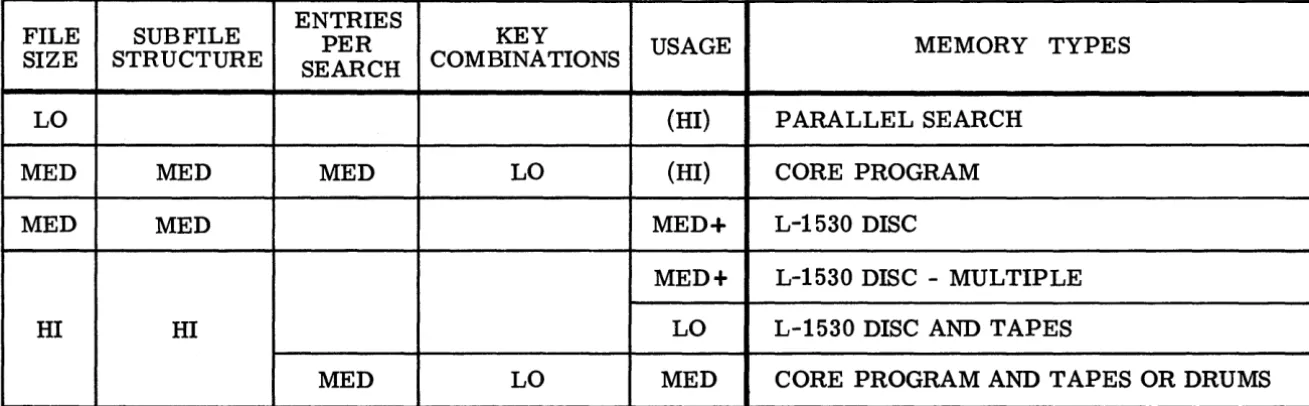
indicates that that parameter is not restrictive for the associated Memory Type. The two parenthetical entries '(Hi)' indicate a restriction in the special sense that only Hi Usage would justify the high cost of these mem-ories. The table is obviously incomplete. Even with these condensed categories and level, 243 Problem Categories could have been defined. Only a few samples that appear intuitively to be of special interest are presented. The largest size file, if not highly structured, for example, is assumed to be a problem for which there is presently no efficient solution.
Finally, to indicate briefly the rationale behind the assignments in Figure 7, The Parallel Search Memory can handle only small files and its cost can be justified only if usage is high.
Requirements for the Core Programmed Search are somewhat similar. File size can be moderately larger, but efficiency decreases drastically if many combinations of keys are used since this requires preparation and storage of many voluminous indexing table s. Lack of subfile structure has the same effect to a lesser degree, and retrieving many entries per search, of course, raises the access time linearly, thereby lessening the speed advantage over Disc Search.
The Librascope Disc is most appropriate for a medium size file with
enough subfile structure (Medium) to permit direct selection of data bands. With a multiple disc system, large files can be handled, similarly, with moderately high speed.
...
o
FIGURE 2. LIBRASCOPE L -1500 -SERIES DISC - PARAMETERS
PHYSICAL CHARACTERISTICS
48 IN DIAM. - ro-500 FIXED-POSITION READ/WRITE HEADS
900 RPM (15RPS) - 6 DISCS PER MODULE (1 SHAFT) - 7 'SLAVE' MODULES PER MASTER
DATA DATA STRUCTURE
BITS CHARACTERS WORDS TRACKS T-SETS BLOCKS BANDS DISCS
CHARACTER 6
WORD 48 8
TRACK 50 X 103 8.3 X 10³
TRACK-SET 150 x 103 25 X 103 3 X 10³ 3
BLOCK
768 128 16*
*
DATA BAND
167 X 103 21 X 103 217
1350DISC 20 x10 6
<~
0.4 X 10⁶ 420 140 20 [image:12.797.98.709.187.481.2]... ... INDEX TRACK SET DATA TRACK SET I
DATA TRACK SET 2
DATA TRACK SET "3 DATA TRACK SET4 DATA TRACK SET 5 DATA TRACK SET 6
FIGURE 3. LIBRASCOPE DISC -ORGANIZATION OF ONE DATA BAND
18 CHARACTERS
/ \
I
110 CHARACTERS PLUS I HORIZONTAL CHECK CHARACTERI~---'\
DATA 192
I
_ I
~:~.':~.'.'.~:'.'
~ DATA 'P rJI
(\jjl
r:) DATA 1158DATA 385
11\\\1
DATA 193II~t
DATA IDATA 578
rlt',
DATA 386•
HORIZONTAL CHECK CHARACTER
DATA 771
11\~\1
DATA 579~\\1
DATA 964III
DATA 7721349
111\1
DATA 115711\'
DATA 965I
I
FLAG 2 _ _
r-:%1~1-_0-1~!1
-TRACKS 1 ____________
j~~~~_-_O_-_4_~~l
__________________________________________________________________ __FIXED ADDRESS
TRACK
I
(TYPICAL)I
I-'
N
FIGURE 4. A SIMPLE SCHEME FOR CORE SEARCH BY CONTENT
VALUES OF K1 o 1 2 3
••
••
••
ADDRESSES OF
••
••
•
••
••
FILE ENTRIES
••
••
•
••
••
CORRESPONDING
•
•
•
•
•
•
•
TO K1 VALUES.
•
•
•
•
•
•
•
AVG ni = 10
•
•
•
•
•
FILE HAS 1, 000 ENTRIES; ENTRY ADDRESS HAS !Q. BITS.
THERE ARE
12.
SEARCH KEYS, K1·•• K10, EACH WITH!2.2.
VALUES.EACH KEY VALUE YIELDS (av.) SET OF!!:! FILE ENTRY ADDRESSES.
••• 10 BITS X 10 ADDRESSES X 100 SETS PER KEY X 10 KEYS = 105 BITS THIS ADDS 10% TO STORAGE OF A 106 -BIT FILE.
(PROGRAM WOULD ADD ANOTHER 1 OR 2%. )