937
THE IMPACT OF DEMOGRAPHIC FACTORS AND VISUAL
AESTHETICS OF MOBILE APPLICATION INTERFACE ON
INTENTION TO USE
MOBILE BANKING IN JORDAN
1MALIK KHLAIF GHARAIBEH, 2MUHAMMAD RAFIE MOHD ARSHAD
1&2 School of Computer Science, Universiti Sains Malaysia, Penang, Malaysia
E-mail: 1[email protected], 2[email protected]
ABSTRACT
The current study examined the effect of demographic profiles and visual aesthetics of mobile application interface on the intention of using mobile banking services among clients living Jordan. The proposed research model was based on three aesthetics from human compute interaction researches. We used SPSS version 22 to analyse the data which was composed of 579 questionnaires from different cities in Jordan using the convenience sampling technique. This study empirically presents that the intention of using mobile banking was positively and significantly influenced by the simplicity of mobile application interface and colourfulness of mobile application interface. Meanwhile, craftsmanship of mobile application interface was found to be insignificantly affected by the intention to use. The results also showed that the intention to use is statistically impacted by internet usage frequency. In contrast, age and familiarity with mobile applications have not significant effect on intention to use mobile banking. There are several factors that bring efficiency to the intention to use mobile banking. Prior studies investigated the relationship between these variables and the adoption of mobile banking services. However, none has paid attention on the impact of visual aesthetics on the intention to use mobile banking services. Findings of the current study prove that the proposed research model is a comprehensive to study the acceptance of mobile banking in Jordan. Overall, the results indicated the appropriateness of fundamental elements of visual aesthetics model in mobile banking adoption context.
Keywords: Visual Aesthetics; Simplicity Of Mobile Application Interface; Mobile Banking; Jordan.
1. INTRODUCTION
Mobile banking is considered the newest technology in a series of mobile technological revolutions.[1]. Although other banking channels such as Automated Teller Machine (ATM) and Internet banking also provide traditional banking transactions, it seems that mobile banking has a more significant impact in the banking sector [2]. Since the latest banking channel has been recognised by banks in both developed and developing countries. Due to the fact that the number of cell-phones is continuously increased as compared to PCs, this causes mobile banking to become more popular than other e-banking channels among bankers. In addition, mobile phones will improve the quality of services since consumers can conduct the financial needs in every place and time. Hence, it is clearly evidenced that
the usage of cell-phones for banking jobs is beneficial for customers and the bank [3]. In this regard, the last statistics presented that there are already around 4.77 billion mobile phone users all over the world. The statistics also outlined that 38 percent of mobile phone users were Smartphone users [4].
938 service, which is confirmed by the limited studies in this domain [6]. In the context of Jordan especially in rural and remote areas which do not have physical banks, it is a good idea for the population to make the banking transactions via mobile banking services. For these people, the high percentage of the people who have mobile and smartphones and the availability of internet connection will make performing banking transactions quicker and simpler. Therefore, the current study aims to discover new variables which can help the Jordanian banks to accelerate the process of mobile banking usage among customers. Accordingly, this paper aims to answer three questions as follows; How does visual aesthetics of mobile application interface which include the simplicity of mobile application interface, craftsmanship of mobile application interface, and colorfulness of mobile application interface affect the intention to use mobile banking services among customers in Jordan?. The second question is, are there any impact of age, familiarity with mobile applications and internet usage
frequency as control variables in the proposed research model?. Finally, what findings and recommendation that can be concluded from the study, that may be used to improve the acceptance of new technology in general and mobile banking in particular?. However, the significance of this research came from the fact that visual aesthetics was not focused on the previous studies. In the current study, visual aesthetics was found to be very important in the usage of mobile banking in Jordan, and this is evidently the vital contribution of the paper
This paper is structured as follows: the first is the overview of the literature about the most common acceptance and use of technology models, the second is the discussion about the research model and associated hypotheses, thirdly, the explanation of the research instrument and sample applied in this research, the fourth one is the analysis of the results of hypotheses testing, and
finally the key conclusions, research
recommendations, research contributions and future research directions.
2. LITERATURE REVIEW
Acceptance of new technology is one of the most mature research fields within the information system. Research in this area has created many theoretical models with roots in the information system, sociology and psychology and still is an important and relevant issue for the IS field [7, 8].
Given the literature review, the researcher noted five theories or models that are commonly utilized in IS research: Technology Acceptance Model (TAM) [9], Extension of Technology Acceptance Model (TAM2) [10], Unified Theory of Acceptance and Use of Technology (UTAUT) [11], Unified Theory of Acceptance and Use of Technology2 (UTAUT2) [12], and Innovations Diffusion of Theory (IDT) [13].
There are several previous studies which examined the main factors affecting the adoption of mobile banking. for example, [14] found that mobile interface usability and customer service have a positive impact on customer satisfaction. The findings also showed that there is a significant indirect impact of customer service and mobile interface usability on loyalty. [15] found that
system quality, compatibility, trialability, trust, and perceived enjoyment have a significant effect on the intention to use. [16] found that social influence, perceived usefulness, and perceived ease of use have a positive impact on customer’s intention to adopt mobile banking services.
939 3. RESEARCH FRAMEWORK AND
HYPOTHESES
3.1 Control Variables
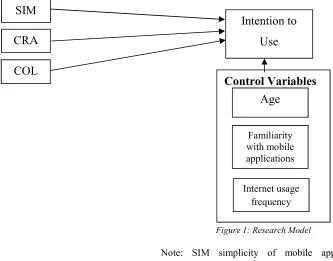
In order to grasp the effect of contextual factors on the proposed research model this study supposed demographic profile as a control variable and modelled their direct effect on the intention to use mobile banking services as presented in figure 4.1. The prior studies confirmed that demographic profile contributes to individual differences on the intention to use and acceptance [17-21]. Therefore, this study defined demographic attributes which affect the intention to use mobile banking services, as the characteristics associated with the individual user which include age, familiarity with mobile applications and internet usage frequency. Thus, this study assumed that demographic profile affects customer’s intention to use mobile banking services as suggested in the following:
H1a: Customer’s intention to use mobile banking varies by age.
H1b: Customer’s intention to use mobile banking varies by the familiarity with mobile applications. H1c: Customer’s intention to use mobile banking varies by the internet usage frequency.
3.2 Visual Aesthetics of Mobile Application Interface
Visual aesthetics defined as the beauty or the pleasing appearance of things [22]. The importance of visual aesthetics has begun to be realised in the field of Human-Computer Interaction (HCI), and the aesthetics of user interfaces have become a subject of major interest [23].In the mobile banking application, good interface design would make the customer feel positive about customer service as it is the first point of contact between customers and bank [14].
Previous research overlooked the impact of aesthetics, and how it could affect a number of constructs such as satisfaction, trust, and perceived credibility [23]. Several studies have also shown that the visual aesthetics can enhance performance [24, 25]. In addition, visual aesthetics can affect the evaluations of the content of websites [26]. Hence, this study used visual aesthetics from the HCI and applied it in the context of this study, and added visual aesthetics of mobile application interface in the research model.
The proposed conceptual model supposes that the simplicity of mobile application interface, craftsmanship of mobile application interface, and
colorfulness of mobile application interface will significantly affect customer's intention to use mobile banking. The research model was tested using 3 hypotheses as shown in figure 1. These hypotheses are as follows:
3.2.1 Simplicity of Mobile Application Interface
According to [27], simplicity is "a term that reflects aspects that facilitate perception and the processing of a layout, such as clarity, orderliness, homogeneity, grouping, and balance". Research in the field of HCI has widely presented the importance of simplicity for the aesthetic appreciation of web sites [22, 28, 29]. In addition, in an experimental study on the websites which are conducted by [27], the simplicity facet has been found to be strongly associated with evaluations of perceived usability and usefulness. Based on the previous studies, and extending these previous results to this study, it is expected that simplicity has a positive and significant impact on the intention to use mobile banking services, a higher level of simplicity will lead to higher level of intention to use mobile banking services. Therefore, the study proposed the hypothesis in order to examine the relationship in the context of mobile banking services as in the following:
H2: Simplicity of mobile application interface positively impacts the intention to use mobile banking services.
3.2.2 Craftsmanship of Mobile Application Interface
940 higher level of intention to use mobile banking services. Therefore, the study proposes the following:
H3: Craftsmanship of mobile application interface positively impacts on intention to use mobile banking services.
3.2.3 Colorfulness of Mobile Application Interface
Colorfulness is "a construct that comprises items related to the evaluation of individual colors and their composition" [27]. Previous studies examined the impact of colorfulness in HCI research. For example, [30] found that colorfulness plays a minor role in people's first impression of appeal. [31] studied the web page text-background colour combinations on readability, retention, aesthetics and behavioural intention. The results showed that colors with greater contrast rate generally lead to greater readability, color
combination did not significantly affect retention, while preferred colors such as blues and chromatic colors led to higher ratings of aesthetic quality and intention to purchase. [27] in an experimental study found that colorfulness facet is strongly associated with evaluations of perceived usability and usefulness. Based on the previous studies, and extending these previous results to this study, it is expected that colorfulness has a positive and significant impact on the intention to use mobile banking services, and a higher level of colorfulness will lead to higher level of intention to use mobile banking services. In addition, this study expected that colorfulness will moderate the relationship between trust, performance expectancy, effort expectancy, and hedonic motivation with the intention to use. Therefore, the research suggested the hypothesis as the following:
[image:4.612.156.489.370.631.2]H4: Colorfulness of mobile application interface positively impacts the intention to use mobile banking services.
Figure 1: Research Model
Note: SIM simplicity of mobile application interface, CRA craftsmanship of mobile application interface, COL colorfulness of mobile application interface.
COL
CRA
Intention to
Use
SIM
Control Variables
Age
Familiarity with mobile applications
941 4. RESEARCH METHODOLOGY
This study selects suburban areas as the sample of the study for the following motives; prior studies were managed in urban areas [32-35], secondly the usage rate of mobile banking services in these areas is still very low, finally to raise the knowledge for clients about mobile banking services and motivate them to use it.
The measurement scale involved items that have been adopted from previous literature and self-developed items to fit the domain of mobile banking services. The survey was translated into the Arabic language using the back translation method, due to Arabic being the formal language of the participants. The instrument was first pre-tested, by three Academic experts who have vast experience in this domain. They recommended modification, which we later carried out. A pilot study was also addressed on 105 clients who have rich knowledge and experience using mobile applications. Then, based on their comments we modified some items to improve the clarity and understandability of the items. The five-point Likert scale was adopted ranging from strongly disagree (1) to strongly agree (5) to estimate the measures of items. Out of 700 questionnaires distributed, the number of returned questionnaires was 579 (this represents a rate of 82.7 percent).
5. DATA ANALYSIS
5.1 Response Rate and Demographic Information
The sample shows that 63.2% of the participants were male and the remaining 36.8 were female. The age distribution presents that more than half of participants (53.4%) was between 20 and 35 years. With respect to the education level. 64.2% of the respondents had a bachelor degree. With regard to familiarity with mobile applications, the results revealed that about (46.5%) of the respondents were from the very good group. Meanwhile (31.8%) showed a good familiarity with mobile applications. Finally, in terms of the internet usage frequency, the results showed that around half of participants (51.5%) used the internet more than three hours per day.
5.2 Reliability Analysis
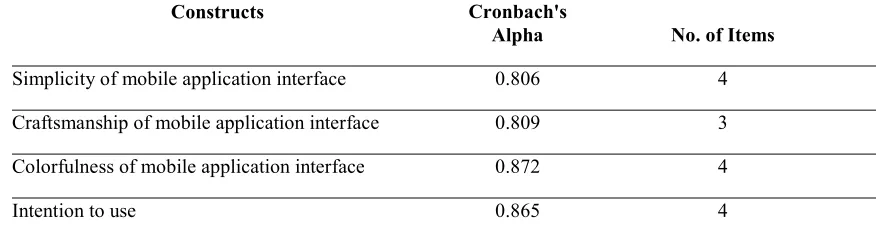
[image:5.612.84.525.474.593.2]Reliability analysis was conducted on the model variables. The reliability values should be equal to or higher than 0.70 to achieve internal consistency or adequate convergence [36]. In the present study, there were three independent variable scales. To check that the scales surpass the lowest acceptable level of 0.70, a reliability coefficient was performed for each set of variables. The results of the analysis outlined that all the items surpassed the cut off level 0.70, which indicates that alpha values are reliable. The following table summarizes the results of the reliability analysis.
Table 1 Cronbach's Alpha Reliability Results
Constructs Cronbach's
Alpha No. of Items
Simplicity of mobile application interface 0.806 4
Craftsmanship of mobile application interface 0.809 3
Colorfulness of mobile application interface 0.872 4
Intention to use 0.865 4
5.3 Correlation Analyses
Correlation analyses is a statistical technique that is used to measure the linear relationship or the association between two continuous variables [36]. In this study, the Pearson correlation coefficient was utilised to measure the strength and direction of the linear relationship between continuous variables. The correlation between the variables of the model is shown in table 2. The results presented
942 Table 2 Pearson correlation for constructs of the
research model SI
M CR A
COL INT
S I M
1
C R A
0.4 25* *
1
C O L
0.1 67* *
0.1 51 **
1
I N T
0.2 25* *
0.1 88 **
0.40 5**
1
**Correlation is significant at the 0.01 level (2-tailed).
6.
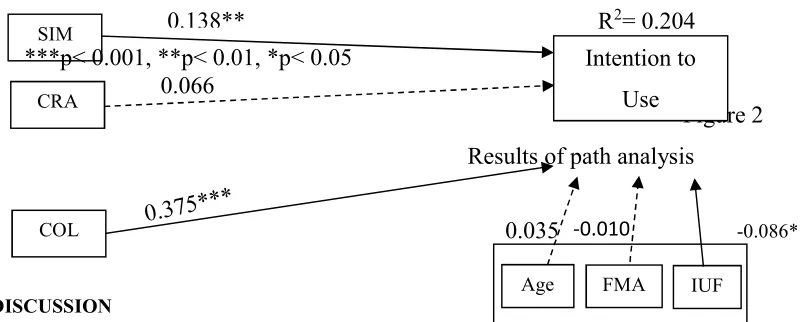
MODEL ANALYSIS AND HYPOTHESES TESTINGFigure 2 presents the path analysis findings for the hierarchical regression analysis. The results showed that R square is 0.204. It means that three independent variables and three control variables explained 0.204% of the variance in the
intention to use mobile banking services. In addition, F change value showed that the model provided is a significant contribution [F (3,572) = 46.641, (p< 0.001). The findings also presented that all independent variables were significant at three levels ***p< 0.001, **p< 0.01, and ***p< 0.05.The implications of these findings are shown in the next section.
Figure 2
Results of path analysis
7. DISCUSSION
Although mobile banking adoption is a widely studied topic, the use of this service is not widespread among customers in Jordan. There is a need to enhance bank systems that are easy for everyone involved in the process performing banking transactions, and for them to be satisfied with the results. Some technical challenges face challenge of updating the mobile banking applications, in terms of design aesthetics such as the fact that the mobile phone is limited by its small screen size. A successful mobile banking adoption also needs users who have the required skills to use such system functions and who are willing to use those functions. Training should be given by the bank staff to teach customers how to use mobile
banking in order to increase the usage of mobile banking, Developers must understand and follow the needs of clients to ensure a fruitful outcome, also the designers must apply the requirements and try to fulfil the wants of the clients when the updating systems are complete. Utilizing mobile banking services by customers would reduce the number of unbanked in Jordan, allow customers to open savings accounts, and increase tax revenues in Jordan. In addition, in the context of rural areas in Jordan, it is a good idea for the population to make the banking transactions via mobile banking services since there is a lack of banking branches and even if there are banks, they are quite far away. The high percentage of people who have mobile and
Intention to
Use
0.035
0.138**
0.066
SIM
CRA
COL
***p< 0.001, **p< 0.01, *p< 0.05
204
= 0.
2R
Age FMA IUF
F
943 smartphones and thus have available internet connection will make performing banking transactions quicker and simpler.
The results find that the simplicity of mobile application interface has a significant impact on the intention to use mobile banking services (β= 0.138, p < 0.01). To put it differently, the customers will consider adopting mobile banking services if the layout of the user interface is user-friendly, the elements are well organized, the user interface has adequate search facilities, and the information is clear and easy to read. As a summary, the simplicity of mobile application interface is considered an important variable that has the strong role that affects the intention to use mobile banking services. The findings also suggest that the colorfulness of mobile application interface (β= 0.375, p < 0.001) is significantly affect the intention to use mobile banking services. This finding reveals that customers will consider adopting mobile banking services if the colors in the user interface are pleasing to look at and colors combination makes the text in the user interface easy to read. In addition, the findings showed that the user interface uses multimedia elements appropriately such as graphics, images, videos, sounds, texts, background, and buttons. Thus, with higher level of expectation with regard to the colors of the mobile banking application, customers are more likely to adopt mobile banking services, compared to those customers with lower level of expectations.
In respect of the demographic factors, the results in this study supported the significant effect of internet usage frequency when it was control variable on intention to use mobile banking services; this finding is contradicted with the study of [19], where he found that the intention to use did not vary by internet usage frequency in the context of customer-generated media for travel planning. In contrast, the analysis from two models showed that the intention to use did not vary by age and familiarity with mobile applications. The finding from the age analysis contradicted the study of [19] where it was found that the intention to use did vary by age.
For more investigation about the impact of internet usage frequency, the results showed that customers who are using the internet per day from one to two hours (β = 0.143, p < 0.05) were significantly associated with the intention to use mobile banking services. In addition, the findings presented that customers who are using the internet per day from one to two hours (β = 0.145, p < 0.05) were significantly related to the intention to use. In contrast, the customers who are using internet for
less than one hour and who are using internet more than three hours were insignificantly associated with the intention to use mobile banking services.
8.
THEORTICAL AND PRACTICAL CONTRIBUTIONTheoretically, this study has several contributions which support the body of knowledge in IS research. This is the first study which uses visual aesthetics in the context of Jordan to explain and determine the main factors which affect the intention to use mobile banking services. The study also added three control variables to the proposed research model which include age, familiarity with mobile applications, and internet usage frequency. The current study also provides a foundation to further the studies on customer's intention to use mobile banking applications and other mobile applications. Moreover, this research believes that the proposed research model offers a significant contribution to knowledge as most of its variables and relationships had rarely been investigated in previous studies, in the mobile banking services domain.
Practically, while prior studies investigated the relationship between different variables and the adoption of mobile banking services, factors such as trust, security, perceived ease of use, and perceived usefulness were frequently investigated. However, the current study takes another direction, where this study pays more attention on the impact of visual aesthetics on the intention to use mobile banking services. It bring awareness to the banks concerning the importance of matching the user requirements in terms of design aesthetics, since the mobile banking interface is small compared to the interface in online banking or ATM. Therefore, the mobile banking designers must take into account the aspect of enhancing the application. This enhancement can be done by interviewing those customers who have a great experience dealing with mobile applications to get detailed information on how to enhance the system effectively.
9. CONCLUSION
944 adoption of mobile banking in Jordan. This research attempted to investigate the factors that affect consumers' intention to use mobile banking by applying a research from HCI. The research model is extended by including three demographic factors as the control variables. SPSS version 22 analysis technique was employed to measure the validity and reliability of the data collected from 579 banking customers in Jordan. The proposed research model adequately fit the data and it was able to account for 20.4 percent of variance in the intention to use. The results showed that the simplicity of mobile application interface and colorfulness of mobile application interface significantly affect the intention to adopt mobile banking services.
The findings of this study can help both banks and customers; for banks, the content analysis through this study showed that the mobile banking application must have certain characteristics as follows; the layout of the user interface must be user-friendly, the elements must be well organized, the mobile banking application must have adequate search facilities, and the information should be clear and easy to read. In terms of color, the colors in the user interface should pleasing look and the mobile banking application must have color combination that can make the text in the user interface as well as easy to read. The findings also showed that the user
interface must use multimedia elements
appropriately such as graphics, images, videos, sounds, texts, background, and buttons. The improvement of the application should be performed by consulting the banking customers who frequently perform banking transactions via mobile device, thus helping the bank enhancing the system effectively.
This article has three main limitations that may offer a direction for further research; Firstly, the current research used suburban data; a future suggestion may be able to conduct a comparative analysis of suburban and rural behavioral and technological facets in mobile banking adoption. Secondly, since mobile banking usage in Jordan is still in its early stages. Further research is required to explore additional variables that may enable faster usage for mobile banking services. Finally, the study used cross-sectional research approach by which data is collected from several areas at a single time period. We recommend a longitudinal future research that could be enhanced by using a longitudinal approach to allow the evaluation of the loyalty after the actual usage
REFERENCES
[1]. 1. Mohammadi, H., A study of mobile
banking loyalty in Iran. Computers in Human
Behavior, 2015. 44: p. 35-47.
[2]. 2. Safeena, R., et al., Technology adoption
and Indian consumers: study on mobile
banking. International Journal of Computer
Theory and Engineering, 2012. 4(6): p. 1020-1024.
[3]. 3. Mehrad, D. and S. Mohammadi, Word of
Mouth impact on the adoption of mobile
banking in Iran. Telematics and Informatics,
2016.
[4]. 4. Statista, Number of mobile phone users
worldwide from 2013 to 2019 (in billions).
2017.
[5]. 5. Gharaibeh, M.K. and M.R.M. Arshad,
Current Status of Mobile Banking Services in
Jordan. World Applied Sciences Journal
2016. 34(7): p. 931-935.
[6]. 6. Fatemifar, A., M. Rahimzadeh, and M.H.
Hosseini, Effective factors of the adoption of
mobile banking services by customers. Kuwait
Chapter of Arabian Journal of Business and Management Review, 2015. 4(6): p. 1-13.
[7]. 7. Benbasat, I. and H. Barki, Quo vadis TAM?
Journal of the association for information systems, 2007. 8(4).
[8]. 8. Venkatesh, V., F.D. Davis, and M.G.
Morris, Dead or alive? The development,
trajectory and future of technology adoption
research. Journal of the association for
information systems, 2007. 8(4).
[9]. 9. Davis, F., Perceived usefulness, perceived
ease of use, and user acceptance of
information technology. MIS Q, 1989.
[10]. 10. Venkatesh, V. and F.D. Davis, A
theoretical extension of the technology acceptance model: Four longitudinal field
studies. Management science, 2000. 46(2): p.
186-204.
[11]. 11. Venkatesh, V., et al., User acceptance of
information technology: Toward a unified
view. MIS quarterly, 2003: p. 425-478.
[12]. 12. Venkatesh, V., J.Y. Thong, and X. Xu,
Consumer acceptance and use of information technology: extending the unified theory of
acceptance and use of technology. MIS
quarterly, 2012. 36(1): p. 175-178.
[13]. 13. Rogers, E., Diffision of innovations. New
York: Free Press, 2003.
[14]. 14. Thakur, R., What keeps mobile banking
customers loyal? International Journal of
945
[15]. 15. Chemingui, H. and B.H. Lallouna,
Resistance, motivations, trust and intention to
use mobile financial services. International
Journal of Bank Marketing, 2013. 31(7): p. 574-592.
[16]. 16. Kazi, A.K. and M.A. Mannan, Factors
affecting adoption of mobile banking in
Pakistan: Empírical evidence. International
journal of research¡ n business and social science, 2013. 2(3): p. 79-92.
[17]. 17. Alathmay, A.A.A.R.A., Demographic
factors as determinants of e-governance adoption: A field study in the United Arab
Emirates (UAE). Transforming Government:
People, Process and Policy, 2015. 9(2): p. 159-180.
[18]. 18. Ameme, B., The impact of customer
demographic variables on the adoption and use of internet banking in developing
economies. The Journal of Internet Banking
and Commerce, 2015. 20(2).
[19]. 19. Ayeh, J.K., N. Au, and R. Law, Predicting
the intention to use consumer-generated
media for travel planning. Tourism
Management, 2013. 35: p. 132-143.
[20]. 20. Al-Gahtani, S.S., Modeling the electronic
transactions acceptance using an extended
technology acceptance model. Applied
computing and informatics, 2011. 9(1): p. 47-77.
[21]. 21. Shaikh, A.A. and H. Karjaluoto, Mobile
banking adoption: A literature review.
Telematics and Informatics, 2015. 32(1): p.
129-142.
[22]. 22. Lavie, T. and N. Tractinsky, Assessing
dimensions of perceived visual aesthetics of
web sites. International journal of
human-computer studies, 2004. 60(3): p. 269-298.
[23]. 23. Seckler, M., K. Opwis, and A.N. Tuch,
Linking objective design factors with subjective aesthetics: An experimental study on how structure and color of websites affect the facets of users’ visual aesthetic perception.
Computers in Human Behavior, 2015. 49: p.
375-389.
[24]. 24. Moshagen, M., J. Musch, and A.S. Göritz,
A blessing, not a curse: Experimental evidence for beneficial effects of visual aesthetics on
performance. Ergonomics, 2009. 52(10): p.
1311-1320.
[25]. 25. Sonderegger, A. and J. Sauer, The
influence of design aesthetics in usability testing: Effects on user performance and
perceived usability. Applied ergonomics,
2010. 41(3): p. 403-410.
[26]. 26. Aladwani, A.M. and P.C. Palvia,
Developing and validating an instrument for measuring user-perceived web quality.
Information & management, 2002. 39(6): p.
467-476.
[27]. 27. Moshagen, M. and M.T. Thielsch, Facets
of visual aesthetics. International Journal of
Human-Computer Studies, 2010. 68(10): p.
689-709.
[28]. 28. Ngo, D.C.L., L.S. Teo, and J.G. Byrne,
Modelling interface aesthetics. Information
Sciences, 2003. 152: p. 25-46.
[29]. 29. Thielsch, M.T. and G. Hirschfeld, High
and low spatial frequencies in website
evaluations. Ergonomics, 2010. 53(8): p.
972-978.
[30]. 30. Reinecke, K., et al. Predicting users' first
impressions of website aesthetics with a quantification of perceived visual complexity
and colorfulness. in Proceedings of the
SIGCHI Conference on Human Factors in
Computing Systems. 2013. Paris, France:
ACM.
[31]. 31. Hall, R.H. and P. Hanna, The impact of web
page text-background colour combinations on
readability, retention, aesthetics and
behavioural intention. Behaviour &
information technology, 2004. 23(3): p.
183-195.
[32]. 32. Asfour, H.K. and S.I. Haddad, The Impact
of Mobile Banking on Enhancing Customers’ E-Satisfaction: An Empirical Study on
Commercial Banks in Jordan. International
Business Research, 2014. 7(10).
[33]. 33. Alalwan, A.A., et al., Adoption of Mobile
Banking in Jordan: Exploring Demographic
Differences on Customers’ Perceptions, in
Open and Big Data Management and
Innovation. 2015, Springer. p. 13-23.
[34]. 34. Khraim, H.S., Y.E. Al Shoubaki, and A.S.
Khraim, Factors affecting Jordanian
consumers' adoption of mobile banking
services. International Journal of Business and
Social Science, 2011. 2(20).
[35]. 35. Alsamydai, M.J., et al., The Factors
Influencing Customer Usage of Mobile
Banking Services in Jordan. International
Journal of Business Management and Research, 2014. 4(2): p. 63-78.
[36]. 36. Pallant, J., SPSS survival manual. A Step