IJPSR (2013), Vol. 4, Issue 6 (Research Article)
Received on 31 January, 2013; received in revised form, 09 March, 2013; accepted, 24 May, 2013
EVALUATION OF WOUND HEALING ACTIVITY OF LEAF EXTRACT OF DODONAEA VISCOSA JACQ INALLOXAN INDUCED DIABETIC WISTAR ALBINO RATS
S.S. Pawar* and H.B. Mahajan
Sinhgad Technical Education Society’s, Smt. Kashibai Navale College of Pharmacy, Pune, Maharashtra, India
ABSTRACT: The present study was undertaken to evaluate the wound
healing activity of leaf extract of Dodonaea viscosa Jacq in diabetic
wistar albino rats. Wound is defined as a loss or breaking of cellular and anatomic or functional continuity of living tissue. Normal wound healing response begins the moment the tissue is injured. Wound healing is the process of repair that follows injury to the skin and other soft tissues. For the study, various excision, incision and granuloma pouch models were used. In each model, animals were divided into three groups (n=6). Group I was control group, Group II was treated with silver sulfadiazine
and Group III was treated with ointment of Dodonaea viscosa. In
excision wound model, the significant (p<0.001) increase in rate of wound contraction was observed. Also, there was increase in rate of reepithelization, matrix density and capillary number. The collagen content was found to increase as compared to control. In incision wound model it was found that there was increase in tensile strength. Cotton
pellet model supports the anti- inflammatory activity of Dodonaea
viscosa plant The present study suggested that the topical administration
of ethanol extract of Dodonaea viscosa in form of ointment plays a
major role in diabetic wound healing. Our present documented findings
may suggest the use of Dodonaea viscosa to treat diabetic wounds.
INTRODUCTION: Wound may be defined as a loss or breaking of cellular and anatomic or functional
continuity of living tissue 1. Cutaneous injury is
characterised by fibroplasia, angiogenesis and re-epithelisation and involves the migration and proliferation of cells such as fibroblasts, endothelial cells and epithelial cells, deposition of connective tissue and contraction of the wound. These steps are controlled by different kind of bioactive molecules like growth factors, cytokines its receptors and matrix molecules.
QUICK RESPONSE CODE
DOI:
10.13040/IJPSR.0975-8232.4(6).2359-63
Article can be accessed online on:
Such a controlled phenomenon can be disrupted in diseases like diabetes, immune compromised persons, ischaemia etc. thus leading to the development of a chronic wound. Prolonged or incomplete wound healing is then a troublesome complication. Efforts are being made all over the world to discover agents that can promote healing and thereby reduce the cost of hospitalisation and save the patient from amputation or other severe
complications 2, 3, 4.
Dodonaea Viscosa Jacq (DV) belongs to Sapindaceae family and is a small evergreen tree of variable size, found both wild and cultivated throughout India. Common in hotter parts of India, cultivated in gardens, village, roadside, found in wild, tropical forest and in Western Ghats of
Keywords:
Wound healing, Excision, Incision, Diabetes
Correspondence to Author: S. S. Pawar
Sinhgad Technical Education Society’s, Smt.Kashibai Navale College of Pharmacy, Pune, Maharashtra, India
Reported pharmacological activities of plant include antimicrobial, anti-inflammatory and antispasmodic activity. It possesses febrifugal and sudorific properties and also used for stomach disorders.
The leaf powder was used traditionally in burns treatment of scalds and as an anti-infective agent. The present study was designed to test the possible wound healing activity of DV in form of ointment in diabetic rats.
MATERIAL AND METHODS:
Preparation of extracts of Dodonaea viscosa Jacq:
The leaves of DV were collected from Saswad region, in the month of October and authenticated at Pune. The shade dried leaves were cut into small pieces and were powdered mechanically to obtain a coarse powder. The coarse powder was then stored in clean dry air tight container. The powdered material was subjected to maceration.
The solvents used were ethyl alcohol (95%) and distilled water. The powder material of DV was evenly packed in conical flask (2 liter capacity) for extraction for about 7 days with different solvents. Then the macerated product was filtered using muslin cloth with cotton and resultant product was kept in water bath to get a final product. Ethyl alcohol extract was subjected for preliminary phytochemical investigation.
Acute toxicity test: Acute toxicity studies revealed
an oral LD50 3750 mg/kg.
Experimental animals: Animals were divided into three groups. Group I was served as control. Group II was treated with silver sulfadiazine and Group III was treated with 10% of plant extract. Albino Wistar rats (150-200g) were obtained from animal house facility of Smt. Kashibai Navale College of Pharmacy, Pune and were housed in clean cages and in a well-ventilated facility with free access to standard feed and drinking tap water.
The animals were kept at room temperature (28±2oC)
with a 12 h day light/ dark cycle under humid tropical conditions. All procedures involving the use of laboratory animals were in accordance to the CPCSEA and were approved by the institutional animal ethical committee.
Treatment protocol: Induction of diabetes:
Diabetes was induced by a single subcutaneous injection of freshly prepared Alloxan at the dose of 100 mg/kg to overnight fasted rats. After 48 hr of Alloxan administration blood glucose level was estimated by using standard kit glucose oxidase
method 5. Animals with blood glucose level above
150 mg/dl were selected for further wound models.
Preparation of ointment: Simple ointment of DV extract (10%) was prepared and applied twice daily on the wound.
1. Incision wound: On the depilated backs of the animals, two paravertebral incisions of 6 cm length were made cutting through the full thickness of the skin. Interrupted sutures, 1 cm apart, were placed to approximate the cut edges
of the skin. The sutures were removed on the 7th
post wound day and skin breaking strength was measured on the 10th day by continuous water
flow technique of Lee 1, 6.
2. Dead space wound: Dead space wounds were created through a small transverse incision made
in the lumbar region 6, 7. A polypropylene tube
(2.5 × 0.5 cm) was implanted subcutaneously beneath the dorsal paravertebral lumbar skin. The day of the wound creation was considered as day zero. Granulation tissue formed on the polypropylene tube was harvested by careful dissection on day 10 and the breaking strength of the granulation tissue was measured. The granulation tissue was dried in an oven at 60°C overnight and the dry weight was noted. Acid hydrosylate of the dry tissue was used for the
determination of the hydroxyproline content 6, 8.
3. Excision wound: An excision wound was
inflicted by cutting away 500mm2 full thickness
RESULTS: Excision model showed the significant increase (p<0.001) in rate and percentage of wound
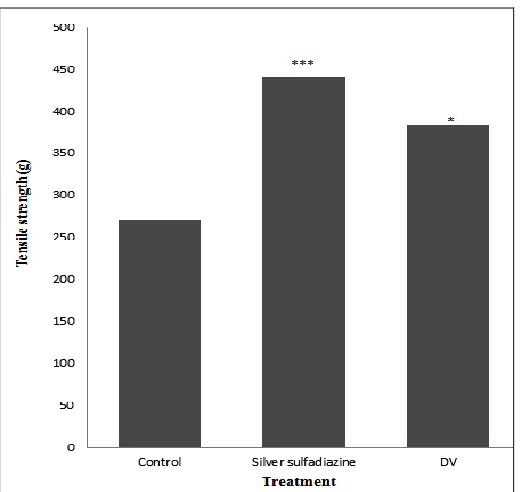
contraction observed on 16th day as per Table 1. In
incision wound model the drug significantly increases the rate of contraction which was proved
by increased tensile strength as shown in Fig. 2. The
force required to break the healed wound was more, which indicates the increase in matrix density.
The dead space model showed significant increase
(p<0.001) in hydroxyproline content indicated in Fig.
1 and decrease in weight of cotton pellet shown in
Table 4.
Thus, less inflammation and thereby excaudate was observed. Increase in collagen content was expected in the treatment and the same was observed as
mentioned in Table 2.
The burn wound model showed significant increase
in rate and percentage of wound contraction. On 8th
there was the significant increase in rate of wound
contraction (p<0.01), on 12th day and on 16th day
significant increase in rate of wound contraction was
observed (p<.0.01) as shown in Table 5.
TABLE 1: AVERAGE MEAN RAW WOUND AREA (mm2) PERCENTAGE CLOSURE OF EXCISION WOUNDS AT DIFFERENT TIME INTERVALS
Days Mean Raw Wound Area (mm
2
) Mean Percentage Closure
Control Silver Sulfadiazine DV Control Silver Sulfadiazine DV
0 492.66 ± 1.33 493.1 ± 1.30 494.6 ± 0.84 - - -
4 392.33 ±3.78 368±11.01 380.66±5.57 20.18 25.35 23.00
8 187.3±033 154.5 ±4.18 166±2.49 61.98 68.60 66.26
12 137.8±4.38 74.5 ±3.46 88.1 ±2.92 71.50 84.86 79.80
16 61.63 ±1.03 47 ±2.38*** 38.83±2.27*** 85.66 99.00 98.10
ANOVA followed by Dunnet’s ‘t’ test: *compared to the Control. Samples were taken at 8 days post-wounding. Values are mean () SEM (n=6).
TABLE 2: RESULT OF COLLAGEN CONTENT FROM REGENERATED TISSUES OF EXCISION WOUND (mg/gm).
Days Control (saline) Sliver sulfadiazine DV
4 8.90343. 11.76± 0.50 13.28± 0.204***
8 15.480.241 17.63 ± 0.514 25.1 ±0.303***
12 17.010.149 24.16 ± 0.691 29.6 ± 0.397***
16 20.480.119 28.13 ±0.419 33.7 ± 0.721***
Values are expressed as meanSEM (n=6). *Comparison with control.
TABLE 3: TENSILE STRENGTH (g) OF RESUTURED INCISION WOUND AFTER 10th POST WOUNDING DAY
Resutured Incision Wound Control Silver sulfadiazine DV 270.83±7.68 441.0±11.12*** 383.9±38.08* Values are expressed as meanSEM (n=6). *Comparison with control
TABLE 4: DRY WEIGHT (mg) OF COTTON PELLET GRANULOMA ON 10th POST WOUNDING DAY
Control Silver sulfadiazine DV
31.61±1.22 58.43±2.98*** 42.2±3.36*
Values are expressed as meanSEM (n=6). Dry weight of Cotton pellet granuloma: P<0.001. *Comparison with control
TABLE 5: AVERAGE MEAN RAW WOUND AREA (MM2) AND PERCENTAGE CLOSURE OF BURN WOUNDS AT DIFFERENT TIME INTERVAL
Days Mean Raw Wound Area (mm
2) Mean Percentage Closure
Control Silver Sulfadiazine DV Control Silver Sulfadiazine DV
0 292.3± 166 294.0± 1.19 291.3 ± 1.39
4 252.5 2.964 236.16 ±2.68 214 ±2.35 13.95 1.09 19.21 1.03 27.451.13
8 199 2.582 172 ±1.789 137.66 ±2.07** 32.39 0.782 41.300.345 53.540.56
12 76.5 1.994 59.5±2.76 35.83±1.44** 74.14 0.69 79.930.875 88.14 0.528
16 38.33 1.87 33.83 1.35 24.331.05*** 87.20 0.64 88.71 0.46 92.06 0.344 Values are expressed as meanSEM (n=6). * Comparison with control
Statistical analysis: Data were computed for statistical analysis using graph pad prism software.
DISCUSSION: The wound-healing process differs from tissue to tissue; there are more similarities than differences between them. In this discussion, skin is considered as a representative tissue type. Different types of wounds involve different phases of the healing process to varying degrees, although the phases themselves remain the same.
FIGURE 1: HYDROXYPROLINE CONTENT OF GRANULOMA. Values are expressed as meanSEM (n=6). P<0.001 *** and p<0.01 * indicates comparison with control.
FIGURE 2: TENSILE STRENGTH (g) OF RESUTURED INCISION WOUND AFTER 10th POST WOUNDING DAY. Values are expressed as meanSEM (n=6). P<0.001 *** and p<0.01 * indicates comparison with control.
For the study, various excision, incision, granuloma pouch and burn wound models were selected. The phytochemical investigations reveal presence of flavonoids, proteins, carbohydrates etc.
The percentage yield of DV extract was found to be 7%. The acute toxicity testing was carried out where the drug was found to be safer.
In excision wound model, the significant (p<0.001) increase in rate of wound contraction was observed also there was increase in rate of re-epithelisation, matrix density and capillary number. The collagen content was found to increase as compared to control. In incision wound model, it was found that there was increase in tensile strength. Cotton pellet
model supports the anti- inflammatory activity of DV
plant. The observed increased in the tensile strength and collagen content of the granulation tissue of the excision wounds indicates rapid wound healing process.
DV revealed the presence of flavonoids, tannins,
saponins and coumarins as bioactive antidiabetic principles. Burn wounds were also healed with higher rate and this may be because of antioxidant activity. As the antidiabetic activity of leaf of DV is well proven, this plant decreases the over load of glucose or it may improve the rate angiogenesis and help in healing of wound. Thus, the observed wound healing activity of title plant may be attributed to the presence of these bioactive principles and their synergistic properties.
CONCLUSION: The present study suggested that
the topical administration of ethanol extract of DVin
form of ointment plays a major role in diabetic wound healing. Our present documented findings
may suggest the use of DV to treat diabetic wounds.
ACKNOWLEGMENT:
Authors are thankful to University of Pune and Smt. Kashibai Navale College of Pharmacy, Kondhwa (Bk), Pune -48 for providing funding assistance for study.
REFERENCES:
1. Rupali Nandanwar, Himanshu Gurjar. Studies on wound healing activity of gel formulation containing cow ghee and
Aloe vera. International Journal of Pharmaceutical Sciences and Research 2010; 1(3): 50-54.
2. JoAn L. Monaco, MS. Acute wound healing an overview. Clinics in Plastic Surgery 2003; 30: 1–12.
3. Schilling JA. Physiological Reviews. Wound Healing 1968; 48(2): 374-423.
5. Dolly Jaiswal, Prashant Kumar Rai. Effect of Moringa oleifera Lam Leaves aqueous extract therapy on hyperglycemic rats. Journal of Ethnopharmacology 2009; 123: 392–396.
6. Shanbhag Tara V, Sharma Chandrakala. Wound healing activity of alcoholic extract of Kaempferia galanga in Wistar rats. Indian J Physiol Pharmacol 2006; 50 (4): 384–390. 7. Barua C.C, AT Akuldar. Wound healing activity of
methanolic extract of leaves of Alternanthera brasiliana
Kuntz using in vivo and in vitro model. Indian Journal of Experimental Biology. Dec 2009; 47: 1001-1005.
8. Billingham RE, Russel PS. Studies on wound healing, with special reference to the phenomenon of contracture in experimental wounds in rabbit’s skin. Annals of Surgery 1956; 144(6): 961-981.
9. Robert H, Demling. The role of anabolic hormones for wound healing in catabolic states. Journal of burns and wounds 2004; 145(12): 46-61.
10. Dunphy J E, Uduppa KN, Edwards LC. Wound healing, a new perspective with particular reference to ascorbic acid deficiency. Annals of surgery. 1956; 144 (30): 304-317. 11. Diwan PV, Tilloo LD, Kulkarni DR. Influence of zinc
sulphate on steroid depressed wound healing. Ind J Pharmacol. 1979; 11(4): 257-264.
12. William L, McKnight M, MacDonald AS. Effects of cortisone acitate, methyl prednisolone and medroxy progesterone on wound contracture and epithelisation in rabbits. Annals of Surgery 1969; 181(1): 67-73.
13. Mallouk Y, Vayssier- Yaussat M, Bonventre JV, Polla BS. Heat shock protein 70 and ATP as partners in cell homeostasis.IntJMolMed.1999: 4: 463-474.
14. Veerapur V.P, Badiger A. M, Joshi S.D, and Nayak V.P. Antiulcerogenic Activity of Dodonaea viscosa Jacq. Leaves. Indian Journal of Pharmaceutical Sciences. 2004; 66(4): 407-411.
All © 2013 are reserved by International Journal of Pharmaceutical Sciences and Research. This Journal licensed under a Creative Commons Attribution-NonCommercial-ShareAlike 3.0 Unported License.
How to cite this article: