2696
FINGER VEIN IDENTIFICATION BASED ON CORNER
DETECTION
1AHMAD S. BADER 2ALI MAKKI SAGHEER
1 Technical institute on Anbar, Middle Technical University
2 Information System Department College of Computer Science & IT University of Anbar
, yahoo.com ahmad_ma87@
1 mail: -E
ABSTRACT
Finger vein is a physiological biometric technology used in the identification systems for personal authentication based on the physical features of the vein patterns in the finger. In this paper, computer vision algorithms (FAST and Harris) were used to extract features (corner points) from the finger vein image, while the matching of patterns was based on the differences between corners represented in the form of points using the Manhattan distance. The False Matching Rate (FMR) and False Non-Matching Rate (FNMR) were minimized to obtain the optimum threshold value. This threshold were used to make the final decision. The proposed system proved that use of two algorithms together reduces the error rate and aids to produce a reliable system of finger vein identification.
Keywords: Finger Vein Identification, Biometric, FAST, Harris.
1- INTRODECTION
Biometric recognition, used physical characteristic and features in the human body for identification of the individuals can be classify Biometrics into physiological biometric and behavioral biometric, the Physiological biometric uses physiological attributes to recognize individuals such as face, iris, fingerprint and hand vein, while in Behavioral biometric on the other hand, recognizes individuals from human behavioral attributes like hand writing, signature or voice recognition [1].
Biometric features are unique attributes for each individual which is better secured than common authentication techniques like a password [2].
One of the promising physiological biometric is finger vein recognition, Rice was patented in 1987 in the United States of America [3]. It turns out that the arrangement of the veins in the human body is unique and differs from person to another. Because the human finger has a unique vein pattern for each finger and person, the technology is suitable for use in authentication between individuals. The beginning of finger vein recognition dates back to 2002 [4]. Finger veins are detected beneath the skin, which makes forgery almost impossible compared to traditional biometric features such as fingerprint that are visible to eyes. In addition, they are obtained an easier method than other techniques like airs [5].
Compared to traditional authentication mechanisms such as password and some biometric authentication techniques like fingerprint, the finger vein recognition may produce a higher security and it's not affected by the condition of the finger skin surface. The key advantage of a finger vein recognition in compares with other techniques is that finger vein pattern can only be taken when a person is alive.
The main aim of this research is to use computer vision algorithms designed to extract the features from the images in the form of corners and find a method to a matching between these corners to distinguish between finger vein patterns. Consequently, Produce reliable and dependable system to identify individuals through the finger vein pattern images.
2- RELATED WORK
In finger vein identification systems, the Minutia is used as a feature extracted from binary images its focus on removed Spurious Minutiae to get better results. In matching compere Minutia of the input image with Minutia of the template image (Videkar
et al.) in [1] or used Modified Hausdorff Distance
(MHD) matching method (Preethy et al.) in [6]. The
2697 cause the loss of a number of important features in the process of matching between two images.
(Xiaohua et al.) in [7], proposed finger vein
recognition algorithm, in feature extraction from finger vein image using the Hu Moment Invariants and matching by Euclidean distance. Although the researcher used a wonderful method of features extraction and matching process, which gave good results but there is a deficiency in the aspect of image processing, which negatively impact on final results of the research.
(Rongyang et al.) in [8], divided image to regions
independent for each other, and proposed Region-based Axis Projection (RAP) matching algorithm for finger vein recognition based on vein vessel network distribution information. The proposed method in the matching process helps to give a correct decision even if there is a small rotation or translation
(Komal et al.) in [9], developed a new approach
to extract finger vein pattern by using Automatic Trimap Generation and Repeat Line tracking to extract features from the image. SURF (Speed up Robust Feature) and Cross validation and graph matching algorithm were used to match between two images. Using the Repeat Line tracking algorithm during the image processing phase has helped to produce a good finger vein pattern that benefits to extract features from this pattern accurately
(Fotios et al.) in [10], proposed biometric
authentication system. The proposed system is relatively low in cost. It is used a local maximum curvatures to extract the vein pattern, but there is a lack of matching between the images, although it is a complex process that uses the FFT to find similarities and differences between the two images.
(Liao et al.) in [11], proposed Maximum Decision
Reliability Ratio (MDRR) fusion method for matching based on similarity ratio. This stage comes after image pre-processing the image using a normalization in addition to ROI abstraction. Obviously the matching method is good but a bit complicated.
(Pang et al.) in [12], produced a new finger vein
recognition system by using a Multi-direction gradient coding to extract the finger vein texture from the finger vein image. Moreover, they and used Fuzzy threshold and gray value to match between
fingers vein texture. Despite implement a multi-direction on original vein image produced a good image for the vein pattern, but after matching with Fuzzy the error rate was somewhat high
(Yazmin et al.) in [13], developed an approach of
hybrid curves, supported by the tangent and secant curves, and depended on the Hough transform. The purpose of this method is to extract points that describe features of the vein. Where researchers have produced a distinctly approach to extract features from the pattern accurately.
(Daniel et al.) in [14], suggested face and vein
identification system, this system extracts features based on Local Binary Pattern (LBP), Local Directional Number Pattern (LDNP) and Local Directional Pattern (LdiP), and used function to measure the correspondence between images and make the eventual decision. in spite of the proposed method is considered to be expensive in terms of time and effort of the device because of the use of the face and vein at the same time during implementation but the result of error is considered significant.
(Yang et al) in [15], proposed a new finger vein
recognition scheme, consisting of an anatomy system analysis-based vein extraction (ASAVE) algorithm and an assimilation matching method. Specifically, the vein pattern is obtained by the orientation map-guided curvature depend on the valley- or half valley-shaped cross-factional profile. In expansion, the obtained vein pattern is significantly thinned and refined to obtain a reliable vein network. In addition to the vein network, the relatively clear vein branches in the image are mined from the vein pattern, referred to as the vein backbone. In matching, the vein spine is employed in vein structure analysis to overcome finger displacements. The similarity of two fixed vein systems is measured by the designed flexible matching and further recomputed by combining the overlap degree of comparable vein backbones. Major experiments on two popular finger vein databases find out the power of the proposed scheme.
2698 to determine the corner points in vein patterns and match between these points to make decisions.
3- DETAILS OF EXECUTION AND
LIMITATIONS
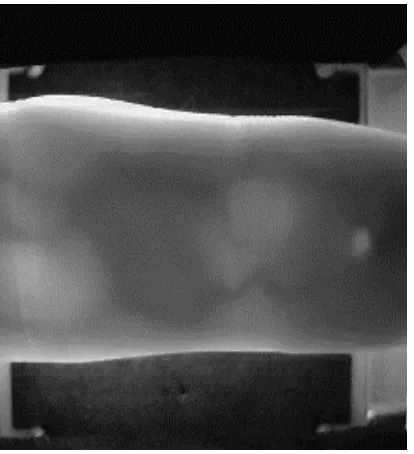
To complete this work, the Fujitsu computer was used with Intel Core i5 2430 processor and 4 GB RAM memory operate with Windows 7 operating system, and complete steps were implemented by using C# on Visual Studio 2015. Also, the work has was applied on a public database designed by Yilong Yin containing images collected for 106 individuals. Each individual has 6 samples per finger (index, middle and ring) for both hands (right and left). (Figure 2) shown image from this database.
[image:3.612.90.297.419.646.2]Furthermore, the implementation of this research was not free from limitations and difficulties, including the difficulty of obtaining references in the field of finger vein recognition, as well as the inability to obtain a new database and clear finger vein images in order to obtain better results. Databases for this purpose are now available mostly before 2012.
Figure 2: Image from targeted database.
4- MATERIALS AND METHODS
In this paper, the finger vein identification system is divided into three main stages to be make the final decision, as shown in Figure (1).
Figure 1: Finger Vein Identification system stages.
5- IMAGE PROCESSING AND VEIN
PATTERN EXTRACTION
The work has been based on a public database
designed by Yilong Yin containing images collected for 106 individuals. Each individual has 6 samples per finger (index, middle and ring) for both hands (right and left). (Figure 2) shown
image from this database.
The finger vein image is obtained through a device that contains a camera and uses infrared light to capture the image. The intensity of the lighting varies from place to another on the same image, so it requires a method that helps to extract the finger vein pattern accurately.
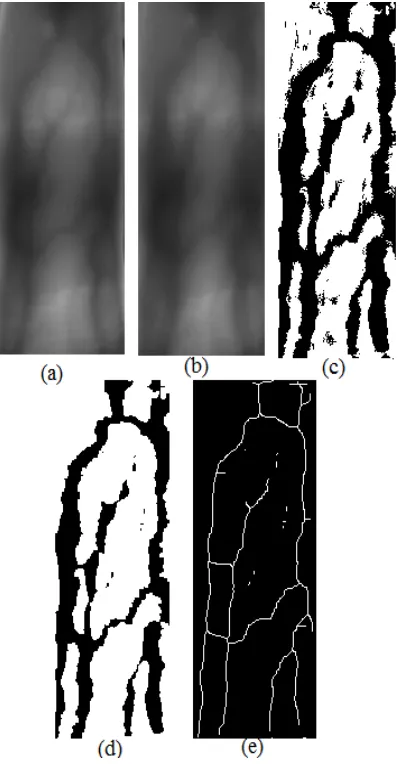
The extraction of the vein pattern from the gray image is the biggest challenge because all the subsequent stages and the accuracy of the results are entirely dependent on the resulting image from this stage. Here is an illustration of the steps that were used to extract the vein pattern from the gray image (Figure 3):
Median filter: replace the pixel value with
the median value to eliminate impulsive noise in the image.
Image Binarization: convert the image
from a grayscale image to a binary image by splitting the image into blocks and using the optimum threshold. Binarization of thresholding is one of biggest challenge that Infrared
Image
Image processing and vein pattern
extraction
Feature Extraction
Matching Template
samples
2699 have to clear up in pattern recognition techniques [16].
Dilation: is a process of mathematical
morphology used to reduce the black noise between vein pattern lines.
[image:4.612.91.291.202.584.2] Zhang-thinning: applied to thin a binary images (vein pattern lines) to convert them into a line of one pixel.
Figure 3: image pre-processing and finger vein pattern extraction. (a) Original IR image (b) Median filter (c) Image Binarization (d) After
Dilation (e) After Thinning.
6- FEATURE EXTRACTION
In this stage, we used computer vision algorithms (FAST and Harris) to extract features from the vein pattern image. The resulting features are points representing the corners in the vein pattern. The following is an illustration of these algorithms:
6.1 Feature from Accelerated Segment Test (FAST)
FAST is an algorithm for corner detection proposed by (Edward et al.) in [17][18], it is faster
than other algorithms used for the same purpose. The examination done on a pixel p by taking a circle of 16 pixels (a Bresenham circle) around the pixel p. considers p is a corner if two conditions meet: first, is that the intensity of 12 adjacent pixels around p be more or less than the intensity of pixel p by the threshold value. Second, if we number the sixteen-pixel circle around p as in (fig 3), at least three sixteen-pixel of 1, 5, 9 and 13 should be higher or lower than the intensity of p by the threshold value.
[image:4.612.318.526.381.563.2]In this paper, the test process is carried out on a binary image where the color of the vein pattern pixels is white and the rest pixels are in black, so one case was taken when the pixel intensity is over 12 pixels around it and be at least three pixels in directions (1, 5, 9 and 13) less than p density by the threshold value.
Figure 4: FAST feature extraction algorithm.
6.2 Harris Corner Detection
The Harris algorithm proposed by (Chris et al.) in
2700 Taylor expansion to get value in almost all directions and they also improved the algorithm in terms of noise response using the Gaussian function (Eq. 4) in lieu of the window function.
= (1)
=
Written as matrix:
(2)
Where M is 2*2 matrix computed from Image derivation.
(3)
Gaussian function:
= (4)
Where
E: Gray scale transformation of pixel.
(x,y): The coordinates of pixel.
u and v: The distance in directions x and y.
w: Is window function.
,
After calculating the eigenvalue of the matrix produce two value (λ1 and λ2), depending on these values, one of three state results:
When one of the eigenvalues (λ1 or λ2) is big and the other is small, then an edge exists.
λ1 λ2 the values are small (near zero), then this pixel point is a flat region. λ1 λ2 and two eigenvalues are large
positive values, then the pixel point is corner.
The measure of the corner response (Eq. 5) depend on the threshold value.
(5)
Where
(6)
(7)
k: constant value between 0.04-0.06
In this paper, the following Parameters were applied in Harris algorithm:
In Eq. 4, sigma value ( ) =1.4.
In Eq. 5, k=0.04.
Threshold value = 19000.
7- MATCHING ALGORITHM
The matching stage is the core point of the system where the final decision will be obtained through this stage. This phase is based entirely on the results of the previous stages in terms of initial image processing and features extraction.
As explained, the features (corners) are obtained in the form of points from two algorithms FAST and Harris to be at this stage matching these points in both image patterns to obtain the final decision either to accept or reject. The algorithm 1 shows how the images match.
Algorithm 1: Corners matching algorithm
Step 1: Calculate the number of acceptable pairs (np) by using Manhattan distance (Eq. 8) in each vein pattern image.
(8)
Where:
Step 2: Calculate the similarity ratio between two
images (Eq. 9).
(9)
2701
Step 3: If r >= Threshold Value (t)
Two images matching.
Else
Two images Not matching.
8- EXPERIMENTAL RESULTS
To show the accurately of the Finger Vein Identification system proposed in this research, we applied the image pre-processing steps and implemented the corner detection algorithms to extract corner points from finger vein patterns. In (fig 4) the red points represent the corners extracted by FAST algorithm.
Figure 5: Corners extracted by FAST algorithm.
[image:6.612.309.534.154.626.2]In (fig 5) the blue points represent the corners extracted by Harris algorithm.
Figure 6: Corners extracted by Harris algorithm.
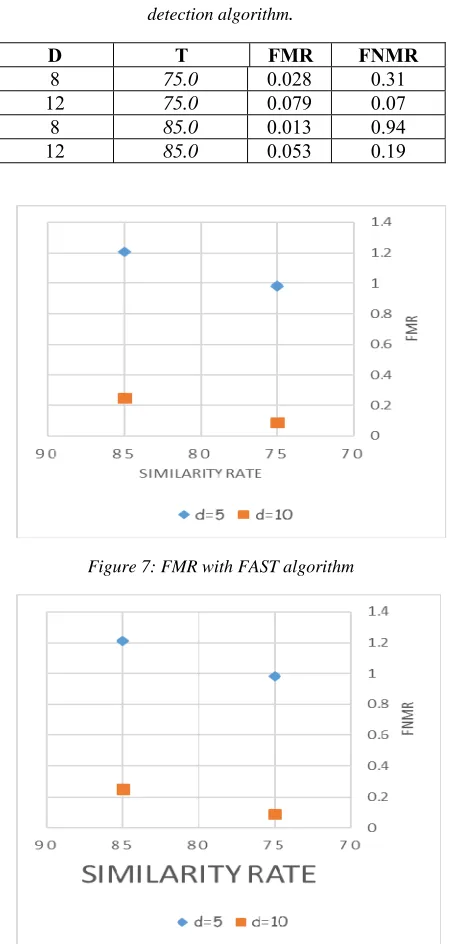
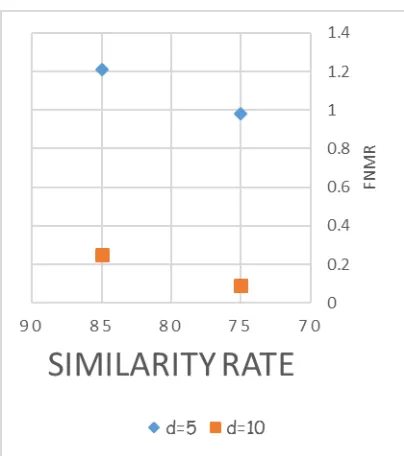
To discuss the results of the algorithms, we used the FMR (Eq. 10) and FNMR (Eq. 11). The results obtained from the application of the proposed Matching algorithm with the features taken by FAST algorithm are presented in Table1. While the results of using the Harris algorithm in features extraction are shown in Table 2.
(10)
(11)
Table 1: Finger Vein Identification using FAST corner detection algorithm.
D T FMR FNMR
8 75.0 0.028 0.31
12 75.0 0.079 0.07
8 85.0 0.013 0.94
[image:6.612.90.281.377.454.2]12 85.0 0.053 0.19
Figure 7: FMR with FAST algorithm
[image:6.612.91.283.514.592.2]2702 Table 2: Finger Vein Identification using Harris corner
detection algorithm.
D (pixel) T (%) FMR
(%) FNMR (%)
5 75.0 0.12 0.98
10 75.0 0.43 0.09
5 85.0 0.0028 1.21
10 85.0 0.046 0.25
[image:7.612.93.407.113.441.2]Figure 9: FMR with Harris algorithm.
Figure 10: FNMR with Harris algorithm.
Table 3: The result of the merges between FAST and Harris algorithms.
FAST Harris FMR
(%) FNMR (%)
D T D T
10 75.0 10 75.0 0.016 0.13
10 85.0 10 85.0 0.002 1.37
10 75.0 10 85.0 0.0067 0.29
The results of the matching in (Algorithm 1) depend on the choice of two values: shifting distance (d in Eq. 8) and the threshold value (t) through which the inputs are classified as either accept or reject. The tables (Table 1 and 2) illustrate the effect of two values (d, t) on the results, when increase value of d and regardless of the value of t lead to increase FMR rate and decrease FNMR rate and vice versa. As for the value of t, the increase serves to raises FNMR rate and conversely. Furthermore, Table 3 presents the results of using the two-stage matching algorithm. The first stage used points obtained by FAST algorithm because it is faster and easier to apply than Harris. The matching ratio of this stage filters the inputs for matching using the features taken by Harris algorithm in the second stage for final decision making.
By comparing the results of each algorithm independently (Table 1 or 2) with the results of the treatment of the two algorithms jointly (Table 3), the use of the two algorithms together yields much better results, although there is a clear variation between the FMR and the FNMR. Through the above, it is found that with the abundance of experience and the good selection of values of D and the proportion of similarity between the two images can get good results.
[image:7.612.90.292.476.704.2]2703 Table 4: The Time Required to Identification process
(MS).
Stage Time (%)
Image processing 637
FAST Features Extraction 5
Harris Features Extraction 11
Matching 17
All 670
Figure 11: Identification Time.
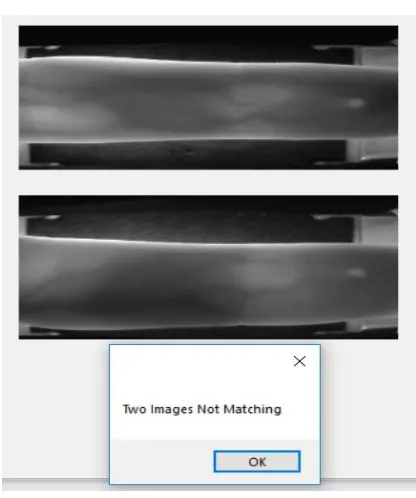
[image:8.612.91.295.137.492.2]Figure 12 shows the implementation of the proposed method on two matching images and this is shown in the figure and that the program knows the match correctly. While Figure 13 shows how the program identifies two non-matching finger vein patterns images as an example of the practical implementation on the program and a clarification of the results obtained and discussed above.
Figure 12: Two Matching Images.
Figure 13: Two NOT-Matching Images
[image:8.612.316.524.333.582.2]2704 images, which causes variation of vein patterns after extraction in each time.
Table 5: Comparison with other Methods.
FMR (%) FNMR (%)
Maximum
Curvature [10] 0% 1.00%
MDRR [11] 0.19% 0.96%
Proposed Method 0.0067% 0.29%
9- CONCLUSION
In this study we proposed a finger vein identification system based on corner detection algorithms (FAST and Harris) to extract features from vein pattern images, and match between this corner points using Manhattan distance to calculate the different ratio between images. The study indicated that the accuracy of the results rests on the efficiency of the choice of the acceptable shift value (d) for each corner in first image with corresponding corner point in second image, and choice of the best value of the threshold (t) which represents the least acceptable similarity ratio between two images. Moreover, the suggested method confirmed that the use of two algorithms together reduces the error rate and helps to produce a reliable system of finger vein identification. The better accuracy has been achieved when used (d) value in (Eq. 8) equal to (10) and used two level matching first with FAST features and second with Harris features in level one (r=75) in (Eq. 9) and in level two (r=85) in same equation.
10. ACKNOWLEDGMENT
Thanks presented for College of Computer Sciences and Information Technology, University of Anbar, by aiding to bring out the research. Also, special thanks to Prof Dr. Ali Makki for assistance this research.
REFERENCES
[1] P. D. Videkar and K. S. Ingle, “Finger Vein Identification Based On Minutiae Feature Extraction With Spurious Minutiae Removal,” International
Research Journal of Engineering and
Technology, 2017.
[2] P. Kaur and others, “Comparative Study on Human Identification for Finger Vein Images,” International Journal of Latest
Scientific Research and Technology, vol.
1, no. 2, pp. 37–40.
[3] J. Rice, “Apparatus for the identification of individuals.” Google Patents, 1987. [4] T. Dunstone and N. Yager, Biometric
system and data analysis: Design,
evaluation, and data mining. Springer
Science & Business Media, 2009.
[5] J.-D. Wu and S.-H. Ye, “Driver identification using finger-vein patterns with Radon transform and neural
network,” Expert Systems with
Applications, vol. 36, no. 3, pp. 5793–
5799, 2009.
[6] P. Prabhakar and T. Thomas, “Finger vein identification based on minutiae feature extraction with spurious minutiae removal,” in Advances in Computing and Communications (ICACC), 2013 Third
International Conference on, 2013, pp.
196–199.
[7] X. Qian, S. Guo, X. Li, F. Zhong, and X. Shao, “Finger-vein recognition based on the score level moment invariants fusion,”
in Computational Intelligence and
Software Engineering, 2009. CiSE 2009.
International Conference on, 2009, pp. 1–
4.
[8] R. Xiao, G. Yang, Y. Yin, and L. Yang, “A novel matching strategy for finger vein recognition,” in International Conference on Intelligent Science and Intelligent Data
Engineering, 2012, pp. 364–371.
[9] K. Bansal and S. Kaur, “Finger Vein Recognition Using Minutiae Extraction and Curve Analysis,” International
Journal of Science and Research, pp.
2402–2405, 2015.
[10] F. Tagkalakis and V. Fotopoulos, “A low cost finger vein authentication system, using maximum curvature points,” in
Applied Electronics (AE), 2015
International Conference on, 2015, pp.
249–252.
[11] L. Ni, Y. Zhang, H. Zheng, S. Liu, H. Huang, and W. Li, “A Fusion Method Based on Decision Reliability Ratio for Finger Vein Verification,” arXiv preprint
arXiv:1612.05712, 2016.
[12] Z. Pang, J. Yang, Y. Chen, and Y. Liu,
Methods
2705 “Research and implementation of finger-vein recognition algorithm,” in Second International Workshop on Pattern
Recognition, 2017, vol. 10443, p.
104430D.
[13] Y. Vasquez, C. Beltrán, M. Gómez, M. Flórez, and J. L. Vázquez-González, “Features extraction in images on finger veins with hybrid curves,” in
Humanitarian Technology Conference
(MHTC), IEEE Mexican, 2017, pp. 34–38.
[14] D. Setiadikarunia, R. A. Saragih, and B. Benjamin, “Face and Vein Identification Using LBP, LDiP and LDNP as
Local-Feature Descriptors,” Journal of
Engineering and Applied Sciences, vol. 12,
no. 13, pp. 3299–3303, 2017.
[15] L. Yang, G. Yang, Y. Yin, and X. Xi, “Finger Vein Recognition with Anatomy Structure Analysis,” IEEE Transactions on Circuits and Systems for Video
Technology, 2017.
[16] M. ASGARI et al., “USING AN ANT
COLONY OPTIMIZATION
ALGORITHM FOR IMAGE EDGE DETECTION AS A THRESHOLD SEGMENTATION FOR OCR SYSTEM,”
Journal of Theoretical and Applied
Information Technology, vol. 95, no. 21,
2017.
[17] E. Rosten and T. Drummond, “Fusing points and lines for high performance tracking,” in Computer Vision, 2005. ICCV 2005. Tenth IEEE International
Conference on, 2005, vol. 2, pp. 1508–
1515.
[18] E. Rosten and T. Drummond, “Machine learning for high-speed corner detection,”
Computer Vision--ECCV 2006, pp. 430–
443, 2006.
[19] C. Harris and M. Stephens, “A combined corner and edge detector.,” in Alvey vision
conference, 1988, vol. 15, no. 50, pp. 10–