3014
ANALYSIS AND IMPLEMENTATION OF KNOWLEDGE
MANAGEMENT SYSTEM (A CASE STUDY APPROACH)
1YOHANNES KURNIAWAN, 2FREDY JINGGA, 3NATALIA LIMANTARA, 4AMIR HAMZAH, 5HENDRA FEBRIANSYAH, 6REYHAN SANDHYAJATI, 7DIEGO FERNANDO CABEZAS
TAPIA
1,2,3,4,5Information Systems Department, School of Information Systems, Bina Nusantara University, Jakarta, Indonesia 11480
7Interdepartemental Center of Embedded Systems of Automation and Computer Sciences, Peter the Great St. Petersburg Polytechnic University, Polytekhnicheskaya st. 21, St. Petersburg, 194021, Russian
Federation
E-mail: 1[email protected]
ABSTRACT
Knowledge Management System (KMS) is a system that applies and uses Knowledge Management (KM) principles. KM implementation in XYZ Indonesia is performed with requirement analysis, then the system is build using application service which is close source. The method that is used for this KM analysis is SECI method. The analysis and implementation of KM system show a positive result in the creation of knowledge culture from knowledge sharing. From this result it is expected for the company that will implement the KM system can use this as a reference.
Keywords: Implementation, Knowledge, Knowledge Management, System, Analysis
1. INTRODUCTION
KMS is defined as a system that uses KM principles and applies these principles. Knowledge Management System refers to a kind of Information Technology (IT) system which store and take knowledge, improve collaboration, to put knowledge, mining repository for hidden knowledge, acquire and use knowledge, or in some cases is used for supporting Knowledge Management (KM) process in an organization. According to Dalkir the benefit of knowledge management is categorize into three which is, individual, communities of practices, and for the organization itself [1].
The organization need to consider organizational culture as a critical success factors of implementation of KM [2]. The collaboration between employee will increasing creativity of employee in organization (by team work) [3,4]. The role of leader will influence the knowledge sharing and creativity of employee [5]
From that case itself, it shows us that the Knowledge Management System gives a positive result for company improvement, including XYZ as one of the biggest network company in the world, that can be said dominate the customer market and start to expand to Small Medium Business (SMB).
XYZ is also the first network company that pioneer in network improvement for a household.
At the beginning XYZ enters Indonesia Market at 2001, in its journey, XYZ becomes one of the brands that help the computer network industry in Indonesia to become better. With the developing business, of course, it is needed for a company to use a system that can help that company to growth. Nowadays Knowledge Management System on Global XYZ already goes on and give a very positive result for the Global market. In XYZ Indonesia, Knowledge Management System has yet to be implemented. The process Knowledge Management in XYZ Indonesia is still implemented in a manual method, for example, knowledge sharing has yet to be organized and document management has not been organized.
With the process of Knowledge Management in XYZ Indonesia that still use the manual method, resulting in an unavailability of storage/database for searching data accurately and quickly. With the availability of KMS, it is expected that the case can be avoided so the process of saving and sharing of knowledge (data and information) can be more quickly and accurate.
3015 managing of knowledge in organization [7]. And The organization need to implementing technology for knowledge sharing purpose [8]. The knowledge management is a tool to create competitive advantage of organization [9,10, 11]. So we need to manage knowledge as an intellectual assets [12], because we know the organization have to consider the culture as a foundation for organizational learning [13].
The Previous research mentioned about the knowledge management as a media to enhance creativity by knowledge sharing [14,15,16,17]. But this study result showed the implementation of KM system shows a positive result in the creation of knowledge culture from knowledge sharing, it’s not directly impacting to creativity. The research question of this research is “How the knowledge management system implementing in this organization?”
The purpose of this research is to analyze the necessities of KMS which in turn the result will be used to build a system that can be passed on by using implementation. the result of the KMS in XYZ Indonesia that was built will be recommended for KM development in the company.
2. METHOD
In this research, the writer uses literature study and implementation from tools that includes which is for attaining the background of the problem and to formulate a solution. Literature study also being used as a basic theory and the implementation from tools. The SECI Model method is used as the basis for analysis and implementation of KM.
In this research, the writer uses a variety of method to collect the data as shown below:
1. Literature Study
Performing data accumulation and information gathering by doing research on E-books, article, journal, and scientific research.
2. Field Research a. Survey
Performing survey on location, employee and management which work in XYZ Indonesia. According to (Cowles & Nelson, 2015) a survey method outlining use data accumulation method that is used for gathering concrete information by asking a question with individual or other research objects, then from those question there will be accumulated and then be analyzed.
b. Questionnaire
Sharing a digital questionnaire to the 70 employees and management that is working in XYZ Indonesia and other countries in the Asia Region.
c. Interview
Performing interview with the 12 employees and 2 managers that is working in XYZ Indonesia.
And we used expert judgement method to assess the validity of questionnaire and interview data (by the company directors and owner). And at the end, we can see the validity of this study by the implementation of this system to the company without error and one hundred of employee knowledge stored into the system.
3. RESULTS AND DISCUSSION
In research to identify the knowledge contained in the company, the authors conducted a survey by giving questionnaires to employees of XYZ Indonesia which will be used as recommendations in designing Knowledge Management Systems at XYZ Indonesia. The following results will be displayed in the form of a percentage, as for the following list of questionnaires distributed:
Is Knowledge Management needed at XYZ
With the presence of KMS on XYZ, it will help employee performance
With KMS on XYZ, it will help the teamwork become more solid
With the presence of KMS on XYZ, it will help employees learn from each other quickly
With the existence of KMS on XYZ, Useful as a solver of a problem obtained in a process of work in progress
With the presence of KMS on XYZ, it will help identify a project that is running by looking at the history of previous projects
With KMS on XYZ, evaluation of a problem can be immediately resolved quickly and easily
With the existence of KMS on XYZ, the information available can quickly and easily spread to all employees
3016 said they agreed to implement KMS at XYZ, even 10% Strongly Agree, 25% Enough Agree, and 10% each for less agree and disagree.
For easier process the analysis on knowledge of company XYZ, its classified into 2 which is: Tacit and Explicit Knowledge. Explicit knowledge is an information from the marketing division that is written or documented, so the knowledge that exists can be shared through a document such as :
- Product data
Product data is part of Explicit Knowledge that contains documentation about a product from XYZ such as specification, product superiority, and its features. - Documentation data settings / XYZ
product setup
Settings documentation/product setup is part of Explicit Knowledge because in this data there is a method on how to configure XYZ products. The data usually is used to present a certain product, and the data will be added if there is troubleshooting on the product.
- Customer Data
This data is also part of Explicit Knowledge because inside the data there is an information about master dealer, reseller, and system integrator which is documented in the database. Here can be reviewed from three existing customer category of XYZ product that is end user interested in.
- Meeting discussion result
Meeting discussion result is one of the explicit knowledges, Meeting result will be used to determine a sales strategy. The results of the meeting are in the form of information about matters discussed in the meeting as well as meeting participant data. Then the result of this meeting will be documented in the form of a report. - Company data
Company data is part of explicit knowledge the data consist of documentation of matters that are related to company history, and the objectives of the company itself, this data is very useful as a basis for product development strategies.
- Distributor Data
Distributor Data is part of Explicit
Knowledge, data containing
documentation about distributors such as
names, addresses, and contacts that can be contacted from the
- Index Picture
Index Picture is part of Explicit Knowledge, which is a Gallery that contains product information in the form of a photo from the product itself which is documented in the system database, which usually used to fill product information on the customer website.
Tacit knowledge is a knowledge in the company which has not been written or has not been documented in accordance with the respective employee positions, as follows:
1. Manager/Supervisor
Leading Skill
Expertise in public speaking
Communication Skill that is used for interacting with a customer
Marketing Skill, in which includes procedure to do a collaboration with the customer and employee, online or offline marketing, how to create an article /press release about new product, how to organize an event that can support brand improvement from XYZ , How to communicate with customer in a good way , precise, and proper, also a procedure on how to do product marketing in a proper way so the information that is delivered can help the customers and can help understanding employee
2. Sales / Promoter
Expertise in Public Speaking
Communication Skill that is used for interacting with a customer
Marketing Skill
Product Knowledge Skill 3. Technical / Support
Expertise in public speaking
Product Knowledge Skill
IT Technical Skill
Knowledge Transformation on XYZ in the Asia Pacific
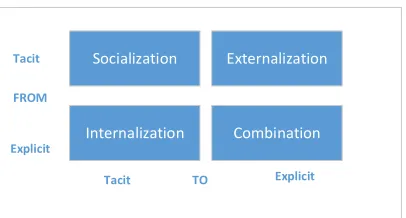
3017 combination, and internalization, (SECI) as shown in Figure 1. To transform Tacit knowledge into Explicit Knowledge an externalization process is required, whereas to transform Explicit Knowledge into tacit knowledge an internalization process is required.
Socialization Externalization
Internalization Combination
Tacit
FROM
Explicit
[image:4.612.93.296.171.280.2]Tacit TO Explicit
Figure 1: Tacit knowledge and Explicit knowledge conversion process
Knowledge transformation in XYZ company on the Asia Pacific classified into several points, namely:
a. Socialization
One of the processes of socialization between management and employees in the company is through face-to-face meetings (meeting, discussion, and monthly assembly) which considered to be less flexible. Through the face-to-face meeting, management and employees can share their knowledge and experience that they have so that new knowledge can be created and be developed. Periodical meetings and discussions must have minutes of meeting. The minutes of this meeting then become an explicit (documentation) form of knowledge. In the knowledge management system of which to be developed, Collaboration features, such as e-mail, electronic discussion, communities of practice allow an exchange of tacit knowledge which someone has so the employee can learn more and give birth to new ideas, creative, and innovative. By using KMS application, companies can encourage all the employee to use intranet and e-mail which considered can save more time and reduce expenditure. This is good to do because its useful for improving coordination, hasten activity, and cultivate the culture of learning from employees.
b. Externalization
The Knowledge Management System will greatly assist the externalization process of XYZ, where the process of articulating Tacit Knowledge will be a clear concept. Support toward externalization can be given by documenting minutes of meeting/meeting discussion result (an Explicit form of knowledge that created during the meeting or face-to-face) into an electronic form which is channeled through knowledge management system application so later it can be published to those who are authorized in the company. XYZ has already acquired an external part of the company to carry out a series of activities in accordance with their fields of expertise, which the company didn't have. By acquiring this external part, there will be a new knowledge in the company that can be studied, developed, and used to increase the employee knowledge.
c. Combination
The process of converting knowledge through combination is by combining all kinds of different Explicit Knowledge to be organized into Knowledge Management System. The use of media for this process can be from the internet which being used to obtain sources. Knowledge management system has features such as knowledge search and document storage will be more convenient in this process. The saved data in the system then will be analyzed especially for regional conditions data, financial, operational, and of strategic nature, such as creating performance indicators. As well as management content that Knowledge Management System application has which will have a function to process company information both structured (database) and unstructured (documents, reports, minutes) so it can support combination process which can improve the employee’s performance.
d. Internalization
3018 acquired from internet media, announcement letter or a decree, bulletin board, and mass media as an external source to assist system process which needs to have a tool to find and retrieve a document. Content management on Knowledge Management System, besides being used to assist combination process, can also be used to facilitate an internalization process, the trigger for this process is the application of "learning by doing". The features that the Knowledge Management System have will be very helpful for the internalization process to happen. In addition, education and training can change written lessons (Explicit Knowledge) into Tacit Knowledge for employee and can be shared through knowledge management system application.
Based on knowledge management cycle, it can be described that McElroy divides the process into two stages, namely, knowledge production and knowledge integration where there is experiential knowledge based on knowledge claims that are then formed and produce beliefs that trigger the cycle to restart. The two processes will be explained as follows:
a. Knowledge Production
At the stage of knowledge production, XYZ Indonesia tries to find solutions to problems that are being faced by carrying out various main processes or processes such as formulation, codification, and evaluation of organizational performance so that the organization will acquire new knowledge about the source of problems that have hindered organizational performance through group interaction and individuals in which knowledge claims are formed.
b. Knowledge Integration
At the stage of Knowledge Integration, the company introduces new knowledge to solve problems that are being faced by the company, so the company can do several ways that can provide new knowledge as a solution that has been previously processed by organizational knowledge addressed to knowledge workers.
Knowledge Management Cycle has its advantages in terms of categorizing, organizing and managing, and flexibility to be accessible again, so the concept cycle built on knowledge management is far better
and more encouraging innovation compared to the innovation cycle itself. In general, the knowledge management cycle contains the steps carried out in the company to create, store, distribute, and use the knowledge within the scope of the organization. In this case, the author chose McElroy Knowledge Management Cycle because it prioritizes business background as a cycle, suitable for implementing Knowledge Management System in XYZ Indonesia compared to other Knowledge Management Cycles.
Cultural factors hold a very important role in assisting the process of knowledge creation and the success of Knowledge Management in the company. Knowledge Sharing means that each employee realizes the importance of knowledge for the company, and together want to build company knowledge to become more competent, and willing to build a Knowledge Sharing culture within the company human resource to acquire an external resource. The features contained in the Knowledge Management System application have a function to facilitate search and etc.
The problem encountered by XYZ in the Asia Pacific, which is also felt by XYZ Indonesia currently is that there is no existing system that can help in documenting employees' improvement. This will cause a problem when there is an employee who has a large contribution to the development of the company. So The documentation that has been made could not be continued by the new employee who replaces the employee who quit
This can result in company business process become costlier in training the new employee and it also cost valuable time until the new employee learns and understand well, for example, an employee who has large contribution with the product. With the implementation of Knowledge Management System, it is felt that it will help in reducing this problem in detail, in reference from the last condition of the Knowledge Management activity at XYZ.
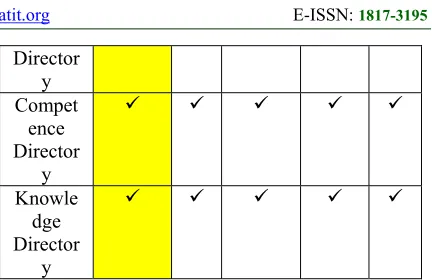
3019 To get the software that is more supportive and in accordance with the planning application features in the process of implementing Knowledge Management System in XYZ Indonesia there are some comparisons of software that can be described as follows:
Table 1: Comparison of software for Knowledge Management System Implementation
Compar ison
Share
Poin
t
Online
IBM
No
tes
Atl
asian
Confluence FreeNAS OpenK
M
Profile Change
Compan y History
Vision and Mission
Employ ee Data Arrange ment
Role Arrange
ment
Adminis tration Arrange ment
Docume nt Arrange
ment
Manage ment Arrange
ment
Project Arrange ment
Team Arrange
ment
Discussi on Forum
Knowle dge Search
Jobs
Director y Compet
ence Director
y
Knowle dge Director
y
From the five offered features of Knowledge Management Software, all of them are similar while also considering a few points such as necessity, functionality, as well as the availability of funds and infrastructure, writers choose SharePoint Online. The reasons for choosing SharePoint Online are caused by the limited work time and expended cost which, according to writers are not particularly relevant in its rent or purchase are IBM Notes and Confluence, another reason writers chooses SharePoint Online is due to flexibility level of software usage where on a few other software it is necessary to do coding before creating features such as IBM Notes, FreeNAS, and OpenKM, also the service given by SharePoint Online is Cloud based which could be accessed from the internet, giving convenience in building and utilization which will later be recommended to XYZ Indonesia. Sharepoint Online also provides features to support Knowledge management system needs to XYZ Indonesia with attractive Interface display. Definitions of cloud is defined by many experts, but the National Institute of Standards and Technology (NIST) definition is a generally accepted standard: “Cloud computing is a model for enabling convenient, on-demand network access to a shared pool of configurable computing resources (such as networks, servers, storage, applications, and services) that can be rapidly provisioned and released with minimal management effort or service provider interaction.”
3020 required security regulation and cloud conformity as needed.
Software voting has also been done based on budget or moderate expended cost, for the software rental it will cost IDR 136.000 per user/month. Sharepoint online has 3 packages which are rented out based on available features given. Writers choose Software package costing IDR 136.000 per user/month based on the system necessity at present moment.
Knowledge taxonomy analysis is a base of clarification to describe concepts as Hierarchical Model, aiming to identify all important Knowledge in the company. Knowledge which should be saved in knowledge management system assumed to be company’s intellectual asset. Knowledge owned by Asia Pacific region XYZ are explained in Figure 2 below.
Knowledge PT. Linksys Regional Asia
Pasifik
Forum
Questions & Answers
Calendar
Date & Time
Training Task
Schedule
Task Complete
Task On‐going Personal Message
Document
Event Article
Features
Form Library
Contact
Mailbox Company Profile
Personal Task Employee Profile
Product
Business
Report
Partnership Home
Vision, mission & Goal
Culture
Roles and Department
Team Cordination History
Notebook
Notes
News
Announcement
Location
Site Content
Site Document
Site Assets
Site Pages
Site Mailbox
[image:7.612.91.291.305.540.2]Knowledge Taxonomy PT. Linksys Regional Asia Pasifik
Figure 2. Knowledge Taxonomy of XYZ Indonesia
Knowledge Management (KM) is a joint intervention from human resources, process, and technology to advocate the process of Creation, Assimilation, Dissemination, and Application of knowledge within the company/organization environment. Knowledge creation is an improvement process of certain knowledge during the study process. Knowledge assimilation is a knowledge collecting, stocking, and selecting process created with existing knowledge. Knowledge dissemination is the process of accessing and distributing knowledge to be available and used in other types of jobs.
Knowledge application is the utilization of existing knowledge to support the disposal of existing problems. Knowledge is built or developed through experience process where such knowledge is applicable, the problem-solving process at work or in a project for instance. Therefore, it is a necessity to develop a systematic approach for the application of Knowledge management, and naturally, the said application could also be developed into a computer-based system so that the utilization of Knowledge management would be easier and systematic. An excellent way is by competence approach to construct the Knowledge management.
Each company/organization has an organizational structure to support company/organization activities and achieve the set targets. Organizational structure has certain jobs which are held by appointed workers to handle such jobs. To afford to complete jobs in an excellent manner, each of the jobs gave a description of the competencies required by workers to be able to carry out their tasks.
These competences are the factor which will shape the company’s/organization’s competence directory and will show the main focus of its business practices. The competencies will be connected to jobs, meaning one competence might be required by two different jobs and certainly at a different level of competence as well. On a side note, the existence of said competencies are limited to the availability of workers, in example sickness, deceased, mutation to another department, a shift in skills and knowledge, and/or switch to other companies. Therefore, every company/organization should be able to manage the key competencies present in the company to maintain its continuity and existence while also in a good shape and spot as a competitor.
Competencies that are a must-have on every job with different levels are directly affected by knowledge as a resource to support it. For that reason, Knowledge management is required by every company/organization to be able to encourage competence improvement of its workers, ensuring faster and better result of jobs done for the company/organization itself. Through competence-based knowledge management, then every worker will get the chance to learn from other workers experience when they fill in that new position.
3021 five key principles underlying the KMS development:
a. Online knowledge storing which can also be done online. Various knowledge could be published in digital form and, if necessary, printed on paper. Knowledge stored within the Intranet network, not in cabinets or boxes, because digitally converted knowledge will be far more efficient to maintain and simple to analyse, browse, update, and disseminate.
b. Ease up online knowledge access. Company/organization has the responsibility and obligation to all employees, so they have access to the knowledge required for their jobs.
c. Converting an employee into “Knowledge Worker”. Employees are expected to improve their skills while serving with internal or external customers so that employees could access the most accurate and up to date knowledge immediately. In this case, Web Technology could facilitate cultural change through knowledge and information supported environment, which could be easily accessed by all and shared one to another.
d. Teamwork to achieve goals. There’s a pressing need for a good teamwork between all members and/or
department within
company/organization
e. Relieving or reducing obstacles and giving examples. In the information era, the lead of company/organization should be proactive in encouraging workers to work as a team, and as such, the leader needs to give example or be a role model, to always openly share knowledge and information with every layer of personnel.
Web and Internet technology is a standard platform
which has been applied in the
company/organization environment, and this technology could support the key principles of KMS greatly and flexibly. Consequently, this technology is highly suitable for the development of Knowledge Management System (KMS) in Indonesia’s XYZ Company. Presented below is a
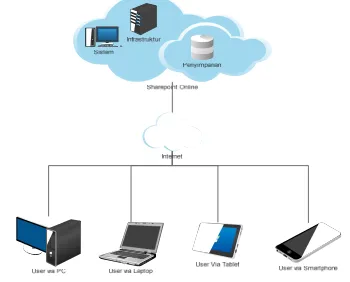
[image:8.612.330.505.153.294.2]picture of Network Diagram of Knowledge Management System of XYZ which explains the network flow diagram from users to the system.
Figure 3: Network Diagram Knowledge Management System
Figure 3 explains how users can access KMS in XYZ. Users can use Personal Computer (PC), Laptop, Tablet, and Smartphone. Establish internet connection by connecting the devices with available internet, be it from Access Point, Router or Modem. After connecting to the internet, users can then login by using their username and password to access KMS.
The utilization of internet connection and cloud is the current trend; however, a number of companies are reluctant to use them due to a couple of factors such as safety. The possibility of data leaks, documents or information stored in the cloud, from internet connection usage is one of the main concerned.
In response to the cloud problem, Microsoft as the developer of the used Tools which is Sharepoint Online, Microsoft has taken such concerns into considerations. Microsoft itself has added extra safety to Sharepoint Online in order to avoid those problems
.
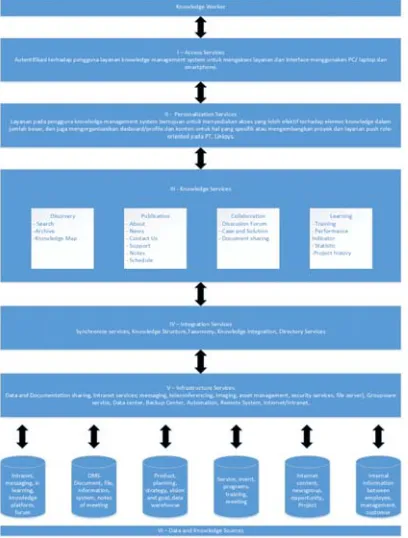
The architecture that researchers use in designing Knowledge Management Systems is Centralized Architecture that is often offered in an organization. This centralized architecture is oriented to the source of data contained in the KM server which is useful for integrating knowledge together into the company and providing services to knowledge workers.
3022 Learning), Personalization Services, and Access Services.
Figure 4: Knowledge Management System Architecture
The figure below showed the Knowledge Management System menu structure for XYZ company.
Figure5: Site Map of Knowledge management System (KMS)
The activity diagram in this study aims to see the response or process of the newly designed Knowledge Management System, to employees who register as new users and how the Knowledge Management System will respond.
[image:9.612.301.514.251.554.2]In the figure below, we will explain the flow of users of Knowledge Management System (employee: sales, sales promoter, sales technical, manager: sales manager, marketing manager, product manager, technical product manager, finance manager, IT admin, and system). New users will sign up to get the user name, then the IT admin will create a username based on the inputted data before. IT Admin and Managers in the knowledge management system are given access rights to create courses and upload material that can be viewed or downloaded by users.
Figure 6: Activity Diagram of new user for Knowledge Management System
3023
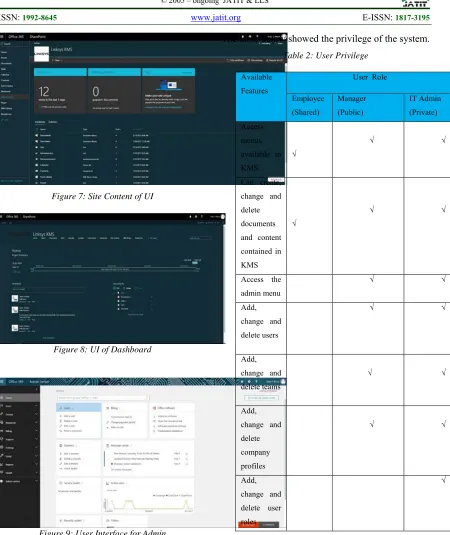
Figure 7: Site Content of UI
[image:10.612.92.542.61.596.2]Figure 8: UI of Dashboard
Figure 9: User Interface for Admin
The table below showed the privilege of the system.
Table 2: User Privilege
Knowledge sharing is the important aspect in knowledge management [18,19,20]. The lesson learned from this research is the knowledge sharing is the important foundation to implementing knowledge management system (as a tool). The important role of knowledge management is to improve the operation process in organization, rather than innovation in organization.
Available Features
User Role
Employee (Shared)
Manager (Public)
IT Admin (Private) Access
menus available in KMS.
√
√ √
Can create, change and delete documents and content contained in KMS
√
√ √
Access the admin menu
√ √
Add, change and delete users
√ √
Add, change and delete teams
√
√
Add, change and delete company profiles
√ √
Add, change and delete user roles
3024
4. CONCLUSION
After conducting an analysis and designing of Knowledge Management System towards XYZ Indonesia, some conclusions can be stated as follows:
1. In reducing the problem and analysis, it can be concluded that XYZ Indonesia requires a media to do learning and knowledge sharing between employees to improve their performance in the company.
2. The proposed Knowledge Management System is a service app with close source feature. The application of knowledge management system is the result of previously conducted analysis according to the company needs where all features are designed with the purpose of managing, storing, documenting, and distributing knowledge within the company and bringing up the culture of knowledge sharing and self-learning among employees.
3. With analysis development, it is known that existing knowledge will be applied into a knowledge management system as company’s intellectual asset to help employees to search for information regarding documents, notes, and past events which had been held like workshop and training, and company’s tacit knowledge based on employees experience and expertise
4. Based on the implementation result, the conclusion reached was that Knowledge Management in XYZ Indonesia could bring massive positive effects to employees in terms of managing knowledge within the company’s scope, internally and externally. Knowledge Management in the company is more than Knowledge storage but also contributes to the creation of Knowledge Culture within the company with the help of Knowledge Sharing. Thus, enabling employees to present better performance to handle problems with the help of designed Knowledge Management System.
After carrying out the analysis and design it can be said that knowledge is a valuable asset for the company, so it needs to be developed in terms of information dissemination to contribute more to the performance of company employees in addressing problems within the company. At this
time a solution and development of Knowledge Management System has been provided to run better as expected by the company.
The previous literature studies mentioned the organization culture impacting to knowledge management and adoption of KMS [21,22]. The contribution of this research related implementation of KMS is focus on how the organization need to aware about knowledge sharing process as a part of organization culture rather than the knowledge management tools (software)
REFRENCES:
[1] K. Dalkir, “Knowledge Management in Theory
and Practice”, Burlington: Elsevier, 2011.
[2] K. Zaheer, Y. K. Lew, and R. R. Sinkovics, “International joint ventures as boundary spanners: technological knowledge transfer in an emerging economy”, Global Strategy
Journal, Vol. 5, 2015, pp. 48–68.
[3] D. Yuntao, K. M. Bartol, Z. Zhang, and C. Li, “Enhancing employee creativity via individual skill development and team knowledge sharing: Influences of dual-focused transformational leadership”, Journal of
Organizational Behavior, Vol. 38, No. 4, 2017,
pp. 39–58.
[4] M. Chenghao, P. S. W. Fong, J. Luo, J. Zhong, and W. Huo, “When and how knowledge sharing benefits team creativity: The importance of cognitive team diversity”,
Journal of Management & Organization, 2017,
pp. 1–18.
[5] S. S. Yeon, D. H. Cho, and S. Kang, “The impact of close monitoring on creativity and knowledge sharing: The mediating role of leader-member exchange”, Creativity and
Innovation Management, Vol. 26, No. 2, 2017,
pp.56–65.
[6] C. Piera, R. Cerchione, and E. Esposito, “Knowledge management in startups: systematic literature review and future research agenda”, Sustainability, Vol. 9, No. 361, 2017. [7] J. Girard, “Defining knowledge management:
Toward an applied compendium”, J Appl
Knowl Manag, Vol. 3, 2015, pp. 1-20.
[8] K. Spiela and V.B. Kovac, “Individual, technological and organizational predictors of knowledge sharing in the Norwegian context”, International Journal of Management,
Knowledge and Learning, Vol. 6, 2017, pp.
5-26.
3025 review of Literature”, Library Philosophy and
Practice (e-journal), 2015, pp: 1-23.
[10]W.U., Rehman, N. Asghar, and K. Ahmad, “Impact of KM practices on firm’s performance: A mediating role of business process capabilities and organizational learning”, Pak Econ Soc Rev, Vol. 53, 2015, pp. 47-80.
[11]J. Paliszkiewicz, S. Svanadze, and M. Jikia, “The role of knowledge management processes on organizational culture”, J Appl Knowl
Manag, Vol. 5, 2017, pp. 29-44.
[12]A. Koohang, J. Paliszkiewicz, J. Gołuchowski, “The impact of leadership on trust, knowledge management, and organizational performance: A research model”, Ind Manage Data Syst, Vol. 117, 2017, pp. 521-537.
[13]S.A. Gürdal and I. Kumkale, “The relationship between organizational culture and knowledge sharing: Kirklareli sample of manufacturing sector IIB”, International Refereed Academic
Social Sciences Journal, Vol. 5, 2014, pp.
19-45.
[14]C. Piera, R. Cerchione, and E. Esposito, “Knowledge management in startups: systematic literature review and future research agenda”, Sustainability, Vol. 9, No. 361, 2017. [15]D. Yuntao, K. M. Bartol, Z. Zhang, and C. Li,
“Enhancing employee creativity via individual skill development and team knowledge sharing: Influences of dual-focused transformational leadership”, Journal of
Organizational Behavior, Vol. 38, 2017, pp.
439–458.
[16]M. Chenghao, P. S. W. Fong, J. Luo, J. Zhong, and W. Huo, “When and how knowledge sharing benefits team creativity: The importance of cognitive team diversity”,
Journal of Management & Organization, Vol.
18, 2017.
[17]S.S. Yeon, D.H. Cho, and S. Kang, “The impact of close monitoring on creativity and knowledge sharing: The mediating role of leader-member exchange”, Creativity and
Innovation Management, Vol. 26, 2017, pp.
256–265.
[18]X. L. Cui, “In- and extra-role knowledge sharing among information technology professionals: The five-factor model perspective”, International Journal of
Information Management, Vol. 37, 2017, pp.
380–389.
[19]D. Andrade, F. Ronnie, and V.N. Júlio, “Contributions of junior companies in an emerging market as collaborative partners for
sharing knowledge and innovation”, Business
Management Dynamics, Vol. 5, No. 12, 2016,
pp. 1–13.
[20]H. Hoarau and K. Carol, “Science and industry: Sharing knowledge for innovation”,
Annals of Tourism Research, Vol. 46, 2014,
pp. 44–61.
[21]K. Zaheer, Y. K. Lew, and R. R. Sinkovics, “International joint ventures as boundary spanners: technological knowledge transfer in an emerging economy”, Global Strategy
Journal, Vol. 5, 2015, pp. 48–68.
[22]K. Zaheer, O. Shenkar, and Y. K. Lew, “Knowledge transfer from international joint ventures to local suppliers in a developing economy”, Journal of International Business