ISSN: 1992-8645 www.jatit.org E-ISSN: 1817-3195
ARTIFACT REMOVAL IN ECG SIGNALS USING MODIFIED
DATA NORMALIZATION BASED SIGNAL ENHANCEMENT
UNITS FOR HEALTH CARE MONITORING SYSTEMS
1NAGESH MANTRAVADI, 2S.V.A.V. PRASAD, 3MD ZIA UR RAHMAN
1
Research scholar, DEPARTMENT OF ECE, LINGAYA’S UNIVERSITY, FARIDABAD, INDIA.
2
DEPARTMENT OF ECE, LINGAYA’S UNIVERSITY, FARIDABAD, INDIA.
3
DEPARTMENT OF ECE, KKR & KSR INISTITUTE OF TECHNOLOGY AND SCIENCE, VINJANAMPADU, GUNTUR AP, INDIA.
E-mail: 1 [email protected], 2 [email protected], 3 [email protected]
ABSTRACT
Low complexity noise cancellation structures are needed for reliable transmission of ECG signals at real time environments. These low complexity structures can be developed with the help of the partial update techniques for better convergence and complexity. In this paper the same idea is used to derive several structures which are good at convergence and complexity. Based on partial update mechanism of the coefficients of the adaptive filter, we upgraded the conventional normalized least mean square (NLMS) algorithm. This modified algorithm updates only some coefficients of the taps where the signal characteristics widely deviate from the previous iteration. The modified NLMS (MNLMS) based on partial update mechanism is combined with signum based algorithms to minimize number of multiplications during filtering process. Further, we proposed maximum value of data for normalizing the step size to decrease the number of multiplications in the denominator of the normalization function. These are suitable to operate at high data rate applications, and to test the working of these structures in real time conditions the MIT-BIH arrhythmia database was used. Here the signal to noise ratio, the miss adjustment error is used as performance measures and all the test data is tabulated. The structures have shown good performance over the standard LMS algorithm in terms of the filtering, complexity and convergence.
Keywords: Adaptive Noise Canceller, Artifacts, Computational Complexity, Convergence, ECG Signal.
1. INTRODUCTION
The cardiac signal obtained from an ECG device is an important source of information for identifying various heart abnormalities. It helps to prevent the death of large group of people who are facing the risk of sudden cardiac arrest and other heart related diseases. It is stated in [1] WHO report that 33% of people with non-communicable diseases are suffering with the cardiac problems. To overcome it the abnormalities in heart need to be identified quickly and accurately. But ECG suffers from artifacts which makes the identification of the abnormalities difficult and error prone. To overcome them filtering of the signal need to be done. The artifacts are of mainly four types and they mainly add to the signal due to the manmade and natural reasons. The power line interference which appears at the fundamental and harmonics of the power line frequency is an example of an artifact. The others are Base Line Wandering, Muscle artifact and motion artifact. The artifacts appear in the form of the spurious
amplitudes and combine with the minor and vital parts of ECG signal. It will be difficult to differentiate the noise and signal amplitudes at this stage. This makes the identification error prone. Challenges arise when less time is available for the diagnosis and also accuracy is required.
ISSN: 1992-8645 www.jatit.org E-ISSN: 1817-3195
The minimization of artifacts requires efficient removal techniques as well as accuracy in acquisition. To have the accuracy many proposals were made in the literature. They range from designing electrodes to developing the hardware. In [5] Nick Van Helleputte et.al proposed a motion artifact canceller at 345 µW technology. It uses the surface electrode – tissue impedance measurement for cancellation. The system has an onboard processing unit for artifact removal and other readouts. Base line wander occurs when the subject performs a physical activity. Generally the base line wander will add into the signal when the subject is breathing and its influence is seen in terms of the baseline drift in the signal. In case of continuous monitoring of activity the impact of base line wander will be more. Similarly in case of the ambulatory monitoring the risk of error will be more. Thomas N et.al in [6] implemented a tracking system for this purpose. Its purpose is to continuously track the drift and cancel it and prevent the saturation of the front end. An acquisition and classification system is seen in the work of [7] shuenn Yun Lee et.al. These days ECG was thought to be operated at all types of the everyday activities. As a result the above techniques can only limit the artifacts and it is necessary to cancel the artifacts beyond this limit. Filtering the signal is next to minimization methods for removing the artifacts. The well-known techniques like EMD, ICA, and DFT have been used for the non-adaptive filtering of the ECG signal. The ECG signal is composed of time varying potentials as a result the fixed co-efficient non-adaptive filters cannot be used. In addition to the signal the noise is also a random signal so using the adaptive filters helps to serve purpose. The adaptive and non-adaptive based proposals exist in the literature [8]–[13].The weights of an adaptive filter will adjust to the signal environment and as a result the noise removal will be high and the signal changes can be tracked easily and accurately.
The success of an adaptive filter depends on the weight vector initialization and how they are updated. Also the error depends on the method of step size adaption. The step size plays an important parameter in adaptive filtering. It controls the rate of convergence and the error. Good convergence rate requires large step size and the good error performance requires the low step size adaption. Noise cancellation of ECG with the help of the LMS algorithm is widely popular technique for adaptive filtering due to the less complexity involved. But as stated in [14] the LMS based
estimation is biased towards the signal power. The stability to the changes in the signal to noise ratio will be poor for an LMS.
ISSN: 1992-8645 www.jatit.org E-ISSN: 1817-3195
the performance of the proposed algorithms in ECG enhancement.
2. ALGORITHMS FOR ECG SIGNAL ENHANCEMENTUNIT IN A HEALTH CARE MONITORING SYSTEMS
In ECG signal enhancement the removal of artifacts is the key phenomenon. In this work we propose an adaptive filtering based signal enhancement unit (SEU) to eliminate various artifacts present in the ECG signals and to facilitate high resolution ECG signals for diagnosis. This SEU consists of a FIR filter of length “P”, adaptive algorithm to update filter coefficients in accordance to the input non-stationery signal and a comparator. Let x(n) be the input ECG signal. In principle, this cardiac activity contaminated with artifacts like power line interference (PLI), baseline wander (BW), muscle artifact (MA) and electrode motion artifact (EM). These artifacts contaminate the tiny features of ECG signal which are crucial for diagnosis. The contaminated ECG signal to be filtered is applied to an adaptive filter structure. In this paper the fundamental algorithm upon which derivatives want to make is the LMS algorithm. The filter coefficients during the updating will reduce the error and tries to cancel the noise in the signal as per the framework of N.V. Thakoor et.al [15]. Let s(n) is a reference signal, which is somewhat correlated with the artifact component present in the recorded ECG signal. O(n) is the output signal after enhancement. A sample of this O(n) is taken and is given as a feedback signal to the algorithm in the SEU. Let it be e(n). The artifact component in the ECG signal is designated as a(n). Therefore, x(n)=c(n)+a(n). Here, c(n) is the actual cardiac activity component. Let z(n) be the
filter coefficients.
Fig.1. A Typical Signal Enhancement Unit
The structure of a typical SEU is shown in the Fig.1.
The weight update relation of the basic LMS algorithm can be written as,
(1)
The NLMS algorithm was a LMS variant with the step size normalized. The variant was introduced to control the miss adjustment error that occurs due to the bad step size, and signal power. The equation for NLMS is given as below
(2)
The denominator of the equation is made to control the convergence with the squared regressor term. This provides the algorithm stability against the signal power. The term δ is used to avoid the stability problems when the signal contains the zero valued coefficients. Also, this behaves as the variant form of LMS due to the scaling of the step size and this improves the convergence. The constant in the denominator is introduced to prevent the algorithm to become unstable when the squared term tends to become zero. The above algorithm gives the reduced error, but the squared term in the denominator will increase the number of MAC operations, this increase the complexity and time to converge will increase. To reduce the number of computations in [16] a partial update based methodology is proposed to update only required tap coefficients rather than all taps of the filter, this yields a modified NLMS (MNLMS) algorithm.
Now the MNLMS mathematically represented as,
(3)
Where q = diag {Q} and Q = {1 if x > xmax}. The
ISSN: 1992-8645 www.jatit.org E-ISSN: 1817-3195
SMNLMS and SSMNLMS algorithms. The weight update equations are written as,
(4)
(5)
(6)
In the equations (3)-(6) the denominator of the normalization function requires “P” multiplications. When the filter length is large, the normalization function requires many multiplications. To avoid these excess multiplications we propose a normalization phenomenon, in which only the maximum value of input block is utilized for normalization. Using this block based approach only one multiplication is needed instead of “P” multiplications. This version is called as a block based MNLMS (BBMNLMS) algorithm. The hybrid versions of BBMNLMS with sign algorithms results SRBBMNLMS, SBBMNLMS and SSBBMNLMS algorithms. The weight update equations of these block based algorithms are given as,
(7)
(8)
(9)
Finally, using these algorithms several SEUs are developed and tested with real ECG signals obtained from MIT-BIH data base [20]-[21].
3. SIMULATION RESULTS
In a typical signal enhancement unit generally adaptive filters are used for artefact elimination. But, the drawback of conventional adaptive filters is, it need to update all the tabs. This increases the computational burden to the filter. In order to avoid this, we propose a modified NLMS algorithm which updates the tap coefficients when the corresponding data value changes more. Otherwise the particular coefficients are not updated. In this section several experiments are performed to test
the developed ANCs in cardiac signal enhancement. The noisy cardiac signals are taken from MIT-BIH arrhythmia database [20]-[21]. The MIT-BIH Arrhythmia Database contains 48 half-hour excerpts of two-channel ambulatory CS recordings, obtained from 47 subjects studied by the BIH Arrhythmia Laboratory ages 23 years to 89 years. Twenty-three recordings were chosen at random from a set of 4000 24-hour ambulatory CS recordings collected from a mixed population of inpatients (about 60%) and outpatients (about 40%) at Boston's Beth Israel Hospital; the remaining 25 recordings were selected from the same set to include less common but clinically significant arrhythmias that would not be well-represented in a small random sample. The ECG recordings were made using Del Mar Avionics model 445 two-channel reel-to-reel Holter recorders, and the analog signals were recreated for digitization using a Del Mar Avionics model 660 playback unit [22]-[23]. In our experiments we have considered a dataset of five cardiac activity records: data101, data102, data103, data104 and data105 to ensure the consistency of results, the simulation results for data 101 are shown in this paper. In these experiments we have used first 4000 samples of the CS. All the experiments were performed for 10 times and average values are tabulated. The length of the adaptive filter is chosen as 10, a random noise of variance 0.001 is added to the signals, which resembles the channel noise. For evaluating the performance of the proposed ANC structures we have measured the signal-to-noise ratio improvement (SNRI) in decibels (dBs) and EMSE.
3.1. Performance of SEU in Power Line Interference Elimination from ECG Signal
In this experiment we prove the ability of the proposed ANCs in eliminating the PLI artifact. The noisy cardiac signal with PLI noise is given as
input to the ANC as shown in the Fig. 1. A synthetic PLI with 60Hz frequency is given as
ISSN: 1992-8645 www.jatit.org E-ISSN: 1817-3195
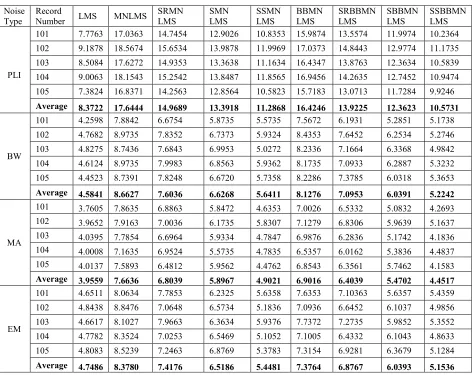
application of sign regressor operation SRMNLMS needs less number of multiplications during the enhancement process. This algorithm achieves 14.9689dB SNRI. Further, using maximum data value normalization BBMNLMS and its sign regressor version needs reduced number of multiplications in the enhancement process than VNLMS and its sign regressor version. But , this technique needs a reference signal. This is the
drawback of the proposed technique. Therefore, based on SNRI, EMSE and number of multiplications among all the considered algorithms SRBBMNLMS based SEU performs better with tolerable SNRI. Hence, this algorithm can be used in practical remote health care monitoring systems for cardiac signal enhancement.
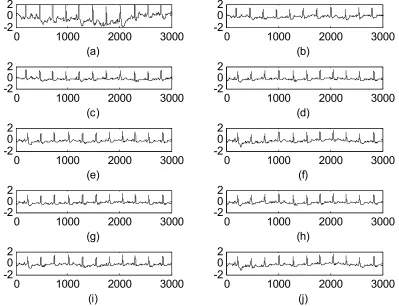
Fig.2. PLI Filtering results a) Cardiac Signal with Power Line Interference, b) Filtering with LMS, c) Filtering with MNLMS, d) Filtering with BBMNLMS, e) Filtering with SRMNLMS, f) Filtering with SRBBMNLMS, g) Filtering
with SMNLMS, h) Filtering with SBBMNLMS, i) Filtering with SSMNLMS, j) Filtering with SSBBMNLMS.
3.2. Performance of SEU in Baseline Wander Elimination from ECG Signal
In this experiment we prove the ability of the proposed SEUs in eliminating the BW artifact. The noisy cardiac signal with BW noise is given as input to the SEU as shown in the Fig. 1.A real base line wander artifact is taken as reference obtained from MIT-BIH data base. The noise cancellation experiments are performed using the algorithms discussed in the previous section. For comparison we also implement LMS based SEU. The
experiments are performed on the dataset consists of five records. The enhancement results are shown
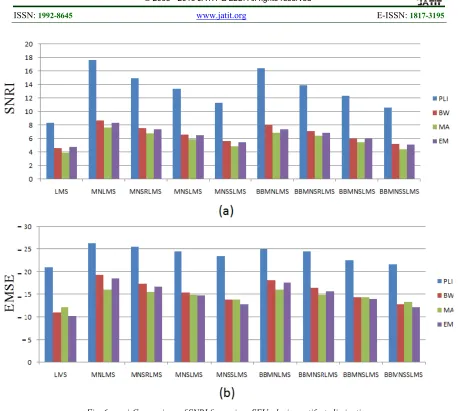
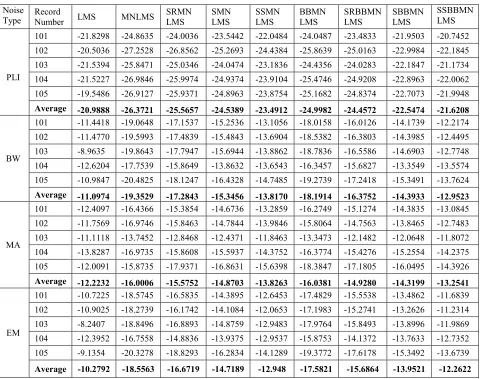
in Fig. 3. The parameters SNRI and EMSE are taken as measures of performance. These are tabulated in Table I and Table II. Fig. 6 shows the comparison of these performance measures. In our experiments, among the considered algorithms it is found that MNLMS algorithm achieves highest SNRI 8.6627dB. However, based on the application of sign regressor operation SRMNLMS needs less number of multiplications during the enhancement process. This algorithm achieves 7.6036 dB SNRI. Further, using maximum data
0
1000
2000
3000
4000
-2
0
2
(a)
0
1000
2000
3000
4000
-2
0
2
(b)
0
1000
2000
3000
4000
-2
0
2
(c)
0
1000
2000
3000
4000
-2
0
2
(d)
0
1000
2000
3000
4000
-2
0
2
(e)
0
1000
2000
3000
4000
-2
0
2
(f)
0
1000
2000
3000
4000
-2
0
2
(g)
0
1000
2000
3000
4000
-2
0
2
(h)
0
1000
2000
3000
4000
-2
0
2
(i)
0
1000
2000
3000
4000
-2
0
2
ISSN: 1992-8645 www.jatit.org E-ISSN: 1817-3195
value normalization BBMNLMS and its sign regressor version needs reduced number of multiplications in the enhancement process than MNLMS and its sign regressor version. Therefore, based on SNRI, EMSE and number of multiplications among all the considered
algorithms SRBBMNLMS based SEU performs better with tolerable SNRI. Hence, this algorithm can be used in practical remote health care monitoring systems for cardiac signal enhancement.
Fig.3. BW Filtering results a) Cardiac Signal with base line wander, b) Filtering with LMS, c) Filtering with MNLMS, d) Filtering with BBMNLMS, e) Filtering with SRMNLMS, f) Filtering with SRBBMNLMS, g) Filtering
with SMNLMS, h) Filtering with SBBMNLMS, i) Filtering with SSMNLMS, j) Filtering with SSBBMNLMS.
3.3. Performance of SEU in Muscle Artifact Elimination from ECG Signal
In this experiment we prove the ability of the proposed SEUs in eliminating the muscle artifact (MA). The noisy cardiac signal with MA noise is given as input to the SEU as shown in the Fig. 1. A real MA is taken as reference obtained from
MIT-BIH data base. The noise cancellation experiments are performed using the algorithms discussed in the previous section. For comparison
we also implement LMS based SEU. The experiments are performed on the dataset consists of five records. The enhancement results are shown in Fig. 4. The parameters SNRI and EMSE are taken as measures of performance. These are tabulated in Table I and Table II. Fig. 6 shows the comparison of these performance measures. In our experiments, among the considered algorithms it is found that MNLMS algorithm achieves highest SNRI 7.6636dB. However, based on the application of sign regressor operation SRMNLMS needs less number of multiplications during the enhancement process. This algorithm achieves 6.8039 dB SNRI. Further, using maximum data
0
1000
2000
3000
-2
0
2
(a)
0
1000
2000
3000
-2
0
2
(b)
0
1000
2000
3000
-2
0
2
(c)
0
1000
2000
3000
-2
0
2
(d)
0
1000
2000
3000
-2
0
2
(e)
0
1000
2000
3000
-2
0
2
(f)
0
1000
2000
3000
-2
0
2
(g)
0
1000
2000
3000
-2
0
2
(h)
0
1000
2000
3000
-2
0
2
(i)
0
1000
2000
3000
-2
0
2
ISSN: 1992-8645 www.jatit.org E-ISSN: 1817-3195
value normalization BBMNLMS and its sign regressor version needs reduced number of multiplications in the enhancement process than MNLMS and its sign regressor version. Therefore, based on SNRI, EMSE and number of multiplications among all the considered
algorithms SRBBMNLMS based SEU performs better with tolerable SNRI. Hence, this algorithm can be used in practical remote health care monitoring systems for cardiac signal enhancement.
Fig.4. MA Filtering results a) Cardiac Signal with muscle artifacts, b) Filtering with LMS, c) Filtering with MNLMS, d) Filtering with BBMNLMS, e) Filtering with SRMNLMS, f) Filtering with SRBBMNLMS, g) Filtering with
SMNLMS, h) Filtering with SBBMNLMS, i) Filtering with SSMNLMS, j) Filtering with SSBBMNLMS.
0
1000
2000
3000
-2
0
2
(a)
0
1000
2000
3000
-2
0
2
(b)
0
1000
2000
3000
-2
0
2
(c)
0
1000
2000
3000
-2
0
2
(d)
0
1000
2000
3000
-2
0
2
(e)
0
1000
2000
3000
-2
0
2
(f)
0
1000
2000
3000
-2
0
2
(g)
0
1000
2000
3000
-2
0
2
(h)
0
1000
2000
3000
-2
0
2
(i)
0
1000
2000
3000
-2
0
2
ISSN: 1992-8645 www.jatit.org E-ISSN: 1817-3195
3.4. Performance of SEU in Electrode Motion Artifact Elimination from ECG Signal
In this experiment we prove the ability of the proposed SEUs in eliminating the EM artifacts. The noisy cardiac signal with EM noise is given as input to the SEU as shown in the Fig. 1. A real EM is taken as reference obtained from MIT-BIH data base. The noise cancellation experiments are performed using the algorithms discussed in the previous section. For comparison we also implement LMS based SEU. The experiments are performed on the dataset consists of five records. The enhancement results are shown in Fig. 5. The parameters SNRI and EMSE are taken as measures of performance. These are tabulated in Table I and Table II. Fig. 6 shows the comparison of these performance measures. In our experiments, among
the considered algorithms it is found that MNLMS algorithm achieves highest SNRI 8.3780dB. However, based on the application of sign regressor operation SRMNLMS needs less number of multiplications during the enhancement process. This algorithm achieves 7.4176dB SNRI. Further, using maximum data value normalization BBMNLMS and its sign regressor version needs reduced number of multiplications in the enhancement process than BBMNLMS and its sign regressor version. Therefore, based on SNRI, EMSE and number of multiplications among all the considered algorithms SRBBMNLMS based SEU performs better with tolerable SNRI. Hence, this algorithm can be used in practical remote health care monitoring systems for cardiac signal enhancement.
Fig.5. EM Filtering results a) Cardiac Signal with muscle artifacts, b) Filtering with LMS, c) Filtering with MNLMS, d) Filtering with BBMNLMS, e) Filtering with SRMNLMS, f) Filtering with SRBBMNLMS, g) Filtering with
SMNLMS, h) Filtering with SBBMNLMS, i) Filtering with SSMNLMS, j) Filtering with SSBBMNLMS.
0
1000
2000
3000
-2
0
2
(a)
0
1000
2000
3000
-2
0
2
(b)
0
1000
2000
3000
-2
0
2
(c)
0
1000
2000
3000
-2
0
2
(d)
0
1000
2000
3000
-2
0
2
(e)
0
1000
2000
3000
-2
0
2
(f)
0
1000
2000
3000
-2
0
2
(g)
0
1000
2000
3000
-2
0
2
(h)
0
1000
2000
3000
-2
0
2
(i)
0
1000
2000
3000
-2
0
2
[image:8.612.112.511.312.618.2]ISSN: 1992-8645 www.jatit.org E-ISSN: 1817-3195
[image:9.612.77.535.66.477.2]ISSN: 1992-8645 www.jatit.org E-ISSN: 1817-3195
Table I: Performance Contrast Of Various Algorithms In Terms Of Snri For The Removal Of Artifacts From Ecg Signals
(All Values In Dbs)
Noise Type
Record
Number LMS MNLMS
SRMN LMS
SMN LMS
SSMN LMS
BBMN LMS
SRBBMN LMS
SBBMN LMS
SSBBMN LMS
PLI
101 7.7763 17.0363 14.7454 12.9026 10.8353 15.9874 13.5574 11.9974 10.2364
102 9.1878 18.5674 15.6534 13.9878 11.9969 17.0373 14.8443 12.9774 11.1735
103 8.5084 17.6272 14.9353 13.3638 11.1634 16.4347 13.8763 12.3634 10.5839
104 9.0063 18.1543 15.2542 13.8487 11.8565 16.9456 14.2635 12.7452 10.9474
105 7.3824 16.8371 14.2563 12.8564 10.5823 15.7183 13.0713 11.7284 9.9246
Average 8.3722 17.6444 14.9689 13.3918 11.2868 16.4246 13.9225 12.3623 10.5731
BW
101 4.2598 7.8842 6.6754 5.8735 5.5735 7.5672 6.1931 5.2851 5.1738
102 4.7682 8.9735 7.8352 6.7373 5.9324 8.4353 7.6452 6.2534 5.2746
103 4.8275 8.7436 7.6843 6.9953 5.0272 8.2336 7.1664 6.3368 4.9842
104 4.6124 8.9735 7.9983 6.8563 5.9362 8.1735 7.0933 6.2887 5.3232
105 4.4523 8.7391 7.8248 6.6720 5.7358 8.2286 7.3785 6.0318 5.3653
Average 4.5841 8.6627 7.6036 6.6268 5.6411 8.1276 7.0953 6.0391 5.2242
MA
101 3.7605 7.8635 6.8863 5.8472 4.6353 7.0026 6.5332 5.0832 4.2693
102 3.9652 7.9163 7.0036 6.1735 5.8307 7.1279 6.8306 5.9639 5.1637
103 4.0395 7.7854 6.6964 5.9334 4.7847 6.9876 6.2836 5.1742 4.1836
104 4.0008 7.1635 6.9524 5.5735 4.7835 6.5357 6.0162 5.3836 4.4837
105 4.0137 7.5893 6.4812 5.9562 4.4762 6.8543 6.3561 5.7462 4.1583
Average 3.9559 7.6636 6.8039 5.8967 4.9021 6.9016 6.4039 5.4702 4.4517
EM
101 4.6511 8.0634 7.7853 6.2325 5.6358 7.6353 7.10363 5.6357 5.4359
102 4.8438 8.8476 7.0648 6.5734 5.1836 7.0936 6.6452 6.1037 4.9856
103 4.6617 8.1027 7.9663 6.3634 5.9376 7.7372 7.2735 5.9852 5.3552
104 4.7782 8.3524 7.0253 6.5469 5.1052 7.1005 6.4332 6.1043 4.8633
105 4.8083 8.5239 7.2463 6.8769 5.3783 7.3154 6.9281 6.3679 5.1284
ISSN: 1992-8645 www.jatit.org E-ISSN: 1817-3195
Table Ii
Performance Contrast Of Various Algorithms In Terms Of Emse For The Removal Of Artifacts From Ecg Signals
(All Values In Dbs)
Noise Type
Record
Number LMS MNLMS
SRMN LMS
SMN LMS
SSMN LMS
BBMN LMS
SRBBMN LMS
SBBMN LMS
SSBBMN LMS
PLI
101 -21.8298 -24.8635 -24.0036 -23.5442 -22.0484 -24.0487 -23.4833 -21.9503 -20.7452
102 -20.5036 -27.2528 -26.8562 -25.2693 -24.4384 -25.8639 -25.0163 -22.9984 -22.1845
103 -21.5394 -25.8471 -25.0346 -24.0474 -23.1836 -24.4356 -24.0283 -22.1847 -21.1734
104 -21.5227 -26.9846 -25.9974 -24.9374 -23.9104 -25.4746 -24.9208 -22.8963 -22.0062
105 -19.5486 -26.9127 -25.9371 -24.8963 -23.8754 -25.1682 -24.8374 -22.7073 -21.9948
Average -20.9888 -26.3721 -25.5657 -24.5389 -23.4912 -24.9982 -24.4572 -22.5474 -21.6208
BW
101 -11.4418 -19.0648 -17.1537 -15.2536 -13.1056 -18.0158 -16.0126 -14.1739 -12.2174
102 -11.4770 -19.5993 -17.4839 -15.4843 -13.6904 -18.5382 -16.3803 -14.3985 -12.4495
103 -8.9635 -19.8643 -17.7947 -15.6944 -13.8862 -18.7836 -16.5586 -14.6903 -12.7748
104 -12.6204 -17.7539 -15.8649 -13.8632 -13.6543 -16.3457 -15.6827 -13.3549 -13.5574
105 -10.9847 -20.4825 -18.1247 -16.4328 -14.7485 -19.2739 -17.2418 -15.3491 -13.7624
Average -11.0974 -19.3529 -17.2843 -15.3456 -13.8170 -18.1914 -16.3752 -14.3933 -12.9523
MA
101 -12.4097 -16.4366 -15.3854 -14.6736 -13.2859 -16.2749 -15.1274 -14.3835 -13.0845
102 -11.7569 -16.9746 -15.8463 -14.7844 -13.9846 -15.8064 -14.7563 -13.8465 -12.7483
103 -11.1118 -13.7452 -12.8468 -12.4371 -11.8463 -13.3473 -12.1482 -12.0648 -11.8072
104 -13.8287 -16.9735 -15.8608 -15.5937 -14.3752 -16.3774 -15.4276 -15.2554 -14.2375
105 -12.0091 -15.8735 -17.9371 -16.8631 -15.6398 -18.3847 -17.1805 -16.0495 -14.3926
Average -12.2232 -16.0006 -15.5752 -14.8703 -13.8263 -16.0381 -14.9280 -14.3199 -13.2541
EM
101 -10.7225 -18.5745 -16.5835 -14.3895 -12.6453 -17.4829 -15.5538 -13.4862 -11.6839
102 -10.9025 -18.2739 -16.1742 -14.1084 -12.0653 -17.1983 -15.2741 -13.2626 -11.2314
103 -8.2407 -18.8496 -16.8893 -14.8759 -12.9483 -17.9764 -15.8493 -13.8996 -11.9869
104 -12.3952 -16.7558 -14.8836 -13.9375 -12.9537 -15.8753 -14.1372 -13.7633 -12.7352
105 -9.1354 -20.3278 -18.8293 -16.2834 -14.1289 -19.3772 -17.6178 -15.3492 -13.6739
Average -10.2792 -18.5563 -16.6719 -14.7189 -12.948 -17.5821 -15.6864 -13.9521 -12.2622
4. CONCLUSIONS
In this paper several signal enhancement units for health care monitoring systems are presented. These are based on partial update based normalized LMS algorithm and its variants. The variations are based on signed versions of MNLMS algorithm. Further, we reduce the computational complexity by using block based normalization with maximum value of data vector. This reduces the computational complexity of the denominator of the normalization operation. The hybrid version of MNLMS and sign regressor algorithm needs minimum number of computations among the considered algorithms. Therefore, based on our simulation results and computed performance measures, it is clear that
among all the considered algorithms SRBBMNLMS based ANC performs better than the counter parts, even though it is just inferior to MNLMS, SRMNLMS and BBMNLMS due to reduced number of multiplications in the enhancement process. Hence, this implementation is well suited for remote health care monitoring systems in clinical environment.
REFERENCES
[1]. Report on Non-Communicable Diseases, 2014, WHO.
ISSN: 1992-8645 www.jatit.org E-ISSN: 1817-3195
Infraction”, American College of Cardiology,
1994, vol 23, no 4. Pp.885-890.
[3]. J.M. Dekker, E.G. Schouten, “ST Segment and T wave Characteristics as Indicators of
Coronary Heart Disease Risk: The Zutphem
study”, American College of Cardiology 1995, vol 25, No.6.
[4]. A. Elhendy, Ron. T, Jeoen. J, “The significance of stress induced ST segment Depression in patients with Inferior Q wave
Myocardial Infraction”, Journal of American
college of Cardiology, vol.33, no.7,1999, pp.1909-1915.
[5]. N.V.Helleputte, K. Mario, “ A 345µW” multi sensor Biomedical SoC Bio Impedance, 3-Channel ECG, Motion Artifact Reduction and
Integrated DSP”, IEEE Journal of Solid state
Circuits vol.50, No.1, 2015, pp.230-244. [6]. Thomas. N, T Marias, Lukas, “A baseline
wander tracking system for artifact Rejection
in Long Term ECG”, IEEE Transactions on
Biomedical circuits and systems, 2015. [7]. Shuenn Yuh Lee, Jia Hua Hong, “Low power
wireless ECG acquisition and Classification
system for Body Sensor Networks, ”IEEE
Journal of Biomedical Informatics, vol.19,no.1, 2015, pp.236-246.
[8]. A. K. Ziarani and A. Konrad, “A nonlinear adaptive method of elimination of power line
interference in ECG signals,” IEEE
Transactions on Biomedical Engineering, vol. 49, no. 6, pp. 540–547, Jun. 2002
[9]. M.B. Velasco, Binemi Weng, K.E. Barner,
“ECG Signal denoising and baseline wander correction based on the Empirical; mode
decomposition”, Computers in Biology and
Medicine, 2008, pp.1-13.
[10]. A.K. Barros, M. Yoshizawa, Y. Yasuda,
Filtering non-correlated noise in impedance
cardiography, IEEE Transactions on
Biomedical Engineering 42, 1995, pp.324– 327.
[11]. Brouse, G.A. Bumont, F.J. Herrmann, J.M. Ansermino, A wavelet approach to
detecting electrocautery noise in the ECG,
IEEE Engineering in Medicine and Biology Magazine 25 (4) (2006) 76–82
[12]. C. Meyer, J.F. Gavela, M. Harris,
Combining algorithms in automatic
detection of QRS complexes in ECG signals,
IEEE Transactions on Information Technology in Biomedicine vol.10, no.3, 2006, pp.468–475.
[13]. M. Kotas, Application of projection pursuit based robust principal component analysis
to ECG enhancement, Biomedical Signal
Processing and Control, 2006, pp.289–298 [14]. S. Olmos, P. Laguna, Steady-state MSE
convergence analysis in LMS adaptive filters with deterministic reference inputs
for biomedical signals, IEEE Transactions
on Signal Processing 48 2000 pp.2229– 2241
[15]. N.V. Thakor, Y.S. Zhu, “Applications of Adaptive Filtering to ECG Analysis: Noise Cancellation and Arrhythmia Detection”,
IEEE Transactions on Biomedical Engineering, vol.38,no.8, 1991, pp.785-794 [16]. Andy W.H. Khong, Wong Seng Gan,
Patrick A. Naylor, “A Low Complexity Fast
Converging partial update adaptive
algorithm employing variable step size for
acoustic echo cancellation”, IEEE 2008,
PP.237-240.
[17]. Md. Zia Ur Rahman, G.V.K.S. Karthik, S.Y. Fathima, A.L-Ekukaille, “An efficient cardiac signal enhancement using time-frequency realization of leaky adaptive
noise cancelers for remote health
monitoring systems”, Measurements, vol
46, 2013, pp.3815-3835.
[18]. Md. Zia Ur Rahman, Rafi Ahmed Shaik, D.V. Rama Koti Reddy, “Efficient and simplified Adaptive Noise Cancelers for
ECG sensor Based Remote Health
Monitoring”, IEEE Sensors Journal, vol.91,
no.3, 2012, pp.566-573.
[19]. Md. Zia Ur Rahman, Rafi Ahamed Shaik, D.V. Ramakoti Reddy, Efficient sign based normalized adaptive filtering techniques for cancelation of artifacts in ECG signals:
Application to wireless biotelemetry”,
Signal processing vol.91, 2011, pp.225-239. [20]. Physio Net, the Massachusetts Institute of
Technology - Boston's Beth Israel Hospital
(MIT-BIH) Arrhythmia Database, http://www.physionet.org/physiobank/datab ase/mitdb/ (Online).
[21]. The MIT-BIH Normal Sinus Rhythm Database Available at
http://www.physionet.org/physiobank/datab ase/nsrdb/ (Online).
[22]. Mark RG and Moody GB, “The Impact of
the MIT Arrhythmia Database”, IEEE
Engineering in Medicine and Biology, vol. 20, no. 3, June, 2001, pp. 45-50.
[23]. Moody GB, Mark RG. The MIT-BIH Arrhythmia Database on CD-ROM and
software for use with it. Computers in