WEB-EXPERT SYSTEM FOR THE DETECTION OF EARLY
SYMPTOMS OF THE DISORDER OF PREGNANCY USING
A FORWARD CHAINING AND BAYESIAN METHOD
1HELIZA RAHMANIA HATTA, 2FITRIA ULFAH, 3DYNA MARISA KHAIRINA,
4*
HAMDANI HAMDANI, 5SEPTYA MAHARANI
1,2,3,4,5
Department of Computer Science, Faculty of Computer Science and Information Technology,
Mulawarman University, Jalan Barong No. 6 Samarinda, East Kalimantan, Indonesia
E-mail: [email protected], [email protected], [email protected],
4*
[email protected], [email protected]
ABSTRACT
Web-Expert system (Web-ES) is used to recognize the symptoms early in women pregnancy disorders. Every pregnancy risk factors will endanger the safety of the mother and the baby, if the information obtained is less in the treatment of pregnancy disorder. This study aims to build web-based expert systems (ES), such as a doctor or a patient to diagnose pregnancy in any place, so it can help women to know about the symptoms of pregnancy disorder. ES is analyzed using forward chaining (FC) method and the Bayesian theorems. One of the Techniques that has been used to make a decision tree, then does a search with FC and the calculation of the probability by Bayesian. Based on the selected input symptoms dataset used 35 patients, the results of a pregnancy disorder which have the highest risk of disruption in eclampsia, with a value of 97% and the suitability of 82.86% system accuracy. Subsequent research, we perform hybrid Bayesian theorem and FC with fuzzy-neural network environments to produce values higher accuracy and will also make a decision in group clinical results.
Keywords: Pregnancy disorders, Web, Expert System, Forward Chaining, Bayesian Theorem
1. INTRODUCTION
An expert system (ES) aims to replace human knowledge, such as health experts, agricultural experts, etc [1]–[4]. Where data is recorded on computers to solve problems that typically require the specific expertise of the experts [1]. The basic concept of ES includes fundamental issues, such as the conduct of human knowledge transfer to the inference engine [4], [5]. The inference engine is a computer program that provides a methodology for reasoning about the information on the basis of knowledge and workplace in formulating conclusions [6].
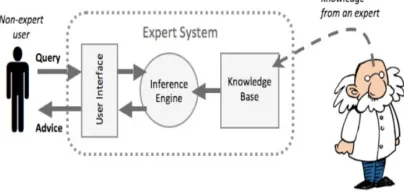
ES composed by two main parts, namely the development environment and environmental consultancy. The development environment is used to enter into the development of environmental experts ES [2], [4], [5], [7], [8]. Environmental consulting on ES is used by non-experts to gain knowledge and expert advice. ES generally do not contain the component repair-knowledge [5]. In
Figure 1 ES can be described in general in the process of utilization.
Figure 1: Interaksi umum expert dengan user pada ES. http://www.igcseict.info/theory/7_2/expert/
[image:1.612.318.520.520.616.2]Pregnancy is a natural thing happens a woman, to a disorder that occurs in pregnant women sometimes bring harm to the developing fetus, such as high-risk in the birth process [10]– [12]. ES requires information about the various symptoms experienced by women during pregnancy to giving a decision on the patient's symptoms are felt first aid [9], [13], [14]. Effective ES is an application that provides information and decisions based on the knowledge base are processed in computing [1], [8].
The problems faced are factors such as lack of information and knowledge about the disorder that occurs during pregnancy [9], [15]. The existence of proper knowledge for a pregnant woman can have an impact on reducing the number of maternal and infant mortality [12]. So, we need a system of knowledge as information for women who undergo pregnancy until the birth process.
Lessons that are given should be easy to understand and can be learned, while pregnant women are uninformed to overcome the problems that experienced, furthermore require consultation with an expert who specializes in the field of content [10], [11]. Is to broaden the knowledge in maintaining health during pregnancy and subsequent prevention of mother [11]. It takes also a means of learning about the pregnancy did not waste a lot of time and cost and may be consulted as needed, such as clinical ES [12], [15].
This study uses Bayesian theorem, a theorem with two different interpretations. The Bayesian theorem is a good method in knowledge engine based on the training data using conditional probability as a base system [1], [7]. The Bayesian theorem is also a method for generating parameter estimation by combining information from samples and other information that has been provided previously [16]. The main advantages in the use of Bayesian is a simplification of a classical way full integral to obtain marginal model [5].
Based on previous research, Bayesian methods can be used on machines with the conditional probability of knowledge as the basis of formula [17]. The Bayesian method estimates the parameters by combining information and samples and information, such as the comparison made by [17], [18]. The main advantages of the use of the Bayesian method is a simplification of a classical way full integral to obtain marginal model [5], [6]. ES uses 10 groups of symptoms from experts with forward chaining (FC) and Bayesian methods for diagnosis of disorders of pregnancy.
The results of the study are expected to help patients such as pregnant women or mothers
who are preparing for pregnancy, so it can find the appropriate rule base pregnancy disorders from experts and hospitals.
This paper is organized as follows; We describe the related work in Section 2, proposed method is presented in Section 3. Section 4 presents our experimental discussion and results. Finally, Section 5 concludes the paper and future work research.
2. RELATED WORK
The results of studies related to the expert system (ES) is also available on the web-based clinical ES [3], [8], [19]–[21], development of ES using Bayesian Networks (BNs) methods [2], [5], [16], [22], BNs with fuzzy system [1], [23], ES for hypertension [24], hypertensive disorders of pregnancy [9], ES for personality disorders [25] and problems in the diagnosis and detection on ES are also present in [26]–[29].
The paper [3] to build web-based ES to facilitate the interaction of patients and physicians called WebMAC. Applications working WebMAC cloud-based system in response to the users of the system is used to connect datasets to a decision-making system use proposed method is BM2-BagWeight. The paper [21] develop validity of expert system for diagnosis using method of certainty factor (CF) and best first search (BFS) based application. The paper [19] use a web-based ES of swine disease diagnosis with CF method. The paper [8] web-based expert system for diagnosis and management of kidney diseases. Meanwhile, [20] work to ES based on web for fault diagnosis.
The paper [2] diagnosis ES using BNs for the field of otolaryngology and have no shortage of web-based. BNs in [16] present a mechanism to construct discrete-time versions of hybrid models and an EM-based algorithm to learn the parameters of the resulting BN. In this paper [16] present a novel class of models, called hybrid time BNs, which combine discrete-time, continuous-time BNs and an EM-based algorithm to learn the parameters of the resulting BN. The paper [22] make maintenance of a BNs for an application using a medical diagnosis. Whereas in [6] integrating expert knowledge with data in BNs. This paper provides a method for eliciting expert judgment that ensures the expected values of a data variable are preserved under all the known conditions.
(LHNFCSF). Whereas in [23] build for fuzzy probability calculation with confidence intervals in BNs and and represents knowledge more explicitly than determining fuzzy probabilities based only on the expert opinion in BNs with combining the method triangular shaped fuzzy numbers (TSFNs).
The paper [24] take on ES for the diagnosis of disease in hypertension using reduced rules base method. The aim was to determine the disease by taking all symptoms of hypertension into account in the Medical Expert System (MES) (7 symptoms, 27=128 different conditions). In this new MES procedure, instead of checking all the symptoms, the reduced rule bases were used. While hypertensive disorders of pregnancy contained on [9] for data collection, analysis, and presentation of immunization safety data and using data in https://brightoncollaboration.org/public/what-we-do/setting-standards/case-definitions/groups.html.
The paper [25] perform development of diagnosis expert system for personality disorders using CF and rule base method. The paper for the diagnosis and detection on ES [26], in this study presents a web-based system, which integrates a full and detailed set of services and functionalities for clinical decision support.
The paper [27], the diagnosis of the VRF system using a Bayesian neural network combined with ReliefF algorithm. This study uses an artificial neural network (ANN), which is built with N-best part of the data features and optimized by Bayesian regularization algorithm, and then the model is verified by testing parts of the data, the correct diagnosis rate (CDR) using N-best feature section data can be obtained. The paper [28] for detection of clinically important colorectal surgical site infection using BNs combination with natural language processing (NLP) and machine learning.
Some research also uses forward chaining (FC) method, this method is used to determine which rules worked and later in the process to find a final result, such as comparative study of forward and backward chaining (BC) in artificial intelligence (AI) [30], and study on forward chaining and reverse chaining in ES [31]. This paper [30] focus on the concept of knowledge representation in artificial intelligence and the elaborating the comparison of FC and BC. While on [31] to solve expert-level problems, ES will need efficient access to a substantial domain knowledge base, and a reasoning mechanism to apply the knowledge from the problems they are given.
In a study [32], to develop ES using fuzzy with FC. This settlement, assist the search process
ahead to know the symptoms of the disease in patients. Model weighting is required to provide the value used by specialists. Model-base expertise for expert decision support [33] using a weighting system in the assessment of expertise. While the calculation using fuzzy expert system (FES) at [34], is used to diagnose human immune, whereas in [32] completed with fuzzy ES by way of incorporation methods.
Other issues were also developed FC for an integrated approach to solve a robust forward/reverse supply chain for short lifetime products, as in paper [35]. The problems that the new ES also present in [36] for identifying children’s severe malnutrition and in [37] prototype ES for diagnose social illness. Other applications of web-based expert system are also present in [38],[39] thus need to be modified for further research.
3. PROPOSED METHOD
Proposed methods of the expert system (ES) diagnosis of disorders of pregnancy using a forward chaining (FC) method and the BNs. ES built web-based, so it can be widely accessible. The system contains some information about pregnancy and diagnosis of disorders of pregnancy. Users of the system can access the web-expert system (Web-ES) is generally no need to register if you need to find information about pregnancy.
The system performs the calculation method of Bayesian theorem selected according to the symptoms. The system will provide an output in the form of the definition of the disorder, the percentage of diagnosis and treatment immediately. In this study, ES is composed of two main parts,
namely the development environment
(development environment area) and environmental consultancy (consultation environment area).
The development environment is a matter relating to the activities of the developers of the system, while the consulting environment is matters relating to the activities of users who access, while the stage as shown in Figure 2.
Selection according to the patient's symptoms with forward chainging
method
Start
The weight of each of the early symptoms
of pregnancy disorders
Calculation with Bayesian
The values of suitability Name disorders of
pregnancy
Treatment recommendations
[image:4.612.93.295.68.213.2]Finish
Figure 2: The method for the detection of early symptoms of the pregnancy
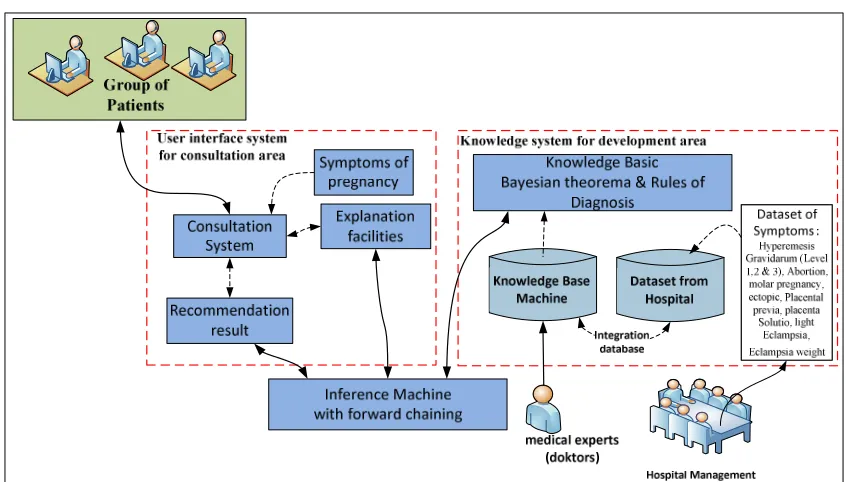
In Figure 3 displays the system
architecture of the proposed methods in solving the early detection of pregnancy. Patients choose according to the symptoms they experienced, then the system will check the web one after the other symptoms rule contained in the database that matches the input. In Figure 2 and Figure 3 exposing the area of the consultations conducted by the patient in the system Web-ES for consultation.
Figure 3: The Proposed Architecture Of Expert System In Disorders Pregnancy
In this consultation system, appropriate work input handling pregnancy and explanations fit the data contained in the inference engine. The completion of the calculation, we use a Bayesian method that already exists in previous studies, e.g. Bayesian probability.
Furthermore, patients produce recommendations based on the data input from the knowledge base contained in the inference engine appropriate knowledge base gained from team doctors. The knowledge base is stored in the database and work according to the rule-base that has been created by a team of experts of pregnancy. So that the output of the ES produced is appropriate rule-base that has been agreed on the basis of knowledge in the database.
The method used in this study, refers to the process of ES development are common, namely the concept of system development life
cycle (SDLC). Emphasis is made on the process consists of identifying the problem and design analysis to test the application. ES concept with the knowledge base, conducted by collecting data and information related to the type of interruption of pregnancy with the literature and consultation with womb experts.
[image:4.612.94.517.240.481.2]4. DISCUSSION AND RESULT
4.1 Discussion
We use a scoring system with the help of some medical experts to determine the weight of each symptom. In the manufacture of ES, facts and science related disturbance factors are used in decision making. These disorders often occur during pregnancy to certain disorders.
The symptoms are known, is the result of identification based on the knowledge of experts. Facts and knowledge gained will be translated by the knowledge engineer knowledge base stored in the ES. The facts presented in tabular form based on the data on symptoms and weight disorders.
[image:5.612.313.521.192.328.2]Each of these factors can be represented by each symptom as in Table 1, like a kind of interference in hyperemesis gravidarum (HG) as follows:
Table 1: Type of Interference in Hyperemesis Gravidarum in Level 1
Symptoms Weight
Nausea or excessive vomiting 0.8
Upper abdominal pain 0.4
dry and dirty Tongue 0.4
Dehydration 0.4
Decreased appetite 0.6
Weight loss 0.4
sunken eyes 0.4
Increased pulse rate & blood pressure drops 0.6 Pulse frequency of about 100 beats / min 0.6
Appear weak and limp 0.4
The symptoms of HG there are 10 types of disturbances that often occur in pregnancy. The greatest weight on symptoms such as nausea or vomiting overload is 0.8. While the symptoms for this type of interference on HG level 2 in Table 2 as follows:
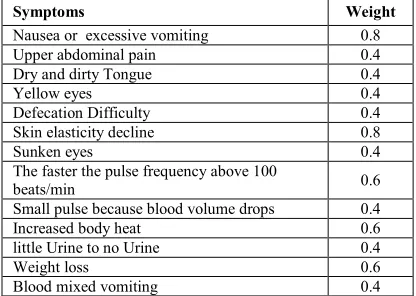
Table 2: Types Of Interferences In Hyperemesis Gravidarum In Level 2
Symptoms Weight
Nausea or excessive vomiting 0.8
Upper abdominal pain 0.4
Dry and dirty Tongue 0.4
Yellow eyes 0.4
Defecation Difficulty 0.4
Skin elasticity decline 0.8
Sunken eyes 0.4
The faster the pulse frequency above 100
beats/min 0.6
Small pulse because blood volume drops 0.4
Increased body heat 0.6
little Urine to no Urine 0.4
Weight loss 0.6
Blood mixed vomiting 0.4
The symptoms of HG level 2 there are 13 common symptoms. Most votes are the symptoms such as nausea or excessive vomiting, skin elasticity decreases with weight value is 0.8. While the symptoms for this type of interference on HG level 3 in Table 3 as follows:
Table 3: Types Of Interferences In Hyperemesis Gravidarum In Level 3
Symptoms Weight
Nausea or excessive vomiting 0.8
Upper abdominal pain 0.4
Dry and dirty Tongue 0.8
Yellow eyes 0.6
Defecation Difficulty 0.6
Decreased Awareness 1.0
Fleeing views 0.8
Blood mixed vomiting 0.4
Little Urine to no urine 0.8 Small pulse because blood volume drops 0.6
Increased body heat 0.6
Increased pulse rate and blood pressure drops 0.8
The symptoms of a HG third level there are 12 common symptoms. Most votes are the symptoms such as decreased awareness to the value of the weights 1.0. While on symptoms for this kind of disorder on abortion contained in Table 4 as follows:
Table 4: Type of Interference in Abortion
Symptoms Weight
Vaginal bleeding 0.6
Lower abdominal pain 0.4
Piece of meat fall 0.8
Positive Pregnancy Test 0.8
Spot 1.0
[image:5.612.90.297.333.454.2]Symptoms of abortion, there are five disorders that often occur. The greatest weight values obtained in spots, namely 1.0. While on the type of disruption in hydatidiform moles in Table 5 as follows:
Table 5: Type of Interference in Mola Hydatidosa
Symptoms Weight
Excessive Headaches 0.4
Swollen face or other body parts 0.4 Nausea or excessive vomiting 0.6
Vaginal bleeding 0.6
Positive Pregnancy Test 0.6
[image:5.612.89.297.576.724.2]Table 6: Type of Interference in Ectopic Disrupted
Symptoms Weight
Vaginal bleeding 0.6
Lower abdominal pain 0.6
Shoulder pain 0.6
Palpable mass & pain in womb 0.6 Womb neck pain when in motion 1.0
These types of symptoms are disturbed ectopic 5 early symptoms, the symptoms among the biggest weight value contained in the motion pain cervix is 1.0. While the symptoms of Placenta Previa in Table 7 as follows:
Table 7: Type of Interference in Placenta Previa
Symptoms Weight
Vaginal Bleeding 0.8
Red Blood 1.0
Positive Pregnancy Test 1.0
Type symptoms in the solution placenta have 3 symptoms which namely have a high weight such as fresh red blood and a positive pregnancy test with a value of 1.0. While the symptoms of solutio placentae can be seen in Table 8 as follows:
Table 8: Type of Interference in Solutio placentae
Symptoms Weight
Vaginal bleeding 0.8
Blackish Blood Colour 1.0
Womb feels tense 1.0
Abdominal pain 0.8
Increased pulse rate & blood pressure drops 1.0
Shock 0.8
Almost all the symptoms of solution placenta have a large weight value, unless the symptoms of vaginal bleeding, abdominal pain, and shock. Then the symptoms of mild preeclampsia in Table 9 as follows:
Table 9: Type of Interference in Lightweight Preclampsia
Symptoms Weight
Excessive Headaches 0.4
Excessive weight gain 0.4
Swollen face or other body parts 0.6 Blood pressure between 140/90 to 160/110 0.8
proteinuria +1 1.0
[image:6.612.314.521.97.180.2]These symptoms which have the largest weight value is +1 proteinuria is 1.0. This symptom is higher than the other symptoms of mild preeclampsia. Later symptoms of preeclampsia in Table 10 as follows:
Table 10: Type of Interference in Preeclampsia
Symptoms Weight
Excessive Headaches 0.6
Excessive weight gain 0.6
Swollen face or other body parts 0.6
proteinuria +2 1.0
Tensions over 160/110 1.0
Yellow eyes 0.4
This phenomenon has the highest weight value on the types of symptoms +2 proteinuria and blood pressure over 160/110 is 1.0. Later symptoms of eclampsia in Table 11 as follows:
Table 11: Types of Interference In Eclampsia
Symptoms Weight
Excessive Headaches 1.0
Excessive weight gain 0.6
Swollen face or other body parts 0.6
Proteinuria +3 or more 1.0
Tensions over 160 / 110 1.0
Yellow eyes 0.4
Fleeing views 1.0
Heart pain 1.0
Convulsions 1.0
Decreased awareness 1.0
Almost all the symptoms of eclampsia have a large weight value, except for some of the symptoms that are weight gain, swollen face or other body parts, and yellow eyes. Further data from any symptoms of this knowledge base is used to input data as the introduction of the diagnosis to the patient. From each of these tables, used for the ES knowledge base, so that the system can recognize the symptoms and weight have been determined by experts.
4.2 Result
Table 12: Results of Diagnosis for 35 Patient
No Full Name Experts Diagnosis System Diagnosis Percentage (%) Status
1 Ina Aswati HG Level 2 HG Level 2 64% detected
2 Shinta Amelia HG Level 3 HG Level 3 80% detected
3 Grace Cecilia Abortus Abortus 73% detected
4 Ria Puspita HG Level 2 HG Level 1 60% low detected
5 Desy Intan Ectopic Disrupted Disruped Ectopic 83% detected
6 Fitria Astuti Abortus Abortus 84% detected
7 Zainab Melia Abortus Abortus 92% detected
8 Indah Saima Abortus Abortus 92% detected
9 Nur halida Abortus Abortus 84% detected
10 Yulia Hartini Abortus Abortus 92% detected
11 Rini Purnama Abortus Abortus 84% detected
12 Manda W Abortus Mola Hidatidosa 51% very low detected
13 Ani Juwita Abortus Abortus 88% detected
14 Ida Nursanti Abortus Disrupted Ectopic 60% low detected
15 Evilia Rimanda HG Level 1 HG Level 1 65% detected
16 Rosalina Abortus Abortus 84% detected
17 Melly Purnama Abortus Abortus 84% detected
18 Rahmawati Abortus Abortus 92% detected
19 Minariah HG Level I HG Level 2 62% low detected
20 Ismi Hartati Abortus Abortus 89% detected
21 Nanda Sri Abortus Abortus 68% detected
22 Yulia Dewi Abortus Abortus 70% detected
23 Ni Putu Santia Abortus Abortus 84% detected
24 Sri Winarsih Abortus Abortus 84% detected
25 Khusnul .K Abortus Abortus 84% detected
26 Syarifah Aisyah Abortus Abortus 84% detected
27 Chistine Intania Abortus Abortus 88% detected
28 Velicia Mirna Abortus Abortus 68% detected
29 Aprianti P Abortus Abortus 84% detected
30 Nur Raudhatuh Abortus Ectopic Disrupted 60% low detected 31 Lestari Indah Placenta Previa Placenta Previa 95% detected 32 Ria Cristina Preeclampsia (height) Eclampsia 89% low detected
33 Hasrani Eclampsia Eclampsia 97% Height detected
34 Melia Indahwati Preeclampsia (low) Preeclampsia (low) 83% detected 35 Sri Marlina Solutio Placentae Solutio Placentae 92% detected
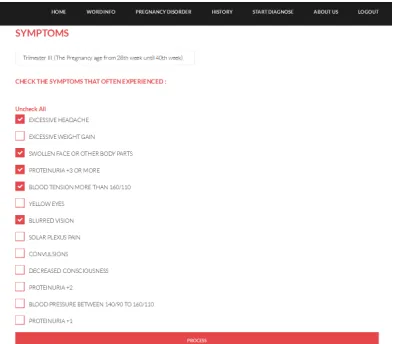
Based on the diagnosis results in Table 12, we show an example of a Web-ES. Figure 4 the selection of the symptoms present as follows:
Figure 4: The process input to the expert system symptoms of pregnancy
Bayes theorem is a required calculation of the value of some rules, such as the Rule1 (R1) as follows:
IF G1 AND G2 AND G3 AND G4 AND G5
THEN Eclampsia with the value of the weight of each of the following symptoms:
G1 = 1.0 = P(E|H1) G2 = 0.6 = P(E|H2) G3 = 1.0 = P(E|H3) G4 = 1.0 = P(E|H2) G5 = 1.0 = P(E|H3)
Thus, summed hypothesis above to find the universe value as follows:
G1 + G2 + G3 + G4 + G5
= 1.0 + 0.6 + 1.0 + 1.0 + 1.0
[image:7.612.98.298.509.681.2]Once the sum of the above is known, a necessary formula to calculate the value of the universe as follows:
P(H1) = = = 0.217
P(H2) = = = 0.13
P(H3) = = = 0.217
P(H4) = = = 0.217
P(H5) = = = 0.217
After the results of P (Hi) is known, the probability of the hypothesis H without any evidence. Then the next using the following steps:
P(Hi) * P(E|Hi-n)
= {P(H1) * P(E|H1)} + {P(H2) * P(E|H2)} +
{P(H3) * P(E|H3)}
= {0.217 * 1} + {0.13 * 0.6} + {0.217 * 1} +
{0.217 * 1} + {0.217 * 1}
= 0.217 + 0.078 + 0.217 + 0.217 + 0.217
= 0.946
The next step, find the value of P (Hi | E) or the probability of the hypothesis Hi true if given value of evidence E.
P(H1|E) = = 0.229
P(H2|E) = = 0.082
P(H3|E) = = 0.229
P(H4|E) = = 0.229
P(H5|E) = = 0.229
After all values P (Hi | E) is known, it takes a whole Bayesian value with equation (4) as follows:
(4)
= (1.0 x 0.229) + (0.6 x 0.082) + (1.0 x 0.229) +
(1.0 x
0.229) + (1.0 x 0.229)
= 0.229 + 0.0492 + 0.229 + 0.229 + 0.229
= 0.97 x 100%
= 97 %
[image:8.612.315.537.359.574.2]It is likely that patients have diagnosed Eclampsia with probability level, i.e. 97%. The output in Figure 5 as viewed in a Web-ES from diagnosis.
Figure 5: The output system from diagnosis
The diagnosis system disorders of
pregnancy is the last process to make a diagnosis analysis, so as to the identification of diagnosis performed by the system based on the symptoms that have been selected by the user before. Diagnosis system also provides features for users who want to know the Bayesian calculation for determining the confidence level of diagnosis.
performed a comparison against the actual data, of course, there will be differences. Of these differences, will be calculated the value of its accuracy.
Accuracy value is what will determine the quality of the applications that have been created. To calculate the degree of accuracy of the system as follows:
• The amount of testing dataset = 35
• The result of correct diagnosis detections = 29 • The result of incorrect diagnosis detections = 6
There are six incorrect diagnosis data in the results of this reference because there is a difference to diagnosis using this system, it would require the calculation of Bayesian methods for further testing. In testing the accuracy, we need the data the diagnosis divided by the number of test data, as follows:
*100%
=
82.86%
From the results of tests performed, the diagnosis early in pregnancy disorders has this level of accuracy of 82.86%. These results are still perceived to be quite accurate to use FC and Bayesian methods, so it is effective for patients to use aid in detecting early symptoms of pregnancy disorders.
5. CONCLUSION AND FUTURE WORK
In this ES, used to perform the initial diagnosis in pregnancy disorders with Web-based applications ES using Bayesian methods. ES works based on the symptoms of the selected user is then processed to produce the output of diagnosis of the disease, the percentage of diagnostic confidence, Bayesian calculations, causes, anticipation, and treatment of disease. Based on these results, a pregnancy disorder that users often encounter is abortion with a total system accuracy rate of 82.86% Eclampsia interference with the possibility of 97%. Subsequent research, we conducted tests on the data symptoms of pregnancy disorders with ES hybrid method for generating a higher level of accuracy with fuzzy sets and BNs.
In this ES, used to diagnose early in pregnancy disorders with Web-based applications ES with Bayesian methods. ES works based on the symptoms of the selected user is then processed to produce the output of the percentage of diagnostic
confidence, Bayesian calculations, causes,
anticipation, treatment, disease and the possibility of another diagnosis. Based on the test data at the highest possible Eclampsia, which is 97% with an accuracy of truth, as the number of patients reached 82.86%. Subsequent research, we conducted the test data that is more appropriate symptoms of pregnancy disorders. We will also perform hybrid ES method for generating a higher level of accuracy with fuzzy sets and BNs analysis using multi-criteria decision making (MCDM) so that it can be used on a group of clinical decision support system.
REFERENCES
[1] A. T. Azar, I. S. Member, A. E. Hassanien, Expert System Based On Neural-Fuzzy Rules for Thyroid Diseases Diagnosis, Computer Applications for Bio-technology, Multimedia, and Ubiquitous City, , 2012, pp. 94–105. [2] A. L. D. C. Alonzo, J. J. M. Campos, L. L. M.
Layco, C. a. Maratas, R. a. Sagum, ENTDEx: ENT Diagnosis Expert System Using Bayesian Networks, J. Adv. Comput. Networks, vol. 2, no. 3, 2014, pp. 182–187. [3] S. Bashir, U. Qamar, F. H. Khan, WebMAC:
A web based clinical expert system, Inf. Syst. Front.. Publish Online 29 October 2016. [4] L. Diseases, Rule-Based Expert System for
the Diagnosis of Memory, Int.J. Innovative Science, Engineering & Technology, vol. 1, no. 3, 2014, pp. 80–83.
[5] W. Wiegerinck, B. Kappen, and W. Burgers, Bayesian Networks for Expert Systems, Theory and Practical Applications, Interactive Collaborative Information Systems, 2010, pp. 547–578.
[6] A. C. Constantinou, N. Fenton, M. Neil, Integrating Expert Knowledge with Data in Bayesian Networks: Preserving Data-Driven Expectations when the Expert Variables Remain Unobserved, Expert Syst. Appl., vol. 56, 2016, pp. 197–208.
[7] D. Biswas, S. Bairagi, N. Panse, N. Shinde, Disease Diagnosis System, Int. J. of Computer Science & Informatics, Vol. 1, no. II, 2011, pp. 48-51.
Int.J. Curr. Res.Aca.Rev. vol. 3, no. 2, 2015, pp. 9–19.
[9] C. E. Rouse, L. O. Eckert, B. J. Wylie, D. J. Lyell, A. Jeyabalan, S. Kochhar, T. F. McElrath, Hypertensive disorders of pregnancy: Case definitions & guidelines for data collection, analysis, and presentation of immunization safety data, Vaccine, vol. 34, no. 49, 2016, pp. 6069–6076.
[10] L. A. Magee, A. Pels, M. Helewa, E. Rey, P. von Dadelszen, The hypertensive disorders of pregnancy (29.3), Best Pract. Res. Clin. Obstet. Gynaecol., vol. 29, no. 5, 2015, pp. 643–57.
[11] E. Lefkou, B. J. Hunt, “Bleeding disorders in pregnancy, Obstet. Gynaecol. Reprod. Med., vol. 25, no. 11, 2015, pp. 314–320.
[12] L. A. Magee, A. Pels, M. Helewa, E. Rey, P. von Dadelszen, Diagnosis, evaluation, and management of the hypertensive disorders of pregnancy, Pregnancy Hypertens., vol. 4, no. 2, 2014, pp. 105–45.
[13] P. von Dadelszen, L. a Magee, Preventing deaths due to the hypertensive disorders of pregnancy, Best Pract. Res. Clin. Obstet. Gynaecol., vol. 36, 2016, pp. 83–102.
[14] M. a J. van Gerven, B. G. Taal, P. J. F. Lucas, “Dynamic Bayesian networks as prognostic models for clinical patient management, J. Biomed. Inform., vol. 41, no. 4, 2008, pp. 515–29.
[15] P. von Dadelszen, J. M. Ansermino, G. Dumont, G. J. Hofmeyr, L. a Magee, M. Mathai, D. Sawchuck, K. Teela, F. Donnay, J. M. Roberts, Improving maternal and perinatal outcomes in the hypertensive disorders of pregnancy: a vision of a community-focused approach, Int. J. Gynaecol. Obstet., vol. 119, 1, 2012, pp. S30–4.
[16] M. Liu, A. Hommersom, M. van der Heijden, P. J. F. Lucas, Hybrid time Bayesian networks, Int. J. Approx. Reason., vol. 80, 2017, pp. 460–474.
[17] D. Marquez, M. Neil, N. Fenton, Improved reliability modeling using Bayesian networks and dynamic discretization, Reliab. Eng. Syst. Saf., vol. 95, no. 4, 2010, pp. 412–425. [18] N. Fenton, M. Neil, Comparing risks of
alternative medical diagnosis using Bayesian arguments, J. Biomed. Inform., vol. 43, no. 4, 2010, pp. 485–95.
[19] C. Nusai, S. Cheechang, S. Chaiphech, G. Thanimkan, Swine-Vet: A Web-based Expert System of Swine Disease Diagnosis, Procedia
Comput. Sci., vol. 63, no. Icth, 2015, pp. 366– 375.
[20] L. Tinggui, “The building of expert system based on web for Fault Diagnosis,” in
Proceedings of the 3rd IEEE International Conference on Computer Science and
Automation Engineering, 2012, pp. 539–542.
[21] F. N. Fauziyah, F. Fahrianto, V. Amrizal, Validity of expert system, diagnosis of the disease treatment with prayer by verse of the koran using method of certainty factor web-based application,” in Proceedings of the 6th IEEE Int. Conf. on Information and Communication Technology for The Muslim World, 2016, pp. 330–335.
[22] A. Refai, H. F. Merouani, H. Aouras, Maintenance of a Bayesian network: application using medical diagnosis, Evol. Syst., vol. 7, no. 3, 2016, pp. 187–196. [23] D. Ersel, D. İçen, Fuzzy probability
calculation with confidence intervals in Bayesian networks, Soft Comput., vol. 20, no. 2, 2016, pp. 819–829.
[24] F. Başçiftçi, A. Eldem, Using reduced rule base with Expert System for the diagnosis of disease in hypertension, Med. Biol. Eng. Comput., vol. 51, no. 12, 2013, pp. 1287– 1293.
[25] C. P. B. Randa, A. E. Pennanasari, “Development of Diagnosis Expert System for Personality Disorders,” in Proceedings of the
Makassar Int. Conf. on Electrical
Engineering and Infonnatics (MICEEI),
November, 2014, pp. 180–183.
[26] J. Novo, a. Hermida, M. Ortega, N. Barreira, M. G. Penedo, J. E. López, C. Calvo, Hydra: A web-based system for cardiovascular analysis, diagnosis and treatment, Comput. Methods Programs Biomed., vol. 139, 2017, pp. 61–81.
[27] S. Shi, G. Li, H. Chen, J. Liu, Y. Hu, L. Xing, W. Hu, Refrigerant charge fault diagnosis in the VRF system using Bayesian artificial neural network combined with ReliefF filter,
Appl. Therm. Eng., vol. 112, 2017, pp. 698– 706.
[28] S. Sohn, D. W. Larson, E. B. Habermann, J. M. Naessens, J. Y. Alabbad, H. Liu, Detection of clinically important colorectal surgical site infection using Bayesian network, J. Surg. Res., vol. 209, 2016, pp. 168–173.
dampers, fans, filters and sensors, Appl. Therm. Eng., vol. 111, 2017, pp. 1272–1286. [30] N. Kapoor, N. Bahl, Comparative Study Of
Forward And Backward Chaining In Artificial Intelligence, Int. J. Eng. Comput. Sci., vol. 5, no. 4, 2016, pp. 16239–16242.
[31] A. Rupnawar, A. Jagdale, S. Navsupe, Study on Forward Chaining and Reverse Chaining in Expert System, Int. J. Adv. Eng. Res. Sci., vol. 6495, no. 12, 2016, pp. 60–62.
[32] Z. Xu, K. Gao, T. M. Khoshgoftaar, N. Seliya, System regression test planning with a fuzzy expert system, Inf. Sci. (Ny)., vol. 259, 2014, pp. 532–543.
[33] E. Herowati, U. Ciptomulyono, J. Parung, Expertise-Base Experts Importance Weights in Adverse Judgment, ARPN J. of Eng. & Applied Sciences, vol. 9, no. 9, 2014, pp. 28– 30.
[34] R. Kaur, V. Madaan, P. Agrawal, Fuzzy Expert System to Calculate the Strength/ Immunity of a Human Body, Indian J. Sci. Technol., vol. 9, no. 44, 2016.
[35] S. R. Mirmajlesi, R. Shafaei, An integrated approach to solve a robust forward/reverse supply chain for short lifetime products,
Comput. Ind. Eng., vol. 97, 2016, pp. 222– 239.
[36] D. Kartika, R. L. Gema, M. Pratiwi, Expert Systems for Identifying Children ’ s Severe Malnutrition, J. Comput. Sci. Inf. Technol., vol. 1, no. 1, 2016, pp. 20–29.
[37] R. Kurniawan, A.M. Nur, R. Yendra, A. Fudholi, Prototype expert system using bayesian network for diagnose social illness,
Journal of Theoretical and Applied
Information Technology, Vol.93, No.2, 2016,
pp. 338-344.
[38] N.AB. Aziz, Web based expert system to identify trusted partner for B2B collaboration,
Journal of Theoretical and Applied
Information Technology, Vol.79, No.3, 2015, pp. 365-369.
[39] E. Lotfi, A. Belabib, M. Bouhorma, Towards a new web-based serious games generator
based on fuzzy expert system, Journal of
Theoretical and Applied Information