RANSOMWARE ANALYSIS BASED ON THE SURFACE,
RUNTIME AND STATIC CODE METHOD
1
LULUK USMAN
,
2 YUDI PRAYUDI, 3IMAM RIADI1,2
Department of Informatics, Universitas Islam Indonesia, Jln. Kaliurang km.14.5, Yogyakarta, Indonesia
3
Ahmad Dahlan University, Jln. Prof.Dr.Soepomo, Janturan, Yogyakarta, Indonesia E-mail : 1 [email protected], [email protected], [email protected]
ABSTRACT
Ransomware is one of the latest malware in recent years that can infect computers and smartphones. The malware is able to encrypt the files inside the computer or smartphone, thus prevents the users (victims) from accessing their system. In addition, the victims will be asked to pay the ransom through certain online payment methods to get a decrypt key. Due to the latest development of ransomware variants, a solution is required to prevent the malware attack. This study analyzes the cryptolockers ransomware which utilize three method such as surface, runtime and static code method. The result provided the detail characteristics of ransomware through three aforementioned methods as well as the solution to prevent the attack.
Keywords: Ransomware, Surface, Runtime, Static Code.
1. INTRODUCTION
As the increasing of technological developments, the cyber threats on computers have been increasing as well. One of the latest malware which has been found in the last few years is Ransomware. This malware has the ability to paralyze the computer data thus unable users to access their system. The purpose of the malware is to squeeze out the infected computer software and request for payment so that the computer can be normal as before [1].
Dell research team, SecureWorks Counter Threat Unit (TM) (CTU) has analyzed the presence of malware file-encrypting which are distributed over the Internet in late February 2014 and known as Cryptolocker. Although it began to be known in the first quarter of 2014, but it has actually been distributed since at least early November 2013. The CTU researchers have assumed that Cryptolocker would become the biggest and most destructive ransomware on the internet [2] and it is proven until now that the cryptolocker is still releasing new variants.
The encryption technique used by Cryptolocker is RSA 2048 and it is utilized largely by technology companies such as Yahoo, Google, Facebook; financial and e-commerce companies to protect financial and other important transactions data. The Cryptolocker used RSA 2048 to encrypt the data inside computer victims and control its decryption key (Private Key). Even though the ransom money has been paid by victims, there is no guarantee that the decryption process will be success.
The goal of our study is to utilize three-stage approach such as surface, runtime and static-code. By analyzing these ransomware in detail, the evidence of digital crime can be collected and the future attack can be prevented.
2. RELATED WORK
Distler [3] in his research has explained the approach in malware analysis: static (code) and dynamic (behavioral). Static is the actual viewing of code in order to get a better understanding of the malware, while the dynamic is to analysis the changes when the malware is executed.
The related research has been done by Rick Flores on win32 malware, kryptic, by utilizing the static analysis [4]. In current study, it is started with performing the hashing on malware, and then followed by collecting information from malware as well as detecting the server which has direct communication to the malware. In this study only utilized static analysis method so that the information obtained is still not completed.
Malhotra [6] has conducted a study related to mobile Malware and several techniques are used for malware detection. Two main techniques are usually utilized by researchers, signature-based and anomaly-based. In the signature-based techniques, sets instruction patterns are studied and analyzed, while in anomaly-based the unusual activities can be detected. The result has suggested that the signature based techniques can be enhanced using DNA matching techniques applied in other domains.
Nugroho & Prayudi [7] have suggested several processes on analyzing the malware such as determining the SOP, defining malware, malware analysis, determining the goals of basic malware analysis and reverse engineering of malware (assembly, disassembly, debugging). Currently, the Reverse Engineering is one of the solutions that can be used to analyze the malware. Reverse Engineering in malware analysis is used to extract the hidden data which are considered as important information inside malware.
Yusirwan et al [8] have conducted the analysis of malware based on static and dynamic analysis and the TT.exe is used as ransomware sample. The current study has concluded that Malware TT.exe is a trojan type malware; and windows 7 and windows 8 are the main target. When the computers are infected by this malware, the high RAM usage is used by the malware and infected other programs in computer victim. The current study has successfully extracted the malware characteristics, how it works and the impact which are affected from the attack.
Our study focus on ransomware cryptlocker with variants DOMSTOLSPROCESS_17924.exe. This cryptolocker has been detected by the end of 2016. To the best of our knowledge, no research has been done on analyzing aforementioned malware based on the surface, runtime and static method. Thus by analyzing this cryptolocker in detail, the future attack can be prevented.
3. RANSOMWARE ANALYSIS
[image:2.612.90.298.647.701.2]In this part, the sample of ransomware is collected. Once the sample is collected and controlled environment is prepared, the detail analysis can be presented.
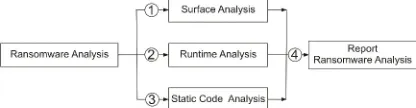
Figure 1: Ransomware analysis method
Figure 1 describes the step by step of analyzing ransomware such as Surface, Runtime and Static Code Analysis. In the last part, the full report of aforementioned techniques can be presented.
3.1 Surface Analysis
This technique is done by observing the process generated by the Ransomware. Some examples of ransomware processes such as creating the file/directory, deletions, changing the file name and other [9]. This technique is trying to detect Ransomware with basic observation without executing the ransomware. Understanding ransomware characteristics can be done by using special software, such as: HashTab and digest.exe (Hash Analysis), TrID (an Analysis), BinText and URstrings.exe (String Analysis), HxD (Binary Editor), CFF Explorer (Pack Analysis), and 7zip (Archiver).
3.2 Runtime Analysis
This technique is done by observing processes that occured in the system, particularly on the process that is directly related to the operating system. This process required special software to analyze the ransomeware, since most system processes run in the background [9]. In runtime analysis, the ransomware should be executed in a controlled environment and its behavior and impact are observed.
Once the Ransomware is executed, the impact on the system can be analyzed. The tool or software to analyze the ransomware such as: Process Explorer, Regshot, Wireshark, TCPView, Process Monitor, Autoruns, FUNdelete, Streams/ADSSpy, and others. These applications are executed on the client side; while for the server side the softwares such as FakeDNS, netcat/ncat and tcpdump/tshark can be utilized.
3.3 Static Code Analysis
The last analysis technique in this study, static code requires the ability of understanding the assembly programming. In this process, the malware code is broken down into its machine instructions (disassembling) and the instructions are analyzed. This is the most effective technique for determining what the malware actually does [9].
Library, Google (Library); OllyDbg, Immunity Debugger, WinDbg/Syser (Debugger); HxD, WinHex, 010editor (Hex Editor); Python, Linux/Cygwin/MSYS Shell (Others).
3.4 Ransomware Analysis Report
Once the process of analyzing ransomware based on surface, runtime, static code are completed, the report related with the characteristics of Ransomware can be presented. In this final report, the recommendations on preventing the ransomware will be presented. In addition, the characteristics of Ransomware also will be presented, so that the researchers can estimate the damage caused by Ransomware.
4. PRACTICAL RANSOMWARE ANALYSIS
TECHNIQUE
This section will describe some of the detail techniques which are used for analyzing Ransomware.
4.1 Packed and Obfuscated Program
Packed or repacked malware is a method to change the malware with compressed or encryption so that the malware will be difficult to be recognized by antivirus and/or malware researchers [10]. Whereas obfuscated is a method to make the source code of a malware becomes difficult to be understood. Obfuscated normally used by network programmers for security reason, so that the program will be difficult to be hacked. However, these technique is used by malware creator to make malware becomes more difficult to be detected and analyzed by malware researchers [11].
4.2 Deobfuscated
Deobfuscated is a method to restore the programs that had previously been obfuscated. By doing a deobfuscated step, the language of a program that had previously been scrambled can be restored as before, so that it will make easier for researchers to conduct analysis on malware [12].
4.3 Packet Capture
Packet capture is the process of recording the data packets which passing through computer networks. In computer networks, for example on HTTP protocol, there was communication between client and server. Communication requires both data exchange, so that we can record, filter, analyze, diverse the data packets from a variety of protocol by using special application.
4.4 Debugging
Debugging is an activity to find out the error in a program.These errors are usually called bugs. The bug can be either error logic, syntax errors, or
the errors on accessing the device that are not allowed by operating system [13].
5. TOOL FOR ANALYSIS
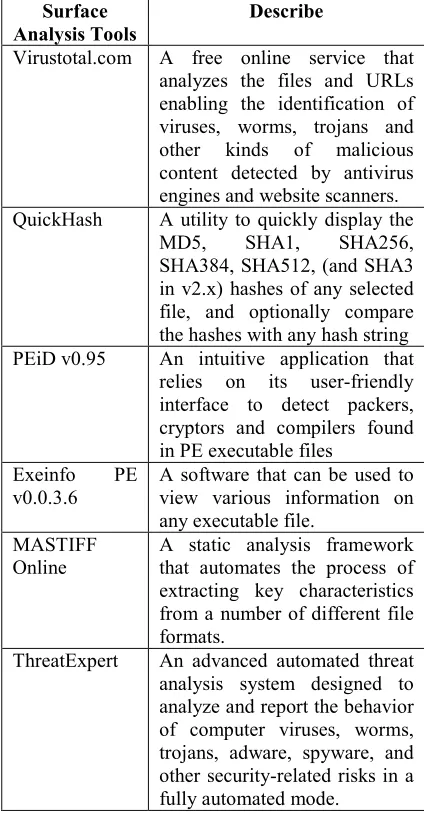
[image:3.612.311.523.202.609.2]In this study, several tools based on surface, runtime and static code analysis are presented. Tool for surface analysis are described in Table 1.
Table 1. Tool used for Surface Analysis
Surface Analysis Tools
Describe
Virustotal.com A free online service that analyzes the files and URLs enabling the identification of viruses, worms, trojans and other kinds of malicious content detected by antivirus engines and website scanners. QuickHash A utility to quickly display the
MD5, SHA1, SHA256, SHA384, SHA512, (and SHA3 in v2.x) hashes of any selected file, and optionally compare the hashes with any hash string PEiD v0.95 An intuitive application that
relies on its user-friendly interface to detect packers, cryptors and compilers found in PE executable files
Exeinfo PE v0.0.3.6
A software that can be used to view various information on any executable file.
MASTIFF Online
A static analysis framework that automates the process of extracting key characteristics from a number of different file formats.
ThreatExpert An advanced automated threat analysis system designed to analyze and report the behavior of computer viruses, worms, trojans, adware, spyware, and other security-related risks in a fully automated mode.
Table 2. Tool used for Runtime Analysis
Runtime Analysis Tool
Describe
Unit Computer
A computer unit used to analyze the Ransomware. Regshot An open-source registry
compare utility that allows to quickly take a snapshot of registry and then compare it with a second one.
Process Monitor
A monitoring software for Windows that displays real-time system, process/thread and Registry activity.
NetworkMiner A Network Forensic Analysis Tool for Windows, can be used as a passive network sniffer/packet capturing tool in order to detect operating systems, sessions, hostnames, open ports etc. without putting any traffic on the network ApateDNS Tools to Fake DNS Responses
for Ransomware Analysis Wireshark A free and open source packet
analyzer, it allows user to see what’s happening on network at a microscopic level.
[image:4.612.91.302.98.448.2]For analyzing the malware based on static code analysis, the tools which can be utilized are presetend in Table 3.
Table 3. The tool that is used for Static Code Analysis
Static Code Analysis Tool
Describe
Dependency Walker
A free program for Microsoft Windows used to list the imported and exported functions of a portable executable file.
BinText A file text scanner / extractor that helps find character strings buried in binary files.
OllyDbg A 32-bit assembler level
analysing debugger for Microsoft Windows
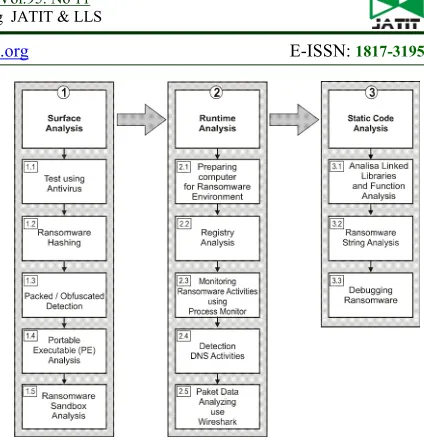
This study used cryptolocker as ransomware sample. The detail explanation of the research flow can be seen in Figure 2.
Figure 2 : Process research of ransomware analysis
Based on the Figure 2, there are several steps that are performed in this study; generally they are grouped into three major groups.
6. RESULT AND ANALYSIS
In the first step, the analysis of ransomware is done by surface methods and the tools which are utilized can be seen as follow:
a. Malwr.com b. Virustotal.com c. QuickHash-v 2.6.1 d. Exeinfo PE e. 7zip f. PEViewer
g. MASTIFFOnline.com h. ThreatExpert.com
In this study, the ransomware sample was obtained from the website malwr.com. The sample is tested by antivirus and followed by hashing the package of the ransomware.
The ransomware sample is uploaded to virustotal.com and it will be scanned by various antivirus engine and the results can be presented. The results showed that the sample of Cryptolocker is the category of ransomware and 39 out of 57 antivirus engines are succesfully recognize it as a ransomware Trojans.
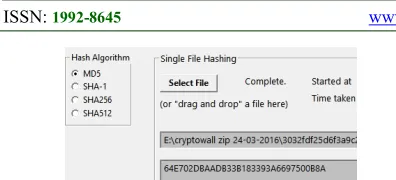
[image:4.612.91.298.521.679.2]Figure 3 : Hashing Ransomware using Quickhash
Figure 3 illustrates the process of hashing with md5. The the value of ransomware hashing can be seen as follow:
Name: Bolletta_64940.EXE or DOMSTOLSPROCESS_17924.exe
[image:5.612.91.301.231.348.2]MD5:64E702DBAADB33B183393A6697500B8A
Figure 4 : Exeinfo has detected packed
Next step is testing using Exeinfo PE to get information about the packed or obfuscated from ransomware. Packed or repacked ransomware is used to upacked the ransomware, thus this process is necessary before doing further analysis.
[image:5.612.98.292.499.543.2]The result showed that the ransomware was packed with NSIS. The display of the test results with the Exeinfo PE can be seen in Figure 4. It can be seen that the malware has used the ransomware package and to unpack the malware, 7zip can be utilized as can be seen in Figure 5.
Figure 5 : Result unpacking using 7zip
There are several programs that can perform the unpacking process, such as:
a. de4dot
b. GunPacker. V05 c. NETUnpack d. 7Zip
e. Universal Extractor
The unpacking process showed that there are four files as can be seen in Figure 5. The names are:
a. amyleneBeneOratrixOperetta, b. Camp.dll,
c. System.dll, d. Conakry,
The result showed that Camp.dll file is detected as a trojan by antivirus.
Figure 6 : Analyzing use PEViewer
Figure 6 shows testing process by utilizing PEViewer and the creation date of malware can be presented. For analyzing the change of registry which is made by ransomware, the Regshot tool can be used. The registry detail of before and after the ransomware is executed, should be captured and compared, thus the change can be analyzed.
At this part, these ransomware are sent to ransomware sandbox and it will be analyzed by engine-MASTIFF. The result of Mastiff ransomware sandbox can be seen as follow: a. When the ransomware is executed, the mallware
will import some DLL files such as kernel32.dll, user32.dll, GDI32.dll, shell32.dll, advapi32.dll, comctl32.dll, ole32.dll and version.dll
b. There is also information about the packed of ransomware and its explains the date of creation.
c. There are no registry change information. Other sandbox analysis is used, the ThreatExpert and the result can be seen as follow: a. There are new processes of creating
ughkegib.exe file by the ransomware. b. Ransomware also made some key in registry. c. Ransomware communicate with certain IP
Address.
For the second part of analysis, the runtime analysis methods is used and controlled environment is needed. One unit computer was used for conducting analysis of ransomware.
Computer configuration:
1. Operating System: Windows 32 bit 8 2. Memory: 1024 MB
3. Hard disk: 80 GB 4. Network: Wifi
Figure 7 : Analysis of Registry by using Regshot
Figure 7 shows the information that the ransomware has tried to turn on itself when the computer is restarted.
The result showed that the ransomware has created the activities which can be seen as follows: a. Program schedule is change:
HKLM\SOFTWARE\Microsoft\WindowsNT\Cu rrentVersion\Schedule\TaskCache\Tasks\
{68070BBC-F2DE-4476-95C6-C2ED1ECE3D0F} \ Hash: EC 5 d B0 B1 CC E5 5F AC 8 c 8 c 1B 8E F1 DF E5 2F66 E4 34 BF 7E 96 40 38 29 46 CD D7 CB ED 2B CB
b. Ransomware changes automatic update in windows 7:
HKLM\SOFTWARE\Microsoft\Windows\Curre ntVersion\WindowsUpdate\AutoUpdate\AUOpti ons: 0x00000004
HKLM\SOFTWARE\Microsoft\Windows\Curre ntVersion\WindowsUpdate\AutoUpdate\Include RecommendedUpdates: 0x1
HKLM\SOFTWARE\Microsoft\Windows\Curre ntVersion\WindowsUpdate\Auto
Update\CachedAUOptions: 0x00000004
c. Ransomware stops the protection of Windows Defender:
HKLM\SOFTWARE\Microsoft\WindowsDefend er\Real-Time
Protection\DisableRealtimeMonitoring: 0x1 d.Ransomware made itself run automatically when
Windows is turned on:
HKU\S-1-5-21-3819072523-3082051562-
3461999040-1001\Software\Microsoft\Windows\CurrentVersi on\Run\ovegodun: "" C:\ProgramData\(random name).exe ""
Figure 8 : Analysis using Process Monitor
Figure 8 illustrates the environment when the ransomware is run. There are several processes that are running, such as explorer.exe, vssadmin.exe and conhost.exe.
Vssadmin.exe used by the administrator to set the Shadow Volume Copies on a computer. The shadow volume copy allows Windows to take automatic or manual backups, or snapshots, of the current state of the files on a particular volume (drive letter).
The conhost.exe is the new host process for console windows. Previously those were handled by csrss.exe which is the “Client Server Runtime Process”, a process running with system-level privileges.
The result showed that the ransomware has prepared some modules such as ntdll.dll, kernel32.dll, kernelbase.dll, user32.dll, shell32.dll, advapi32.dll, gdi32, comctl32.dll, ole32.dll, version.dll, msvcrt.dll, combase.dll, shlwapi.dll, sechost.dll, rpcrt4.dll, imm32.dll, msctf.dll, cryptbase.dll, bcryptprimitives.dll, uxtheme.dll, shfolder.dll, SHCore.dll, oleaut32.dll, clbcatq.dll, propsys.dll, profapi.dll, setupapi.dll, cfgmgr32.dll, devobj.dll, system.dll, camp.dll.
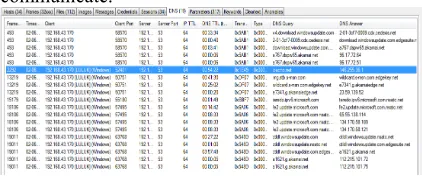
[image:6.612.313.524.320.409.2]Next process is to detect DNS activity, at this stage Networkminer and ApateDNS are used for analysis. Networkminer has analyzed the DNS addresses that will be used by ransomware to communicate.
Figure 9 : Analysis using networkminer
Figure 9 shows some of the domains that were contacted. The result showed the ipecho.net domain, the domain which is used to find out the ip public from computer victims. Other information has been obtained and showed that there are several domains frequently contacted such as redtable.biz.
Further analysis by Wireshark, showed the data packets sent by ransomware.
Figure 10 : Analysis using wireshark
From the results of the analysis done by wireshark, there are several result obtained such as: 1. Ransomware communicate with ipecho.net to
get ip public of victim.
2. Figure 10 showed communication with multiple servers with ssl Protocol, to secure the communication between a victim's computer and the server.
In third section, the ransomware analysis was conducted by Static Code and the tools which are utilized can be seen as follow:
b. BinText c. OllyDbg
The analysis has been done by dependency walker, and the result can be seen as follow: 1. Ransomware was able to duplicate or replace the
file with another file.
2. The Ransomware was able to count or calculate the files that will be used as the target of infection.
3. The Ransomware has capability related with Anti-Detection/Stealthyness.
4. The Ransomware run CMD and perform a specific command.
5. It is able to collect information inside victim's computer.
6. Other capability on manipulating.
7. The ransomware was able to add/remove/change data in the registry.
8. The Ransomware made itself run automatically when the windows in turn on.
Figure 11 : Analysis using Bintext
[image:7.612.310.533.93.195.2]Figure 11 showed the results by Bintext that the Ransomware was doing unpacking data. Packed is used by ransomware to protect itself from malware analyst software.
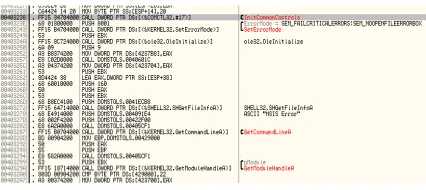
Figure 12 : Analysis using Ollydbg
Figure 12 showed that the ransomware register itself with the help of comctl32.dll. Next, the ransomware manipulate the system to not showing the error dialog box when an error occurs.
[image:7.612.91.304.459.554.2].
Figure 13 : Analyzing use Ollydbg
Figure 13 showed that the ransomware created the space for itself on the drive: C:%appdata\local\Temp%
Figure 14 : Analyzing use Ollydbg
Figure 14 showed that the ransomware are calling the module cryptbas.dll and bcryptprimitives.dll. The modules handles the encryption process of files in computer victim.
Until this part, the Ransomware is analyzed based on Surface, Runtime and Static Code. There are several result can be seen as follows: Ransomware cryptolocker is trojan type malware and it was created on Tuesday, October 07, 2014. The targets are all versions of Windows OS, including Windows XP, Windows Vista, Windows 7, and Windows 8.
On the early step, ransomware will unpack itself, then do the communication with the server to get the RSA public key. Ransomware scan computer to find out the data and encrypt it by using AES encryption so that the file can not be opened.
AES key will be encrypted by the RSA public key. Once the infected files are encrypted, the computer displays the message on Notepad or HTML which contains the instructions on how to get the Cryptolocker Decryption Service. The ransomware forces victims to pay a ransom in order to get the key for decrypting the infected files. Victims must pay through unique Bitcoins address.
Figure 15 : Process of Ransomware
The results from analysis showed that the ransomware duplicates it self into the system folder on following computer address: C:\user\user name\appdata\local\Temp\ <random> \ <random> .exe
[image:7.612.312.531.510.593.2] [image:7.612.90.303.630.716.2]Table 4. Configuration of local security policies
No Name Type Security
Level
Description
1 %AppData%\*.e xe
Path Disallowed Block the existence of the executable file in Appdata 2 %AppData\*\*.e
xe
Path Disallowed Block the existence of the executable files from Appdata 3 %Temp%\Rar*\
*.exe
Path Disalowed Block executable file from winrar 4 %Temp%\7z*\*.
exe
Path Disalowed Block executable file from 7zip 5 %Temp%\*.zip\
*.exe
Path Disalowed Block any executable file inside
compressed file zip
7. CONCLUSION
In order to analyze the ransomware, the surface method tried to identify the program whether it is classified as ransomware or not. Next step, it detects obfuscated/package that protects the ransomware and revealed the creation time of application. On the other hand, the Runtime method will provides the information only when the malware is executed. The runtime method allows user to analyze several activities created by ransomware such as the change on registry, monitoring the activities on the system file, monitoring the processes and threads that occured and data communication performed by malware with server. In addition, by utilizing static code method, it provides the information that had not been found by other previous methods such as the ransomware were able to hide from surveillance of computer security system and able to turn off the firewall and antivirus.
Based on this study, the integration of the three methods such as surface, runtime and static code was able to give more detail the characteristics of ransomware, thus the prevention of ransomware attack can be presented. Other limitation is that the the analysis process takes longer time. In the future, minimizing process time for analysis is needed and more detailed results are expected.
REFERENCES
[1] Suryadhi, A. (2012, 12 17). The ITSecurityissuesof Cyber Espionage Until 2013'TheInsane'Madware. Retrieved 09 14,
2014, from detikinet: http://inet.detik.com/read/2012/12/17/131135/2 120417/323/3/spionase-cyber-hingga-si-gila-madware
[2] Intelligence, D. S. (2014, 8 27). CryptoWall Ransomware. Retrieved 12 28, 2016, from SecureWork:
http://www.secureworks.com/cyber-threat-intelligence/threats/cryptowall-ransomware/ [3] Distler, D. (2007). Malware Analysis: An
Introduction. SANS Institute InfoSec Reading Room (pp. 18-19). SANS Institute.
[4] Flores, R. (2012, 06 01). Retrieved 05 06, 2015, from https://www.exploit-db.com: https://www.exploit-db.com/docs/18387.pdf [5] Konstantinou, E. (2008). Metamorphic Virus:
Analysis and Detection. Egham, Surrey TW20 0EX, England: Department of Mathematics, Royal Holloway, University of London. [6] Malhotra, B. (2016). A Survey on Various
Malware Detection Techniques on Mobile Platform. IJCA Online, 15-20.
[7] Nugroho, H. A., & Prayudi, Y. (2014). The use ofthe technique of reverse engineering in malwareanalysis for identification ofmalware attacks. National Conference information system2014.Macassar:DipanegaraSTIMIK [8] Yusirwan, S., Prayudi, Y., & Riadi, I. (2015).
Implementation of Malware Analysis using Static and Dynamic Analysis Method. International Journal of Computer Applications , 11-15.
[9] Perdhana, M. R. (2011). Harmless Hacking Malware Analysis dan Vulnerability Development. Yogyakarta: Graha Ilmu. [10]Senthil Arasu & Barathi. (2014, January).
Retrieved 06 06, 2015, from http://ijarcsms.com/docs/paper/volume2/issue1 /V2I1-0018.pdf
[11]Michael Sikorski & Andrew Honig. (2012). Practical Malware Analysis The Hands-On Guide to Dissecting Malicious Software. No Starch Press.
[12]Uppal, D., Mehra, V., & Verma, V. 2014. Basic survey on Malware Analysis, Tools and Techniques. International Journal on Computational Sciences &Applications (IJCSA) Vol.4, No.1, February 2014.