7018
A PROPOSITIONAL LOGIC WITH SUBJUNCTIVE
CONDITIONALS FOR SOCIAL MEDIA FRAMEWORK TO
EMPOWER THE ENDOWMENT OF GREEN LIBRARY
TECHNOLOGY SUSTAINABILITY
1TENGKU ADIL TENGKU IZHAR, 2MOHD SHAMSUL MOHD SHOID, 3MOHAMMAD
FAZLI BAHARUDDIN, 4MAZWANI AYU MAZLAN
1Lecturer, Faculty of Information Management, Universiti Teknologi MARA, Malaysia
2Lecturer, Faculty of Information Management, Universiti Teknologi MARA, Malaysia
3Lecturer, Faculty of Information Management, Universiti Teknologi MARA, Malaysia
4Lecturer, Faculty of Information Management, Universiti Teknologi MARA, Malaysia
E-mail: 1[email protected]
ABSTRACT
Many libraries are reluctant to adopt green innovation strategies unless there are clear cost benefits from doing so because such short-term investments for long-term returns are considered risky in corporate environments where performance is judged and based on short-term quarterly returns. However, for the adventurous, a holistic integration of green into entire product lifecycle is worth tackling because of the growth potential it offers. This is because there is limited framework that incorporate social media to promote the important of green technology in library. The aim of this paper is to propose a framework based social media to empower green technology library initiative. The significant of the proposed framework will strengthen library community awareness of environmental sustainability. This is important as society is a part and parcel of what sustainability stands for. Ensuring that library users have access to library resources that their health is being protected within the sustainable environment.
Keywords: Framework, Green Technology, Library, Social Media, Sustainability
1. INTRODUCTION
Social media has the potential to facilitate much closer relationship between libraries and their users [1-4]. Current usage of social media by the library community generally remains ad hoc and somewhat experimental but they likely play an important role in library service provision and outreach the future [5-8]. Social media presents a good number of opportunities for libraries, but also many challenges. The main opportunities associated green initiative of libraries using social media are seen to be related to its low cost [9-11]. At the same time, its ability to take the library service to users in their preferred spaces, the opportunity to build a sense of green community between the library and its users, to support co-development of collections and help keep librarians updated on
7019 for green technology [14, 15]. These heterogeneous external sources are growing very significantly in the last few years, especially due to the availability of wireless and mobile technologies, crowd-sourcing facilities, Internet of Things and sensor networks, as well as social media and web data. All these technologies generate huge amount of data and together they can be extracted to generate values to the organization and to establish situational awareness of the community or market trends.
There has been wide academic and research interest in the application of social media modalities, as instructional tools, in contemporary educational settings. Although research on this topic has grown exponentially in recent years, very little is known about the breadth of research regarding the engagement of social media to empower green library initiative for sustainability community. There is limited framework develop that incorporate social media to promote the important of green technology in library. Currently there is limited framework that differentiation in how social media channels are used to promote green technology. Similar objectives and tactics apply across all social media tools, but it is envisaged that this will change rapidly with strategies becoming increasingly channel-specific.
There are many options and degrees to which a company can differentiate itself as a good green, sustainable citizen; and, there are many constructive contributions that could be made by social media to get the green messages out with the desired result [16]. The strategy of going "green"
represents a somewhat moving target.
Sustainability varies widely depending upon the product lifecycle stage being analyzed, as well as indirect effects from the supply chain [17]. Many libraries are reluctant to adopt green innovation strategies unless there are clear cost benefits from doing so because such short term investments for long term returns are considered risky in corporate environments where performance is judged and based on short-term quarterly returns. However, for the adventurous, a holistic integration of green into entire product lifecycle is worth tackling because of the growth potential it offers [18].
The aim of this paper is to propose a framework based social media to empower green technology initiative for library sustainability. In order to achieve this aim, we review the literature hence for analysis and synthesis of previous existing model on social media, library and green technology for the development of the proposed framework.
Green libraries are related to the overall green building movement, libraries have specific needs that raise some extra challenges for their preservation books must be kept away from sunlight as well as moisture and temperature change. Sunlight plays major role in green design, because it can be used to reduce the reliance on artificial lighting. Another challenge the library presents the weight of the books. A common strategy in green is to raise the floors to increase circulation, but the weight of the stacks can be an impediment to this strategy. To deal with this challenge, many designers have resorted to zooming the library into designated area. Libraries need to be built flexibly, in order to make room for expansions in size and in wiring capabilities. Library building are long term investments made to benefit the community so when designing them architects need to be looking so or 100 years into the future. Therefore, this research will be a focus on the factors to implement the green library and its services affect towards the environment world. Green library refers to library that contributes towards maintaining the natural ecological balance in the environment, and preserving the planet and its natural systems and resources. Green Library has many meanings, including preserving natural resources for the future, living in a carbon-neutral way, and meeting the needs of the community. For the purpose of this task is as living and working in a practical and environmentally responsible manner, to ensure the protection of the world’s resources for future generations. It also improved day to day operations and procedures of the library, as well as educating the community about responsible environmental practices. Libraries are in a unique high profile position which enables them to be community role models by implementing sustainable strategies.
The remainder of this paper is organized as follows. Section 2 is literature review. Section 3 is proposed framework and relationship. Section 4 is discussion. The final section contains the concluding remarks
2. LITERATURE REVIEW
2.1 Green Technology Awareness
Green technology refers to the
7020 green technology refers to products, equipment or systems that meet the following criteria, namely maximizing environment quality, lower greenhouse gas emissions or to zero and provides a healthier environment and a better life for all. In addition, green technology saves energy, natural resources and promoting sources of renewable energy.
Libraries are particularly responsible not
only for disseminating information on
environmental sustainability but also for serving as examples to follow. Small steps in going green can have a big impact on the library’s image [19]. According to Hauke & Werner [19], ecological sustainability which can often be an undervalued aspect for the marketing strategy of the library, has more impact on clients and on stakeholders than one might expect. Enthusiastic library users are calling on libraries not just to provide popular services but to communicate a clear green identity. Although “Green marketing” today leads to 1,100,000 Google hints, a “green” library image as a marketing tool, or “green” library marketing strategies seem expressis verbis never to be described nor discussed in the LIS literature. A public library may be part of a network of the municipalities. The library can highlight the municipality’s green profile and this could be a good marketing strategy [19]. The creation of green libraries is approaching a tipping point, generating a Green Library Movement, which is comprised of librarians, libraries, cities, towns, college and university campuses committed to greening libraries and reducing their environmental impact [20]. The amount of information available on green libraries and green library practices is limited but continues to grow. Libraries are trusted community institutions, which makes them ideal locations for green technology demonstrations and strategically positions them to become community models for sustainability [21].
There are many options and degrees to which a company can differentiate itself as a good green, sustainable citizen; and, there are many constructive contributions that could be made by social media to get the green messages out with the desired result [16].The strategy of going "green"
represents a somewhat moving target.
Sustainability varies widely depending upon the product lifecycle stage being analyzed, as well as indirect effects from the supply chain [8, 22].
2.2 Value of Social Media
Social media describes a set of tools that fosters interaction, discussion, and community, i.e.,
[image:3.612.313.522.399.519.2]it allows people to build relationships and share information in virtual communities and networks. That is, social media is about conversations based in authenticity, honesty, and open dialogue. Some of the various tools of social media include social networks, bookmarking sites, social news, media sharing, microblogging, blog comments and forums, personalized homepages, personalized rich profiles, communities of action, photo sharing, video, wall postings, email, instant messaging, music sharing, wikis, location sharing, podcasts, and virtual worlds [23-25]Additionally, “ social media relates to the technology and platforms that enable the interactive web’s content creation, collaboration, and exchange by participants and the public” [26]. In 2009, Minneapolis-based Russell Herder and Ethos Business Law surveyed management, marketing, and human resources executives within companies across the US. Results revealed that the most popular social media channels are Facebook (80%), Twitter (66%), YouTube (55%), LinkedIn (49%), and Blogs (43%). (Matthews, 2011) .
Table 1. Value of Social Media to Empower Green Library Initiative
Authors Media sharing
Content creation
Collabora- tion
Technol ogy platform
Grahl [23]
/
Herrera [24]
/
Waters [25]
/
[26] / /
Matthews [3]
/
Base on Table 1, the findings show the gap of social media value to empower green library initiative. In contrast to our study, we proposed a framework that application to evaluate the value of social media toward green library initiative efforts.
2.3 Impact of Social Media
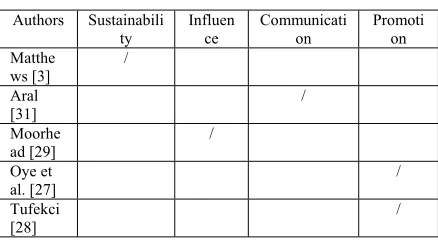
7021 influence others; and provide a wide access range, emotional support, and surveillance [29]. Social media should make a great tool for reaching out to citizens of the world to embrace a lifestyle of using more green technology to reduce carbon emissions in a cost-effective way.
Social media are more than marketing tools but can also help entrepreneurs benefit from new insights and available resources as they expand their social capital [30]). Communication is a basic tool used to bring organizational change, and it is relevant to maintain commitment to sustainability [23].
[image:4.612.85.304.351.471.2]Social media as communication tools are essential in making citizens commit to sustaining the environment. Social media is playing an active role in transforming the way people communicate, interact, consume, collaborate, and create, both in business and society [31].
Table 2. Impact of Social Media to Empower Green Library Initiative
Authors Sustainabili
ty Influence Communication Promotion Matthe
ws [3]
/
Aral [31]
/
Moorhe
ad [29] /
Oye et al. [27]
/
Tufekci [28]
/
Table 2 shows the gaps of the impact of social media to empower green technology in library. It is important that the proposed framework can be applicable and flexible to evaluate the impact of social media.
2.4 Usefulness of Social Media
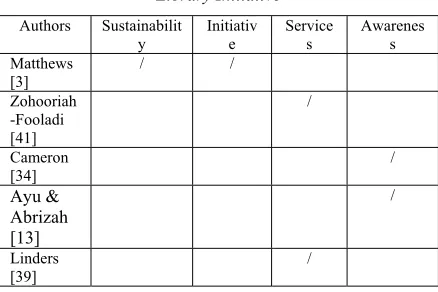
Social media can provide many useful benefits to the individual or organization growing and evolving its sustainable green identity and actions. In a positive, supportive spirit of sustainability and green initiatives, the following ideas are offered to ensure that the use of social media is increasingly successful and useful, in that, it contributes to strategic innovation and management including planning, implementation, and control [3]. Social media can be used for green companies by giving the value to the consumer in the comparison of products and services [2, 3].
Study by Zhoorian-Fooladi [14] showed that the librarians use social media to promote library services, manage organizational knowledge and receiving instant feedback from users.
Workflow obstacles, technology obstacles,
organizational obstacles and personal obstacles deter librarians from participating in social media. Many libraries are already experimenting with different social media services like Twitter or Facebook to interact and connect with their patrons, yet there are still a number of questions that come up as this is still fairly new territory [32].
Recently, Kai-Wah & Du [33] showed how the use of social media by library has now become mainstream. For example, in Asia, North America and Europe, 71% were found to be using social media tools with a further 13% saying they planned to use them. Facebook and Twitter were the most commonly used tools. Study by Ayu & Abrizah [13] showed the employs content analysis to examine current uses of the library Facebook page. A checkpoint was developed to analyze the libraries’ usage and application of Facebook page. The authors explores the use and application of Facebook among Malaysian academic libraries in order to provide academic libraries with ideas for best practices in using social networking sites to better profile themselves and communicate effectively with their users.
Social media has been used for green awareness with great success. Social media is useful for individual and team situation awareness [34]. In using social media to reach customers, firms have to be tactful and understand the personality and nature of each target group. Socializing, as well as seeking and exchanging information online, is related to personality, and the preference for types of social media is also related to personality differences [35]. Citizens tend to respond to green infrastructure and green technologies positively when they understand the life-cycle cost savings, get financial benefit from green use, have laws to implement green infrastructure on private properties, and mandate public projects to include green infrastructure in their processes [36]. Customers may use green technology if they are adequately informed through social media about the benefits of green technology.
7022 with around 63% removing unwanted friends from their lists, 37% removing their names from tagged pictures, and 44% deleting unwanted comments made on their profiles [38]. Social media can help customers form partnerships with government, firms, and industries. For example, through social media, citizens can influence how their governments function in terms of budgets and collaborations, instead of just being a consumer of public services [39].Social media are platforms to share and produce news for social, economic, political, and entertainment benefits, but social media is only significant to those with social media experience as well as to those who are gratified by seeking information, status, and socialization [40].
Table 3. Usefulness of Social Media to Empower Green Library Initiative
Authors Sustainabilit y
Initiativ e
Service s
Awarenes s Matthews
[3]
/ /
Zohooriah -Fooladi [41]
/
Cameron
[34] /
Ayu & Abrizah [13]
/
Linders [39]
/
Table 3 shows the gaps of social media usage from the previous study. Based on Table 3, there are still some limitation that focus on green library sustainability toward the green library initiative.
3. FACTORS TO IMPLEMENT GREEN LIBRARY
3.1 Energy factor
Energy is the importance factor by produced a good of green library. It is because by controlled an energy it can protect air quality. Energy is the most importance factor that we have to control it. Based on the LEED (Leadership in Energy and Environmental Design) rating, energy is the heaviest factor should be focused on. We can use the other alternatives way to save the energy. The energy that we used should be independent. For example, wind, solar or geothermal. All this kind independent energy come from the nature.
Therefore, it is very important to know what condition or recognize the locations before decide to build a new green library. This purposes to make it sure that the objective to build a green library can be achieved. Based on previous articles, that have a few recommendations to enhance the use of independent energy. It is because not only can protect the environment but also can save the cost and provide a good healthy environment such as air quality.
Aside from that, the libraries itself must use a suitable material the libraries. For example, use an adequate window, glass windows and window palate as initiative to allow natural light squally in to the library. From this initiatives, we don’t need to use electricity during the day, only use an electricity energy at night or during summer. From the previous study shows that Indian Library are constantly use the natural energy because of their culture and the compactness of people. We as an individual should agree with an energy give a big impact to the environment and society. Energy is the first step to move forward as a new era. Renewable energy gives a positive impact on both environment and human. For example, by using natural energy, the greenhouse spout can be decrease, lessen demand in contacts of maintenance and resources. Most of developed country use their natural excess as the initiatives to save the energy. For example, Austria use a solar to replace an electricity on their green library. We can say that, all the ideas or creativity to implement a green library should be starting from the heart of the institutions like library because something important usually started from important places.
3.2 Educational factor
7023 green library movement. Besides, the outdated collections such as CD, books and etc. are preferred to reuse if all these thing are in a good condition. For example, book can make a rough paper or make an origami to garnish a library or special rooms as well as non-printed collections also can be as an exhibition for next generations. Librarians also must have extra knowledge and have to attend the seminar to enhance their teaching skills. Also know how to transformed all the printed collections into computerized systems. From the previous study, focus on public libraries given because mostly people going there for spent time there. So on going to educate people about the green, they should steer with the example. Educate not only focus on designing or renovations but we should live in the green environment and share an experience to others. From that we can see the extent of our efforts.
3.3 Management factor
The role of management gives a big impact for the library’s objectives. If the management are committed with their role, the aims to be green library can be achieved. The role of management is focus on how to market the library itself by focusing on green library. The management should provide a few activities. For example, make a collaboration with other organization that are provided a green information such as exhibition or gardening activities. Aside from that, the management of library also can make a conference that topic related with green environment. This effort can give some knowledge to community. Besides that, the management also can find a strategic location to build a library or provide some space to do activities for green networking.
Beside that, the management also should be very effective and efficient to choose the materials. Management can discuss with the supplier to supply all the collections and materials that are friendly environment. Other than that, all the things such as computers or books can be recycle or reuse. Such as computer, the management can donate the computer to others that needed. Indirectly, we can help the people out there. Same goes the books, we can give to people that interested to keep the book collections. So that we can see how importance of the management to the library to make it sure that objective to implement a green library was achieved it.
4. THE AFFECT IN IMPLEMENTATION OF
GREEN LIBRARY TOWARDS
ENVIRONMENT WORLD
4.1 Resources
The environmental concerned was built for retained the natural environment quality. The use of natural and reuse resources was the another way to achieved the implementation of green library. In 1990s, the information professionals start to give supported towards the implementation of green library. In addition, the green worldwide aspects were already saved a lots of natural reuse resources.
4.2 Environmental
Either the external aspects resources, internal environmental aspects in green library also must be important to take a good cared of it. A good quality surrounding in the green library will gave a positive effect especially in the services ongoing and the collection materials too. Moreover, in contrast to our study, usually human being attitudes very discouraged when it comes to the environment cared aspects.
4.3 Materials
Materials were the main aspects in order to produce and contributed a good quality of the green library. The suitable and right choose of materials such as building materials have helped to achieve the target in implementation of green library. Besides that, the standards and requirement aspects also important to follow in order to reduce damaged
towards environment surrounding in
implementation of green library. A high quality condition in green library was always happened when using a low energy building and systems.
4.4 Educational
The environmental education in green library must always suitable, comfortable and comes along with updated materials collection. Therefore, a friendly environment surrounding in green library must always in flexible condition. In addition, it is also helped to educate the users about the environmental awareness.
4.5 Management
7024 projects management in order to approach a good greening library management.
5. FRAMEWORK
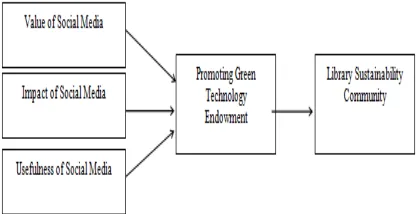
[image:7.612.90.300.330.437.2]In the proposed framework, social media is important as an achievement target to promote green technology. Social media becomes a guideline for library toward the implementation of green technology. Library need to understand the impact of social media to support the effort of green technology awareness in the library. Social media plays an important role for library to understand the value and usage of social media to improve the awareness of library community. In the proposed framework, social media aspect focuses on the value, impact and usefulness of social media in promoting green technology endowment for library sustainability community.
Figure 1: Proposed Framework based Social Media for Green Library Endowment
Sustainability on the other hand can be defined as the capacity to meets their own needs of ability to present without compromising of future generations. Role of the library on this worldwide phenomenon is very big. Libraries are considered to be the place of knowledge and provide user the variety of data for lifelong learning. For sustainability, librarians can be as role model by providing suitable and relevant information related to green issues and concerns by its collection and designing various programmes with the users. There is no comfortable place to model better practices for sustainable designing for reduced energy consumption and as an educator in the library in a whole range of new idea.
6. PROPOSITIONAL LOGIC
In the proposed framework, we denote
Value of social media is important because Value
relies user understanding of social media in sharing
the information of green technology using social media platform. We denote Impact of social media
relies the effective of using social media to promote green technology in library. Library need to understand the implementation of social media that could impact the effectiveness of promoting green library. The Usefulness of social media indicates the
implementation of social media that benefit the usage of social media platform to promote green library. The three aspects of social media are proposed to empower the usage of social media as a main platform to promote green library initiative for library sustainability community. The proposed framework implies the propositional logic as,
SM = Value + Impact + Usefulness (1)
where social media (SM)implies the aspect of Value,
Impact and Usefulness. Therefore, we denote the
implication as,
SM (Value (Impact (Usefulness))) (2)
In Fig.1, we understand that each social media consists of Value + Impact + Usefulness. This implies each
relationship as
SM(Value) (3)
which indicate social media has value toward green library endowment
SM (Value 1,…, Value n) (4)
where SM →( ¬Value ) is implies if it has value on
green library initiative.
We indicate social media has impact toward green library endowment
SM(Impact) (5)
7025 where SM →( ¬ Impact ) is implies if it has impact on
green library initiative. Lastly we indicate social media is useful toward green library endowment
SM(Usefulness) (7)
SM (Usefulness 1,…, Usefulness n) (8)
where SM →( ¬ Usefulness) is implies if it is useful on
green library initiative.
The framework indicates the relationship between social media platform and green technology (GT) initiative as
SM (Value (Impact (Usefulness))) = GT (Library (Sustainability)
The relationship implies on the
implementation of social media to empower green technology initiative for library sustainability community. The three variable; value, impact and usefulness indicate on important of social media as a main platform to promote green technology initiative.
The findings of this research will ensure the implementation of green library towards the environment world whether it is explicitly stated or not to improve the condition of mankind. he fact that humans are causing harm to the environment is no longer seriously questioned. Since libraries are public buildings meant for the betterment of all, they have the responsibility to not contribute to the destruction of the environment. This research also can give a contribution to educate the community regarding our current situation, and empower them to make a difference. Libraries are discovering that their green building gives them a great opportunity to educate the citizenry. As libraries continue to take a more progressive stance on improving the human condition, sustainability will have to be a central theme. Green libraries often offer various programs about environmental education by explaining how they are reflected in their architectural design and mechanism. Moreover, this research can build the awareness toward the community across the globe on the important and benefit of the implementation of green library towards the environment world. A few years ago, the implementation of green library started being known by the community. Nevertheless, through this research, the development of the green library towards the environment world will be outstanding and it becomes the focus to the next generation.
7. FUTURE WORK
Based on the previous study it gives many explanations about how to convert the existing libraries into green libraries. There are many advantage of using a green technology such as can save costs and space. It is focus on the academic library because many people use academic library to find information. The importance of doing this research are based on the previous study because there are a lot of information on how to change the environment in the library, but less focus on the importance of using green technology based system. Many of the previous study are discussing about the ways and effect when using a green technology system in the library but not have enough explanation about the advantages of using it. In this research we would like to make an interesting research about the advantage of using a green technology in the library. From previous study also, we can see that the article did not discussing more about the importance of buildings green libraries as sustainable development. The building of green technology also can help library to be eco-friendly. By using a green technology, they can reduce the space used in the library when all the physical collection changed into a digital collection. So, many users can have a luxury space when they come to the library. Besides that, when they used digital collection, they can reduce the use of printed paper where we already know the cost of paper production are high and can give harmful to the environment. Because of that, we choose topic about the advantages of using green technology application in library to make a research. This research is very importance to give awareness about the green technology effect for the future.
The research framework will be developed based on the previous studies. Few framework related to the research will be adopted and modify in order to proposed a framework that is flexible to promote green technology initiative for library sustainable communities. In order to test the flexibility and the application of the framework, mixed-method approach will be applied.
Mixed-method research methodology is
7026 from the sample and study the large population by using the statistical technique in order to determine the finding. Basically, the data collection for the study will use mathematics mechanism in order to represent the finding or analysis. Then, the result of the research can be stated in a form of numerical scales. Then the data will be supported with more information by getting the data and information based on the interview.
In this study, a Mixed Method Sequential Transformative Research Strategy based on a QUAN → Qual model will be used in the data collection process. This strategy has two distinct data collection phases in which the main priority to the quantitative phase, while the results from the quantitative data collection will be used to further inform the secondary data collection. The Transformative Research Strategy has a theoretical lens overlaying the sequential procedures to guide the study. In this context, the theoretical lens will be the framework model to inform and guide the research, and help to shape the direction, research questions and research instruments.
The data collection process of a questionnaire will be followed by qualitative collection of data in which the same voluntary staffs will be interviewed to better understand purposely in the aspect of their awareness and understanding the importance of green technology implementation in the library. Face-to-face interviews will be conducted on participants who expressed their interest when they filled in the questionnaires earlier. The questions in the interview generally cover more in depth the participant’s understanding and awareness on the change and improvement in using social media to promote green library initiative for library sustainability community.
In order to ensure quality research outcome resulting from the use of the research instrument, data will be collected from the library social media pages such as Facebook and Twitter. Data will be accessed and collected to identify any initiative done by the libraries in promoting green library. The evaluation process will compare both of the data in order evaluate the level of green library initiative. After obtaining a valid and satisfactory number of returned questionnaires, the researchers will embark on data analysis and interpretation stage. From the results of data analysis and interpretation, deductions will be finally made to evaluate the sustainability of library communities. For this study, descriptive statistics is being used with the aim to summarize the samples, rather than use the data to learn about the population that the samples of data are thought to represent. Therefore,
the chosen sample size will not be based on any probability theory, but a comfortable and reasonable sample representation for each category.
7. SIGNIFICANT
This research is in line with the Eleventh Malaysia Plan 2016-2020 (. RMK11 have six strategic trusts as a platform for the country to make vital policy shifts and invent new approaches to address new and existing challenges.aThe six strategic thrusts to help Malaysia stay ahead of the challenges and opportunities of the fast-changing global and political landscape. This research is line with one of the RMK11 strategic trusts which to; (1) pursuing green growth for sustainability and resilience.
Recent flooding and other extreme weather events are the most obvious signs that unless we live more sustainably we will face increasingly biblical consequences. Literal storms have arrived within a dreadful economic climate, leading to cuts that threaten the social care, health and other services that an ageing and unhealthy population relies on in increasing numbers. Industrialization and hi-tech financial markets helped get us into this mess. Now technology, if used to empower people and communities, holds the key to creating a sustainable future.
As we all know that social networking technologies can strengthen the understanding of green technology by promoting the information to improve awareness and understanding about green
technology. Therefore, this research will
strengthening the enabling environment for green growth by adopting the sustainable consumption
and production as reported in RMK11
(www.epu.gov.my). The research is important for library to conserve natural resources for present and future generations.
7.1 Novel theories
7027 empower the information regarding green growth in library.
7.2 Potential Applications
The study will develop novel framework for life long awareness as a reinforced commitment to green growth to ensure that Malaysia’s precious environment and natural endowment are conserved and protected for present and future generations.
7.3 Impacts on Society, Economy and Nation
7.3.1 Impact on Society
More information are shared on social media. Such information might be relevant or not. Social media could be very productive tools for society not only in sharing information but also the value of integrity, ethical, trustworthiness also promotes to the society. The values are important in the era of globalization in line with the government effort to practice integrity in government body. In this research, social media can be used as a platform to promote green growth for the society which will lead to better quality of growth, strengthened food, water and energy security, lower environmental risks and ecological scarcities, and ultimately better wellbeing and quality of life.
7.3.2 Impact on Economy
The research will lead to better economy for the nation. As reported in RMK 11 book, green growth refers to growth as resource-efficient, clean, and resilient. It is a commitment to pursue development in a more sustainable manner from the start, rather than a more conventional and costly model of ‘grow first, clean up later’.
7.3.3 Impact on Nation
Malaysia is a unique multicultural society. Social media engagement in library will not only promote the usage of relevant information for academic purposes but the good adoption and practice of social media will promote social harmony, as well as national unity at the national level. This is in one of the six strategic thrusts in RMK11 which to improve wellbeing for all. It includes better usage in sharing and using information from social networking technologies. As a result it will improve the quality of information outcomes and institutional excellence
in promoting green growth for sustainability community.
8. CONCLUSIONS
Librarians need to constantly search knowledge to improve the environment in the libraries to be better. Librarians need to look further and make an improvements such as using new technology in their library. For example, the use of green technology system in the library can help in reducing the cost of energy consumption and can also take care of the environment to make it secure. In addition, the librarian can also reduce the use of time in completing daily tasks. The use of green technology based system in the library that is easily accessible and convenience to the user can be very helpful for the user to find information in the library. Users do not have to bother to find information manual. This way can save time for users to get the information that they need. By using a green technology, it can help the user to find the information easily in a safe ways. Besides that, new technology can give a new ways of creating and expressing knowledge, and then dedicating spaces to supporting that creativity in a natural step for libraries of all kinds. In addition, by using a building with green technology it can change the environment in the library and can help to reduce maintenances cost. This is because the material use in making green buildings can help to sustain the energy.
In the future, descriptive statistics will be used with the aim to summarize the samples, rather than use the data to learn about the population that the samples of data are thought to represent. Therefore, the chosen sample size will not be based on any probability theory, but a comfortable and reasonable sample representation for each category.
ACKNOWLEDGMENT
7028
REFRENCES:
[1] W. Newman. (2012, 15 March). Strategic
Intent For Green Marketing And Disclosure
Using Social Media. Available:
Http://Sustainablebusinessforum.Com/Willia
mnewman/57188/Strategic-Intent-Green-Marketing-And-
Disclosure-Using-Social-Media
[2] R. Matthews. (2011, 15 March). Social Media
Marketing And Environmental Sustainability.
Available:
Http://Www.Thegreenmarketoracle.Com/201 1/02/Social-Media-Marketing-And.Html
[3] R. Matthews. (2011, 15 March). 50 Best
Blogs For Green Business Students.
Available:
Http://Www.Thegreenmarketoracle.Com/201 1/03/50-Best-Blogs-For-Green-
Business.Html
[4] B. Thurston. (2012) The Social Media Road Map. Fast Company. 69-80
[5] M. G. Trotta, "Product Lifecycle
Management: Sustainability And Knowledge Management As Keys In A Complex System
Of Product Development," Journal Of
Industrial Engineering And Management, Vol. 3, Pp. 309-322, 2010.
[6] R. J. Orsato, "Competitive Environmental Strategies: When Does It Pay To Be Green?,"
California Management Review, Vol. 48, Pp.
127- 143, 2006.
[7] H. Ny, J. P. Macdonald, G. Broman, R. Yamamoto, And K.-H. Robert, "Sustainability Constraints As System Boundaries: An
Approach To Making Life-Cycle
Management Strategic," Journal Of Industrial
Ecology, Vol. 10, Pp. 61-77, 2006.
[8] S. K. Sikdar, P. Glavic, And R. Jain,
Technological Choices For Sustainability.
New York: Springer, 2004.
[9] M. Chu And Y. Nalani-Meulemans, "The Problems And Potential Of Myspace And Facebook Usage In Academic Libraries,"
Internet Reference Services Quarterly Vol.
13, Pp. 69–85, 2008.
[10] C. D. Rosa, J. Cantrell, And A. Havens, "Sharing, Privacy And Trust In Our Networked World: A Report To The Oclc Membership," Dublin2007.
[11] L. Charnigo And P. Barnett-Ellis, "Checking Out Facebook.Com: The Impact Of A Digital Trend On Academic Libraries," Information
Technology And Libraries Vol. 26, Pp. 23–34,
2007.
[12] V. Cornell, "Greening The Library: Collection Development Decisions," The Journal Of New
Members Round Table, Vol. 1, Pp. 1-15,
2010.
[13] A. R. Ayu And A. Abrizah, "Do You Facebook? Usage And Applications Of Facebook Page Among Academic Libraries In Malaysia," The International Information &
Library Review, Vol. 43, Pp. 239-249, 2011.
[14] N. Zhoorian-Fooladi, "Academic Librarians And Their Social Media Presence: A Story Of Motivations And Deterrents," Information
Development, Vol. 30, Pp. 159-171, 2014.
[15] A. Tyler. (2012) Welsh Libraries And Social
Media: A Survey. Ariadne. Available:
Http://Www.Ariadne.Ac.Uk/Issue68/Tyler [16] K. C. Williams, R. A. Page, And A. R.
Petrosky, "Green Sustainability And New Social Media," Vol. 9, Pp. 11-13, 2014. [17] H. Ny, J. P. Macdonald, G. Broman, R.
Yamamoto, And K.-H. Robert, "Sustainability Constraints As System Boundaries: An
Approach To Making Life-Cycle
Management Strategic," Journal Of Industrial
Ecology, Vol. 10, P. 61, 2006.
[18] J. M. Ginsberg And P. Bloom, "Choosing The Right Green Marketing Strategy," Mit Sloan
Management Review, Vol. 4, Pp. 77-84, 2004.
[19] P. Hauke, K. Latimer, And K. U. Werner. (2013). The Green Library: The Challange Of
Environmental Sustainability. Available:
Http://Edoc.Hu- Berlin.De/Miscellanies/Greenlibrary-42062/379/Pdf/379.Pdf
[20] M. Antonelli, "The Green Library Movement: An Overview And Beyond," Elecronic Green
Journal, Vol. 1, Pp. 1-11, 2008.
[21] Laura L. Barnes. (2012, 17 March). Green
Buildings As Sustainability Education Tools.
Available:
Https://Www.Ideals.Illinois.Edu/Bitstream/Ha ndle/2142/34138/Green%20buildings%20as% 20sustainability%20education%20tools%20de posit%20version.Pdf?Sequence=2
[22] H. Ny, Macdonald, J.P., G. Broman, R. Yamamoto, And K. H. Robert, "Sustainability Constraints As System Boundaries: An
Approach To Making Life-Cycle
Management Strategic," Journal Of Industrial
Ecology, Vol. 10, Pp. 61-77, 2006.
[23] B. Grahl. (2013). The Media Of Social
Media’. Available:
7029 [24] H. Herrera, M. Morelli, And T. Palfrey,
"Turnout And Power Sharing," The Economic
Journal, Vol. 124, P. 131, 2013.
[25] R. D. Waters And G. D. Saxton, "What Do Stakeholders Like On Facebook? Examining Public Reactions To Nonprofit Organizations’ Informational, Promotional, And
Community-Building Messages," Journal Of Public
Relations Research , Vol. 26, P. 280, 2014.
[26] H. Cohen. (2011). Social Media Definition.
Available:
Https://Heidicohen.Com/Social-Media-Definition/
[27] N. D. Oye, A. H. Mahamat, And N. Z. Rahim, "Model Of Perceived Influence Of Academic Performance Using Social Networking," International Journal Of Computers And
Technology, Vol. 2, P. 24, 2012.
[28] Z. Tufekci, C. Wilson, And "Social Media And The Decision To Participate In Political Protest: Observations From Tahrir Square,"
Journal Of Communication, Vol. 62, P. 363,
2012.
[29] S. A. Moorhead, D. Hazlett, L. Harrison, J. Carroll, A. Irwin, And C. Hoving, "A New Dimension Of Health Care: Systematic Review Of The Uses, Benefits, And Limitations Of Social Media For Health
Communication " Journal Of Medical
Internet Research, Vol. 15, P. 85, 2013.
[30] E. Fischer And A. R. Reuber, "Social Interaction Via New Social Media: (How) Can Interactions On Twitter Affect Effectual
Thinking And Behavior?," Journal Of
Business Venturing, Vol. 26, P. 1, 2011.
[31] S. Aral, C. Dellarocas, And D. Godes, "Introduction To The Special Issue-Social Media And Business Transformation: A
Framework For Research," Information
Systems Research, Vol. 24, P. 3, 2013.
[32] A. Burkhardt, "Social Media: A Guide For College And University Libraries," College
And Research Libraries News, Vol. 70, Pp.
10-24, 2010.
[33] S. Kai-Wah C And H. S. Du, "Social Networking Tools For Academic Libraries," Journal Of Librarianship And Information
Science, Vol. 45, Pp. 64-75, 2012.
[34] M. A. Cameron, R. Power, B. Robinson, And J. Yin, "Emergency Situation Awareness From Twitter For Crisis
Management," In Swdm'12 Workshop, Lyon, 2012, Pp. 695-698.
[35] A. E. Hughes, S. E. Crowell, L. Uyeji, And J. A. Coan, "A Developmental Neuroscience Of Borderline Pathology: Emotion Dysregulation And Social Baseline Theory," Journal
Abnorm Child Psychol Vol. 40, P. 21, 2012.
[36] J. Foster, A. Lowe, And S. Winkelman, "The Value Of Green Infrastructure For Urban Climate Adaptation.," Center For Clean Air
Policy, Vol. 750, Pp. 1-52, 2011.
[37] L. Rainie, A. Smith, K. L. Schlozman, H. Brady, And S. Verba. (2012). Social Media
And Political Engagement. Available:
Http://Www.Pewinternet.Org/
[38] H. Seo, J. B. Houston, L. A. T. Knight, E. J. Kennedy, And A. B. Inglish, "Teens’ Social Media Use And Collective Action," New
Media & Society, Vol. 16, P. 883, 2014.
[39] D. Linders, "From E-Government To We-Government: Defining A Typology For Citizen Coproduction In The Age Of Social Media," Government Information Quarterly Vol. 29, P. 446, 2012.
[40] C. S. Lee And L. Ma, "News Sharing In Social Media: The Effect Of Gratifications And Prior Experience," Computers In Human
Behavior, Vol. 28, P. 331, 2012.
[41] N. Zohoorian-Fooladi And A. Abrizah, "Personafying Academic Librarians’ Social
Media Presence," Malaysian Journal Of
Library & Information Science, Vol. 19, P.