International Journal of Emerging Technology and Advanced Engineering
Website: www.ijetae.com (ISSN 2250-2459,ISO 9001:2008 Certified Journal, Volume 4, Issue 8, August 2014)
702
Low Voltage Ride through Solution for PMSG Wind Turbine
Using STATCOM
Pravin S Phutane
1, A. K. Jhala
21PG Student, RKDF College of Engg, Bhopal, M.P., India 2 RKDF College of Engg, Bhopal, M.P., India
Abstract— This paper presents enhancement of power quality by means of LVRT capability of wind farm driven by PMSG. As the share of wind generated power is increasing continuously in all over the world, hence penetration of this wind power in to grid become larger and larger, the grid connection condition of the wind turbine is more important. It is important that to avoid cascading effect wind turbine should stay connected to grid during grid disturbances. Connecting wind farm to grid posses some difficulties and challenging task for the TSOs as there are many connection requirements and description of these requirements are known as Grid Codes. Low voltage ride through capability is one of the dynamic requirements mentioned in E-ON NETZ gird code. This paper presents reactive power control to satisfy grid code requirement using STATCOM. Simulation results shows the presence of real power, reactive power with STATCOM and without STATCOM.
Keywords— permanent magnet synchronous generator (PMSG), Low Voltage Rude Through (LVRT), Grid Codes, STATCOM.
I. INTRODUCTION
[image:1.612.322.580.242.474.2]Compare to last decade wind generation of power as a part of renewable energy is significantly increased all over the world. Reliability and stability point of view it is interesting and important to observe behavior of wind generators during grid disturbances. Nowadays variable speed wind turbine is most popular viz. is Doubly Fed Induction Generator (DFIG) or Permanent Magnet Synchronous Generator (PMSG). PMSG have advantages over DFIG which are presented in [8] such as higher efficiency and energy yield, for the magnet field excitation no additional power supply etc. Wind generators used in generation of power tend to drain or absorb large amount of VAR from grid. Induction generators need excitation hence in steady state operation absorbs reactive power; moreover in case of short circuit fault need to absorbing more reactive power due to over speeding this will cause low voltage and stability problems[5].market share of different wind generator types has been reported in [1].however PMSG becoming more and more popular and attracting due to its advantages and drawbacks of other wind generators.
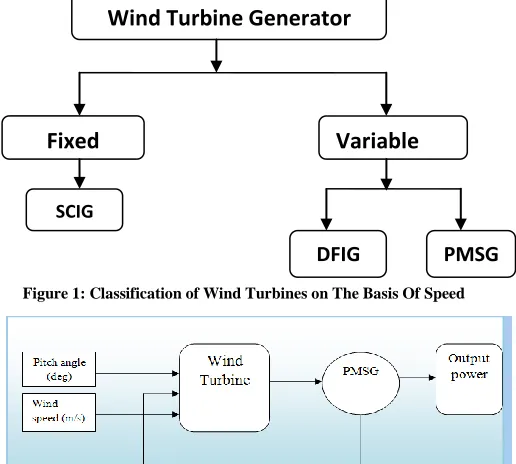
Figure 1: Classification of Wind Turbines on The Basis Of Speed
Figure 2: Block Diagram for Permanent Magnet Synchronous Generator
II. GRID CODES AND LVRTREQUIREMENT
Wind power generation is one of the key parts of renewable energy. As the penetration of the wind power increases in the electrical grid, it becomes challenging to maintain stability of the system. Hence Integrating wind farm to grid requires some essential conditions; description of these connection conditions known as Grid Codes [7].These grid codes was originally proposed by E.ON, Germany in Europe in 2003 for large wind farms. Essential conditions are nothing but some technical requirements with in grid codes which varies for different grids.
Technically grid codes requirement divided into two parts as;
i) Static Requirement ii)Dynamic Requirement
Wind Turbine Generator
Fixed
Speed
Variable
Speed
DFIG
PMSG
International Journal of Emerging Technology and Advanced Engineering
Website: www.ijetae.com (ISSN 2250-2459,ISO 9001:2008 Certified Journal, Volume 4, Issue 8, August 2014)
703 Static Requirement includes
i) Power Factor ii) Voltage Control iii) Quality of Voltage iv) Harmonic’s v) Frequency & Flicker
Dynamic Requirement includes, performance of wind turbine during disturbances and fault sequences i.e;
i) Fault Ride Through or Low Voltage Ride Through (LVRT) capability
ii)Fault recovery capability
[image:2.612.332.533.188.422.2]The main objective of the grid codes to give idea regarding technical specification complies by generic wind turbine model. As presented in [7] LVRT is Dynamic Requirement of the grid codes which is demanded by most of the transmission system operators (TSO). In case of any disturbance or voltage dip, turbine should stay connected to grid. In other words large wind farms must stay connected to grid during voltage sags down to certain percentage of nominal voltage for specific time duration [9].Interpretation of voltage verses time characteristics Describes LVRT capability curve
Figure 3: LVRT Curves for different countries
III. STATCOM
It was observed that STATCOM is effective in eliminating of the quality problems which may occur at the power systems which work by connecting to wind power plant.
If a VSC is connected to the transmission system through a shunt transformer to generate or absorb reactive power from the bus to which it is connected. Such a controller is known as Synchronous Static Compensator or STATCOM and is used for voltage control in transmission systems. If we compare STATCOM with a SVC, The major advantage is its reduced size, sometimes even to less than 50 %, and a potential cost reduction achieved from the elimination of capacitor and reactor banks as well as other passive components required by the SVC.
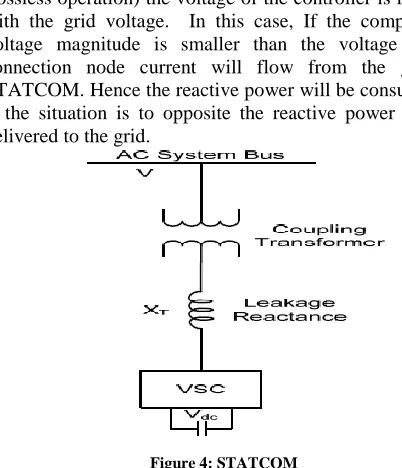
As it was mentioned before STATCOM can be treated as a synchronous voltage source, because its output voltage can be controlled as desired. Assuming that no active power is exchanged between STATCOM and the grid (lossless operation) the voltage of the controller is in phase with the grid voltage. In this case, If the compensator voltage magnitude is smaller than the voltage at the connection node current will flow from the grid to STATCOM. Hence the reactive power will be consumed or if the situation is to opposite the reactive power will be delivered to the grid.
Figure 4: STATCOM
STATCOM connection is to ac system bus. AC system voltage and the voltage-sourced converter terminal voltage is the same. This ensures that there is sending of only reactive power and no real power between the STATCOM and the AC system. The expressions sending current flowing from the STATCOM to the system and the reactive power injection are given as,
I
s= (V
2-V
1)/X
T(1)
Q
S=V
12{(V2/V1-1)/ X
T} (2)
The STATCOM is very convenient compared to other devices,
TABLE I Sr.
No .
FACTS Devices
Load flow
Vtg. control
Transient stability
Dyna. stability
1 UPFC High High Medium Medium
2 TCSC Medium Low High Medium
3 STATCOM High High Medium Medium
4 SVC Low High Low Medium
International Journal of Emerging Technology and Advanced Engineering
Website: www.ijetae.com (ISSN 2250-2459,ISO 9001:2008 Certified Journal, Volume 4, Issue 8, August 2014)
704 IV. CASE STUDY
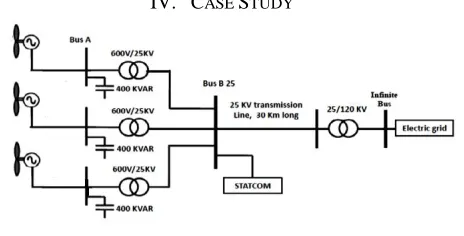
Figure 5: Single line diagram of studied system
Fig shows the single line diagram of wind farm under study system. Wind farm consist of 3 no’s of PMSG driven wind turbine having 1.5MW capacity each. This wind farm is to be investigated for further study and connected to 25KV distribution system through a 25 KV transmission line. The rotor of PMSG is driven by variable pitch control turbine. In order to limit generator output power the pitch angle is controlled at its nominal value for winds exceeding 9 m/s. In this studied system bus b25 is the main bus which connects wind farm and grid.
[image:3.612.57.289.140.258.2]In this paper this bus b25 is under study. For monitoring purpose monitoring equipments are placed at this bus. These equipments will monitor the total active power and reactive power from grid.
Table II PMSG Parameters
V. SIMULATION RESULTS
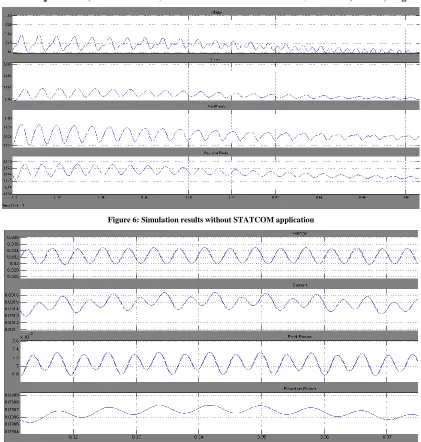
To study the effect of STATCOM on the steady state operation, the operation of the wind farm is monitored twice, one without STATCOM and the other with STATCOM connection at the main bus B25 of the wind farm. Figure 6 shows Simulation results without STATCOM application and Figure 7 shows Simulation results with STATCOM application.
Table III
Comparison of Real and Reactive Power with and Without STATCOM
Strategy Real
power(watts)
Reactive power(VAR)
TIME CYCLE (seconds )
With STATCOM
0.072 0.038 0.3-0.37
Without STATCOM
0.029 0.147 0.3-0.48
Rated power (MW) 1.5
Rated voltage (V) 300
Stator resistance (Ω) 0.425
d-axis inductance (H) 0.0082
q-axis inductance (H) 0.0082
Flux Linkage(Wbturns) 0.433
Pole pair 5
International Journal of Emerging Technology and Advanced Engineering
Website: www.ijetae.com (ISSN 2250-2459,ISO 9001:2008 Certified Journal, Volume 4, Issue 8, August 2014)
[image:4.612.95.516.128.570.2]705
Figure 6: Simulation results without STATCOM application
Figure 7: Simulation results with STATCOM application
VI. CONCLUSION
The main purpose of this paper to investigate use of STATCOM to support variable speed wind turbine in order to fulfillment of required LVRT Curve. It is applied to 4.5MW variable speed wind farm (which consist of three 1.5MW wind turbines) connected to grid. Simulation studies show that reactive power support with STATCOM and without STATCOM.
In other words this paper demonstrates reactive power compensation support by using STATCOM furthermore this operation of STATCOM improves the behavior of wind farm in steady state.
REFERENCES
[1] Hyong Sik Kim, Dylan Dah-Chuan Lu. Wind Energy Conversion
System from Electrical Perspective —A SurveySmart Grid and Renewable Energy, 2010, 1, 119-131 Doi:10.4236/sgre.2010.13017
Published Online November 2010
International Journal of Emerging Technology and Advanced Engineering
Website: www.ijetae.com (ISSN 2250-2459,ISO 9001:2008 Certified Journal, Volume 4, Issue 8, August 2014)
706
[2] Emna Mahersi, Adel Khedher, M.Faouzi Mimouni. The Wind
energy Conversion System Using PMSG Controlled by Vector Control and SMC Strategies INTERNATIONAL JOURNAL of RENEWABLE ENERGY RESEARCH, Vol.3, No.1, 2013
[3] R. A. Ibrahim et.al, ―A Review on Recent Low Voltage Ride
Through Solutions for PMSG Wind Turbine‖. 2012 International Symposium on Power Electronics,Electrical Drives, Automation and Motion
[4] Mirza Mohd. Shadab et.al. ―PERFORMANCE ANALYSIS OF
PERMANENT MAGNET SYNCHRONOUS GENERATOR
CONNECTED WITH WIND TURBINE‖. International Journal of Advanced Technology & Engineering Research (IJATER), VOLUME 2, ISSUE 2, MAY 2012, ISSN NO: 2250-3536
[5] Omar Noureldeen Low Voltage Ride through Strategies for SCIG
Wind Turbines Interconnected Grid , International Journal of
Electrical & Computer Sciences IJECS-IJENS Vol: 11 No:2
[6] Miad Mohaghegh Montazeri et.al ―Improved Low Voltage Ride
Thorough Capability of Wind Farm using STATCOM‖. 2011 IEEE International Electric Machines & Drives Conference (IEMDC)
[7] Willi Christiansen & David T. Johnsen. ―Analysis of requirements in
selected Grid Codes‖
[8] Rajveer Mittal, K. S. Sandhuand D. K. Jain, LOW VOLTAGE
RIDE-THROUGH (LVRT) OF GRID INTERFACED WIND DRIVEN PMSG.ARPN Journal of Engineering and Applied Sciences, VOL. 4, NO. 5, JULY 2009 ISSN 1819-6608
[9] Lihui Yang et.al Advanced Control Strategy of DFIG Wind Turbines
for Power System Fault Ride Through. Power Systems, IEEE Transactions on (Volume:27 , Issue: 2 ) May 2012, pg no.713 – 722
[10] Xinyan Zhang et.al ―Fault Ride-Through Study of Wind Turbines‖
http://dx.doi.org/10.4236/jpee.2013.15004 Published Online October 2013 (http://www.scirp.org/journal/jpee)
[11] Pravin S. Phutane and A.K. Jhala, 2014. A Review: Low Voltage
Ride Through (LVRT) In Wind Farm. International Journal of
Electrical Engineering & Technology
(IJEET).Volume:5,Issue:5,Pages:36-43]
[12] Dongliang Xie, Zhao Xu et. Al, A Comprehensive LVRT Control
Strategy for DFIG Wind Turbines With Enhanced Reactive Power Support. IEEE TRANSACTIONS ON POWER SYSTEMS, VOL. 28, NO. 3, AUGUST 2013
[13] Jon Are Suul, Marta Molinas et.al, STATCOM-Based Indirect
Torque Control of Induction Machines during Voltage Recovery after Grid Faults, IEEE TRANSACTIONS ON POWER ELECTRONICS, VOL. 25, NO. 5, MAY 2010
[14] Ahmed Samir Awad, et. Al. Low Voltage Ride Through
Characterizatio n of Single Wind Turbines ,
[15] Thanh Hai Nguyen_ and Dong-Choon Lee. Ride-Through Technique
for PMSG Wind Turbines using Energy Storage Systems, Journal of Power Electronics, Vol. 10, No. 6, November 2010
[16] Chong H., Huang A.Q., Baran M.E., Bhattacharya S., Litzenberger
W., Anderson L., Johnson A.L., Edris, A.-A., STATCOM Impact Study on the Integration of a Large Wind Farm into a Weak Loop Power System, IEEE Transactions on Conversion 23 (2008), No. 1, 226-233].
[17] M. Kenan DOSOGLU1, Ali OZTURK1, Gokhan POYRAZ1, Ugur