
7312
ASYNCHRONOUS REASONING SCHEME FOR GLOBAL
ONTOLOGY MANAGEMENT IN INTERNET OF THINGS
INFORMATION SYSTEMS:
ASYNCR*/GOM
1YONGGOO CHOI, 2ILKYEUN RA, 3SANGWON LEE
1Professor. Department of Computer Information, Dong Seoul University, Seongnam 13117, Republic of
Korea
2Professor. Department of Computer Science and Engineering, University of Colorado Denver, Colorado
80204, United States of America
3Associate Professor. Department of Computer & Software Engineering (Institute of Convergence
Creativity), Wonkwang University, Iksan 54538, Republic of Korea E-mail: 1[email protected], 2[email protected], 3[email protected]
ABSTRACT
In the open and dynamic Things of Internet (IoT), synchronization of the things is mandatory to provide their adaptable behaviors and maximum autonomies. The core goal of the synchronization is consistent context reasoning and up-to-date context maintaining in the IoT information systems. For realizing this goal, we present an asynchronous reasoning (AsyncR*) scheme, which is capable of non-stop reasoning while always maintaining up-to-date context information in the IoT information system. The AsyncR*
scheme based on semantic-timestamp and forged-version scheduling methods to preserve a serializability between concurrent ontology transactions. We also present a global ontology management (GOM) model and an ontology transaction (OT) model for efficiently governing the IoT ontology system. Finally, we talk key issues of the correctness of the AsyncR* scheme in consideration of diverse synchronous situations.
Keywords: AsyncR* (Asynchronous Reasoning), GOM (Global Ontology Management), Ontology System Model, Ontology Transaction Model, Internet of the Things (IoT).
1. INTRODUCTION
The vision of ubiquitous computing has typically focused on providing people with comfortable living environments. As a key task for achieving this vision, all of the intelligent devices around human being let themselves manage overall matters related to human activities without explicit human intervention. The Internet of Things (IoT) [1] has become a key concept in industry and academic fields to achieve such key tasks.
The IoT is completely integrated into everyday life of people to provide people with diverse context-aware services and context information in an “anyone, anywhere, anytime, and anything” fashion. Therefore, all of the intelligent objects on the IoT must be able to share common knowledges, reason their situations and interoperate with each other. For these tasks, ontologies [2] have clear
advantages in the IoT context model due to enabling knowledge sharing and interoperability with semantically well-defined concepts and their relationships in the open and dynamic environments.
7313 The design philosophy behind the AsyncR*
scheme is that a reasoning process that was once started should not be interrupted and avoided in any cases to preserve consistent behaviors of the things in the IoT, and an ontology information system for them should always maintain up-to-date context information. Analogously, it should provide a high degree of concurrent execution of ontology tasks.
The AsyncR* scheme based on semantic-timestamp
and forged-version scheduling methods to preserve a serializability between concurrent ontology transactions. We also present a global ontology management (GOM) model and an ontology transaction model for efficiently governing the IoT ontology system. Finally, we talk key issues of the correctness of the AsyncR* scheme in consideration
in the global ontology system.
2. BACKGROUNDS
2.1. IoT Ontology Modeling Scheme
Ontology is the study to express the general concepts that symbolize the basic categories of objects or elements that make up the world [3]. In other words, in the IoT, the Ontology describes a way to express relationships between things clearly. This type of ontology allows the user to define the status of certain IoT objects, such as various sensors, air conditioners, fans and lamps, and to define the relationships between objects. These defined objects and their relationships can be used for search, statistics, and analysis on situation and status data, as well as analysis on their associations and links. These applications are based on semantic web technology. The semantic web is a kind of web technology for the next generation that will give computers a handle on the information that exists on the web. In other words, the semantic web makes it possible for computers to understand the meaning of web information resources and self-designate the process of handling information such as extracting, transforming, cleansing, and loading information [4]. Until now, it is known that Ontology is best suited for modelling methodologies to systematically represent and deduce these semantic web resources.
An ontology modelling component consists of a large number of concepts, relationships between concepts, and constraints. In other words, it helps us classify the things that are in this world into a common class and explicitly articulate relationship between them [5].
Concept: It is a basic unit of ontology used to abstract the properties of an object in a particular area. Things in the same category are called classes.
Relationship or attribute: This is an ontology unit for expressing meaningful associations between classes.
Objects or instances: This refers to the physical object of the abstract concept, and the value at the bottom of the ontology hierarchy.
Communication: This formats relationship among the ideas of the Ontology and is used to clearly infer information.
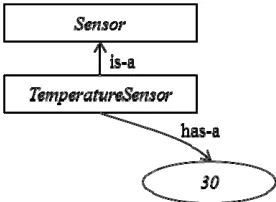
To further explain the Ontology concept, see a sensor Ontology example as shown in Figure 1.
Example 1(Sensor Ontology): The fact that
‘TemperatureSensor is a kind of Sensor’ is a true
proposition and knowledge that everybody has agreed to. TemperatureSensor and Sensor are the
[image:2.612.348.486.416.517.2]central concepts used to express knowledge, and their relationship is expressed as is-a (Figure 1).
Figure 1: Hierarchical Representation of the Partial Sensor Ontology
TemperatureSensor and Sensor can be expressed
as meaningful hierarchical relationships through the relationship is-a. And the TemperatureSensor
concept can be expressed as a hasValue relationship,
and the property can be expressed as an integer. It is true that TemperatureSensor has a value of 30, and
when you format it, it becomes an axiom. End of Example 1.
7314 circumstances of objects for interoperability and situation analysis through semantic based reasoning of IoT data. To express things on a semantic web, abstract IoT and sensor streaming data (such as user, object, time, location, service, and situation) are expressed in an on-demand knowledge base and various status information is deduced. Major Ontology includes SSN (Semantic Sensor Network), Onto-Sensor, and SensorData [6, 7, 8, and 9]. They are primarily an extension of the data recognition model of the Open Geospatial Cooperative (OGC) SWE (Sensor Web Enablement) [8]. However, these IoT ontology models are designed to serve the interoperability of things, so there is a limit to the real time sharing of objects. Accordingly, synchronization techniques are necessary for IoT multiple products to jointly use a single knowledge base, Ontology.
2.2. IoT Ontology Sharing Scheme
In the open and dynamic context of the IoT, the purpose of synchronization among the things is to ensure the maximum autonomy of things and to enable the thorough interoperability of things at the same time. To preserve consistency in the context information based on the IoT Ontology knowledge, concurrency control schemes are required. They are necessary between devices to add new knowledge classes to the ontology to keep things in synchronization, and devices that use knowledge in real time from the ontology. In the IoT, the purpose of the situational synchronization technique is to give things a context-knowledge view of the current situation, and to do so. To do so, Ontology storage should reflect the context of the current application on a real-time basis from various sensors around IoT. In IoT situations, the purpose of synchronization is to ensure proper behavior and to maintain independence of objects. That is, to ensure that things are as independent as possible while maintaining their thorough synchronization.
The basic principle of IoT Ontology sharing is to set the sequence of approaches to things. That is, it is necessary to control the concurrency control for the use of the status information of the different objects in the Ontology management system to ensure effective interoperability through synchronization of devices. Using the Ontology status information for real-time big data analysis in IoT environment, there are two works; changing the Ontology schema structure to add a new instance to the Ontology and searching for the Ontology schema. This environmental approach requires
access to a number of classes in the semantic hierarchy structure of the Ontology.
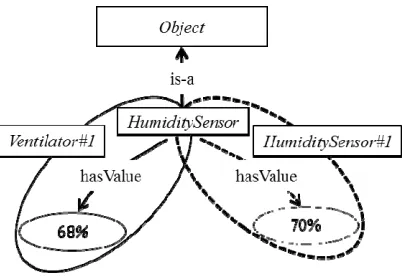
Example 2(Undesirable Behavior when Approaching the IoT Ontology Semantic
Hierarchical Structure): Let's assume that, in a
humidity sensor HumiditySensor in an object Object
in the IoT environment, 70% of a value measured at humidity sensor 1 HumiditySensor#1 H1 is about to
[image:3.612.318.519.247.385.2]be added while 78% of a value measured at a specific time is used in a ventilator 1 Ventilator#1
(Figure 2).
Figure 2: Concurrent Access of an Element in Ontological Semantic Web
Figure 2 shows that various things use the context awareness information in the IoT Ontology. While Ventilator#1 recognizes that the humidity
instance is 68%, the 70% of humidity instance of
HumiditySensor#1 recently measured can be added
to the IoT Ontology. Real-time access to Ontology repository for IoT context-aware services is more likely to cause phantom phenomena [10], which can negatively affect the real-time interoperability of intelligent things in IoT.
End of Example 2.
7315 To prevent these undesirable behaviors from a phantom phenomenon there are conservative and optimistic concurrent-control schemes. The conservative schemes are to have a locking method in advance to prevent other objects from accessing the IoT context information when an object in the IoT are accessed. On the other hand, the optimistic scheme is to allow multiple objects to access a single IoT Ontology simultaneously, but to grant the final result through a consistency check at the end of the access.
3. GLOBAL ONTOLOGY MANAGEMENT MODEL
3.1. Ontology System Model
In order to apply the IoT information system to mission-critical applications, it is necessary to integrate the local ontologies for overall governments for them. This integrated local ontology defines as global ontology [11]. The global ontology is composed by upper-level ontologies (UO) and local ontologies (LOs) for a unified and coherent reasoning. The UO specifies
the semantic representation of common concepts and their semantic relationships of the things such as object, users, context, services, and so on [12]. On the other hand, the LOs are a semantic
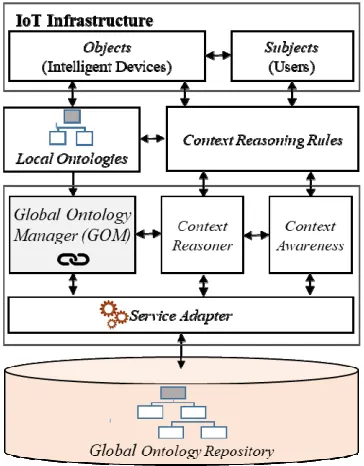
representation of the concepts and their relationships for any specific goals in domain-specific situations with the local IoT environments. The repetitive blocks of the local ontologies include in a global ontology according to the upper-level ontology schema rules that is specified in semantic relationships between ontology concepts or their instances. In the mission-critical IoT applications, providing consistent behaviors of the things and reasonable performances for efficient interoperability of them comes from a global ontology management (GOM) model (Figure 3).
We suppose that the local ontology blocks are inserted into the global ontology repository by a middle-ware solution over a span with a certain period of time. Such large global ontology bases are necessary to drive semantic context-awareness services in the intelligent business applications and scientific terminologies [13]. In the GOM system,
the context reasoning rules provide ways to make high-level contexts which are more meaningful from the low-level context [14] and used by the context reasoner. The context awareness is a task that recognizes a specific situation by combining
the reasoning results with other contexts. The GOM
[image:4.612.327.509.185.418.2]scheduler processes in the execution order between a context reasoning task and an insertion operation. Finally, the service adaptation [15] plays a role in executing adaptive services related to global ontology.
Figure 3: Global Ontology Management System
3.2. Ontology Transaction Model
7316 situations is meaningful, but updating and deleting existing ontology blocks for ontology management is meaningless because of the double-side context information features.
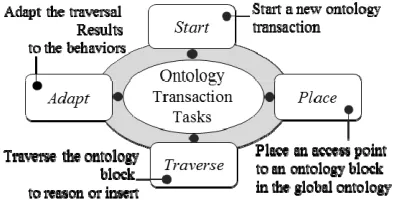
In the ontology transaction model, a set of ontology tasks is OT = {S, P, T, A} ⊂ OT, and
{Reasoning, Insertion} ∈T, where S, P, T, and A
are the abbreviations for Start, Place, Traverse, and
[image:5.612.95.292.242.342.2]Adapt respectively (Figure 4).
Figure 4: Tasks in the Ontology Transaction
In the Start step in an ontology transaction, GOM
system creates a new ontology process to begin the ontology transaction. And then the Place step
directly moves an access position on a target ontology block in the global ontology using primary context types [17] such as ontology identifier, time, location, state, etc. The Traverse step searches
ontology blocks located in the Place step for
reasoning or insertion. Depending on the traversal results, the Adapt step performs context-awareness
services based on reasoning results, or actually inserts the ontology block from local ontologies into global ontology repository.
4. ASYNCHRONOUS REASONING SCHEME
4.1. Ontology Process State Block
The first design philosophy behind AsyncR* is
that a reasoning process that was once started should not be stopped in any case to preserve the consistency of the behaviors of the IoT objects, while the global ontology is always maintaining up-to-date context information under the dynamic environments. Simultaneously, it provides a high degree of concurrent execution of ontology tasks for preserving autonomous behaviors of the intelligent devices on the IoT. To elucidate the
AsyncR* scheme, we assume that the global
ontology resides in computing main memory after being parsed in accordance with ontology schema rules, and each domain ontology in the global ontology has ontology block numbers (OBNs) to distinguish them from the others. We also assume that an ontology state block (OSB) has the ontology process state information such as ontology transactions, domain-ontology blocks, their associated time-stamps, and etc. To deal with such
OSB, AsyncR* scheduler maintains the following
[image:5.612.315.520.255.342.2]data structure (Figure 5).
Figure 5: Ontology State Block
In Figure 5, when an ontology transaction is started, the OSB is immediately created by a GOM
system, and the PID has a unique number to be able
to distinguish the process from other processes. The
OBN assigns the ontology block number in the
global ontology to be accessed by an ontology transaction. The TID records a number of the task
types defined in an ontology transaction. It only has one of two digits: 1 means a reasoning task, or 2
means an insertion task. The OID is assigned a
number of an operation in an ontology transaction. It has one of four digits: 1 means start, 2 means
place, 3 means traverse, or 4 means adapt operation.
The STS and the ETS records each start and end
time of the ontology transaction. The other part in the OSB has reasoning results in the case of the
reasoning task, or a forged-version number in the case of the insertion task when required by AsyncR*
scheduler.
4.2. Scheduling Algorithm
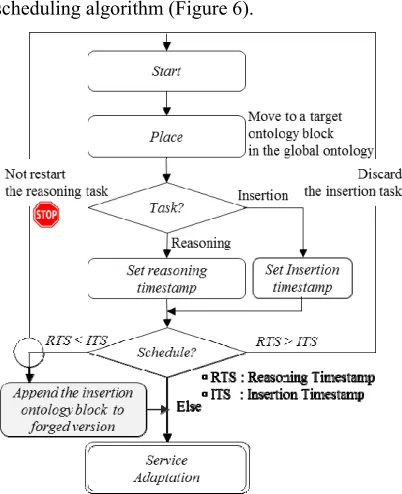
In this AsyncR* scheduling algorithm, our
forged-7317 version control scheme are used in the AsyncR*
[image:6.612.93.294.107.354.2]scheduling algorithm (Figure 6).
Figure 6: AsyncR* Scheduling Algorithm
In AsyncR* scheduling algorithm in the Figure 4,
each ontology transaction progresses according to the following scheduling rules.
Rule 1(Start scheduling): If an ontology
transaction begins in Start step, the GOM
system creates an OSB and assign a PID, OBN, TID, OID, and STS respectively to the OSB as shown in Fig. 3.
Rule 2(Place scheduling): According to the
context reasoning rules and ontology schema, the GOM system directly moves an access
position on a target ontology block in global ontology using primary context types. The rule of finding an access position of an ontology block is the same as OT(STS) >=
max(OBN(d-time)), where d-time is the time
assigned to the ontology block.
Rule 3(Semantic timestamp scheduling): If
an ontology transaction is successfully initiated, AsyncR* scheduler assigns the
ontology task type to the TID and the
starting time to STS in the OSB respectively.
If two different ontology transactions access the same ontology block in the global ontology, the AsyncR* scheduler processes
as follows.
Case 1(In the case of service requests in
the order of OT1: Reasoning and OT2:
Reasoning): The ontology transactions
OT1 and OT2 run a “come,
first-serve” basis in time sequence because of non-conflict serializability.
Case 2(In the case of service requests in
the order of OT1: Reasoning and OT2:
Insertion): In case that while OT1 is
executing a reasoning task on a specific ontology block in the global ontology,
OT2 is supposed to insert a new ontology
block at the same position, the insertion ontology block issued by OT2 leads a
phantom block to OT1. In this case, after
the insertion task in the OT2 is completed,
the OT1 should be restarted for preserving
serializability of the ontology transactions. However, since restarting the reasoning task of the OT1 results in inconsistent
interoperability among IoT objects, OT1
should not be interrupted in any case. Therefore, for asynchronous reasoning of
OT1, the AsyncR* scheduler temporally
made a new forged-version for OT2, and
insert it into the global ontology repository as soon as OT1 have finished.
Case 3(In the case of service requests in
the order of OT1: Insertion and OT2:
Reasoning): The OT1 is cancelled because
the ontology block of the insertion in the
OT1 is unnecessary for any other
applications.
Case 4(In the case of service requests in
the order of OT1: Insertion and OT2:
Insertion): Ontology transactions run a
“first-come, first-serve” basis in time sequence of pseudo-conflict serializability. Considering the above cases, AsyncR* timestamp
scheduling algorithm can streamline them as shown in Table 1.
Table 1: Timestamp Compatibility Matrix for AsyncR* Scheduling
OT1.time1 OT2.time2 AsyncR* scheduling
Reasoning Reasoning Sequence Reasoning Insertion Forged-version
[image:6.612.313.521.638.723.2]7318
Rule 4(Forged-version scheduling): If an
ontology transaction requests a traveling on an ontology block for an insertion task while other transaction is traveling on the same ontology block for a reasoning task, the
AsyncR* scheduler decides to create a forged
version of the ontology block and waits until the reasoning task is finished. Right after finished, the forged-version ontology block is inserted into a global ontology repository.
Rule 5(Service adaptation): If an ontology
transaction scheduling is completed successfully, the AsyncR* scheduler assigns
ending time of the transaction to ETS in the OSB and begins ontology tasks: context awareness, or insertion task.
4.3. Proof of Correctness
In the academic field, a correctness criterion pertaining to concurrency control schemes has been widely used in serializability among transactions [18]. To prove the correctness of AsyncR* scheme,
we will show that the AsyncR* scheduler always
produces a serial execution history. Due to preservation requirement of creation order of any conflicting insertion ontology transactions, it is necessary to show that the forged-version timestamp scheduling scheme for the AsyncR*
always processes them in the order of their creation sequence.
Definition 1(Global ontology structure): When a
global ontology (GO) consists in an upper-level ontology (UO) and several local ontologies (LOs), it can express in follow:
(1) where i is the number of a specific ontology
domain, and j is the number of a ontology block in
the block i. By the Equation the global ontology
presents as GO = { UO∝ { { LO11, LO12, ...., LO1n
}, ..., LOij, ..., LOmn } }, where LOijis the ontology
blocks in global ontology, and each LOij has
seamlessly semantic relationships with each other according to the upper-level ontology schema rules.
Definition 2(Context integration and integrity
constraints of a global ontology): The global
ontology should preserve ① context integration
that completely converges the local (or domain) ontologies to share the global ontology among the things in the IoT, and ② context integrity that entirely contains all the essential context information pertaining to context reasoning.
Suppose 1(Uniform access to an ontology block in
the global ontology): Access to an ontology block
in the global ontology is uniform in main memory ontology.
Lemma 1(Non-stop reasoning): In the IoT
information systems, context reasoning for context-awareness services should never be interrupted and avoided in any other situations for consistent interoperability among the things in the IoT environments.
Proof) Let’s recall Definition 1. If in the IoT dynamic environments, an ontology transaction interrupts and avoids reasoning process on LOij, at
the moment, LOi(j+1) may be added in another
ontology transaction. In this case, the LOij becomes
old-fashion context block in time sequence for a situation status. This schedule scheme leads to inconsistent interoperability because of context information loss, and violates the context integrity constraints in the definition 1. Therefore, a reasoning task in an ontology transaction should be always executed in non-stop fashion to combat such side-effects caused by a result of such miss-scheduling.
Lemma 2(New-fashion placing): If some ontology
transaction intents to access an target ontology block in the global ontology, the access point should be always placed in the most recently inserted ontology block in time sequence.
Proof) The IoT applications are typically based on prompt interoperability using context information generated in a real-time fashion from various sensors on the IoT. Let’s recall Definition 1 and Suppose 1. Suppose that the local ontology sets {
LO11, LO12, ...., LO1n } in a global ontology are
listed in chronological order, and LO11 > LO12 in
time sequence is established. If an ontology transaction intends to traverse an ontology block
LO1j for context reasoning, the LO11 always
becomes the target ontology block. In the same manner, if an ontology transaction intends to insert a new ontology block from local ontology repositories, it become inserted into the front of
7319 data structure that has a “last-in, first-service (LIFO)” fashion.
Theorem 1(View serializability [19] of AsyncR*
scheme): Suppose that the local ontology sets are
represented as { LO11, LO12, ...., LO1n } ⊂GO, LO11
> LO12 in time sequence. Now, consider the
following schedule history H:
(1)The AsyncR* scheduler receives LO11, where
LO11 denotes that an ontology transaction OT1
retrieves the LO11 contained in LO1j.
(2)The AsyncR* scheduler places LO1j, where LO1j
denotes that OT2 inserts the new LO into LO1j.
(3)The AsyncR* scheduler places in LO11.
According to schedule history H, the AsyncR*
scheme is view serializability if and only if differencing R2 from R1 is null where R1 is a result
set of Case 1 and R2 is a result set of Case 2
Proof: The serial graph of H is represented as OT1→OT2→OT1. The AsyncR* scheduler receives
an absolute position of LO11 from the global
ontology and has a start timestamp t1 according to
ontology state block (OSB) in Fig. 3. The R1 of
LO11 execution gets LO11⊂OL1j (Case 1). Now,
suppose that OT2 at the almost same time t2
requests an absolute position of LO1j so as to insert
a new ontology block from local ontology repositories into LO1j. The insertion task of OT2
could not be immediately granted according to Lemma 1. Therefore, the AsyncR* creates a
forged-version LO11+ of LO1j at time t6 and inserts a local
ontology block into LO11+ (Figure 7). The OT2
waits until the reasoning task of OT1 is finished.
Right after finished at the time t5, forged-version
ontology block inserts into global ontology repository at the time t7 (Case 2 of Rule 3 and Rule
4) (Fig. 5). Therefore, the serial graph of H
executes in serial as OT1→OT2 and reasoning tasks
of OT1 executed in non-stop fashion (Lemma 1).
According to Case 2 of Rule 2, the inconsistent interoperability occurs in AsyncR* scheduling rules
since differencing R2 from R1 is always null value.
This is sufficient to prove that AsyncR* scheduler
only produces serializable executions semantically.
Theorem 2(Correctness of AsyncR* scheme): For
any history H, H is serializable if only if every
transaction in H obeys the schedule rules of
AsyncR*.
Proof: This necessary condition is capable of being proven by following the same discussion as that of Theorem 1. From Lemma 1 and 2, we can also infer
that all conflicting insertion transactions in H are
executed in the order of their creation and H is
serializable, if every ontology transaction in H
obeys the concurrency control rules of AsyncR*.
Hence, if every transaction in H obeys the
scheduling rules of AsyncR*, H is serializable.
Finally, H is serializable if and only if every
ontology transaction in H obeys the scheduling
[image:8.612.322.511.213.395.2]rules for AsyncR*.
Figure 7: Proof of view serializability of the ontology transactions using Petri Nets [20]
5. DISCUSSION AND CONCLUSIONS
In this paper, we proposed an AsyncR* scheme,
which was capable of non-stop reasoning while always maintaining up-to-date context information in the IoT information system. The AsyncR*
scheme based on semantic-timestamp and forged-version scheduling methods to preserve a serializability between concurrent ontology transactions. The background of the AsyncR*
scheme was that a reasoning process that was once started should not be stopped in any case to preserve the consistency of the behaviors of the IoT objects, while the global ontology should always maintain up-to-date context information. For realizing this design philosophy, we also presented a global ontology management (GOM) model and an ontology transaction model for the AsyncR*
scheme. Finally, we talked correctness issues of the proposed scheme using Petri Nets. The AsyncR* scheme is simple, but provides a high degree of concurrency of ontology tasks.
7320 scheme could be strengthened by additional evidence demonstrating its strengths over the conventional approaches. The implementation of the proposed scheme and the quantitative analysis of execution times according to a real-time variance of computerized resources needed for the proposed timestamp and version scheme will be included in future works. Finally, we would like to extend our scheme to allow further theoretical investigation by using some properties such as multiple versions and operation semantics for more novel models.
ACKNOWLEDGMENTS
This paper was supported by Dong Seoul University for the research year (2016.8 ~ 2017.7) of the first author, Yonggoo Choi.
REFRENCES:
[1] IStrategy, I. T. U., and Policy Unit. “ITU Internet Reports 2005: The internet of things.”,
International Telecommunication Union
(Geneva), 2005.
[2] T. R. Gruber, “A Translation Approach to Portable Ontology Specifications”, Knowledge
Acquisition, Vol. 5, No. 2, 1993, pp. 199-220.
[3] J. Park, “Ontology,” in Management Information Systems, G.B. Davis (ed.) Cambridge,
Blackwell Publishing, Vol. 7, 2005, pp. 233-236.
[4] Amit Sheth and Matthew Perry, “Traveling the Semantic Web through Space, Time, and Theme”, IEEE Internet Computing, Vol. 12,
No. 2, 2008, pp. 81-86.
[5] Mustafa Jarrar, Jan Demey, and Robert Meersman. “On Using Conceptual Data Modeling for Ontology Engineering”, Journal
on Data Semantics i, Springer Berlin
Heidelberg, 2003, pp. 185-207.
[6] Holger Neuhaus and Michael Compton. “The semantic sensor network ontology”, AGILE Workshop on Challenges in Geospatial Data
Harmonisation, 2009.
[7] D. J. Russonmanno, C. Kothari, and O. Thomas, “Sensor Ontologies: from Shallow to Deep Models”, Proceedings of System Theory,
SSST’05 Proceedings of the 37th Southeastern Symposium on Los Alamitos (USA), Mar. 2005, pp. 107-112.
[8] A. Sheth, C. Henson, and S.S. Sahoo, “Semantic Sensor Web”, Internet Computing IEEE, Vol.
12, Aug. 2008, pp. 78-83.
[9] C. Michael, H. Cory, L. Laurent, N. Holger, and S. Amit, “A Survey of the Semantic Specification of Sensors”, Proceedings of the 2nd International Workshop on Semantic
Sensor Networks (SSN09) (USA), Oct. 2009,
pp. 17-32.
[10] Weikum, Gerhard, and Gottfried Vossen.
Transactional information systems: theory, algorithms, and the practice of concurrency control and recovery. Elsevier, 2001.
[11] R. F. Brena and H. G. Ceballos. “Combining Global and Local Ontology handling in a Multiagent System”, FLAIRS Conference,
2004.
[12] M. Lenzerini, “Ontology-based Data Management”, Proceedings of the 20th ACM international conference on Information and
knowledge management, 2011.
[13] J. Seidenberg and A. Rector. “A Methodology for Asynchronous Multi-User Editing of semantic Web Ontologies”, Proceedings of the 4th International Conference on Knowledge
Capture, 2007.
[14] C. Perera, et al., “Context Aware Computing for the Internet of Things: A survey”, IEEE
Communications Surveys & Tutorials, Vol. 16,
No. 1, 2014, pp. 414-454.
[15] H. Guermah, et al., “An Ontology Oriented Architecture for Context Aware Services Adaptation”, arXiv preprint arXiv:1404.3280,
2014.
[16] C. Bettini, et al., “A Survey of Context Modelling and Reasoning Techniques”,
Pervasive and Mobile Computing, Vol. 6, No.
2, 2010, pp. 161-180.
[17] G. D. Abowd, et al., “Towards a Better Understanding of Context and Context-Awareness”, International Symposium on Handheld and Ubiquitous Computing,
Springer Berlin Heidelberg, 1999.
[18] N. S. Barghouti and G. E. Kaiser, “Concurrency Control in Advanced Database Applications”, ACM Computing Surveys, Vol.
23, no. 3, 1991, pp. 269-317.
[19] M. Sunil, “Timestamp-Ordering Protocol for Concurrent Transactions - A Performance Study”, International Journal of Computer Applications, National Conference on
Emerging Trends in Computer Technology,
2014, pp. 24-26.
[20] T. Murata “Petri Nets: Properties, Analysis and Applications”, Proceedings of the IEEE, Vol.
![Figure 7: Proof of view serializability of the ontology transactions using Petri Nets [20]](https://thumb-us.123doks.com/thumbv2/123dok_us/8901616.955110/8.612.322.511.213.395/figure-proof-serializability-ontology-transactions-using-petri-nets.webp)
