7164
THE INFLUENCE OF ENVIRONMENTAL UNCERTAINTY
ON THE ACCOUNTING INFORMATION SYSTEM QUALITY
AND ITS IMPACT ON THE ACCOUNTING INFORMATION
QUALITY
1RUHUL FITRIOS, 2AZHAR SUSANTO, 3ROEBIANDINI SOEMANTRI, 4HARRY SUHARMAN
1 Accounting Departement, Faculty of Economics & Business, Riau University, Pekanbaru, Indonesia
2,3,4Accounting Departement, Faculty of Economics & Business, Padjadjaran University, Bandung, Indonesia
E-mail: 1[email protected], 2[email protected], 3[email protected]
ABSTRACT
The organizational environment is one factor that is considered when planning and operating the accounting information system. The inability of decision makers to capture information about changes and environmental complexity underlies the lack of accounting information systems quality. This study aims to examine the effect of environmental uncertainty on the accounting information system quality and their impact on the accounting information quality. The study was conducted on 104 financial unit of higher education accredited in Java from 238 target populations selected by stratified random sampling technique. This study uses descriptive method and verificative method. The study results show that environmental unvertainty significantly influences the accounting information system quality, dan accounting information system quality significantly influences accounting information quality. The study results can be used to solve the problem on there have no quality of accounting information system by improving the ability accounting information system to adjust and accommodate environmental changes and complexity.
Keywords: Environmental Change; Environmental Complexcity; Accounting Information System Quality; Accounting Information Quality.
1. INTRODUCTION
An organization is in an environment, where the organization needs resources from the environment, then supply the goods and services to the environment [1]. The environment generally changes faster than the organization, such as technological changes, tastes and values [1]. Factors in the organizational environment create uncertainty for the organization [2]. To reduce the effects of such environmental uncertainty, organizations need the role of information [3].
Information contributes to make better the quality of organizational or individual decisions and improve the ability of the organization to plan and prepare its activity schedule [3]. Organizations need and use information, both financial and non-financial information to take decisions and solve problems more closely [4]. Thus it can be said that
information becomes a resource in business and is vital to the survival of a business organization [5].
Information is said to have qualify, only if the information is relevant and useful to the user [6]. People need such high-quality information,
namely: information products that have
characteristics, attributes, or qualities that make information more valuable to them [7]. Such quality information is generated by an effective information system [1]. In addition usefull accounting information is generated by accounting information systems by collecting data and converting it into important quality information [8]. Several previous studies have proved the importance of the role of accounting information systems to produce quality accounting information [9], [10], [11].
7165
decision makers [12]. Quality of accounting
information system is described by characteristics, such as integration, reliability, and flexibility [13]. System integration is formed when system components connect and work in harmony [14]. The reliability of a system is seen when the accounting information system is able to produce accurate, timely information reflecting the results of properly authorized transactions and of all activities undertaken within the organization over a period of time [15]. System flexibility is demonstrated by the ability of the system to accommodate changes in information needs [16].
Some phenomena reveal that accounting information systems in various universities, as follows: Accounting information system at Gadjah Mada University has not been integrated because many units (faculties / directorates) have their own system application and have separate databases [17]. Financial information system of State University of Legal Entity has been considered less flexible and feared will hamper the progress of higher education [18]. Accounting information system at Brawijaya University has not been reliable, because there are income of university which is too late to be reported [19].
One of the factors that affect the quality of accounting information system is environmental uncertainty. Environmental uncertainty is a consequence of how many environmental factors affect the organization, and how quickly those factors change [20]. To overcome the effects of environmental uncertainty the organization must solve it by being more flexible and adaptive to change in the face of those external changes [21].
Information systems help organizations not only to see environmental changes, but also to react to those changes [1]. To achieve these objectives, the organizational environment is one of the organizational factors that must be considered in the planning of accounting information systems [1]. Further information systems should be flexible to accommodate
environmental change [22]. Accounting
information system should be able to create value for the company as an organizational solution to the challenges posed by the organization's environment [1].
Several previous research results have proven the effect of the environment on the quality of
accounting information systems that the
uncertainty of the organization's environment is an important factor that affects the quality of accounting information systems [23], [24], [25], [26].
Based on the background of the problem, the research questions are 1) How much influence the environmental uncertainty on the accounting information systems quality? and 2) How much influence the accounting information system quality on the accounting information quality?
2. LITERATURE REVIEW
2.1. Environmental uncertainty
Environmental uncertainty is the inability of the organization to accurately predict the effects of various aspects of the company's external environment [27]. Similar opinion, environmental uncertainty suggests that managers do not have sufficient information about the organizational environment intended to understand or predict future events [28]. Similarly, environmental uncertainty is characterized by the amount of uncertainty found in the environment, due to changes and complexity in the organizational environment that may affect the organization's objectives [29]. Based on the above opinion it can be concluded that environmental uncertainty is the inability of decision makers to predict appropriately the environmental influences of the organization, as it lacks sufficient information for decision-making, as a result of changes and complexity of the organization's environment.
Environmental uncertainty is described by 2 (two) dimensions: stability or unstability and degree of complexity [30]. Environmental uncertainty can be seen from the degree of change (dynamic or stable) and the complexity of an organization's environment [29]. There are 2 (two) dimensions of organizational environment referred to as: (1) Environmental change, and (2) Environmental complexity [31].
An environment is said to be stable if the elements of the environment do not change during a certain period of time (months or years), while the dynamic environment is when environmental elements change unpredictably [30]. The environment is said to be stable when environmental changes occur very minimal, otherwise dynamic environment if elements of the organization environment, both specific and
general environment often change [29].
Furthermore, environmental change concerning the extent of conditions such environmental changes can’t be predicted [31].
7166 environment [30]. The same thing is said that the external environment is regarded as a simple or complex environment determined based on how many elements / environmental factors affect the organization [20]. In addition, it can be argued that environmental complexity is a function of the strength, quantity, and reciprocity of the specific and general environments that the organization should manage [2]. Furthermore, the complexity of the environment can be said as the extent to which the organizational environment becomes complex, so the environment becomes difficult to understand [31]. Based on the above description can be concluded that the simple / complex environment is the state of the environment indicated by the many elements / environmental factors affect the organization and the amount of knowledge the organization has about the environment.
The concept of environmental uncertainty is downgraded to indicators through dimensions: 1) Stable / dynamic environment dimention, through indicators: technological change, and socio-political changes through changes in legislation, and 2) complex environments dimention, through indicators: diverse customers, and diverse of suppliers and the diverse outputs of products produced for different customers, and information about the environment owned by the organization.
2.2. Accounting information system quality
An accounting information system is an integrated structure within an entity that employs physical resources and other components to transform economic data into accounting information, the aim of satisfying the information needs of various users [28]. Accounting information system can be regarded as a collection of data that is processed to produce information required by the user [29]. In Addition, Accounting information systems is called a system that collects, records, stores, and processes data to generate information for decision makers [3]. In addition, more specific accounting information systems are said to be a collection of sub-systems or components, interconnecting with each other to process financial data into financial information [10].
Based on the above statements can be concluded that the accounting information system is a set of subsystems or components, in the form of physical and non-physical resources, which are mutually integrated to process financial data and
become financial information for the purpose of decision making.
Quality indicates how well the result of a job can fulfill the objectives to be achieved by management [1]. In addition quality can also be defined as the capacity of a product or service to meet customer [34]. The quality associated with an accounting information system can be assessed when the system shows a flexible, efficient, accessible, and timely information system [34]. In addition, the quality of information systems is also demonstrated by the ease of use of the system [1]. The above description shows that the accounting information system quality is a clue indicating the ability of accounting information system to process financial data and generate accounting information useful for decision makers.
The accounting information system quality can be seen from the characteristics: system flexibility, system reliability, and ease of learning [35]. The characteristics of accounting information system quality can also be seen from: providing the correct functionality for end users; fast in taking data and moving between different display screen of data; reliable; well integrated with other systems, etc. [36]. In addition it can also be seen the quality components of information systems, including: acceptability, availability, cohesiveness, ease of learning, effectiveness, efficiency, flexibility, reliability, robustness, ..., and visibility [37]. Previous studies used various indicators in determining the quality of the infomation system. the quality of business intelligent systems is measured by indicators: flexibility, reliability, accessibility, and system integration [38]. The effectiveness of accounting information systems is measured by indicators: flexible, accessible, efficient, easy to use, security, availability, and processing integrity [39]. Other studies use flexibility, ease of learning, ease of use, reliability, sophistication, accessibility, and integration to measure the quality of accounting information systems [40]
Based on the phenomenon found, the accounting information system quality in this study is examined from the characteristics: integration, flexibility, and reliability.
7167 business processes and decision making [42]. Based on the above statements it can be said that system integration is shown by how the integration between system components, data integration, and system compatibility with other systems in data processing and produce information.
System flexibility is demonstrated by the ability of computer-based information systems to react to unexpected situations and events [36]. System flexibility can also be demonstrated by systems capable of responding to organizational changes, both small and large changes [6]. In addition the system flexibility refers to how quickly the system can change to support environmental change [43]. Based on the above explanation it can be said that the flexibility system is the ability of the system to follow the changes quickly and easy to modify.
Reliability of the system is demonstrated by the ability of the system to minimize the error rate and produce the correct and consistent output [37]. In addition, a reliable system is visible when performing pre-programmed functions, where reliable system applications can reject improper system usage, such as improper entry and data processing [4]. System reliability can also be demonstrated by the system operating completely 24 hours a day and only stopping for routine repair or maintenance [36]. Based on the above explanation can be said that the reliability is the system works correctly, able to minimize errors, and operate full time.
2.3. Accounting information quality
The quality of accounting information is the level or degree of accounting information generated that is measured by characteristic characteristics: content, form, and time that provide value to the end user [7]. Information Quality is the degree of information described by different groups of characteristics into categories of time, content and form [36]. Then quality of information is effective information, which is useful information to make a decision [8]. Thus it can be said that the quality of accounting information is the degree of information used for decision making.
The quality of information generated by the accounting information system has characteristics: relevance, accuracy, timeliness and completeness [44]. In addition, an effective information system produces information that has the characteristics: accurate, timely, and relevant [1]. Then an information becomes more valuable to the
organization because it has the characteristics: accessible, accurate, complete, relevant, reliable, timely and vierifiable [34]. In addition Quality of usefull information has features: relevant,
accuracy, timeliness, conciseness, clarity,
quantifiability, and consistent [32]. The
dimensions of the quality of accounting information used in this study are accurate, relevant, timely, and complete.
The dimensions of the quality of accounting information used in the study are accurate, relevant, timely, and complete.
3. FRAMEWORK AND HYPOTHESIS
3.1. The influence of environmental uncertainty on accounting information system quality
Environmental uncertainty is a major factor affecting the use of accounting information systems by managers [28]. The same thing is said that the external environment of the organization affects the information system used by the organization [1]. The external environment has a very strong influence on the accounting information system, while the information system has little ability to change the environment [10]. In addition the business environment and corporate character greatly contribute to accounting information systems that are specifically designed to meet the needs of the company [32].
Environmental uncertainty arises because of changes and complexity of the organization's environment. This environmental change is indicated to occur in elements, such as: economic conditions [2], technology [28], and socio-political environment [30]. Complex environments give rise to a greater need to gather information to be used to respond to such complexity [30]. Then environmental complexity will encourage the organization to have the ability to process and understand the vast amount of such information [31]. Accounting information systems can be used to increase the amount of information about the environment available for decision making [31]. Organizational environment is therefore one of the factors that the organization should consider in planning an accounting information system [1].
Several previous studies have proven the role of environmental uncertainty about the quality of
accounting information systems of an
7168 considers the characteristics of the external environment as an integral component [25]. Environmental stress has a positive correlation with the implementation of Computer Based
Information Systems / Business Process
Reengineering Projects in USA based
organizations [26]. Furthermore the use of accounting information systems becomes more effective by identifying the external environment of the organization [23].
3.2. The influence of accounting information system quality on accounting information quality.
The accounting information system aims to generate accounting information for internal and external users [32]. Accounting information system collects the data and converts it into important quality information [8]. In addition, accounting information systems help improve the quality of decision making by providing accurate and timely information [3]. Similarly the quality of the information system considers the accuracy and timeliness of the information generated and the ease of use [1].
Several previous studies have proven the role of accounting information systems quality to produce accounting information quality. The results of study in Iran show that accounting information systems affects the quality of
information [46]. The results showed that the accounting information system has implications for the quality of accounting information [47]. Study results in Jordan conclude the impact of the existence of accounting information systems on the quality of financial statements submitted to the government in Jordan [9].
The results of research on Islamic banks in Jordan show that accounting information systems help users get timely information [10]. Research on the implementation of accounting information system in hospitals in Riau Province, Indonesia concluded the magnitude of the effect of accounting information systems on the accounting information quality generated [48]. Other research results conducted at universities in Bandung, Indonesia concluded that the accounting information systems quality affect the accounting information quality [49].
4. HYPOTESIS
Based on the above framework can be concluded research hypothesis, as follows:
1) Environmental uncertainty influences the
accounting information systems quality.
2) Accounting information systems quality
influences the accounting information quality.
Figure1: Research Model
5. RESEARCH METODHOLOGY
This research uses descriptive and
verificative research methods that are intended to prove the phenomenon and research hypothesis. Descriptive method is used to describe data collected about the characteristics of the events, persons or situations under study [50]. The descriptive method is also intended to collect information about existing conditions with a view to describing a natural event [51]. Thus the descriptive method in this study describes the real conditions about the influence of variable
environmental uncertainty, the quality of accounting information systems and the quality of accounting information. While the verification method is intended to test the hypothesis derived from the theory [52]. In addition verification theory focuses on how to test the hypothesis up to a certain level of trust [53]. Thus, this study will examine the conclusions of the theory as stated in the research hypothesis with the facts in the field.
The population of this study is all units of finance on higher education accredited in Java, with the target population of 238 higher education accredited. Questionnaires were distributed to 543 Environmental Uncertainty
Stable/dynamic environmental
Simple-complex environmental
Accounting Information System Quality
Flexibility system
Reliability system
Integration system
Accounting information Quality
Accurate
Relevant
Timelines
7169 respondents for 155 unit of finance on higher education accredited selected using stratified random sampling technique. 104 units of finance on higher education returned the questionnaire with the number of respondents a total of 325 respondents.
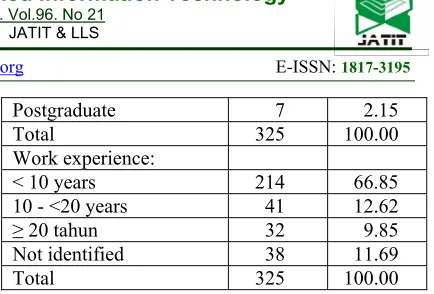
Respondents of this study are those responsible for the preparation of financial statements: staff of financial reporting, head of subdivision, head of accountancy / finance and / or bureau of finance. Characteristics of respondents are described by job position / position, level of formal education and work experience (table 1).
Table1. Respondent Characteristics
Description Frequency Percent
Position:
Manager/Head of Section 115 35.38
Head of Subsection 75 23.08
Accounting Staff 135 41.54
Total 325 100.00
Education level:
High School 27 8.31
College 28 8.62
Undergraduate 176 54.15
Graduate 87 26.77
Postgraduate 7 2.15
Total 325 100.00
Work experience:
< 10 years 214 66.85
10 - <20 years 41 12.62
≥ 20 tahun 32 9.85
Not identified 38 11.69
Total 325 100.00
The questionnaire was constructed using a likert scale model, giving 5 answer choices for each question. The collected data was processed by using SPSS analysis tool for descriptive analysis and structural equation modeling (SEM) based on Partial Least Square (PLS) for hypothesis testing.
[image:6.612.316.533.45.192.2]Based on the theoretical framework constructed above, we can illustrate the overall path model (figure 2). The measurement model is reflective, either at the first order or in the second order for all latent variables. The structural model describes the model of influence of environmental uncertainty on the accounting information systems quality and their impact on the accounting information quality.
Figure 2: Overall Path Model
6. RESULT AND DISCUSSION
6.1. The Result of the Study
6.1.1. descriptive analysis
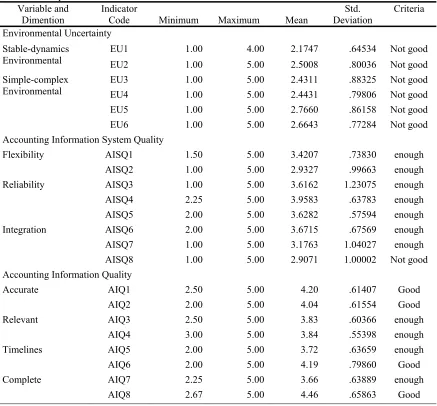
7170 "enough" criteria, except for AISQ2 items (ease of system modification) and AISQ8 (inter-system integration) not good. Then for the quality of accounting information shows there are 4 (four) of indicators enter the category of "good", and 4 (four) of other indicators into the category
[image:7.612.93.530.185.591.2]"enough". Respondents' answers about the quality of accounting information systems on higher education accredited in Java successfully describes the phenomenon of accounting information system that occurred at several universities, as revealed in the introduction of this study.
Table 2. Descriptive Statistics of Variables Variable and
Dimention Indicator Code Minimum Maximum Mean Deviation Std. Criteria
Environmental Uncertainty Stable-dynamics
Environmental EU1 EU2 1.00 1.00 4.00 5.00 2.1747 2.5008 .64534 .80036 Not good Not good
Simple-complex Environmental
EU3 1.00 5.00 2.4311 .88325 Not good
EU4 1.00 5.00 2.4431 .79806 Not good
EU5 1.00 5.00 2.7660 .86158 Not good
EU6 1.00 5.00 2.6643 .77284 Not good
Accounting Information System Quality
Flexibility AISQ1 1.50 5.00 3.4207 .73830 enough
AISQ2 1.00 5.00 2.9327 .99663 enough
Reliability AISQ3 1.00 5.00 3.6162 1.23075 enough
AISQ4 2.25 5.00 3.9583 .63783 enough
AISQ5 2.00 5.00 3.6282 .57594 enough
Integration AISQ6 2.00 5.00 3.6715 .67569 enough
AISQ7 1.00 5.00 3.1763 1.04027 enough
AISQ8 1.00 5.00 2.9071 1.00002 Not good
Accounting Information Quality
Accurate AIQ1 2.50 5.00 4.20 .61407 Good
AIQ2 2.00 5.00 4.04 .61554 Good
Relevant AIQ3 2.50 5.00 3.83 .60366 enough
AIQ4 3.00 5.00 3.84 .55398 enough
Timelines AIQ5 2.00 5.00 3.72 .63659 enough
AIQ6 2.00 5.00 4.19 .79860 Good
Complete AIQ7 2.25 5.00 3.66 .63889 enough
AIQ8 2.67 5.00 4.46 .65863 Good
6.1.2. verificative analysis
1) evaluation of measurement model
Evaluation of the measurement model is used to assess the validity and reliability of indicators of measurement variables. Test validity is intended to determine the feasibility of an instrument to measure respondents' answers [49].
The result of evaluation of measurement model through convergent validity shows that the outer loading of each indicator of environmental uncertainty variable, the quality of accounting
7171 the quality of accounting information is higher than the correlation with other constructs.
Based on the evaluation of the above measurement model, it can be concluded that the measurement model is valid. In other words, the
measurement indicators of environmental
uncertainty, accounting information system quality, and accounting information quality are capable of measuring the constructs.
The reliability test shows the consistency of a measuring instrument to measure the concept being measured [49]. Based on evaluation of measurement model through internal consistency reliability, the value of composite reliability is more than 0.708. Thus it can be concluded that the environmental uncertainty variable, accounting information system quality, and accounting information quality meet the criteria reliable.
2) evaluation of structural model
The structural model evaluation is intended to determine how well empirical data support the constructed theories / concepts [54]. The results of evaluation of measurement model are presented, as follows:
a) Evaluation of R Square Results
R Square quality accounting information system as depicted in table 7 shows the value of 0.41. It can be interpreted that the constructs of environmental uncertainty can explain the quality of accounting information system by 41%, while the remaining 59% is explained by other variables. Furthermore the value of R Square quality accounting information is 0.37. This can be interpreted that the environmental uncertainty is able to explain the quality of accounting information through accounting information system quality by 37%, while the remaining 63%
is explained by other variables.
Table 3. Evaluation of Structural Models
Original Sample (O) Standard Error (STERR) (|O/STERR|) T Statistics R Square
EU -> AISQ -0.640 0.0593 10.801 0.41
AISQ -> AIQ 0.606 0.0698 8.678 0.37
b) Test of Hypothesis
Hypothesis testing is intended to determine the influence of environmental uncertainty on accounting information system quality, and the influence of accounting information system quality against accounting information quality.
(1) The statistic hypothesis of environmental
uncertainty influence on accounting
information system quality is:
H0 = there is no environmental uncertainty
influence on accounting information system quality.
H1 = there is environmental uncertainty
influence on accounting information system quality.
The structural model evaluation yielded a coefficient value of -0.64039 (see table 3). These results indicate that environmental uncertainty is inversely related to accounting information system quality. While the result of the statistic t value of 10.80142>1.96 shows the results of this study
reject H0 and receive H1. Thus it can be concluded
that environmental uncertainty has a significant influence on the quality of accounting information systems.
(2) The statistical hypothesis of accounting
information system quality influence on accounting information quality is:
H0 = there is no effect of accounting
information system quality. against accounting information quality.
H1 = there is influence of accounting
information system quality. against accounting information quality.
The structural model evaluation yielded the path coefficient value of 0.60556 (see table 3). These results indicate that accounting information system quality is directly related to accounting information quality. While the statistic t value of 8.677886>1.96 shows that the results of this study
reject H0 and receive H1. Thus it can be concluded
that accounting information system quality has a significant influence on accounting information quality.
6.2. The Results Discussion
7172 relationship of environmental uncertainty with accounting information system quality, where any increase in environmental uncertainty would decrease accounting information system quality, as indicated by the value of the path of coefficients. Furthermore, the results of study describes that the ability or role of environmental uncertainty in explaining accounting information system quality through R square value of 0.410.
The results of this study confirm the opinions of experts as stated in the framework of thinking that the external environment of the organization affects the information systems used by organizations [1], that the business environment has a major contribution to accounting information
systems designed specifically to meet
organizational needs [32], and that the external environment has a very strong influence on accounting information system [14].
The results of this study reinforce the results of previous research, which states that the accounting information system more effectively used by identifying the external environment of the organization [23]. But the results of this study are not in line with the results where environmental
stress is positively correlated with the
implementation of computer-based information systems [26].
The quality of an accredited college accounting information system is shown by the dimensions that reflect it. The dimension of system integration provides the most dominant role to describe the quality of accounting information systems, followed by system reliability and system flexibility. Field empirical facts show that the system is not flexible, the system is not reliable and the system has not been integrated. Empirical facts of this field at once prove the phenomenon that appears in the real world and the basis of this research problem.
The loading factor results show that the complex environment plays a major role in
determining the environmental uncertainty
variable. The inability of managers or decision makers to capture information and predict the environmental impact of environmental complexity is indicated by the indicators. Empirical facts show that managers or decision makers have not been able to capture information or predict the diversity of consumers (students, professors, etc.) and suppliers associated with higher education organizations, yet can predict the various products produced for different customer groups to be accommodated in the accounting information system. Empirical facts of research also indicate
that managers or decision makers have not been able to capture information about the environment resulting from existing accounting information systems.
The role of a stable-dynamic environment for determining the environmental uncertainty variable can be seen from the loading factor of the indicator. The inability of managers or decision makers to capture information and predict the environmental impact of a dynamic-dynamic environment (change) is indicated by indicators of technological change and socio-political change through changes in legislation. Empirical facts of research indicate that managers or decision makers have not been able to predict technological changes that are useful to improve the ability of accounting information systems. Empirical facts also indicate that managers have not been able to predict well the changes in legislation to be accommodated in the accounting information system.
The results of empirical studies have proved the effect of accounting information system quality on accounting information quality. This result is indicated by a statistic t value greater than the critical value. The results of this study also found a
straightforward relationship of accounting
information system quality with accounting information quality, whereby any increase in accounting information system quality will improve accounting information quality. In addition, this research is able to illustrate that the ability or role of accounting information system quality in explaining accounting information quality through R square value is 0.370.
The results of this study support the opinion that accounting information systems produce quality information [8], that quality accounting information systems will produce accurate and timely information [3], and that the quality of accounting information systems will result information that considers the accuracy and timeliness of the information [1]. The empirical research reinforces the results of previous research that the quality of accounting information systems affect the quality of accounting information [9], [10], [46], [47], [48], [49].
7. CONCLUSION
7173 accounting information systems to adapt to
environmental changes and accommodate
environmental complexity, through the inability of managers to capture information about changes and complexity of the organization's environment, and impact on the quality of accounting information.
The result of this research is able to answer the problem of research which arise based on phenomenon, where the quality of accounting information system can be improved by increasing the ease of accounting information system to adjust to environmental change and accommodate environmental complexity.
REFERENCES
[1] Laudon, K. C., & Laudon, J. P. 2014.
Management Information Systems, Managing
the Digital Firm. Prentice Hall, pp. 116, 116,
116, 123, 241, 51, 563, 219, 241, 114, 94, 563
[2] Jones, G. R., 2013, Organizational Theory,
Design, and Change, Seventh Edition,
Pearson Education, pp. 87, 88, 85
[3] Romney, M.B., & Steinbart, P.J., 2015,
Accounting Information Systems, Thirteenth
Edition, Pearson Education Limited, pp. 4, 10, 12
[4] Sousa, K. J., & Oz, E., 2015, Management
Information Systems, Seventh Edition,
Cengage Learning, pp. 7, 461
[5] Hall, J. A., 2016, Accounting Information
Systems, Ninth Edition, Cengage Learning,
pp. 4.
[6] Haag, S., & Cummings, M., 2009,
Information Systems Essentials, Third
Edition, McGraw-Hill/Irwin, pp. 9, 116. [7] O’Brien, J.A., & Marakas, G.M., 2013,
Introduction to Information Systems,
Sixteenth Edition, McGraw-Hill Education, pp. 415, 644.
[8] Gelinas, U.J., & Dull, R.B., 2008,
Accounting Information Systems, Seventh
Edition, Thomson South Western, pp. 17, 17 [9] Abdallah, A. A. J. 2013, The Impact of Using
Accounting Information Systems on the Quality of Financial Statements Submitted to the Income and Sales Tax Departement in
Jordan, European Scientific Journal, Special
(1), pp. 41-48.
[10] Alrabei, A.D.A., 2014, The Impact of Accounting Information System on the Islamic Banks of Jordan: An Empirical Study,
European Scientific Journal, 10(4),
pp.184-198.
[11] Susanto, A., 2016, The Influence of Accounting Information System Quality to
Acconting Infornation Quality and Its Implications to the Good Study Program
Governance, Int. Business Manage., 10(24),
pp. 5767-5776. DOI:
10.3923/ibm.2016.5767.5776
[12] Susanto, A., 2017. Empirical Testing of the Quality Information Systems that Influenced by the Culture of the Organization Research
at the Hospital in Riau-Indonesia. J. Eng.
Applied Sci.., 12 (12) pp. 3156-3162. DOI:
10.3923/jeasci.2017.3156.3162
[13] DeLone, W. H., & McLean, E. R., 2003, The DeLone and McLean Model of Information Systems Success: A Ten-Year Update,
Journal of Management Information System,
Spring, 19(4), pp. 9-30.
[14] Susanto, A., 2013, Sistem Informasi
Akuntansi:
Struktur-Pengendalian-Resiko-Pengembangan, Lingga Jaya, Edisi Perdana.
Bandung, pp.73, 72, 29.
[15] Romney, M. B., & Steinbart, P. J., 2006,
Accounting Information Systems, Tenth
Edition, Pearson Education Inc., pp. 278. [16] Simkin, M.G., Rose, J.M., & Norman, C.S.,
2012, Core Concepts of Accounting
Information Systems, Twelfth Edition,
JohnWiley & Son Inc., pp. 5.
[17] Widyawan, 2014, Menikmati Fasilitas Sistem Informasi di UGM https://ugm.ac.id/id/ berita/8630-menikmati.fasilitas.sistem.
informasi.di.ugm (Accessed January 13,
2016).
[18] Nasir, M., 2015, Keuangan PTN-BH Dinilai
Tak Fkelsibel, http://dok.joglosemar.co/
baca/2015/09/12/keuangan-ptn-bh-dinilai-tak-fleksibel.html (Accessed January 13, 2016). [19] Bisri, M., 2015, Rektor Akui Laporan
Keuangan UB Masih Bermasalah,
http://www.malang-post.com/pendidikan/ 110505-rektor-akui-laporan-keuangan-ub-masih-bermasalah (Accessed January 13, 2016).
[20] Dinitzen, H. B., & Jensen, L. K., 2010,
Organisational Theory a Practical Approach,
First Edition, The Author and Hans Reitzels Forlag, pp. 25, 26.
[21] Stroh, L. K., Northcraft G. B., & Neale, M.A.,
2002, Organizational Behavior: A
Management Challenge, Third Edition,
Lawrence Erlbaum Associates, Inc., pp. 386 [22] Baporikarr, N., 2017, IT Strategic Planning
through CSF Approach in Modern
Organizations, Editor by Caroline Howard &
7174
system and technologies in Modern
Organizations, IGI Global, pp. 7.
[23] Kloviene, L., & Gimzauskiene, E., 2015, The Effect of Information Technology on Accounting System’s Conformity with Business Environment: A Case Study In
Banking Sector Company, Procedia
Economics and Finance, 32(2015), pp. 1707–
1712. https://doi.org/10.1016/S2212-5671
(15) 01476-8.
[24] Agbejule, A. & Burrowes, A. 2007, Perceived Environmental Uncertainty, Supply Chain Purchasing Strategy, and Use of MAS Information An Empirical Study of Finnish
Firms, Managerial Auditing Journal, 22 (9),
pp. 913-927. DOI
10.1108/02686900710829417
[25] Brown, D.L., Dillard, J.F., & Marshall, R.S.,
2005, Strategically Informed,
Environmentally Conscious Information
Requirements for Accounting Information
Systems, Journal of Information Systems,
19(2), pp. 79-103. https://doi.org/10.2308/jis. 2005.19.2.79
[26] Agrawal, V. K., & Haleem, A. 2003, Culture, Environmental Pressures, and the Factors for Successful Implementation of Business Process Engineering and Computer-Based
Information Systems, Global Journal of
Flexible Systems Management, 4(1/2), pp.
27-41.
[27] Hoque, Z., 2004, Strategic Management
Accounting Concept, Processes and Issues,
Second Edition, Spiro Pers, pp. 39, 39 [28] Bateman, T. S., & Snell, S. A., 2013,
Management, Third Edition,
McGraw-Hill/Irwin, pp. 53, 53
[29] Robbins, S. P., & Coulter, M., 2012,
Management, Eleventh Edition, Pearson
Education Inc., pp. 49, 274.
[30] Daft, R. L., 2010, Organization Theory and
Design, Tenth Edition, Cengage Learning, pp.
145, 146, 142, 145
[31] Wagner III, J.A., & Hollenbeck, J.R., 2010,
Organizational Behavior Securing
Competitive Advantage, Fifth Edition,
Roudledge, pp. 274, 274
[32] Wilkinson, J.W., Cerullo, M.J., Raval, V., &
Wong on Wing, B., 2000, Accounting
Information Systems Essential Concepts, and
Applicatons, Fourth Edition, John Wiley and
Son, Inc., pp. 7, 18, 33, 8
[33] Simkin, M.G., Rose, J.M., & Norman, C.S.,
2012, Core Concepts of Accounting
Information Systems, Twelfth Edition,
JohnWiley & Son Inc., pp. 5.
[34] Stair, R., & Reynolds, G., 2010, Principles of
Information System A Managerial Approach,
Ninth Edition, Cengage Learning, pp. 57, 7 [35] Petter, S., DeLone, W., & McLean, E., 2008,
Measuring Information Systems Success:
models, dimensions, measures, and
interrelationships, European Journal of
Information Systems, 17(3), pp. 236-263.
[36] Bocij, P., Greasley, A., & Kickie, S., 2015,
Business Information Systems: Technology, Development and Management for the
E-Business, Pearson Education Limited, pp.
393, 44, 11.
[37] Avison, D., & Fitzgerald, G., 2006.
Information Systems Development
Methodologies, Techniques & Tools, Fourth
Edition, McGraw-Hill, pp. 570-571
[38] Darma, J., 2017, How the Clarity of Business Vision Affect the Quality of Business Intelligence System and It’s Impact on the Quality of Decision Making ( Evidence from
North Sumatera-Indonesia), Journal of
Engineering and Applied Sciences, 12(9), pp.
2461-2466. 2017. DOI:
10.2923/jeasci.2017.2461.2466
[39] Puspitawati, L., 2016, The Analysis of Effectiveness Measurement in Accounting Information Systems Through Competence Factor of Information Systsme User (Research on Higher Education in Bandung),
International Journal of Applied Business and
Economic Research, Vol. 14, No. 2 (2016):
815-841
[40] Susanto, A., 2016. The Effect of Internal Control on Accounting Information System. Int. Business Manage., 10(24), pp. 5767-5776, DOI: 10.3923/ibm.2016.5523.5529 [41] Whitten, J. L., & Bentley, L. D., 2007.,
Systems Analysis & Design Methods, Seventh
Edition, McGraw-Hill Irwin, pp. 26
[42] Valacich, J. S., & Schneider, C., 2016,
Information Systems Today: Managing in the
Digital World, Seventh Edition, Pearson Education Limited, pp. 54
[43] Baltzan, P., 2014, Business Driven
Information Systems, Fourth Edition,
McGraw-Hill/Irwin, pp. 185.
[44] McLeod, Jr. R., and Schell, G., 2007,
Management Information System, Tenth
edition, Prentice Hall, pp. 34
7175
Newsletter ACM SIGCPR Computer
Personnel, 20(3), pp. 40-68. DOI:
10.1145/568508.568511
[46] Sajady, H., Dastgir, M., & Hashem, H., 2008, Evaluation of Effectiveness of Accounting
Information systems, International Journal of
Information Science & Technology, 6(2), pp.
49-50.
[47] Susanto, A., and Meiryani, 2018. The Quality of Accounting Information Systems and its Impact on The Quality of Accounting
Information: User Ability and top
Management Support. J. Eng. Applied Sci., 13
(2) pp. 384-387. DOI: 10.3923/jeasci.2018. 384-387.
[48] Fitrios, R., 2016, Factors That Influence
Accounting Information System
Implementation And Accounting Information
Quality, International Journal of Scientific &
Technology Research, 5(4), pp. 192-198.
[49] Susanto, A., 2017, How the Quality of Accounting Information System impact on Accounting Information Quality (Research on
Higher Education in Bandung), J. Eng.
Applied Sci., 12 (14), pp. 3672-3677. DOI:
10.3923/jeasci.2017.3672.3677
[50] Sekaran, U. & Bougie, R. 2013, Research
Methods for Business, A Skill Building
Approach, Sixth Edition, John Wiley & Sons,
Inc., pp. 97, 225
[51] Sevilla, C. G., Ochave, J. A., Punsalan, T. G.,
Regala, B. P., & Uriarte, GG. Research
Method, 1992, Rex printing Company. Inc,
pp. 94
[52] Punch, K. F., 2016, Developing Effective Research Proposal, Third Edition, Sage Publication, Ltd., pp. 69
[53] Flynn, B. B., Sakakibara, S., Schroeder, R. G., Bates, K. A., & Flynn, B. E., 1990, Empirical Research Methods in Operations
Management, Journal of Operations
Management 9(2), pp. 250-284, DOI:
10.1016/0272-6963(90)90098-X
[54] Hair, Jr, J.F., Hult, G.T.M., Ringle, C.M., &
Sarstedt M., 2014, A Primer on Partial Least
Squares Structural Equation Modeling
(PLS-SEM), Seventh Edition, Sage Publications,