3730
ENERGY EFFICIENCY AND SCHEDULING TECHNIQUES
USING CLOUD COMPUTING METHODS WITHIN DATA
CENTERS
YAO FRANCOIS MICHAEL KRA1, SAAD MASOOD BUTT2, NOAH KWAKU BAAH3, IMRAN
MEMON4 ,BOAFOH KYEI BAFFOUR-5 ,FRANCK ADDO MANTE-6 , MALO TEHINKE
ACHILLE -7
1- 3School of Computer Science and Engineering, Southeast University, Nanjing, Jiangsu Province, China 2-Atlantic International University, Honolulu, HI 96813, United States
4-College of Computer Science, Zhejiang University, Hangzhou, Zhejiang Province, China 5-6 College of Computer and Information Engineering, Hohai University, Nanjing, Jiangsu Province, China
7-Institute of Functional Nano and Soft Materials, Soochow University, Suzhou, Jiangsu Province, China
ABSTRACT
As knowledge increases and technology advances, a large pool of data has become available to man. With data growing endlessly every day, data centers have become important in ICT, emphasizing the need to ensure efficient use of energy. Due to the high quantity of electricity consumed by these data centers, Data centers in the U. S. alone has been estimated to consume about 92-billion -kilowatt-hours of voltage during the year 2013. By 2020, the power consumed is predicted to reach 140-billion kilowatt hours and estimated to causes release of about 145-million metric-tons of carbon substances yearly. Datacenters have rapidly come to be the pillar of the global mobile system. In the present paper, we surveyed on various techniques used for efficient scheduling of tasks in datacenters and also reviewed the traditional scheduling algorithms advantages and their disadvantages to better insight new researchers in this field of research. We discussed contributing issues to data centers energy inefficiency such as Physical servers, Energy-efficient hardware, energy efficient workflows, Cooling Equipment, and Power plants. We recommended some optimal techniques and prospect directions regarding the future development of new algorithms to overcome some of the energy inefficiency drawbacks in the cloud data centers.
Keywords: Data Green Centers, Task scheduling, Cloud Computing, Energy Efficiency, Scheduling Algorithms
1.INTRODUCTION
Resourcefully big data centers cause a significant problem Data Center’s consumption of power has substantially augmented for decades to an extraordinary level. Today’s ICT economy growth, incentives, and data digitization have based on cloud platforms. Organizations run huge data centers and transfer large data amongst their sub-branches Infrastructure providers. For that matter, power consumption in the United Stated of America where most of the largest data centers such as Google, Facebook, Amazon, IBM, and others has located is in prominently confronted with an increment of expenditure growth for data centers’ electricity usage. Based on a report by National Resources Defense Council stated that, “In 2013, the U.S. Data Centre consumed an estimated average 91 billion
3731 the penetration of data advancements in our day to day relations worldwide at both individual and communal levels, by incorporating business, trade, training, assembling, and correspondence administrations. At the individual level, the existence of online trading, online banking, social networking e-commerce and other kinds of workloads which produces a huge diversity in the area of computing systems has been scaled out. In the meantime, processing and data preparing necessities of different open associations and private enterprises have been expanding quickly. Illustrations incorporate advanced administrations and capacities demand by several ventures, extending from assembling to lodging, and also come out from the transportation sectors to banking. The increment in the processing assets requires a versatile and consistent data innovation (IT) framework involving servers. The capacity (bandwidth considerations), system data transmission, solidly based systems, electrical grid, and workforce have invested billions of US Dollars in capital for energy consumption which is more, operational expense to give some examples. Data Centers are the foundation of recent IT framework. The scope of Data Centers travers’s varieties of uses, from vitality creation and conveyance, elaborate climate modeling and forecast to assembling, transportation, recreation and also interpersonal communication. In this case, urgency is necessary to raise proficiency in all these areas through quickened utilization of computing innovations that unavoidably needs expanding the area of Data Centers [94]. Many Techniques and approaches have been on track to solve such controversial issues in Cloud Data Hubs, but other problems persist to be addressed in this area. For instance, Alibaba’s Alipay (shopping in China), PayPal (international money transfer) and others have introduced electronic wallet for basic transaction online, but now it has turned to one of the main payment mediums for all kinds of activities i.e. shops, mall, and supermarket and so on. Handling this transaction transacting between sellers and buyers, need to build a vast and efficient data center to handle those transactions. Cloud computing data centers’ energy consumption is hot research area where researchers still considering because organizations are moving globally to the dynamic digitization of all their data. By doing so, Data centers infrastructure (public, private and hybrid cloud) providers are expanding data centers construction worldwide to provide the need of those organizations and end users. Because data centers contribute to more than half of the power use in the United States “The world’s most
strategic Data Centers location”, researchers, organizations and data centers owners have paid much more attention to reducing energy use in clouds data hubs. In our article, researchers conducted a study factoring the structure in figure 4 on the modern up to date research in the green data hub.
2. CONTRIBUTIONS OF THE PAPER
In this research analysis, we tend to examine the energy efficiency scheduling technique and its infrastructure that powers the components and server’s devices. As an illustrative of information technologies, we tend to use cloud computing, as one of the main leading and most favorable Information, communication and scientific methodology that produces up to an outsized proportion of a hundred to the total power usage within the clouds data housing. On-demand data infrastructures of cloud data center entities which make the data housing possible to embrace energy usage at a high level by using the energy as well as cooling as secondary instruments, similarly as servers and interconnecting devices. During this survey, we tend to concentrate on energy efficiency scheduling of data centers. We alienated into several domains: hardware (Servers) and software (Network). We additionally investigated by covering some software systems results run on its highpoint of Information & Communication Technology materials; they embrace the Cloud Management System quite harder for cloud infrastructure manager and also outlines some drawbacks [105].
In this paper, we made a survey factoring the structure in figure 5 which demonstrates contemporary study in the green data facility.
1. Looking at some of these techniques employed in this regard and analyzed the solutions they suggested.
2. Improved some processes and techniques to address and minimize energy wastage in data centers.
3. Give researchers and data center managers the necessary insight to architecting innovative solutions to the current challenges.
4. Illustrate some of the drawbacks omitted in this area from past research.
3732 usage. Section 5, Section 6, and Section 7, respectively described and reviewed some scheduling algorithm over energy consumption, task scheduling metrics and the taxonomy of the previously done work. Section 7,the conclusion and its future development
3. DATA-CENTERS
The datacenters have been the backbone for today’s worldwide information infrastructure providers not only supporting just commerce and science research but our need for social media, the internet of things and some various aspect which account in different data center. Demand for consumers right with more data and high bandwidth has fueled out the surge for data center business [14] , and more data centers built. Several counties in the US are giving tax breaks as inducements to encourage construction or siting of data centers as they believe them to be “key economic drivers” [2]. Google has started building in the new data center that will cost an estimated $500 million dollars and which is still under construction and has been scheduled to be operational around 2018 [3]. No doubt the new facilities currently being developed are bigger and better at energy management [4,5]. They are however in the minority as many data centers are smaller “retrofitted facilities – frequently old warehouses or large open buildings that have converted” [6] and hence have “compromises in critical data center design elements” [6]. One important factor that has not adequately considered as a result of this compromise is the energy requirements for the facility. As one white paper stated; “Electrical power usage is not a typical design criterion for data centers” [7].
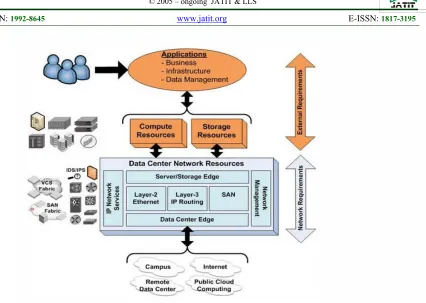
As shown within the reference architecture in figure 1 below, “the Fiber Channel storage area networks” (SAN) as ordinarily utilized in many exercises turn out to be a vital mission, and implementation period necessities rise to becoming invariably obtainable. Therefore, the linkage within the data center incorporates several mixture of networking protocols whereas encountering rising calls for accomplishments, accessibility, and protection [69] To feature on those tools for modeling, data center energy’s prices do not seem to be yet much at hand and have rarely been used during the design phase [7]. It is, therefore, difficult to predict much less control energy usage over the lifetime of the facility Several researchers have paid man-hours attention to the issue of efficient scheduling for cloud data centers (providers) and come up with many options to achieve optimum conditions. Several algorithms
have been proposed and implemented. Each algorithm has its strong point and drawbacks. ● Energy-efficient hardware
[image:3.612.326.513.296.362.2]● Solid state disks are known to use far less energy than their energy efficient workflows Data centers waste significant amounts of energy globally per annum despite their pivotal role in increasing productivity and guaranteeing economic prosperity. They even reduce energy usage through work, commerce and currently trending e-learning have come about as a result of the “communicate more, travel less” paradigm which encourages digital alternatives to already established brick-and-mortar options. However, the scale and complexity of demand have increased beyond predictions and this end in rising operating expenditure and damage to the natural world.
Figure 1: Structure Of Pue Improvement With Regard To Data Centers [68]
Data Sources: “Google data Center improvement on PUE data ranging from 2008 to 2017”
. This figure describes how best “Google” have put workforce in progress for enhancing (PUE) research at every data centers embalmment as of the year 2008 till now.
Coal burning plants power several data centers. These plants spew large volumes of CO2 into the atmosphere to power data centers. The report show that “for (year) (amount) of CO2 was emitted in support of data centers globally or the US alone”. The impact on the environment aside, it contributes to increasingly high operating costs as IDC reports suggest that “energy usage per server grows at 9% per year” ” [8]. Some studies suggest it is possible for an efficient data center to use up to 80% less energy. The invariably translates to huge cost savings for operators. Another school of thought that has risen to prominence suggests that by redesigning workflows [9] (using efficient algorithms) enormous energy savings can be realized and consequently operating costs can be lowered and environmental impact of data centers minimized.
4. BACKGROUND
3733 ensure efficient usage of energy and other related resources is due to the high level of electricity used by these data hubs. Data facilities in the United States of America, alone were estimated to utilize about ninety-one billion kilowatt-hours of power within year 2013. The energy used has estimated to be able to supply twice the homes in the city of New York. By 2020, the demand is predicted to rise to 140 billion kilowatts per hours used and estimated to cause the release of about 150 million metric tons of carbon toxins yearly [59]. According to the Independent, about 416 terawatt-hours of power used worldwide in 2015 by data hubs was appreciably more than the overall demand and usage in the United Kingdom by about 300 terawatt hours [108]. With such high-energy consumptions came the need to have energy efficient data centers[60]. Green data center is a viable solution to the problem stated above. According to the Independent, 416.2 terawatt per hours’ time of power utilization in the world’s data centers that was used in 2015 was considerably complex than the United Kingdom’s total average of electricity consumption of about 300 terawatt hours [60] With such high-energy consumptions came the need to have energy efficient data centers. Green data center is a viable solution to the problem stated above.
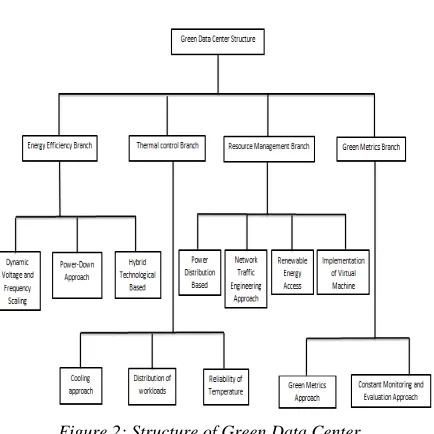
Green data center is merely a data center that causes as little harm as possible to the environment. Green data centers are eco-friendly data centers [61]. Most existing data centers are underutilized and waste a lot of energy and resources [62] . After so much research has been carried out on green data centers, it has realized that improving the efficiency of the devices in the data centers can help cut down the cost significantly and maximizes usage of resources. Most research work on green data centers has focused on decreasing the energy usage of datacenter resources, increasing the utilization of data centers, controlling the thermal behavior of data centers, and developing green metrics, monitoring, and experimental techniques. The building blocks of data centers looking at architecture are servers, networks, and cooling equipment. Green technologies have to apply to these individual components or a combination of the components [62].
Green data centers approach can be implemented as follow:
[image:4.612.313.530.90.307.2]1. Ensuring energy efficiency 2. Resource management 3. Thermal control 4. Green metrics [62]
Figure 2: Structure of Green Data Center
4.1 Ensuring Energy Efficiency
A straightforward approach to green data centers is to ensure Energy efficiency. A very paramount aspect of green data centers. “According to the United States Department of Energy in Advanced Research Projects Agency stated that:” up to apropos $25 million fund for a brand new program targeted on by making innovative components to encompass the energy efficiency of data centers [63] (National Electrical Manufacturers Association 2016). Energy efficiency can accomplish in the following ways: dynamic speed scaling, power-down mechanism, and hybrid technology [62]
The dynamic speed scaling approach tries to reserve power by reducing the rate of resources. It has inferred from the law of affinity stating that energy depletion is comparative to the cube of the motor speed. Thus, through reducing the speed of devices, power consumption is also reduced; in [64] the power down mechanism considers putting devices in a low power mode when devices are idle or not actively in use. Hybrid technology combines both the dynamic speed scaling approach and electricity down mechanism to optimize energy consumption. 4.2 Resource Management
3734 other devices running in free data centers have significantly reduced with cloud computing. Virtualization focuses on running smaller virtual machines on servers so as to greatly optimize usage of server resources. Each virtual machine appears as a real server running its free applications. Virtualization helps to make optimal and efficient use of server resources and therefore reduces wastage. Power distribution among data center resources is also another factor to be considered. According to Jin et. Al. There is an over-provision of
power in data centers for future expansions and also to handle peak levels. However, it has identified that peaks levels rarely occur for all data center devices at the same time. As a result, more devices have operated under a single power budget for fewer devices. Hence a significant amount of energy can be saved. In renewable energy usage. An excellent way for data centers to go green. However, challenges have noted due to the unstable nature of renewables.
4.3 Thermal Control
In computers and other related devices, cooling is a major concern. A Large amount of power used in data centers for cooling of devices. Devices need an optimal temperature for Reliability and performance. Above certain temperatures, performance reduces; therefore, the urgency of the need for cooling. In data centers, the number of computers per unit area has significantly maximized leading to a higher dissipation of heat. [65] realized that in most data centers, the cooling approach used is to keep the entire data center at a certain temperature to cool devices. The distribution of heat across the data center has not taken into consideration which makes this approach inefficient. in [65] proposed a dynamic cooling system that provides cooling when and where need in the data center thereby optimizing power and cost of cooling devices. in [65] employ a distributed control layer which has based on parameters calculated from an aggregate of sensors to variable cool the devices in the data center. In their approach, idle or inactive computer resources are put on standby saving more energy. [66] supposes that the effectiveness of
cooling strategies degrades not linearly with amount of temperature resulting in higher energy-consumption as well as cost. They propose that data centers run at a slightly higher temperature than they
are mostly run to save energy and cost. However, it results in a little tradeoff with the reliability of the device this may not be very significant.
4.4 Functionalities
There are quite some metrics that have been developed to monitor and evaluate the effectiveness and efficiency of energy usage in data centers. Using metrics for monitoring and evaluation helps data center managers to make informed decisions that enable them to optimize energy and power consumption and cut down cost.
Power could be a green data Centre’s utmost valuable necessity: The continuous on-demand of energy by computing server by contemporary societies implies that most data centers might be in need of more power in order to operate fully [99]. Not with standing in (ipnetworksystems 2017) are not fascinated by green concerns, activity energy usage is essential to grasp truth capability of the area.
The most common commodity in the various Green Data Center Eco-systems is Power: Resources such as servers, switches and cooling equipment are an unique setup of a green data-center, of which several of them are put and maintained by skilled workers from various departments, but of them want the power to operate. Activity energy consumption creates a normal
standard that will be able to tell what quantity each drawing upon the overall knowledge Center capability.
The power consumption operational cost of green data Centre: By measuring
the particular energy usage of different knowledge Center parts and applying the environmental value of electricity, learning the truth monthly expense of these components. It allows focusing on that knowledge Center subsystems have the potential to avoid wasting the first energy and also the most cash through potency improvements.
3735
Figure 3: Data Facility Infrastructure
[image:6.612.88.526.399.700.2]Data sources: Base Reference Design by Brocade community (Brook Reams and pmadduru 2017)
Table: 1. Functionality of Green Data Center Metrics
Metric Objective Proposed By
Site infrastructure power overhead multiplier Determine how much of a data center’s power is consumed in overhead instead of making it to the critical IT equipment.
Stanley et al.
Hardware power overhead multiplier
Determine how much of power input to equipment is wasted in power supply conversion losses or diverted to internal fans rather than making it to the user computing components.
Stanley et al.
Deployed hardware utilization ratio Determine which fraction of deployed equipment is consuming power while not running any application or handling any data someone really needs.
Stanley et al.
Deployed hardware utilization efficiency Help quantify opportunity for servers and storage to increase their utilization by virtualizing.
3736
Free cooling Estimate the amount of money that can be saved each year by using cold outside air to cool computer rooms rather than using energy to run compressor-based refrigerant cooling systems.
Stanley et al.
Enable energy saving features Estimate the amount of energy, money, and carbon that could be saved each year by letting IT equipment hibernate during times when it is not in use.
Stanley et al.
Power Usage Effectiveness (PUE) Characterize the total energy efficiency
of a data center.
Green Grid, 2010
Data Center Infrastructure Efficiency Characterize the total energy efficiency
of a data center.
Green Grid, 2010
Heating, Ventilation, and Air Conditioning Characterize the energy efficiency of
The HVAC system.
Lawrence Berkeley National Laboratory, 2009 Carbon Usage Effectiveness Characterize the overall
efficiency of The cooling system.
Green Grid, 2010
Because of these four conditions, green data Center enhancements that conserve energy provide a number of the most significant advantages to your business. Activity power in your Knowledge Center is, therefore, additionally the most efficient thanks to appraising that price and perceive the substantial impact of these inexperienced enhancements.
5.CLOUD COMPUTING
The innovation of clouds model in today's Information Technology era has generated many incomes for infrastructure providers. During which users do not essentially to worry how the information is saved, despite the numerous definitions it has received within the literature. We tend to consider what constitutes cloud computing
3737 fees commensurate with the resources offered received from the cloud support provider.
Figure4: Cloud Computing Architecture
Data sources: Wikimedia common. This architecture “Diagram showing overview of cloud computing, with typical types of applications supported by that computing model by Sam Johnston using Omni Group’s OmniGraffle and Inkscape [70,110].
In managing, power consumption optimization efforts in data centers have directly led us to some substantial number of improvements in reducing energy inefficiency [14] . Cloud infrastructure providers (data centers) have significantly benefited end users’ advancement. Although it has been greatly significant to have depth-knowledge on mitigating energy usage, infrastructure providers by who credit has been given for hosting cloud services. In this sense, equal attention should be given to energy reduction techniques in some specific aspects on how the data is tackled. The management of energy operations becomes one of the key aspects of today’s servers’ energy wastage. With a significant focus on reducing all costs related to energy, including costs lead to capital, operating and the effect resulting in environmental problems [1] , a lot of energy saving technologies modeled for mobile-devices have become natural-candidates to deal with this modern problem-space
Business Continuity – Strict regulatory requirements, standards and brand-affinity aspirations have forced several businesses to implement business continuity and disaster recovery strategies that near-totally prevent outages or in the event of the inevitable, ensure recovery time and tolerance for outage reduced from days and hours to minutes and seconds [10]. It necessarily requires systems to replicate and store data generated in a secure location(s) to ensure service and data availability during and after disaster strikes [11]. Most businesses achieve this through SLA
agreements with data center service providers. That is where the challenge arises: Data centers fear of failure results in vast underutilization of equipment majority of the time since the systems are oversized for the worst-case scenario [14]. Running such a facility at full capacity in anticipation of disasters and interruptions other measures have been deployed to combat is guaranteed to make inefficient use of energy. Case in point: several banks employ data centers in their backup and disaster recovery strategies.
They typically select locations outside of and with different risk factors from their geographies and in line with their risk appetite. In the result of a disruption to their primary operating site, data is available up to the point of the interruption and hence guarantees there is no data loss.
Business Needs – Transaction volumes for shopping online continues to grow. In 2012 online shopping retail sales figures stood at $231 billion dollars and are projected to reach $370 billion dollars in 2017 [12]. Amazon and other online storehouses make millions of dollars in sales per second. To guarantee their profits they (and many businesses like them) invest in data centers that are supersized and running at maximum capacity. One thing is for sure: not all servers on the platform will be at 100% productive. It is evident that the fear of a slowdown or an interruption influences the running of data centers. On-demand Processing – For its entire buzz, Big Data is only as important and relevant as there are sufficient computing power and storage facilities available. Research firms, banks, pharmaceutical companies, biotech companies and businesses that depend on data crunching maintain enterprise infrastructure for these needs. Because a company’s demand on computing resources varies drastically over time, maintaining sufficient resources to meet peak demand proves expensive. If the company cuts cost by maintaining only the minimal infrastructure, it will not have adequate resources to meet peak requirements. The processing, therefore, is outsourced to Data center operators who step in to service the need.
5.1 Energy Efficiency Model
3738 lessening power usage in computing servers: (1) DVFS [91]. (2) Data Protection Management. The “Dynamic Voltage and Frequency Scaling scheme” alters the CPU energy (referring to the performance level) as per the advertised load [103]. The previously mentioned relies upon the point which sees electricity within chips as diminishing relative to “V^2*f, whereby V represents voltage, and f” in [73] and also is in the working recurrence in [86, 84]. The extent of the Dynamic Voltage and Frequency Scaling enhancement is restricted to [79]. As a result, computing server building blocks, for example, transports, memory chips, and hard disks stay functional with first working recurrences. In another case, Data Protection Management systems is capable of turning off computing utilities host (which incorporates the various building blocks), thereby making this method highly power saving. Nonetheless, should it happen of a need to energize the server, there is enough quantity of power which ought to be consumed when comparing to the “Dynamic Voltage and Frequency Scaling scheme” [73,74].
5.2 Job Organization Over Power Utilization The cloud-computing data hub accommodates a huge number of servers and capacity units networked through a system looking like a fat-tree topology [104] Different researchers assume and accept that the system base provides enough bandwidth to maintain a strategic distance from deferrals brought about by the system. The running of the cloud-computing data hub has been described in the following way. Users forward demands to the data hub for computing jobs [102]. A task might embrace coming into data, processing, retrieving program system, or storing roles. The data hub group jobs in line with the SLA and demanded requests. Every role has been allotted to 1 of the accessible servers. On their part, the servers do the required jobs, and a feedback is returned to the user. Power utilization of information centers includes various components, like “servers, load, interconnection network, cooling system, power distribution system” [99]. It has already established that data centers are inefficient in their use of power. This process has brought many factors ranging from business requirements, capacity issues, poor design methods
and lack proper energy requirements modeling. Several more factors are feeding into the energy inefficiency of data centers. Many of these factors are complex in their nature and dovetail with several others. A few of them, however, stand out: The biggest constituents of the data center energy bill are:
1. Physical servers, 2. Cooling equipment and 3. Power plant
Figure 5: Constituents of The Data Center Energy
5. 3Energy Efficiencies
1) Power Non-proportional Servers:
A datacenter is made up of around ten thousand server machines that operate in cycle to offer sservices to the customers. Preferably, systems would show power quotient, whereby servers use energy in commensurate to their load [96]. Recent servers are inedible from power proportion. Admittedly, servers use 80 percent of their peak energy even at 20 percent usage level. The energy non-proportional server hardware may be a vital input to power efficiency within the data center. The facts which have been considered here show that servers are usually utilized 10 to 150 percent high-usage time, creating much room for various inactive periods, [15] stresses this point in the data centers. Meaning, in most cases, servers are under-utilized in terms of performance. Research shows that the inactive periods in servers utilize a higher part of the topmost energy. Server’s inactive natures are problematic for the fact that they lack the depth that is appropriate to supply the basic power [95].
2) Over-Sized Data Center and Energy Substructure:
Present data centers are massive in size. A standard data center has been designed to contain the peak workload, which happens moderately sometimes, instead of averaging workload. These practices follow by ending up in underutilized server hardware, in most of the vital issue contributing to extreme power usage in data centers. Admittedly, an
3739 be terribly costly. Undeniably, provisioning has supported the nominal ratings of servers, and much underuse the power infrastructure [97] Three-level structure consisting of end nodes and switches in a shape of a tree form the most generally utilized server farm designs. It comprises mostly of the main part of the base, the assemblage part that caters for forwarding, and also the access layer which sustains the collection of computing servers [81] (or hosts) . First data hubs utilized two-layer designs without assemblage layer. Nevertheless, such information focuses, contingent upon the kind of switches utilized and per-host transmission capacity necessities, could commonly boasts of note exceeding five thousand end-nodes. Having in mind the huge number of servers in recent data hubs with a pool of requests approximately 150,000 hosts and keeping layer-2 switches at the entrance range, a 3-layered outline turns into the most suitable choice. Despite the point stating 10 Gigabit Ethernet (GE) transceivers as financially accessible, for 3-layered design, the processing servers (gathered in racks) are networked utilizing 1 GE joins because of the way those 10 GE transceivers:
Are excessively costly and
Likely presents more limit than required for interfacing registering servers.
In present information focus, rack availability accomplished with reasonable Top-of-Rack (ToR) switches. An ordinary Top-of-Rack switch [90] offers twice 10 GE uplinks plus 48 GE interfaces which connects computing hosts inside a carrier. The distinction amongst the downstream, as well as upstream connection limits pertained to a switch characterize based on the proportion of its over-usage, of which discussed earlier with a case equivalent - 48/20 = 2.4:1 [83]. Accordingly, considering complete capacity, thus 1 GE capacity, just 416 Mb/s stays accessible to every one of the single servers [82]. Having looked at the upper part of a chain of command, the racks have orchestrated in modules coupled with accumulation switches adjusting the unit network. Regular oversubscription proportions associated with the accumulation switches are close to 1.5:1 that additionally decreases the accessible data transfer capacity for the person processing the hosts to 277 Mb/s. The transmission capacity of the center, as well as assemblage system disseminates using dynamic forwarding path approach [85], for example, the
Square with Cost Multi-Path (ECMP) forwarding. The ECMP forwarding approach ensures stability of each capacity flow, distinguishing the movement by calculating a hash function on the headers of the receiving packet. Considering a 3-layered design, the last quantity of reasonable ECMP paths limits the aggregate quantity of center changes to 8. This kind of bound likewise restrains the delivering transfer speed to the total switches. Such restriction is waived with the accessibility of 100 GE joins. Outlining data facility topologies is a critical investigation theme. Fat-tree successors continually suggest for vast scale data hubs.
At intensive institutions use the massive computing power made available in/by data centers to analyze and gain more insight into data sets gathered. The collection of data is not predictable by volume. It means there are instances when computing power must be scaled up considerably to do the analyses to complete it in the time frame favorable to these firms. To ensure there is a little time lapse between the request for more computing power and implementation, data centers servicing such requests are continually kept running at peak or near-peak capacity. It leads to a situation where servers run but not service any paid-for requests and consequently waste energy.
3) Energy-Inefficient Legacy Server Hardware: There is yet additional important element in making energy inefficiencies within the data centers is the indisputable fact that earlier energy-inefficient server hardware has inhabited them. Raising energy efficiency in data centers demands starting from basic and upgrading the out of date equipment and facilities within a modern data center. Nevertheless, most data center providers would try every possible means to prevent building several facilities and result in getting extra output from underperforming legacy centers. Due to advancements in low-level energy control and improvements in the main CMOS equipment [71],, large scale integration circuits and procedure designs, today’s blade hosts area unit far extra power output than those data centers mapped out and established few years ago.
In the last couple of years, there has been a proliferation of internet dependent services that support (in one way or the other) various sectors of the global economy. These services are designed
from the ground up to have very high availability, and in many cases, no downtime at all is to be noticed by end users. In theory that means no downtime at all to facilitate and guarantee the continuous availability of these services, there is the
3740 than one hour of downtime per year feed, facilitate and secure global commerce and several other essential information-based services of the modern era. The facilities running these services (datacenters) are mostly large with several 100,000s of servers, in the case of Google, Amazon, Apple and some global service providers, millions of servers. These servers are powered up and are running continually. The servers do not operate in isolation. There is the cooling equipment (air conditioners and chillers), security infrastructure, and “availability guarantee equipment” like generators, UPS systems, with a facility that large running at full capacity, the energy requirements scale up to the point where efficiency has been compromised. As of 2010, the gross approximated power bill for data hubs was $11.5 billion, and power expenditure in a standardized data hub was predicted to increase in twofold every five years. In 2011 Google alone reported that is used 260 MW of electricity in its data centers. At the end of 2015, it announced a large bulk purchase of 781MW of renewable power for its data centers. The modern data center has its own way to come about, as a result of the continuous drive for more and more cloud-based services with more clients coming to the cloud. The connectivity of global demand for data already contain the need of enormous and profitable to entities that have invested the necessary resources with several of them, having built what are now mega data centers. However, there arises a challenge at this point: it has known that not all up and running systems are doing work is being paid to execute accurately. There is, therefore, a remarkable percentage of power used in data centers that just goes to waste. This wastage has grave consequences for both the profit margins of companies and the overall health of the environment [15]. As one article put it, “data center power is out of control.” Google’s energy requirements alone have multiplied 12 times in the last four years. It can be recognized that energy inefficiency impacts the environments negatively as much as it impacts the companies’ bottom line. Many businesses and organizations have considered moving cloud based to enjoy most of the benefits the cloud services render to the society. Such as an increase in security, efficiency, ease of action and development in return margin. To accomplish all this real-time information providing end users, the major factor to consider is energy consumption. Over hundreds of organizations as well as individuals enjoy this service and expect to get their information stored and retrieved at any odd given time. In these networking
devices, such as servers, routers, switches, and computers must be powered on 24/7 to meet the requests of users. The adoption of virtualization in data centers has helped to mitigate this energy problem. According to our analysis, we found out that some authors from diverse background have focused on energy efficiency by using different approaches and techniques.
4) Energy-Inefficient Legacy Server Software During the early stage of computers, memory was very costly and processors were slow. Code were written strictly to be able to run in some practical size of time with the compactible mainframes with merely 64 KB of memory. As generations computers move on , younger IT individuals today have certainly not perceived magnetic core memory and have not realize even the ways the big supercomputers had this limited amounts data sizes. Core memory expended tiny magnetic donuts, approximately the diameter of sketch line lead, eased on tiny wires in couple of three ways one magnet each data bit. Having the 64 KB of memory disk size required at least five hundred and twelve thousand (512,000) tiny magnets, all looped by using hand against wires internal a cube. Programmers used to count the cycles each directive used to ensure the program could run perfectly in a credible period of time. Some Engineers teamed up of failing to do the right thing, and make a several years effort in developing a program but the running of the problem spent several hour to get the right run time. Consequence, the industry developed programs that looked ahead and transferred data from tape or disc exactly when needed. Such methods were desirable to get highest use out of affluent memory resources. The software expand is no astonishment, but it is as much the fault of many researchers and developers. The hardware and software developers have allowed it happened by proving that Moore's Law still holds true. As we have known with legacy COBOL programs, no one can replace millions of lines of program code overnight over epochs. Subsequently, just as the hardware side of the business has been working diligently to improve energy efficiency, the software side must learn to acknowledge the result of their products which has been on data center energy usage and make more aggressiveness attack on bloated in ineffective code.
3741
Table2: Taxonomy of Existing Task Scheduling Algorithms Technique
PAPERS
TITLE PROPOSED TECHNIQUES ALGORITHM USED D.C OBJECTIVE
【24】 Energy Efficient Task
Provisioning for Distributed Cloud Networks
using Meta
Heuristic Multidisciplinar y Technique
combined major
advantages PSO and Bat Algorithms and develop an optimized
energy efficient
scheduling and
migration algorithm
PSO and Bat Algorithms techniques
Yes To propose a technique not
only basing on CPU and memory including network bandwidth to develop energy efficient task for cloud data centers using both meta
heuristic PSO and Bat
Algorithms
【25】 Current perspective in task scheduling techniques in cloud
computing: A review
Reviewed Metaheuristics, Greedy, Heuristic, ant colony, Genetic task scheduling techniques
Greedy, Heuristic, and ant colony algorithms
Yes To present a review on scheduling proposals in cloud environment
【26】 Workflow
Scheduling in Cloud
Computing Environment using Firefly Algorithm
This firefly algorithm has been designed
based on the
inspiration on the
swarm behavior of fireflies
Firefly Algorithm Yes To schedule jobs and thereby evenly distribute the load and in turn reduce the overall completion time (make span) employing Firefly algorithm
【27】 Virtual machine customization
and task
mapping architecture for efficient allocation of cloud data center resources
the focus of existing
approaches is on
virtual machine
migration and
placement algorithms, to further reduce the
energy consumption
and resource wastage in a typical data center
machine
migration and
placement algorithms
Yes Propose a new architecture for cloud resource allocation that maps groups of tasks to customized virtual machine types.
【28】 Energy Aware
Scheduling of HPC Tasks in Decentralized Cloud Systems
using Dynamic
Voltage and Frequency Scaling (DVFS), HPC, comparing with Cloud
min-min Scheduling
(CMMS) algorithm
EAGS Algorithm Yes Minimizing the
computing-energy consumption in
decentralized multi-cloud
systems using Dynamic
Voltage and Frequency
Scaling (DVFS) when
scheduling dependent HPC
tasks under deadline
constraints 【29】 Genetic
Algorithm Based Bi-Objective Task Scheduling in Hybrid Cloud Platform
Reviewed several algorithms which optimize either cost or time and came out with a strategy to merge both at the same time.
Bi-Objective Optimization
Yes Focus on the scheduling
3742
【30】 A Critical
Analysis of Energy Efficient Virtual Machine Placement Techniques and its Optimization in a Cloud Computing Environment
Server Consolidation, Load balancing, VM consolidation, dynamic allocation of virtual machines to hosts
VM selection Algorithm
Yes Proposes a technique for optimizing virtual machine placement by live migration using dynamic threshold values ensuring a deadlock free resource allocation focusing on multidimensional resources.
【31】 A Literature
Survey in Cloud Access Control Using Novel Optimization Algorithm
Reviewed scheduling algorithms to improve Upton
Surveyed on
Optimization Algorithm
Yes To propose an improved clonal
selection algorithm based on
time, cost and energy
consumption models in cloud computing environment.
【32】
A Task
scheduling Algorithm Based on Potential Games in Cloud Computing Environment
Nash equilibrium,
reviewed task
scheduling algorithms such as genetic, ant colony.
task scheduling
algorithm (EABPG)
Yes To propose a new task
scheduling algorithm based on potential game
【33】
Workload Distribution Technique in Virtualized Data Center
Consolidation and Migration
Minimize Servers and Maximize VM using VMWARE
Polynomial time algorithm, Linear Sum Assignment problem.
Yes To increase the efficiency of
the system as well as to decrease the cost needed to manage the data
【34】)
A Review on Energy Efficient Techniques in Green Cloud Computing
Reviewed several algorithms
N/A
yes To study and analyze the concept of various techniques of Power and performance
Management, Resource
Management, Energy Efficient Data Center Architecture and Resource Allocation and Optimization.
【35】
Scheduling Divisible Jobs to Optimize the Computation
and Energy
Costs
Reviewed various job scheduling techniques and proposed DLT to optimize
Divisible Load Theory (DLT)
Yes
To investigate a new analytical framework model that enables an existing private cloud data-center for scheduling jobs and minimizing the overall computation and energy cost together
【36】 Analysis of
Different Algorithms Under Cloud Computing
Compared FIFO,
Round Robin, Priority Queue, Multi Level, Feedback Queue and
Multilevel Queue
Scheduling
Yes To show results on the basis of
3743
【37】 Energy-Efficient Task Scheduling Algorithms for
Cloud Data
Centers
Compared with most
efficient-server first
scheme algorithm and hybrid algorithms
ESF-ES Algorithm
Yes To develop ESF-ES algorithm
which focuses on minimizing
energy consumption by
minimizing the number of servers of cloud data centers
【38】
Survey on
Scheduling Algorithms in Cloud
Computing
problems in scheduling and also about various kinds of scheduling Algorithms.
Scheduling Algorithms
Yes provides the survey on
scheduling algorithms with respect to the resource sharing
【39】 A power efficient Genetic Algorithm
or resource
llocation in cloud omputing Data enters
DVFS consolidation,
Best Fit Decreasing, Based on Genetic Algoritm Yes To propose a new resource allocation approach, completion time and system power consumption
【40】
A Review On Energy Efficient Cloud
Computing Algorithms
VMs placement, VM
migration N/A Yes Compare different algorithms that decrease the power consumption with the help of virtualization and energy efficient scheduling of Virtual Machines (VMs).
【41】 Cloud
Computing: Energy
Efficiency for Data Resources, Architectural Elements and Open Challenges
Outlined the
distribution of power usage in data centers
Power Usage
Effectiveness (PUE)
Yes Outline visions, challenges
and architectural elements for energy-efficient management
of cloud computing
environment
【42】 Energy
Efficiency Model for Cloud Computing
Consolidation of possible aspects of energy efficient infrastructure model
yes Investigate possible areas in
cloud infrastructure
responsible for substantial amount of energy consumption
compromising QoS and
performance 【43】 Job Scheduling
Model for cloud computing based
on
Multi-Objective Genetic Algorithm.
Macroscopic
scheduling model - decision component for cloud computing and MO-GA -reducing power consumption
Multi-Objective Genetic Algorithm
Yes To develop a scheduling
model for cloud computer based on MO-GA algorithm to maximize the profit of service provides under the constraint of deadlines.
【44】 Green Solution
for cloud
computing with load balancing
and power
consumption management
Ant and Bee Colony
3744
【45】 Cluster Based
BEE algorithm for virtual machine placement in
cloud Data
Center
HoneyBee algorithm with hierarchical clustering to minimize energy consumption in servers.
HoneyBee, HCT algorithm, Hierarchical Clustering,
Yes Focus on maximizing the use
of resources and reduce energy by putting idle servers to sleep.
【46】 An Efficient
Scheduling Algorithm for Multiple Charge Migration Tasks
in Hybrid
Electrical Energy Storage Systems
Hybrid EES (HEES), appropriate Charge management policies, charge allocation,
placement and
migration.
MSMDSolver, Charge Migration Scheduling,
Yes To define and solves the
problem of scheduling
multiple charge migration tasks in HEES systems with the objective of minimizing the total energy drawn from the source bank
【47】 Efficient QoS
Based Resource Scheduling using PAPRIKA
Method for
Cloud Computing
Reviewed several
resource scheduling
techniques and used
different approach
upon the limitations
PAPRIKA Model Yes To propose an efficient QoS based resource scheduling algorithm using potentially all pair-wise rankings of all
possible alternatives
(PAPRIKA)
【48】
Performance and Energy
Modeling for Live Migration
of Virtual
Machines
Xen virtualized Environment, VM configuration, VMM level
Yes To estimate VM live migration cost in terms of both performance and energy in a quantitative approach
【49】
Experimental Analysis of Application Specific Energy Efficiency of Data Centers with
Heterogeneous Servers
TPC-W,
BS Seeker, Matrix Stress mark, Application Specific Energy Efficiency (ASEE)
Yes To introduce the notion of Application Specific Energy Efficiency (ASEE) in order to rank energy efficiency of heterogeneous servers based on the hosted applications
【50】 Independent Tasks
Scheduling in Cloud
Computing by Improved Genetic Algorithm
Combined Min-Min
and Max-Min to
improve Genetic
Algorithm
Min-Min,
Max-Min, Genetic
Algorithm
Yes Combine Min-Min and
Max-Min in Genetic Algorithm to
schedule and complete
multiple jobs in an efficient manner.
【51】 Network Aware
Resource Allocation in Distributed Clouds
Defragmentation to minimize the VM movement, least amount of inter-rack traffic
Data-center selection algorithm, 2-approximation algorithm
Yes To develop efficient resource
allocation algorithms for use in distributed cloud
【52】
Power
Consumption of Virtual Machine Live Migration in Clouds
leveraging power consumption and the effects of live migration of VMs,
Yes To quantify the cost of live migration for both source and destination physical servers, according to the CPU utilization percentage
【53】
3745 After the study of the various algorithms and approaches above table, we consider two sides to the energy efficiency scheduling challenges:
1) Need of Efficient hardware
2) Moreover, efficient workflows are usually inherent in the software.
5.4 Heuristic Algorithms
Heuristic algorithm plans the bigger jobs on maximum green resources. The simulation outcomes have revealed that the H-Green algorithm reduces the energy usage in worldwide grids [107]. Heuristic algorithms are better at addressing efficiency because usually efficiency is often a high priority. An efficient heuristic algorithm can determine a solution in a reasonable time [16] and guarantee a solution has been found for the problem in a proper time frame. Applying this to scheduling will allow jobs to be queued so as to minimize execution time while respecting the quality of service constraints of the underlying service. With the inherent faster execution time comes longer idle times for processing jobs which permit the powering down of server hardware to cut down energy use of the processing facility.
The hybrid forms ' Ant Colony Optimization (ACO), Particle Swarm Optimization (PSO), Differences (DE) and Genetic Algorithms (GA)' were
distinguished in [ 110]. They analyzed the quality of various hybrid algorithms, taking account of their different classification accuracies. Hybridization was carried out to remove the disadvantages of each technique by combining the advantages of other techniques, leading to a better integration with global optima. There were various methods such as PSO, GA, PSOGA, GA-DE and ACO-PSO-GA. They claimed to use parameter classification reliability, sensitivity and specificity to retrieve different datasets from a UCI database.
5.5 Metaheuristic Algorithms
Metaheuristic algorithms deal with finding optimal or near-optimal solutions for intractable problems. They are applied to the solution of challenges that have enormous search spaces such that it is impossible to search all of them efficiently.
They have the advantage of the probability of finding an optimal solution in a short (reasonable) time and are inspired by natural processes. Some of the best-known metaheuristic algorithms are genetic, taboo search, and simulated annealing [17]. By their nature, they must be highly optimized when employed to solve problems
Energy Efficient Allocation of Virtual
Machines in
Cloud Data
Centers
Minimization of
Migrations
(MM), Highest
Potential Growth
(HPG), Random
Choice (RC)
MBFD algorithm,
Best Fit
Decreasing (BFD) algorithm.
The objective is to continuously consolidate VMs leveraging live migration and switch off idle nodes to minimize power consumption, while providing required Quality of Service
【53】
DENS: Data
Center Energy-Efficient Network-Aware Scheduling
It implements a set of energy-efficient optimization
techniques, such as DVFS and DPM
DENS
methodology Yes underlines the role of Communication fabric in data center energy consumption and presents a scheduling approach that combines energy efficiency and network awareness, termed DENS.
【54】 Dynamic
Resource Allocation and Power
Management in Virtualized Data Centers
Improved a previous work which used prediction-based approach for resource provisioning.
Lyapunov Optimization.
Yes To make use of queueing
information available in
systems to make online control decisions, routing and resource allocation using Lyapunov Optimization.
【55】)
Energy Aware Task Scheduling in Data Centers
Dynamic Voltage and Frequency
Scaling (DVFS), Benefit-driven Scheduling (BS)
Power Best Fit
(PBF), Load
Balancing (LB), Benefit-driven Sch
3746
6. CONTEXT-AWARE JOB SCHEDULING
This approach seeks to sanitize the utilization of operation inputs in a cloud computing environment while resulting in appreciable advances in the service quality [18,107]. This method is often employed by providers where it is desirable to minimize user’s input. The context aware is described as users’ physical, social, emotional or informational state. It describes the situation(s) in which the individual or system (machine) is immersed. Context consciousness is, therefore, the capacity to recognize and respond to the situations changes in a manner that supports efficient running of operations [19,106].
7. TASK SCHEDULING ALGORITHMS
In [111], A. Younes, et .al proposed a genetic algorithm (PGA) to determine the task assignment and scheduling for leveraging the homogeneous and heterogeneous multi-processing problem. Their fundamental idea is to process and exploit the different advantages of heuristic-based algorithms in reducing space search and the limited time desirable to reach the preeminent solution. They claimed that their results have a significant which overtake the previously used approaches in view of task execution time frames.
In [113] Analytic Hierarchy Process (AHP) was stated in their paper in order to improve and speed up task scheduling in cloud computing by enhancing task identification in priority queues. They also claimed that the findings indicate that AHP can be used to give priority queues more precision to tasks rather than to use conventional algorithms previously used.
8. CONCLUSION
The number of the state of the art of datacenter has risen due to a confluence of many factors. It has resulted in significant energy consumption levels by these facilities hurting both profits and the environment. With increasing reliance on data centers, the scale and complexity of their operations more research is required to fine-tune already known techniques to (or “intending to”) save costs and improve the efficiency of energy in data hubs. Many research has been done in this field and covered most of the energy efficiency and inefficiency topics but they did not illustrate many basic functionalities of the scheduling algorithm and their metrics in they are research, they however tackle some specific
issues. In our we survey, we illustrated some basic descriptions of scheduling algorithms functionalities and metrics as well as green data center metrics. In this article, we have explored some of the reasons why there are many increament in power costs and the measures that can be used to address them , give researchers and data center managers the necessary insight to architecting innovative solutions to the current challenges and trends. What is needed is further work to determine and address the drawbacks of these processes (first individually) and then how these can be combined into a highly efficient and refined process that leads to huge energy savings which will invariably drive ultimate energy efficiency in cloud computing architectures. In our future work , we will discuss in details all the categories related to the energy-efficient scheduling algorithms , which we will classify into details several categories such as DVFS-based efficient scheduling, consolidation-based energy-efficient scheduling; online energy-energy-efficient scheduling, offline energy-efficient scheduling, and so on. And in each category, we will also analyze some popular and classic algorithms, their drawbacks and strengths .
REFERENCES
[1] Barroso, L. A., & Hölzle, U. (2007). The case for energy-proportional computing. Computer, (12), 33-37.
[2] Meisner, D., Gold, B. T., & Wenisch, T. F. (2009, March). PowerNap: eliminating server idle power. In ACM sigplan notices (Vol. 44, No. 3, pp. 205-216). ACM.
[3] S. Liberatore, (2016) “Google’s plan to take over the world: a Search engine to build ANOTHER half-billion-dollar data center in the US.” Daily Mail
[4] Inside Microsoft’s Dublin Mega Data Center ( 2009) . Data Center Knowledge, p. 1
[5] Chao, J. (2016). Data Centers Continue to Proliferate While Their Energy Use Plateaus| Berkeley Lab. News Center.
[6] D. Foundry, “PURPOSE-BUILT VS. PURPOSE-BUILT VS .,” pp. 2–4.
[7] Rasmussen, N. (2006). Implementing energy efficient data centers. American Power Conversion.
[8] Shehabi, A., Smith, S., Sartor, D., Brown, R., Herrlin, M., Koomey, J., ... & Lintner, W. (2016). United states data center energy usage report.
3747 [10]“key-drivers-radically transforming business
continuity management-04,www.itbusinessedge.com.” .
[11]“You’re Not Going to Believe me,” 2012. [12]Abramovich, G. (15). Mind-Blowing Stats
About Online Shopping. Insight/Market Research (May 7, 2014), available at:
http://www. cmo.
com/articles/2014/5/6/Mind_Blowing_Stats_O nline_Shopping. html (last visited June 8, 2016).
[13]Sverdlik, Y. (2016). Here’s how much energy all US data centers consume. DataCenterKnolwedge. com. June, 27.
[14] L.Young, Large (2015).Stanford.Edu.” p. 5, [15] Zhu, X., Zha, Y., Liu, L., & Jiao, P. (2016,
June). General Framework for Task Scheduling and Resource Provisioning in Cloud Computing Systems. In 2016 IEEE 40th Annual Computer Software and Applications Conference (COMPSAC) (pp. 664-673). IEEE.
[16]Lorincz, J., Capone, A., & Begušić, D. (2011). Heuristic algorithms for optimization of energy consumption in wireless access networks. KSII Transactions on Internet & Information Systems, 5(4).
[17]Said, G. A. E. N. A., Mahmoud, A. M., & El-Horbaty, E. S. M. (2014). A comparative study of meta-heuristic algorithms for solving quadratic assignment problem. arXiv preprint arXiv:1407.4863.
[18]Priyanka, R., & Nakkeeran, M. (2015). An Enhanced Hyper-Heuristics Task Scheduling In Cloud Computing. International Journal of Computer Science and Mobile Computing. ISSN, 130-135.
[19]Assuncao, M. D., Netto, M. A., Koch, F., & Bianchi, S. (2012, November). Context-aware job scheduling for cloud computing environments. In Proceedings of the 2012 IEEE/ACM Fifth International Conference on Utility and Cloud Computing (pp. 255-262). IEEE Computer Society.
[20]Go4Expert. Shabbir Administrator Staff Member. (2010). Types of scheduling algorithms. Accessed Jun 4, 2010. http://www.go4expert.com/articles/types-of-scheduling-t22307/.
[21]More Process. (2016). Shortest Job First and shortest remaining time next. Accessed October 4, 2016 http://www.moreprocess.com/process- 2/shortest-job-first-sjf-shortest-remaining-time-next-srtn-scheduling-algorithm.
[22]Wikipedia. (2016). Highest Response Ratio Time. Accessed October 6, 2016.
https://en.wikipedia.org/wiki/Highest_response _ratio_next.
[23]Stallings, W., & Paul, G. K. (2012). Operating systems: internals and design principles. Pearson.
[24]Dhanalakshmi, M., & Basu, A. (2016). Energy Efficient Task Provisioning for Distributed Cloud Networks using Meta Heuristic Multidisciplinary Technique. International Journal of Applied Engineering Research, 11(9), 6195-6199.
[25]Thaman, J., & Singh, M. (2016). Current perspective in task scheduling techniques in cloud computing: A review. International Journal in Foundations of Computer Science & Technology, 6(1), 65-85.
[26]SundarRajan, R., Vasudevan, V., & Mithya, S. (2016, March). Workflow scheduling in cloud computing environment using firefly algorithm. In Electrical, Electronics, and Optimization Techniques (ICEEOT), International Conference on (pp. 955-960). IEEE.
[27]Piraghaj, S. F., Calheiros, R. N., Chan, J., Dastjerdi, A. V., & Buyya, R. (2016). Virtual machine customization and task mapping architecture for efficient allocation of cloud data center resources. The Computer Journal, 59(2), 208-224.
[28]Alsughayyir, A., & Erlebach, T. (2016, February). Energy aware scheduling of HPC tasks in decentralised cloud systems. In Parallel, Distributed, and Network-Based Processing (PDP), 2016 24th Euromicro International Conference on (pp. 617-621). IEEE.
[29]Leena, V. A., & Rajasree, M. S. (2016). Genetic algorithm based bi-objective task scheduling in hybrid cloud platform. International Journal of Computer Theory and Engineering, 8(1), 7. [30]Choudhary, A., Rana, S., & Matahai, K. J.
(2016). A critical analysis of energy efficient virtual machine placement techniques and its optimization in a cloud computing environment. Procedia Computer Science, 78, 132-138. [31]Sugumar, J. J. C. D. R. A Literature Survey in
Cloud Access Control Using Novel Optimization Algorithm.
[32]Zheng, M. C., & Li, X. (2015). A Task Scheduling Algorithm Based on Potential Games in Cloud Computing Environment. International Journal of Future Generation Communication and Networking, 8(1), 247-260.
3748 and Migration”, International Journal of Advanced Research in Computer and Communication Engineering Vol. 4, Issue 12, 2015
[34]Gupta, P. M. (2015). A review on energy efficient techniques in green cloud computing. International Journal of Advanced Research in Computer Science and Software Engineering, 5(3), 550-554.
[35]Abdullah, M., & Othman, M. (2015). Scheduling Divisible Jobs to Optimize the Computation and Energy Costs. International Journal of Engineering Science Invention, 4(2). [36]Khurana, S. K. S. (2014). Analysis of different
scheduling algorithms under cloud computing. [37]Nirubah, T. J., & John, R. R. (2014). Energy-Efficient Task Scheduling Algorithms for Cloud Data Centers. International Journal of Research in Engineering and Technology, 3(3).
[38]Deshmane, M. K., & Pandhare, M. B. (2014). Survey on scheduling algorithms in cloud computing. International Journal of Emerging Trend in Engineering and Basic Sciences (IJEEBS).
[39]Portaluri, G., Giordano, S., Kliazovich, D., & Dorronsoro, B. (2014, October). A power efficient genetic algorithm for resource allocation in cloud computing data centers. In Cloud Networking (CloudNet), 2014 IEEE 3rd International Conference on (pp. 58-63). IEEE. [40]Prasher, A., & Bhatia, R. (2014). A Review On
Energy Efficient Cloud Computing Algorithms. International Journal of Application or Innovation in Engineering & Management (IJAIEM), 3(4).
[41]Buyya, R., Beloglazov, A., & Abawajy, J. (2010). Energy-efficient management of data center resources for cloud computing: a vision, architectural elements, and open challenges. arXiv preprint arXiv:1006.0308.
[42]Banerjee, A., Agrawal, P., & Iyengar, N. C. S. (2013). Energy Efficiency Model for Cloud Computing. International Journal of Energy, Information and Communications, 3(6), 29-42. [43]Liu, J., Luo, X. G., Zhang, X. M., Zhang, F., & Li, B. N. (2013). Job scheduling model for cloud computing based on multi-objective genetic algorithm. International Journal of Computer Science Issues (IJCSI), 10(1), 134.
[44]Dalapati, P., & Sahoo, G. (2013). Green solution for cloud computing with load balancing and power consumption management. Int. J. Emerg. Technol. Adv. Eng, 3(3), 353-359.
[45]45. Hemalatha, M. (2013). CLUSTER BASED BEE ALGORITHM FOR VIRTUAL MACHINE PLACEMENT IN CLOUD DATA CENTRE. Journal of Theoretical & Applied Information Technology, 57(3).
[46]Xie, Q., Zhu, D., Wang, Y., Pedram, M., Kim, Y., & Chang, N. (2013, January). An efficient scheduling algorithm for multiple charge migration tasks in hybrid electrical energy storage systems. In Design Automation Conference (ASP-DAC), 2013 18th Asia and South Pacific (pp. 749-754). IEEE.
[47]Lawrance, H., & Silas, S. (2013). Efficient Qos based resource scheduling using PAPRIKA method for cloud computing. International Journal of Engineering Science and Technology, 5(3), 638.
[48]. Liu, H., Xu, C. Z., Jin, H., Gong, J., & Liao, X. (2011, June). Performance and energy modeling for live migration of virtual machines. In Proceedings of the 20th international symposium on High performance distributed computing (pp. 171-182). ACM.
[49]Metri, G., Srinivasaraghavan, S., Shi, W., & Brockmeyer, M. (2012, June). Experimental analysis of application specific energy efficiency of data centers with heterogeneous servers. In Cloud Computing (CLOUD), 2012 IEEE 5th International Conference on (pp. 786-793). IEEE.
[50]Kumar, P., & Verma, A. (2012). Independent task scheduling in cloud computing by improved genetic algorithm. International Journal of Advanced Research in Computer Science and Software Engineering, 2(5). [51]Alicherry, M., & Lakshman, T. V. (2012,
March). Network aware resource allocation in distributed clouds. In Infocom, 2012 proceedings IEEE (pp. 963-971). IEEE. [52]Huang, Q., Gao, F., Wang, R., & Qi, Z. (2011,
April). Power consumption of virtual machine live migration in clouds. In 2011 Third International Conference on Communications and Mobile Computing (CMC 2011) (pp. 122-125). IEEE.
[53]Beloglazov, A., & Buyya, R. (2010, May). Energy efficient allocation of virtual machines in cloud data centers. In Cluster, Cloud and Grid Computing (CCGrid), 2010 10th IEEE/ACM International Conference on (pp. 577-578). IEEE.
![Figure 1: Structure Of Pue Improvement With Regard To Data Centers [68] Data Sources: “Google data Center improvement on PUE](https://thumb-us.123doks.com/thumbv2/123dok_us/8897593.953677/3.612.326.513.296.362/figure-structure-improvement-regard-centers-sources-google-improvement.webp)