
International Journal of Emerging Technology and Advanced Engineering
Website: www.ijetae.com (ISSN 2250-2459,ISO 9001:2008 Certified Journal, Volume 5, Issue 1, January 2015)
376
Privacy Preservation and Integrity Auditing In Cloud Storage or
Web Servers
Ugale Santosh A
1, Vaidya Milindkumar B
2 1,2M.E Computer & Sangamner, India
Abstract— Cloud is growing technology for enabling on-demand access to a shared pool of configurable server resources (applications, networks, memory, storage, processors and services) with infrastructure that can be rapidly provisioned and released with minimal management efforts. Cloud offers the promise of massive cost savings combined with increased IT agility due to different advantages like pay per use, resources flexibility, and geographical independence. However, this technology challenges many traditional approaches to hosting service provider and enterprise application design and management. Large number of enterprises and personal user’s use cloud services; however, storage security as a major problem to adopt cloud storage. User uploads data on server and use on demand or for the applications without keeping any copy on local machine.
User can upload data on cloud servers without hassle to verify integrity or other security threats which can effect on data integrity. Hence, auditing process for cloud storage is important task to ensure data integrity. Normal users are not skillful for performing such auditing tasks. Also they are not aware about security risks and actions. So, to perform such audit user need to be dependent on the TPA (Third Party Auditor). He will check and verify that the data integrity on the cloud storage is maintained. TPA can be a physical system or a personal expertise with exuberant knowledge and highly capable handling such task. He audits the integrity of cloud storage and provides appropriate results to the user. Results contain removed, uploaded and modified files so that user can take appropriate actions. User has to make sure that privacy is preserved from TPA with minimal consumption of cloud resources while auditing process. In this paper, we proposed the system which checks and verifies the integrity of data without downloading files avoiding additional resources and vulnerability.
Keywords—Auditing, Cloud, Cloud servers, Data integrity, Data privacy, Security, Storage.
I. INTRODUCTION
In recent years, internet becomes necessity of the users. Users rely on remote storage instead of keeping any local copy and access as per requirement. Different cloud service provider provides a remote storage with cloud technology.
It provides different advantage like for pay per use basis, geographical independent, availability, security, relief burden of storage, software, hardware and capital expenditure [14]. As remote storage fully managed by CSP, users keep faith on service provider and upload important data on cloud server without worrying about the security concern. Users are not aware about different backend security threats. To ensure data correctness on the cloud is being put at risk due to different reasons. First of all, although the infrastructures under the cloud servers are much more reliable and powerful compare to personal‘s computing devices but they are still facing an issue of threats for data integrity [7]. Also most of the cloud service provider behave unfaithfully towards the users for their outsource data.
Cloud Service provider might hide the data loss incidents to maintain industry reputation [3] [12]. As a user does not have physically possess their data storage. The reason different cryptographic algorithms cannot be adopted directly on the remotely [10]. Also downloading data on local storage to check data integrity is not practical solution due to slow bandwidth and communication cost. It is necessity of user to audit data on cloud server itself to identify changes and take appropriate actions. In this paper, we proposed the protocol to check integrity auditing with privacy preservation with the help of TPA.
II. PROBLEM STATEMENT
The cloud system model, we considered is Linux platform cloud data storage which stores user‘s data remotely.
International Journal of Emerging Technology and Advanced Engineering
Website: www.ijetae.com (ISSN 2250-2459,ISO 9001:2008 Certified Journal, Volume 5, Issue 1, January 2015)
377 Figure 1 Architecture of system [1]
Design Goals following are different security and
performance parameters which proposed system should be achieve.
Public Auditability: It allows TPA to check the correctness
of the cloud data on demand without downloading or retrieving user‘s data locally.
Storage Correctness: It ensures users that cloud data store
appropriately and store securely without any intact.
Privacy Preserving: It ensures auditing process does not
create new vulnerability and TPA should not derive user data using auditing information.
High performance: It ensures design should be create
minimum overheads on the cloud server. As most of the cloud resources are pay per consume basis. Design allows auditing task with less communication cost and computation overload on cloud server.
Batch Auditing: TPA able to audit multiples cloud users
and multiple cloud servers.
Secure communication: communication between user,
cloud and TPA be highly secure and free from vulnerability.
Central Management server To ensure design should be
support to multi users and multi cloud from different infrastructures and cloud service provider.
III. LITERATURE SURVEY
A. Mac Based solution
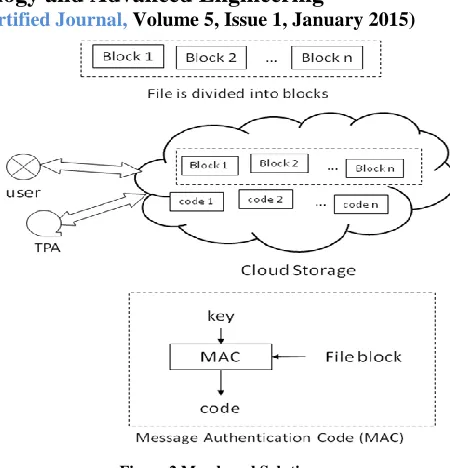
[image:2.612.335.560.115.349.2]In MAC-based solution, TPA demands a random number of blocks and their code from CSP and TPA uses the key to verify the correctness of the file blocks, as illustrated in figure 2 [1].
Figure 2 Mac-based Solution This scheme suffers from different drawbacks:
1. Auditing protocol demands retrieval of data; this is not privacy-preserving.
2. Communication and computation complexity is linear
with the sample size which poses additional online burden to users, and cloud server.
3. Auditing problem is still not easy to solve even if system introduced a TPA.
4. The TPA has to maintain the state between audits. Keeping track on the revealed MAC key.
5. This scheme supports the static files. It cannot audit dynamic file efficiently.
B. Homomorphic linear authenticators
International Journal of Emerging Technology and Advanced Engineering
Website: www.ijetae.com (ISSN 2250-2459,ISO 9001:2008 Certified Journal, Volume 5, Issue 1, January 2015)
[image:3.612.61.288.120.313.2]378 Figure 3. Homomorphic linear authenticators
This scheme suffers from different demerits such as block numbers of the stored file must know to the TPA which is difficult due to the virtual storage on cloud. Also, due to the moving properly of data storage from one data storage to another at run time it difficult to keep same block for storage. A basic property of cloud server is auto scaling the reason storage is always virtual storage for easy extension of disk space. So getting block number to calculate the aggregate authenticator is difficult. TPA should be technical person having knowledge and capabilities handling protocol.
Demerits:
1.This scheme stores the metadata on the server along with data which unnecessary consume disk space on the cloud server.
2.Auditing process perform by human, efficiency,
accuracy and security are the main concern. It‘s difficult to get block numbers to TPA of cloud storage due to virtual environment.
3.All computation and masking procedure computed on the cloud storage which consumes unnecessary resources.
The analysis of these schemes leads to main result, which overcomes all drawbacks of basic schemes. Proposed scheme to be presented based on files storage on Linux based cloud storage.
IV. PROPOSED WORK
This section presents our auditing scheme which provides solution for data integrity checking. Considering three entities in our scheme users upload data using credential provided by cloud service provider.
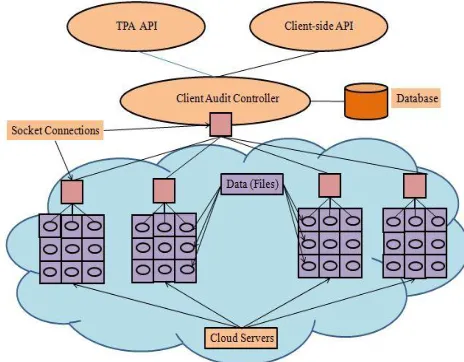
Clouds keep copy of data on remote storage. TPA is responsible for auditing process. Figure 4 illustrate the overview of integrity auditing structure
Figure 4. Proposed System Architecture [15]
V. AUDITING ALGORITHM
Definition and framework
Inode: Inode is an data structure found in many linux
system, every inode stores all information about a file system. Inode does not store the file‘s contents and file name excepts for certain modern file system.
MD5: MD5 digital signature is like a fingerprint for a file; changing just one single byte in a file will result in a different MD5 hash value. MD5 hashes can be used to catalog files on a file system and then determine at a later date that the files have not been modified in any way, for example if someone broke into a system and altered system files.
Client Program: It is the preconfigured client program
installed on remote cloud server. It is responsible for the secure socket communication between TPA system and cloud servers, directory traversal, and get file stats and different hash value. Client configured such way that it listen on the predefined port and IP address to improve security. Client program also include the different optimized c language programs for directory traversal and stats for files and folders based on the TPA requirement.
Socket connection: Considering all security aspect TPA
[image:3.612.326.558.182.363.2]International Journal of Emerging Technology and Advanced Engineering
Website: www.ijetae.com (ISSN 2250-2459,ISO 9001:2008 Certified Journal, Volume 5, Issue 1, January 2015)
[image:4.612.53.284.175.413.2]379 Based on the TPA request both system connect and communicate each other. This improves the security parameter for the communication between TPA and cloud.
Figure 5 Auditing Protocol [15]
Proposed system work in three steps initialize, update and audit stage called check integrity.
S={x, e, i, o, f, DD, NDD, success, failure} Let S be the solution perspective of the class x= Initial state of the class Initialize ()
x= {Initialize ()} sets the default values for all variables. Input i =(I1,I2)
I1= {{U}{V}{F}{σ}}
DD=deterministic data it helps identifying the load store functions or assignment functions.
NDD=Non deterministic data of the system S to be solved. Success-desired outcome generated.
Failure-Desired outcome not generated or forced exit due to system error.
Set of ‗k‘ cloud users U = {u1, u2, u3, u4………. ..uk} Set of ‗m‘ cloud servers V = {v1, v2, v3, v4……. ...vm} Set of files on cloud storage F = {f1, f2, f3, ……. fn} Set of file tags σi = { f+t+i+u+g+b+d+s+p+pr+md5}, i ϵ (1, n)
F= File Name. pr= File permissions. t= File type.
i= File Inode number. u=File User ID. g= File Group ID.
s= File Size. p= file path. b= File Block count.
n= Number of links For file. md5= md5 hash value
I = Initial Values in Database, N = Interval of auditing process, M = New Value database, LI= List Of files.
d= depth of file.
ST= Detail info of modified files.
Set of file tags σ calculated based on the file types. γ= directory path
α = query
v=cloud IP address ß= set of results μ= consist of file stats.
Initialize Integrity Auditing Algorithm
A. Initiate
This is first stage of algorithm. In this step TPA send a init () request to the client program install on cloud servers which include paths and user information of the files. Once receiving init request server compute the stats and an information for all files mentioned in the init request.
Initialize () α = ( γ, vj )
Where, γ ϵ n and vj is a jth cloud server.
(γ is set or path of (n) files and vj is cloud IP address) vj cloud server produces ß= (μ1, μ2, μ3, μ4… μi)
Where, μi comes from (f1, f2, f3, f4, f5…fn) consists of pair (fi, σi ).
TPA store the received values in (I) database
[image:4.612.341.553.537.674.2]International Journal of Emerging Technology and Advanced Engineering
Website: www.ijetae.com (ISSN 2250-2459,ISO 9001:2008 Certified Journal, Volume 5, Issue 1, January 2015)
380 Figure 6 illustrate sets of variables and values.
I = {ui, vj, fi, σi}
Where, ui is user, vj cloud server and σi consist of signature tag of file fi
B. Update
This step required when user uploads/modify the files on cloud server. Users inform TPA to update information. TPA send Query Update α = (γ , vj )
Where γ ϵ n‘ and vj is a jth cloud server. n‘ updated files. Set of tags σ‘i = { f+t+i+u+g+b+d+s+p+pr+md5}
i ϵ (1, n‘) where σ‘ updated files tags Number of files
F = {f1, f2, f3, f4, ……. f‘n}
Cloud server produces ß‘ = {μ‘1, μ‘2, μ‘3… μ‘i}
Where μi comes from (f1, f2, f3, f3…fn‘) consists of pair (fi, σ‘i )
TPA add/replace the ß‘ values {ui, vi, fi, σ‘i} in I = {ui, vi, fi, σi} I = {ui, vi, fi, σi}
Where ui is user, vi cloud server and σi consist of signature tag of file fi
C. Check Integrity
Schedule of periodic verification phase of the scheme cloud users need to specify the scan interval of the integrity checking protocol. User can keep the auditing interval minimum but it will consume computing resources of the cloud and indirectly increase the cost. Basically it will be few hours to users get the integrity auditing report as early as possible. So that user can take the necessary action to get modified file restored. Frequent auditing process would lead to a waste of network bandwidth and computing resources of TPA, CSPs, and Clients.
On the other hand, loose auditing process is not conducive to detect the exceptions in time to take action. For example, if a file owner authorizes TPA system to audit the data once a day, week or month TPA arranges this task at a fixed time on every day, each weekend or month end.
Based on the interval (N), in this phase TPA send the check request to the cloud servers, based on request client program on the cloud servers compute the file stats and information for the paths or directory in TPA request and sent result to the TPA system (M). Result of the files stats and hash are in the form of file or database. TPA system stores the new database (M). TPA system is having two databases. Initial database (I) and one after check request (M).
TPA system compares the stored databases (I) and (M) and concludes the results based on the comparisons and send list of modified files to users. As TPA system contains files stat and hash value of the files it not possible to get files contents. It preserves the privacy of user‘s data from keeping copy information outside the cloud server. Also in this scheme I am utilizing fully automated TPA so it‘s not necessary to mask the results from client program.
Initial values I = {ui, vi, fi, σi}
Where, ui user, vi cloud sever IP, μi = (fi, σi ) file name with file stats.
Interval to check integrity (N)
Set of tags σ‘i = { f+t+i+u+g+b+d+s+p+pr+md5} i ϵ (1, n‘) where σ‘ updated files tags
Number of files F = { f1, f2, f3, f4, ……. fn‘} TPA to cloud server Query Check α‘ = (γ , vj ) Produces ß‘ = {μ‘1, μ‘2, μ‘3… μ‘i}
Where μi comes from (f‘1, f‘2, f‘3……….f‘n)
TPA store the received ß‘ values {f‘i, σ‘i } in database (M) along with user and server details.
M = {ui, vi, f‘i, σ‘i }
TPA Search M {ui, vi, f‘i, σ‘i } in to the database I {ui, vi, fi, σi} If M {ui, vi, f‘i, σ‘i } ϵ I {ui, vi, fi, σi}
Figure 7. Results comparison [15]
As illustrated in Figure 7 TPA system compares the values.
Success
If M {ui, vi, f‘i, σ‘i } ≠ Search result I {ui, vi, fi, σi}
Results: Files modified lists (f‘i)
Else M {ui, vi, f‘i, σ‘i } = Search result I {ui, vi, fi, σi} Results: Uploaded/removed/modified files
Failure Desired results are not generated.
International Journal of Emerging Technology and Advanced Engineering
Website: www.ijetae.com (ISSN 2250-2459,ISO 9001:2008 Certified Journal, Volume 5, Issue 1, January 2015)
381 Using above results TPA informs to users and users take appropriate actions. Users easily identify uploaded, deleted and modified files keeping privacy preservation in auditing process and minimum resources consumption.
TABLEI
DATA SETS
FName FType fInode fUser fGrp fBlock FLink
test.sh F 4818957 0 0 8 1
stat.c F 4818845 0 0 24 1
FDepth FSize fPath Fper fMd5
1 201
bytes ./test.sh 100644
401Xms1xIAU0x
ge9IFWu9Q==
1 11365
bytes ./stat.c 100644
jhB1O64smacIDo
EOYLjuwe==
VI. RESULT ANALYSIS
A. Traverse directories and computes stats
Client to program to traverse directory and computes files stats.
root@cloud1 [~]# cd /home/santosh/imp/
root@cloud1 [/home/santosh/imp]# ls -a
-rw-r--r-- 1 root root 2152 Jan 8 00:56 client1.c -rw-r--r-- 1 root root 1523 Jan 8 01:23 output1.txt -rw-r--r-- 1 root root 1248 Jan 8 01:23 output2.txt
root@cloud1[/home/santosh/imp]# ./workingtraval /home/santosh/imp/
client1.c,f,4818968,0,0,8,1,1,2152,/home/santosh/imp/clien t1.c,42,100644, a62c910ca8d5b3486298b7cb3bfdd861 output1.txt,f,4818848,0,0,8,1,1,1523,/home/santosh/ imp/output1.txt,42,100644,
1cc9a4b76749a87cdca88bf79a4f9a57
output2.txt,f,4818853,0,0,8,1,1,1248,/home/santosh/ imp/output2.txt,42,100644,
3042fa5e1bf700092c617b8cfda089c5
Output of directory traversal and file tags save in output.txt We retrieve file using two ways socket communication.
B. Socket communication between system and cloud
material[root@ cloud1~]# ./cloudsystemclient
[cloud1] Obtaining socket descriptor successfully.
[cloud1] Bind tcp port 20000 in add 127.0.0.1 successfully. [cloud1] Listening the port 20000 successfully.
[cloud1] Server has got connected from 174.141.234.125. Initialize received from client!
[cloud1] Sending output.txt to the Client...Ok sent to client! [cloud1] Connection with Client closed. Cloud Server will wait now...
[root@auditsystem ]# ./auditsystemclient
[asystem] Connected to Cloud server 213.175.220.205 at port 20000...ok!
[asystem] Sending Initialize () to the Server Data Sent 0 = 1 [asystem] Receiving file from Server and save it as output.txt...Ok received from server!
[asystem] Connection close.
C. Auditing
Initial stat contain on 174.141.234.125 (I), If unauthorized file get uploaded called hacked.txt and deleted file name client1.c modified stats are
root@cloud1[/home/santosh/imp]# ./workingtraval
/home/santosh/imp/
output1.txt,f,4818848,0,0,8,1,1,1523,/home/santosh/imp/ou tput1.txt,42,100644, 1cc9a4b76749a87cdca88bf79a4f9a57 output2.txt,f,4818853,0,0,8,1,1,1248,/home/santosh/imp/ou tput2.txt,42,100644, 3042fa5e1bf700092c617b8cfda089c5 hacked.txt,f,4817562,0,0,8,1,1,17,/home/santosh/
/imp/hacked.txt,42,100644,6d6fe48f956a4bc88345c84d326 1d407
D. Results
Auditing server compares initial values (I) and modified results (M) and provides results. File deleted for user ID:1 File name client1.c File Path ,/home/santosh/imp/client1.c Updated files for user ID 1 File name hacked.txt File Path ,/home/santosh/
International Journal of Emerging Technology and Advanced Engineering
Website: www.ijetae.com (ISSN 2250-2459,ISO 9001:2008 Certified Journal, Volume 5, Issue 1, January 2015)
[image:7.612.49.295.137.288.2] [image:7.612.56.290.191.470.2]382 Figure 8. Snapshot of entering cloud details
Figure 9. Snapshot of initializing system.
Figure 10. Snapshot of Integrity Auditing
Merits of proposed system
1. TPA auditing process is fully computerized and
automatic the reason it is efficient than manual process.
2. This scheme avoids files tags/stats and hash storage on the cloud server. It saves disk space and cost on the cloud storage.
3. TPA does not retrieve any file contents locally which ensures public auditing by privacy preservation process.
4. TPA system does not require any prior knowledge of
files blocks to compute the results.
5. All check are done on the TPA system will avoid unnecessary computation of cloud server it saves resources and cost.
6. TPA system audit files from multiuser from same cloud or from different cloud servers.
7. CSP unable make any changes in the computed stats and hashes as database stored on the TPA system. 8. Auditing process bases on the files it easier to recover
the modified files instead of complete storage.
VII. CONCLUSION AND FUTURE SCOPE
In this paper, we have proposed an integrity auditing system for Linux platform cloud data storage. We have utilized file based and fully automatic and computerized TPA auditing system for efficient and avoiding new vulnerability threats, while eliminate burden of the users from auditing task. The system completely based on the file tags and checksum value. TPA may concurrently handle multiple audit sessions from different users for their cloud data on request.
We further extend integrity auditing process to multi cloud server. In this system our client program installed on multiple servers and communicates with automated TPA on request. In this system, communication secure with help of socket programming. Cloud servers listen on the predefined port and IP address to accept connection from TPA system. It makes secure communication between TPA and cloud server. Also to increase efficiency, we considered the highly efficient program for directory traversal in ‗c‘ programming which is light weighted for storage and execution.
[image:7.612.73.281.500.669.2]International Journal of Emerging Technology and Advanced Engineering
Website: www.ijetae.com (ISSN 2250-2459,ISO 9001:2008 Certified Journal, Volume 5, Issue 1, January 2015)
383 REFERENCES
[1] Cong Wang ,Sherman S.M Chow, Qian Wang, Kui Ren and wening
Lou, ―Privacy-Preserving Public Auditing for Secure cloud storage‖ in IEEE transaction on computers vol 62 No 2 February 2013.
[2] Cong Wang, Qian Wang, Kui Ren, Ning Cao, and Wenjing Lou
―Toward Secure and Dependable Storage Services in Cloud Computing‖ IEEE Transaction on Services Computing vol 5 No 2 April-June 2012.
[3] Qian Wang, Cong Wang, Kui Ren , Wenjing Lou And Jin Li ―
Enabling Public Auditability and Data Dynamics for Storage Security in Cloud Computing" IEEE transaction Paper on Parallel and Distributed Systems vol 22 No 5, pp. 847-859, May 2011.
[4] Kan Yang and Xiaohua Jia ―An Efficient and Secure Dynamic
Auditing Protocol for Data Storage in Cloud Computing‖ IEEE transaction on parallel distributed system, Vol 24 No 9 September 2013.
[5] Yan Zhu, Hongxin Hu, Gail-Joon Ahn and mengyang Yu
―Cooperative Provable Data possession for Integrity Verification in Multicloud Storage.‖ IEEE Transactions on parallel and distributed system, Vol 23, No. 12, pp. 2231-2244,December 2012.
[6] Shucheng Yu, C. Wang, K. Ren, and Wenjing Lou, ―Achieving
secure, scalable, and fine-grained access control in cloud
computing,‖ in Proc. of IEEE NFOCOM’10, San Diego, CA, USA,
March 2010.
[7] Cloud Security Alliance, ―Security guidance for critical areas of
focus in cloud computing,‖ 2009,
http://www.cloudsecurityalliance.org.
[8] G. Ateniese, R. Burns, R. Curtmola, J. Herring, L. Kissner, Z.
Peterson, and D. Song, ―Provable data possession at untrusted
Stores,‖ in Proc. of CCS’07, Alexandria, VA, October 2007,
pp. 598–609.
[9] Q. Wang, C. Wang, J. Li, K. Ren, and W. Lou, ―Enabling public verifiability and data dynamics for storage security in cloud
computing,‖ in Proc. of ESORICS’09, volume 5789 of LNCS.
Springer-Verlag, Sep. 2009, pp. 355–370.
[10] A. Juels and J. Burton S. Kaliski, ―Pors: Proofs of retrievability or
large files,‖ in Proc. of CCS’07, Alexandria, VA, October 2007, pp.
584–597.
[11] H. Shacham and B. Waters, ―Compact proofs of retrievability,‖ in
Proc. of Asiacrypt 2008, vol. 5350, Dec 2008, pp. 90–107.
[12] M. A. Shah, M. Baker, J. C. Mogul, and R. Swaminathan, ―Auditing
to keep online storage services honest,‖ in Proc. Of HotOS’07. Berkeley, CA, USA: USENIX Association, 2007, pp.1–6.
[13] M. Armbrust, A. Fox, R. Griffith, A. D. Joseph, R. H. Katz, A. Konwinski, G. Lee, D. A. Patterson, A. Rabkin, I. Stoica, and M. Zaharia, ―Above the clouds: A berkeley view of cloud computing,‖ University of California, Berkeley, Tech. Rep.
[14] P. Mell and T. Grance, ―Draft NIST working definition of cloud computing,‖ Referenced on June. 3rd, 2009 online at http://csrc.nist.gov/groups/SNS/cloud-computing/index.html, 2009.
[15] Ugale Santosh A ―Survey Paper on Integrity Auditing of storage‖ IJCER vol. 4 issue 3 March 2013
http://www.ijceronline.com/papers/Vol4_issue03/Version-2/L04302088092.pdf.
![Figure 6. Sets of variables [15]](https://thumb-us.123doks.com/thumbv2/123dok_us/8704989.880479/4.612.53.284.175.413/figure-sets-of-variables.webp)

