Eaack Based Intrusion Detection Technique for
Manet’s
Mr Ganesh Murgod1, Asst Prof Deepa Bendigeri2, Dr Jagadeesh Pujari3
1,3
Information Science Department, VTU University
Abstract— The defection to wireless technology from wired technology has been a global shift in the past few decades. The open system and remote distribution of nodes make MANET endangered to intruders. An emerging technique EAACK (Enhanced Adaptive Acknowledgement) method designed for MANET was proposed for intrusion detection. EAACK exhibit higher mis-behavior detection rates in situation where it does not cost for the network performances.
Keywords— Enhanced Adaptive ACKnowledgement (EAACK), Mobile Adhoc NETwork (MANET), and Elliptic Curve Cryptography (ECC).
I. INTRODUCTION
Due to their natural quality and quantifiability wireless networks area unit perpetually most popular since the primary day of their invention. Because of the improved technology and reduced prices, wireless networks have gained rather more preferences over wired networks within the past few decades. Formally, MANET is a set of mobile nodes equipped with each a wireless unit of transmitter and a receiver that communicates with one another via two way wireless links. One in all the key blessings of wireless networks is its ability to permit electronic communication between completely different parties and still maintain their quality. However, this communication is restricted to the vary of transmitters. This implies that 2 nodes cannot communicate with one another once the space between the 2 nodes is on the far side the communication varies of their own. MANET solves this drawback by permitting intermediate par- ties to relay information transmissions. This is attained by separating MANET into two types of networks, namely, single-hop and multi hop. During a single-hop network, all nodes among a similar radio frequency communicate directly with one another. On the opposite hand, during a multi hop network, nodes allow different intervening nodes to communicate if the destination node is out of their transmission range. In contrary to the normal wireless network, MANET incorporates a suburbanized network infrastructure. MANET doesn't need a hard and fast infrastructure; therefore, all nodes area unit unengaged to move arbitrarily .MANET is capable of making a configuring and self-maintaining network while not the assistance of a centralized infrastructure, that is commonly unfeasible in crucial mission areas like Warfield. Tokenish configurations Associate in fast preparation create MANET able to be utilized in emergency circumstances wherever an infrastructure is unavailable no cooperative nodes into the network. What is more, as a result of MANET’s distributed design and dynamical topology, a conventional centralized observance technique isn't any longer possible in MANETs. In such case, it's crucial to develop Associate in nursing intrusion detection system (IDS). or impracticable to put in cases like natural or human-induced disasters, military Warfield etc.
II. RELATED WORK
Discovering malicious nodes
A. Watchdog
It is very popular and highly efficient IDS for improving the output of network with the presence of corrupted nodes. These IDS can be classified into two methods such as Watchdog and Path rater. It is responsible for discovering corrupted node disoperation in the network. Watchdog finds out malicious disoperation by listening to its next hop’s transmission in the network. If a Watchdog IDS overhears that its next node fails to send the packet within a predefined time interval, the failure counter is incremented. Whenever a node’s failure counter exceeds a predefined threshold value, the Watchdog node reports it as disoperation. In this scenario, the Path rater collaborates with the routing Protocols to avoid the attacker nodes in further communication. The Watchdog-IDS fails to discover malicious nodes in the following situations: 1) partial dropping; 2) false misbehaviour report; 3) ambiguous collisions; 4) receiver collisions; 5) collusion and 6) limited transmission power.
B. Two-Ack
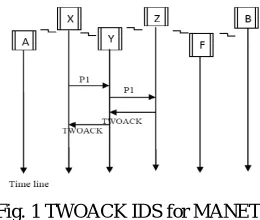
[image:3.612.257.387.314.424.2]It is another important IDS TWOACK for discovering malicious nodes in MANETs [6] .The main aim of this IDS to solve the receiver collision and less transmission power issues, TWOACK detects misbehaving paths by acknowledging every data packet sent over every three successive nodes in the path between source and destination. Upon recovery of a packet, every node along the path has to return back an acknowledgment packet to the starting that is two distance(hops) away from it in the path. TWO-ACK involves a routing procedure like Dynamic Source Routing (DSR).
Fig. 1 TWOACK IDS for MANETs
In Fig 1: Node X wants to transmit the Packet 1 to node Y, and then, node Y transmit the Packet 1 to node Z. When node Z receives Packet 1, because it is two hops away from node X, node Z is produce a TWOACK packet, that contains reverse route from node X to node Z, and sends it back to node X. The Reclaim of this TWOACK packet at node X tells us that the imparting of Packet 1 from node X to node Z is correct and successful. Else, if TWOACK packet is not received within predefined time, both nodes Y and Z are reported as harmful. The same method is applied to every three consecutive nodes along the remaining path. The TWO-ACK IDS effectively processes the receiver collision and limited transmission power issues of Watchdog. However, the acknowledgment process involved in every packet dispatch process added a remarkable network overhead. Due to the battery problem of MANETs, such redundant transmission process will degrade the life of the whole system.
C. AACK
Fig. 2 End-to-End ACK IDS for MANETs
[image:4.612.239.385.610.697.2]
Fig 3 Routing overhead
III. PROPOSED SYSTEM
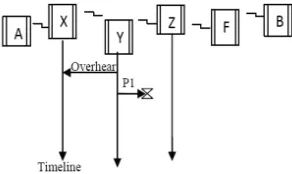
Secure IDS architecture (EAACK) was introduced on basis of security attributes and various algorithms, like RSA and DSA. EAACK is crafted to overcome three drawbacks of Watchdog IDS, namely, 1) Receiver collision, 2) Limited transmission power, 3) False misbehavior. Receiver collisions: As shown in Fig. 3, after node X sends Packet 1 to node Y, it tries to overhear if node Y forwarded this packet to node Z; meanwhile, node F is forwarding Packet 2 to node Z. In such case, node X overhears that node Y has successfully forwarded Packet 1 to node Z but failed to detect that node Z didn’t get this packet because of collision between Packet 1 and Packet 2 at node Z.
Fig. 4 Receiver collisions in MANETs
imited transmission power:Example of Limited power, shown in Fig. 5, in order to manage the battery resources in MANETs, node Y limits its transmission power so it is very strong to be overheard by node X after transmitting the packet (P1) to node Z , but too weak to reach node Z because of transmission power can be reduced
to node Z successfully, node X still inform node Y is behaving improper, as in the below figure. Due to the open medium system of MANETs, intruders can easily gain control over one or two nodes to attain this false misbehavior report attack. As mentioned earlier, TWOACK and AACK resolve two of these three weaknesses, namely, limited transmission power and receiver collision. But, both of them are endangered to the false misbehavior attack.
. Fig 6 False misbehavior in MANETs
IV. IMPLEMENTATIONS
A. Secure Ids Description
EAACK has three important fragments namely, ACK, secure ACK (S-ACK), and Misbehaviour Report Authentication (MRA). In order to differentiate different packet types in different strategies to include a 2-b packet header in the proposed method. As stated in DSR [7], there is 6 b guarded in the DSR header. But in this technique, use 2 b of the 6 b to flag various types of packets.
Fig. 7 EAACK protocol in MANETs
In these secure IDS, there is a bi-directional link between nodes. Furthermore, for each transmission process, both source and destination nodes are not corrupted. All acknowledgment packets are required to be digitally signed and verified.
1) ACK:ACK is an end-to-end ACK technique. It aims to lower network overhead when no network wrongdoing is detected. Consider this case, first source node forwards an ACK data packet to the destination node D. Source and Destination along with all intermediate nodes are interactive and node D successfully receives packet, node D is required to return back an ACK acknowledgment packet to source but in a reverse order. Within estimated time, if source node receives packet, then the packet transmission from source to destination is correct. Else, the source node will change to S-ACK mode by forwarding a S-ACK data packet to look out for the misbehaving nodes in the path.
2) S-ACK:It is an improved version of the TWOACK IDS [6].For every three successive nodes in the path, the third node has to return back an S-ACK acknowledgment packet to the node, from where it started. The purpose of implementing S-ACK mode is to identify misbehaving nodes in the existence of receiver collision or limited transmission power.
3) MRA:Unlike the TWOACK technique, where the source node has confidence over the misbehavior report, it switches to MRA mode and guarantees this misbehaviour report. The MRA field is crafted to overcome the drawbacks of Watchdog as it fails to recognize misbehaving nodes. The false misbehaviour report can be produced by intruders to falsely report innocent nodes as corrupt. The core of MRA field is to verify whether or not the destination node has received the announced missing packet through another path. To start the MRA mode, the source node searches first its local knowledge base and gets for an alternative path to the destination. If there exists no path, the source calls for DSR routing technique to search another path. Because of Manet’s architecture, it is easy to find out multiple paths. When the destination gets an MRA packet, it looks out in its local knowledge base and verifies if the reported packet is present. If it is already present, then we can say that this is a corrupted report and whoever produced this report is marked as intruder. Otherwise, the misbehaviour report is believed and taken for granted.
B. Secure Ids In Dsa And Rsa
The signature dimensions of DSA are too smaller than the RSA. So the DSA scheme always produces slightly less network overhead than RSA does. It is good to see that the Routing Overhead differences between RSA and DSA schemes vary with different numbers of attacking nodes [15]. Assume that this is due to the effect, that more attacking nodes require more ack packets, thus increasing the ratio of digital signature in the entire network overhead. In this view, we find DSA as a wiser digital signature technique in MANETs [1].The logic is that data communications in MANETs consume more battery. Although the DSA technique needs more calculation to verify than RSA, considering the trade off between battery power and performance, DSA is still preferable.
V. CONCLUSIONS
Here, we represent a relative study of secure system for detecting attacker nodes and attacks. As the properties of MANETs reside, prevention techniques alone are not sufficient to control the whole network distribution. In this scenario detection should be concentrated as another part before an intruder can damage the entire network architecture. We study about secure detection technique named EAACK protocol uniquely crafted for MANETs and in future it is required compare against other popular mechanisms. Security is major part in MANETS; hybrid cryptography architecture will tackle the issue in an efficient manner. This way we can better preserve battery and memory space of mobile nodes.
REFERENCES
[1] EAACK – A Secure Intrusion Detection System for MANETs Elhadi M. Shakshuki, Senior Member, IEEE, Nan Kang and Tarek R. Sheltami, Member, IEEE
[2] Investigating Intrusion and Detection Systems in MANET and Comparing IDSs for Detecting Misbehaving Nodes Marjan Kuchaki Rafsan,Ali Movaghar and Faroukh Koroupi,World Academic of Science Engineering and Technology 44 2008
[3] D. Johnson and D. Maltz, “Dynamic Source Routing in ad hoc wireless networks,” in Mobile computing. Norwell, MA: Kluwer, 1996,ch. 5, pp. 153–181. [4] S. Marti, T. J. Giuli, K. Lai, and M. Baker, “Mitigating routing misbehavior in mobile ad hoc networks,” in Proc. 6th Annu. Int.Conf. Mobile Comput. Netw., Boston, MA, 2000, pp. 255–265.
[5] “A study of different types of attacks on multicast in mobile ad hoc networks” Hoang Lan Nguyen, Uyen Trang Nguyen, Elsevier AdHoc Networks(2008) 32-46.
[6] D. Johnson and D. Maltz, “Dynamic Source Routing in ad hoc wireless networks,” in Mobile computing. Norwell, MA: Kluwer, 1996,ch. 5, pp. 153–181. [7] T. Sheltami, A. Al-Roubaiey, E. Shakshuki, and A. Mahmoud, “Video transmission enhancement in presence of misbehaving nodes In MANETs,” Int. J. Multimedia Syst., vol. 15, no. 5, pp. 273–282, Oct. 2009.
[8] K. Stanoevska-Slabeva and M. Heitmann, “Impact of mobile ad-hoc networks on the mobile value system,” in Proc. 2nd Conf. m-Bus., Vienna, Austria, Jun. 2010
[9] A. Tabesh and L. G. Frechette, “A low-power stand- alone adaptive circuit for harvesting energy from a piezoelectric micro power generator,” IEEE Trans. Ind. Electron., vol. 57, no. 3, pp. 840–849, Mar. 2010.
[10]“Misbehavior Nodes Detection and Isolation for MANETs OLSR Protocol”Ahmed M. Abdulla, Imane A. Saroitb, Amira Kotbb, Ali H. Afsaric a* 2010 Published by Elsevier Ltd.
[11] H Yang, H Y. Luo, F Ye, S W. Lu, and L Zhang, “Security in mobile ad hoc networks:Challenges and solutions” (2004). IEEE Wireless Communications. 11 (1), pp. 38-47.
[12] K. Liu, J. Deng, P. K. Varshney, and K. Balakrishnan, “An acknowledgment-based approach for the detection of routing misbehaviour in MANETs,” IEEE Trans. Mobile Comput., vol. 6, no. 5, pp. 536–550, May 2007.
[13] “ Security Issues in Mobile Adhoc Networks-A Survey” Wenjia Li and Anupam Joshi University of Maryland, Baltimore Country. [14] M. Zapata and N. Asokan, “Securing ad hoc routing protocols,” in Proc.ACM Workshop Wireless Secur., 2002, pp. 1–10.