comment
reviews
reports
deposited research
interactions
information
refereed research
Research
Characterization of alternatively spliced products and
tissue-specific isoforms of USP28 and USP25
Rebeca Valero, Mònica Bayés*, M Francisca Sánchez-Font, Olga
González-Angulo, Roser Gonzàlez-Duarte and Gemma Marfany
Address: Departament de Genètica, Facultat de Biologia, Universitat de Barcelona, Av. Diagonal 645, 08028 Barcelona, Spain. *Current address: Unitat de Genètica, Departament de Ciències Experimentals i de la Salut, Universitat Pompeu Fabra, Dr Aiguader 80, 08003 Barcelona, Spain.
Correspondence: Gemma Marfany. E-mail: [email protected]
Abstract
Background: The ubiquitin-dependent protein degradation pathway is essential for the proteolysis of intracellular proteins and peptides. Deubiquitinating enzymes constitute a complex protein family involved in a multitude of cellular processes. The ubiquitin-specific proteases (UBP) are a group of enzymes whose predicted function is to reverse the ubiquitinating reaction by removing ubiquitin from a large variety of substrates. We have lately reported the characterization of human USP25, a specific-ubiquitin protease gene at 21q11.2, with a specific pattern of expression in murine fetal brains and adult testis.
Results: Database homology searches at the DNA and protein levels and cDNA library screenings led to the identification of a new UBP member in the human genome, named USP28, at 11q23. This novel gene showed preferential expression in heart and muscle. Moreover, cDNA, expressed sequence tag and RT-PCR analyses provided evidence for alternatively spliced products and tissue-specific isoforms. Concerning function, USP25overexpression in Down syndrome fetal brains was shown by real-time PCR.
Conclusions:On the basis of the genomic and protein sequence as well as the functional data, USP28
andUSP25establish a new subfamily of deubiquitinating enzymes. Both genes have alternatively spliced
exons that could generate protein isoforms with distinct tissue-specific activity. The overexpression of
USP25 in Down syndrome fetal brains supports the gene-dosage effects suggested for other UBP
members related to aneuploidy syndromes. Published: 13 September 2001
GenomeBiology2001, 2(10):research0043.1–0043.10
The electronic version of this article is the complete one and can be found online at http://genomebiology.com/2001/2/10/research/0043 © 2001 Valero et al., licensee BioMed Central Ltd
(Print ISSN 1465-6906; Online ISSN 1465-6914)
Received: 16 May 2001 Revised: 9 July 2001 Accepted: 11 July 2001
Background
Ubiquitin modification of protein substrates has a major role in a variety of cellular processes such as cell-cycle progres-sion, DNA repair, antigen presentation, differentiation and development, transcriptional activation and selective degra-dation of damaged proteins (for review see [1-3]). Covalent attachment of ubiquitin molecules is the first step for degra-dation of the tagged protein via the 26S proteasome
pathway. This is a finely regulated and highly specific process as an error in substrate recognition might compro-mise cell survival.
ubiquitin-conjugates (deubiquitinating enzymes, DUBs) not only affect the fate and degradation of intracellular proteins but seem to be essential in the maintenance of cell-free ubiq-uitin pools [3-5]. Failures of the ubiqubiq-uitin system have been implicated in many human diseases, among them some important neurodegenerative disorders and several carcino-mas. The accumulation of ubiquitin adducts has been described in patients with Alzheimer’s, Huntington’s, and Parkinson’s diseases although the direct involvement of ubiquitinated protein aggregates in the pathological condi-tion has not been proved. On the other hand, a missense mutation in the ubiquitin carboxy-terminal hydrolase L1 (UCHL1) has been found in a German family with Parkin-son’s disease [6].
Two classes of deubiquitinating enzymes have been described: the UCHs (ubiquitin carboxy-terminal hydrolases) and the UBPs (ubiquitin processing proteases) [4,7,8]. The UCH family members share a small size, cleave ubiquitin from small peptides and amino acids and appear well conserved (40%) across species. In contrast, the UBP family gathers larger and distantly related enzymes that release ubiquitin from a wide range of ubiquitin-protein conjugates [5]. As the human UBP family is likely to be quite large, a systematic nomenclature has been proposed for these enzymes based on the abbreviation USP, for ubiquitin-specific protease [9].
In the UBP family, protein sequence comparisons have shown that homology is restricted to the regions encom-passing the active site cysteine and histidine residues and other peptide segments putatively involved in catalysis or substrate binding [7,10]. More than 90 deubiquitinating enzymes have been characterized after data from genome sequencing projects [5]; as many as 16 are encoded in yeast, which is in agreement with the high specificity attributed to this family [2,3]. Although at present the overall homology among UBPs is low, subfamilies of closely related members (60% to 88% amino acid identi-ties) begin to emerge [11-13].
Lately, we have identified a novel UBP member, named
USP25, in the gene-poor region of human chromosome 21q11.2 and characterized the full cDNA sequence [14]. Iso-lation of the mouse homolog cDNA allowed us to perform northern and in situhybridization analyses. Higher levels of
USP25expression in mouse were detected in the prolifera-tive compartments of fetal brain and in maturating sperma-tocytes of adult testis, allowing the correlation of gene expression with high protein turnover.
Here we describe a human USP25homolog, USP28, which maps to 11q23 and is preferentially expressed in heart and muscle. Tissue-specific alternatively spliced exons of USP25
and USP28 have been identified, in agreement with several isoforms described for vertebrate UBPs [13,15].The func-tional deubiquitinating assay has been performed for the two
members of the newly described UBP subfamily. Overex-pression of USP25 as measured by real-time PCR in Down versus control fetal brains supports the gene-dosage effects reported for other UBP members.
Results
Cloning of USP28
A TBlastN comparison of USP25sequence against nr data-base at the National Center for Biotechnology Information (NCBI) server revealed a homologous USPsequence on PAC clone pDJ356d6 (GenBank accession number AC002036) located at 11q23. Specific probes designed following this genomic sequence were used to screen 106 recombinant phages of a human fetal brain cDNA library (Clontech). Six positive clones were isolated, subcloned and sequenced. Four clone sequences were chimeric and were thus dis-carded. Two overlapping cDNA clones, 5A11 (2.3 kb) and 3A11 (1.5 kb), showed an exact match with chromosome 11 PAC clone pDJ356d6. Evidence that clones 5A11 and 3A11 did not encode the full-length cDNA was based on the protein alignment between the deduced amino acid sequence and USP25, the mRNA size obtained from north-ern analysis when probed with cDNA clone 5A11, and the absence of the strictly conserved UBP cysteine domain in either clone 5A11 or 3A11.
Three different strategies were followed to isolate the 5cend of USP28 cDNA. First, a chromosome 11-specific forward primer (5.2 cr11F) was designed from the TBlastN analysis of
USP25 (Figure 1). This sequence corresponded to the 5c -ter-minal sequence of the predicted exon encoding the cysteine domain in the chromosome 11 PAC DNA. A reverse oligonu-cleotide, 11race4,was also designed on the basis of the 3A11 cDNA clone sequence (Figure 1). An RT-PCR reaction using heart mRNA as template was subsequently performed with the forward and reverse primers. The expected 958 bp ampli-fied fragment was subcloned in pUC18. Its sequence over-lapped with 3A11 and 5A11 cDNA clones, thus allowing the characterization of an additional 908 bp. The overall cDNA sequence, although still incomplete, contained the cysteine domain, together with all other UBP reported signatures.
Second, 106recombinant phages from kidney and placenta cDNA libraries (Clontech) were screened using three differ-ent 5c-USP28-specific probes obtained after PCR amplifica-tion with primers deduced from the TBlastN comparison to
USP25 (Figure 1). Five different positive clones were iso-lated: four from kidney and one from placenta. All inserts were subcloned in pBLUESCRIPT SK+ (Stratagene). Sequence analysis revealed a further 318 bp, although the cDNA was still incomplete.
comment reviews reports deposited research interactions information refereed research Figure 1
USP28 nucleotide and amino acid sequences (GenBank accession number AF266283). Nucleotides and residues are numbered from the presumptive first ATG (methionine) codon. Specific primers used for cloning are also indicated. The alternative polyadenylation signal is underlined.
5.2.c11F 11race7 11race6 5.2 c11R 5’cr11F 5’cr11R 5.1 cr11F 5.1 cr11R TCGGCC -1 ATGACTGCGGAGCTGCAGCAGGACGACGCGGCCGGCGCGGCAGACGGCCACGGCTCGAGC 60 M T A E L Q Q D D A A G A A D G H G S S 20
TGCCAAATGCTGTTAAATCAACTGAGAGAAATCACAGGCATTCAGGACCCTTCCTTTCTC 120 C Q M L L N Q L R E I T G I Q D P S F L 40
CATGAAGCTCTGAAGGCCAGTAATGGTGACATTACTCAGGCAGTCAGCCTTCTCACTGAT 180 H E A L K A S N G D I T Q A V S L L T D 60
GAGAGAGTTAAGGAGCCCAGTCAAGACACTGTTGCTACAGAACCATCTGAAGTAGAGGGG 240 E R V K E P S Q D T V A T E P S E V E G 80
AGTGCTGCCAACAAGGAAGTATTAGCAAAAGTTATAGACCTTACTCATGATAACAAAGAT 300 S A A N K E V L A K V I D L T H D N K D 100
GATCTTCAGGCTGCCATTGCTTTGAGTCTACTGGAGTCTCCCAAAATTCAAGCTGATGGA 360 D L Q A A I A L S L L E S P K I Q A D G 120
AGAGATCTTAACAGGATGCATGAAGCAACCTCTGCAGAAACTAAACGCTCAAAGAGAAAA 420 R D L N R M H E A T S A E T K R S K R K 140
CGCTGTGAAGTCTGGGGAGAAAACCCCAATCCCAATGACTGGAGGAGAGTTGATGGTTGG 480 R C E V W G E N P N P N D W R R V D G W 160
CCAGTTGGGCTGAAAAATGTTGGCAATACATGTTGGTTTAGTGCTGTTATTCAGTCTCTC 540 P V G L K N V G N T C W F S A V I Q S L 180
TTTCAATTGCCTGAATTTCGAAGACTTGTTCTCAGTTATAGTCTGCCACAAAATGTACTT 600 F Q L P E F R R L V L S Y S L P Q N V L 200
GAAAATTGTCGAAGTCATACAGAAAAGAGAAATATCATGTTTATGCAAGAGCTTCAGTAT 660 E N C R S H T E K R N I M F M Q E L Q Y 220
TTGTTTGCTCTAATGATGGGATCAAATAGAAAATTTGTAGACCCGTCTGCAGCCCTGGAT 720 L F A L M M G S N R K F V D P S A A L D 240
CTATTAAAGGGAGCATTCCGATCATCTGAGGAACAGCAGCAAGATGTGAGTGAATTCACA 780 L L K G A F R S S E E Q Q Q D V S E F T 260
CACAAGCTCCTGGATTGGCTAGAGGACGCATTCCAGCTAGCTGTTAATGTTAACAGTCCC 840 H K L L D W L E D A F Q L A V N V N S P 280
AGGAACAAATCTGAAAATCCAATGGTGCAGCTGTTCTATGGTACTTTCCTGACTGAAGGG 900 R N K S E N P M V Q L F Y G T F L T E G 300
GTTCGTGAAGGAAAACCCTTTTGTAACAATGAGACCTTCGGCCAGTATCCTCTTCAGGTA 960 V R E G K P F C N N E T F G Q Y P L Q V 320
AACGGTTATCGCAACTTAGACGAGTGTTTGGAAGGGGCCATGGTGGAGGGTGATGTTGAG 1020 N G Y R N L D E C L E G A M V E G D V E 340
CTTCTTCCCTCCGATCACTCGGTGAAGTATGGACAAGAGCGTTGGTTTACAAAGCTACCT 1080 L L P S D H S V K Y G Q E R W F T K L P 360
CCAGTGTTGACCTTTGAACTCTCAAGATTTGAGTTTAATCAGTCCCTTGGGCAGCCAGAG 1140 P V L T F E L S R F E F N Q S L G Q P E 380
AAAATTCACAATAAGCTGGAATTTCCTCAGATTATTTATATGGACAGGTACATGTACAGG 1200 K I H N K L E F P Q I I Y M D R Y M Y R 400
11race4
AGCAAGGAGCTTATTCGAAATAAGAGAGAGTGTATTCGAAAGTTGAAGGAGGAAATAAAA 1260 S K E L I R N K R E C I R K L K E E I K 420
ATTCTGCAGCAAAAATTGGAAAGGTATGTGAAATATGGCTCAGGCCCAGCTCGGTTCCCG 1320 I L Q Q K L E R Y V K Y G S G P A R F P 440
CTCCCGGACATGCTGAAATATGTTATTGAATTTGCTAGTACAAAACCTGCCTCAGAAAGC 1380 L P D M L K Y V I E F A S T K P A S E S 460
TGTCCACCTGAAAGTGACACACATATGACATTACCACTTTCTTCAGTGCACTGCTCGGTT 1440 C P P E S D T H M T L P L S S V H C S V 480
TCTGACCAGACATCCAAGGAAAGTACAAGTACAGAAAGCTCTTCTCAGGATGTTGAAAGT 1500 S D Q T S K E S T S T E S S S Q D V E S 500
ACCTTTTCTTCTCCTGAAGATTCTTTACCCAAGTCTAAACCACTGACATCTTCTCGGTCT 1560 T F S S P E D S L P K S K P L T S S R S 520
TCCATGGAAATGCCTTCACAGCCAGCTCCACGAACAGTCACAGATGAGGAGATAAATTTT 1620 S M E M P S Q P A P R T V T D E E I N F 540
GTTAAGACCTGTCTTCAGAGATGGAGGAGTGAGATTGAACAAGATATACAAGATTTAAAG 1680 V K T C L Q R W R S E I E Q D I Q D L K 560
ACTTGTATTGCAAGTACTACTCAGACTATTGAACAGATGTACTGCGATCCTCTCCTTCGT 1740 T C I A S T T Q T I E Q M Y C D P L L R 580
CAGGTGCCTTATCGCTTGCATGCAGTTCTTGTTCATGAAGGACAAGCAAATGCTGGACAC 1800 Q V P Y R L H A V L V H E G Q A N A G H 600
5A11.2
TATTGGGCCTATATCTATAATCAACCCCGACAGAGCTGGCTCAAGTACAATGACATCTCT 1860 Y W A Y I Y N Q P R Q S W L K Y N D I S 620
GTTACTGAATCTTCCTGGGAAGAAGTTGAAAGAGATTCCTATGGAGGCCTGAGAAATGTT 1920 V T E S S W E E V E R D S Y G G L R N V 640
AGTGCTTACTGTCTGATGTACATTAATGACAAACTACCCTACTTCAATGCAGAGGCAGCC 1980 S A Y C L M Y I N D K L P Y F N A E A A 660
CCAACTGAATCAGATCAAATGTCAGAAGTGGAAGCCCTATCTGTGGAACTCAAGCATTAC 2040 P T E S D Q M S E V E A L S V E L K H Y 680
ATTCAGGAGGATAACTGGCGGTTTGAGCAGGAAGTAGAGGAGTGGGAAGAAGAGCAGTCT 2100 I Q E D N W R F E Q E V E E W E E E Q S 700
TGCAAAATCCCTCAAATGGAGTCCTCCACCAACTCCTCATCACAGGACTACTCTACATCA 2160 C K I P Q M E S S T N S S S Q D Y S T S 720
CAAGAGCCTTCAGTAGCCTCTTCTCATGGGGTTCGCTGCTTGTCATCTGAGCATGCTGTG 2220 Q E P S V A S S H G V R C L S S E H A V 740
ATTGTAAAGGAGCAAACTGCCCAGGCTATTGCAAACACAGCCCGTGCCTATGAGAAGAGC 2280 I V K E Q T A Q A I A N T A R A Y E K S 760
GGTGTAGAAGCGGCACTGAGTGAGGTGATGCTGAGCCCTGCCATGCAAGGGGTCATCCTG 2340 G V E A A L S E V M L S P A M Q G V I L 780
GCCATAGCTAAAGCCCGTCAGACCTTTGACCGAGATGGGTCTGAAGCAGGGCTGATTAAG 2400 A I A K A R Q T F D R D G S E A G L I K 800
GCATTCCATGAAGAATACTCCAGGCTCTATCAGCTTGCCAAAGAGACCCCCACCTCTCAC 2460 A F H E E Y S R L Y Q L A K E T P T S H 820
3’cr11F
3’ cr11R 5A11.1
AGTGATCCTCGACTTCAGCATGTCCTTGTCTACTTTTTCCAAAATGAAGCACCCAAAAGG 2520 S D P R L Q H V L V Y F F Q N E A P K R 840
GTAGTAGAACGAACCCTTCTGGAACAGTTTGCAGATAAAAATCTTAGCTATGATGAAAGA 2580 V V E R T L L E Q F A D K N L S Y D E R 860
TCAATCAGCATTATGAAGGTGGCTCAAGCGAAACTGAAGGAAATTGGTCCAGATGACATG 2640 S I S I M K V A Q A K L K E I G P D D M 880
AATATGGAAGAGTACAAGAAGTGGCATGAAGATTATAGTTTGTTCCGAAAAGTGTCTGTG 2700 N M E E Y K K W H E D Y S L F R K V S V 900
TATCTCCTAACAGGCCTAGAACTCTATCAAAAAGGAAAGTACCAAGAGGCACTTTCCTAC 2760 Y L L T G L E L Y Q K G K Y Q E A L S Y 920
CTGGTATATGCCTACCAGAGCAATGCTGCCCTGCTGATGAAGGGGCCCCGCCGGGGGGTC 2820 L V Y A Y Q S N A A L L M K G P R R G V 940
AAAGAATCCGTGATTGCTTTATACCGAAGAAAATGCCTTCTGGAGCTGAATGCCAAAGCA 2880 K E S V I A L Y R R K C L L E L N A K A 960
GCTTCTCTTTTTGAAACAAATGATGATCACTCCGTAACTGAGGGCATTAATGTGATGAAT 2940 A S L F E T N D D H S V T E G I N V M N 980
GAACTGATCATCCCCTGCATTCACCTTATCATTAATAATGACATTTCCAAGGATGATCTG 3000 E L I I P C I H L I I N N D I S K D D L 1000
GATGCCATTGAGGTCATGAGAAACCATTGGTGCTCTTACCTTGGGCAAGATATTGCAGAA 3060 D A I E V M R N H W C S Y L G Q D I A E 1020
AATCTGCAGCTGTGCCTAGGGGAGTTTCTACCCAGACTTCTAGATCCTTCTGCAGAAATC 3120 N L Q L C L G E F L P R L L D P S A E I 1040
ATCGTCTTGAAAGAGCCTCCAACTATTCGACCCAATTCTCCCTATGACCTATGTAGCCGA 3180 I V L K E P P T I R P N S P Y D L C S R 1060
TTTGCAGCTGTCATGGAGTCAATTCAGGGAGTTTCAACTGTGACAGTGAAATAAGCTCCC 3240 F A A V M E S I Q G V S T V T V K * 1077
vector-derived forward primers (GR1, GR2). The compari-son with the PAC clone PDJ105h16 sequence (htgs database) allowed us to identify the first presumptive methionine. However, as no further in-frame stop codons were detected, the use of another initiation codon could not be ruled out. The search for a putative TATA box in the upstream genomic sequence rendered no positive results.
No cDNA clones with a poly(A)+tail could be isolated, but BlastN comparisons against the dbEST database allowed the identification of an overlapping EST (AI337094) containing the polyadenylation signal.
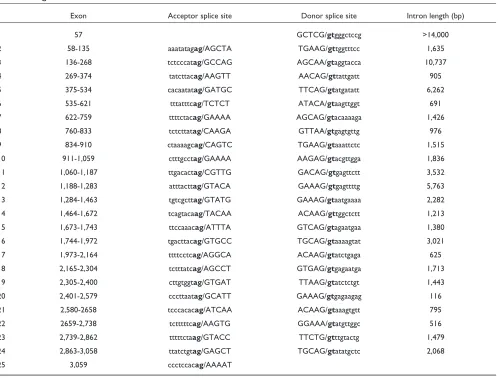
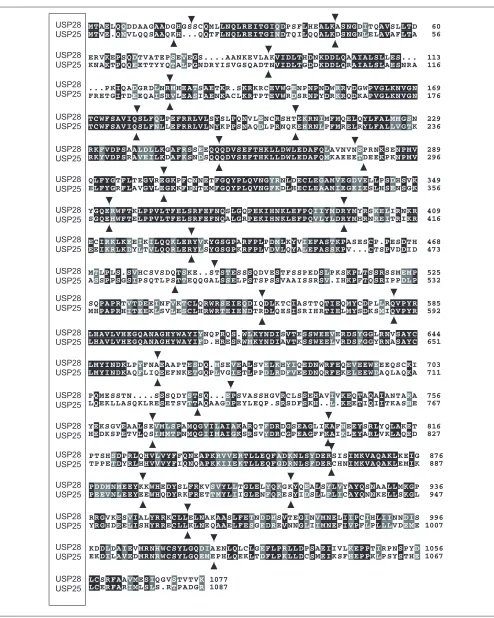
USP28 cDNA (accession number AF266283) is at least 3,624 bp long and encodes 1,077 amino acids with a relative molec-ular mass of 122.4 kDa. The gene is organized in 25 exons and exon-intron boundaries were determined after comparison with the human htgs database (Table 1). Average exon length was 130 bp, the shortest being 71 bp and the longest 229 bp. Nucleotide and amino acid identities between USP28 and
USP25 (Figure 2) are 55.77% and 51.36%, respectively. USP28 is more similar to USP25 than to any other known UBP. Besides, exon-intron boundaries between USP28 and
USP25 are highly conserved (Figure 2). The homology between USP28 and USP25 with other UBP family members appears to be confined to the reported conserved domains.
Expression analysis of USP28in human tissues
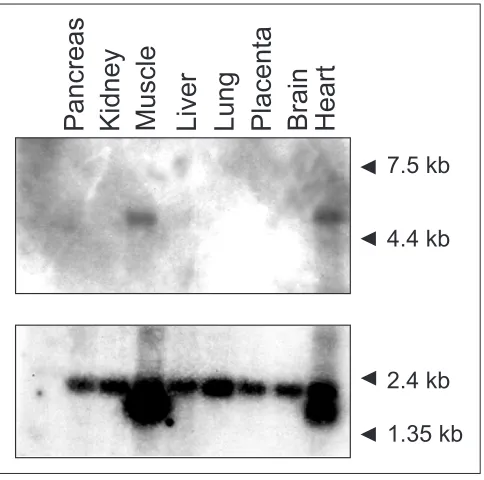
Northern analysis for USP28 was performed using the cDNA clone 5A11 as probe (Figure 3). A single transcript of approx-imately 4.5 kb was identified in heart and skeletal muscle after short film exposure. At longer exposures a transcript of the same size was detected in all assayed tissues, albeit at a very low level. To compare the amount of RNA poly(A)+ loaded in each lane an actin probe was used as a control.
Alternative splicing of USP25and USP28
Isoforms generated by alternative splicing have been described for some vertebrate UBPs [13,15]. Sequence analy-sis of the isolated USP25 cDNA clones revealed four alterna-tively spliced exons. Three of those generated an in-frame stop codon in some human fetal brain cDNA clones and were located between exons 3 and 4, 10 and 11, and 17 and 18 (exons numbered according to [14]. The fourth alternatively spliced product corresponded to exon 19 and added 32 amino acids to the protein product (exon 19 has been renamed 19b in this work). It had been previously identified in a single I.M.A.G.E consortium neuroepithelium cDNA clone (id: AA209364 [16]). In order to verify all these puta-tive exons, specific sets of primers (Table 2) were designed for RT-PCR amplification on 24 different tissues (Multiple Tissue cDNA Panels, Clontech).
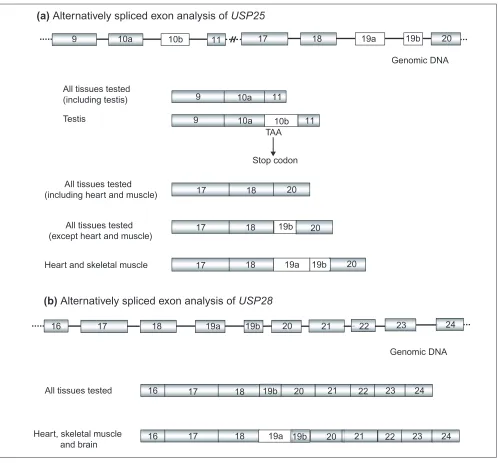
The additional sequences between exons 3-4 and 17-18 were not further observed in any tissue tested. However, the alternative sequence between exons 10 and 11 (named exon
10b) was clearly detected and verified by sequencing in testis (Figure 4a), where both transcripts (exons 10-11 and 10-10b-11) had been amplified at similar levels. Exon 10b was also detected, albeit faintly, in small intestine, spleen and periph-eral leukocytes. This exon encompasses 124 bp and gener-ates a stop codon in the open reading frame (ORF) at nucleotide 1,453. Therefore, this transcript would produce a 361 amino acid truncated protein where the cysteine, but not the histidine UBP domain, would be preserved.
RT-PCR experiments performed with specific primers, 321F-321R (located in exons 17 and 19b, respectively) and N1-121R (in exons 18 and 20, respectively) (Table 2), allowed us to visualize three mRNA isoforms. The shortest, already identi-fied in many expressed sequence tags (ESTs), showed exon 18 directly fused to exon 20 and was detected in all the 24 different tissues tested (Multiple Tissue cDNA Panel, Clon-tech). The second isoform contained exons 18-19b-20, was of intermediate size and corresponded to the reported USP25 [14]. This isoform was detected in all the assayed tissues except fetal and adult muscle and heart (Figure 4a). Finally, the longest isoform was only detected in fetal and adult muscle and heart mRNAs and included a new exon (named 19a) which was always fused to 19b (18-19a-19b-20) in these tissues (Figure 4a). Exon 19a contained 114 bp that added 38 amino acids to the reported USP25 protein.
Primers 5A11.2 and 5A11.1 from USP28(Table 2), located respectively in exons 16 and 24, were used to verify the homolog of the USP25 muscle and heart isoform (exons 18-19a-19b-20). RT-PCRs were performed in different tissues and the amplified products were subcloned and sequenced. Two USP28 sequences were detected in adult and fetal muscle, heart and brain. The shortest fragment corre-sponded to the reported USP28 cDNA containing exon 19b (Figure 4b). The longest contained a new exon (named 19a) (Figure 4b), which introduced 62 amino acids to the reported ORF. The tissue-specific exon 19a from USP25(38 amino acids) and USP28 (62 amino acids) showed 41.6% amino acid identity.In contrast to USP25exon 19b, the exon 19b of USP28(sharing 53.1% amino acid identity) was not alternatively spliced, as it was always present in the tran-scripts from all tissues assayed.
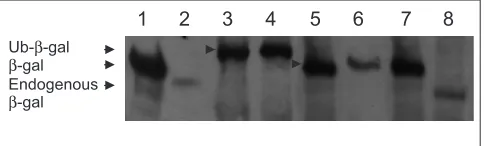
Assay for ubiquitin-specific protease activity
cleave Ub-M-E-gal (lane 4). The endogenous E. coli XL1-blue E-galactosidase (lacking the Dpeptide, and thus producing a shorter protein) was also detected (lanes 2 and 8).
Overexpression of USP25in Down syndrome patients
As USP25is located on chromosome 21, its overexpression could be presumed in Down syndrome (DS) patients. In order to assess the expression level of USP25in DS versus control samples, we analyzed eight independent fetal brain samples (four trisomic and four disomic) by real-time quan-titative PCR. An average of 1.7-fold overexpression of USP25
was shown in trisomic versus disomic samples.
Discussion
Database homology searches with the reported USP25[14] have led to the characterization of a new UBP member in the human genome, named USP28, which maps at 11q23. Structural comparisons at the genomic and protein levels of
USP25 and USP28, and the deubiquitinating enzymatic assays, allowed the definition of a new UBP subfamily.
Sequence alignments of UBPs have been hindered by the few shared conserved segments, which need specific computer programs to be identified. Nonetheless, several UBP sub-families have been reported so far. DUB1 and DUB2, with 88.4% amino acid identities, is one of those. Similarly, align-ments of UBP41, UBP46, UBP52 and UBP66 from chick skeletal muscle suggest a new subfamily. In our case, the alignment of the newly reported USP28 with USP25 showed homologies beyond the conserved UBP domains and amino acid identities amounting to 51%. In addition, the extensive alignment at the amino-terminal segment supports the pro-posed USP28 translation initiation site.USP25and USP28
share the exon-intron distribution and those intron posi-tions with an inaccurate match, located between exons 1-2, 13-14 and 17-18 (Figure 2), could be explained by slippage of the donor or acceptor splice sites. All these data strongly
comment
reviews
reports
deposited research
interactions
information
[image:5.609.57.555.113.491.2]refereed research
Table 1
Genomic organization of USP28
Exon Acceptor splice site Donor splice site Intron length (bp)
1 57 GCTCG/gtgggctccg >14,000
2 58-135 aaatatagag/AGCTA TGAAG/gttggtttcc 1,635
3 136-268 tctcccatag/GCCAG AGCAA/gtaggtacca 10,737
4 269-374 tatcttacag/AAGTT AACAG/gttattgatt 905
5 375-534 cacaatatag/GATGC TTCAG/gtatgatatt 6,262
6 535-621 tttatttcag/TCTCT ATACA/gtaagttggt 691
7 622-759 ttttctacag/GAAAA AGCAG/gtacaaaaga 1,426
8 760-833 tctcttatag/CAAGA GTTAA/gtgagtgttg 976
9 834-910 ctaaaagcag/CAGTC TGAAG/gtaaattctc 1,515
10 911-1,059 ctttgcctag/GAAAA AAGAG/gtacgttgga 1,836
11 1,060-1,187 ttgacactag/CGTTG GACAG/gtgagttctt 3,532
12 1,188-1,283 atttacttag/GTACA GAAAG/gtgagttttg 5,763
13 1,284-1,463 tgtcgcttag/GTATG GAAAG/gtaatgaaaa 2,282
14 1,464-1,672 tcagtacaag/TACAA ACAAG/gttggctctt 1,213
15 1,673-1,743 ttccaaacag/ATTTA GTCAG/gtagaatgaa 1,380
16 1,744-1,972 tgacttacag/GTGCC TGCAG/gtaaaagtat 3,021
17 1,973-2,164 ttttcctcag/AGGCA ACAAG/gtatctgaga 625
18 2,165-2,304 tctttatcag/AGCCT GTGAG/gtgagaatga 1,713
19 2,305-2,400 cttgtggtag/GTGAT TTAAG/gtatctctgt 1,443
20 2,401-2,579 cccttaatag/GCATT GAAAG/gtgagaagag 116
21 2,580-2658 tcccacacag/ATCAA ACAAG/gtaaagtgtt 795
22 2659-2,738 tctttttcag/AAGTG GGAAA/gtatgttggc 516
23 2,739-2,862 tttttctaag/GTACC TTCTG/gtttgtactg 1,479
24 2,863-3,058 ttatctgtag/GAGCT TGCAG/gtatatgctc 2,068
25 3,059 ccctccacag/AAAAT
Figure 2
Protein alignment of USP25 and USP28. Amino acid identities are boxed in black and conserved amino acid changes are boxed in gray. The exon-intron boundaries in each gene are marked by arrowheads.
c11 M TAELQQD D A A GA AD GHG S S CQM LL N Q L R E I T G IQDP S FLH EA L KAS N GDIT QA VS LL TD 60
USP25 M TVE.QNV L Q Q SA AQ KH. . . QQT FL N Q L R E I T G INDT Q ILQ QA L KDS N GNLE LA VA FL TA 56
c11 E R VKEPSQDT V A T E PSEVEGS . . . . A A N K E V L A KV I D L THDNK D D L QAA I A L S LLE S. . . 113
USP25 K N AKTPQQEE T T Y Y QTALPGN D R Y I S V G S Q A D T NV I D L TGDDK D D L QRA I A L S LAE SN R A 116
c11 . . . P KIQ ADG R DLNRMHE ATSA ETKR . SK RK R CE V WGEN PN PNDWRRVDG WP V G L K N V G N 169
USP25 F R E T GIT DEE Q AISRVLE ASIA ENKA C LK RT P TE V WRDS RN PYDRKRQDK AP V G L K N V G N 176
c11 T C W F S A V I Q S L FQLPE F R R L V LSYS LPQNV LEN CRS H TEKR NIMF MQE LQY L F A LM MGSN 229
USP25 T C W F S A V I Q S L FNLLE F R R L V LNYK PPSNA QDL PRN Q KEHR NLPF MRE LRY L F A LL VGTK 236
c11 R KFV D P SAAL D LL KGA FRSSEEQ Q Q D V S E F T H K L L D W L E D A F QLA V N V NSP R NKS EN P M V 289
USP25 R KYV D P SRAV E IL KDA FKSNDSQ Q Q D V S E F T H K L L D W L E D A F QMK A E E ETD E EKP KN P M V 296
c11 QL F Y GTF LT EG VRE G KPFCNNETF G Q Y P L Q V N GY RNLDE C L EGA MVE GD VELLPSDHSVK 349
USP25 EL F Y GRF LA VG VLE G KKFENTEMF G Q Y P L Q V N GF KDLHE C L EAA MIE GE IESLHSENSGK 356
c11 YG Q ERW F TKL P P V L T F E L S R F E F N QSL GQP E K I H N K L E F P QI IYMD R Y MYRSKELIRNK R 409
USP25 SG Q EHW F TEL P P V L T F E L S R F E F N QAL GRP E K I H N K L E F P QV LYLD R Y MHRNREITRIK R 416
c11 ECIR KL KEEIKIL Q QKL E R YVKY G S G PAR F P LPDMLKYVIE F A STK PA S E SCP .PE SDT H 468
USP25 EEIK RL KDYLTVL Q QRL E R YLSY G S G PKR F P LVDVLQYALE F A SSK PV . . .CT SPV DDI D 473
c11 MTLPLS.SVH C S V S D QTSK E . . S TSTES SSQ D V EST F S S P E DSLP K SK PLTSS RS S ME MP 525
USP25 ASSPPSGSIP S Q T L P STTE Q Q G A LSSEL PST S P SSV A A I S S RSV. I HK PFTQS RI P PD LP 532
c11 S QP A P RTVTDEEIN FVKTC LQR W RSE I EQDI QD LK T CIA S T T QT I EQM YCDP LLRQ V P Y R 585
USP25 M HP A P RHITEEKLS VLESC LHR W RTE I ENDT RD LQ E SIS R I H RT I ELM YSDK SMIQ V P Y R 592
c11 L H A V L V H E G Q A N A G H Y W A Y IYN Q PRQS.WLK Y N D ISV TES S W E EVER D SYG GLR NVS A Y C 644
USP25 L H A V L V H E G Q A N A G H Y W A Y IFD . HRESRWMK Y N D IAV TKS S W E ELVR D SFG GYR NAS A Y C 651
c11 L M Y I N D KL PYF N AEA A P TESDQ.MS EVEALS VELKHY IQE D NWR F EQEVE E WEE E Q S CKI 703
USP25 L M Y I N D KA QFL I QEE F N KETGQPLV GIETLP PDLRDF VEE D NQR F EKELE E WDA Q L A QKA 711
c11 PQM E S S T N . . . . SSS Q D YSTSQ. . .EPS V A S S H G VRC L SSEHA VIVK EQTAQAIA N T ARA 756
USP25 LQE K L L A S Q K L R ESE T S VTTAQA A GDPE Y L E Q P . SRS D FSKH. .L.K EETIQIIT K A SHE 767
c11 YEK S G VEA ALS EVML SPAM Q GVILA IAKARQ TFD RDGSE A GL IK AFHEE YSR LY QL AKET 816
USP25 HED K S PET VLQ SIMM TPNM Q GIIMA IGKSRS VYD RCGPE A GF FK AIKLE YAR LV KL AQED 827
c11 P T S HSDPR LQH VLV Y FFQ NEA P KR V VERT L L E Q FADKN L SYD E RS I SI M K V A Q A K LK EIG 876
USP25 T P P ETDYR LHH VVV Y FIQ NQA P KK I IEKT L L E Q FGDRN L SFD E RC H NI M K V A Q A K LE MIK 887
c11 PD D MNME E YK KW HED YS LF RK VS VY LLTG L ELYQKG KYQEALSYLVYA Y QSNA AL LMK GP 936
USP25 PE E VNLE E YE EW HQD YR KF RE TT MY LIIG L ENFQRE SYIDSLLFLICA Y QNNK EL LSK GL 947
c11 RR GV KESVIA LY R RKC L LEL NA KA ASL F ETNDDHSVT EGINVM N ELIIPCIHLI IN ND IS 996
USP25 YR GH DEELIS HY R REC L LKL NE QA AEL F ESGEDREVN NGLIIM N EFIVPFLPLL LV DE ME 1007
c11 K DDLDAIEVM R NHW C S Y L G QD IA E NL QL CLGEF L PRL L DPSAE II V LKE P PTIR P NSP YD 1056
USP25 E KDILAVEDM R NRW C S Y L G QE ME P HL QE KLTDF L PKL L DCSME IK S FHE P PKLP S YST HE 1067
c11 L CSR F AAVMESIQ G VST V T VK 1077
USP25 L CER F ARIMLSLS . RTP A D GR 1087
USP28 USP25
USP28 USP25
USP28 USP25
USP28 USP25
USP28 USP25
USP28 USP25
USP28 USP25
USP28 USP25
USP28 USP25 USP28 USP25
USP28 USP25
USP28 USP25
USP28 USP25
USP28 USP25
USP28 USP25
USP28 USP25
USP28 USP25
USP28 USP25
support a common ancestry for USP25 and USP28, and suggest that the minor variations observed may contribute to functional differences.
Northern analysis showed abundant USP28 expression in adult skeletal muscle and heart (Figure 3). The transcript size (4.5 kb approximately) was longer than expected from
cDNA analysis, although this variability could be due to dis-tinct polyadenylation and transcription initiation sites, as reported for USP25 and other UBPs [17].
The high specificity attributed to individual members of the ubiquitin proteolytic system and the structural complexity of
USP25 and USP28 prompted us to analyze the tissue-spe-cific mRNA isoforms and the cellular localization of the pro-teins. Alternative splicing had been also reported for other UBP members, such asUSP3[17], USP4(previously named
UnpEL-UnpES [13]), USP5 (previously named ISOT-1/2
[18-20]), USP9X(previously named DFFRX[15]) and USP15
[9]. Some cDNA clones of USP25 and USP28 contained additional exons that introduced in-frame stop codons, simi-larly to what has been reported for USP15andUSP3. These transcripts most probably originated from splicing errors and were fortuitously cloned, as they did not appear after northern or RT-PCR analyses. Besides, the absence of the conserved domains in the truncated proteins would compro-mise functionality. Nonetheless, the USP25RT-PCR assays in testis produced comparable amplification levels of sequences containing either exons 10-10b-11 (10b introduces an in-frame stop codon) or exons 10-11. This argues in favor of a tissue-specific function for the truncated protein, possi-bly related to substrate availability and/or enzyme activity.
Exon 19b is present in all USP28 transcripts in all the assayed tissues. In constrast, exon 19b from USP25 is present in all tissues but not in all transcripts, thus constitut-ing an alternatively spliced exon. The high degree of sequence homology of exon 19b from both genes supports its functional relevance. In addition, the tissue specificity shown for exon 19a of USP25(muscle and heart) and USP28
(muscle, heart and brain) could confer the enzyme a tissue specificity to deubiquitinate a ubiquitous substrate. This would apply to a widely expressed gene whose function was only relevant in some tissues, as suggested for Fam[20]. Alternatively, the tissue-specific exon would bestow on the enzyme the ability to recognize a tissue-specific substrate, as suggested for Faf [20].
The specific subcellular localization reported for some deubiq-uitinating enzymes may imply spatial restriction of either the locus of action or the accessibility to the substrate but it might also indicate regulation of cellular processes where ubiquityla-tion plays a role unrelated to protein degradaubiquityla-tion (for a recent review see [21]). In our case, preliminary subcellular localiza-tion experiments with protein fusions to GFP showed that USP25 was cytosolic (data not shown) and did not support an involvement outside the ubiquitin-proteasome pathway.
Although several deubiquitinating enzymes have been shown to contribute to development and differentiation (that is, Faf (Drosophila Fat facets) [15] and UBP43 [22]), the specific function of most family members remains unknown. Homology searches of the domains conserved
comment
reviews
reports
deposited research
interactions
information
[image:7.609.55.297.86.326.2]refereed research
Figure 3
Northern analysis of USP28in adult human tissues. Molecular weight marker sizes are indicated. Hybridization with an actin probe used as control is shown below.
Kidney
Muscle
Liver
Lung
Placenta
Brain
Pancreas
Heart
7.5 kb
4.4 kb
2.4 kb
1.35 kb
Table 2
Primers used in the splicing analysis of USP25and USP28
Primer Sequence 5c-3c Position in
name cDNA
(nucleotides)
261F GCCATGACCGTGGAGCAGAACG 367-388
261R CAGCACTAAACCAACAAGTATTGCCA 891-916 1.2F GAAGCCAGCATAGCAGAGAATAAAGC 769-794 1.2R CACAGGTGGTAATTCAGTAAACCAATG 1,450-1,476
321F GGGATGCACAACTTGCCCAG 2,478-2,496
321R CCCTGCTTCAGGGCCACACCTG 2,772-2,793
N1 AGGAGACCCAGAATAT 2,574-2,589
121R CAACCTTGCATATTCCAACT 2,810-2,829
*5A11.1 GCTGCTTTGGCATTCAGC 1,947-1,968
[image:7.609.53.295.536.729.2]between different UBPs would help to elucidate the function of new members and define the substrate-specific domains. The contribution of USP25to Down syndrome pathogenesis is still unclear. However, its overexpression (1.7-fold r0.13,
P< 0.05 according to the Mann-Whitney test) in Down syn-drome with respect to control fetal brain samples would support its involvement in the pathology. In fact, several UBPs have shown gene-dosage effects, such as USP9Y (whose gene is located in the Y-chromosome pseudoautoso-mal region and is involved in pseudoautoso-male azoospermia [23]) and other USPs related to aneuploidy syndromes: DFFRX in
Turner syndrome [15] and USP18 in DiGeorge syndrome [24]. On the other hand, in vitrooverexpression or inhibi-tion of some ubiquitin-specific proteases has led to pro-grammed cell death, supporting the idea that their activity is dose dependent [25].
Materials and methods
USP28cDNA cloning
[image:8.609.59.557.84.547.2]To screen cDNA libraries from human fetal brain, placenta and kidney (Clontech), specific primers of the USP-like region
Figure 4
Alternatively spliced exon analysis of USP25andUSP28. (a)The specific USP25 isoforms of testis (exons 10a-10b-11) and heart and muscle (18-19a-19b-20). (b)The specific USP28isoform of heart, muscle and brain (18-19a-19b-20).
9 10a 10b 11 17 18 19a 19b 20
9 10a 11
9 10a 10b 11 TAA
Stop codon
18
17 19a 20
17 18 20
Genomic DNA
All tissues tested (including testis)
Testis
All tissues tested (including heart and muscle)
Heart and skeletal muscle
17 18 19b 20 All tissues tested
(except heart and muscle)
19b
Heart, skeletal muscle and brain
17 18 20
All tissues tested 16 21 22 23 24
17 18 20 21 22 23 24
16 19a
17 18 19a 19b 20 21 22
19b
19b
23 24
Genomic DNA 16
(a)
Alternatively spliced exon analysis of
USP25
on chromosome 11 were designed (Figure 1) after comparison of USP25 cDNA against AC002036, a PAC that contained genomic DNA from chromosome 11. Approximately, 106 phages of each library were plated and transferred onto Nylon membranes (HybondN, Amersham-Pharmacia Biotech).
Probes were labeled by random hexamer priming with [D -32P]dCTP. A solution containing 50% (v/v) formamide, 5x
SSC, 5x Denhart’s, 0.1% (w/v) SDS and 100 Pg/ml denatured salmon sperm was used to pre-hybridize and hybridize the filters for 2 h and 18 h, respectively. Washes were performed as follows: two washes in 2x SSC/0.1%SDS at 65°C for 10 min and two times in 1x SSC/0.1%SDS at 65°C for 10 min. Filters were exposed during two days with double screen in order to amplify the positive signals. Positive clones were subcloned into pBLUESCRIPT SK+ (Stratagene), sequenced in an ABI377 automatic sequencer (Applied Biosystems) and ana-lyzed at the NCBI BLAST server [26]. As only truncated cDNA clones were initially isolated, additional screenings were needed to identify the full-length cDNA.
Northern blot analysis of USP28
The cDNA clone 5A11 (from nucleotides 1,473 to 3,618, Figure 1) was used to probe a human multiple tissue north-ern blot (Clontech). Hybridization and washes were carried out according to the manufacturer’s protocol. A control actin probe was used to assess the amount of RNA poly(A)+ loaded in each lane.
Specificity of alternative splicing events
A set of primers corresponding to exon sequences of USP25
and USP28(Table 2) (USP25 primers numbered according to [14]) were designed for RT-PCR experiments on 24
samples from different tissues (Multiple Tissue cDNA Panels, Clontech). Amplification was performed in a total volume of 25 Pl containing: 2.5 Pl of template cDNA, 200 PM dNTPs, 5 pmol of each primer, 1x Taq Platinum buffer, 1.5 mM MgCl2 and 1U Taq Platinum (GIBCO-BRL). After denaturing at 94°C for 3 min, two-step PCR was carried out for 35 cycles at 94°C for 30 sec and 58°C for 30 sec. Final extension was for 5 min at 72°C. Bands differing from the expected size were subcloned in pBLUESCRIPT SK+ (Strata-gene) and subsequently sequenced in an ABI377 automatic sequencer (Applied Biosystems). Sequences were analyzed using the BLAST software at the NCBI [26,27].
Assay for ubiquitin-specific protease activity
The ubiquitin-specific protease activity of USP25, USP25-specific heart and muscle isoform, which contains the addi-tional exon 19a (USP25 isoform), and USP28 was determined as described [10,11]. The three corresponding cDNAs were cloned in-frame in pGEX-4T-1 (Amersham Pharmacia Biotech) downstream from the glutathione-S-transferase (GST) coding region. Plasmid pACY184 Cmr expressing Ub-Met-E-gal protein fusion (pAC-M-E-gal) was kindly provided by M. Hoschtrasser. E. coli XL1blue bacteria were co-trans-formed with pAC-M-E-gal and either pGEX-4T-1-USP25 or pGEX-4T-1-USP25 isoform or pGEX-4T-1-USP28. Ampr and Cmrcolonies were grown and induced for 3 h with
isopropyl-E-thiogalactopyranoside (final concentration 1 mM). Total protein extracts were analyzed by western blotting with anti-E-galactosidase rabbit polyclonal antibody (Cappel).
Overexpression of USP25 in Down syndrome patients
Total RNA from 5 mg of fetal brains of Down and control samples (three samples each) were obtained using ABI PRISM 6700 Automated Nucleic Acid workstation. RT-PCRs were produced according to Taqman Reverse transcription reagents (Roche Molecular Systems). Quantitative PCRs were per-formed using the Universal Master Mix (Applied Biosystems) following the manufacturer’s specifications. The real-time amplification was analyzed by the ABI Prism 7700 Sequence detection system. USP25 primers and the Taqman probe (using FAM as reporter and TAMRA as quencher) were designed according to the Primer Express software. Forward primer: 5c-GATGAAAGGTGTCACAACATAATGAAA-3c; reverse primer: 5c-CCACTCCTCATATTCCTCCAAGTTT-3c; TaqMan probe: 5c -TCAAGCCAAACTGGAAATGATAAAACCT-GAAGA-3c. To normalize the USP25 quantitative determina-tions, GAPDH (Applied Biosystems) was used as endogenous control. The standard deviation of the disomic and trisomic samples was 0.08 and 0.13, respectively. The overexpression (1.7 fold) of USP25 in trisomic fetal brains shows statistical significance according to the Mann-Whitney test (P< 0.05).
Acknowledgements
We thank the Serveis Científico-Tècnics de la Universitat de Barcelona for the use of the 377 ABI PRISM and Robin Rycroft for revising the
comment
reviews
reports
deposited research
interactions
information
[image:9.609.55.297.88.161.2]refereed research
Figure 5
Deubiquitinating activity assay for USP25, the muscular USP25 isoform and USP28. The immunoblot was detected using anti-E-galactosidase (E-gal) antibodies. The sizes corresponding to Ub-E-gal, E-gal and endogenous deleted E-gal are shown by black arrows. Arrowheads on the lanes show the size of the Ub-E-gal fusion protein and the deubiquitinated E-gal. Lane 1, molecular weight marker containing wild-type E-gal; lane 2, untransformed XL1blue (negative control); lanes 3 and 4, XL1blue cells transformed, respectively, with pAC-M-E-gal alone or pAC-M-E-gal and empty pGEX vector; lanes 5, 6 and 7, XL1blue cells transformed, respectively, with pAC-M-E-gal and USP25, pAC-M-E-gal and muscular USP25 isoform, and pAC-M-E-gal and USP28; lane 8, XL1blue cells transformed with the empty pGEX vector.
1
2
3
4
5
6
7
8
English version. We are very grateful to M. Hochstrasser for the gift of the pAC-M-E-gal plasmid. This study was funded by Fundació Síndrome de Down/Marató de TV3-1993, European Union Grant BIO4-CT97-2123 and Ministerio de Ciencia y Tecnología PM99-0168 to R.G-D.
References
1. Hershko A, Ciechanover A: The ubiquitin system for protein degradation.Annu Rev Biochem1992, 61:761-807.
2. Hochstrasser M: Ubiquitin-dependent protein degradation. Annu Rev Genet1996, 30:405-439.
3. D’Andrea A, Pellman D: Deubiquitinating enzymes: A new class of biological regulators. Crit Rev Biochem Mol Biol 1998, 33:337-352.
4. Hochstrasser M: Ubiquitin, proteasomes, and the regulation of intracellular protein degradation. Curr Opin Cell Biol1995, 7:215-223.
5. Chung CH, Baek SH: Deubiquitinating enzymes: their diversity and emerging roles. Biochem Biophys Res Commun1999, 266: 633-640.
6. Leroy E, Boyer R, Auburger G, Leube B, Ulm G, Mezey E, Harta G, Brownstein MJ, Jonnalagada S, Chernova T, et al.: The ubiquitin pathway in Parkinson’s disease. Nature1998, 395:451-452. 7. Baker RT, Tobias JW, Varshavsky A: Ubiquitin-specific proteases
of Saccharomyces cerevisiae. Cloning of UBP2 and UBP3, and functional analysis of the UBP family. J Biol Chem 1992, 267:23364-23375.
8. Wilkinson KD: Regulation of ubiquitin-dependent processes by deubiquitinating enzymes.FASEB J1997,11:1245-1256. 9. Baker RT, Wang XW, Woollatt E, White JA, Sutherland GR:
Identi-fication, functional characterization, and chromosomal localization of USP15, a novel human ubiquitin specific pro-tease related to UNP oncoprotein, and a systematic nomenclature for human ubiquitin-specific proteases. Genomics1999, 59:264-274.
10. Papa FR, Hochstrasser M: The yeast DOA4 gene encodes a deubiquitinating enzyme related to a product of the human tre-2 oncogene.Nature1993, 366:313-319.
11. Zhu Y, Lambert K, Corless C, Copeland NG, Gilbert DJ, Jenkins NA, D’Andrea A: DUB-2 is a member of a novel family of cytokine-inducible deubiquitinating enzymes. J Biol Chem 1997,272:51-57.
12. Baek SH, Park KC, Lee JI, Kim KI, Yoo YJ, Tanaka K, Baker RT, Chung CH:A novel family of ubiquitin-specific proteases in chick skeletal muscle with distinct N- and C- terminal extensions.Biochem J1998, 334:677-684.
13. Frederick A, Rolfe M, Chiu MI: The human UNP locus at 3p21.31 encodes two tissue-selective, cytoplasmic isoforms with deubiquitinating activity that have reduced expression in small cell lung carcinoma cell lines.Oncogene1998, 16: 153-165.
14. Valero R, Marfany G, Gonzalez-Angulo O, Gonzalez-Gonzalez G, Puelles L, Gonzalez-Duarte R: USP25, a novel gene encoding a deubiquitinating enzyme is located in the gene-poor region 21q11.2.Genomics1999, 62:395-405.
15. Jones MH, Furlong RA, Burkin H, Chalmers IJ, Brown GM, Khwaja O, Affara N: The Drosophiladevelopmental gene fat facets has a human homologue in Xp11.4 which escapes X-inacti-vation and has related sequences on Yq11.2 A.Hum Mol Genet 1996, 5:1695-1701.
16. Lennon G, Auffray C, Polymeropoulos M, Soares MB:The IMAGE consortium: an integrated molecular analysis of genomes and their expression.Genomics1996, 33:151-152.
17. Sloper MK, Eyre HJ, Wang XW, Sutherland GR, Baker RT: Charac-terization and chromosomal localization of USP3, a novel human ubiquitin-specific protease. J Biol Chem 1999, 274:26878-26884.
18. Falquet L, Paquet N, Frutiger S, Hughes GJ, Hoang-Van K, Jaton JC: A human de-ubiquitinating enzyme with both isopeptidase and peptidase activities in vitro.FEBS Lett1995, 359:73-77. 19. Wilkinson KD: Roles of ubiquitinylation in proteolysis and
cel-lular regulation.Annu Rev Nutr1995, 15:161-189.
20. Chen X, Overstreet E, Wood SA, Fischer JA: On the conserva-tion of funcconserva-tion of the Drosophila Fat facets
deubiquitinat-ing enzyme and Fam, its mouse homolog.Dev Genes Evol2000, 210:603-610.
21. Weissman AM: Themes and variations on ubiquitylation. Nature Rev Mol Cell Biol2001, 2:169-178.
22. Liu LQ, Ilaria R, Jr, Kingsley PD, Iwama A, van Etten RA, Palis J, Zhang, DE: A novel ubiquitin-specific protease, UBP43, cloned from leukemia fusion protein AML1-ETO-expressing mice, functions in hematopoietic cell differentiation.Mol Cell Biol1999, 19:3029-3038.
23. Sun C, Skaletsky H, Birren B, Devon K, Tang Z, Silber S, Oates R, Page DC: An azoospermic man with a de novo point muta-tion in the Y-chromosomal gene USP9Y. Nat Genet 1999, 23:429-432.
24. Schwer H, Liu LQ, Zhou LM, Little MT, Pan Z, Hetherington CJ, Zhang DE: Cloning and characterization of a novel human ubiquitin-specific protease, a homologue of murine UBP43 (USP18).Genomics 2000, 65:44-52.
25. Monney L, Otter I, Olivier R, Ozer HL, Haas AL, Omura S, Borner C: Defects in the ubiquitin pathway induce caspase-indepen-dent apoptosis blocked by Bcl-2. J Biol Chem1998, 273: 6121-6131.
26. NCBI BLAST server[http://www.ncbi.nlm.nih.gov/BLAST/] 27. Altschul SF, Madden TL, Schaffer AA, Zhang J, Zhang Z, Miller W,