6
I
January 2018
Efficient Fault-Tolerant Protocol for Cognitive
Radio Sensor Network using Ant Colony
Optimization
Amit N. Thakare1, Dr. L. G. Malik2, Mrs. Achamma Thomas3
1
Research Scholar, 2Former Professor, 3HOD, Department of Computer Science and Engineering, G. H. Raisoni College of Engineering, Nagpur, 440016,India
Abstract: Wireless sensor network is used as wide area for communication technologies, Due to increasing the number of applications over the telecommunication network there is need of development of next generation wireless sensor network, which is used by the application. There is need to divert towards the next generation communication network. All the users are depends on cognitive technology because of self-organization technology as an autonomous system. The each node is capable and behaves like cognitive users. As the space is available the users can occupy the space and used it as autonomy and transfer the data from one user to other user. Each node senses it and own and others condition of states such as ideal state, busy state, sleep state and works accordingly. The arrival rate and departure rate of each user results into the congestion in the network and due to that the delay is possible, thus traffic is burst. Due to the heavy load in the network the faults occurs and packets may drop. The rate of packet dropping is more due to heavy load. All the sensor nodes deployed in the region of any applications are gather data and send the data to their respective neighboring nodes and send it to the base station. Here the single-sink multiple channels and multiple sink multiple channels are considered to analyzed the network performance. We try to develop the efficient fault-tolerant protocol for cognitive radio sensor networks motivated from the ant colony optimization.
Keywords:Wireless Sensor Networks, Cognitive radio sensor networks, Routing, Ant Colony Optimization, fault-tolerant.
I. INTRODUCTION
load on the same route and while increasing the node density due to the today’s need of increasing the number of users in the networks for their respective applications, the routing protocols are designed for the scalability issues. The care should be taken as the every node used their power for sensing and data transmission and some of the nodes are exhaust due to their major utilization. We should keep them in balance condition so that the all nodes consumes less energy for above utilization to sustain for longer duration of time, that is their network lifetime will increase. Here we try to design the fault-tolerant protocol.
The rest of the papers are organized as follows, section II describes the literature survey, section III shows the designed issues, section IV described about the designed protocols, section V shows the results, whereas, it concluded by the section VI.
II. LITERATUREREVIEW
In wireless sensor networks the multiple nodes are connected with each other for communications with respective neighbor connectivity, sensing and data transmission with energy consumption without any contention and collision are called reliable links between the nodes. But the due to transmission power and variability of contentions causes the damage of links or prone to failure of nodes causes the faults in the network. For avoiding of such faults, we need to design the fault –tolerant routing protocols in wireless sensor networks. Based on these issues many researchers are designed the routing protocols for solving the issues of number of faults occurs in the sensor networks as described below.
Bhaskar Krishnamachari et al. [20] proposed the distributed solution for wireless sensor networks. The sensor measurement specially a faults and utilized the distributed Bayesian algorithm for detection for the faults and correcting that faults. They find that how the faults are tolerable with respect to the some percentage of faulty sensor nodes. The proposed model is in the form of Bayesian fault-recognition algorithms. Haiyang Liu et al. [21] proposed the multi-source, multi-layer routing protocol for wireless sensor networks. The framework are designed in such way that the distributed and scalable algorithm and also used the probabilistic approach. The network lifetime issues are discussed and solve it by two of the algorithm. Muhammad Saleem et al., [12] the survey of swarm Intelligence based routing protocol for wireless sensor networks. It provides an extensive survey of biologically based protocols. Hai Liu et al. [21] proposed the fault-tolerance algorithms and protocols for wireless sensor networks. The nodes in WSN are prone to failure due to energy depletion. The issues are categories in different applications are discussed the node placement, topology control, data gathering and aggregation, and sensor surveillance target and event detection. Xiaoxiong Zhong et al. [22] consider the capacity analysis of multi-radio multi-channel cognitive radio sensor networks, Here the author try to put the limitation about capacity for accessing the multiple channels in dynamic spectrum access environment. The author try to propose the small world model for secondary users, how the secondary users occupied when the primary users are in halt condition. Al-Karaki et al. [23] the author proposed the survey on routing protocol in wireless sensor networks. The author describe about the three different categories of topology such as hierarchical routing protocols, flat routing protocols, location based routing protocols for wireless sensor networks. Abbasi and Younis et al. [19] proposed the classification of clustering protocols of wireless sensor networks. The author presented and highlights the different issues based on the some objectives, features and complexity. Biradar et al. [24] proposed and design the issues of wireless sensor networks and presented the classification and comparison of routing protocols of the said network. The design issues such as fault-tolerance, scalability, production cost, operating environment are considered for their research work. Akkaya and Younis et al. [19] done the surveyed on some routing protocols for WSN. The author described about the classification for various protocols with the three main categories such as data-metric, hierarchical and location-based routing protocols. In addition they discussed about the protocols using contemporary methodologies such as network flow and QoS services. Zungeru et al. [18] proposed the survey and comparison of classical routing and swarm-intelligence-based routing protocol for WSNs. The author surveys the state-of-the-art in routing in wireless sensor networks. The routing is categorized according to computational complexity, network structure, path establishment and energy efficient. The author presented the comparison of classical and swarm intelligence based routing protocols for wireless sensor networks.
III.DESIGNISSUESOFROUTINGPROTOCOLS
Wireless sensor network has different challenges and issues to overcome the constraints of WSN’s and solve the design application issues. The challenges and design issues in WSN are limited energy consumptions, fault tolerance, scalability, productive cost, data aggregation, load balancing, congestion, security, and self-organization.
Fault-tolerance: CR-WSNs should have self-forming, self-configuration and self-healing properties. In other words, whenever some nodes or links fail, an alternative path that avoids the faulty node or link must be derived. In CR-WSNs, faults can occur for a variety of reasons, such as hardware or software malfunctioning, or natural calamities, e.g., fire, floods, earthquakes, volcanic eruptions, or tsunamis etc. A CR-WSN should always be prepared to deal with such situations. The fault tolerance or reliability of a wireless sensor node using the Poisson distribution within the time interval (0,t) occurs.
Scalability: Sensor node deployment in WSNs is application dependent and affects the performance of the routing protocol. A large number of nodes is deployed in the region having short communication range and high failure rates. The routing protocols have effectively acceptable for those challenges.
IV.PROPOSEDROUTINGPROTOCOL
The main objective of the proposed routing protocols to solve the issue of fault occurs in the wireless sensor networks. We try to develop the fault-tolerant routing protocols for cognitive radio wireless sensor networks. The consideration of cognitive capabilities in the wireless sensor networks and finding the shortest route from source to destination without any obstacle just like ant colony optimization. The ant finds the food source from its nest. They start randomly and follow the pheromone trails of master ants who find the complete paths, and other ants follow the same. In single-sink channels are used as well as multi-sink multiple-channels.
Pseudo code for routing in WSNLet consider the CRSN sensor node i and j as edge (i, j) ant start searching food from the best path. Cluster Head Selection Algorithm
Algorithm 1:Neighbor Discovery with multipath construction I/p: n number of nodes is deployed in region randomly. O/p: Optimum path selection with multi-hops construction Sink nodes advertise the hello message periodically For each path (i, j) do
Perform the spectrum sensing; End for
finding the number of hops to its neighbor node (Nd, ID, List of Nd); Compute the probability of choosing multi-hop{ 0,1}
Probability of choosing path {0,1} through channel; Like ants choose the path randomly
either channel is busy or idle; If [channel is busy (ON)] Primary user (active) is used; else if [channel is Idle(OFF)] Secondary user (active) is used;
Ants used available space (shortest route)
Depends on channel sensing neighbor discovery works,
For selection of channel the next hop neighbor node with handoff for PU to SU (Channel list, radio frequency, transmission range)
Ants find the optimum neighbor with avoiding obstacles. End for
End if End
Let consider the CRSN sensor node i and j as edge (i, j) ant starts searching food from best path. Cluster Head Selection Algorithm
Algorithm 2: Setup Phase for each path (i , j) do perform spectrum sensing; end for
Compute probability for choosing multi- path;
if [node j nearest neighbor to node I, ant k1 & k2 checks both path & take decision ] chose path, then Calculate length ;
Compute as shortest path and form a cluster (all nearer nodes); else longest path
ant k computes best path (i , j) by dropping pheromone trail; end
pheromone value = 1;
if node with greater pheromone value then others then ant k select path(i ,j) in multi-hop fashion;
else if node which have deeper pheromone value choose as CH then Advertise as cluster head (CH);
End
Transfer data from CH to Master CH (as sink node); for each path (i, j) do
If one sink exhaust (because of energy level) the other channel and sink node chose End
Algorithm 3 Multi –Hop routing algorithm for each edge do
Set initial pheromone value 1; end for
for each CH do compute the visibility end for
While not stop do for each ant k do Select CH; for i=1 to n do
Compute probability Pij and select next CH j with; Probability pij;
end for end for
for each path do
Update the pheromone value; end for
end while
select shortest path ij &
Choose the CH as a leader for each CH to base station do sends packet under leader control;
end for
Algorithm 4: Communication inside cluster for each cluster do
All nodes sends data to CH
CH check the availability of network If (Network is busy) then
Perform spectrum sensing;
If a spectrum band is available then Utilize primary network;
Transfer the data through primary networks (PUs);
if CH is elected in transferring data then send the data with max packet size; else
send the data with restricted packet size; end
else
utilize secondary network(SUs); Here access SU over CSMA protocol; end
else
Utilize the secondary network; end
end
The initial assumption in the proposed protocol is considered in the following form. All sensor nodes and sink node (Base Station) are stationary after deployment. The sensor nodes are uniformly distributed with random deployment.
The sensor nodes with heterogeneous configuration. All nodes have limited energy.
Cross layer MAC layer and Network layer jointly work with TCP transport protocol.
In proposing work we consider two methods for our demonstration of the adaptive routing protocol for solving the fault-tolerance issues in communication.
Single sink and multiple channels. Multiple sink and multiple channels.
Now consider multiple sinks, multiple channels and demonstrate and find out performance. Here while finding the shortest path among routing in communication the wireless sensor network having the capabilities of cognitive radio spectrum utilization. Here the spectrum senses the available spectrum band search for a certain duration of time for neighboring node and jumps on the vacant band, identify the primarily used band if free serve the channel and if busy, it went back for spectrum sensing. The served channel take a decision and senses the carrier which sends the data to the cognitive sensor node, a user (CR) as forwarding ANT send the information to next coming ants through pheromone trails either send back to carrier sensing for the other vacant band.
To evaluate the performance of the proposed scheme against the recent routing schemes, we considered the three different parameters such as packet delivery fraction, end to end delay and throughput. We evaluated the CRSNs as next generation WSNs. The simulation was done by extending in the open source software NS2 version NS-2.34 with multi-sink & multi-channel extensions to enable dynamic spectrum access and cognitive radio sensor networks. The CRSN network consists of 25 nodes, which are arranged in a grid topology of 1,000m x 1,000m. The licensed arrival and departure time are considered with packet size variation of 100,200,300,400,500 with a queue size of 50. It is assumed that the network utilizes an unlicensed channel which is shared with other legacy networks. This condition causes network interference, which is represented by the parameter (i.e., PU channel). Here we consider the 11 channels for our experimentation in CRSN network. We compare the performance [AODV-Cogns], [DSR-[AODV-Cogns], AntHocNet. In this simulation, we used Mac/Cogmac standard as the MAC layer protocol. Here we consider the following parameters.
A. Network Model
Here we consider the set of senor node n and a sink node in the network. Each node consists of it location information as (xi and yi). The sensor nodes are in sleep mode which is used to save the energy. Sensor nodes are communicated with each other with cognitive medium access control protocol. Similar to sensor node the sink nodes contain the computation power, and memory. Similar to sensor nodes the sink node also contains the id and location. When the communication starts it connect the sensor node and sink node. The threshold energy is minimum residual energy and rest of things is only for sensing and relaying the data.
V. SIMULATIONRESULTS
We apply the novel technique on two protocols AODV and DSR with MAC layer protocol as Cognitive radio sensor network. We analyze on two techniques.
A. Packet Variation B. Pause Time variation
C. Variation on Packet arrival and departure (α, β) respectively.
The packet variation in the novel protocol when applying with the fixed number of nodes deployed in the specific region is given below.
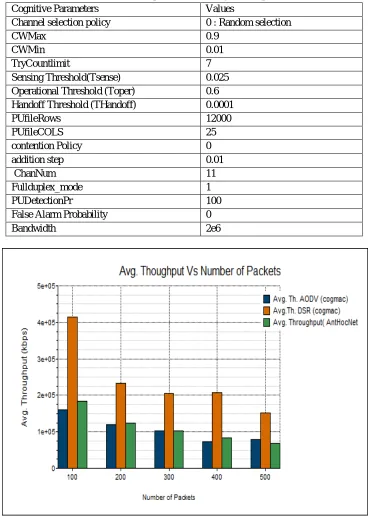
1) Throughput: The parameter evaluation in wireless sensor networks with the considering the above mentioned parameters in NS2 was evaluated. Depends on analysis of throughput with respect to packet size shown in the screenshot above. In the simulation throughput of the network is decreased with respect to
increasing the number of packet size.
2) Average End-to-End Delay: The same as throughput the average end to end delay for the 25 number of nodes with respect to packet size with some statistical values mention in each graphical representation. Here the average end to end delay is less at starting state and increasing as packet size increased.
[image:7.612.140.474.313.731.2]3) Packet Delivery factorial: The PDF is another parameter in the sensor networks also depends on the total number of sending and receiving packets from any source to destination with respect to time. Here initially it is less as the packets size increases, it also increases.
Table I: Performance parameters
Simulation Parameters Values
Channel Type Channel/Wireless Channel
Radio-propagation model Propagation/Two Ray Ground
Network Interface Type Phy/WirelessPhy
MAC type MAC/cogmac/802_11
Interface queue Type Queue/DropTail/PriQueue
Antenna Model Antenna/OmniAntenna
Max packet in ifq 50
Number of Mobile nodes 25
Routing Protocol AODV/DSR /AntHocNet
Topography 1000mx1000m
Energy Model(Initial) 100 Joule
Data transmission rate 2 sec
Radio transmission range 200
Pause time 0,30,60,90,120,150 sec.
Packet Size 100,200,300,400,500 bytes
Constant Bit Rate (CBR) 256 kb
Channel Number Type/radio 11
Tx power 31.32e-3 mW
Rx power 35.28e-3 mW
Idle Power 712e-6
Table II: Simulation parameters for cognitive capabilities Cognitive Parameters Values
Channel selection policy 0 : Random selection
CWMax 0.9
CWMin 0.01
TryCountlimit 7
Sensing Threshold(Tsense) 0.025 Operational Threshold (Toper) 0.6 Handoff Threshold (THandoff) 0.0001
PUfileRows 12000
PUfileCOLS 25
contention Policy 0
addition step 0.01
ChanNum 11
Fullduplex_mode 1
PUDetectionPr 100
False Alarm Probability 0
Bandwidth 2e6
Figure 1: Average throughput Vs Number of Packets
Figure 2: Packet delivery fraction Vs Number of Packets
The above figure 2 shows the packet delivery fraction by varying the number of packets from 100-500 bytes. Here we observed that at initial stage the PDF is highest in AntHocNet (cogmac) when the packets are less, though it is the characteristics of Ants. As soon as the packets are increased at 300 packets sudden down of PDF by AntHocNet (cogmac) and gradually the DSR (cogmac) shows outstanding packet delivery fraction. It proves that even though the load is more, the DSR (cogmac) is capable because of its self-organizing characteristics. Even the single sink is used via multiple channels still the network is sustaining more or less.
[image:9.612.130.487.444.712.2]The above figure 3 shows that the as number of packets are increases the averagely the end-to-end delay of DSR (cogmac) is very less and the AntHocNet (cogmac) and AODV (cogmac) is high as compare to the DSR (cogmac). Thus the AODV (cogmac) and AntHocNet (cogmac) shows high delay because of processing, queuing, and transmission delay. As compare to other two protocols the DSR (cogmac) shows very less end-to-end delay averagely upto 32 ms.
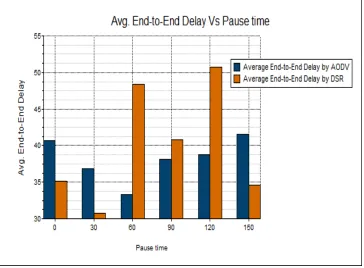
Figure 4: Avg. End-to-End delay Vs Pause time
The above figure 4 shows that only the AODV (cogmac) and DSR (cogmac) are compared because the pause time doesn’t effect anthocnet. Here the averagely the AODV (cogmac) has less delay than the DSR (cogmac), but when the pause time is less the end-to-end delay of DSR (cogmac) is less. The delay is because of processing, queuing the packets.
Figure 5: Packet Delivery Fraction Vs Pause time
[image:10.612.132.485.468.653.2]VI.CONCLUSIONS
The proposed bio-inspired cognitive capable routing algorithm with AODV, DSR and AntHocNet routing protocol is analyzed. It is observed that the proposed method of multi-sinks, multi-channel routing techniques are implemented on AODV and DSR, the findings and observations from above graphs are that the proposed bio-inspired DSR (cogmac) gives overall accuracy and reliability with highest throughput and high packet delivery fraction and less end to end delay as compare to AODV (cogmac) and AntHocNet with maintaining the energy level. Thus for next generation routing protocol for wireless sensor network which are prone to failure of nodes even though the energy of individual nodes exhaust, find out the alternate solution for the same with using available spectrum bands as secondary users. In future work we have to solve the scalability issues.
VII. ACKNOWLEDGMENT
I would like to acknowledge to my guide Dr. Latesh G. Malik, and research center G. H. Raisoni College of Engineering, Nagpur & all the researchers who indirectly contribute a lot for my research work.
REFERENCES
[1] I.F. Akylidiz, Su W.Sankarasubramaniam Y. Cayirci E., Wireless Sensor Networks: A Survey”, Computer Networks,38(4): 393-422, 2002. [2] I.F. Akylidiz, et al, (2009), “CRAHNs: Cognitive Radio Ad Hoc Networks” Ad Hoc Network, Elsevier, Vol.7, No. 5, pp.810-836, 2009.
[3] Muhammad Saleem, Gianni A. Di Caro, Muddassar Farooq, The survey of Swarm Intelligence based routing protocol for wireless sensor networks, International Journal of Elsevier on Information Science, 2010.
[4] Caro G. D. and Dorigo M. (1998), “Ant Colonies for adaptive routing in packet-switched communication networks”, LNCS, Vol. 1408.
[5] Caro G. Di, Ducatelle F., and M Gambardella L. (2005). “AntHocNet: An adaptive nature-inspired algorithm for routing in mobile ad hoc networks”, European Transactions on Telecommunications, 16(5):443–455.
[6] Di Caro G.A., Dorigo M. (1998), “Ant Colonies for Adaptive Routing in Packet-Switched Communications Networks”, Proceedings of PPSN V – FifthInternational Conference on Parallel Problem Solving from Nature.
[7] Idris H, Ezugwu AE, Junaidu SB, Adewumi AO. (2017), “An improved ant colony optimization algorithm with fault tolerance for job scheduling in grid computing systems”, Deng Y, ed. PLoS ONE.;12 (5):e0177567. doi:10.1371/journal.pone.0177567.
[8] G. P. Joshi et al., “Cognitive radio wireless sensor networks: applications, challenges and research trends,” Sensors, vol. 13, no. 9, pp. 11196–11228, 2013. [9] B. Chandrashekaran, “Survey of Network Traffic Models” http://www.cse.wustl.edu/jain/cse56706/ftp/trafficmodels3.pdf/
[10] Le The Dung, et al., “Simulation modeling and analysis of one hop count distribution in cognitive radio ad-hoc networks with shadow fading”, Elsevier, simulation, Modeling, practice and theory, 69 (2016), 43-54.
[11]I. F. Akyildiz, W.-Y. Lee, M. C. Vuran, and S. Mohanty, “Next generation/dynamic spectrum access/cognitive radio wireless networks: A survey,” Computer Networks, vol.50, no. 13, pp. 2127-2159, Sep. 2006.
[12]Muhammad Saleem, Gianni A. Di Caro, Muddassar Farooq, The survey of Swarm Intelligence based routing protocol for wireless sensor networks, International Journal of Elsevier on Information Science, 2010.
[13]H. Liu, A.Nayak, et al, “Fault-tolerance algorithm/protocols in wireless sensor networks,” in Guide to wireless sensor Networks, S.Misra, Eds. New York: Springer-verlag, 2009, pp. 261-292
[14]Cao L, Xu C, Shao W, et al., Distributed Power Allocation for Sink-Centric Clusters in Multiple Sink Wireless Sensor Networks. Sensors (Basel, Switzerland). 2010, 10(3): 2003-2026.doi:10.339./s 100302003.
[15]Athar Ali Khan, et al., “Cognitive –Radio-based Internet of Things: Applications, Architecture, Spectrum relate Functionalities and future research directions”, [16]I. F. Akyilidiz et al., “NeXt generation /dynamic spectrum access/cognitive radio wireless networks: A survey,” Computer Network Journal (Elsevier), Sept.
2006.
[17]Awad, S.A.B. et al. (2010) ‘Cluster based routing protocol for mobile nodes in wireless sensor network’, 23 May, Wireless Press Commun., Vol. 61, No. 2, pp.251–281.
[18]Zungru A. M., Ang. M., L., & Seng P., K., (2012), “Classical and swarm intelligence based routing protocols for wireless sensor networks: A survey and comparison”, Journal of Network and Computer Applications, Elsevier, 35(2012) 1508-1536.
[19]bbasi A., Younis M. (2007), A survey on clustering algorithms for wireless sensor networks, Journal of Computer Communications, Special Issues on Network Coverage and Routing Schemes for Wireless Sensor Networks, 2826-2841.
[20]Krishnamachari B. and Iyengar S. (2004), “Distributed Bayesian Algorithms for Fault-Tolerant Event Region Detection in Wireless Sensor Networks”, IEEE Trans. Comput., Vol. 53, No. 3, pp. 241- 250.
[21]Liu H., Nayak A., (2009), “Fault-tolerance algorithm/protocols in wireless sensor networks,” in Guide to wireless sensor Networks, S. Misra, Eds. New York: Springer-verlag, pp. 261-292.
[22]Zhong X., Qin. Y., Li L., (2014), “Capacity Analysis in multi-radio, multi-channel cognitive radio networks: A small world perspective”, Wireless Personal Communication, Springer.
[23]Amsterdam, Holland, (1998), Springer-Verlag, Lecture Notes in Computer Science, Vol. 1498 (also Technical Report IRIDIA 97-18.1).