Openstack: Open-Source Solution for Cloud
Computing
Priyanka Makkar1
1Amity University Haryana
Abstract-Cloud computing is a quite new concept for which the resources are virtualized, dynamically extended provided as a service on the Internet. In this paper, comparative study of OpenStack services has been done. The aim is to provide the computer industry with the opportunity to build a hosting architecture, massively scalable which is completely open source, while overcoming the constraints and the use of proprietary technologies.
Keywords: Opencloud, IaaS, PaaS, SaaS , OpenStack, Virtualization
I. INTRODUCTION
OpenStack is a set of software tools for building and managing cloud computing platforms for public and private clouds. Some of the biggest companies in software development and hosting, as well as thousands of individual community members, many think that OpenStack is the future of cloud computing. OpenStack is managed by the OpenStack Foundation, a non-profit that oversees both development and community-building around the project. And most importantly, OpenStack is open source software, which means that anyone who chooses to can access the source code, make any changes or modifications they need, and freely share these changes back out to the community at large. It also means that OpenStack has the benefit of thousands of developers all over the world working in tandem to develop the strongest, most robust, and most secure product that they can.
II. OPENSTACK SERVICES
Table 1 OpenStack services
Service Project
name
Description
Dashboard Horizon Provides a web-based self-service portal to interact with underlying OpenStack
services, such as launching an instance, assigning IP addresses and configuring access controls.
Compute Nova Manages the lifecycle of compute instances in an OpenStack environment.
Responsibilities include spawning, scheduling and decommissioning of machines on demand.
Networking Neutron Enables network connectivity as a service for other OpenStack services, such as OpenStack Compute. Provides an API for users to define networks and the attachments into them. Has a pluggable architecture that supports many popular networking vendors and technologies.
Storage
Object Swift Stores and retrieves arbitrary unstructured data objects via a RESTful, HTTP
based API. It is highly fault tolerant with its data replication and scale out architecture. Its implementation is not like a file server with mountable directories.
Block Cinder Provides persistent block storage to running instances. Its pluggable driver
Identity Service
KeyStone Provides an authentication and authorization service for other OpenStack
services. Provides a catalog of endpoints for all OpenStack services.
Image Service
Glance Stores and retrieves virtual machine disk images. OpenStack Compute makes use
of this during instance provisioning.
Telemetry Service
Ceilometer Monitors and meters the OpenStack cloud for billing, benchmarking, scalability, and statistical purposes.
Higher-level services Orchestratio
n Service
Heat Orchestrates multiple composite cloud applications by using either the native HOT template format or the AWS CloudFormation template format, through both an OpenStack-native REST API and a CloudFormation-compatible Query API
III. CLOUD COMPUTING
According to National Institute of Standards and Technology (USA) [4] Cloud computing is a model for enabling ubiquitous, convenient, on-demand network access to a shared pool of configurable computing resources (e.g., networks, servers, storage, applications, and services) that can be rapidly provisioned and released with minimal management effort or service provider interaction.
[image:3.612.173.438.373.600.2]This cloud model is composed of five essential characteristics, three service models, and four deployment models.
Fig. 1 Attributes of Cloud
IV. MODELS OF CLOUD COMPUTING
A. Infrastructure as a Service (IaaS)
where the equipment is provided in the form of virtual machines. The client maintains the applications, runtimes, integration SOA (Service Oriented Architecture), databases, server software while the supplier maintains the Cloud virtualization, hardware server, storage, networks. Among the main actors of IaaS we find Amazon EC2, Rackspace, GoGrid. [1]
Amazon Elastic Cloud Compute (Amazon EC2), Amazon Simple Storage Service (Amazon S3), Rackspace Cloud Servers, GoGrid, Joyent, and AppNexus.
[image:4.612.176.437.168.329.2]Amazon EC2 example:
Fig. 3 Amazon EC2 IaaS example
B. Platform as a Service (PaaS)
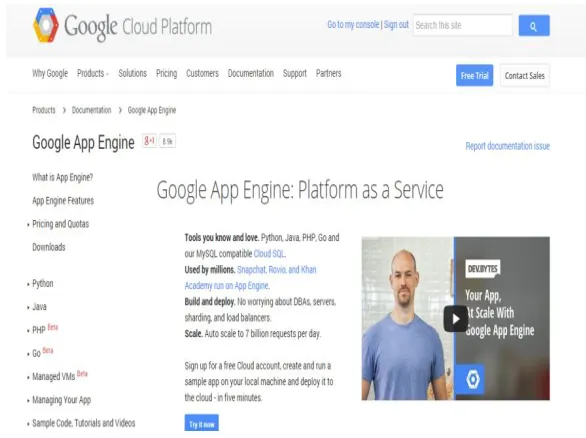
you can develop your own applications using the services provided. The client maintains only those applications while the supplier maintains the runtimes Cloud, SOA integration, databases, server software, virtualization, server hardware and the storage networks. We have among the key players: Google Apps Engine, Windows Azure. [1]
Google App Engine offers users the ability to build and host web applications on Google's infrastructure
Fig. 4 PaaS Example: Google App Engine
C. Software as a Service (SaaS),
the entire applications are available remotely. Among the providers we have GoogleApps, salesforce, facebook.[1]
[image:4.612.156.449.429.648.2]services via any internet enabled device. Enterprise users are able to use applications for a range of needs.
Fig. 5 SaaS Examples
V. OPENSTACK IN CLOUD ENVIRONMENT
The cloud is all about providing computing for end users in a remote environment, where the actual software runs as a service on reliable and scalable servers rather than on each end-user's computer. Cloud computing can refer to a lot of different things, but typically the industry talks about running different items "as a service"—software, platforms, and infrastructure. OpenStack falls into the latter category and is considered Infrastructure as a Service (IaaS). Providing infrastructure means that OpenStack makes it easy for users to quickly add new instance, upon which other cloud components can run. Typically, the infrastructure then runs a "platform" upon which a developer can create software applications that are delivered to the end users.
VI. CONCLUSION
OpenStack is designed to deploy large-scale cloud deployments for private, public and hybrid cloud and that too economically. Today corporations, service providers, SMBs, researchers, and global data centres all looking towards or using Openstack. Openstack being used and supported by various commercial and non-commercial houses is a proof for the standardization and maturity of Openstack. Since its first release it has been evolved and besides fixing up of various bugs, various contributors are contributing towards it and new features are adding up day by day. Anyone can run it, build on it, or submit changes back to project.
REFERENCES
[1] Omar Seeraoui, Mohammed Aissaoui, Mohsine Eleuldj OpenStack: Toward an Open-Source Solution for Cloud Computing International Journal of Computer Applications (0975 - 8887) Volume 55 - No. 03, October 2012.
[2] Webopedia: http://www.webopedia.com/TERM/C/cloud_computing.html
[3] IBM: http://www.ibm.com/cloud-computing/us/en/what-is-cloud-computing.html
[4] Merriam Webster: http://www.merriam-webster.com/dictionary/cloud%20computing [5] NIST: http://csrc.nist.gov/publications/nistpubs/800-145/SP800-145.pdf
[6] Wikipedia: http://en.wikipedia.org/wiki/Cloud_computing