www.ijraset.com Vol. 2 Issue VI, June 2014
ISSN: 2321-9653
I N T E R N A T I O N A L J O U R N A L F O R R E S E A R C H I N A P P L I E D S C I E N C E
AN D E N G I N E E R I N G T E C H N O L O G Y (I J R A S E T)
Page 224
FPGA Implementation OF RFID Mutual
Authentication Protocol
Chetna Devi Kh1, Mrs.Ashwini2
PG Scholar at PESIT Bangalore1,Asst. Prof, Dept of E&C PESIT, Bangalore2
Abstract: Radio frequency identification, or RFID, is a generic term for technologies that use radio waves to automatically identify people or objects. The wide deployment of RFID also incurs many security concerns and practical attacks. Many authentication schemes have been proposed. But these schemes have not been verified with hardware implementation.This project focuses on solving the security problem related to RFID tag reader.A specially designed pad generation (PadGen) function will be included to improve security. The PadGen function is used to produce a cover-coding pad to mask the tag’s access password before the data are transmitted .The optimization of the area utilization is also done .The hardware implementation of the project is done using FPGA kit. Simulation of the codes is done with the help of XILINX and ModelSim.
Keywords-RFID,FPGA,Mutual authentication,Security.
I.INTRODUCTION
Due to the low cost and the convenience in identifying an object without physical contact, Radio Frequency Identification (RFID) systems have become more and more popular. It uses a wireless system that can provide enterprises with efficient real-time product track-and-trace capability.An RFID application contains three basic roles: tag, reader and back-end database.Each tag contains a unique identification, often called the tag identification (TID). The reader is used to query the tag’s TID and forward it to the back-end database. Once the tag is found valid, the back-end database will look up its product information for further processing. RFID tags are classified into three types: active, semi-passive, and passive.
The wide deployment of RFID also incurs many security concerns and practical attacks . The ISO 18000-6C protocol, also known as the EPC C1G2 protocol, provides basic security tools using a 16-b pseudorandom number generator (PRNG) and a 16-b cyclic redundancy code (CRC).
An authentication scheme was originally included as part of the EPC C1G2 industrial standard to secure RFID transactions. However, the Gen2 specification has the vulnerability that the TID is transmitted without any guard.Solving the authentication protocol with the area optimisation is very important.
II.LITERATURE SURVEY
Till now papers are published based on the security requirements and detailed study of challenges . A clear survey was done for recent technical research on the problems of privacy and security for radio frequency identification(RFID.) A detailed analysis of the security weakness of the one-way reader-to-tag authentication scheme has been provided.
III.PROPOSED SYSTEM
I N T E R N A T I O N A L J O U R N A L F O R R E S E A R C H I N A P P L I E D S C I E N C E
AN D E N G I N E E R I N G T E C H N O L O G Y (I J R A S E T)
Page 225
protocol using the XOR operation tag’s Apwd and Kpwd for achieving a TRMA scheme. Designing new authentication protocols conforming to the standard and providing an adequate security level are therefore exciting challenges.
In the authentication scheme based on the ISO 18000-6C protocol the RFID systems are vulnerable to cloning attacks as well as password disclosure and information leakage .To solve this problem PadGen function is proposed. The PadGen function is the key component in constructing the
16-b pads to cover-code the two 16-b Apwd halves ApwdM
(comprising the 16 most significant bits) and ApwdL
(comprising the 16 least significant bits). The PadGen
function is used to produce a cover-coding pad to mask the tag’s Apwd before transmission. PadGen takes two 16-b
random numbers RTxand RMxas its inputs.
IV.WORK METHODOLOGY
[image:3.612.286.563.105.647.2]The proposed scheme based on XOR or MOD operation to generate PadGen function is an improvement over the weak one-way reader-to-tag authentication scheme proposed by the 18000-6C protocol.
Fig 1 : Tag-reader authentication using the xor or mod scheme
[image:3.612.46.278.420.587.2]Xor scheme is utilised because it does not require the implementation of any special cryptographic hash functions/keys within the tag and a center server/database.
Fig 2: Functional block diagram of the xor-padgen operation
The present approach will obtain PAD1and PAD2using one
set of (RTx,RMx). As compared with the design, the present
approach is an efficient way to generate PAD function for
mutual authentication.
V.RESULT
Simulations of the proposed design will be conducted in the
Xilinx 12.2 and modelsim. The verified Verilog code will be
then downloaded on FPGA.
[image:3.612.304.578.457.657.2]www.ijraset.com
I N T E R N A T I O N A L J O U R N
AN D E N G IN E E
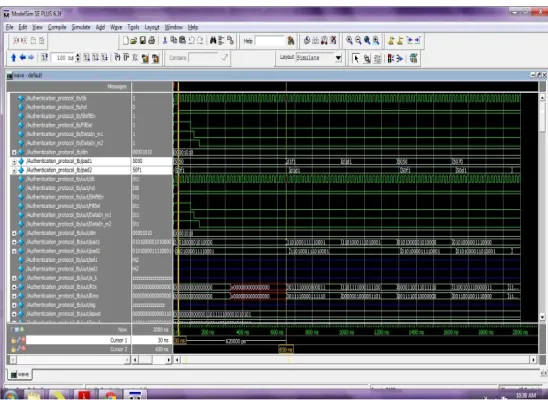
Fig 4: Verilog simulation result using FPGA downloaded data
Table I
FPGA resource utilizations of the proposed design
Resources Xor scheme
Propos ed work Previous work .Xilinx 12.2 Vertex5 XC5VLX3 0 Number of slice registers
416 599
Number of slice LUTs
330 427
VI. CONCLUSION
The PadGen functions are used to protect the Apwd against exposure. The main advantage of the proposed scheme is that it does not require the implementation of any special cryptographic hash functions/keys within the tag and a center server/database. There is also no need for the tag and the reader to synchronize security keys/hash values. The PadGen function was modified to strengthen the security of the mutual authentication scheme in this project. Area can also be effectively reduced in the process. In future design can be still made robust by implementing search based mechanism to improve the recolonization time.
Vol. 2
ISSN:
N A L F O R R E S E A R C H I N A P P L I E
E R I N G T E C H N O L O GY (I J R A S E T
Fig 4: Verilog simulation result using FPGA downloaded data
FPGA resource utilizations of the proposed design
Previous work
The PadGen functions are used to protect the Apwd against exposure. The main advantage of the proposed scheme is that it does not require the implementation of any special cryptographic hash functions/keys within the tag and a center There is also no need for the tag and the reader to synchronize security keys/hash values. The PadGen function was modified to strengthen the security of the mutual authentication scheme in this project. Area can also be s. In future design can be still made robust by implementing search based mechanism to
REFERENCES
[1] A. Juels, “RFID security and privacy: A research survey,” IEEE J. Sel. Areas Commun.
pp. 381–394, Feb. 2006.
[2] D. M. Konidala, Z. Kim, and K. Kim, “A simple and
cost effective RFID tag–reader mutual authentication scheme,” in Proc. Int. Conf. RFIDSec
141–152.
[3] H. M. Sun and W. C. Ting, “A Gen2
authentication protocol for security and privacy,”
IEEE Trans. Mobile Comput., vol. 8, no. 8, pp.
1052–1062, Aug. 2009
[4]
[5]
S. Piramuthu, “Lightweight cryptographic
authentication in passive RFID
IEEE Trans. Syst., Man, Cybern. C, Appl. Rev.
38, no. 3, pp. 360–376, May 2008.
Yu-Jung Huang ,Wei-Cheng Lin, and Hung “Efficient Implementation of RFID Authentication Protocol,” IEEE
Electron., vol. 59, no. 12, Dec. 2012.
ACKNOWLEDGEMENT
The satisfaction that allows the successful completion of any work is incomplete without the mention of the names of the people who made it possible. I consider it as my privilege to express my gratitude and sense of appreciation to Mrs.Ashwini,Asst.Prof ECE Dept.,PESIT for her valuable guidance and dynamic support.
2 Issue VI, June 2014
N: 2321-9653
E D S C I E N C E
T)
REFERENCES
A. Juels, “RFID security and privacy: A research
IEEE J. Sel. Areas Commun., vol. 24, no. 2,
D. M. Konidala, Z. Kim, and K. Kim, “A simple and
reader mutual authentication
Proc. Int. Conf. RFIDSec, Jul. 2007, pp.
H. M. Sun and W. C. Ting, “A Gen2-based RFID authentication protocol for security and privacy,”
, vol. 8, no. 8, pp.
S. Piramuthu, “Lightweight cryptographic
authentication in passive RFID-tagged systems,”
IEEE Trans. Syst., Man, Cybern. C, Appl. Rev., vol.
376, May 2008.
Cheng Lin, and Hung-Lin Li, “Efficient Implementation of RFID Mutual
IEEE Trans. Ind.
, vol. 59, no. 12, Dec. 2012.
ACKNOWLEDGEMENT