(Peak to Average Power Ratio) Reduction
Techniques in OFDM(Orthogonal Frequency
Division Multiplexing) System
Abhijeet kharat, Deepak mishra, Praveen mishra Guided by prof sunil patil
Department of Electronics & Telecommunication Engineering
KJ Somaiya Institute Of Engineering & Information technology,Mumbai-400022(INDIA)
Abstract: Communication is one of the important aspects of life. For better transmission, even single –carrier waves are being replaced by multi – carriers. Multi – carrier systems like CDMA and OFDM are now –a –days being implemented commonly. In the OFDM system, orthogonally placed sub –carriers are used to carry the data from the transmitter end to the receiver end. Presence of guard band in this system deals with the problem of ISI and noise is minimized by larger number of sub –carriers. It also provides high data rates in multimedia services But the large Peak –to –Average Power Ratio of these signal have some undesirable effects on the system. In this paper we have focused on the basics of an OFDM System and have undertaken various techniques to reduce the PAPR in the system so that this system can be used more commonly and effectively. In this paper instead of taking binary data as an input, we had taken an image as an input.
Keywords
: Orthogonal frequency division multiplexing (OFDM),Cumulative Distribution function(CCDF), Peak to Avearge Power ratio (PAPR), Clipping, Selected mapping(SLM), Partial Transmit sequence(PTS), FFT,IFFT, Inter-symbol Interference(ISI).1.INTRODUCTION
Orthogonal frequency division multiplexing (OFDM) is widely used in modern wireless communication system because of its high spectrum efficiency and low susceptibility to multi-path. It has receive rising interest recently and has been proposed for number of communication system, such as wireless local area networks and high data rate wireless transmissions. The principal of OFDM is to divide high rate information bits stream into several parallel low rate data sub streams and used these sub stream to modulate numbers of sub-carriers by Fourier transform techniques. OFDM offers ISI free transmission.
2. OFDM SYSTEM
Orthogonal Frequency Division Multiplexing is a special form of multicarrier modulation which is particularly suited for transmission over a dispersive channel
OFDM signal is defined as
The Discrete time OFDM signal x(n) sampled at the Nyquist rate t=nts is defined as
Most existing PAPR reduction methods are implemented on the discrete time OFDM signals.
3. PAPR IN OFDM
A well known problem of Orthogonal Frequency Division Multiplexing (OFDM) is the possible occurrence of high peak to average power ratio(PAPR). Presence of large number of independently modulated sub-carriers in an OFDM system the peak value of the system can be very high as compared to the average of the whole system. This ratio of the peak to average power value is termed as Peak-to-Average Power Ratio. The maximum peak power increases proportionally to the number of carriers in the system. After linear region, the scalar relationship is lost and the amplifier moves into saturation region. The use of amplifiers in that region leads to distortions.
3.1 COMPLEMENTARY CDF
The Complementary Cumulative Distribution Function (CDF) is one of the most regularly used parameters, which is used to measure the efficiency of any PAPR technique. Normally, the Complementary CDF (CCDF) is used instead of CDF, which helps us to measure the probability that the PAPR of a certain data block exceeds the given threshold.
The CCDF of the PAPR of the data block is desired is our case to compare outputs of various reduction techniques. This is given by
P(PAPR > z) = 1-P(PAPR z) (4)
=1-(1-exp(z))
4. PAPR REDUCTION TECHNIQUES
Many methods have been developed for PAPR reduction in OFDM signals. In this section we discuss about Selective Mapping(SLM), Partial Transmit Sequence(PTS) techniques for reducing the PAPR in OFDM and compare their performance characteristics.
[image:3.612.346.524.124.253.2]4.1 Selected Mapping (SLM) Technique
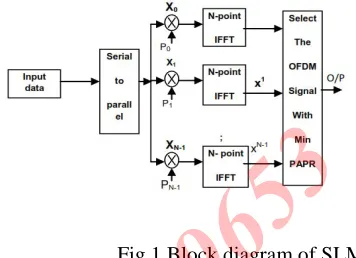
Fig 1 Block diagram of SLM
In this a set of sufficiently different data blocks representing the information same as the original data blocks are selected. Selection of data blocks with low PAPR value makes it suitable for transmission. It generates the set of favorable blocks at the transmitter end which represent the original information and then chooses the most favorable block for transmission. Here the input block given by X=[X(0),X(1),…..X(N-1)] is multiplied with U
different phase sequences Pu= [P0u,P1u,….PN-1u] T to produce a modified data block given by
Xu=[Xu[1],Xu[2],……Xu[N-1]]T
The IFFT of U independent sequences are taken to
produce the time domain sequences xu=[xu(0),xu
(1),…..xu(N-1)]T among which the one with the lowest
PAPR is selected for transmission. The amount of PAPR reduction for SLM depends on the number of phase sequences U and the proper design of the phase sequences.
4.2 Partial Transmit Sequence(PTS)
The partial sequence(PTS) partitions an input block of N symbols into V disjoint sub blocks as
Then each partitioned sub block is multiplied by complex
phase vector bv=ejθv where v=1,2,…..V. Unlike the SLM technique in which Scrambling(rotating its phase independently) is applied to each subcarrier, Scrambling is applied to each sub block in the PTS technique. The sub blocks are combined to minimize the PAPR in the time domain.. These are called the partial transmit sequences. Complex phase factors, , are introduced to combine the PTSs. The set of phase factors is denoted a vector . The time domain signal after combining is given by
Fig 2 Block diagram of PTS
5. RESULTS AND DISCUSSION
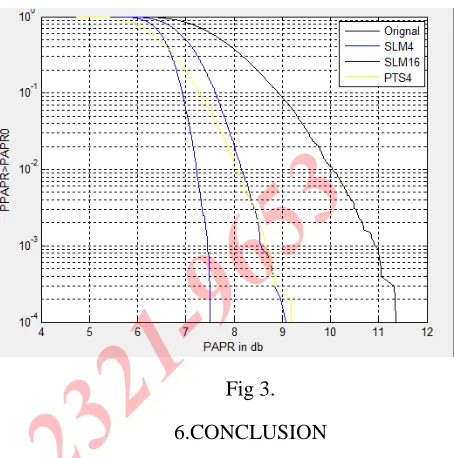
[image:4.612.341.568.111.340.2]Input may be like random binary data or image. We are taking image as an input. Image like Gray Scale, Color image etc has been taken. The PAPR reduction techniques discussed in this paper namely Selected mapping(SLM), Partial Transmit sequence(PTS) technique have been simulated to compare their performance characteristics .In fig 3 the required result is shown.
Fig 3.
6.CONCLUSION
OFDM is a very attractive technique for multicarrier transmission and has become one of the standard choices for high – speed data transmission over a communication channel. It has various advantages; but also has one major drawback: it has a very high PAPR. In this project, the different properties of an OFDM System are analyzed and the advantages and disadvantages of this system are understood. The bit –error –rate is also plotted against the signal –to –noise ratio to understand the performance of the OFDM system.
7. REFERENCES
[1] H. Taub, D. L. Schilling, G. Saha, “Taub’s Principles of Communication Systems”: Tata McGraw Hill, 2008.
[2] T. S. Rappaport, “Wireless Communication: Principles and Practice”: 2nd Edition, Prentice Hall, 2002.
[3] S. H. Han, J. H. Lee, “An Overview of Peak – to – Average Power Ratio Reduction Techniques for Multicarrier
Transmission”, IEEE Transaction on Wireless
Communication, April 2005.
[4] S. H. Han, J. H. Lee, “PAPR Reduction of OFDM Signals Using a Reduced Complexity PTS Technique”, IEEE Signal Processing Letters, Vol. 11, No. 11, November 2004.
[5] S. Y. L. Goff, B. K. Khoo, C. C. Tsimenidis, B. S. Sharif, “A Novel Selected Mapping Technique for PAPR Reduction in OFDM Systems”, IEEE Transactions on Communication, Vol. 56, No. 11, November 2008.
[6] S. Y. L. Goff, S. S. Al – Samahi, B. K. Khoo, C. C.
Tsimenidis, B. S. Sharif, “Selected Mapping Without Side
Information for PAPR Reduction in OFDM”, IEEE Transactions on Wireless Communications, Vol. 8, No. 7, July 2009.