www.impactjournals.com/oncotarget/
Oncotarget, December, Vol.3, No 12
Gene expression-based risk score in diffuse large B-cell
lymphoma
Caroline Bret
1,2,3, Bernard Klein
2,3, and Jérôme Moreaux
2 1 Department of Biological Hematology, St Eloi Hospital, Montpellier, France2 INSERM U1040, Institute of Research in Biotherapy, Montpellier, France 3 University of Montpellier 1, UFR de Médecine, Montpellier, France
Correspondence to: Jérôme Moreaux, email: [email protected] Keywords: DLBCL, gene expression profile, risk score, prognosis
Received: December 29, 2012, Accepted: December 30, 2012, Published: December 31, 2012
Copyright: © Bret et al. This is an open-access article distributed under the terms of the Creative Commons Attribution License, which per-mits unrestricted use, distribution, and reproduction in any medium, provided the original author and source are credited.
ABSTRACT:
Diffuse large B-cell lymphoma (DLBCL) is the most common type of non-Hodgkin
lymphoma and displays heterogeneous clinical and molecular characteristics. In this
study, high throughput gene expression profiling of DLBCL tumor samples was used to design a 12-gene expression–based risk score (GERS) predictive for patient’s overall survival. GERS allowed identifying a high-risk group comprising 46,4% of the DLBCL patients in two independent cohorts (n=414 and n=69). GERS was shown to be an independent predictor of survival when compared to the previously published prognostic factors, including the International Prognostic Index (IPI). GERS displayed a prognostic value in germinal-center B-cell–like subgroup (GCB) and activated B cell–like (ABC) molecular subgroups of patients as well as in DLBCL patients treated with cyclophosphamide, doxorubicin, vincristine and prednisone (CHOP) or Rituximab-CHOP (R-Rituximab-CHOP) regimens. Combination of GERS and IPI lead to a potent prognostic classification of DLBCL patients. Finally, a genomic instability gene signature was highlighted in gene expression profiles of patients belonging to the high-risk GERS-defined group.
INTRODUCTION
Diffuse large B-cell lymphoma (DLBCL) is the most
common type of non-Hodgkin lymphoma, accounting for
30 to 40% of adult non-Hodgkin lymphomas. DLBCL
is considered as a heterogeneous disease associated
with clinical and biological diversity[1]. Most patients
diagnosed with DLBCL achieve long-term remission,
but a third of them relapse after conventional Rituximab
(R)-based chemotherapy regimens such as combination
of cyclophosphamide, doxorubicin, vincristine and
prednisone (CHOP)[2].
Prior to therapy, the usual prognostic tool is the
International Prognostic Index (IPI), based on clinical and
biochemical pre-treatment parameters. In addition to this
bio-clinical approach, molecular methods have brought
a new definition of DLBCL, demonstrating molecular
heterogeneity within morphologically similar tumors
and linking gene expression profiles (GEP) to prognosis.
Using these approaches, two main subgroups of DLBCL
displaying different outcomes after chemotherapy were
described: the germinal-center B-cell–like subgroup
(GCB) and the activated B cell–like subtype (ABC).
The GCB subgroup is associated with good
outcome, accounts for 50% of DLBCL and tumor cells
have a healthy germinal-center B cells GEP. ABC
subgroup has a poorer outcome, accounts for 30% of
cases and tumor cells have a healthy peripheral blood
activated B cells GEP, in particular a nuclear factor
k
B
(NF-
k
B) signature. The remaining 20% of DLBCL are
unclassifiable and associated with the ABC subgroup as
“non GCB” forms[3,4]. Using CHOP-like chemotherapy,
the 5-year overall survival rates of patients with GCB
signature and of patients with ABC profile were 60% and
30% respectively[5].
Based on our previous experience in building
powerful risk scores in patients with multiple myeloma[6]
or acute myeloid leukemia[7], we aimed to determine a
gene expression based-risk score (GERS) in DLBCL
design of GERS using 12 genes whose expression predicts
for patients’ overall survival which has strong prognostic
value in 2 independent large cohorts of DLBCL patients.
RESULTS
Gene Expression-based Risk Score (GERS) in
DLBCL
Using Maxstat R function and Benjamini-Hochberg
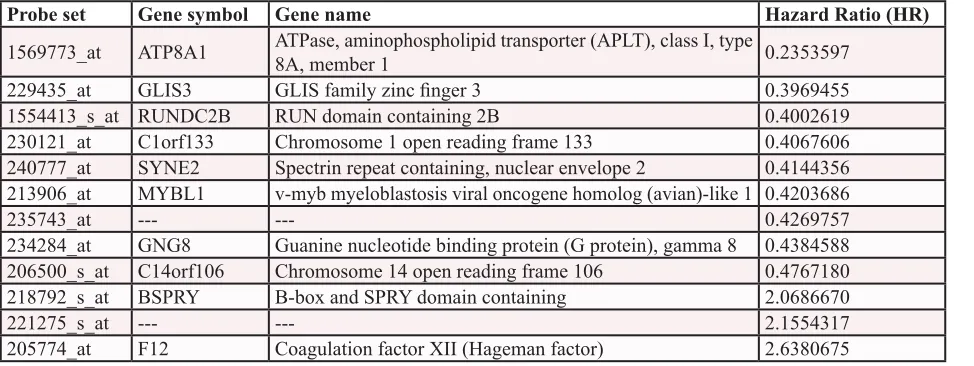
multiple testing correction [8], 12 probe sets were found
to have prognostic value for overall survival (adjusted
P
value <.05) in two independent cohorts of patients with
newly-diagnosed DLBCL (accession number GSE10846,
n=414[9] and accession number GSE23501, n=69[10])
(Table 1). These probe sets probed for 10 unique genes
and 2 expressed sequence tag clones. They were used to
build the Gene Expression-based Risk Score (GERS).
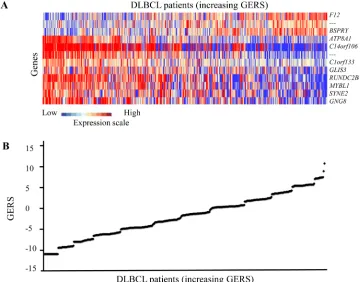
Figures 1A and 1B show expression of the 12 prognostic
probe sets and GERS from patients’ tumor samples
of the training cohort (ranked according to increasing
GERS). When used as a continuous variable, GERS had
a prognostic value in the two cohorts of patients with
DLBCL (
P
≤10
-4; data not shown). Patients of the training
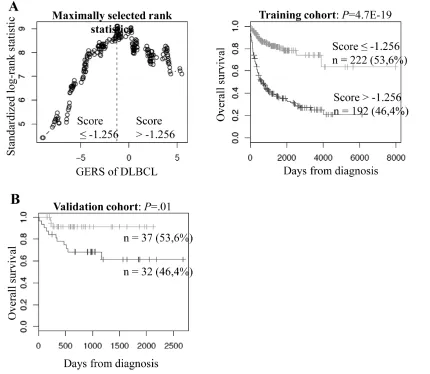
cohort (n=414) were ranked according to increased
prognostic score, and for a given score value X, the
difference in survival of patients with a GERS ≤X or >X
was computed. A maximum difference in overall survival
(OS) was obtained with X=-1.256, splitting patients in a
high-risk group (46.4% of patients, GERS >-1.256) with
a 22.3 month median OS and a low risk group (53.6% of
patients, GERS ≤-1.256) with not reached median survival
(Figure 2A). The prognostic value of GERS was validated
in an independent DLBCL patient’s cohort (n=69) (Figure
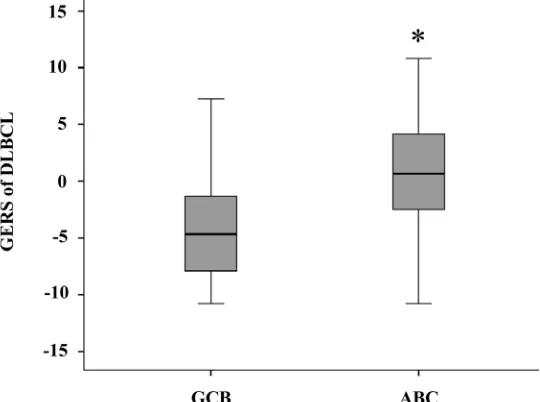
2B). With respect to germinal center B-cell like (GCB)
and activated B-cell like (ABC) molecular subgroups[4],
GERS was significantly higher (
P
=1.5.10
-28) in ABC
molecular subgroup compared to GCB subgroup (Figure
3).
Cox analysis was used to determine whether
the GERS provides additional prognostic information
compared to previously-identified poor outcome-related
factors such as GCB or ABC
molecular subgroups and the
IPI (low risk group/IPI score 0 or 1, low-intermediate risk
group/IPI score 2, high-intermediate risk group/IPI score
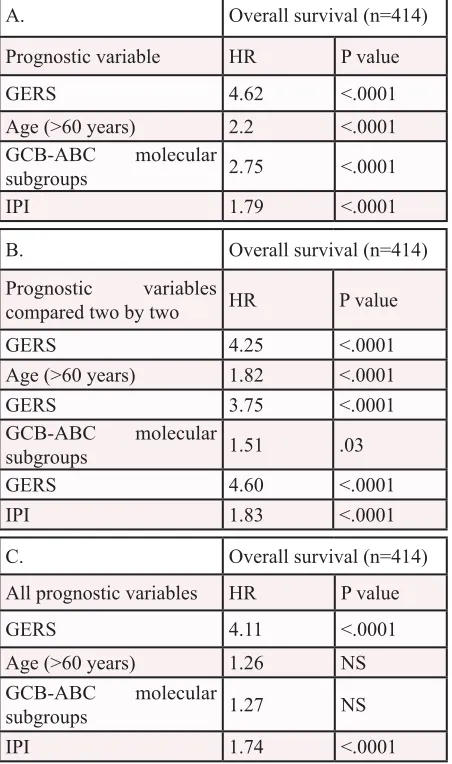
3 and high risk group/IPI score 4 or 5). Using univariate
analyses, GERS, age, ABC/GCB molecular subgroups
and IPI had prognostic value (
P
<.0001, Table 2A). When
compared two by two, GERS tested with age,
GCB-ABC
molecular subgroups or IPI remained significant (
P
<.0001,
P
=.03 and
P
<.0001 respectively, Table 2B). When all
parameters were tested together, only GERS and IPI kept
prognostic values (Table 2C).
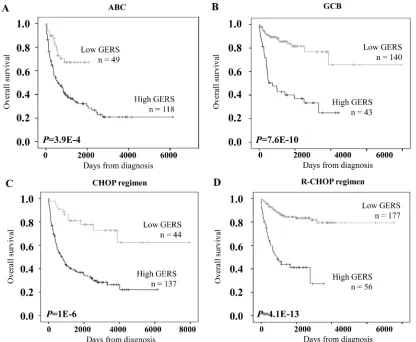
[image:2.612.125.485.407.689.2]Interestingly, GERS had prognostic value in GCB
or ABC molecular subgroups. GERS segregated patients
of ABC subgroup into a high-risk group with 19.1 month
Figure 1: GERS in DLBCL patients. A. Clustergram of genes ordered from best to worst prognosis. The level of the probe set signal
is displayed from low (deep blue) to high (deep red) expression. B. DLBCL patients (n=414) were ordered by increasing GERS (Genemedian OS and a low risk group with not reached median
OS (
P
=4.9E-4, Figure 4A). GERS separated patients of
GCB subgroup into a high-risk group with 24.6 month
median OS and a low risk group with not reached median
OS (
P
=7.6E-10, Figure 4B). Of interest, GERS remained
a powerful prognostic factor separating DLBCL patients
treated with CHOP regimen or R-CHOP regimen (
P
= 1E-6
and
P
= 4.1E-13 respectively, Figures 4C and 4D).
Combining prognostic information of GERS and
IPI into a single staging
Since GERS and IPI displayed independent
prognostic information, we found that GERS allowed
splitting patients with low risk IPI group into a high-risk
group with 89.9 month median OS and a low risk group
of patients with not reached median survival (
P
=4.3E-7,
Figure 5A). The same holds true for patients within
low-intermediate risk IPI group (segregated in a high-risk
group with a 27.7 month median OS and a low risk group
with not reached median survival, P=3E-4, Figure 5B), for
patients within high-intermediate risk IPI group (separated
into a high-risk group with 11.3 month median OS and
a low risk group with 54.9 month median OS, P=2E-4,
Figure 5C) and for patients within high risk IPI group
(split into a high-risk group with 6.9 month median OS
and a low risk group with 27.1 month median OS,
P
=.002,
Figure 5D). To combine the prognostic information of
GERS and IPI, a staging was built, scoring patients from
1 to 8 (2 GERS sub-groups in each of the 4 IPI groups as
previously described).
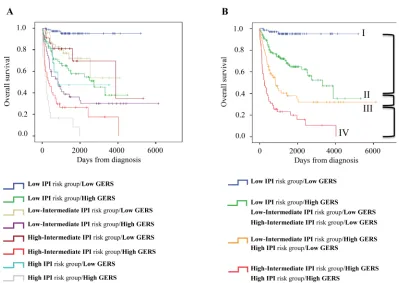
Kaplan-Meier analysis with the 8 patient groups of
the training cohort was performed (Figure 6A). When 2
consecutive groups showed no prognostic difference, they
were merged yielding to 4 patient groups with different
OS (Figure 6B). Group I comprised 23% of patients with
low IPI risk/low GERS. Group II accounted for 40.2% of
patients with low IPI risk/high GERS, low-intermediate
IPI risk/low GERS and high-intermediate IPI risk/low
GERS. Group III comprised 19.6% of patients with low
IPI risk/high GERS and high IPI risk/low GERS. Group
IV accounted for 17.2% of patients with low-intermediate
IPI risk/high GERS and high IPI risk/high GERS. Group I
patients had a not reached median OS, patients of groups
II, III and IV had respectively a median OS of 109.3
months, 27.7 months and 8.5 months (Figure 6B).
Tumor cells of patients in GERS high-risk group
have a genomic instability gene signature
Gene set enrichment analysis was performed
comparing gene expression profiles of DLBCL patients
with high and low GERS (n=192 and n=222 respectively
in the training cohort). Genes related with genomic
instability pathways (gene sets: RESPONSE_TO_UV and
RESPONSE_TO_RADIATION,
P
<.001, supplementary
Figure S1 and supplementary Tables S1 and S2) and
apoptosis (gene set: MITOCHONDRIAL_OUTER_
MEMBRANE,
P
<.001, supplementary Figure S1 and
supplementary Tables S3) were enriched in GERS
high risk group. Conversely, gene encoding for protein
translation (gene set: STRUCTURAL_CONSTITUENT_
OF_RIBOSOME,
P
=.04, supplementary Figure S2 and
supplementary Tables S4) were enriched in GERS low
risk group.
DISCUSSION
Given the genetic heterogeneity of hematological
malignancies, GEP of tumor cells have enabled the
identification of additional molecular heterogeneity
[image:3.612.70.557.90.273.2]associated with prognostic value[7,11-20]. DLBCL is
Table 1: List of the 12 probe sets associated with prognostic value in DLBCL patients.
Hazard ratios
(HR) are indicated for each gene used to design GEP-based risk score (GERS) in DLBCL patients. Probe
sets are sorted by increasing HR.
Probe set
Gene symbol Gene name
Hazard Ratio (HR)
1569773_at
ATP8A1
ATPase, aminophospholipid transporter (APLT), class I, type
8A, member 1
0.2353597
229435_at
GLIS3
GLIS family zinc finger 3
0.3969455
1554413_s_at
RUNDC2B
RUN domain containing 2B
0.4002619
230121_at
C1orf133
Chromosome 1 open reading frame 133
0.4067606
240777_at
SYNE2
Spectrin repeat containing, nuclear envelope 2
0.4144356
213906_at
MYBL1
v-myb myeloblastosis viral oncogene homolog (avian)-like 1
0.4203686
235743_at
---
---
0.4269757
234284_at
GNG8
Guanine nucleotide binding protein (G protein), gamma 8
0.4384588
206500_s_at
C14orf106
Chromosome 14 open reading frame 106
0.4767180
218792_s_at
BSPRY
B-box and SPRY domain containing
2.0686670
221275_s_at
---
---
2.1554317
characterized by its biological heterogeneity leading to
heterogeneous responses to therapy and different survival
outcomes. Using GEP, several DLBCL subgroups with
different OS were identified mainly based on the cell
origin or the tumor microenvironment, including the
ABC and GCB subtypes[4] and the stromal signatures[9].
Various prognostic models have been developed to stratify
risk in patients with newly diagnosed DLBCL.
Using publicly data from two independent patients’
cohort[9,10], a GEP-based risk score (GERS) was
built, incorporating prognostic information of 12 genes/
expressed sequence tag clones in DLBCL patients.
GERS first allowed splitting DLBCL patients of the 2
independent cohorts into a high risk and a low risk groups.
GERS was shown to be an independent predictor for OS
when compared to the previously published prognostic
factors. Interestingly, when combined to IPI, GERS led to
a more potent prognostic classification of DLBCL patients.
Besides the powerful prognostic value of GERS,
the current study highlights pathways that could be
involved in poor prognostic DLBCL. Among the 12
prognostic genes used to build GERS, the
BSPRY
gene
encodes B-box and SPRY domain containing protein. A
high expression of BSPRY in tumor cells was associated
with poor OS in DLBCL patients according to GERS.
In murine models,
BSPRY
gene shows an ubiquitous
expression in various tissues, the highest expression
being found in testis with two alternative splice isoforms
(BSPRY-1 and BSPRY-2)[21]. BSPRY protein can interact
with 14-3-3 proteins[22] and is involved in the regulation
of epithelial Ca
2+transport
via
the modulation of Transient
Receptor Potential Vallinoid 5 (TRPV5) activity[23].
More recently, the function of the two alternative splice
isoforms was investigated in embryonic stem (ES) cells
and early embryonic development. Interestingly, the
knockdown of
BSPRY-1 and BSPRY-2
resulted in ES
[image:4.612.97.527.299.673.2]cells differentiation and in developmental retardation
of early embryos
in vitro
[21]. These data emphasize an
Figure 2: Prognostic value of GERS in DLBCL patients. A. Patients of the training cohort (n=414) were ranked according to
increasing GERS and a maximum difference in OS was obtained with a score =-1.256, splitting patients into a high risk (46,4%) and a low risk (53,6%) groups. B. The prognostic value of GERS was assayed on an independent cohort of 69 patients (validation cohort). The parameters to compute GERS of patients in the validation cohort and the proportions delineating the 2 prognostic groups were those definedimplication of BSPRY in ES cell pluripotency and early
embryonic development. The involvement of BSPRY in
cancer stem cells biology has not been explored. Taken
together, these data suggest that BSPRY could be involved
in B lymphomagenesis. Two other genes -
ATP8A1
and
MYBL1
- used to build GERS could be of interest. Their
low expression in tumor cells was associated with poor
OS.
ATP8A1
encodes for the ATPase aminophospholipid
transporter class I type 8A member 1, which belongs to
the family of aminophospholipid translocases. ATP8A1
is involved in the translocation of amphipaths such as
phosphatidylserine (PS) and phosphatidylethanolamine
(PE) within the plasma membrane, which can occur during
apoptosis[24,25]. ATP8A1 is implicated in the exposure
of PS in the outer leaflet of the plasma membrane of
neuroblastoma cells, this alteration of surface lipid
components leading to phagocytosis of cancer cells[26].
MYBL1,
also known as
A-myb,
encodes for v-myb
myeloblastosis viral oncogene homolog (avian)-like 1, a
transcription factor.
MYBL1
belongs to the MYB family,
including the v-myb oncogene and the
C-myb
and
B-myb
genes[27,28]. In human hematopoietic cells, MYBL1 is
specifically expressed by centroblasts[29]. MYBL1 is a
survival factor for murine B lymphomas transactivating
c-myc expression[30] and is overexpressed in human
acute and chronic B-cell neoplasias[31]. In transgenic
mice, ectopic expression of MYBL1 induces lymphoid
hyperplasia in lymph nodes with an expansion of
follicular center B cells[32]. Interestingly, the previously
published GCB signature also included the gene encoding
MYBL1
[9]
as well as the signature published by the group
of A. Alizadeh[4]. MYBL1 could be involved in DLBCL
pathogenesis in addition to its role in Burkitt lymphoma or
chronic lymphoid leukemia (CLL)[31].
Interestingly, GSEA analysis highlighted a
significant enrichment of genes associated with genomic
instability and apoptosis in tumor cells of patients within
high risk GERS group (supplementary Figure S1 and
supplementary Tables S1, S2 and S3). In particular,
enrichment for genes encoding for nucleotide excision
DNA repair (NER) pathway (genes belonging to the
ERCC family:
ERCC2/XPD
,
ERCC3/XPB
,
ERCC4/XPF
and
ERCC8/CSA
) and an overexpression of
MCL1
were
obtained. Transgenic mice expressing an
MCL1
transgene
in lymphoid tissues develop lymphoma after a long
latency[33]. In non-Hodgkin lymphoma,
MCL1
expression
was significantly lower in patients in complete remission
than with progressive disease[34]. These data suggest
that targeting NER DNA repair or
MCL1
could have a
therapeutic interest in patients with a high risk GERS.
F11782, a novel dual catalytic inhibitor of topoisomerases
I and II, is a potent inhibitor of NER[35]. More recently,
it was demonstrated that PARP activation following UV
radiation exposure promoted association between
PARP-1 and XPA, a central protein in NER. Administration
of PARP inhibitors confirmed that poly-(ADP-ribose)
mediated PARP-1 association with XPA and decreased
UV radiation-stimulated XPA chromatin association.
These observations illustrate the function of PARP in
NER DNA repair[36]. Clinical grade PARP inhibitors,
alone or in combination with chemotherapy, could be of
clinical interest in the high-risk group of DLBCL patients
identified with GERS. In DLBCL tumors with low risk
GERS, GSEA analysis highlighted an enrichment of
genes encoding for protein translational machinery
(supplementary Figure S2 and supplementary Tables S4).
[image:5.612.174.444.487.688.2]Deregulated protein synthesis plays an important role in
human cancer and deregulated translational control has
been recognized as an integral part of the malignant state
[37-39]. Multiple drugs have been developed to target
molecules involved in the regulation of protein translation.
Rapamycin and rapalogs (temsirolimus, everolimus, and
deferolimus) inhibit mTORC1 signaling[40-42]. Other
small molecule inhibitors (Torin1, PP242 and PP30)
have been developed to target the mTOR kinase domain,
which may inhibit mTORC1 and mTORC2 signaling
pathways[43] [44]. CGP57380 has been developed as an
ATP competitive inhibitor of the MNK kinases, which
may prevent a subsequent round of translation on the
same mRNA[45] [46]. Other drugs have been found
to block the recruitment of eIF4E to the eIF4F ternary
complex, including 4EGI-1 and Ribavirin. They inhibit
both translation initiation and eIF4E-mediated transport of
mRNA[47-50]. These inhibitors may constitute a potential
therapeutic approach in these subgroups of DLBCL
patients.
Given the heterogeneity of DLBCL patients, the
current GERS combined with IPI could help identifying
high-risk patients who may benefit from intensive
therapeutic strategies and new targeted treatments.
MATERIALS AND METHODS
Patients
Gene expression microarray data from two
independent cohorts of patients diagnosed with DLBCL
were used. The first cohort, used as the training cohort,
comprised 414 patients[9] and the second one as the
validation cohort comprised 69 patients [10].
Pre-treatment clinical characteristics of patients were
previously published by the groups of G. Lenz and of R.
Shaknovich. Affymetrix gene expression data are publicly
available
via
the online Gene Expression Omnibus (http://
www.ncbi.nlm.nih.gov/geo/) under accession number
GSE10846 and GSE23501. They were performed
using Affymetrix HG-U133 plus 2.0 microarrays for
the two cohorts of patients. The data were analyzed
with Microarray Suite version 5.0 (MAS 5.0), using
Affymetrix default analysis settings and global scaling as
normalization method. The trimmed mean target intensity
of each array was arbitrarily set to 500.
Gene expression profiling and statistical analyses
The statistical significance of differences in overall
survival between groups of patients was calculated by the
log-rank test. Multivariate analysis was performed using
the Cox proportional hazards model. Survival curves were
plotted using the Kaplan-Meier method. All these analyses
have been done with R.2.10.1 and bioconductor version
2.5. Gene annotation and networks
were generated through
the use of Ingenuity Pathways Analysis (Ingenuity
®Systems, Redwood City, CA).
Selection of prognostic genes on the training set
(cohort of 414 patients)
Probe sets were selected for prognostic significance
using Maxstat R function and Benjamini Hochberg
multiple testing correction[8], yielding 12 significant
[image:6.612.59.285.152.534.2]probe sets in the two independent cohorts of patients with
DLBCL (Table 1).
Table 2: Cox univariate and multivariate
analysis of OS in DLBCL patient’s training
cohort (n=414).
The prognostic factors were
tested as single variable (A) or multivariables
(B, C) using Cox-model. P-values and the hazard
ratios (HR) are shown. NS: not significant at a
5% threshold.
A.
Overall survival (n=414)
Prognostic variable
HR
P value
GERS
4.62
<.0001
Age (>60 years)
2.2
<.0001
GCB-ABC
molecular
subgroups
2.75
<.0001
IPI
1.79
<.0001
B.
Overall survival (n=414)
Prognostic variables
compared two by two
HR
P value
GERS
4.25
<.0001
Age (>60 years)
1.82
<.0001
GERS
3.75
<.0001
GCB-ABC
molecular
subgroups
1.51
.03
GERS
4.60
<.0001
IPI
1.83
<.0001
C.
Overall survival (n=414)
All prognostic variables
HR
P value
GERS
4.11
<.0001
Age (>60 years)
1.26
NS
GCB-ABC
molecular
Building the gene expression-based risk score
(GERS)
To gather prognostic information of the 12
prognostic probe sets within one parameter, the GERS
of DLBCL was built as the sum of the beta coefficients
weighted by ± 1 according to the patient signal above or
below the probe set Maxstat value[8].
Validation in the independent cohort of patients
The GERS of DLBCL patients was individually
calculated and patients were grouped according to the
prognostic models and cut-offs from the training cohort.
The prognostic value of this scoring was evaluated using
log-rank statistics and Cox models.
Gene set enrichment analysis (GSEA)
We compared the gene expression levels from
high risk GERS versus low risk GERS DLBCL patients
and picked up the genes which had significant different
expression for Gene set enrichment analysis (GSEA).
Gene set enrichment analysis was carried out by
computing overlaps with canonical pathways and gene
ontology gene sets obtained from the Broad Institute[51].
ACKNOWLEDGEMENTS
This work was supported by grants from ARC
(SL220110603450, Paris France).
REFERENCE
1. Staudt LM, Dave S. The biology of human lymphoid malignancies revealed by gene expression profiling. Adv. Immunol. 2005; 87:163–208.
2. Siegel R, Naishadham D, Jemal A. Cancer statistics, 2012. CA Cancer J Clin. 2012; 62(1):10–29.
[image:7.612.93.509.345.687.2]3. Rosenwald A, Wright G, Chan WC, Connors JM, Campo E, Fisher RI, Gascoyne RD, Muller-Hermelink HK, Smeland EB, Giltnane JM, Hurt EM, Zhao H, Averett L, Yang L, Wilson WH, Jaffe ES, Simon R, Klausner RD, Powell J, Duffey PL, Longo DL, Greiner TC, Weisenburger DD, Sanger WG, Dave BJ, Lynch JC, Vose J, Armitage JO,
Figure 4: Prognostic prediction applying GERS in ABC/GCB subgroups of DLBCL patients.
The prognostic value ofGERS was tested in the training cohort for DLBCL patients of ABC molecular subgroup (A, n=167), GCB molecular subgroup (B, n=183),
Figure 5: Prognostic value of GERS for subgroups of DLBCL patients defined by international prognostic index (IPI).
DLBCL patients within low, low-intermediate, high-intermediate or high-risk IPI groups were split using GERS cutoff (-1.256). IPI was
available for 321 of the 414 patients of the training cohort.
Figure 6: Combination of the prognostic information of GERS and IPI. A. Kaplan-Meier analyses were performed to combine
the prognostic information of GERS and IPI risk classifications. Patients were scored from 1 to 8 (2 GERS sub-groups in each of the 4 IPI groups). B. After merging consecutive groups with no prognostic difference, 4 patient groups with different overall survival (OS) were [image:8.612.108.507.388.671.2]Montserrat E, López-Guillermo A, Grogan TM, Miller TP, LeBlanc M, Ott G, Kvaloy S, Delabie J, Holte H, Krajci P, Stokke T, Staudt LM, Lymphoma/Leukemia Molecular Profiling Project. The use of molecular profiling to predict
survival after chemotherapy for diffuse large-B-cell
lymphoma. N. Engl. J. Med. 2002; 346(25):1937–47. 4. Alizadeh AA, Eisen MB, Davis RE, Ma C, Lossos IS,
Rosenwald A, Boldrick JC, Sabet H, Tran T, Yu X, Powell JI, Yang L, Marti GE, Moore T, Hudson J, Lu L, Lewis DB, Tibshirani R, Sherlock G, Chan WC, Greiner TC, Weisenburger DD, Armitage JO, Warnke R, Levy R, Wilson W, Grever MR, Byrd JC, Botstein D, Brown PO, Staudt LM. Distinct types of diffuse large B-cell lymphoma identified by gene expression profiling. Nature. 2000; 403(6769):503–11.
5. Wright G, Tan B, Rosenwald A, Hurt EH, Wiestner A, Staudt LM. A gene expression-based method to
diagnose clinically distinct subgroups of diffuse large
B cell lymphoma. Proc. Natl. Acad. Sci. U.S.A. 2003; 100(17):9991–6.
6. Moreaux J, Klein B, Bataille R, Descamps G, Maïga S, Hose D, Goldschmidt H, Jauch A, Rème T, Jourdan M, Amiot M, Pellat-Deceunynck C. A high-risk signature
for patients with multiple myeloma established from the
molecular classification of human myeloma cell lines. Haematologica. 2011; 96(4):574–82.
7. Samra EB, Klein B, Commes T, Moreaux J. Development
of gene expression-based risk score in cytogenetically normal acute myeloid leukemia patients. Oncotarget. 2012; 3(8):824–32.
8. Kassambara A, Hose D, Moreaux J, Walker BA, Protopopov A, Rème T, Pellestor F, Pantesco V, Jauch A, Morgan G, Goldschmidt H, Klein B. Genes with a spike expression are
clustered in chromosome (sub)bands and spike (sub)bands have a powerful prognostic value in patients with multiple
myeloma. Haematologica. 2012; 97(4):622–30.
9. Lenz G, Wright G, Dave SS, Xiao W, Powell J, Zhao H, Xu W, Tan B, Goldschmidt N, Iqbal J, Vose J, Bast M, Fu K, Weisenburger DD, Greiner TC, Armitage JO, Kyle A, May L, Gascoyne RD, Connors JM, Troen G, Holte H, Kvaloy S, Dierickx D, Verhoef G, Delabie J, Smeland EB, Jares P, Martinez A, Lopez-Guillermo A, Montserrat E, Campo E, Braziel RM, Miller TP, Rimsza LM, Cook JR, Pohlman B, Sweetenham J, Tubbs RR, Fisher RI, Hartmann E, Rosenwald A, Ott G, Muller-Hermelink HK, Wrench D, Lister TA, Jaffe ES, Wilson WH, Chan WC, Staudt LM, Lymphoma/Leukemia Molecular Profiling Project. Stromal gene signatures in large-B-cell lymphomas. N. Engl. J.
Med. 2008; 359(22):2313–23.
10. Shaknovich R, Geng H, Johnson NA, Tsikitas L, Cerchietti L, Greally JM, Gascoyne RD, Elemento O, Melnick A. DNA methylation signatures define molecular subtypes of diffuse large B-cell lymphoma. Blood. 2010; 116(20):e81–
9.
11. Moreaux J, Cremer FW, Rème T, Raab M, Mahtouk K,
Kaukel P, Pantesco V, De Vos J, Jourdan E, Jauch A, Legouffe E, Moos M, Fiol G, Goldschmidt H, Rossi JF, Hose D, Klein B. The level of TACI gene expression
in myeloma cells is associated with a signature of microenvironment dependence versus a plasmablastic
signature. Blood. 2005; 106(3):1021–30.
12. Moreaux J, Hose D, Rème T, Jourdan E, Hundemer M, Legouffe E, Moine P, Bourin P, Moos M, Corre J, Möhler T, De Vos J, Rossi JF, Goldschmidt H, Klein B. CD200 is a new prognostic factor in multiple myeloma. Blood. 2006;
108(13):4194–7.
13. Condomines M, Hose D, Raynaud P, Hundemer M, De Vos
J, Baudard M, Moehler T, Pantesco V, Moos M, Schved J-F, Rossi JF, Rème T, Goldschmidt H, Klein B. Cancer/
testis genes in multiple myeloma: expression patterns and
prognosis value determined by microarray analysis. J.
Immunol. 2007; 178(5):3307–15.
14. Bret C, Hose D, Rème T, Sprynski A-C, Mahtouk K, Schved J-F, Quittet P, Rossi JF, Goldschmidt H, Klein B. Expression of genes encoding for proteins involved in
heparan sulphate and chondroitin sulphate chain synthesis
and modification in normal and malignant plasma cells. British Journal of Haematology. 2009; 145(3):350–68. 15. Bou Samra E, Moreaux J, Vacheret F, Mills K, Rufflé F,
Chiesa J, Piquemal D, Boureux A, Lavabre-Bertrand T, Jourdan E, Commes T. New prognostic markers, determined
using gene expression analyses, reveal two distinct subtypes of chronic myelomonocytic leukaemia patients. British
Journal of Haematology. 2012; 157(3):347–56.
16. Frick M, Dörken B, Lenz G. New insights into the biology
of molecular subtypes of diffuse large B-cell lymphoma and Burkitt lymphoma. Best Practice & Research Clinical
Haematology. Elsevier Ltd; 2012; 25(1):3–12.
17. Hendrix A, Braems G, Bracke M, Seabra M, Gahl W, De Wever O, Westbroek W. The secretory small GTPase
Rab27B as a marker for breast cancer progression. Oncotarget. 2010; 1(4):304–8.
18. Castellano G, Torrisi E, Ligresti G, Nicoletti F, Malaponte G, Traval S, McCubrey JA, Canevari S, Libra M. Yin Yang 1 overexpression in diffuse large B-cell lymphoma
is associated with B-cell transformation and tumor
progression. Cell Cycle. 2010; 9(3):557–63.
19. Higgins GS, Harris AL, Prevo R, Helleday T, McKenna WG, Buffa FM. Overexpression of POLQ confers a poor
prognosis in early breast cancer patients. Oncotarget. 2010; 1(3):175–84.
20. Ertel A, Dean JL, Rui H, Liu C, Witkiewicz A, Knudsen KE, Knudsen ES. RB-pathway disruption in breast cancer:
Differential association with disease subtypes,
disease-specific prognosis and therapeutic response. Cell Cycle. 2010; 9(20):4153–63.
and Early Embryonic Development. J. Reprod. Dev. 2012; 58(6):691-9.
22. Birkenfeld J, Kartmann B, Anliker B, Ono K, Schlötcke B, Betz H, Roth D. Characterization of zetin 1/rBSPRY,
a novel binding partner of 14-3-3 proteins. Biochem.
Biophys. Res. Commun. 2003; 302(3):526–33.
23. van de Graaf SFJ, van der Kemp AWCM, van den Berg D, van Oorschot M, Hoenderop JGJ, Bindels RJM. Identification of BSPRY as a novel auxiliary protein inhibiting TRPV5 activity. J. Am. Soc. Nephrol. 2006; 17(1):26–30.
24. Fadok VA, Voelker DR, Campbell PA, Cohen JJ, Bratton DL, Henson PM. Exposure of phosphatidylserine on the surface of apoptotic lymphocytes triggers specific recognition and removal by macrophages. J. Immunol. 1992; 148(7):2207–16.
25. Ikeda M, Kihara A, Igarashi Y. Lipid asymmetry of
the eukaryotic plasma membrane: functions and related
enzymes. Biol. Pharm. Bull. 2006; 29(8):1542–6.
26. Levano K, Sobocki T, Jayman F, Debata PR, Sobocka MB, Banerjee P. A genetic strategy involving a
glycosyltransferase promoter and a lipid translocating
enzyme to eliminate cancer cells. Glycoconj. J. 2009; 26(6):739–48.
27. Lyon J, Robinson C, Watson R. The role of Myb proteins
in normal and neoplastic cell proliferation. Crit Rev Oncog. 1994; 5(4):373–88.
28. Introna M, Luchetti M, Castellano M, Arsura M, Golay J. The myb oncogene family of transcription factors:
potent regulators of hematopoietic cell proliferation and
differentiation. Semin. Cancer Biol. 1994; 5(2):113–24. 29. Golay J, Broccoli V, Lamorte G, Bifulco C, Parravicini
C, Pizzey A, Thomas NS, Delia D, Ferrauti P, Vitolo D, Introna M. The A-Myb transcription factor is a marker of centroblasts in vivo. J. Immunol. 1998; 160(6):2786–93. 30. Arsura M, Hofmann CS, Golay J, Introna M, Sonenshein
GE. A-myb rescues murine B-cell lymphomas from
IgM-receptor-mediated apoptosis through c-myc transcriptional
regulation. Blood. 2000; 96(3):1013–20.
31. Golay J, Luppi M, Songia S, Palvarini C, Lombardi L, Aiello A, Delia D, Lam K, Crawford DH, Biondi A, Barbui T, Rambaldi A, Introna M. Expression of A-myb, but not
c-myb and B-myb, is restricted to Burkitt’s lymphoma, sIg+ B-acute lymphoblastic leukemia, and a subset of chronic
lymphocytic leukemias. Blood. 1996; 87(5):1900–11. 32. DeRocco SE, Iozzo R, Ma XP, Schwarting R, Peterson D,
Calabretta B. Ectopic expression of A-myb in transgenic
mice causes follicular hyperplasia and enhanced B
lymphocyte proliferation. Proc. Natl. Acad. Sci. U.S.A.
1997; 94(7):3240–4.
33. Zhou P, Levy NB, Xie H, Qian L, Lee CY, Gascoyne RD,
Craig RW. MCL1 transgenic mice exhibit a high incidence of B-cell lymphoma manifested as a spectrum of histologic subtypes. Blood. 2001; 97(12):3902–9.
34. Kuramoto K, Sakai A, Shigemasa K, Takimoto Y, Asaoku H, Tsujimoto T, Oda K, Kimura A, Uesaka T, Watanabe
H, Katoh O. High expression of MCL1 gene related to vascular endothelial growth factor is associated with poor
outcome in non-Hodgkin’s lymphoma. British Journal of Haematology. 2002; 116(1):158–61.
35. Barret JM, Cadou M, Hill BT. Inhibition of nucleotide excision repair and sensitisation of cells to DNA cross-linking anticancer drugs by F 11782, a novel fluorinated epipodophylloid. Biochem. Pharmacol. 2002; 63(2):251–8. 36. King BS, Cooper KL, Liu KJ, Hudson LG.
ribose) Contributes to an Association between
Poly(ADP-ribose) Polymerase-1 and Xeroderma Pigmentosum
Complementation Group A in Nucleotide Excision Repair. J. Biol. Chem. 2012; 287(47):39824–33.
37. Ruggero D, Pandolfi PP. Does the ribosome translate
cancer? Nat. Rev. Cancer. 2003; 3(3):179–92.
38. Hagner PR, Schneider A, Gartenhaus RB. Targeting the
translational machinery as a novel treatment strategy for hematologic malignancies. Blood. 2010; 115(11):2127–35.
39. Thomas G, Hall MN. TOR signalling and control of cell growth. Curr. Opin. Cell Biol. 1997; 9(6):782–7.
40. Guertin DA, Sabatini DM. Defining the role of mTOR in
cancer. Cancer Cell. 2007; 12(1):9–22.
41. Rapalogs in cancer prevention: Anti-aging or anticancer?
Blagosklonny MV. Cancer Biol Ther. 2012;13(14):1349-54.
42. Anisimov VN, Zabezhinski MA, Popovich IG, Piskunova TS, Semenchenko AV, Tyndyk ML, Yurova MN, Antoch MP, Blagosklonny MV. Rapamycin Extends Maximal Lifespan in Cancer-Prone Mice. The American Journal of Pathology. American Society for Investigative Pathology; 2010; 176(5):2092–7.
43. Thoreen CC, Kang SA, Chang JW, Liu Q, Zhang J, Gao Y, Reichling LJ, Sim T, Sabatini DM, Gray NS. An
ATP-competitive mammalian target of rapamycin inhibitor
reveals rapamycin-resistant functions of mTORC1. J. Biol.
Chem. 2009; 284(12):8023–32.
44. Feldman ME, Apsel B, Uotila A, Loewith R, Knight ZA, Ruggero D, Shokat KM. Active-site inhibitors of mTOR
target rapamycin-resistant outputs of mTORC1 and
mTORC2. PLoS Biol. 2009; 7(2):e38.
45. Bianchini A, Loiarro M, Bielli P, Busà R, Paronetto MP, Loreni F, Geremia R, Sette C. Phosphorylation of eIF4E
by MNKs supports protein synthesis, cell cycle progression and proliferation in prostate cancer cells. Carcinogenesis. 2008; 29(12):2279–88.
46. Phillips A, Blaydes JP. MNK1 and EIF4E are downstream effectors of MEKs in the regulation of the nuclear export of HDM2 mRNA. Oncogene. 2008; 27(11):1645–9.
47. Kentsis A, Topisirovic I, Culjkovic B, Shao L, Borden KLB. Ribavirin suppresses eIF4E-mediated oncogenic
transformation by physical mimicry of the 7-methyl
101(52):18105–10.
48. Assouline S, Culjkovic B, Cocolakis E, Rousseau C, Beslu N, Amri A, Caplan S, Leber B, Roy D-C, Miller WH, Borden KLB. Molecular targeting of the oncogene eIF4E in acute myeloid leukemia (AML): a proof-of-principle clinical trial with ribavirin. Blood. 2009; 114(2):257–60. 49. Moerke NJ, Aktas H, Chen H, Cantel S, Reibarkh MY,
Fahmy A, Gross JD, Degterev A, Yuan J, Chorev M, Halperin JA, Wagner G. Small-molecule inhibition of the interaction between the translation initiation factors eIF4E and eIF4G. Cell. 2007; 128(2):257–67.
50. Tamburini J, Green AS, Bardet V, Chapuis N, Park S,
Willems L, Uzunov M, Ifrah N, Dreyfus F, Lacombe C, Mayeux P, Bouscary D. Protein synthesis is resistant to rapamycin and constitutes a promising therapeutic target in
acute myeloid leukemia. Blood. 2009; 114(8):1618–27. 51. Subramanian A, Tamayo P, Mootha VK, Mukherjee S,
Ebert BL, Gillette MA, Paulovich A, Pomeroy SL, Golub TR, Lander ES, Mesirov JP. Gene set enrichment analysis:
a knowledge-based approach for interpreting genome-wide
expression profiles. Proc. Natl. Acad. Sci. U.S.A. 2005;