5
III
March 2017
www.ijraset.com Volume 5 Issue III, March 2017 IC Value: 45.98 ISSN: 2321-9653
International Journal for Research in Applied Science & Engineering
Technology (IJRASET)
©IJRASET: All Rights are Reserved
507
A Study on the Effect of Earthquakes in Specific
Structures or Buildings
Sourabh Bhargava1, Ramanand Tiwari2 , Mr. V. S. Parihar3
1,2
Scholar M. Tech (Construction Technology and Management), 3Asst. Professor , Department of Civil Engineering Acropolis Institute of Technology & Research, Bhopal (M.P.)
Abstract: In this paper work we are trying to find out the post effects of the earthquake on the various buildings. Recently there were number of earthquakes were occur in India’s various states, so by considering the seriousness of this activity we trying to understand the effects of these earthquakes on the various types of buildings at various localities. The purpose of this research paper is how to save lives at the low cost of construction through use of horizontal bands and proper seismic knowledge and also use of principles of earthquake resistant design.
Keywords: Earthquake, Localities, Buildings, Indian, Techniques.
I. INTRODUCTION
[image:2.612.197.416.348.442.2]An earthquake is a trembling or a shaking movement of the ground, caused by the slippage or rupture of a fault within the Earth's crust a sudden slippage and rupture along a fault line results in an abrupt release of elastic energy stored in rocks that are subjected to great strain
Figure 1: Effect of Earthquakes Buildings
An Earthquake (also known as a quake, tremor and temblor) is the result of a sudden release of energy in the earth’s crust that creates seismic waves earthquakes are measured using observations from seismometers An earthquakes point of initial rupture is called its focus or hypocenter the epicenter is the point at ground level directly above the hypocenter In Nepal there are three major fault lines (ICIMOD, 2007) the main central thrust (MCT) at the foot of the greater Himalaya joining the midland mountain but the main boundary fault (BMF) at the junction of the lesser Himalaya This faults line is the main cause of movement of Indian plates going under the Eurasian plates The first earthquake was reported by Nepal in 1255 AD then after there were several earthquakes reported but the earthquake occurred in 1934 (Bihar-Nepal) is quite devastated for Kathmandu valley I have written this paper for improvement of the quality of the construction as well as the cost effective solutions for constructing seismic resistant houses in developing countries like Nepal India I have also used the horizontal bands proper bindings of the joints either column or beams
[image:2.612.173.475.594.698.2]Technology (IJRASET)
There were almost 5 lack houses were collapsed in the Lumjung-Kathmandu-Nepal on the devastating quake occurred April 25, 2015 at 11:56AM I vested all the affected places in Kathmandu valley and collect all the data which is required to prepare this paper I have to discuss some points regarding failure of buildings during earthquake such as unreinforced masonry buildings soft story effects, in adequate confinement of steel in RCC structure soil liquefaction poor detailing of R seismically weak sot story at the first floor insufficient shear reinforcement.
II. INERTIAL FORCES
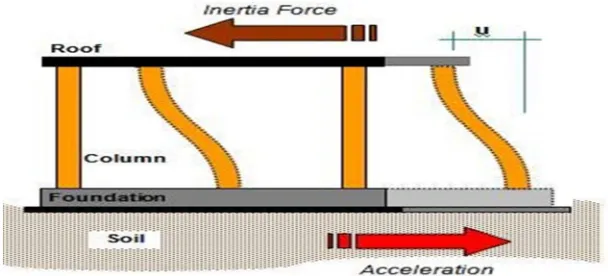
[image:3.612.152.456.302.440.2]When earthquake shaking occurs a building gets thrown from side to side and up and down that is while the ground is violently moving from side to side the building tends to stand at rest similar to a passenger standing on a bus that accelerates quickly Once the building starts moving it tends to continue in the same direction but by this time the ground is moving back in the opposite direction (as if the bus driver first accelerated quickly, then suddenly braked) Internal forces in a building caused by vibration of the building's mass during earthquake shaking are called inertial forces The building's mass size and shape its configuration - partially determine these forces and also partially determine how well they will be resisted Inertial forces are equal to the product of mass and acceleration per the Newton's Second Law F = m x a Acceleration ais the change of velocity (or speed in a certain direction) over time and is a function of the nature of the earthquake mass m is an attribute of the building Since the forces are inertial an increase the mass generally results in an increase the force
Figure 3: Inertial Forces of Structures
The other detrimental aspect of mass besides its role in increasing the lateral loads is that failure of vertical elements such as columns and walls can occur by buckling when the mass pushing down due to gravity exerts its force on a member bent or moved out of plumb by the lateral forces This phenomenon is known as the P-e or P-Delta effect The greater the vertical force the greater the moment due to the product of the force P, and the eccentricity e, (or Delta) Although buildings generally have large vertical load-carrying reserves due to code gravity load requirements, this safety factor does not necessarily mitigate the P-e problem which can induce bending in columns earthquakes shake the ground in a variety of directions - including up and down components Historically codes generally treated these vertical earthquake forces lightly although they may be two-thirds as great as the lateral earthquake forces and seismic design and design for lateral forces are not really synonymous terms It is vertical loads that almost always cause buildings to collapse in earthquakes; however, in earthquakes buildings generally fall down, not over The lateral forces use up the strength of the structure by bending and shearing columns, beams and walls and then gravity pulls the weakened and distorted structure down It is important to note that the main difference between the nature of earthquake and wind loading is due to the fact of the earthquake ground motion induces internally generated inertial forces caused by vibration of the building mass whereas wind loading acts the form of externally applied pressure.
III. FUNDAMENTAL PERIOD OF VIBRATION
www.ijraset.com Volume 5 Issue III, March 2017 IC Value: 45.98 ISSN: 2321-9653
International Journal for Research in Applied Science & Engineering
Technology (IJRASET)
©IJRASET: All Rights are Reserved
509
pole by hand, we could adjust the rate at which the pole will naturally vibrate so that the two either will or will not coincide If they coincide, then the dimensions of the swing will start to increase, the pole will be said to resonate and the loads on it will increase ground motion will impart vibrations to a building of similar nature in our shaking of the flag pole the fundamental periods of structures may range from about 0.05 second of the well anchored piece in equipment 0.1 second for one story simple bent and frame 0.5 second for a low structure up to about 4 stories and between 1-2 seconds for a tall building from 10-20 stories a water tank on an offshore drilling in rig will be between 2.5 and 6 seconds and large suspension bridge may have a period of about 6 seconds natural periods of soil are usually in the range of 0.5 to 1 second so that it is possible for the building and ground to have the same fundamental period and therefore there is a high probability for the building to approach a state of partial resonance (quasi-resonance) hence in developing a design strategy for a building it is desirable to estimate the fundamental periods both of the building and of the site so that a comparison can be made to see if the probability of quasi-resonance exists in the initial study shows this to be the case then it would be advisable to change the resonance characteristics of the building.
IV. CONCLUSION
In this paper you have been introduced to the effects of earthquakes and the associated human and economic losses we have explained the characteristics of earthquakes and identified some of the typical earthquake representations used in earthquake engineering studies and design further on we have identified the four main types of damaging effects of earthquakes and we have concluded that out of all these damaging effects structural engineers are most involved in dealing with effects of the ground shaking the building structures Finally we have explained two important terms related to building reaction to earthquakes i.e. inertial forces and fundamental period of vibration We have explained how inertial forces are developed during an earthquake and what affects the size of these forces we have defined what the fundamental period of vibration is and what are typical values of this period for various types of structures.
REFERENCES
[1] IS: 456-2000: Indian Standard Plain and Reinforced Concrete – Code Of Practice (Fourth Revision) [2] National Building Code of India 2005.
[3] IS: 1983 (Part 1): 2000: Indian standard Criteria for Earthquake Resistant Design of Structures.
[4] IS 875 (Part 1-3): 1987 Indian Standard Code of Practice for Design Loads (other than earthquake) for Buildings and structure [5] Pankaj Agarwal, Manish Shrikhande: “Earthquake Resistant Design of Structures”, PHI Learning Private Limited, 2011.
[6] Performance-based seismic engineering of buildings, Vision 2000 Committee, Report to California Office of Emergency Services, Structural EngineerAssociations of California, Sacramento, CA, April 1995.
[7] Govt. of India: India Meteorological Department, 2015