Technology (IJRASET)
Improvement in Quality of Plasma Sprayed
Titanium Dioxide as Thermal Barrier Coating
Material
Sathish Kumar U
1, Vishnu A
21Assistant professor,2PG student, Department of mechanical Engineering,
Anna University Chennai, RVS College of Engineering &Technology, India
Abstract: The depletion of fossil fuel resources at a faster rate in the present world generating an essential demand for increase in efficiency of internal combustion engines. The use of coating in the automotive industry has been found to yield a significant effect on the efficiency of engines. Higher the operating temperature more will be the efficiency of the system. However, such higher temperatures demand for enhanced temperature resistant materials in the combustion area of engines. There are various TBC materials under investigation to find the best which give good performance and also affordable to coat in CI as well as SI engines. The main purpose of this paper is to verify weather is there any improvement in wear and other essential qualities of Plasma sprayed Titanium Dioxide as Thermal Barrier Coating (TBC) material.
Keywords: Thermal Barrier Coating, Plasma Spray Process, Titanium Dioxide, Wear, Corrosion
I. INTRODUCTION
Thermal-barrier coatings (TBCs) are refractory-oxide ceramic coatings applied to the surfaces of metallic parts in the hottest part of automobile engine parts, gas-turbine engines which enabling modern engines to operate at significantly higher temperatures than their predecessors. Many engineering design factors influence the overall efficiency of automobile engines, but a major step in increasing engine temperature and engine efficiency was the introduction of TBCs. The first use of Thermal barrier coating (TBC) was for aircraft engines. Then the concept of TBC Coating for diesel engines began in 1980s. Because of petroleum crisis and the subsequent increase in the cost of fuels, the improvement of fuel economy with better performance of the I.C Engines has become a high priority to the researchers. A lots of investigations had modeled and analysed the effects of in-cylinder thermal insulation. Reducing the heat rejection in reciprocating engines is a possible way of reducing the fuel consumption rate. This may be possible by eliminating a part of the cooling system and incorporating high-temperature insulting materials in the combustion chamber to withstand the higher combustion temperature. The advent of high temperature, high performance ceramics has tempted engine researchers to strive for higher operating temperatures with subsequent higher engine thermal efficiency by reducing fuel consumption. Investigations still going on to find out the most suitable Thermal Barrier Coating material which gives better performance and also affordable to use it in both SI and CI engine parts. While selecting a TBC material, Its essential to analyse weather it satisfies the essential property requirements. So my work is an analytical study to check weather Titanium Dioxide is a good TBC material or not.
II. THERMAL BARRIER COATING
Thermal barrier coatings (TBC) are highly advanced material usually applied to metallic surfaces, such as on gas turbine or engine parts, operating at elevated temperatures, as a form of exhaust heat management. TBC materials not only act as heat resisting medium but also prevent the thermal fatigue and shocks. Thus coating a TBC material in combustion engines is essential for long life, higher efficiency and also for reducing the fuel consumption rate.
A. Essential Property Requirement of TBC.
For coating in engine piston, combustion chamber, or in any substrate the following properties are essential.
Technology (IJRASET)
Chemical inertness. Good wear resistance. Good corrosion resistance.
Thermal expansion coefficient match with metallic substrate. Good adhesion to metallic substrate.
Low sintering rate of the porous microstructure.
B. Various TBC Materials
1) Zirconates: The main advantages of zirconates are their low sintering activity, high thermal expansion coefficient, low thermal conductivity and also good thermal cycling resistance. The main problem is the very high thermal expansion coefficient which results in residual stress in the coating, and this can cause crakes and also phase transfer takes place at a temperature above 500°C.
2) Yittria Stabilized Zirconia: 7-8% yittria stabilized zirconia has high thermal expansion coefficient, low thermal conductivity and high thermal shock resistance. Main Disadvantages of yittria stabilized zirconia are its sintering above 1473 K, phase transformation at 1443 K, corrosion and oxygen transparent.
3) Alumina: Advantages are its high hardness and chemical inertness. It has relatively high thermal conductivity and low thermal expansion coefficient compared with yittria stabilized zirconia. Even though alumina alone is not a good thermal barrier coating candidate, Only the addition of small percentage yittria stabilized zirconia can increase the hardness of the coating and improve the oxidation resistance of the substance.
3) Mullite: Mullite is an important ceramic material because of its low density, high thermal stability, stability in severe chemical environments, low thermal conductivity and optimum strength. Compared with yittria stabilized zirconia, mullite has a much lower thermal expansion coefficient and higher thermal conductivity, and is much more oxygen resistant. The low thermal expansion coefficient of mullite is an advantage when compared to yittria stabilized zirconia in high thermal gradients and in thermal shock conditions. But one main disadvantage is its large mismatch in thermal expansion coefficient with metallic substrate which leads to poor adhesion. The other disadvantage of mullite is its possibility of crystallization at approximate 1023-1273K.
4)Forsterite:The optimum level thermal expansion coefficient of forsterite permits a good match with the substrate. At thicknesses of some hundred microns, it shows a very good thermal shock resistance. However, its limited availability and high cost is its main drawback to use it as Thermal Barrier Coating.
5)Titanium Dioxide: Main advantages of titanium Dioxide is its high easy availability ,chemical stability and also low cost. Possibility of Crystallization at a temperature above 1500 K is one of the disadvantages.
III. TITANIUM DIOXIDE (TIO2)
Technology (IJRASET)
Fig 1 . Structure of Titanium dioxide
[image:4.612.185.425.309.646.2]Titanium dioxide, also known as Titanium Oxide or Titania, with its molecular formula TiO2 and molecular weight 79.87 g/mol, is a kind of white powder. It is a soft solid powder and melts at 1800 Degrees Celsius. It has special performance, such as insulation, corrosion, flags, etc. It has a wide range of applications, from paint to sunscreen to food colouring. When used as a food colouring and the other most important application areas are paints and varnishes as well as paper and plastics, which account for about 80% of the world's titanium dioxide consumption. Other pigment applications such as printing inks, fibers, rubber, cosmetic products and foodstuffs account for another 8%. It is polymorphous and it exists in three types of crystal structures: (a) rutile, (b)anatase and (c) brookite. Only rutile is used commercially and the structure is shown in the Fig.1.
TABLE I: PROPERTIES OF TITANIUM DIOXIDE
Chemical Formula TiO2
Flash Point Non Flammable
Density (Rutine) 4.23 g/cm3
Melting Point 1,843 °C (3,34 to 9 °F; 2,116 K)
Thermal Conductivity 1.8 to 2.2 w/m k
Molar Mass 79.866 mole
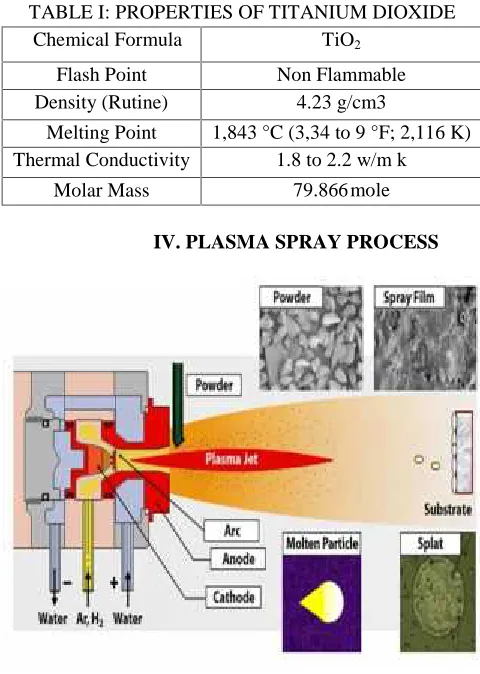
IV. PLASMA SPRAY PROCESS
Fig 2 : plasma spray process
Technology (IJRASET)
plasma jet are still 10,000°K several centimeters form the exit of the nozzle. Nozzle designs and flexibility of powder injection schemes, along with the ability to generate very high process temperatures, enables the plasma spray technique to utilize a wide range of coatings. The range goes from low melting point polymers such as nylon, to very high temperature melting materials such as refractory materials including tungsten, tantalum, ceramic oxides like Titanium Oxide,Stabilized Zirconia etc and other refractory materials
V. EXPERIMENTAL PROCEDURE
A .Coating Preparation
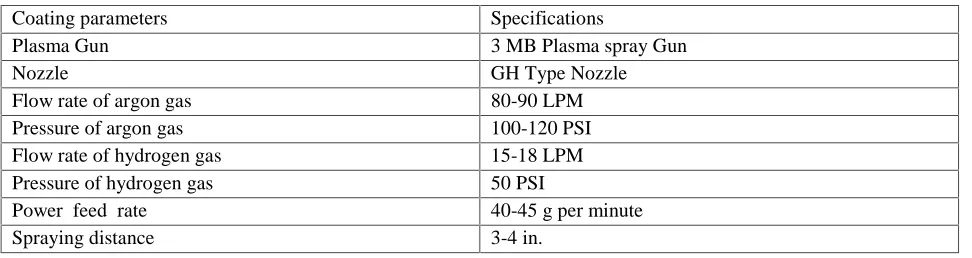
[image:5.612.66.552.289.418.2]Aluminium (Al), Stainless steel(SS) are the different substrate material as a base of piston and piston ring. Initially a 6 mm diameter and 30mm length substrate is smoothened through blasting process by using Alumina as Abrasive materials. Prior to the spraying of the Titanium Dioxide coatings, an MCrAlY layer was applied as bond coating to enhance adhesion and to reduce thermal expansion mismatch between the substrate and the ceramic coatings .The thickness of the bond coating was around 100 μmon average, and the top Titanium Dioxide coatings.are in the range of 300 to 450μm. Coating is done by plasma spray process with specifications follows
TABLE II: PLASMA SPRAY COATING SPECIFICATIONS.
Coating parameters Specifications
Plasma Gun 3 MB Plasma spray Gun
Nozzle GH Type Nozzle
Flow rate of argon gas 80-90 LPM
Pressure of argon gas 100-120 PSI
Flow rate of hydrogen gas 15-18 LPM
Pressure of hydrogen gas 50 PSI
Power feed rate 40-45 g per minute
Spraying distance 3-4 in.
B. Coating Characterization.
The microstructure, porosity and crystalline phase and orientation of the Titanium dioxide coatings were characterized. A scanning electron microscope (SEM) is a type of electron microscope that produces images of samples by scanning it with a focused beam of electrons. The electrons interact with atoms in the sample, producing various signals that can be detected and that contain information about the sample's surface topography and composition Wear test has conducted in PIN-ON-DISC TESTRIGModelno.TR-20-M26. Pin-on-Disk wear testing is a method of characterizing the coefficient of friction, frictional.force and rate of wear between two materials. During this tribological test, a stationary disk articulates against a rotating pin while under a constant applied load. . X-ray diffraction (XRD) relies on the dual wave/particle nature of X-rays to obtain information about the structure of crystalline materials. A primary use of the technique is the identification and characterization of compounds based on their diffraction pattern. The diffraction of X-rays by crystals is described by Bragg’s Law,2dsinθ = n λ.The directions of possible diffractions depend on the size and shape of the unit cell of the material. The intensities of the diffracted waves depend on the kind and arrangement of atoms in the crystal structure
VI. RESULTS AND DISCUSSION
A. Coating Thickness Measurement
Thickness of the coating was measured using Sensor and the measurement has done at SI’TARC (Scientific Industrial Testing and Research Centre), Coimbatore. The data point values expressed in microns are the average of three readings. Plasma sprayed coated thickness of Piston is 135.85 µ m.
B. Surface Roughness Measurement
Technology (IJRASET)
Normal Piston: 10.889 µm
Themeasurements has done at SI’TARC (Scientific Industrial Testing and Research Centre), Coimbatore
.The average height of the bumps on a surface of Plasma Sprayed Titanium Dioxide coated substrate is less when compared to Normal substrate. So it indicates there is less roughness of the coated substrate and thus may be wear also less for the coated substrate.
C. Micro Structure
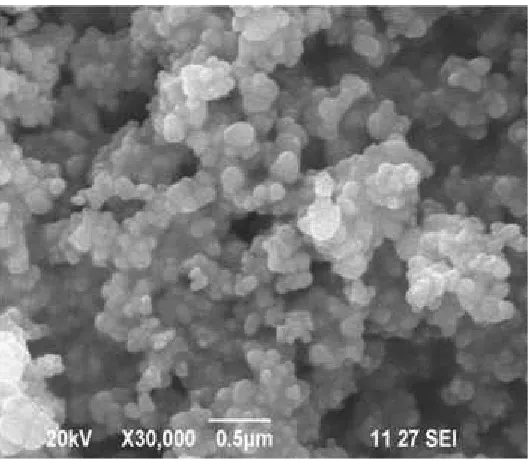
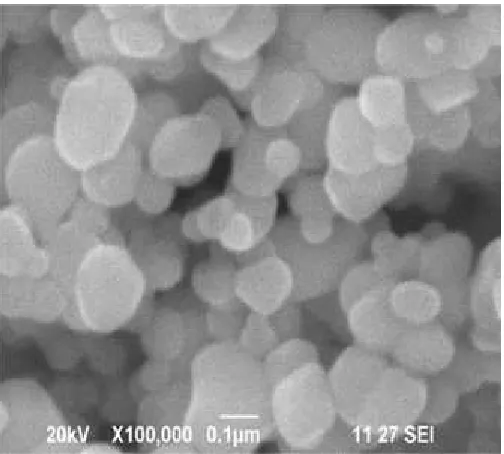
[image:6.612.177.435.188.415.2]The following figures shows SEM images of Titanium Dioxide powder
Fig. 3 : SEM image of TiO2 powder with magnification ( x 10,000)
[image:6.612.175.439.448.679.2]Technology (IJRASET)
Fig. 5: SEM image of TiO2 powder with magnification (x 55,000)
Fig. 6: SEM image of TiO2 powder with magnification (x100,000)From Figure 3 to Figure 6 shows various magnifications of powder Titanium Dioxide with magnification (x 10,000) , ( x 30,000) , (x55,000) , (x 100,000) . It can be seen that the particles are
equi-axed type and distributed homogeneously. SEM test of Titanium Dioxide sample powder has been conducted from Nano Technology Department of KARUNYA UNIVERSITY, Karunya Nagar, Coimbatore.
D. Wear Test
[image:7.612.181.433.335.562.2]Technology (IJRASET)
TABLE III: WEAR LOSS OF TIO2 COATED MATERIAL
Material Sliding Distance (M) Initial Weight (G) Final Weight( G) Weight Loss (G) Aluminium
500 11.0635 11.0633 0.0002
1000 11.0633 11.0630 0.0003
1500 11.0630 11.0624 0.0006
Steel 500 17.2650 17.2649 0.0001
1000 17.2649 17.2648 0.0001
[image:8.612.176.437.297.663.2]1500 17.2647 17.2643 0.0004
TABLE IV: WEAR LOSS OF NORMAL MATERIAL
Material Sliding Distance (M) Initial Weight (G) Final Weight (G) Weight Loss (G) Aluminium
500 3.4763 3.4746 0.0017
1000 3.4745 3.4722 0.0023
1500 3.4722 3.4693 0.0029
Steel 500 26.4920 26.4910 0.0010
1000 26.4910 26.4896 0.0014
1500 26.4896 26.4878 0.0018
Fig. 10 : Comparison of wear loss between TiO2 coated Al substrate and Normal Aluminium substrate
0 0.0005 0.001 0.0015 0.002 0.0025 0.003 0.0035
500 1000 1500
W ear lo ss (m g)
Sliding Distance (m)
Technology (IJRASET)
Fig. 11: comparison of wear loss between tio2coated steel substrate and normal steel substrate E. X-Ray Diffraction
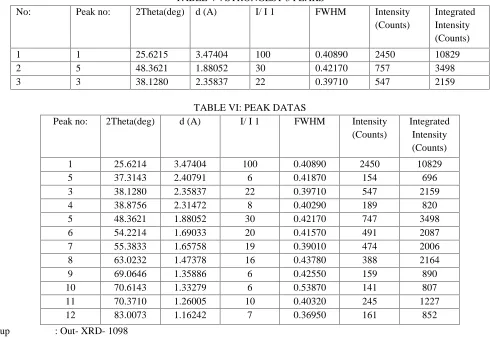
The following data and corresponding figure shows the XRD result of coating material Titanium Dioxide powder tested from KARUNYA University , Coimbatore.
[image:9.612.56.546.360.699.2]Basic Data Process Group : out–XRD- 1098 Data : Titanium Dioxide # Strongest 3 Peaks
TABLE V : STRONGEST 3 PEAKS
No: Peak no: 2Theta(deg) d (A) I/ I 1 FWHM Intensity
(Counts)
Integrated Intensity (Counts)
1 1 25.6215 3.47404 100 0.40890 2450 10829
2 5 48.3621 1.88052 30 0.42170 757 3498
3 3 38.1280 2.35837 22 0.39710 547 2159
TABLE VI: PEAK DATAS
Peak no: 2Theta(deg) d (A) I/ I 1 FWHM Intensity
(Counts)
Integrated Intensity (Counts)
1 25.6214 3.47404 100 0.40890 2450 10829
5 37.3143 2.40791 6 0.41870 154 696
3 38.1280 2.35837 22 0.39710 547 2159
4 38.8756 2.31472 8 0.40290 189 820
5 48.3621 1.88052 30 0.42170 747 3498
6 54.2214 1.69033 20 0.41570 491 2087
7 55.3833 1.65758 19 0.39010 474 2006
8 63.0232 1.47378 16 0.43780 388 2164
9 69.0646 1.35886 6 0.42550 159 890
10 70.6143 1.33279 6 0.53870 141 807
11 70.3710 1.26005 10 0.40320 245 1227
12 83.0073 1.16242 7 0.36950 161 852
Group : Out- XRD- 1098
0 0.0005 0.001 0.0015 0.002
500 1000 1500
W ear lo ss (m g)
Sliding Distance (m)
Technology (IJRASET)
Date and Time : 10-12-2015 14:24:05
Measurement condition X-ray tube
Target : Cu Voltage : 40.0 (kV) Current : 30.0 (mA) Slits
Auto Slits : not used Divergence slit : 1.00000 (deg) Scatter slit : 1.00000 (deg) Receiving Slit : 0.30000 Scanning
Drive axis : Theta–2Theta
Scan range : 10.0000–90.0000 (deg) Scan mode : Continuous Scan Scan speed : 10.0000 (deg/min) Sampling pitch : 0.1000 (deg)
Preset time : 0.60 (sec)
Data Process condition
Smoothing : Auto Smoothing point : 5 B.G. Substruction : Auto Sampling Points : 5 Repeat times : 30 Ka1-a2 Separate : [Manual] Ka1 a2 ratio : 50 (%) Peak Search : Auto
Differential points : 5
FWHM threshold : 0.050 (deg) Intensity threshold : 30 (par mil ) FWHM ratio (n-1)/ n : 2
[image:10.612.197.415.534.701.2]System error Correction: No Precise Peak Correction: No
Technology (IJRASET)
VII. CONCLUSION
Various tests are carried out on Plasma sprayed coated Titania on Aluminium and steel sample. This study helps to understand the possibility of using Titanium Dioxide in Piston parts of Internal combustion engines for its better thermal efficiency and less fuel consumption. The SEM images shows that the particles are equi-axed type and distributed homogeneously. Although some porosity is observed. Unmelted particles are not observed in the coatings due to complete melting during spraying. In the powder, various phases has identified. Besides the tetragonal and cubic phases, there are some monoclinic phase in the titanium dioxide powder. There are no reaction products at the coating-substrate interfaces, which indicates good bonding between them. The test results conclude that it is possible to use Titanium Dioxide as Thermal Barrier Coating(TBC) Material and there is a good future scope for it in Automobiles and industries for enhancing the efficiency with less fuel consumption rate.
REFERENCES
[1] http://www.iluka.com/_uploads/documents/Briefing%20Material/ILU%20Mineral%20Sands%20Products%20Attributes%20and% 20Applications.pdf. Accessed 12 March 2013
[2] L. Pawłowski, Strategic Oxides for Thermal Spraying: Problems of Availability and Evolution of Prices, Surf. Coat. Technol., 2013, 220, p 14-19 [3] U. Diebold, The Surface Science of Titanium Dioxide, Surf. Sci. Rep., 2003, 48, p 53-229
[4] Pawlak W., Wendler B, Multilayer, hybrid PVD coatings on Ti6Al4V titanium alloy, Journal of Achievements in Materials and Manufacturing Engineering 37/2(2009) 660-667.
[5] Hwang B., Lee S, and Ahn J, Correlation of Microstructure and wear resistance of Molybdinum and Molybdenium Blend coatings Fabricated by Atmospheric Plasma spraying, Mater. Sci., Vol A366, 2004,p 152-163
[6] Zeng Y., Lee S.W , GAO L, and Ding C.X, Atmospheric Plasma Sprayed coatings of Nanostructured Zirconia, J. Eur. Ceram. Soc., Vol 22(No. 3), 2002, p 347-35Thomas, T.R., “Trends in surface roughness” , International Journal of Machine Tools andand Manufacture, 38, Issues 5-6. pp 405-411(1998)
[7] ASTM g99-95a, ASTM Standard Test Method for Wear Testing with a Pin-on-Disc Apparatus, ASTM, Philadelphia, 1995,p 1-5
[8] McPherson R., The Relationship between the Mechanisms of Formation, Microstructure and properties of Plasma-Sprayed Coatings, Thin Solid Films, Vol 83, 1981, p 297