*Corresponding author:Mangal Charan Murmu
INTERNATIONAL JOURNAL OF CURRENT MEDICAL AND
PHARMACEUTICAL RESEARCH
ISSN: 2395-6429, Impact Factor: 4.656
Available Online at www.journalcmpr.com
Volume 5; Issue 10(A); October 2019; Page No. 4593-4600
DOI: http://dx.doi.org/10.24327/23956429.ijcmpr201910752
Research Article
A STUDY ON COMPARISON OF VOLUME AND FREQUENCY BASED FEEDING
PROTOCOL IN VERY LOW BIRTH WEIGHT BABY
Pradeep Kumar Jena, Sudipta Sahoo and Mangal Charan Murmu*
Department of Pediatrics S C B Medical College, Cuttack, Odisha, India
ARTICLE INFO ABSTRACT
Introduction: Very Low Birth Weight (VLBW) neonates are increased risk for potential nutritional compromise. These infants are born with limited nutrient reserves, immature metabolic pathways and increased nutrient demands. These neonates require specialized nutritional support due to their biochemical immaturity, faster growth rates and increased metabolic demand. These demands results from increased risk of several problems such as respiratory distress syndrome, sepsis, gastro-oesophageal reflux, apnoea and other factors related to feeding intolerance. Providing optimal enteral nutrition to high risk premature neonates is a difficult clinical challenge. Material &Method: The study was conducted from October 2016 to September 2018 at Newborn wards and SNCU, Department of Paediatrics SCB MCH and SVPGIP, Cuttack. 200 babies were included in our study. It was a randomised prospective study Result: Babies of Volume advancement group regain birth weight earlier (mean of 7.27days) than the babies of frequency advancement group (mean of 8.05 days).Gain of weight on D10 and on D15 was more in the babies of VA group than the babies of FA group (p=0.001, p=0.001 respectively). Days of attainment of full enteral feeding was earlier in volume advancement (VA) group (mean of 8.25days) than the frequency advancement (FA) group (mean of 15.40 days). Conclusion: Volume advancement feeding protocol is found to be better than frequency advancement feeding protocol considering the benefits of rapid weight gain in volume advancement group, earlier attainment of full enteral nutrition, lesser duration of hospital stay and lower incidence of feeding interruption.
Copyright © 2019 Pradeep Kumar Jena et al. This is an open access article distributed under the Creative Commons Attribution License, which permits
unrestricted use, distribution, and reproduction in any medium, provided the original work is properly cited.
INTRODUCTION
Backgrounds: Providing optimal enteral nutrition to high risk
premature neonates, very low birth weight is a difficult clinical challenge. These infants are born with limited nutrient reserves, immature metabolic pathways and increased nutrient demands. These neonates require specialized nutritional support due to their biochemical immaturity, faster growth rates and increased metabolic demand .These demands results from increased risk of several problems such as respiratory distress syndrome, sepsis, gastro esophageal reflux, apnea and other factors related to feeding intolerance[1]. The structural and functional integrity of GI tract is dependent upon the provision of enteral nutrition. With holding enteral feeding after birth places the infant at risk for all the complications associated with luminal starvation, including mucosal thinning, flattening of the villi, bacterial translocation. There have also been several reports about early imitation of enteral feeding to achieve an early catch-up growth and avoid gut atrophy [2]. Early enteral feeding enhances maturation of the motor responses of the small intestine of the preterm babies compared with infants receiving exclusively parenteral nutrition.[3] Optimal growth of preterm infants has yet o be determined, and, thus, cannot have been achieved, but the
general objective remains consistent -to achieve postnatal growth and body composition equivalent o those of normally growing, healthy human foetuses of the same gestational age [4].Most preterm infants fail to grow after birth for days, often weeks and once they start to grow they do not keep up with normal rates of intrauterine growth [5]. This problem is worse for smaller, more preterm infants, and even more so for infants who have serious illness with marked physiological instability [6]. As a result, most preterm infants do not achieve normal size, anthropometric indices, or body composition by term gestation. This problem is compounded for infants with intrauterine growth restriction (IUGR) from inadequate foetal nutrition who are born small for gestational age and are even more susceptible to postnatal nutritional deficits [7, 8]. The recommended goal of nutritional support for VLBW from birth to term is to match the in utero growth rates of the normally growing foetus coupled with satisfactory functional development [9]. The postnatal nutrition in preterm infants is designed to mimic the growth and body composition of the healthy foetus growing in the uterus. Some recent evidence has demonstrated that inadequate nutrition in premature infants in the first week results in growth retardation and may lead to Permanent detrimental effects [10, 11]. Malnutrition is a cause of morbidity and mortality in VLBW infants receiving les
Article History:
Received 12th June, 2019 Received in revised form 23rd August, 2019
Accepted 7th September, 2019 Published online 28th October, 2019
Key words:
Very low birth weight baby, Intrauterine Growth Retardation,
nutrition in the first week of life. Therefore, parenteral nutrition is required until full enteral nutrition can be established [12]. Now the survival rates of VLBW infants have improved with use of mechanical ventilation and exogenous surfactant [13], preterm infants are faced with another challenge in nutrition. Extra uterine growth retardation is associated with adverse outcomes including chronic lung disease, increased risk to infection, severe retinopathy, and abnormal neurodevelopment outcome [14-16]. To achieve weight gain of preterm infants who are appropriate for gestational age without adverse effect, there should be no interruption in delivery of nutrients from time of birth [17, 18]. It is difficult for most VLBW infants to reach this suggested caloric and protein intake because of fluid restriction, intolerance, delay in imitation of nutrition, immaturity of intestinal functions, and slow progress of enteral feeding.[19-21] Much controversy about initiation and advancement of feeding of VLBW babies. Implementation of a standardized feeding regimen for very low birth weight babies reduces variations in the practitioners and may enhance early recognition of feeding intolerance and reduce the rate of Necrotizing enterocolitis [ 23]. The advantage of frequency advancement feeding is by giving les frequent meals, will help feeding tolerance, provide enough time for the gut to metabolize the meal, and reduce the stagnation of the feed. This feeding approach will reduce the risk of feeding intolerance and development of Necrotizing enterocolitis. This is based on the fact that VLBW newborn has immature gut motility, low enzymatic activity which leads to an inability to digest and absorb properly [22-24]. Volume advancement feeding approach is carried out by increasing the feed and reducing parenteral nutrition. With this, it is hoped that there will be a shortened in the total days on intravenous parenteral nutrition, which may eliminate the catheters associated problems. [25] It is believed that those VLBW neonates in volume advancement feeding protocol will take less time to reach full feeds and have better weight gain after discharge. [26]
Aim and objectives: To compare two strategies for the
advancement of enteral feeding in very low birth weight babies that is volume advancement and frequency advancement enteral feeding protocol and different complication arising there on & to find the most preferable feeding protocol. There are very limited studies and data to support any of these feeding protocols to be optimal.
Two studies were done previously comparing the volume and frequency based feeding advancement feeding protocol [28,29].
Dr Amal Zubani et al[28], a randomised prospective study was done in Dept of paediatric, King Faisal Specialist Hospital and Research Centre,Saudi Arabia, during December 2010 till June 2014, taking VLBW neonates(haemodynamically stable) as study population. All babies in both groups were started on minimal enteral feeding as gastrointestinal priming after 24hrsof birth for 3 days with expressed breast milk or premature formula at rate of 1ml/kg/day(every 8hr in FA group and every 4hr in VA group). FA group were started at 8hourly feeding intervals and the frequency was gradually increased to every 3hourly intervals with increase in volume by only 10ml/kg/day.
The VA group, feeds were started at 2hourly intervals and the feeds were increased gradually every 2 hr with an increase in
volume by 20-25 ml/kg/day. Results found as Full feed achieved in VA group was significantly earlier than FA group (p-value <0.001). No significant difference in the length of hospital stay in both group (p-value=0.221). TPN days (p<0.001) Feed interruptions (p-value=0.02) Days on ventilation value=0.034). Number of infections (p-value=0.042) was in favour of VA group. No significant differences in the weight on discharge (p-value=0.376) and the weight at 30 days post discharge from the hospital (p-value=0.322).
Another study was done by Dr Afaq Hussain et al[29] in Children Hospital Multan during February 2017 to August 2017, taking VLBW babies as study population. The protocol for frequency advancement (FA) group was to give 1ml/kg/ human milk or pre-formula milk after every 8hrs and in volume advancement (VA) group after every 3hrs initially. After 3days, in FA group duration of feeds was decreased gradually from 8 to 2 hours & feed volume of 10ml/kg/day until full recommended dose of feeding i.e 150ml/kg/day reached. While in VA group, volume of 20ml/kg/day was given until full recommended dose of feeding reached. In their study they found VA feeding was better as compared to FA feeding in VLBW neonates.
MATERIAL & METHOD
The study was conducted from October 2016 to September 2018 at Newborn wards and SNCU, Department of Paediatrics SCB MCH and SVPPGIP, CUTTACK, with approval from institutional ethical committee of the hospital. It was a randomised prospective study. After obtaining written consent from the legal guardian to participate in this study, samples were included in the study. The babies were randomized into two groups: volume advancement (VA) and frequency advancement (FA) with the alteration of sequence of admission. All VLBW neonates of birth weight (up to and 1499g) born in our hospital and referred from other hospital before initiating feeding and who were haemodyanamicaly stable were included in the study.
Inclusion criteria: All very low birth weight baby both AGA
and SGA who were hemodynamically stable.
Exclusion criteria: Baby with 1.congenital abnormalities,
weight of all the babies were measured and recorded. Length and head circumference were measured weekly. Blood glucose, transcutaneous bilirubine, urine output were monitored. Babies were screened for sepsis. Babies were vigilantly monitored for feeding intolerance, and appearance of any signs of necrotising enterocolits. A chart of feeding volume, feeding time interval, feeding interruption, number of times and amount baby vomited, pre feeding gastric residuals, pre feeding abdominal girth were maintained. Vitals of the babies were monitored; development of hypoglycaemia, seizure, neonatal hyperbilirubinemia and the requirement of double surface phototherapy (dspt) /double volume exchange transfusion (dvet) were recorded. Babies were discharged when able to maintain temperature without radiant warmer and Haemodynamicaly stable & have documented weight gain for three consecutive days. All data collected were entered in master chart and statistical analysis was done. Both the groups were comparable in terms of baseline characters (gestational age, birth weight, sex). Mean, standard deviation, chi square were calculated and then p value was calculated. P value <0.05 is considered significant.
OBSERVATION & RESULTS
This study includes 200 patients admitted over two years (October 2016-september2018) in our hospital. All babies included were haemo-dynamically stable VLBW. All included neonates were divided randomly in two groups volume advancement (VA) and frequency advancement (FA) in our current study(C).
The two groups were comparable for gender, birth weight, gestational age, head circumference, birth length at the initiation of the protocol. There are two study available by Amal Zubani et al (AZ)[28] in 2016 and by Afaq Husain et al(AH)[29] in 2018.
Citation has been done only where the data of previous study is available.
Table 1 Gender of the two study groups (Volume advancement & frequency advancement)[28.29].
Group
V A F A Total
C AZ AH C AZ AH C AZ AH
Gender
Male Count 50 22 24 52 16 23 102 38 47
% 50 46.9 54.5 52 42.1 53.4 51 44.7 54
Female Count 50 25 20 48 22 20 98 47 40
% 50 53.1 45.5 48 57.9 46.6 49 55.3 46
Total Count 100 47 44 100 38 43 200 85 87
% 100 100 100 100 100 100 100 100 100
Shows gender of all the neonates which were included in the two study groups were comparable. In VA group total number of females was 50 and in FA group total number of females were 52. In VA group total numbers of males was 50 and in FA group total number of males were 48.Total numbers of female in the study were 102 and total number of male in the study were 98.
Analysis :(chi square=0.08 ,p value= 0.777 ,statistically not significant)
Hence one of the baseline characteristics of these two study groups were comparable.
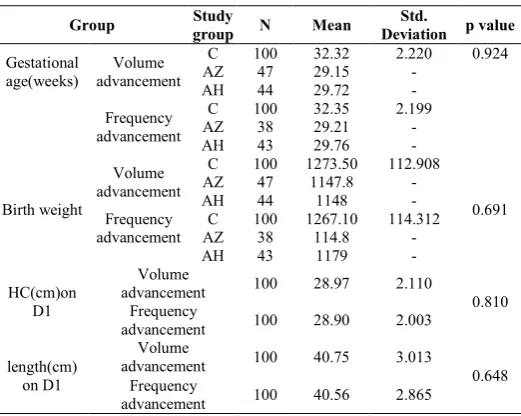
Table 2 Different parameters of the babies included in the two study groups (Volume advancement & frequency
advancement)[28,29].
Group group Study N Mean Deviation Std. p value
Gestational age(weeks)
Volume advancement
C 100 32.32 2.220 0.924
AZ 47 29.15 -
AH 44 29.72 -
Frequency advancement
C 100 32.35 2.199
AZ 38 29.21 -
AH 43 29.76 -
Birth weight
Volume advancement
C 100 1273.50 112.908
0.691
AZ 47 1147.8 -
AH 44 1148 -
Frequency advancement
C 100 1267.10 114.312
AZ 38 114.8 -
AH 43 1179 -
HC(cm)on D1
Volume
advancement 100 28.97 2.110
0.810 Frequency
advancement 100 28.90 2.003
length(cm) on D1
Volume
advancement 100 40.75 3.013
0.648 Frequency
advancement 100 40.56 2.865
Gestational weeks of the babies included in both the study group vary from 28 weeks to 39 weeks.
Mean gestational age of the neonates in the volume advancement group was 32.32 weeks. Mean gestational age of the neonates in the frequency advancement group was 32.35 weeks. P value =0.924, statistically not significant. Gestational age, another baseline character was also comparable in both the groups.
Birth weight of the babies in volume advancement (VA) group varies from 1010 g to 1450g. Mean birth weight of neonates in volume advancement group was 1273.50grams. Birth weight of the babies in frequency advancement group varies from 1010 g to 1470g.Mean birth weight of neonates in frequency advancement group was 1267.312 grams. P value=0.691, statistically not significant.
Birth weight another baseline character was also comparable in both the study group.
Table 3 Baseline antenatal risk factors (Volume advancement & frequency advancement).
Parameter
Group
Total P value Volume
Advancement
Frequency Advancement
Preeclampsia Count 2 4 6 0.407
% 2 4 3
GDM Count 2 3 5 0.651
% 2 3 2.5
Placental insufficiency
Count 4 4 8
1.0
% 4 4 4
Oligohydramnious Count 7 4 11 0.352
% 7 4 5.5
Baseline antenatal factor were comparable in both the groups statistically significant difference was not found.
Table 4 Prelacteal feed comparison (Volume advancement & frequency advancement).
Prelacteal feed
Group
Total P value Volume
Advancement
Frequency Advancement
Yes Count 3 2 5
0.651
% 3 3 2.5
No Count 97 98 195
% 97 98 97.5
Total Count 100 100 200
In volume advancement group, out of total neonates 3 babies have prelacteal feed and in volume advancement group, out of total neonates 2 babies have prelacteal feed. Statistical analysis: chi square is 0.205, p-value =0.651 i.e. statistical not significant.
Table 5 Changes in different parameter on day 15 of life (Volume advancement & frequency advancement)[28,29].
Group N Mean Standard
deviation P value
Change in head circumference
Volume Advancement 99 0.700 0.2559
0.257
Frequency Advancement 98 0.655 0.2076
Change in Length
Volume Advancement 99 1.019192 0.2801883
0.873
Frequency Advancement 98 1.014 0.1292
Gain in weight Volume Advancement 99 104.55 22.373 0.0001
Frequency Advancement 98 40.20 16.053
Gain of wt D10 (gm)
Volume Advancement 99 32.32 14.202
0.001
Frequency Advancement 98 11.02 9.791
Gain of wt D15 (gm)
Volume Advancement
C 99 104.44 22.737 0.0001
AZ 47 134.68 0.001
AH 44 299 0.001
Frequency Advancement
C 98 40.20 16.053
AZ 38 398.26
AH 43 105
Days of regaining birth
weight
Volume Advancement
C 99 7.27 0.855 0.001
AZ 47 7.88 0.260
Frequency Advancement
C 98 8.05 0.854
AZ 38 8.03
Days of attaining full feeding
Volume Advancement
C 99 8.25 0.675 0.0001
AZ 47 10.32 <0.001
AH 44 11.04 <0.001
Frequency Advancement
C 98 15.40 1.023
AZ 38 22.53
AH 43 15.76
As one baby from VA group had died on day 7, n=9. Mean change in head circumference on day 15 of life in VA group was 0.70cm whereas mean change in head circumference on day 15 of life in FA group was 0.65cm. P value= 0.257, statistically not significant. Hence there was no effect of the type feeding protocols on change in head circumference on day 15 of life.
Mean change in length on D15 of life in babies of VA group was 1.019 cm whereas mean change in length on D15 of life in babies of FA group was 1.014cm. P value=0.873, which is not significant statistically. Hence there was no statistically significant difference in change in length on day 15 of life in these two study groups.
Mean gain in weight on day 10 of life in volume advancement group was 32.32gms whereas mean gain in weight on day 10 of life in frequency advancement group was 1.02 grams. P value=0.001, significant statistically. Average gain in weight on day 10 of life was significantly more in the volume advancement group. Average change in weight on day 15 of life in babies of volume advancement group was 104.5grams. Average change in weight on day 15 of life in babies of frequency advancement group was 40.20 grams. P value =0.001, significant statistically. Weight gain in babies of VA group was god than the babies in FA group. Volume advancement group, babies had regained their birth weight in 6 to 9 days whereas in frequency advancement, babies regained their birth weight in 6 to 10 days. Majority of the babies took 8 to 9 days. In volume advancement group, mean days to regain birth weight was 7.27 days. In frequency advancement group, mean days to regain birth weight was 8.05 days. p-value=0.01 ,statistically significant. In volume advancement group, babies attained their full enteral feeding in 8 to 12 days whereas babies in frequency advancement group, babies took 15 to 18
days for attaining full enteral feeding. Mean days of attaining full fed in volume advancement group was 8.25 days. In frequency advancement group mean days of attaining full fed was 15.40days. P value =0.001, which is statistically significant. Babies in volume advancement group attained their full fed earlier than the babies in the frequency advancement group.
Table 6 Feeding interrupted& intolerance in number of babies in both group (Volume advancement & frequency
advancement)[28,29].
Parameter
Group
Total
P value V A
F A C AZ
C
Feeding Interrupted
Yes Count 17 32 49
0.011 0.025
% 17 32.7 24.7
No Count 83 66 149
% 83 67.375.3
Total Count 100 98 198
% 100 100 100
Feeding Intolerance
Yes Count 4 7 11
0.334
% 4 7.1 5.6
No Count 96 91 187
% 96 92.9 94.4
Total Count 100 98 198
% 100 100 100
In volume advancement group, 17 babies had interrupted feeding and in frequency advancement group 32 babies had interrupted feeding. Statistical analysis: chi square =6.512, p value=0.01(statistically significant).Hence babies of frequency advancement feeding protocol feeding had more interruption of feeding as compared to the babies of volume advancement feeding protocol group.
In volume advancement group 4 neonates had feeding intolerance but in frequency advancement group 7 neonates had feeding intolerance. Statistical analysis: chi square =0.9318, p value =0.334 i.e. statistically not significant. Feeding intolerance was not affected by any of these two feeding protocols.
Table 7 Different complication in both the study group (Volume advancement & frequency advancement)[28,29,30].
Parameter
Group
Total P value Volume
advancement
Frequency
advancement C AZ
Sepsis
Yes Count 4 8 12
0.146 0.042
% 4 8.2 6.1
No Count 96 90 186
% 96 91.8 93.9
Total Count 100 98 198
% 100 100 100
Seizure
Yes Count 1 1 2
0.988
% 1 1.02 1.01
No Count 99 97 196
% 100 98.98 98.99
Total Count 100 98 198
% 100 100 100
Hypogl ycemia
Yes Count 9 5 14
0.284
% 9 5.1 7.1
No Count % 91 91 94.9 93 92.9 184
Total Count 100 98 198
% 100 100 100
NEC
Yes Count 2 1
3(C) 1(AZ) 1(AH)
0.572
% 2 1 1.5
No Count 98 97 195
% 98 98.98 98.5
Total Count 100 98 198
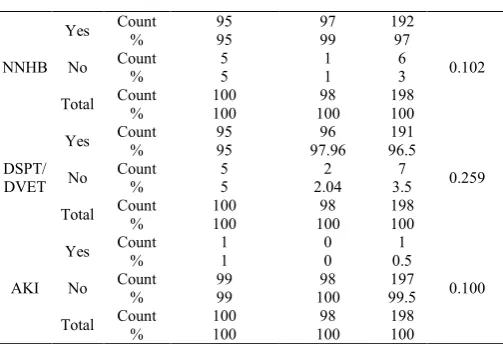
NNHB
Yes Count 95 97 192
0.102
% 95 99 97
No Count 5 1 6
% 5 1 3
Total Count 100 98 198
% 100 100 100
DSPT/ DVET
Yes Count 95 96 191
0.259
% 95 97.96 96.5
No Count 5 2 7
% 5 2.04 3.5
Total Count 100 98 198
% 100 100 100
AKI
Yes Count 1 0 1
0.100
% 1 0 0.5
No Count % 99 99 100 98 99.5 197
Total Count 100 98 198
% 100 100 100
Out of total babies in volume advancement group, 4 had developed sepsis and out of total babies in frequency advancement 9 had developed sepsis. Statically analysis: chi square =1.5068, p value= 0.219 (statistically not significant). Developments of sepsis in the babies of both the groups were not statistically significant. Sepsis was not influenced by the type of feeding protocols. Seizure developed in one baby of volume advancement group as well as in one baby of frequency advancement group. Statistical analysis: chi square=0.002, p value=0.988(statistically not significant). Development of seizures had not influenced by the type of feeding protocols.
In volume advancement group, 9 babies had hypoglycemia and infrequency advancement group 5 babies had hypoglycemia. Statistical analysis: chi square =1.14, p value =0.284 (statistically not significant). Hypoglycemia in neonates was not affected by the type of feeding protocols.
In volume advancement group, 2 babies had developed NEC and in frequency advancement group 1 baby had developed NEC. Statistical analysis: chi square=0.318, p value=0.572(statistically non significant). Types of feeding protocol had no influence on development of NEC.
95 babies out of 10 babies in volume advancement group had neonatal hyperbilrubinemia whereas in frequency advancement group 97 babies out of 98 babies had NNHB. Statistical analysis: chi square =2.67 ,p value =0.102. Neonatal hyperbilrubinemia was not affected by the type of feeding protocol. There was no statistical significant difference in the development of neonatal hyperbilrubinemia (NNHB) in both the groups.
In volume advanced group, 95 babies out of 10 babies received phototherapy/DVET and in frequency advancement group, 96 babies out of 98 babies had received phototherapy/DVET. Statistical analysis: chi square=1.2709, p value=0.259 (statistical non significant).There was no significant difference in two study groups in terms of receiving phototherapy or DVET.
Only one baby in volume advancement group had AKI, no baby in frequency advancement group had developed acute kidney injury. Acute kidney injury was diagnosed by monitoring the urine output. Development of AKI was not affected by the type of feeding protocols followed.
Table 8 Outcome in terms of death and survival in study groups[28,29].
Parameter
Group
Total Volume
Advancement
Frequency Advancement
Outcome
Survival Count 99 98 197
% 99 98 99.5
Death Count 1 0 1
% 1 0 0.5
Total Count 100 98 198
% 100 100 100
Only one baby in volume advancement group had died on day 7 of life and no death had occurred in frequency advancement group.
Table 9 Comparing the length of stay in hospital in both the study groups.[28,29,30,31]
Group statistics Mean(days) Std.
Deviation
P value
C AZ AH C AZ AH
Duration of hospital
stay
V A 99 16.08 38.55 41.20 1.085
0.0001 0.221 0.34
F A 98 23.95 50.71 42.62 2.672
In volume advancement group (VA) group babies stayed in hospital in the range of 15 to 20 days. However babies in frequency advancement group length of hospitalization ranges from 21 days to 30 days. In volume advancement group, mean days of hospital stay was 16.08 days and in frequency advancement group mean days of hospital stay was 23.95 days. Babies of frequency advancement group had longer duration of hospital stay as compared to the babies in volume advancement group. Statistical analysis: p value =0.001(statistically significant). Babies of volume advancement group discharged earlier from the hospital as they fulfilled the discharge criteria (consecutive 3 days of weight gain) earlier.
DISCUSSION
All included new born were divided into two groups as volume advancement (VA) group and frequency advancement (FA) group. The two groups were comparable for gender, birth weight, gestational age, head circumference, birth length at the initiation of the protocol. There are two study available by Amal Zubani et al[28] in 2016 and by Afaq Husain et al[29] in 2018.
As only two studies are available for comparison of our study and not all aspect have been studied by previous author citation are not available for all the tables.
Citation to Table-1
The baseline demographic parameter of sex distribution shows there is slight female predominance in both volume advancement and frequency advancement study, comparable with the study done by Amal Zubani et al[28] in 2016 and differ from the study done by Afaq Husain et al[29] in 2018 showing male predominance.
Citation to Table-2:
The study done by Amal Zubani et al[28] in 2016 and Afaq Husain et al[29] in 2018 , the mean gestational age was aroung 29 weeks where as current study having mean gestational age of 32 weeks. So also in mean birth weight is low (1150grams) as compared to current study(1250grams)
This aspect of study has not done by any of the previous author, citation not available.
Citation to Table-5:
In volume advancement group birth weight was regained in 7.27 days (mean) whereas birth weight was regained in 8.05 days (mean) in frequency advancement group, which was statistically significant, with p value of 0.01. However, when this was compared with other similar studies, the time of regaining birth weight was not significantly different in the two groups.
Mean head circumference (HC) in VA group on day 1 of life was 28.97 cm whereas mean head circumference in FA group on day 1 of life was 28.90 cm. P value=0.810, which was not statistically significant. Mean length in VA group on day 1 of life was 40.75cm where as mean head circumference in FA group on day 1 of life was 40.56 cm. P value=0.648, statistically not significant.
In Amal Zubani et al study[28], both groups have regained their birth weight within 7-10days, babies in frequency advancement group attained birth weight at day 8.03(mean) of life as compared with 7.8day (mean) of life in volume advancement group, which was not statistically significant. In volume advancement group weight gain on D10 & ON D15 of life is more than that of frequency advancement group. It was mostly due to more daily feeding volume increment i.e. 20ml/kg/day in VA group versus 10ml/kg/day in FA group. In Afaq Husain et al[29] study, weight gain was significantly more in VA group (p=0.01).
In Amal Zubani et al study [28], weight gain was more in favor of FA group as compared to VA group which was in contrast o the present study. The reason most probably was due to the fact that babies in FA group had spent more days on TPN. Days to reach full feeding was significantly different in two groups, babies of VA group attain full feeding much earlier than babies in FA group.
VA group had taken a mean of 8.25 days whereas FA group had taken mean of 15.40 days. (p=0.001)
Afaq Husain et al[29] study also found les days to reach full fed in VA group as compared to FA group just like this present study. In contrast Amal Zubani et al[28] study had shown an average difference of about 12 days in attaining full feed in both the groups (p<0.01). FA group reached full fed earlier than VA group.
Citation to Table -6
Feeding was interrupted more in FA group than VA group and statistically significant (p=0.01).
In previous study by Amal Zubani et al[28] feeding interruption was also statistically significant more in FA group. (p =0.025)
Feeding intolerance was not significantly different in both groups which indicate that as if feeding intolerance was not influenced by the feeding protocols chosen in the present study.
Citation to Table- 7
Sepsis in both groups were not statistically significant.(p=0.146) mostly due to following the universal aseptic measures. In Amal Zubani et al[28] study ,sepsis was
statistically significant (p=0.042)and was found to be associated more in FA group.
It is a well known fact hat parenteral nutrition also increases the risk of catheter elated blood stream infections, it seems a reasonable explanation for association of more sepsis in the study by Amal Zubani et al[28]. Bombell S et al[30] concluded that early enteral feeding increases the GI motility, prevent normal flora and reduces the risk the risk of infections. In this study total duration of iv fluid was longer in FA group as compared to VA group. Therefore, though volume advancement group should have les incidence of sepsis, we did not found any statistically significant association of sepsis in any of the said groups. Strict adherence to universal method of sepsis prevention may be the reasonable explanation.
Seizure in both groups was not significantly different (p=0.98), one baby from each group had developed seizure which was associated with hypoglycemia and hypocalcaemia. However seizure as a variable was not taken into consideration in previous studies Comparing incidence of hypoglycemia in both the groups, it was no found statistically significant. There was no effect of feeding protocols in blood glucose level in neonates (p=0.284).
Two babies in volume advancement group had developed NEC whereas in frequency advancement group one baby had developed NEC. This difference was not statistically significant (p=0.572).
In Amal Zubani et al[28] study, only one neonate of VA group had NEC. In Afaq Husain et al[29] study, also one patient had NEC which was in VA group. Recent systematic reviews have also concluded that VA did not increases the risk of NEC in neonates and is a safe option.
Number of babies who had developed neonatal hyperbilrubinemia (NNHB) and received phototherapy was more in FA group than VA group but he difference was not found statistically significant (p=0.102, p=0.259 respectively). In previous studies NNHB was not taken as a comparing parameter.
There was only one patient from VA group who had developed AKI of stage 1, the baby had improved gradually over 12hrs with conservative management. In previous studies no such report was mentioned regarding AKI in study groups.
Citation to Table-8:
Unfortunately, there was one death in the study groups that belonged to VA group. The baby was of 29 weeks gestational age developed sepsis on DAY 4 of life with multiorgan dysfunction in form of gastrointestinal bleeding sclerema, had NEC with gut perforation, had apnea for which baby got intubated, was in shock and was on vasopresors and died on Day 7 of life.
Citation to Table-9
babies got discharged slow, hence length of hospitalization increases.
In Amal Zubani et al[28] study, there was no significant difference in length of hospital stay in two groups (p=0.21).In Afaq Husain et al study[29], there were similar duration of hospital stay in both groups (p=0.34). Recent Cochrane database review have concluded that VA feeding is better than FA feeding because it takes less to reach full feed, rapid weight gain. In addition, it has no adverse effects on NEC. Furthermore, some researchers have found that VA feeding also has beneficial effects on the development of neural outcomes.[30,31]
Summary
Babies of Volume advancement group regain birth weight earlier, Gain of weight on D10 and on D15 , attainment of full enteral feeding was more in the babies of VA group than the frequency advancement (FA) group (mean of 15.40 days). Feeding interruption was more in frequency advancement group than the babies in volume advancement group (p=0.01). Feeding intolerance, Feeding protocols, incidence of sepsis in both the groups were not statistically significant. One baby from each group had seizure which was associated with hypoglycemia .Seizure in both the groups were statistically non-significant (p=0.98).Difference in both the groups in terms of number of babies, who had developed hypoglycemia was not significant (p=0.284). There was no significant difference in both the groups regarding development of neonatal hyperbilrubinemia (p=0.10) and number of babies who had received phototherapy/DVET (p=0.25). Only one baby in VA group had acute kidney injury of stage-1, which got improved with conservative management. Two babies of VA group had developed NEC whereas only one baby of FA group had NEC, this difference was not significant statistically(p=0.57). Unfortunately there was one baby from VA group who had died on day 7 of life with sepsis, multi organ dysfunction, with extreme prematurity. Rest of the neonates in both groups were discharged successfully. Babies of frequency advancement group stayed for a longer period(mean 23.95 days) in the hospital in comparison to the babies of volume advancement group (mean 16.08 days).Difference in length of stay in hospital was statistically significant (p=0.001).
CONCLUSION
Volume advancement feeding protocol is found to be better than frequency advancement feeding protocol considering the benefits of rapid weight gain in volume advancement group, earlier attainment of full enteral nutrition, lesser duration of hospital stay and lower incidence of feeding interruption. The incidence of associated adverse events like feeding intolerance, development of necrotising enterocolits (NEC), sepsis, seizure, acute kidney injury, neonatal hyperbilrubinemia and receiver of phototherapy/DVET were not statistically significant among the two groups. Hence volume advancement feeding protocol should be considered as the preferred feeding protocol.
Limitation of our Study:Due to small sample size we cannot
reach in a conclusion about the significance of these associations. Further studies with large number of samples, multi centric study are required to draw any inference for
validation.
What is the existing knowledge till date : Many of the developing country in their nursery still using frequency
advancement of feeding practice for the very Low birth weight, small for gestational age baby for the feeding the baby. What this study add to existing knowledge: The present study contributes to the knowledge of feeding in very low birth weight and small for gestational age that Volume advancement feeding protocol is found to be better than frequency advancement feeding protocol in all the parameter of the development.
Institutional Ethics Committee (S C B Medical College, Cuttack. 753007, India) ref number- 687/19.09.2018
This study is not funded by any agency.
Contributionship statement
Dr Pradeep Kumar Jena: Concept and design , revising critically for intellectual contents, final approval and agreement to be accountable.
Dr Sudipta Sahoo: Data analysis and interpretation, drafting the work, final approval and agreement to be accountable . Dr. Mangal Charan Murmu: Drafting the work, Manuscript writing, validation of data, final approval and agreement to be
accountable.
Bibliography
1. Salhotra A, Ramji S. Slow versus fast enteral feed advancement in very low birth weight infants: a randomized control trial. Indian Pediatr. 2004 May;41(5):435-41.
2. Simpson C, Schanler RJ, Lau C. Early introduction of oral feeding in preterm infants. Pediatrics. 2002 Sep;110(3):517-22
3. Troche B, Harvey-Wilkes K, Engle WD, et al. Early minimal feedings promote growth in critically ill premature infants. Biology of the Neonate. 1995;67:172-181
4. American. Academy. of. Pediatrics Committee on Nutrition Nutritional Needs of Low-Birth-Weight Infants PEDIATRICS1985: 75 ; 5 :976-985
5. Ehrenkranz R, Younes N, Lemons J, et al. Longitudinal growth of hospitalized very low birthweight infants. Pediatrics. 1999;104:280-289
6. Richard A Ehrenkranz, Abhik Das, Lisa A. Wrage, Brenda B. Poindexter, Rosemary D. Higgins, Barbara J. Stoll, and William Oh Early Nutrition Mediates the Influence of Severity of Illness on Extremely Low Birth Weight Infants Pediatr Res. 2011 Jun; 69(6): 522-529. 7. Wahlig T, Georgieff M. The effects of illness on
neonatal metabolism and nutritional management.Clin Perinatol. 1995;22:77-95
8. Theresa M. Wahlig,Catherine W. Gatto, Stephen J. Boros,Mark C. Mammel,Marla M. Mills,Michael K. Georgieff, Metabolic response of preterm infants to variable degrees of respiratory illness . J pediatr.1994;124:283-8.DOI:
https://doi.org/10.1016/S0022-3476(94)70321-3 9. Adamkin D. Aggressive nutritional management of the
very low birth weight infants. J Arab Neonatol Forum 2006;3:11-6
10. Ehrenkranz RA Early, aggressive nutritional management for very low birth weight infants: what is the evidence? Semin Perinatol. 2007 Apr;31(2):48-55. 11. Embleton NE, Pang N, Cooke RJ. Postnatal
consequence of current recommendations in preterm infants? Pediatrics. 2001 Feb; 107 (2):270-3.
12. Smallpiece V, Davies PA: Immediate feeding of premature infants with undiluted breast-milk. Lancet 1964; 2:1349-1352.
13. Paranka MS, Yoder BA, Brehm W: Improved outcome of extremely premature infants in the 1990s. Mil Med 1999; 164:568-571.
14. Lucas A, Morley R, Cole TJ: Randomised trial of early diet in preterm babies and later intelligence quotient. BMJ 1998;317:1481-1487
15. Latal-Hajnal B, von Siebenthal K, Kovari H, Bucher HU, Largo RH: Postnatal growth in VLBW infants: significant association with neurodevelopmental outcome. J Pediatr 2003;143:163-170
16. Ho MY, Yen Yu, Hsieh MC, Chen HY, Chien SC, Hus-Lee SM. Early versus late nutrition support in premature neonates with respiratory distress syndrome. Nutrition 2003;19:257-60
17. Agostoni C, Buonocore G, Carnielli VP, DeCurtis M, et al: Enteral nutrient supply for preterm infants: commentary from the European Society for Paediatric Gastroenterology, Hepatology, and Nutrition Committee on Nutrition. J Pediatr Gastroenterol Nutr 2010; 50:85-91.
18. Koletzko B, Goulet O, Hunt J, Krohn K, Shamir R; Parenteral Nutrition Guidelines Working Group; European Society for Clinical Nutrition and Metabolism; European Society of Paediatric Gastroenterology, Hepatology and Nutrition (ESPGHAN); European Society of Paediatric Research (ESPR). 1. Guidelines on Paediatric Parenteral Nutrition of the European Society of Paediatric Gastroenterology, Hepatology and Nutrition (ESPGHAN) and the European Society for Clinical Nutrition and Metabolism (ESPEN), Supported by the European Society of Paediatric Research (ESPR). J Pediatr Gastroenterol Nutr 2005;41 Suppl 2:S1-87
19. Ibrahim HM, Jeroudi MA, Baier RJ, Dhanireddy R, Krouskop RW: Aggressive early total parental nutrition in low-birth-weight infants. J Perinatol 2004;24:482-486.
20. Te Brakke FWJ, van den Akker CHP, Wattimena DJL, Huijmans JGM, van Goudoever JB: Amino acid administration to premature infants directly after birth. J Pediatr 2005; 147:457-461.
21. Can, E, Bulbul, A, Uslu, S, Comert, S, Bolat, F, Nuhoglu, A. Effects of aggressive parenteral nutrition on growth and clinical outcome in preterm infants. Pediatr Int. 2012; 54:869-874.
22. Neu J. Necrotizing enterocolitis: the search for a unifying pathogenic theory leading to prevention. Pediatr Clin North Am. 1996 Apr;43(2):409-32
23. S Patole and N de Klerk. Impact of standardised feeding regimens on incidence of neonatal necrotising enterocolitis: a systematic review and meta-analysis of observational studies Arch Dis Child Fetal Neonatal Ed. 2005 Mar; 90(2): F147-F151.
24. Berseth CL. Gastrointestinal motility in the neonate. Clin Perinatol 1996; 23:179-90.
25. Berseth CL. Gestational evolution of small intestine motility in preterm and term infants. J Pediatr 1989; 115:646-51.
26. Ramritu P, Halton K, Cook D, Whitby M, Graves N. Catheter-related
bloodstreaFFFFFFFFFFFFFFFFFFFFFFFFFFFFFFFFF FFFFFFFFFFFFFFFFFFFFFFFFFFFFFFFFFFFFFFFF FFFFFFFFFFFFFFFFFFFFFFFFFFFFFFFFFFFFFFFF FFFFFFFFFFFFFFFFFFFFFFFFFFFFFFFFFFFFFFFF FFFFFFFFFFFFFFFFFFFFFFFFFFFFFFm infections in intensive care units: A systematic review with meta-analysis. J Adv Nurs 2008;62:3-21
27. Wilson DC, Cairns P, Halliday HL, Reid M, McClure G, Dodge JA. Randomised controlled trial of an aggressive nutritional regimen in sick very low birthweight infants. Arch Dis Child Fetal Neonatal Ed 1997;77:F4-11.
28. Zubani A, Mersal A, AlSaedi S, AlAhmadi K, AlDeek A, Sadiq Bb. Comparison of volume and frequency based feeding protocols in very low birth weight infants: A prospective randomized study. J Clin Neonatol 2016;5:233-7
29. Afaq Hussain, Abdur Rehman, and Nazia Fatima Comparison of volume and frequency advancement feeding protocols in very low birth weight neonates Pak J Med Sci. 2018 Jan-Feb; 34(1): 78-81.
30. Bombell S, McGuire W. Delayed introduction of progressive enteral feeds to prevent necrotising enterocolitis in very low birth weight infants. Cochrane Database Syst Rev. 2008;2:CD001970. doi: 10.1002/14651858.CD001970.pub2
31. Slow advancement of enteral fed volumes to prevent necrotising enterocolits in very low birth weight infants. Cochrane colabaration 2013.
How to cite this article:
Pradeep Kumar Jena, Sudipta Sahoo and Mangal Charan Murmu (2019) ' A Study on Comparison of Volume And Frequency Based Feeding Protocol in very low birth weight baby', International Journal of Current Medical and Pharmaceutical Research, 05(10), pp 4593-4600.
![Table 7 Different complication in both the study group (Volume advancement & frequency advancement)[28,29,30]](https://thumb-us.123doks.com/thumbv2/123dok_us/1335572.1642048/4.595.306.558.522.794/table-different-complication-study-volume-advancement-frequency-advancement.webp)