©IJRASET 2015: All Rights are Reserved
190
Efficiency Improvement of Three Phase Induction
Motor Using WCCA Method
Banti khan1, Ashita Goyal2 1
PG Scholar, School of Energy and Environmental Studies, DAVV, India
2
PG Scholar, School of Computer Science and IT, DAVV, India
Abstract— In this paper, the effect of Water Cooling Capillaries Action (WCCA) on the efficiency of 1.1 kW, 50 Hz, three phase squirrel cage induction motor is presented. This method is used to lower down the temperature of stator windings. So, resistance also decreases as a result of which efficiency of motor increases. Efficiency analysis of a three phase induction motor was done by means of load test. Based on the result obtained from this test, the efficiency of three phase induction motor using WCCA method was increased by 4.30% when compared to the efficiency of motor without using this method.
Keywords —Capillaries, Efficiency Analysis, Load Test, Three Phase Induction Motor, Stator Windings
I. INTRODUCTION
Three phase induction motors consume approximately 60% of industrial electricity. Just 1% increase in efficiency of all the motors in India will save 500 MW powers which needs the initial generation cost of 2000 crores [1]. Three phase induction motors are widely used in heavy and medium industrial load applications and agriculture purposes. Globally around 40% of the electricity supplied to the industrial load is consumed by induction motorized system [2]. It is therefore important to improve the efficiency of this type of electric motorized system. Efficiency is mainly depends on the properties of enamel used for coating of windings of motor and its operating temperature [3]. It is a well known fact that the operating temperature of induction motor has a very strong relationship with the resistance of stator windings. When temperature increased stator resistance also increases but motor efficiency decreases [2]. Most commonly used motors are Totally Enclosed Fan Cooled (TEFC) type which is provided with an external forced air cooling fan mounted on Non-Driven End (NDE) of shaft, with cooling ribs running axially along the outer surface of motor frame [4]. TEFC type air cooling method has some limitations as cooling is effective only along the axis of rotor but it cannot remove the motor’s surrounding heat and the heat transfer coefficient of air is too low to reduce excessive heat from stator’s fin [5]. With increase in motor’s power rating, dimension of system increases by lowering the stator temperature. For this a highly effective cooling and ventilation system is required which can ensure sufficient heat removal from the inner side of motor [6]. Substantial improvement can be achieved by adopting direct water cooling method, which can ensure relatively low temperature of stator. In this paper, the efficiency of three phase induction motor is increased by using Water Cooling Capillary Action (WCCA) method; it is a low cost method which does not require big external heat exchanger as well as external energy for cooling. Water absorbed by capillaries creates natural ventilation system which lower down the stator temperature as well as resistance which in turn increases the efficiency. Materials and methods adopted are described in section IV and experimental result by load test on 1.1 kW, 50 Hz, three phase squirrel cage induction motor is discussed in section V.
II. MECHANISMS OF HEAT GENERATION INSIDE AN INDUCTION MOTOR
As a result of electrical and mechanical losses inside the machines, all rotating electrical machines dissipate heat. Losses are higher during the process of starting of motor and dynamic braking and are increases with loading [7]. The mechanism of heat generation in induction motors are classified into four groups, mainly related to the places where losses occur. These are joule losses, iron losses, stray losses and mechanical losses [8].
A. Joule losses
This mechanism corresponds to the conversion of electrical energy into thermal energy. These types of losses are directly related to electric resistance of the conductor and changes proportionally to the square of the current which is represented by equation as [9]:
Pj =I 2
©IJRASET 2015: All Rights are Reserved
191
Energy conversion by joule effect in squirrel cage induction electric motors occurs in the stator (copper windings) and in the squirrel cage (aluminium bars).
B. Iron losses
These losses are due to the conversion of electric energy into thermal energy in the iron. They are divided in the hysteresis and Foucault (eddy currents) losses. The eddy current losses are joule losses that occur in the flow of an induced electric current. The hysteresis losses are due to the energy expended to align the iron magnetic poles to the applied magnetic field [10].
C. Stray load losses
The stray load losses are minor losses in the electric motor operation and their quantification is very difficult [11]. This includes the losses due to the skin effect, high frequency among others that are unknown or not easily quantified.
D. Mechanical losses
These losses comprise the conversion of the mechanical energy into thermal energy due to mechanical friction. Here includes mainly the losses due to rolling bearings (ball/ring interface) and the cooling fan losses.
III. EFFECT OF HEAT ON EFFICIENCY OF INDUCTION MOTOR
In industrial terms efficiency is the ratio of shaft output power to the input power or in other words, it represents the success of machine in converting electrical power to mechanical power [12]. This can be expressed by the following equation:
= ℎ
ℎ +
The difference between the electrical (input) and mechanical (output) power is the sum of motor losses and these losses are directly related with the heat generated inside the motor as described in section. Section winding resistance is directly related to the motor’s temperature and it is proved that with increase in temperature due to heat and losses, the efficiency of motor degrades [13]. When the stator and core temperature of three phase induction motor is increased, stator resistance also increases as a result of which efficiency decreases [14]. So, it is required to maintain the stator temperature by adopting cooling method in order to improve the efficiency.
IV. MATERIALS AND METHOD
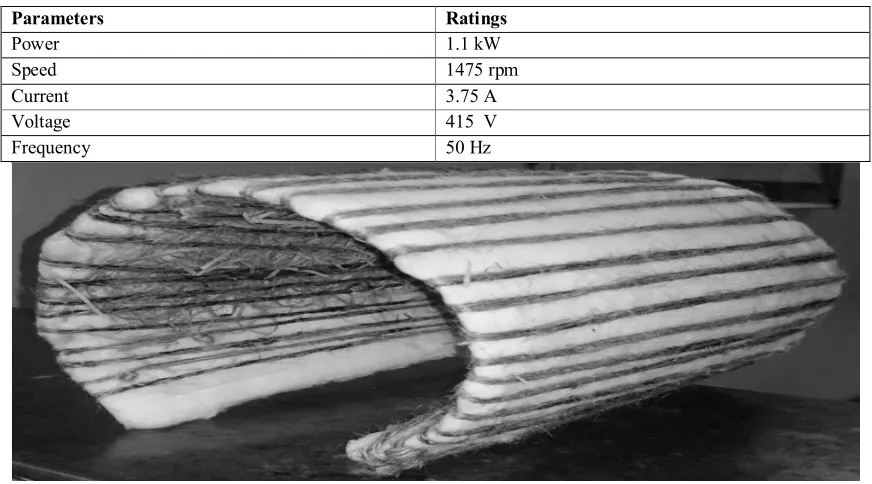
This section provides an overview of experimental setup of WWCC method. For this purpose a three phase squirrel cage induction motor is selected and its specifications are given in table I.
cooling phenomenon takes place when passage air molecules come in contact with the wet layer of jacket; simultaneously there is reduction of surrounding temperature. This heat removal process is beneficial for improving the efficiency of motor.
V. RESULT AND DISCUSSION
A. Load Test
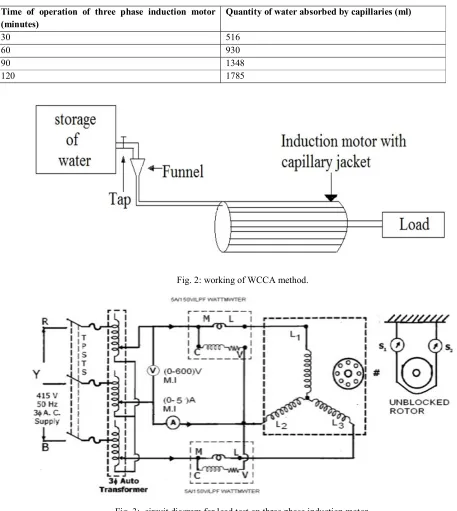
This test was conducted on 1.1 kW three phase induction motor as per circuit diagram shown in figure 3. Current, voltage, input power and spring balance readings were observed in order to measure the torque, output power and efficiency of the motor [12]. Net torque (Newton-metre) produced by three phase induction motor is obtained by using following formula:
T= (F2-F1)*R*9.81
Where R is the radius of brake drum and its measured value is 0.040 metre. F1, F2 are the spring balance reading in Kg. Output
power in Watts is calculated as:
=2 60
Where, Nr is rotor speed in rpm, measured by a non-contact type digital tachometer. Percentage efficiency of motor is calculated by using formula:
% =
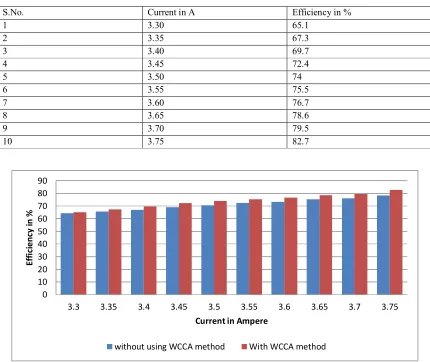
Table IV shows the experimental outcome of load test on three phase induction motor without using WCCA method. With increase in loading on motor, its efficiency increases up to a certain point and maximum efficiency calculated 78.4%. Load test done on the same three phase induction motor using WCCA method, its maximum efficiency calculated 82.7%. Variation in efficiency with loading is shown in table V. Figure 4 shows the comparison of percentage efficiency, when load test done on three phase induction motor with and without using WCCA method separately. Result clearly shows that the efficiency of induction motor is comparatively higher for WCCA method with variations in current.
[image:4.612.88.524.459.701.2]VI. FIGURES AND TABLES
TABLE I: SPECIFICATION OF THREE PHASE INDUCTION MOTOR
Parameters Ratings
Power 1.1 kW
Speed 1475 rpm
Current 3.75 A
Voltage 415 V
Frequency 50 Hz
TABLE II: COMPOSITION OF JUTE FIBRE
Composition Weight in Percentage (%)
Lignin 12-14
- cellulose 58-63
Hemicelluloses 21-24
Minor constituents 2-4
TABLE III: QUANTITY OF WATER ABSORBED BY THE CAPILLARIES WITH RESPECT TO TIME
Time of operation of three phase induction motor (minutes)
Quantity of water absorbed by capillaries (ml)
30 516
60 930
90 1348
[image:5.612.63.520.197.708.2]120 1785
Fig. 2: working of WCCA method.
[image:5.612.99.514.486.692.2]©IJRASET 2015: All Rights are Reserved
[image:6.612.82.527.106.250.2]194
TABLE IV: EFFICIENCY OF THREE PHASE INDUCTION MOTOR WITHOUT USING WCCA METHOD FROM LOAD TEST.
S.No. Current in A Efficiency in %
1 3.30 64.4
2 3.35 65,7
3 3.40 67.1
4 3.45 69.2
5 3.50 70.6
6 3.55 72.5
7 3.60 73.2
8 3.65 75.4
9 3.70 76.1
[image:6.612.91.521.286.648.2]10 3.75 78.4
TABLE V: EFFICIENCY OF THREE PHASE INDUCTION MOTOR WITH WCCA METHOD FROM LOAD TESTS
S.No. Current in A Efficiency in %
1 3.30 65.1
2 3.35 67.3
3 3.40 69.7
4 3.45 72.4
5 3.50 74
6 3.55 75.5
7 3.60 76.7
8 3.65 78.6
9 3.70 79.5
10 3.75 82.7
Fig.4: Comparison of efficiency of three phase induction motor for different current values with and without applying WCCA method.
VII. CONCLUSION
In this paper, the stator and core temperature of a 1.1 kW three phase induction motor is lowered by means of WCCA method.
0 10 20 30 40 50 60 70 80 90
3.3 3.35 3.4 3.45 3.5 3.55 3.6 3.65 3.7 3.75
Ef fi ci e n cy in %
Current in Ampere
©IJRASET 2015: All Rights are Reserved
195
Experimental results included an efficiency analysis and the effect of cooling by WCCA method on efficiency of motor was presented. When stator and core temperatures was decreased by WCCA method, the stator resistance decreases which in turn increased the efficiency of three phase induction motor results from load test shows that the maximum efficiency increased from 78.4% under normal operating condition to 82.7% under cooled operating condition by means of WCCA method. The efficiency of specific induction motor was therefore increased by 4.30%. It should be noted that the method used in this paper is of low cost and consumes less water. It does not require any external energy for cooling. Materials used to prepare apparatus for this method are easily available and of low cost. WCCA method is highly effective due to high specific heat capacity of water and high heat transfer coefficient.
REFERENCES
[1] D.E. Selvaraj, C.P. Sugumaran and B. Guruprakash, “Analysis of efficiency, thermal withstanding capacity and electromagnetic interference of three phase squirrel cage induction motor coated with SiO2 and TiO2 nanocomposite filled enamel”, International Journal of Science and Engineering Applications,vol.1(1),
pp. 17-21, 2012.
[2] R. Gouws and H.V. Jaarsveldt, “Impact of thermoelectric cooling modules on the efficiency of a single-phase asynchronous machine”, Journal of Energy in Southern Africa, vol. 25(1), pp. 13-18, 2014.
[3] E.L. Brancato, “Estimating the lifetime expectancies of motors”, IEEE Electrical Insulation Magazine, vol. 8(3), pp. 5-13, 1992.
[4] K.G. Bante, S.G. Tarnekar and D.R. Tutakane, “AC motor cooling system analysis based on application case study”, International Journal of Engineering Inventions, vol. 2(8), 9-15, 2013.
[5] M. Sikora, R. Vlach and P. Navratil, “The unusual water cooling applied on small asynchronous motor”, Engineering Mechanics, vol. 18(2), 143-153, 2011. [6] S.C. Mukhopadhyay, “Prediction of thermal condition of cage-rotor induction motors under non-standard supply systems”, International Jounal On Smart Sensing and Intelligent System, vol. 2(3), 381-395, 2009.
[7] S.L. Ho and W.N. Fu, “Analysis of indirect temperature rise test of induction machine using time stepping FEM”, IEEE Trans. on Energy Conversions, vol. 16(1), 55-60, 2001.
[8] S.C. Mukhopadhyay and S.K. Pal, “Temperature analysis of induction motors using a hybrid thermal model with distributed heat sources”, Journal of Applied Physics, vol. 83(11), 6368-6370, 1998.
[9] R. Findlay, N. Stranges and D.K. Mackay, “Losses due to rotational flux in three phase induction motor”, IEEE Transactions on Energy Conversions, vol. 99(2), 543-549, 1994.
[10] C. A. Hernandez-Aramburo, T. C. Green and A.C. Smith, “Estimating rotational iron losses in an induction machine”, IEEE Transactions on Magnetics, vol. 39(6), 3527-3533, 2009.
[11] C. A. Hernandez-Aramburo, T. C. Green, and A. C. Smith, “Assessment of power losses of an inverter-driven induction machine with its experimental validation”, IEEE Transaction on Industrial Applications, vol. 39(8), 994–1004, 2003.
[12] P.S. Bhimbhra, “Electrical machinery”, 7th
ed., Khanna Publishers, India, 2007.
[13] H. Oraee, “A quantitative approach to estimate the life expectancy of electric motors”, IEEE Transactions on Dielectrics and Electrical Insulation, vol. 7(6), 790-796, 2000.
[14] A. Mihalcea, B. Szabados, J. Hoolboom, “Determining total losses and temperature rise in induction motors using equivalent loading methods”, IEEE Transactions on Energy Conversions, vol. 16(3), 214-219, 2001.