Targeting DNA repeat sequences with Py-Im polyamides
Thesis by JeenJoo Sophia Kang
In Partial Fulfillment of the Requirements for the degree of
Doctor of Philosophy
California Institute of Technology Pasadena, California
2015
© 2015 JeenJoo Sophia Kang
Acknowledgements
I learned a great deal in graduate school, and a good measure of it is from the people I have interacted with over the years. Many people on- and off- campus that have positively influenced my years at Caltech. I would like to acknowledge at least some of them here.
I would like to thank my advisor Prof. Peter Dervan for his scientific guidance during my graduate studies. The intellectual freedom that he promotes in the lab, balanced by his advice on risk, has taught me to explore different areas of research in a considered manner. He has been supportive of, and appreciated the joy of, pursuing self-generated ideas even as I kept going “off the ranch”. I expect the scientific judgment and understanding of new technologies that I have gained during my graduate education will prove essential to my future career. I would also like to thank my graduating committee chaired by Prof. Bob Grubbs and joined by Prof. Jim Heath and Prof. Linda Hsieh-Wilson. Their advice and support has been indispensible to my development in graduate school. Beyond science, the genuine interest of professors in the welfare of students makes Caltech an exceptional place.
late nights in the lab. My fellow graduate students: Alexis Kurmis, Ben Li, Thomas Martinez, Dave Montgomery, Jerzy Szabowski, Fei Yang; and post-doctoral colleagues: Alissa Hare, Amanda Hargrove, Jevgenij Raskatov, Dan Gubler, Amanda Silberstein, Jamie Wang, Sam Weisbrod, and Tim Welch were wonderful labmates. We are all so different, yet the work of this lab brought us all together for a short while— there is something special in that, and I look forward to when we might cross paths again.
My work would not have progressed without the help of Igor Antoshechkin in the Sequencing facility; and Shelley Diamond and Diana Perez in the Flow cytometry facility. They provided not only scientific help, but also moral support in the face of difficulties. Similarly, Vicky Brennan, Joe Drew, and Agnes Tong fix everything.
Thank you to all my friends, but in particular those in chemistry and the Korean (sometimes-) Tennis club. You have injected fun and relief into these years; my time spent with you defines a great deal of my Caltech experience. Some of our memories— grillin’n’chillin, “stop it, Myles”, “Leonard”, poker nights, “yeah, we’re three people”, nyan cat, tennis, “definitely a halibut”— I hope to build on over a lifetime of friendship.
Abstract
Table of Contents
Acknowledgements ... iv
Abstract ... vi
Table of Contents ... vii
List of Figures and Tables ... ix
Chapter 1 ... 1
1.1 Complexity coded in DNA ... 2
1.2 Epigenetic Organization of DNA ... 2
1.3 Transcriptional Regulation ... 5
1.4 Molecular recognition of DNA ... 7
1.5 Biological modulation with Py-Im polyamides ... 12
1.6 Scope of Work ... 15
1.7 References ... 17
Chapter 2 ... 21
Abstract ... 22
2.1 Introduction ... 23
2.2 Results ... 26
2.3 Discussion ... 39
2.4 Materials and Methods ... 41
2.5 Acknowledgment ... 45
2.6 References ... 47
Chapter 3 ... 50
Abstract ... 51
3.1 Introduction ... 52
3.2 Results ... 54
3.3 Discussion ... 71
3.4 Materials and Methods ... 73
3.5 Acknowledgments ... 82
Chapter 4 ... 98
Abstract ... 99
4.1 Introduction ... 100
4.2 Results ... 103
4.3 Discussion ... 107
4.4 Materials and Methods ... 109
4.5 References ... 112
Chapter 5 ... 114
Abstract ... 115
5.1 Introduction ... 116
5.2 Results ... 121
5.3 Discussion ... 127
5.4 Materials and Methods ... 127
List of Figures and Tables
Chapter 1 ... 1
Figure 1.1 ... 3
Figure 1.2 ... 6
Figure 1.3 ... 7
Figure 1.4 ... 8
Figure 1.5 ... 9
Figure 1.6 ... 10
Figure 1.7 ... 11
Figure 1.8 ... 12
Figure 1.9 ... 13
Figure 1.10 ... 14
Chapter 2 ... 21
Figure 2.1 ... 25
Figure 2.2 ... 27
Figure 2.3 ... 28
Table 2.1 ... 29
Figure 2.4 ... 30
Figure 2.5 ... 32
Figure 2.6 ... 33
Table 2.2 ... 34
Figure 2.7 ... 35
Figure 2.8 ... 36
Figure 2.9 ... 38
Chapter 3 ... 50
Figure 3.1 ... 53
Figure 3.2 ... 55
Figure 3.3 ... 56
Figure 3.4 ... 58
Figure 3.5 ... 59
Figure 3.6 ... 61
Figure 3.7 ... 63
Figure 3.8 ... 65
Table 3.1 ... 68
Figure 3.9 ... 69
Figure 3.10 ... 70
Table 3.6 ... 74
Figure 3.11 ... 75
Table 3.7 ... 76
Table 3.8 ... 76
Table 3.9 ... 77
Table 3.2 ... 83
Table 3.3 ... 89
Table 3.4 ... 91
Table 3.5 ... 92
Chapter 4 ... 98
Figure 4.1 ... 100
Table 4.1 ... 103
Figure 4.3 ... 104
Figure 4.4 ... 106
Table 4.2 ... 107
Figure 4.5 ... 108
Table 4.3 ... 110
Chapter 5 ... 114
Figure 4.1 ... 117
Figure 4.2 ... 119
Figure 4.3 ... 121
Table 4.1 ... 122
Figure 4.4 ... 123
Figure 4.5 ... 125
Chapter 1
1.1 Complexity coded in DNA
The blueprint for living organisms encoded in deoxyribose nucleic acid (DNA) determines every possible transcriptomic and proteomic state for all the cells in an organism. According to the central dogma of molecular biology put forth in 1958, DNA is the foundational molecule from which ribonucleic acid (RNA) is transcribed, and protein is translated from the RNA transcript (Figure 1.1A).1 The coordination and control of these molecules are critical to the spatiotemporal organization of cell activity and tissue maintenance in organismal health. In humans, the 3 billion letter genome is organized in 23 chromosomes and encodes over 20,000 protein-coding genes.2 In addition, over 15,000 long non-coding RNA transcripts have been identified and are thought to play a regulatory role.3 The structural organization of DNA and its gene expression profile is specific to each cell-type and is accomplished by layers of exquisitely controlled processes. The etiology of many diseases can be found in misregulated DNA. Modulation by chemical means of DNA regulation may yield strategies for therapeutic benefit.
1.2 Epigenetic Organization of DNA
Figure 1.1 Structural organization of DNA in the cell. A) DNA (in black) is wrapped around the nucleosome core particle and organized as compact heterochromatin or transcriptionally active euchromatin. Transcription factors (TF) bind DNA and recruit cofactors (CF) and RNA polymerase II (RNAP) to transcribe mRNA from DNA. mRNA is translated into protein by ribosomes. B) The nucleosome core particle is comprised 147 base pairs of DNA wrapped around a histone octamer. Epigenetic modifications, including methylation (Me), acetylation (Ac), ubiquitiniylation, and SUMO-lation on the tails of histones govern chromatin structure. Methylated DNA is recognized by methyl-binding proteins (MBP) which recruit histone deacetylases (HDAC) to modify chromatin into a transcriptionally inactive state. C) Chromosomes end in the telomeric 5’-TTAGGG-3’ hexamer repeat sequence, which can trigger a DNA damage response due to its similarity to a DNA double-stranded break. Telomeres form a
RNAP
RNA Protein
Translation
Nucleus
DNA Euchromatin
Heterochromatin Cytoplasm
A
B
C
Transcription
RNAP TF
TF TF
TFCF
TTAGGG-repeat
DNA break signal from exposed end 3’
5’
3’ 5’
POT1 TRF1 TRF2
TRF1
TRF2
TRF1 TRF2 TRF1 TRF2
TRF1
TRF2
MBP
Me Me
Me
Me HDAC
Me
Ac
loop structure with invasion by the 5’ strand to conceal the DNA end. TRF1 and TRF2 bind the telomere sequence and POT1 stabilizes the single-stranded DNA.
accessible for transcription and the requisite transcription machinery. Alternatively it can be packed more sparsely into euchromatin, which is a more transcriptionally active structure. The regulation of chromatin structure occurs by chemical annotation of the histones and DNA at the associated loci.5 Histones can be methylated, acetylated, ubiquitinylated, phosphorylated, and SUMO-lated to modulate transcription or to respond to genotoxic stress. Proteins bound to enhancers modify, or recruit other enzymes that modify, the proximal histones that determine the transcriptional landscape of the cells. These epigenetic modifications are heritable and strongly correlate with the transcriptional programs that determine cell fate.6 The key element of the epigenetic code on mammalian DNA is the methylation of the 5’ carbon of cytosines in the palindromic CG dyad. This two base pair motif is concentrated in sequences called CpG islands, often associated with promoter sites.7 The methylation of these CpG islands is transcriptionally repressive; methylated cytosines are bound by methyl binding proteins which recruit histone modifying enzymes to annotate the proximal histones into transcriptionally repressive heterochromatin (Figure 1.1B).8 In this manner, DNA is purposefully
structured and regulated for function.
kilobases with a 5’ single strand overhang.10 The repeating overhang is looped back to invade the double-stranded repeat region (Figure 1.1C).11 The sequence repetition ensures complementarity and the end is hidden in the loop. Proteins including TRF1 and TRF2 of the shelterin complex, as well as POT1, which binds the single stranded portion, clamp this structure together.11 The maintenance of this structure is important to maintain
genome integrity, as its disruption is known to cause genotoxic stress signals and deleterious recombination.12
1.3 Transcriptional Regulation
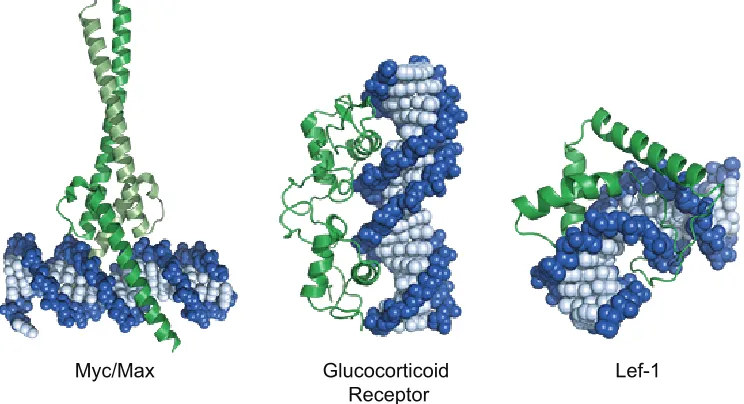
In the context of this regulated DNA structure, transcription is enabled when transcription factor proteins bind enhancer regions coded in the DNA sequence. Transcription factors are proteins that bind DNA in a sequence-specific manner and function to either activate or repress transcription.13 The enhancers of genes under a transcription factor’s control contain the conserved cognate binding sequence for the protein. Transcription factors achieve specificity through their DNA binding domains (DBD). There are several conserved structural motifs for DNA binding and they include basic-helix-loop-helix, zinc finger, and high mobility group box DBDs (Figure 1.2).14-16 These DBDs are linked to protein domains that transactivate transcription.
Figure 1.2 Crystal structures of transcription factors bound to DNA. DNA binding domains of transcription factors fall into several families, including basic-helix-loop-helix (Myc/Max, PDB 1NKP), zinc-finger (glucocorticoid receptor, PDB 1R40), and high mobility group (Lef-1, PDB 2LEF).55
cascades for precise detection of environmental cues.13 Further, the expanded footprint of
the bound proteins provides gene specificity. The interferon β (IFNB) gene enhancer is
an example of the coordinate binding of multiple transcription factors for transcriptional activation. The DNA serves as a sequence-encoded scaffold for the binding of ATF-2, c-Jun, IRF-3A, IRF-7B, IRF-3C, IRF-7D, p50, and RelA at the enhancer of IFNB (Figure 1.3).13 These factors in turn recruit the coactivators CBP/p300 in a multivalent fashion. The composite enhanceosome modifies chromatin and recruits RNA polymerase II to transcribe the IFNB gene into messenger RNA. Combining all these elements encoded in both the sequence and structure of DNA achieves exquisite control of the transcriptomic program.
Myc/Max Glucocorticoid
[image:17.612.130.502.105.307.2]Figure 1.3 Model of the interferon β enhanceosome. 17
1.4 Molecular recognition of DNA
The sequence-specific molecular recognition of DNA is key to this regulatory system. DNA is comprised of four nucleotides linked by anti-parallel phosphodiester backbones in a double helix (Figure 1.4). In the B-form DNA typically found in nature, the four nucleotides hydrogen-bond by the Watson-Crick pairings: adenosine (A) pairs with thymine (T) through two hydrogen bond interactions; cytosine (C) pairs with
5 ’ - T A A A T G A C A T A G G A A A A C T G A A A G G G A G A A G T G A A A G T G G G A A A T T C C T C T G - 3 ’ 3 ’ - T T T A C T G T A T C C T T T T G A C T T T C C C T C T T C A C T T T C A C C C T T T A A G G A G A C A - 5 ’
ATF-2 IRF-3A IRF-3C
IRF-7D
p50
RelA IRF-7B
c-Jun
Figure 1.4 Structure of deoxyribose nucleic acid. DNA comprised of four nucleic acid bases linked by a phophodiester backbone in a double helix (PDB 1BNA) is shown.59
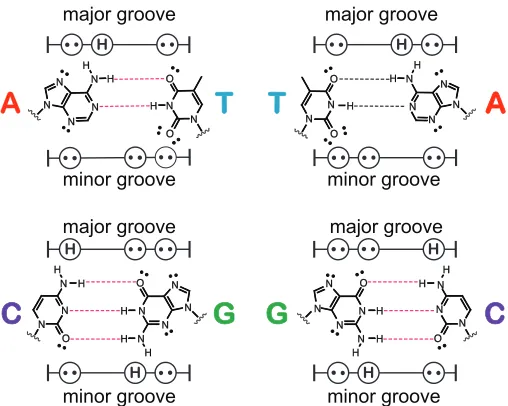
guanosine (G) through 3 hydrogen bonding interactions.18 This specific pairing pattern provides for heritability of the genetic code as identical daughter genomes are synthesized during replication following the base complementarity. The exposed edges of the base pair form a wide major groove and a narrow minor groove on opposite sides of the double helix (Figure 1.4). Each of the four base pairs exposes a unique stereo- electronic edge in the grooves (Figure 1.5A). These sequence-specific stereo-electronics are recognized by DNA binding proteins. In addition, they are recognized by small molecule ligands which may be used to modulate the binding activity of the proteins.
minor groove
major groove
N N N N
N
H H
N N N
O
H H
N N O
O
N N
N N O
N H H H H
A
T
G
Figure 1.5 Each base pair has a unique stereo-electronic edge in both the major and minor groove.55 Hydrogen-bonding patterns are shown for both the major and minor groove for each of the base pairs. Circles with two dots represent lone pairs and circles with an H represent a hydrogen on the exocyclic amine of guanine.
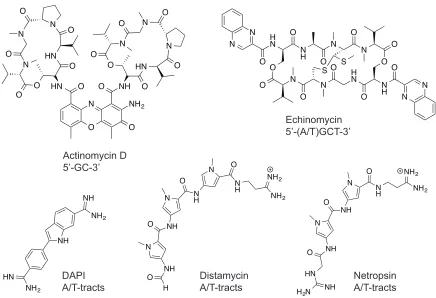
There are DNA-binding natural products with known sequence specificity that have been successfully employed as therapeutic drugs and scientific tools. Actinomycin D is a DNA-intercalator with a sequence preference for 5’-GC-3’ that was one of the earliest chemotherapeutics for cancer (Figure 1.6).19 Echinomycin is a bis-intercalating minor groove binding ligand that preferentially binds 5’-(A/T)CGT-3’ and was found to downregulate hypoxia inducible factor transcriptional activity (Figure 1.6).20-22
Fluorescent DNA-binding ligands such as DAPI have seen wide use as nuclear stains in microscopy (Figure 1.6).23,24 Among DNA minor groove-binding ligands, distamycin and netropsin lend themselves to rational design and chemical modification due to their modular structure (Figure 1.6).25
major groove minor groove
G
G
C
N N N O N N N N O N H H H H H major groove minor grooveA
NT
N N N N N N O O H H H H
H major groove
minor groove
G
NC
N N O N N N N O N H H H H H H H H major groove minor groove
A
T
N N [image:20.612.197.451.71.274.2]Figure 1.6 Structures of DNA binding small molecule ligands and their preferred binding sequences.
The minor groove surface of DNA presents a binding target for effecting modulation of dysfunctional biology in disease states. Distamycin preferentially binds AT-tracts, as there is steric hindrance from the exocyclic amine of guanosines in C•G/G•C on the minor groove floor (Figure 1.7A).26 The introduction of a N-methyl imidazole ring (Im) to replace a N-methyl pyrrole ring (Py) provides a “hole” for the “bump” of the guanine residue.27,28 In particular, the 2:1 binding of distamycin in the minor groove of DNA29 (Figure 1.7B) suggested that linked Py-Im polyamides can target
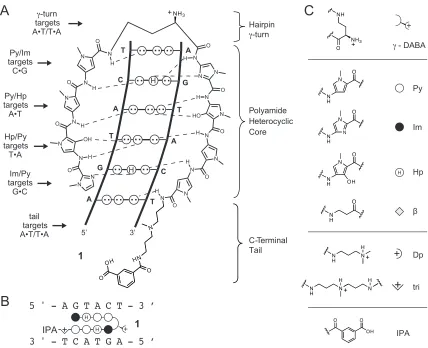
sequences through cofacial arrangement of the aromatic ring pairs to distinguish the edges of the four Watson-Crick base pairs.30 Pairing rules for programmable specificity have been determined: Im/Py specifies a G•C base pair, Hp/Py codes for T•A base pairs
O N O
HN O NH
O O O N N HN O O O N O O N N O O HN O NH2 N O O
N N HN
O NH
O N O N O O O O O N O N O H N O NH
O N N S S Actinomycin D 5’-GC-3’ DAPI
A/T-tracts DistamycinA/T-tracts NetropsinA/T-tracts Echinomycin 5’-(A/T)GCT-3’ NH2 N NH 2 NH O O NH O N N H HN
H2N NH
[image:21.612.108.544.71.369.2]Figure 1.7 Crystal structures of distamycin bound in the minor groove of DNA. A) Distamycin bound 1:1 (PDB 2DND) and B) 2:1 in an antiparallel orientation (PDB 378D).59
and Py/Py binds both T•A/A•T (Figure 1.8).27,28,31-34 This pairing register of the antiparallel polyamide strands can be covalently enforced with a γ-amino butyric acid
linker to form a hairpin architecture.35 However, Py-Im polyamide strands, particularly those containing many imidazoles, were found to be over-curved compared to natural DNA.36 β-alanine residues were introduced to relieve the curvature in such cases, which
allowed targeting longer sequences and sequences with more C•G/G•C residues.37-41 The development of this molecular recognition technology has enabled sequence-specific targeting of DNA with affinities similar to that of transcription factors.42
Distamycin 1:1
Distamycin 2:1 A
Figure 1.8 Pairing rules for Py-Im polyamide DNA sequence-specificity. A) Hydrogen-bonding pattern of the minor groove is depicted as described above. Model for the binding of a ImHpPyPy-γ-DABA-ImHpPyPy-tri-IPA polyamide bound to 5’-AGTACT-3’. Hydrogen bonds shown with dashed lines. B) Ball and stick notation for polyamides, with legend in C).
1.5 Biological modulation with Py-Im polyamides
Studies support Py-Im polyamides effecting biological modulation through its DNA binding capacity. The accessibility of DNA in the context of chromatin for Py-Im polyamide binding was demonstrated in a crystal structure of a polyamide bound to the nucleosome core particle (Figure 1.9A). In live cell culture experiments, the cell-permeability and nuclear localization of dye-conjugated polyamides were observed
N N N O N N O H H O N H N N N N O N N O H H O N H N H N O N N N N O H O H OH HO A
.
.
.
.
.
3’.
.
.
.
.
.
.
.
.
5’. .
G.
.
.
. ..
..
Py/Im targets C•G Py/Hp targets A•T.
..
.
Im/Py targets G•C.
Hp/Py targets T•A.
..
T C A T H H γ-turn targets A•T/T•A tail targets A•T/T•A A G T C A T N HN O O OH Hairpin γ-turn NH3 C-Terminal Tail Polyamide Heterocyclic Core N H N H β N H O Im Dp + N H N H N H tri +γ- DABA
NH O NH3 Hp N O N H OH Py N O N H N O N H H + + + IPA H H
5 ' - A G T A C T - 3 ’
3 ' - T C A T G A - 5 ’ OH
[image:23.612.108.536.70.418.2]Figure 1.9 Py-Im polyamides access chromatin. A) Crystal structure of a nucleosome core particle with B) polyamide dimer 1 bound in the adjacent minor grooves.60 C) Confocal microscopy of MCF-7 breast cancer cell line treated with nuclear-stain Hoechst or D) dye-conjugate polyamide 2.61 Images show co-localization to the nucleus.
through confocal microscopy in a wide range of cell lines (Figure 1.9C).43-44 This demonstrated that access to chromatin with no external transfection was possible with these oligomers. Transcriptional modulation was demonstrated in cell culture by Py-Im polyamides targeted to the respective consensus binding sequences of the transcription factors hypoxia-inducible factor, androgen receptor, glucocorticoid receptor, and
NF-κB.46-50 An X-ray crystal structure of a cyclic polyamide bound to DNA provided a
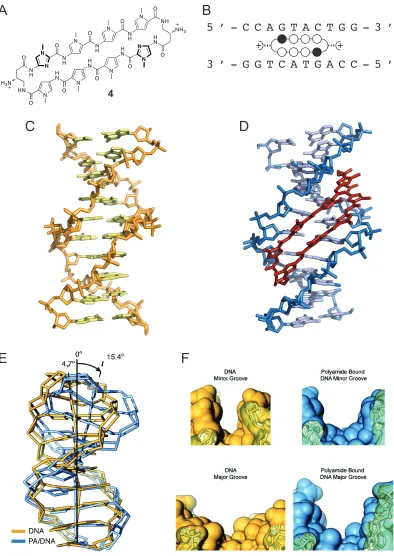
rationale for the exclusion of major-groove binding proteins upon minor groove binding by the polyamide.51 The crystal structure revealed that polyamide binding caused an expansion of the minor groove and compression of the major groove (Figure 1.10). Py-Im polyamides were also found to disrupt processive DNA enzymes. For example, a high
Hoechst 33342
MCF-7
Polyamide 2
[image:24.612.115.533.76.306.2]Figure 1.10 Allosteric disruption of major groove by minor groove binding cyclic polyamide.51 A) Structure of cyclic polyamide 4. B) Ball-and-stick notation for
polyamide 4 shown with the sequence of the DNA oligonucleotide. C) Crystal structure of native B-form DNA (PDB 1D8G). D) Crystal structure of cyclic polyamide 4 bound in the minor groove of DNA (PDB 3OMJ). E) Binding of polyamide 4 causes a distortion to the native DNA structure. F) The binding of polyamide 4 causes a widening of the minor
N O
H N
O N H N O
N N
H N O NH N
O
N H O N
N H O N N H O
N N
H N
N O HN
NH3
N H O
H3N
+ +
5 ’ - C C A G T A C T G G - 3 ’
3 ’ - G G T C A T G A C C - 5 ’ N
O
O N H
N
N O HN
N H H3N
A
4
B
C
D
[image:25.612.116.510.70.626.2]groove (top), and a compression of the major groove (bottom). Native structure shown in yellow, polyamide-bound structure shown in blue.
affinity hairpin targeted to the androgen response element also disrupted RNA polymerase II elongation, causing cytotoxicity and p53 activation without DNA damage.52 Another study showed that high doses of this polyamide can disrupt helicase activity and can cause replicative stress.53 These results indicate DNA minor groove binding Py-Im polyamides can cause a variety of alterations to biological activity.
Studies in mouse models have shown that many of these effects observed in cell culture translate to the mouse with systemic treatment of the polyamide. Pharmacokinetics studies have shown that Py-Im polyamides are bioavailable and have reasonable exposure.54 Cyclic architecture and acetylation of the turn of the same core aromatic oligomer sequence have each been explored and shown to have different pharmacokinetic and toxicity profiles.55,56 Gene expression has been measured in the tumor of mouse xenograft models and shown to be modulated by polyamide treatment similarly to the experiments done in cell culture.57 In a xenograft model of prostate cancer, the high-affinity Py-Im polyamide targeted to the androgen receptor response element reduced tumor size.52 Indeed, a C-14 labeled analog of the molecule showed
preferential localization to the tumor xenograft.58 In sum, Py-Im polyamides are a class of molecules well-suited for the study of biological perturbation through DNA binding.
1.6 Scope of Work
1.7 References
(1) Crick, F. H. Symposia. of the. Society for Experimental Biology. 1958, 12, 138. (2) Harrow, J.; Frankish, A.; Gonzalez, J. M.; Tapanari, E.; Diekhans, M.;
Kokocinski, F.; Aken, B. L.; Barrell, D.; Zadissa, A.; Searle, S.; Barnes, I.; Bignell, A.; Boychenko, V.; Hunt, T.; Kay, M.; Mukherjee, G.; Rajan, J.; Despacio-Reyes, G.; Saunders, G.; Steward, C.; Harte, R.; Lin, M.; Howald, C.; Tanzer, A.; Derrien, T.; Chrast, J.; Walters, N.; Balasubramanian, S.; Pei, B.; Tress, M.; Rodriguez, J. M.; Ezkurdia, I.; van Baren, J.; Brent, M.; Haussler, D.; Kellis, M.; Valencia, A.; Reymond, A.; Gerstein, M.; Guigó, R.; Hubbard, T. J. Genome Res. 2012, 22, 1760-1774.
(3) Derrien, T.; Johnson, R.; Bussotti, G.; Tanzer, A.; Djebali, S.; Tilgner, H.;
Guernec, G.; Martin, D.; Merkel, A.; Knowles, D. G.; Lagarde, J.; Veeravalli, L.; Ruan, X.; Ruan, Y.; Lassmann, T.; Carninci, P.; Brown, J. B.; Lipovich, L.; Gonzalez, J. M.; Thomas, M.; Davis, C. A.; Shiekhattar, R.; Gingeras, T. R.; Hubbard, T. J.; Notredame, C.; Harrow, J.; Guigó, R. Genome Res. 2012, 22, 1775-1789.
(4) Kornberg, R. D. Science. 1974, 184, 868-871. (5) Berger, S. L. Nature. 2007, 447, 407-412.
(6) Heintzman, N. D.; Hon, G. C.; Hawkins, R. D.; Kheradpour, P.; Stark, A.; Harp, L. F.; Ye, Z.; Lee, L. K.; Stuart, R. K.; Ching, C. W.; Ching, K. A.; Antosiewicz-Bourget, J. E.; Liu, H.; Zhang, X.; Green, R. D.; Lobanenkov, V. V.; Stewart, R.; Thomson, J. A.; Crawford, G. E.; Kellis, M.; Ren, B. Nature. 2009, 459, 108-112. (7) Bird, A. P. Nature. 1986, 321, 209-213.
(8) Nan, X.; Ng, H. H.; Johnson, C. A.; Laherty, C. D.; Turner, B. M.; Eisenman, R. N.; Bird, A. Nature. 1998, 393, 386-389.
(9) Mah, L. J.; El-Osta, A.; Karagiannis, T. C. Leukemia. 2010, 24, 679-686. (10) de Lange, T. Cold Sprin. Harb. Symp. Quant. Biol. 2010, 75, 167-177. (11) de Lange, T. Science. 2009, 326, 948-952.
(12) Sfeir, A.; de Lange, T. Science. 2012, 336, 593-597. (13) Tjian, R.; Maniatis, T. Cell. 1994, 77, 5-8.
(15) Juo, Z. S.; Chiu, T. K.; Leiberman, P. M.; Baikalov, I.; Berk, A. J.; Dickerson, R. E. J. Mol. Biol. 1996, 261, 239.
(16) Love, J. J.; Li, X.; Case, D. A.; Giese, K.; Grosschedl, R.; Wright, P. E. Nature
1995, 376, 791.
(17) Panne, D. Curr. Opin. Struct. Biol. 2008, 18, 236-242. (18) Watson, J. D.; Crick, F. H. Nature. 1953, 171, 737-738.
(19) Kamitori, S.; Takusagawa, F. J. Mol. Biol. 1992, 225, 445-456.
(20) Waring; M., J.; Wakelin; G., L. P.; Waring, M. J.; Wakelin, L. P. G. Nature.
1974, 252, 653-657.
(21) VanDyke, M. M.; Dervan, P. B. Science. 1984, 225, 1122-1127.
(22) Kong, D.; Park, E. J.; Stephen, A. G.; Calvani, M.; Cardellina, J. H.; Monks, A.; Fisher, R. J.; Shoemaker, R. H.; Melillo, G. Cancer Res. 2005, 65, 9047-9055. (23) Larsen, T. A.; Goodsell, D. S.; Cascio, D.; Grzeskowiak, K.; Dickerson, R. E. J
Biomol. Struct. Dyn. 1989, 7, 477-491.
(24) Otto, F. Methods Cell. Bio. 1990, 33, 105-110.
(25) Kopka, M. L.; Yoon, C.; Goodsell, D.; Pjura, P.; Dickerson, R. E. Proc. Natl. Acad. Sci. U. S. A. 1985, 82, 1376-1380.
(26) Pelton, J. G.; Wemmer, D. E. Biochemistry. 1988, 27, 8088-8096.
(27) Wade, W. S.; Mrksich, M.; Dervan, P. B. J. Am. Chem. Soc. 1992, 114, 8783-8794.
(28) Kielkopf, C. L.; Baird, E. E.; Dervan, P. B.; Rees, D. C. Nat. Struct. Biol. 1998, 5, 104-109.
(29) Mitra, S. N.; Wahl, M. C.; Sundaralingam, M. Acta Crystallogr. D. Biol. Crystallogr. 1999, 55, 602-609.
(30) Dervan, P. B.; Edelson, B. S. Curr. Opin. Struct. Biol. 2003, 13, 284-299. (31) Trauger, J. W.; Baird, E. E.; Dervan, P. B. Nature. 1996, 382, 559-561. (32) White, S.; Baird, E. E.; Dervan, P. B. Chem. Biol. 1997, 4, 569-578.
(33) White, S.; Szewczyk, J. W.; Turner, J. M.; Baird, E. E.; Dervan, P. B. Nature.
(34) Kielkopf, C. L.; White, S.; Szewczyk, J. W.; Turner, J. M.; Baird, E. E.; Dervan, P. B.; Rees, D. C. Science. 1998, 282, 111-115.
(35) Mrksich, M.; Parks, M. E.; Dervan, P. B. J. Am. Chem. Soc. 1994, 116, 7983-7988.
(36) Kelly, J. J.; Baird, E. E.; Dervan, P. B. Proc. Natl. Acad. Sci. U. S. A. 1996, 93, 6981-6985.
(37) Trauger, J. W.; Baird, E. E.; Mrksich, M.; Dervan, P. B. J. Am. Chem. Soc. 1996, 118, 6160-6166.
(38) Swalley, S. E.; Baird, E. E.; Dervan, P. B. Chem- Eur. J. 1997, 3, 1600-1607. (39) Trauger, J. W.; Baird, E. E.; Dervan, P. B. Ange. Chem. Int. Edit. 1998, 37,
1421-1423.
(40) Turner, J. M.; Swalley, S. E.; Baird, E. E.; Dervan, P. B. J. Am. Chem. Soc. 1998, 120, 6219-6226.
(41) Wang, C. C.; Dervan, P. B. J. Am. Chem. Soc. 2001, 123, 8657-8661.
(42) Hsu, C. F.; Phillips, J. W.; Trauger, J. W.; Farkas, M. E.; Belitsky, J. M.; Heckel, A.; Olenyuk, B. Z.; Puckett, J. W.; Wang, C. C.; Dervan, P. B. Tetrahedron.
2007, 63, 6146-6151.
(43) Dudouet; Burnett; Dickinson; Wood; Melander; Belitsky; Edelson; Wurtz; Briehn; Dervan; Gottesfeld Chem. Biol. 2003, 10, 859-867.
(44) Edelson, B. S.; Best, T. P.; Olenyuk, B.; Nickols, N. G.; Doss, R. M.; Foister, S.; Heckel, A.; Dervan, P. B. Nucleic Acids Res.. 2004, 32, 2802-2818.
(45) Nickols, N. G.; Jacobs, C. S.; Farkas, M. E.; Dervan, P. B. Nucleic Acids Res.
2007, 35, 363-370.
(46) Olenyuk, B. Z.; Zhang, G. J.; Klco, J. M.; Nickols, N. G.; Kaelin, W. G.; Dervan, P. B. Proc. Natl. Acad. Sci. U. S. A. 2004, 101, 16768-16773.
(47) Nickols, N. G.; Jacobs, C. S.; Farkas, M. E.; Dervan, P. B. ACS Chem. Biol. 2007, 2, 561-571.
(48) Nickols, N. G.; Dervan, P. B. Proc. Natl. Acad. Sci. U. S. A. 2007, 104, 10418-10423.
(49) Muzikar, K. A.; Nickols, N. G.; Dervan, P. B. Proc. Natl. Acad. Sci. U. S. A.
2009, 106, 16598-16603.
(51) Chenoweth, D. M.; Dervan, P. B. J. Am. Chem. Soc. 2010, 132, 14521-14529. (52) Yang, F.; Nickols, N. G.; Li, B. C.; Marinov, G. K.; Said, J. W.; Dervan, P. B.
Proc. Natl. Acad. Sci. U. S. A. 2013, 110, 1863-1868.
(53) Martínez, T. F.; Phillips, J. W.; Karanja, K. K.; Polaczek, P.; Wang, C. -M.; Li, B. C.; Campbell, J. L.; Dervan, P. B. Nucleic Acids Res. 2015, 42, 11546-11559. (54) Synold, T. W.; Xi, B.; Wu, J.; Yen, Y.; Li, B. C.; Yang, F.; Phillips, J. W.;
Nickols, N. G.; Dervan, P. B. Cancer Chemother. Pharmacol. 2012, 70, 617-625. (55) Raskatov, J. A.; Hargrove, A. E.; So, A. Y.; Dervan, P. B. J. Am. Chem. Soc.
2012, 134, 7995-7999.
(56) Yang, F.; Nickols, N. G.; Li, B. C.; Szablowski, J. O.; Hamilton, S. R.; Meier, J. L.; Wang, C. -M.; Dervan, P. B. J. Med. Chem. 2013, 56, 7449-7457.
(57) Nickols, N. G.; Szablowski, J. O.; Hargrove, A. E.; Li, B. C.; Raskatov, J. A.; Dervan, P. B. Mol. Cancer. Ther. 2013, 12, 675-684.
(58) Raskatov, J. A.; Puckett, J. W.; Dervan, P. B. Bioorg. Med. Chem. 2014, 22, 4371-4375.
(59) Muzikar, K. A. Repression of DNA-binding-dependent glucocorticoid receptor-mediated gene expression. Ph. D. Thesis, 2011. Figures used with permission. (60) Edayathumangalam, R. S.; Weyermann, P.; Gottesfeld, J. M.; Dervan, P. B.;
Luger, K. Proc. Natl. Acad. Sci. U. S. A. 2004, 101, 6864-6869.
Chapter 2
Design of Sequence-Specific DNA Binding Molecules
for DNA Methyltransferase Inhibition
The text of this chapter is taken in part from a manuscript co-authored with Jordan L. Meier and Peter B. Dervan (California Institute of Technology).
Abstract
The CpG dyad, an important genomic feature in DNA methylation and transcriptional regulation, is an attractive target for small molecules. To assess the utility of minor groove binding oligomers for CpG recognition, we screened a small library of hairpin pyrrole-imidazole polyamides targeting the sequence 5′-CGCG-3′ and assessed their sequence specificity using an unbiased next-generation sequencing assay. Our findings indicate that hairpin polyamide of sequence PyImβIm-γ-PyImβIm (1), previously
identified as a high affinity 5′-CGCG-3′ binder, favors 5′-GCGC-3′ in an unanticipated reverse binding orientation. Replacement of one β alanine with Py to afford
PyImPyIm-γ-PyImβIm (3) restores the preference for 5′-CGCG-3′ binding in a forward orientation.
2.1 Introduction
The role of epigenetic dysregulation in cancer has motivated interest in DNA methylation and methods for its modulation.1,2 In mammals, DNA methylation occurs in the major groove of DNA at the 5′ position of both cytosine residues in the palindromic CG dyad (CpG). CpG’s are rare in the genome and 70% methylated, with nearly all unmethylated CpG’s clustered in G,C-rich regions called “CpG islands”.3 Approximately 60% of RNA Polymerase II transcribed human genes contain CpG islands,4 and their methylation causes transcriptional repression.5 In cancer, for example, otherwise functional tumor suppressor genes can be silenced by hypermethylation in their associated CpG island.6 Importantly, inhibition of DNA methylation at tumor suppressor
genes has been shown to reactivate apoptotic pathways and sensitize cancer cells to previously ineffective chemotherapy.7,8
The most effective demethylation agents are cytidine analogs such as 5-aza-deoxycytidine, which find limited use due to significant side effects.1 These cytidine
analogs are suicide inhibitors incorporated into DNA to form covalent methyltransferase-DNA adducts.9 The methyltransferase is sequestered and unavailable to methylate CpG’s, resulting in genome-wide demethylation. DNA binding molecules, such as the bis-intercalating natural product echinomycin,10 can disrupt CpG methylation in vitro but have dose-limiting toxicities that have abrogated further clinical advancement.11 While
Hairpin pyrrole-imidazole (Py-Im) polyamides are a class of sequence-specific oligomers that bind in the minor groove of DNA.15-20 Programmable sequence preference is accomplished by side-by-side pairings of aromatic amino acids that distinguish the edges of the four Watson-Crick base pairs.15-20 Referred as the pairing rules, Im/Py codes for G•C base pairs, Hp/Py codes for T•A base pairs, and Py/Py binds both T•A/A•T in preference to G•C/C•G. Eight-ring hairpin oligomers linked by a central aliphatic γ -aminobutyric acid unit have affinities for match sites with Ka ~108 to 1010 M-1.16,21 These
binding energetics are comparable to natural transcription factors, and like natural DNA binding proteins, are sensitive to differences in the sequence-dependent microstructure of DNA. To relax the curvature of all ring hairpins, β alanine (β) can be substituted for
Py-rings in some cases such that β/β pairs replace Py/Py for T•A/A•T specificity, and Im/β
replaces Im/Py pairs in strategic locations while retaining specificity for G•C base pair.
22-26 Hairpin Py-Im polyamides usually bind with the N-to-C terminus aligned in the 5′
-to-3′ direction of DNA, referred to as “forward orientation”.27 This modest forward binding
preference can be enforced by substitution of the prochiral α position in the γ-turn, i.e., replacement of γ-aminobutyric acid by (R)-2,4-diaminobutyric acid.28 Hairpin
architectures containing β/β pairs and β/ring pairs have been found in some cases to
prefer the N to C terminus aligned in a 3′-to-5′ direction of DNA.29 While adhering to the
Figure 2.1 Structure of Py-Im polyamides S1 and S2 previously reported to bind methylated 5’-CGCG-3’ oligonucleotide duplex.32 Legend for ball-and-stick notation.
hairpin high affinity sites.30 Although the canonical pairing rules are remarkably predictive of polyamide DNA binding specificity, we identified high affinity DNA binding sites in the reverse orientation for several polyamides containing β/Im pairs.30
Eight-ring hairpin Py-Im polyamides have been shown to discriminate 5′ -GGGG-3′, 5′-GCGC-3′ and 5′-GGCC-3′ with appropriate arrangement of four Im/Py pairs.31
From experience, sequences with CpG steps such as 5′-CGCG-3′ are not as readily accessed for reasons not well understood. In an effort to improve the affinity of an eight-ring hairpin polyamide for the sequence 5′-CGCG-3′, Sugiyama and coworkers replaced two Im/Py pairs with Im/β pairs (Figure 2.1). A change from PyImPyIm-γ-PyImPyIm
(S1) to PyImβIm-γ-PyImβIm (S2) afforded a 65-fold increase in affinity for 5′
-CGCG-3′.32 Both hairpins conform to the pairing rules and would bind 5′-CGCG-3′ in the forward orientation. In this study, we employ a high-throughput sequencing assay of polyamide-DNA association to revisit targeting the 5′-CGCG-3′ sequence. Our findings indicate that hairpin polyamides of sequence PyImβIm-γ-PyImβIm S2 favor 5′-GCGC-3′,
S2 H N O H N O N H O N H O
N NH
O N N NH O N N H N O H N O N N N H N O N N O HN NH N H O
TC G C GAm m
AG C GC Tm m
β N H O GABA Dp NH O Im N N O N H Py N O N H Ac +
TC G C GAm m
AG C GC Tm m Ac + + S1 H N O H N O N H O N N H O
N NH
a reverse binding mode. The issue of designing a hairpin polyamide sequence that prefers 5′-CGCG-3′ to 5′-GCGC-3′ remains to be solved. Using Bind-n-Seq methods30 as our screen for a library of polyamide-biotin conjugates, we find that replacement of one β
alanine with Py to afford PyImPyIm-γ-PyImβIm restores the preference for forward
binding 5′-CGCG-3′. Recent structural work has shown that a cyclic Py-Im polyamide binding in the minor groove causes significant widening of the minor groove width of
DNA,33,34 and provides a mechanistic rationale for disruption of DNA-binding proteins in
the major groove. We demonstrate the ability of our 5′-CGCG-3′ specific minor groove binding hairpin polyamides to inhibit enzymatic CpG methylation in the major groove of a 5′-CGCG-3′ sequence.
2.2 Results
Sequence Based Analysis of PyImβIm-γ-PyImβIm Specificity. The 5′
-CGCG-3′ sequence is a compelling DNA target for an 8-ring hairpin Py-Im polyamide because it is one of the least represented 6-bp sequence patterns in the human genome, potentially promoting greater genomic specificity.30 Minoshima and coworkers have previously targeted this sequence and shown that polyamide S2 (Figure 2.1) can bind the fully methylated sequence.32 In their study, the substitution of two β’s for Py moieties resulted
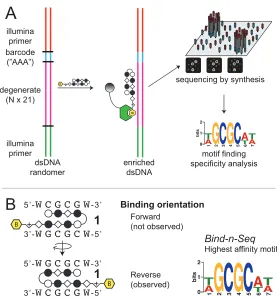
Figure 2.2 A) Scheme of Bind-n-Seq method.30
Polyamide-biotin conjugate is incubated in a genome-sized library of all possible 21mers, enriched, sequenced, and the resulting dataset analyzed with motif-finding software.30 B) Polyamide
1 could potentially bind in the forward orientation or the reverse orientation. The highest affinity binding sequence of
1 is the reverse orientation binding 5’-GCGC-3’.
that allows facile identification of high affinity binding sites of biotin-labeled Py-Im polyamides by affinity purification followed by sequencing (Figure 2.2A).30 As a first step, we synthesized an analog of S2 and examined polyamide-biotin conjugate 1 of sequence PyImβIm-γ-PyImβIm(Figure 2.2B), which has a biotin affinity tag appended at the C-terminus of the heterocyclic oligomer (Figure 2.3). Polyamide-biotin conjugate 1
was incubated at 50 nM in a library of all possible 21 base pair DNA sequences,
B + B + 1 0 1 2 bits 1 A T 2
G
C
3G
4C
5TA
6AT70 1 2 bits 1 A T 2
G
C
3G
4C
5TA6AT75’-W C G C G W-3’
3’-W G C G C W-5’
5’-W G C G C W-3’
3’-W C G C G W-5’
B + 1 Binding orientation Forward (not observed) Reverse (observed) Bind-n-Seq Highest affinity motif
A
B
B + dsDNA randomer enriched dsDNAsequencing by synthesis
motif finding specificity analysis barcode (”AAA”) illumina primer degenerate (N x 21)
[image:38.612.185.462.69.369.2]Figure 2.3 Structures of Py-Im polyamides 1-3.
enriched, and sequenced to identify polyamide-bound sequences. This dataset was then analyzed by the DREME algorithm to construct a motif logo summarizing the highest affinity sequences. A binding preference for 5′-GCGC-3′ was revealed, suggestive of a reverse binding mode (Table 1).
Redesign Hairpin for CGCG versus GCGC Preference. In order to restore the preference for binding 5′-CGCG-3′ in the forward orientation, we considered two possible points of modification (Figure 2.4A). First, we made a single modification to 1
at the turn unit, replacing the GABA turn to a chiral γ-amino GABA, affording 2 (Figure
2.3 and 2.4B). The γ-amino GABA turn has previously been shown to restore forward
orientation and increase affinity, including in β-containing polyamides.28-30 This effect is
thought to arise from a steric interaction with the floor of the minor groove when the chiral α-amino GABA turn unit is bound in the reverse orientation.23,28 Assessment of polyamide 2 by Bind-n-Seq found that this modification improved the reverse/forward ratio but was insufficient to restore a forward orientation binding preference (Table 2.1). To confirm the high-throughput sequencing findings, we performed a thermal DNA
H N O H N O N H O N H O
N NH
O N N NH O N N H N O H N O N N N H N O N N O HN O O O H N O NH HN S O HN NH O O O H N O N H O N N H O
N NH
O N N NH O N N H N O H N O N N N H N O N N H N O HN O O O H N O NH HN S HN NH O O H N O H N O N H O N H O
N NH
O N N NH O N N H N O H N O N N N H N O N N O HN O O O H N O NH HN S O HN NH O O NH3 2
1 B NH+
3
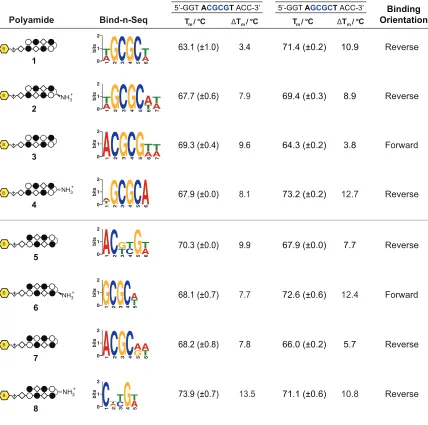
Table 2.1 The preferred binding orientations of polyamides 1-8 were queried with Bind-n-Seq to generate the highest affinity sequence motif. Polyamide-mediated thermal stabilization (ΔTm)
of 12 base pair oligonucleotides of the forward (5′-CGCG-3′) and reverse 5′-GCGC-3′ sequences were use to validate the revealed motifs. Melting temperatures reflect the mean and standard deviation of quadruplicate measurements.
denaturation study, as previous studies have shown the thermal stabilization (ΔTm) of
duplex DNA by Py-Im polyamides correlates well with binding affinity.35 Assays were performed with DNA oligonucleotides differing only in the central binding sequence (5’-
B
3 1
B
2
NH3+
B
7
B
6
B NH+
3
5
B
4
NH3+
B 8 B NH + 3 Bind-n-Seq Polyamide 0 1 2 bits 1
AT
G
2C
3G
4C
5AT60 1 2
bits
1
AT
G
2C
3G
4C
5TA6AT70 1 2
bits
1
A
C
2G
3C
4G
5AT6AT70 1 2 bits 1 GT A 2
G
C
3G
4C
5A
60 1 2
bits
1
A
C
2TG3C4 T5
G
AT60 1 2
bits
1
G
C
2G
3C
4T5 A 0 1 2 bits 1A
C
2G
3C
4GA5TA60 1 2
bits
1
C
GA2 T3
C T
4
G
A5 T 3.8 10.9 12.7 8.9 7.7 5.7 12.4 64.3 (±0.2) 71.4 (±0.2) 69.4 (±0.3) 73.2 (±0.2) 67.9 (±0.0) 66.0 (±0.2) 72.6 (±0.6) 10.8 71.1 (±0.6) 69.3 (±0.4) 9.663.1 (±1.0) 3.4
67.7 (±0.6) 7.9
70.3 (±0.0) 9.9
68.2 (±0.8) 7.8 68.1 (±0.7) 67.9 (±0.0) 8.1
7.7
73.9 (±0.7) 13.5
Reverse Reverse Reverse Reverse Forward Reverse Reverse Forward
5’-GGT ACGCGT ACC-3’
Tm/ °C ΔTm/ °C Tm/ °C ΔTm/ °C
Binding Orientation
Figure 2.4 A) Scheme of Py-Im polyamide binding in the minor groove of DNA. B) Single position changes made to hairpin polyamide 1 to afford 2 and 3. Positions are highlighted in yellow.
CGCG-3’ versus 5’-GCGC-3’) to directly test the binding orientations identified by the Bind-n-Seq logos (Table 2.1). This analysis substantiated a reverse orientation binding preference for polyamide 1, with a ΔTm of 10.9 ºC in the reverse direction as compared to
3.4 ºC in the forward direction. Modification at the turn to the γ-amino GABA in
polyamide 2 resulted in increased stabilization of the forward 5′-CGCG-3′ oligomer by 4.5 ºC; stabilization by polyamide 2 in the reverse 5′-GCGC-3′ orientation was diminished by 2.0 ºC. This indicated an improved forward preference for 5′-CGCG-3′.
T C C C C A 5’ 3’ H H H H A G G G G T N N N N O N O N N N N O N O O H H H H N H H H H N O O N N N N H O O N N N O Hairpin GABA turn Possible modifications Polyamide heterocycle core C-terminal tail N H H N N R H2
R + 1
W C G C G W W G C G C W
A
B
B + 1
W C G C G W
W G C G C W
B + NH3
+
2
W C G C G W
W G C G C W B +
3
W C G C G W
Nonetheless, the relative magnitudes of the ΔTm support an overall modest energetic
preference for reverse orientation binding.
The inability of the γ-amino GABA turn to enforce forward orientation binding
led us to investigate alternative solutions for the molecular recognition of 5′-CGCG-3′. We posited that reverse binding is abetted by the flexibility afforded by the two β units in
the core binding region, as had been similarly noted in polyamides containing a β/β
pair.29 We thus considered whether removing one β residue might reinstitute sufficient
rigidity in one of the polyamide strands to limit reverse binding while retaining the specificity and affinity provided by the other β. Of the two β moieties in the core of
polyamide 1, the C-terminal β in the core binding region was retained based on previous
studies that have shown it is necessary for high affinity recognition of the 5′ C•G base pair.24 To isolate the effect of each modification, we returned to parent polyamide 1 and replaced the N-terminal β with a Py while retaining the achiral GABA turn, to provide
polyamide 3 (Figure 2.3 and 2.4B). The assessment of 3 by Bind-n-Seq followed by DREME analysis generated a high affinity motif consistent with forward binding 5′ -CGCG-3′ (Table 2.1). This was corroborated by ΔTm measurements showing
considerable preference for the forward 5′-CGCG-3′ direction.
Figure 2.5 A panel of polyamides was synthesized for assessment by Bind-n-Seq and DNA thermal
stabilization for binding the 5’-CGCG-3’ sequence. According to the pairing rules, polyamides 1-4 target 5’-CGCG-3’ in the forward orientation and
polyamides 5-8 target 5’-CGCG-3’ in the reverse orientation. Structural modifications are highlighted in yellow.
expanded the library of compounds to include polyamides 4-8, which contain single modifications targeting the 5′-GCGC/CGCG-3′ core (Figure 2.5 and 2.6). In contrast to our findings with 5′-CGCG-3′ targeting polyamide 2, we confirmed that the incorporation of an α-amino GABA turn in polyamide 6 restores forward orientation binding for the 5′ -GCGC-3′ sequence.30 This difference is striking given the two polyamides are composed of nearly identical amino acid sequences. Bind-n-Seq data and Tm assays of polyamides
4, 5, 7, and 8 together suggest that all other modifications preferentially bind the reverse orientation, and 5, 7, and 8 do so with poor specificity (Table 2.1). Indeed, amongst all variations tested of both 5′-CGCG-3′ forward binding and 5′-GCGC-3′ reverse binding cores, polyamide 3 displayed the highest specificity for the 5′-CGCG-3′ sequence (Table 2.1).
2
B
1
3 B
NH3+ B
7 5
B 6
B NH+
3 B
8 4
NH3+
B B NH
+ 3
Forward orientation for binding 5’-CGCG-3’
Figure 2.6 Structures of Py-Im polyamides 4-8.
Sequence-Specific Binding Hemi-methylated DNA. Next, we considered the potential for minor groove binding hairpin Py-Im polyamides to prevent DNA methylation undergoing DNA replication. To do so, they must be able to bind the hemi-methylated DNA of daughter strands that have not yet undergone maintenance methylation. DNA thermal stabilization analysis was used to pursue evidence of the above trends of binding orientation with hemi-methylated DNA sequences. The sense strand of each of the 12 base pair oligomers containing 5′-CGCG-3′ or 5′-GCGC-3′ cores were methylated on both cytosines, whereas the antisense strand was left unmethylated. Flanking sequences were modified to lack self-complementarity and enforce hemi-methylated duplex formation. Analysis of ΔTm of the hemi-methylated DNA oligomers
confirmed the above magnitudes of stabilization and trends of reverse and forward binding modes for 1, 2, and 3 (Table 2.2A).
Inhibition of Methyltransferase. With a specific polyamide capable of binding
O H N O N H O N N N H O N N N H O N NH O N H N O H N O N N N H N O H N O HN O O O H N O NH HN S O HN NH O O N N
7 B
O H N O N H O N N N H O N N N H O NH O N H N O H N O N N N H N O H N O HN O O O H N O NH HN S O HN NH O O N N NH3
6 B NH+
3 O H N O N H O N N N H O N N N H O NH O N H N O H N O N N N H N O H N O HN O O O H N O NH HN S O HN NH O O N N
5 B
O H N O N H O N N N H O N N N H O NH O N H N O H N O N N N H N O H N O HN O O O H N O NH HN S O HN NH O O N N NH3
8 B NH
+ 3 H N O H N O N H O N H O
N NH
O N N NH O N N H N O H N O N N N H N O N N O HN O O O H N O NH HN S O HN NH O O NH3
4 NH+
3
Table 2.2 A) Tm study with hemi-methylated DNA duplex. B) Tm study of three generations of
5′-CGCG-3′ methylation inhibitors without biotin affinity tags.
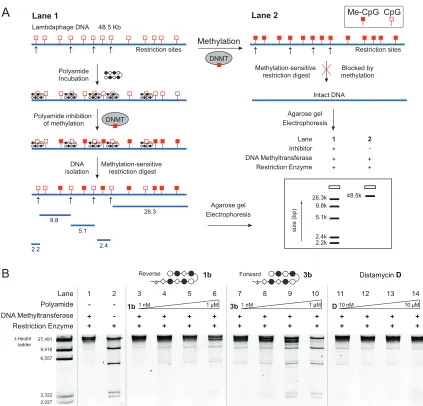
hemi-methylated DNA in hand, we evaluated its application as a sequence-specific inhibitor of DNA methyltransferases. The biotin enrichment tag was deleted from the C-terminus by re-synthesis to afford parent hairpins 1b and 3b (Figure 2.7). Melting temperature analyses confirmed these molecules show comparable binding preference to biotin conjugates 1 and 3, respectively (Table 2.2B). We developed an in vitro assay to probe the methylation state of specific sites employing the methylation-sensitive restriction enzyme MluI to compare sequence specific effects of 1b, 3b, and AT-binding distamycin D as a control (Figure 2.8A). In this assay, we measured the ability of these
+ 1b
9b
W C G C G W W G C G C W
+ 3b
W C G C G W W G C G C W
5’-GGT ACGCGT ACC-3’
67.7 (±0.3) 73.6 (±0.4) 7.1 13.0 74.1 (±0.3) 68.1 (±0.7) 13.7 7.7 Reverse Forward
77.3 (±0.6) 16.7 69.8 (±0.1) 9.4 Forward
NH3 + +
W C G C G W W G C G C W
5’-GGT AGCGCT ACC-3’
B + 1
W C G C G W W G C G C W
B + NH3
+ 2
W C G C G W W G C G C W
B + 3
W C G C G W W G C G C W
5’-GGT AC GC Gm m T TGG-3’ 3’-CCA TG C G CA ACC-5’
5’-GGT AGC GC m mT TGG-3’ 3’-CCA TC G C GA ACC-5’
62.7 (±0.5) 67.4 (±0.5) 68.1 (±1.0) 4.1 8.8 9.5 69.3 (±1.5) 69.1 (±1.2) 63.6 (±1.0) 10.4 10.2 4.7 Reverse Reverse Forward Polyamide Polyamide
Tm/ °C ΔTm/ °C Tm/ °C ΔTm/ °C
Tm/ °C ΔTm/ °C Tm/ °C ΔTm/ °C
Figure 2.7 Structures of polyamides 1b, 3b, D, and 9b used in in vitro
functional assays.
compounds to inhibit the methylation activity of M.SssI, a robust prokaryotic methyltransferase that operates in a processive manner like human methyltransferases and shares structural similarities with the catalytic core of human DNMT1.36 We
employed the methylation-sensitive enzyme MluI, which cleaves at seven 5′-ACGCGT-3′
sites,37 to interrogate methylation of the lambdaphage DNA (48.5 kb), of which five bands were visualized by agarose gel electrophoresis. Both 1b and 3b were titrated from increasing concentrations 1 nM to 1 µM while D was dosed ten-fold higher from 10 nM to 10 µM. Full digestion of the DNA by MluI indicates a lack of CpG methylation at 5′ -ACGCGT-3′ restriction sites, and is demonstrated by positive control lane 2 (Figure 2.8B). In contrast, full methylation would protect DNA from MluI digestion, as in lane 1, where no compound was added to DNA prior to exposure to M.SssI for methylation.
Consistent with our biophysical characterization of the compounds, polyamide 3b
showed the most robust inhibition of CpG methylation (Figure 2.8B, lanes 7-10) at
H N O H N O N H O N H O
N NH
O N N NH O N N H N O H N O N N N H N O N N O H2N
HN NH D O H N O N H O N N H O
N NH
O N N NH O N N H N O H N O N N N H N O N N H N O H2N
HN NH 3b 1b H N O N H N O H N O N H N O N NH H3N
H
9b NH3
+ + O H N O N H O N N H O
N NH
O N N NH O N N H N O H N O N N N H N O N N H N O H2N
HN NH
Figure 2.8 A) Scheme of in vitro assay of DNA methyltranferase inhibition. Generic polyamide shown in ball-and-stick notation, CpG sites represented by red squares. (B) Inhibition of methyltransferase activity reflects sequence-specificity of Py-Im polyamides. Lambdaphage DNA was incubated with M.SssI and subject to methylation-sensitive restriction digest at 5’-ACGCGT-3’ sites by MluI. DNA is 240 pM in match sites. Positive control lane 2 was not subject to methylation and completely digested while negative control lane 1 shows minimal digestion. Increasing concentration of 3b inhibits methylation at the restriction sites as visualized by additional, smaller restriction fragments. Polyamide 1b and 3b was titrated from 1 nM to 1 µM at ten-fold dilutions and distamycin ranged from 10 nM to 10 µM at ten-fold dilutions. Visualized on 0.7% agarose gel with SYBR gold.
5′-ACGCGT-3′ sites. In lane 10, full MluI digestion comparable to positive control lane 2 was observed at 1 µM of 3b, indicating this concentration was sufficient to block all methylation at the cognate binding sites. Further, incomplete protection was evidenced at
Restriction sites Restriction sites
48.5 Kb Intact DNA Lambdaphage DNA Polyamide Incubation Polyamide inhibition of methylation Methylation-sensitive restriction digest Methylation-sensitive restriction digest DNA isolation Methylation DNMT DNMT Blocked by methylation Lane Inhibitor DNA Methyltransferase Restriction Enzyme + + + + +
-Lane 1 Lane 2
1 2 Agarose gel Electrophoresis Agarose gel Electrophoresis Me-CpG CpG size (bp) Forward
Reverse Distamycin D
+ 1b + 3b
Lane Restriction Enzyme λHindIII ladder 27,491 9,416 6,557 2,322 2,027 DNA Methyltransferase Polyamide
1 2 3 4 5 6 7 8 9 10 11 12 13 14
- - 1b
+ - + + + + + + + + + + + + + + + + + + + + + + + + + +
1 nM 1 µM 3b1 nM 1 µM D10 nM 10 µM
[image:47.612.107.530.68.474.2]100 nM of 3b by additional, partially digested bands in lane 9. In contrast, polyamide 1b
showed weak inhibition of M.SssI and was active only at the highest concentration (Figure 2.8B, lanes 3-6). This reflects its weaker affinity for the 5′-CGCG-3′ forward binding orientation, also observed by thermal duplex denaturation analysis. Inhibition by
1b at 1 µM, however, was reduced relative to that observed at 100 nM of 3b, consistent with the binding preferences of the two molecules. There was no inhibition by distamycin D at all concentrations tested, even at the highest concentration of 10 µM, underscoring the importance of CpG specificity of Py-Im polyamides in preventing CpG methylation. To enable quantitation of enzyme activity inhibition, the substrate DNA was changed to a 7.5 kb fragment containing a single 5′-ACGCGT-3′ site (Figure 2.9A).
We were encouraged by these results to consider the design of an improved methylation antagonist at 5′-CGCG-3′. We revisited the single modifications to 1 in polyamide 2 and 3 that had promoted forward orientation binding. We combined the γ
-amino modification at the GABA turn that had encouraged 2 to bind in the forward orientation, albeit insufficiently, with the Py substitution in the top strand, as in 3, to afford 9b (Figure 2.9B). Analysis by thermal denaturation assays revealed that the effects of the modifications were additive, and 9b displayed increased affinity and preference for forward orientation binding (Table 2.2B).
We then sought to determine IC50 values for the three generations of 5′-CGCG-3′
Figure 2.9 A) Scheme of in vitro DNMT inhibition assay with single restriction site. Generic polyamide shown in ball-and-stick notation and CpG sites represented by red squares. DNA (7.5 kb) with a single MluI restriction site was incubated at 50 pM with inhibitor and subjected to methylation by M.SssI. DNA was isolated for restriction digest by MluI to reveal methylation at the target site. B) Single changes in polyamides 2 and 3 that promote forward orientation binding were combined in designing 9b as a third generation candidate for improved methylation
inhibition. C) Representative gel image of the polyamides 1b, 3b, and 9b in the assay described in (A), suggestive of differential inhibitory activity. Dose ranges of compounds were adjusted in relation to their DNA binding affinities. D) IC50 values of 5′-CGCG-3′ targeting polyamides. Values are determined from band intensities in the in vitro as assay shown in (C) and normalized
Restriction site Restriction site
7.5 Kb 4.3 Kb 3.2 Kb Intact DNA DNA Polyamide Incubation Polyamide inhibition of methylation Methylation-sensitive restriction digest Methylation-sensitive restriction digest DNA isolation Methylation DNMT DNMT Blocked by methylation Lane Inhibitor DNA Methyltransferase Restriction Enzyme + + + + +
-Lane 1 Lane 2
1 2 Agarose gel Electrophoresis Agarose gel Electrophoresis Me-CpG CpG size (bp) A 7.5k 4.3k 3.2k D C B Inhibitor IC50
1b 2.2 µM 117 nM 2.6 nM
3b
9b
95% Confidence
1.2 - 3.9 µM 65 - 210 nM 1.0 to 6.7 nM
+ 1b 9b + 3b Restriction Enzyme Methyltransferase Polyamide
NH3+ +
-
-- + + +
+ + + +
33 µM 10 nM
+ + + + + + + + + + + + Restriction Enzyme Methyltransferase
Polyamide 10 µM 330 pM
+ + + + + + + + + + + + + + + + + + + + Restriction Enzyme Methyltransferase
Polyamide 1 µM 33 pM
+ + + + + + + + + + + + + + + + + + + + 8 kb 6 5 4 3 8 kb 6 5 4 3 8 kb 6 5 4 3
B + NH3 +
2
W C G C G W
W G C G C W
B + 3
W C G C G W
W G C G C W
NH3 +
9b +
W C G C G W
[image:49.612.112.527.69.579.2]against maximal methylation with no inhibitor. IC50 values were calculated from at least three replicates and fit to a four-variable, dose-response model.
affinities, compounds 1b, 3b, and 9b were titrated from 10 nM to 33 µM, 330 pM to 10
µM, and 33 pM to 1 µM, respectively (Figure 2.9C). It is worth noting that an additional SDS wash step was necessary in this assay to remove the higher affinity 9b from the DNA before resolution by the MluI restriction enzyme. Prior to the addition of this SDS incubation, inhibition was maximally revealed to approximately 40%, due to polyamide inhibition of the MluI restriction enzyme. Overnight incubation of DNA in 2% SDS removed additional polyamide and improved the revealed inhibition, suggesting the compressed inhibitory range is an artifact of this method and the high affinity of 9b. The IC50 values of 1b, 3b, and 9b were determined to be 2.2 µM (95% confidence: 1.2-3.9
µM), 117 nM (95% confidence: 65-210 nM), and 2.6 nM (95% confidence: 1.0-6.7 nM), respectively (Figure 2.9D). This is in good correlation with the iterative improvement shown in the biophysical analyses of these compounds, as well as the previous qualitative in vitro assay. Polyamide 9b shows nearly 1000-fold improvement over 1b as a 5′ -CGCG-3′ methylation antagonist.
2.3 Discussion
demands caution in the design of imidazole and β-rich polyamides, as the inherent
conformational flexibility of the β subunit can support unintended reverse DNA-binding
modes. While previous studies have shown that an β-amino GABA turn unit can be used
to restore the forward orientation binding preference of β-containing polyamides, we
found 5′-CGCG-3′ binding Py-Im polyamides required an alternative solution. Specifically, restoring the rigidity of the N-terminal strand via substitution of its β
-subunit with a Py appears necessary to resolve the undesired reverse-binding of these architectures.
Potential mechanism for inhibition of CpG methylation. The lack of inhibition of CpG methylation by the reverse binding 1b as compared to 3b at the interrogated 5′ -CGCG-3′ sites suggests inhibition of the precessive M.SssI enzyme is a sequence-specific, localized event. The M.SssI methyltransferase, like eukaryotic methyltransferases, is a “flipase” that swings the target cytosine out of the double helix and into its catalytic core.38 All known CpG methyltransferases operate by this conserved mode of action. Structural studies of mouse DNMT1, the relevant mammalian methyltransferase for maintenance methylation, show that enzyme residues enter the double helix from both the major and minor grooves in an intercalative-manner around the target CpG.39 These residues disrupt local base pairing and rotate the substrate
disallows the conformational reorganization of the CpG substrate necessary for catalysis and results in the inhibition of methyltransferase activity.
Conclusion
In this study, we examined programmable Py-Im polyamides targeting the 5′ -CGCG-3′ sequence as a model for sequence-specific inhibition of CpG methylation. The unbiased Bind-n-Seq method was critical for revealing unanticipated binding modes of the polyamides. Through deliberate, incremental synthetic modifications, we were able to discern structure activity relationships that guided improved design of CpG methylation antagonists. Further work will be necessary to understand whether this represents a more general solution for controlling Py-Im polyamide orientation or is specific to the 5′-CGCG-3′ sequence. This study demonstrates that high affinity minor groove binding Py-Im polyamides can inhibit major groove CpG methylation by methyltransferase in a sequence-specific manner. It will be the focus of future research to assess these molecules as antagonists of CpG methylation in cells and its utility in the desilencing of specific genes. It will be of interest whether the intrinsic rarity of the CpG dinucleotide sequence and non-covalent binding of polyamides will reduce off-target effects.
2.4 Materials and methods
diamino-N-methyldipropylamine and purified by reverse phase HPLC. For biotin- conjugated polyamides, the free amine at the C-terminus was allowed to react with 2
Table 2.3 Mass Spectrometry (MALDI-TOF) for Py-Im polyamides.
Py-Im Polyamide Formula [Mass+H] Found
PyImβIm-γ-PyImβImβ-(+)-PEG4-Biotin
(1) C73H108N25O17S
+ 1638.8 1638.0
PyImβIm-(R)α-NH2γ-PyImβImβ-(+
)-PEG4-Biotin (2) C73H109N26O17S
+ 1653.8 1653.8
PyImPyIm-γ-PyImβImβ-(+)-PEG4-Biotin
(3) C76H109N26O17S
+ 1689.8 1689.2
PyImβIm-(R)β-NH2γ-PyImβImβ
-(+)-PEG4-Biotin (4) C73H109N26O17S
+ 1653.8 1653.8
ImβImPy-γ-ImβImPyβ-(+)-PEG4-Biotin
(5) C73H108N25O17S+ 1638.8 1639.0
ImβImPy-(R)α-NH2γ-ImβImPyβ
-(+)-PEG4-Biotin (6) C73H109N26O17S
+ 1653.8 1653.9
ImPyImPy-γ-ImβImPyβ-(+)-PEG4-Biotin
(7) C76H109N26O17S
+ 1689.8 1690.1
ImβImPy-(R)β-NH2γ-ImβImPyβ-(+
)-PEG4-Biotin (8) C73H109N26O17S
+ 1653.8 1654.1
PyImβIm-γ-PyImβImβ-(+)- (1b) C52H73N22O10+ 1165.6 1165.6
PyImPyIm-γ-PyImβImβ-(+)- (3b) C55H74N23O10+ 1216.6 1216.4
PyImPyIm-(R)α-NH2γ-PyImβImβ-(+)- (9b) C55H75N24O10+ 1231.6 1231.7
equivalents of pre-activated PEG4-biotin NHS ester (Thermo Scientific) and 4 equivalents of DIEA for 1 hour at 55ºC in DMF. The product was purified by reverse phase HPLC and lyophilized. Purity and identity of compounds were verified by analytical HPLC and matrix-assisted laser desorption/ionization time-of-flight (MALDI-TOF) mass spectrometry (Table 2.3).
according to previously reported methods.30 Each Py-Im polyamide-biotin conjugate was equilibrated at 50 nM concentration for 15 hours with a uniquely barcoded library of all possible 21mers. DNA associated with polyamide-biotin conjugates were affinity purified with streptavidin magnetic beads (M-280 Dynabeads) and eluted. Isolated DNA was amplified by touchdown PCR and sequenced at the California Institute of Technology Millard and Muriel Jacobs Genetics and Genomics Laboratory on an Illumina HiSeq 2000 Ge