University of Huddersfield Repository
Papalexi, Marina, Cheng, Siu Yee, Dehe, Benjamin and Bamford, David
The use of social media and its potential in the research lifecycle
Original Citation
Papalexi, Marina, Cheng, Siu Yee, Dehe, Benjamin and Bamford, David (2014) The use of social media and its potential in the research lifecycle. In: European Operations Management Association (EurOMA) conference, 2025 June 2014, Palermo, Italy.
This version is available at http://eprints.hud.ac.uk/id/eprint/21023/
The University Repository is a digital collection of the research output of the University, available on Open Access. Copyright and Moral Rights for the items on this site are retained by the individual author and/or other copyright owners. Users may access full items free of charge; copies of full text items generally can be reproduced, displayed or performed and given to third parties in any format or medium for personal research or study, educational or notforprofit purposes without prior permission or charge, provided:
• The authors, title and full bibliographic details is credited in any copy;
• A hyperlink and/or URL is included for the original metadata page; and
• The content is not changed in any way.
For more information, including our policy and submission procedure, please contact the Repository Team at: [email protected].
1
The use of social media and its potential in the research
lifecycle
Marina Papalexi ([email protected]) University of Huddersfield
Siu Yee Cheng University of Huddersfield
Benjamin Dehe University of Huddersfield
David Bamford University of Huddersfield
Abstract
There is limited evidence regarding the use of social media in Operations Management research and how it could be used to support engagement and dissemination of outcomes (Rowlands et al., 2011). The literature shows that many academics rarely use these tools for research purposes even though they are recognised as powerful tools to develop and sustain their networks (RIN, 2010). In this paper the authors focus on exploring some of the benefits of using social media in OM research. The paper describes how social media supported and improved the engagement and dissemination of a Lean healthcare research project.
Keywords: Social Media, Research Lifecycle, Operations Management
I ntroduction
2
Literature review
The use of technology and social media tools
Developments in technology have allowed individuals and organisations to increasingly use various types of technologies to facilitate communication and collaboration. These technologies are formally defined as social media; they are communication mechanisms allowing users to communicate with their networks all over the world instantaneously and simultaneously (Williams et al., 2012). A typical classification of social media includes the world of blogs, wiki pages, Twitter, LinkedIn, YouTube, instant messaging
DQG)DFHERRN6RFLDOPHGLDDUH³DVHWRIWHFKQRORJLHVDQGFKDQQHOVWDUJHWHGDWIRUPLQJ
and enabling a potentially massive community of participants to productively
FROODERUDWH´%UDGOH\, p.2). They have been used by many organisations, not only as tools for increasing communications with their customers but also for improving learning within their organisation (Huang, Yang, Huang, & Hsiao, 2010). According to
FRQVXOWLQJILUP0F.LQVH\ &RPSDQ\³% of executives, that have implemented a social media strategy [...] have gained measurable business benefits, including better
DFFHVV WR NQRZOHGJH DQG KLJKHU UHYHQXH´ +HQQHPDQ , p. 4), it can be assumed that this is even more important today. Social media has been heavily used for advertising; research has shown that 88% of marketers are using social media and spend over $60 billion annually on social media advertising (Gil-Or, 2010; Smith, 2011). Interestingly, in Higher Education, the use of these tools has served a key role in reinforcing the links between teacher and learners. Philosophy instructor Darien Ripple decided to use Facebook to not only connect with students and disseminate information, but also to assess student learning (Wilson, 2013). He chose this way to improve his communication with the students and also to deal with the issues of the discontinuation of universities system. Furthermore, Rowlands et al. (2011) indicated in their paper that
µ6RFLDOPHGLDare used LQWKHUHVHDUFKZRUNIORZ¶and that social networking is one of the most useful tools for the dissemination of the research findings as well as for identifying research opportunities. In addition to this, they discovered that the majority of researchers use social media because of their availability and potential effectiveness (Rowlands et al., 2011). However, it was noted that no research generating evidence about a more prescriptive use of the different social media tools within OM research could be found.
Research lifecycle
3
Eynden et al., 2009; Radack, 2009; Post and Anderson, 2006). This model has been adapted in order to explore the activities typically associated in a research lifecycle.
Figure 1 ± Typical Research Life Cycle (adapted fromAdams and Barndt, 1978)
,QWKHµ3ODQQLQJ¶SKDVHWKHLGHQWLILFDWLRQRIWKHWRSLFDUHDWKHVSHFLILFDWLRQRIWKH SURMHFW¶VDLPVDQGSXUSRVHVEDVHGRQSUHOLPLQDU\UHVHDUFKKDYHWREHFODULILHGOHDGLQJ
towards the preparation and submission of the proposal. Subsequently, the actions included in phase 2, focus more on the research methodology and approach in order to identify the type of information required to address the research questions. During the execution of the research project, the main activities are the analysis of the data and the development of the result. Finally, the last stage is related to the reviewing of the research, including presentations of the results to all the stake holders, summarising the key themes and identifying opportunities for further research. The authors were keen to analyse these four stages of the research lifecycle further in order to identify the likely challenges and to what extent social media could help overcoming them.
Generic problems and challenges associated with undertaking actions research in OM
Initially, researchers have to be clear about the topic that they are interested in. Fisher (2010) and his colleagues highlight in their book that in the first phase, researchers may be disordered; they have not yet completely set up the final project aims; they have not yet identified the approach and research methods that are going to be adopted. When this phase is completed usually a grant application is sent to potential funders, then it has been observed that a problem typically encountered in a research project is the lack of open access to required data (Whyte and Pryor, 2011). Research cannot be supported if there is insufficient literature available to build an effective literature review (Maylor
Planning Development/ Engagement
Execution Transfer/ Dissemination
Phase 1 Phase 2 Phase 3 Phase 4
Defining the research project
x Identify potential topics
x Set up project aims and objectives
x Complete initial literature review
x Identify research questions and hypothesis Prepare proposal Submit for approval
x Detailed literature review
x Identify research approach
x Identify theory and framework used in the research
x Identify research methods
x Identify the type of information need to answer the RQ
x Arrange access to collect data
x Agree timetable of activities
x Roles and responsibilities within the team
x Gathering evidence
x Cleaning data
x Analysing data
x Testing knowledge claims and hypothesis
x Interpretation of data
x Resolve issues
x Progress monitoring
x reports
x Finalize/test all systems
x Writing up final reports
x Conference papers
x Publications
x Transfer knowledge / Training
x Finalize/test all systems
x Transfer responsibility
x Project review
x Archive lessons learned
[image:4.595.117.489.130.391.2]4
and Blackmon, 2005). However, efforts have been undertaken by OECD to improving
WKLV DFFHVV 2(&' FUHDWHG D UHSRUW µPrinciples and Guidelines for Access to ReVHDUFK 'DWD IURP 3XEOLF )XQGLQJ¶which guides researchers about how they can obtain the appropriate data and it KDVVWURQJO\LQIOXHQFHG8.5HVHDUFK&RXQFLOV¶GDWD
access policies. Apart from access to primary data, researchers often face difficulties in gaining access to organisations that can offer them some useful information for developing their research (Maylor and Blackmon, 2005). This access may depend on the researcher having pre-existing contacts or their ability to make new relevant contacts; the distance between him and an organisation, especially when a research project is related to a comparison of two or more countries and any time constraints that a researcher has for data collection. In addition to this, there is another issue related to relationship management. In other words, researchers not only have difficulty in gaining access to organisations but also to keep them engaged (Fry at al., 2008). Finally, at the end of a project, the participants often struggle to disseminate effectively and efficiently the outcomes of their project (Harmsworth et al., 2000). The main role of dissemination is to make people aware of the project outcomes. Researchers seek to create an awareness of their research to make a contribution and increase the impact factor in the wider community beyond academic circles and the partners directly involved in the research (Harmsworth et al., 2000). This may lead to development of best practices. Therefore, researchers should be more motivated in disseminating their research outcomes.
Research question
The objectives of this research were to gain a deeper understanding of the phenomenon of using social media and to assess the way these tools can be used for improving research engagement and dissemination in OM research. A µ/HDQ KHDOWKFDUH¶ ESRC funded research project was used as the case study to understand the extent social media can support and improve the engagement and dissemination of the UHVHDUFK SURMHFW¶V
findings. To structure the paper the following research question (RQ) was developed: RQ: How can the use of social media improve research engagement and dissemination in OM?
M ethodology
A case study approach was used (Yin, 2008). This approach has been chosen because this research required in-depth appreciation of the contribution of social media in a real-life project real-lifecycle. According to Yin, (2008) case studies should be used when phenomena or events have to be described or explored in the everyday contexts. The value of this approach is well recognised in a wide variety of fields such as business, law and politics (Crowe at al., 2011). Therefore, the purpose of this paper is to explore the impact of combining social media in disseminating OM research by analysing their use in a real-life project related to the implementation of Lean thinking in the healthcare sector, and generating empirical evidence to support it.
5
project focussed on four service access points (Single Points of Access, SPA) through which patients accessed a NHS Trust's mental health services. It aimed to examine and improve patient access to mental health services by implementing Lean philosophy in
RUGHUWRXQGHUVWDQGWKHRSHUDWLRQDOGLIIHUHQFHVDWHDFKRIWKH7UXVW¶V63$VDQGLGHQWLI\
improvement opportunities. Lean tools were adapted and applied to interrogate work practices to eliminate wasteful activities and develop more efficient and standardised ways of working. In order to have a better understanding of impact of social media at each stage of the Lean in Healthcare project, the Adams and Barndt (1978) research life cycle model was adopted to evaluate the impact of social media upon at each research phase.
Throughout the project, a series of Podcasts, Prezis and papers around different aspects of the project were produced to form the basis of research dissemination. A Twitter account was created to engage with people who were interested in the research topic, keep informedof latest project developments or to be involved in research events. The project website was the central source of information and was used to gauge the level of interest in the project. The number of visitors to the website following a social media event and the extent of user interaction were used to determine the impact of social media usage to facilitate research dissemination. Web traffic data for the project website was generated through Google Analytics during the period when social media was deployed.
Findings (case study description in terms of application and utilisation of Social media tools and techniques)
The strategic method of using Social M edia
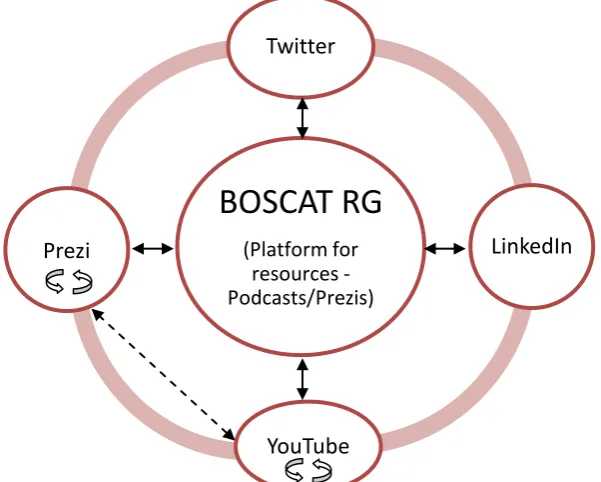
During the Lean in Healthcare project different types of social media was used and included a website hosted under the University of Huddersfield, Business Operations, Supply Chain and Transport Research Group (BOSCAT), Twitter and YouTube; each of these had a different purpose. Therefore the key aim of the engagement and the dissemination was not to use social media but a combination/integration of them. The project team developed a strategy in using social media for the purpose of building a network of interested people, raise awareness of the project and disseminate the outputs. Figure 2 represents the Lean in Healthcare project social media strategy and shows the internal and cross-platform links and relationship between the different research dissemination methods:
6
people to be engaged, develop interesting discussions and discover threats and opportunities.
x Prezis related to the project were hosted on the Prezi website. As it was mentioned, the presentations contained active links back to the project website and to other platforms. There were also internal links within each Prezi that directed the user to other Prezis related to the project without going back to the website.
x YouTube hosted videos created for the project. Like the Prezi website, there were not only active links back to the project website and to other platforms but also there wereinternal links within YouTube which allowed people to be aware of other project videos.
x By using Twitter and LinkedIn account a number of groups working in the same sector were identified; many interesting conversations developed between them and the project team. Twitter and LinkedIn redirected users to the website and this was a way used in order these groups to be engaged and to develop and sustain networks and collaborations.
The project team used their personal LinkedIn profiles instead of creating a project research group because an analysis of existing Lean Healthcare groups revealed saturation and high competition. It was considered that establishing another Lean Healthcare LinkedIn group would offer little impact in terms of research dissemination.
Figure 2 ± the strategic method of using Social Media
Research seminar event
The Lean in Healthcare project was used as the case study. The project incorporated the application of social media to disseminate project findings and engage with interested parties. However, when the project lifecycle was applied it was acknowledged that
BOSCAT RG
(Platform for resources -‐ Podcasts/Prezis)
YouTube
Prezi
[image:7.595.147.448.439.680.2]7
social media was only used for two of the four phases of the research lifecycle; engagement and dissemination, due to social media usage beginning in month seven of the project. Subsequently, a research seminar that was held in month eleven of the Lean in Healthcare project has been presented as an example to demonstrate how social media can be used throughout the whole research cycle.
The research seminar was a key deliverable for the Lean in Healthcare project for the purpose of dissemination of Lean thinking. However, the topic of the seminar was not defined by the Lean in Healthcare project¶V aims and objectives. As such, it created an opportunity for the researchers to apply social media to influence the research process. Twitter was the social media platform used to engage with interested parties, and the number of visitors to the Lean in Healthcare website following a social media event was used as an indicator of interest in the Lean in Healthcare research. Table 1 shows the dates when social media events took place within the different stages of the research life cycle and number of visitors to the website following the event.
Table1 ± Number of visitors to the project website following a social media event Project Lifecycle Dates Social Media Event Website visitor numbers
Planning Oct 2014 - -
Engagement/Planning 28/10/14 06/11/14 11/11/14
Twitter Twitter Twitter
40 34 37
Execution 12/11/14 Twitter 41
Dissemination 29/11/14 Twitter
Prezi 43 190 in total
Social Media was used to help inform, plan and disseminate the findings of the research seminar. As social media was already being used prior to the start of planning the research seminar, the research team had access to individuals/groups that had an interest in the ESRC Lean in Healthcare project and already engaged in social media interactions. Furthermore, it also allowed the researchers to analyse discussions that were taking place in the healthcare and researcher social media community in order to ideQWLI\DUHOHYDQWDQGµWUHQGLQJ¶WRSLFIRUWKHUHVHDUFKVHPLQDU7KLVZDVVXEVHTXHQWO\ LGHQWLILHG DV µ&KDOOHQJHV WR +HDOWKFDUH 7UDQVIRUPDWLRQ¶ 2QJRLQJ DQDO\VLV RI VRFLDO
media activities in Phase 2 allowed the researchers to select a date for the research seminar event which did not clash with other seminar/conference events to improve attendance rates. Social media was also used to inform people about the event; raising awareness and providing instructions to people on how to participate.
Phase 3 of the research cycle corresponded with the execution and delivery of the seminar event. During the seminar, the research team issued a series of tweets in order to share real time discussions taking place at the event. This saw a number of the live
8
Discussion
Social media was not used for research planning and execution in the case study, ESRC Lean in Healthcare project. However, social media was used throughout the research lifecycle in the development of a research seminar. This example revealed that social media tools were useful for pinpointing a topic that was of interest and would appeal to the research audience group. As McCarthy (2013) explained, in one of his interviews, social media has a bigger reach than the traditional academic channels. Therefore, an area for further research is the use of these tools for the other two phases of the research lifecycle;research planning and execution. In particular, researchers can use Twitter and LinkedIn for communicating an idea or identifying research opportunities, discussing ways of approach and develop it, reviewing the literature and collecting research data. In addition to this, they can use them for communicating their work, for finding out about others work, or for developing and sustaining networks (Rowlands et al., 2011). This was clearly demonstrated in the research seminar example which saw the research team build a network of individuals with an interest in healthcare research and share communications about research findings. Moreover, social media can be used within the research community in order to support the internationality of research between the established researchers and institutions, as well as facilitate the sharing of knowledge between researcher and practitioner. McCarthy (2013), who is a Professor and Canada Research Chair in Technology & Operations Management, decided to experiment with using social media in his career; he realised that by using them, feedback is much more instantaneous and as a result these tools can improve the very slow process of research. Similar observations were also recorded during Phase 1 of the research seminar; analysis of social media trends allowed the research team to quickly identify a topic that was of relevance to the healthcare community at that particular time. If social media were not employed, the research team would have likely chosen an alternative topic based on a review of current peer reviewed publications containing articles which were prepared several months/years earlier (McCarthy, 2013). During that time, the community would have moved onto newer issues. As such, social media can serve as a platform for researchers to identify new areas for research that would be relevance and of high value to their audiencesLHFUHDWLQJDUHVHDUFKµSXOO
9
Despite the perceived positives associated with social media, there is a portion of people who are reluctant to use social media - questioning the quality of the offered information (Hansen, 2011). There have been several debates on the quality of data provided over the internet, on the authority of sources and whether these data have the permission to be there (Fry at al., 2008). Moreover, an idea or a question published through social media can easily be influenced by people comments. People have different opinion of a subject and they might try to drive a conversation upon their interests. As a result, the initial idea will never be developed or it may be different at the end. Researcher should develop a strategy of how social media can be used in a research setting in order their potential impact to be avoided.
Conclusion
The Lean in Healthcare project was used as a case study to incorporate the application of social media for two of the four phases of the research lifecycle; engagement and dissemination. The project team developed a strategy to implement these tools in order to increase SHRSOH¶V LQWHUHVW DQG GLVVHPLQDWH WKH UHVHDUFK RXWFRPHV 7KH research highlighted that social media offers an easy and approachable way for targeting groups of people who might be interested in a particular research topic; keeping them informed of latest project event and disseminating the findings. For a better understanding of how social media can be used, a research seminar that was held during the project was given as an example. This example demonstrated how social media could be used throughout a whole research cycle. In this way, the explanation of the application of social media for engagement and dissemination becomes more understandable and also a brief description of how these tools could be used for planning of a research and execution is given.
This paper provides initial evidence of how social media can: positively influence the research process; actively facilitate research dissemination; and also highlight a relatively undeveloped topic that would benefit from further research within the application arena of operations management research. Ultimately, the use of social
PHGLDZLOOKHOSHYLGHQFHDVSHFWVRIWKHµLPSDFW¶RIUHVHDUFK7KHUHIRUHLWPXVWQRZEH
consciously, tactically and strategically used as a defined tool.
References
Adams, J. R. and Barndt, S. E., (1978), "Organizational Life Cycle Implications for Major Projects." Project Management Quarterly, Vol. IX, No. 4, p. 32-39.
%UDGOH\$µ5H$QHZGHILQLWLRQRIVRFLDOPHGLD>:HEORJPHVVDJH@¶5HWULHYHGIURP http://blogs.gartner.com/anthony_bradley/2010/01/07/a-new-definition-of-social-media/ &KR<&KR( 0F/HDQ*1µ+5'¶VUROHLQNQRZOHGJHPDQDJHPHQW¶$GYDQFHVLQ
Developing Human Resources, Vol. 11, pp. 263-272.
)LVKHU&%XJOHDU-/RZU\'0XWFK$DQG7DQVOH\&µ5HVHDUFKLQJDQG:ULWLQJD 'LVVHUWDWLRQDQHVVHQWLDOJXLGHIRUEXVLQHVVVWXGHQWV¶3HDUVRQ(GXFDWLRQ/LPLWHG, 3rd edition.
Fry, J., Lockyer, S., Oppenheim, C., Houghton, J., & Rasmussen, B. (2008). µIdentifying the benefits of
curating & sharing research data¶. Retrieved February 10, 2011, from
http://www.jisc.ac.uk/publications/reports/2008/databenefitsfinalreport.aspx.
Gil-2U2³%XLOGLQJFRQVXPHUGHPDQGE\XVLQJYLUDOPDUNHWLQJWDFWLFVZLWKLQDQRQOLQHVRFLDO QHWZRUN´$GYDQFHVLQ0DQDJHPHQW9RO1RSS-14.
10
Harmsworth, S., Turpin, S., and TQEF National Co-ordination TeamµCreating an Effective
Dissemination Strategy: An Expanded Interactive Workbook for Educational Development Projects
Bridging the Gap ± Innovations Project 2001.
HennHPDQ7µ&RPSDQLHVPDNLQJIULHQGVZLWKVRFLDOPHGLD¶:RUNIRUFH0DQDJHPHQW
Retrieved from http://www.workforce.com/section/10/feature/27/11/92/index.html.
Huang, J. -6<DQJ6-++XDQJ<0 +VLDR,<7µ6RFLDOOHDUQLQJQHWZRUNV%XLOG
PRELOHOHDUQLQJQHWZRUNVEDVHGRQFROODERUDWLYHVHUYLFHV¶(GXFDWLRQDO7HFKQRORJ\ 6RFLHW\9RO
13, No.3, pp.78-92.
Janke, L., Asher, A. and. Keralis, S., µ7KH3UREOHPRI'DWD¶&RXQFLORQ/LEUDU\DQG,QIRUPDWLRQ
Resources (CLIR) Report.
0D\ORU+DQG%ODFNPRQ.µ5HVHDUFKLQJ%XVLQHVVDQG0DQDJHPHQW¶3DOJUDYH0DFPLOODQ 0F&DUWK\,µ)URP7H[WERRNWR7DEOHW¶,GHDV#%HHGLH5HWULHved from
http://beedie.sfu.ca/ideas/2013/12/from-textbook-to-tablet/
OECD (2007). Principles and guidelines for access to research data from public funding. Retrieved February 10, 2011, from http://www.oecd.org/dataoecd/9/61/38500813.pdf.
Post, G., & AnGHUVRQ'µ0DQDJHPHQWLQIRUPDWLRQV\VWHPV6ROYLQJEXVLQHVVSUREOHPVZLWK
LQIRUPDWLRQWHFKQRORJ\¶WKHG1HZ<RUN0F*UDZ-Hill Irwin.
5DGDFN6µ7KHV\VWHPGHYHORSPHQWOLIHF\FOHVGOF¶5HWULHYHGIURP
http://csrc.nist.gov/publications/nistbul/april2009_system-development-life-cycle.pdf
5,1µ,I<RX%XLOG,W:LOO7KH\&RPH"+RZ5HVHDUFKHUV3HUFHLYHDQG8VH:HE¶KWWS www.rin.ac.uk/our-work/communicating-and-disseminating- research/use-and-relevance-web-20-researchers.
5RZODQGV,1LFKRODV'5XVVHOO%&DQW\1DQG:DWNLQVRQ$µ6RFLDOPHGLDXVHLQWKH UHVHDUFKZRUNIORZ¶/HDUQHG3XEOLVKLQJ9RO1R
Smith, K.T., (³'LJLWDOPDUNHWLQJVWUDWHJLHVWKDWPLOOHQQLDOVILQGDSSHDOLQJPRWLYDWLQJRUMXVW
DQQR\LQJ´-RXUQDORI6WUDWHJLF0DUNHWLQJ9RO1RSS-499.
Van den Eynden, V., Corti, L., Woollard, M. & Bishop, L. (2009). µManaging and Sharing Data: A Best
Practice Guide for Researchers¶. Retrieved 02/06/2010, from
http://www.data-archive.ac.uk/media/2894/managingsharing.pdf
:K\WH$DQG3U\RU*µ2SHQ6FLHQFHLQ3UDFWLFH5HVHDUFKHU3HUVSHFWLYHVDQG3DUWLFLSDWLRQ
The International Journal of Digital Curation, Vol.6, No.1.
:LOOLDPV'/&ULWWHQGHQ9/.HR7DQG0F&DUW\3³7KHXVHRIVRFLDOPHGLDDQ H[SORUDWRU\VWXG\RIXVHVDPRQJGLJLWDOQDWLYHV´-RXUQDORI3XEOLF$IIDLUV9RO1RSS -136.
Wilson, C., µ0DNLQJ&RQQHFWLRQV+LJKHU(GXFDWLRQ0HHWV6RFLDO0HGLD¶7KH0DJD]LQHRI
Higher Learning, Vol.45, No.4, pp.51-57.