2016 International Conference on Electronic Information Technology and Intellectualization (ICEITI 2016) ISBN: 978-1-60595-364-9
Simulation Study on the Desulfurization
Efficiency Based on Swirl Atomizing
Dingping Liu, Jing Cui and Shang Xiao
ABSTRACT
Based on the kinetics of chemical reaction, the theory of turbulent diffusion and the theory of mass transfer, the turbulent flow of flue gas in the desulfurization tower was described by standard k –εmodel, and Lagrangian discrete phase model was employed to solve the particle momentum. The SO2 absorption model of wet
flue gas desulfurization (WFGD) tower was established, and swirl atomizing layer (SAL) was installed on the tower. The concentration distribution of SO2 was
simulated using CFD method. The results showed that SAL could improve the desulfurization efficiency.
INTRODUCTION
The SO2 absorption was the core part of WFGD. According to the mechanism of chemical reaction, the absorption was essentially a gas-liquid reaction. In order to achieve high desulfurization efficiency, the absorption equilibrium, oxidative equilibrium and crystallization equilibrium were needed happen at the same time. In 1995, Gerbec etc. [1] established the unsteady model of WFGD. And chemical equilibrium and precipitation and dissolution of salt ware built into the model, which laid a foundation of quantitative description of chemical reaction in desulfurization tower.
__________________________
CFD could guide the engineering design and optimization, because it could reduce physical model test, shorten the development cycle, save the cost of study and get a lot of local and transient data. It had been introduced to study flow field in tower and concentration distribution. Xiao etc.[3]studied the effect on flow field under several different inlet boundary conditions. Geng Ping [4] by numerical simulation, it illustrated that conventional spray layer was easy to form dead zone and gas corridor. Liu J.Y.[5]by numerical simulation, found the flow field, the droplet trajectories, the escape rate and the residence time in WFGD tower.
From the research situation at home and abroad, the numerical simulation study of WFGD tower were mainly concentrated in flow field and rarely quantitative description of desulfurization. Based on the kinetics of chemical reaction, the theory of turbulent diffusion and the theory of mass transfer, The SO2 absorption model of WFGD 460000Nm3/h handling capacity was established. The SO2 concentration distribution and the desulfurization efficiency of tower could be calculated.
PHYSICAL AND MATHEMATICAL MODEL
Physical Model
The physical model was limestone/gypsum WFGD tower of 460000Nm3/h handling capacity of a coal-fired power plant[6]. Absorption region of the desulfurization tower was selected as area calculation, leaving out the demister and spray beam. To facilitate the numerical simulation, the physical model were simplified reasonably.
Two-Film Theory
According to the theory of chemical absorption, Calculation of Hatta [7] showed that the reaction was rapid, who was controlled by mass transfer of SO2.
In 1923, the two-film theory, a classic dynamics theory of mass transfer between interface, was proposed by W.G. Whitman and L.K. Lewis. Some researchers [8-12] both at home and abroad applied the theory to study the SO2absorption and obtained some achievements.
) ( A Ai G
A k P P
N (1)
G M
G RT P
DP k
The process of FGD was conducted in gas, liquid and solid phase.
Considering limestone fully dissolving in the slurry, the resistance of gas film controlled the process, which were described by equation (1).
NA was the mass transfer rate of SO2, mol/(m2⋅s); kG was defined by equation(2), the mass transfer rate of gas film, mol/(m2⋅s⋅Pa); PA, PAi was partial pressure of SO2 in the main body and interface phase, Pa; D was molecular diffusion coefficient, m2/s; P was the total pressure, Pa; R was gas constant, J/(mol⋅K); T was thermodynamic temperature, K; PM was logarithmic mean partial pressure of inert constituent in the main body and interface phase, Pa; δ was gas film thickness and Related to the Reynolds number.
Combining test data of the WFGD tower in operation conditions, a semi-rational derivate formula was showed by equation (3).
)
( 2
1
Bi A A
c P T
ud
N
(3)
Where α1、α2 was empirical constant; u was the relative velocity of gas and slurry particles, m/s; d was the average diameter of particles, m. Using user-defined functions (UDF) described the absorption rate equation of SO2, being got on the basis of equation (3). So the absorption process of SO2 could be simulated by CFD.
User-Defined Functions
In simulation, source item had the relationship with the mass transfer rate of SO2described by equation(4):
MS -mLNASV (4)
Where, Ms was absorption mass source; m was molar mass of slurry; SV was the surface density of discrete phase described by equation(5)
.
V d d m SV
1 )
6 / 1 (
2
3
(5)
The relationship between MS and other parameters was loaded into the source term of SO2 in UDF, together with other control equations for iterative calculation. Its derivative of related transport equation variables was added to UDF, in order to improve the stability and convergence of iterative calculation.
A three-dimensional mathematical model was developed to simulate flow field of desulfurizing tower. The grid number was more than 1.5 million. Gas flow was 460000 Nm3/h, the density of flue gas was 1.12kg/m3, the inlet velocity of flue gas was 7.8m/s, the inlet concentration of SO2 was 1168mg/m3.
RESULTS AND DISCUSSIONS
Velocity Flow Field Analysis
Figure1 showed that, when closing the SAL, the streamline was inhomogeneous and a large number of flue gas, soaring as soon as it entered, didn`t fully mix with slurry soared, which against the absorption of SO2. Figure2 showed that opening the
SAL could solve the problems of inhomogeneous streamline and short contact time in conventional absorption of SO2.
Concentration Distribution of SO2
Figure 1. The gas streamline when
closing the SAL. Figure 2. The gas streamline when opening the SAL.
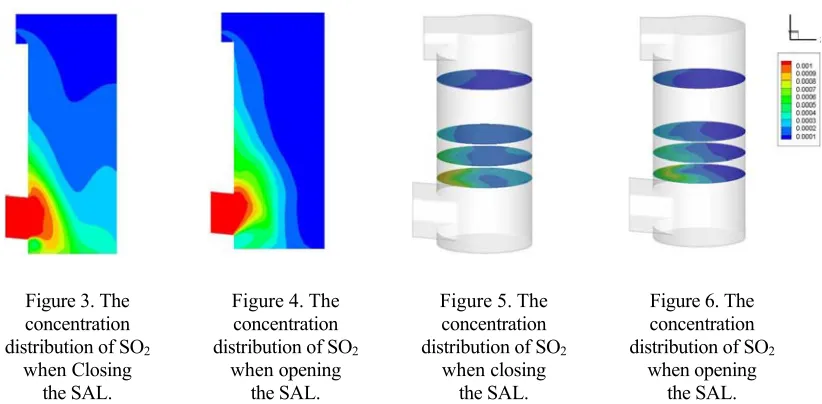
The SO2concentration distribution in X-Z section at Y=0, closing and opening SAL, was respectively shown in Figure3 and Figure4. The SAL was installed at elevation z = 6.66m in the tower.
Figure5 and Figure6 showed that, when opening SAL, the concentration gradient of SO2 was less with the increasing of the depth of section. The concentration gradient of SO2 tended to zero in section at Z=15m. The outlet average mass fraction of SO2 increased to 0.00754% from 0.00613%, when closing SAL. That is to say, the desulfurization efficiency increased to 94.17% from 92.82%.
Those figures showed that the increase of the gas local velocity was bad for the absorption of SO2. Although the increase of the gas local velocity might strengthen the turbulent intensity of droplets, indirectly enhancing the mass transfer by increasing the mass transfer coefficient, meanwhile it reduced the local liquid gas ratio. Because of SO2 being soluble in water, the influence of liquid gas ratio on the absorption of SO2 was higher than that of turbulent intensity, consequently the increase of the gas local velocity reduced the absorption rate of SO2. SAL could optimize the gas velocity and improve the absorption rate of SO2.
[image:5.612.102.513.351.553.2]CONCLUSIONS
Figure 3. The concentration distribution of SO2
when Closing the SAL.
Figure 4. The concentration distribution of SO2
when opening the SAL.
Figure 5. The concentration distribution of SO2
when closing the SAL.
Figure 6. The concentration distribution of SO2
when opening the SAL.
Combining two-film theory, based on the kinetics of chemical reaction, the theory of turbulent diffusion and the theory of mass transfer, the concentration distribution of SO2 and velocity flow field analysis were simulated, conclusions as follows:
1. When opening SAL, the distribution of flow field became inhomogeneous, and the absorption efficiency of SO2 improved obviously.
3. The simulation results agreed with the experimental approximately. The model could be used to estimate the desulfurization efficiency in engineering.
REFERENCES
1. Gerbec M., Stergarsek A., Kocjancic R. 1995. “Simulation Model of Wet Flue Gas Desulphurization plant”. Computers & Chemical Engineering, 19(Supplement 1): 283-286. 2. Yongming Lin. 2006. “Study on Large Scale Limestone-gypsum Spraying Desulphurization
Technology and Project Application”. Hang Zhou: Zhejiang University. In Chinese.
3. Y.J. Xiao, C.T. Li, S.H. Li, J.K. 2014. “Optimal Design of a Wet-type Desulphurization Absorber by the Numerical Simulation Method”. Chemical Engineering Research & Design, 92(7): 1257-1266.
4. Ping Geng, Qingwei Hou, Chunmei Lu. 2005. “Numerical study on flow field of FGD spray scrubber”. Journal of Shandong university(Engineering science), 35(5): 24-28. In Chinese. 5. Jiayu Liu, Yaming Liu, Yajie Hao. 2016. “Motion Characteristics of Gypsum Slurry in Wet-type
Desulphurization Tower”. Journal of Central South University (Science and Technology), 47(1): 130-137. In Chinese.
6. Dingping Liu, Fang Lei, Xiao Shang. “Simulation and Experimental Study on Atomizing Desulfurization Technology Adopted in Flue Duct of Desulfurization Tower”. Journal of Chinese Society of Power Engineering, 25(19): 830-834. In Chinese
7. Levenspiel O. 2002. “Chemical Reaction Engineering”. 3rd. Beijing: Chemical Industry Press. 8. Luca Marocco. 2010. “Modeling of the fluid dynamics and SO2 absorption in a gas–liquid
reactor”. Chemical Engineering Journal, 162 (1): 217-226.
9. Warych J., Szymanowski M. 2002. “Optimum Values of Process Parameters of the Wet Limestone Flue Gas Desulfurization System". Chemical Engineering Technology, 25(4): 427-432.
10. Sh. Darake, M.S. Hatamipour, A. Rahimi, 2016. “SO2 Removal by Seawater in a Spray Tower: Experimental Study and Mathematical Modeling". Chemical Engineering Research and Design, 109(5) 180-189.
11. Mingchen Qin, Yong Dong, Lin Cui. 2015. “The Simulation of Fluid Dynamics and Mass Transfer in a Double-loop WFGD". Journal of Shandong University (Engineering Science), 05: 88-94. In Chinese