2017 International Conference on Computer, Electronics and Communication Engineering (CECE 2017) ISBN: 978-1-60595-476-9
Optimal Allocation Based on Cost, Testing Effort and Reli
abilityNan ZHANG
Harbin University of Commerce, Harbin 150028, China
Keywords:Software reliability, Testing effort, Testing resource, Optimal allocation.
Abstract. In this paper, we investigate a software resource allocation problem. We incorporate generalized modified weibull testing effort function in software reliability growth model to get a better description of the software debugging process. The main purpose is to minimize the cost of software development when the number of remaining faults and a desired reliability objective are given. A real software failure project is demonstrated the effectiveness of proposed models.
Notation
the expected number of initial faults
the rate of fault detection per testing effort at time the expected mean number of faults detected in time the current testing effort consumption at time
the cumulative testing effort consumption in time the total amount of testing effort
a scale parameter a shape parameter a shape parameter
a kind of accelerating factor parameter
a weighting factor to measure the relative importance of a fault correction from module i.
cost of a fault removed during debugging process. cost of a fault removed during operation process. cost of testing per unit testing effort expenditure.
Introduction
Software reliability is one of important index in software development process, which defined as the probability of failure-free software operation in a specified time and space. Since 1970s, software reliability growth models have been built to estimate software reliability during software development processes [1-2]. In these software reliability growth models, an exponential and an S-shaped curve are described to fault phenomenon in software debugging process [1-2]. Besides, in these models, the span of time concludes calendar time, clock time, and CPU execution time. Moreover, some researchers verified that the CPU execution time is a better time for software reliability growth models than other time [3-5].
The remainder of paper is organized as follows. We incorporate generalized modified weibull testing effort function into the software reliability growth model in section 2. The applications of these models to actual data set are discussed in section 3. Section 5 is conclusions.
Software Reliability Growth Models with Generalized Modified Weibull Testing Effort Function
The distribution of resource consumed in the software debugging process is defined as a consumption curve of software testing effort [9].The testing-effort can be represented as the number of CPU hours, the number of executed test cases, etc. Furthermore, experience has studied that testing effort are usually performed by different curve in the software debugging phase of a project [9].
Let be the cumulative amount of testing effort expenditures in the testing time interval and be the consumption rate of the testing effort expenditures. According to the assumptions, we get the different equation:
(1) Solving equation (1), we get
(2) By various values to , we obtain different testing effort function models.
In this paper, a new software reliability growth model with the generalized modified weibull testing effort function is proposed to predict the software reliability. Here are assumptions in model:
(1) Software debugging process is modeled with a Non-Homogeneous Poisson Process.
(2) In the time t, the mean number of faults detected by testing effort expenditures is proportional
to the mean number of remaining faults
(3) Testing effort expenditures are described by a generalized modified weibull curves. (4) The new models are perfect debugging.
Based on assumptions, we can get the following differential equation [1-2]
(3) Solving the above equation under boundary condition , we get
(4) The generalized modified weibull distribution with five parameters had a great flexibility in accommodating all the forms of the hazard rate function, can be used in a variety of problems for modeling software faults [3-5]. The generalized modified weibull testing effort function is described as follow:
Resource Allocation
This section investigated resource allocation problem based on a Software reliability growth model with generalized modified weibull testing effort function. Assumptions as follow:
(1) The software system consisted of N independent modules.
(2) The each module is estimated by a Software reliability growth model with generalized modified weibull testing effort function in debugging process.
(3) The expenditures of testing resource in debugging process are denoted by W.
(4) In minimized number of remained faults, the testing resource W is allocated to each module. According to the above assumptions, the mean value function is given by
(8)
Many cost models are proposed in the literature, such as RCA PRICE S model, Putnam’s SLIM cost model, Boehm’s COCOMO model, Checkpoint, COOMO’II and so on [6, 10]. In this paper, software cost is evaluated by testing effort expenditures, cost criterion, and cost of removal faults. The equation as follow:
(9) According to equation (4), equation (8), and equation (9), a software cost model based on Non-Homogeneous Poisson Process is computed by:
(10) From equation (10), we can see the relationship between software cost and testing resource. We supported that denoted the amount of testing effort and is the testing effort of module. Therefore, the optimization equation is given by:
(11) Solving equation (11), we get
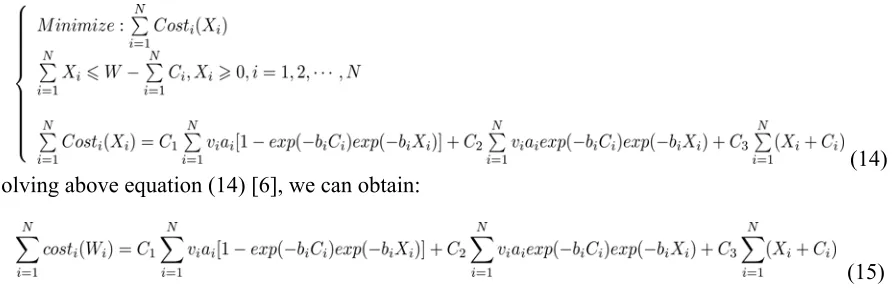
(12) Moreover, we have
(14) Solving above equation (14) [6], we can obtain:
(15)
Numerical Examples
In section, we evaluate the performance of the proposed models based on the real software faults data set. The method of least square estimation minimizes the sum of squares of the deviations between what we actually observe, and what we expect. Sometimes least square estimation may have smaller bias or it may approach normality faster. Thus, we use the method of least square estimation to estimate the parameters of the proposed models [11-13].
[image:4.612.85.531.67.221.2]Assume that a software system is composed of 6 modules, and the total amount of generalized modified weibull testing effort expenditures is 50000 man-hours. The software reliability is 0.95. According to above equations, the optimal expenditures of testing effort can be estimated and shown in table 1.
Table 1. The optimal expenditures of testing effort.
Module ai bi Wi Cost
1 23 0.00139 2997.1 1572.7
2 15 0.000912 3721.6 2002.8
3 10 0.000603 4016.7 2113.7
4 20 0.000598 8213.9 4165.6
5 13 0.000269 24403.5 12168.3
6 15 0.000427 6648.2 3401.2
Conclusions
In this paper, we incorporated generalized modified weibull testing effort into software reliability growth models. Besides, this paper proposed a method to optimize allocation of testing resource considering cost, reliability and testing effort. Numerical examples are described and discussed.
Acknowledgement
This paper is supported by the Heilongjiang Province postdoctoral Grant No. LBH-Z15115, and the Harbin University of Commerce under Grant No. 15RW21.
References
[4] Shaik. Mohammad Rafi, K. Nageswara Rao, Shaheda Akthar, Incorporating Generalized Modified Weibull TEF in to Software Reliability Growth Model and Analysis of Optimal Release Policy, Computer and Information Science, 3(2), 2010, 145-162
[5] Ahmad N., Khan M.G.M., Rafi L.S. Analysis of an Inflection S-shaped Software Reliability Growth Model Considering Log-logisitc Testing Effort and Imperfect Debugging, International Journal of Computer Science and Network Security, 11(1), 2011, 161-171.
[6] Chin-Yu Huang, Jung-Hua Lo, Sy-Yen Kuo, and Michael R. Lyu, Optimal Allocation of Testing-Resource considering Cost, Reliability, and Testing-Effort, Proceedings of the 10th IEEE Pacific Rim International Symposium on Dependable Computing (2004)
[7] Chin-Yu Huang, Jung-Hua Lo, Optimal resource allocation for cost and reliability of modular software systems in the testing phase, the Journal of Systems and Software, 79 (2006) 653-664 [8] P.C. Jha, Deepali Gupta, Bo Yang, P.K. Kapur, Optimal testing resource allocation during module testing considering cost, testing effort and reliability, Computers & Industrial Engineering, 57 (2009), 1122-1130.
[9] Li Q.Y., Li H.F., Lu M.Y., Software Reliability Growth Model with S-shaped Testing Effort Function, Journal of Beijing University of Aeronautics and Astronautics, 37(2), 2011, 149-154. [10] B. Boehm, C. Abts, S. Chulani, Software Development Cost Estimation Approaches a Survey, Annals of Software Engineering, 10, (2000), 177-205
[11] S. Yamada, T. Ichimori, and M. Nishiwaki, Optimal Allocation Policies for Testing Resource Based on a Software Reliability Growth Model, International Journal of Mathematical and Computer Modelling, 1995, 295-301
[12] M. Nishiwaki, S. Yamada, and T. Ichimori, Testing-resource Allocation Policies based on an Optimal Software Release Problem, Mathematica Japonica, 43(1), 1996, 91-97.