Numerical Investigation of an Impinging Diffusion
Flames-Effects of Fuel Variability
Nadjib Ghiti1, Abed Alhalim Bentebbiche1, Samir Hanchi2
1Laboratoire de Mécanique Avancée—LMA, Bab-Ezzouar, Alger, Algeria
2Laboratoire de Mécanique des Fluides, EMP, Bordj El Bahri, Alger, Algeria
Email: [email protected]
Received January 16, 2013; revised February 17, 2013; accepted February 25, 2013
Copyright © 2013 Nadjib Ghiti et al. This is an open access article distributed under the Creative Commons Attribution License,
which permits unrestricted use, distribution, and reproduction in any medium, provided the original work is properly cited.
ABSTRACT
In our study, we investigate the differences between the combustion of different hydrocarbon fuels CH4, C3H8, C4H10.A numerical simulation of an impinging jet diffusion flames is used. The jet injector has a 10 mm in diameter and the dis-tance between the jet flame and the vertical wall is 2 time half diameter. The fuel jet velocity was fixed for 11.8 m/s, corresponding to a Reynolds number of 6881. The flame characteristics varied from hydrocarbon to another for the same Reynolds number. The combustion products of CO, CO2, NO, OH, are depending on the methane and propane and butane flames for the same conditions. The temperature of the flame was varied from hydrocarbon to another the same as for the chemical species production rate. The concentration of the thermal and prompt NO pollutant depends on the temperature flow field and on the thermochemical characteristics of the hydrocarbon fuels.
Keywords: Flame; Diffusion; Turbulent; Methane; Propane; Butane
1. Introduction
A diffusion flame is a very common practical system, such as a match flame or a candle flame, and is funda- mental to many more complex systems. However, in a diffusion flame there is a relatively long time scale, al-lowing sufficient recombination reactions to take place such that it involves complex interaction of flow, trans- port and chemistry. There is more chemical and physical interaction in diffusion flames than in a premixed flame. The first systematic analysis of a confined, jet diffusion flame dates back to 1928 by Burke and Schumann (pub- lished in 1948) [1]. Due to environmental concerns, the amount of NOx emission in combustion processed and its
formation mechanism have always been of interest. Be-ing of particular interest is source of nitric oxide, which is a major pollutant to the atmosphere. It has been postu-lated that there are two major mechanisms Zeldovich thermal and Fennimore prompt NO in the production of total NO. Barlow and Carter (1993) [2] reported a rather complete simultaneous measurement on temperature and species concentrations (NO, OH, and major species) in hydrogen flames. However, the amount of naturally ge- nerated NO in a gas phase hydrocarbon flame is very small, and most measurements were done with a certain amount of NO addition.
dynamics of hydrogen and syngas impinging flames by Mira Martinez et al. [6] including a pure H2 and (20% CO, 80% H2), (40% CO, 60% H2), (20% CO, 20% CO2, 60% H2) the results of their study show that the flames develop vertical structures in the primary jet associated with the buoyancy and shear layer instability, and the wall jet progresses parallel to the impinging plate form-ing large scale vortex rform-ings at different locations and strengths as a consequence of the fuel compositions.
Choe McDaid et al. [7] studied the effect of ignition location on the propagation of premixed and diffusion flames of hydrogen and mixtures of hydrogen and carbon dioxide towards. They found that the fuel velocity and Reynolds had a large effect on the observed flame ve- locities, and the type of the fuel affected the velocities and accelerations of the flame front. Experimental and numerical study had been conducted by Subhash et al. [8] to investigate the occurrence of off stagnation peak for laminar/air flame impinging on a flat surface of this off stagnation peak using a commercial CFD code Fluent. They found that this off stagnation in heat flux is prima- rily due to the peak in the axial velocity close to the im- pingement surface. Jaramillo et al. [9] applied the DNS and RANS techniques to study the fluid flow and heat transfer in plane impinging jets. The DNS results have been used as reference solution to assess the performance of several Reynolds averaged Navier Stokes (RANS) models. However all the models predict correctly the local Nusselt number at the stagnation region to investi- gate the complex flow field of an impinging jet Naseem et al. [10] used an LES simulation with a dynamic sma- gorinsky model. The large eddy simulation helps to un-derstand the reason of occurrence of second peak in the radial distribution of Nusselt number at the target wall. They found that the LES simulation of a complex flow impinging jet is highly sensitive to the quality of the grid.
Zhen et al. [11] studied the emission of CO and NOx
from swirling and non-swirling of an impinging inverse diffusion flames and they found that the parameters of air jet Reynolds numbers, overall equivalence ration and Nozzle to plate distance have significant influence on the overall pollutants emission. To reduce the NOx produc-
tion a new down fired combustion technology based on multiple injection and multiple staging was developed by Min Kuang et al. [12]. An experimental study was per- formed by Zhen et al. [13] to investigate the effects of the nozzle length on the air pollutant emission and noise radiation. They found that the noise radiation from the inner reaction cone of the flame is stronger than that from the lower and upper parts of the flame for the stoichiometric air/fuel ration. Zhen et al. [14] performed an experimental work to compare between the emission and impingement heat transfer behaviors liquefied petro-
leum gas added of hydrogen and methane air flames (LPG-H2-air) and (CH4-H2-air) comparison shows a more significant change in the laminar burning speed, tem- perature and CO/NOx emissions in the CH4 flames. Gur- preet et al. [15] investigated the heat transfer charactiris- tics of natural gas/air swirling flame impinging on a flat surface the dip in heat flux at and around stagnation point was observed in almost all cases which could be the main cause of non uniformity even in case of heating with swirling impinging flames.
Nadjib et al. [16] investigated the influence of the ni- trogen dilution on the extinction of methane impinging diffusion flame, and they found that when the dilution rate increased the extinction of the diffusion flame increased.
In the current study, we investigated an impinging dif- fusion flame with three fuels, Methane, Propane and Bu-tane with fixed fuel jet velocity. We also reported on the temperature response to the increase of the CH atom mole fraction, on the other hand we studied the relation between NO fraction production and heating high tem- perature for a non-premixed turbulent hydrocarbons jet flame situation.
2. Mathematical Model
2.1. Turbulent Governing Equations
In the present study, Fluent [20] (commercial CFD soft- ware) was used to model the flow field and heat transfer for diffusion turbulent methane/air flame impinging ver- tically on a flat surface with a reduced reaction mecha- nism (8 species are considered).
The general form of transport equations for two di- mensional stationary turbulent reactive flows can be written as: 0 i i U x
(1)
vx
vy
S
x y x x y y
(2)
where denotes 1, , , ,v vx y h Yi and diffusion coefficient
is 0, ,
p
k C
and Dim respectively. S is a source
term. Fluent uses a control-volume-based technique to convert the governing equations to algebraic equations that can be solved numerically.
In order to resolve the turbulent flow problem we are used K-Epsilon turbulent RNG based model.
ti
i j k j
k
U k G
x x x
(3)
i t
1 2
i j j
U C
x x x k
G C
where i i j
j
U G u u
x
and
2 t k C
The model constants appearing in the above equations are
1 2
0.09, 1.44, 1.92, k 1.0
C C C and 1.0.
The effects of the mean strain rate and mean rotation on turbulent diffusion have been affected by using the re- normalized RNG k- model Yakhot et al., 1992 [21], which employs equations of the same form as the standard k- model. The RNG k- model assumes different model coefficients evaluated by the renormalization group theory which vary with the ration of the turbulent to the mean strain, n, as described below:
1 3 2 3 0.0845 1.42 1 4.8 1.68 1 0.012 C CC n n
C n (5) with 0.7194 k where
1 2 1, 2 ,
2
j i ij ij ij
j i
U U kS
n S S S S
x x (6)
Though the modification of the above constants of the model, it is intended to simulate and control the modelling of the energy dissipation. The RNG k- model is a modification version of the standard k- turbulent model. It adopts a non-equilibrium strain parameter nkS , Where S is the strain rate modulus and the ratio k is the turbulence time scale.
2.2. Modeling Non-Premixed Combustion
In non-premixed combustion, fuel and oxidizer enter the reaction zone in distinct streams. This is in contrast to premixed systems, in which reactants are mixed at the molecular level before burning. Examples of non-pre- mixed combustion include methane combustion, pulve- rized coal furnaces, and diesel (compression) internal- combustion engines.
In order to resolve the turbulent chemistry interaction we are focused to use Pre PDF model based on the reso- lution of mean transport species equation and its variance
2 f [20].
tt f f t
v f (7)
2 2
tt
2
f f f
t
v (8)
The species fractions considered in this investigation are
C H ,C H ,CH ,O ,N ,H O,NO,CO ,CO,O3 8 4 10 4 2 2 2 2 H .
In order to model nitric oxide formation in a flame, the ch
ken into account. The reactions
emical reactions involving nitrogen compounds must be ta
O , N OH, N2 2O
are the principle mechanismsin forming Zeldovich “thermal” NO; the reactions N
N O H, N O O2 2
are the major paths in formingNO were included.
he impingement surface is parallel to ding vertically on the the fuel jet is 10 mm Fenimore “prompt” NO. In the numerical work, both Zeldovich thermal and Fenimore prompt formation of
2.3. Computational Domaine
Using a 2D model, t
[image:3.595.60.287.265.411.2] [image:3.595.361.470.464.709.2]the fuel jet; and the jet was sprea impinging plate. The diameter of
Figure 1 a total of seven transport equations (continuity,
axial, and radial momentums, turbulence kinetic energy and its dissipation rate, energy, and radiative intensity), are solved using the commercial CFD package FLUENT [20]. A second-order discretization scheme was used to solve all governing equations. Solution convergence was determined by two criteria. First is ensuring that the re- siduals of the solved equations drop below specified thresholds set at 10−3 for all variables, while a residual of 10−6 was used for the energy equation. The second con- vergence criterion is ensuring that the value of a sensitive property (e.g., concentration of a radical species) at a critical spatial location has stabilized and is no longer changing with iterations.
3. Numerical Results
In this simulation the temperature and concentration of major species C4H10, C3H8, CH4, H2, H2O, CO2, N2, and O2 and minor species NO, CO, and OH was performed using Fluent software code. CH4, C3H8, C4H10, was used as the fuel in the impinging jet.
Velocity magnitude, flame temperature and the struc- ture of the turbulent flame region were compared with different fuel jet flames.
Figures 2-6 show contours plots for temperature and
mass fractions of OH and CO2 and OH and NO and pro-duction rate plotted versus mixture fraction for flames C4H10, C3H8, and CH4 at the same axial location.
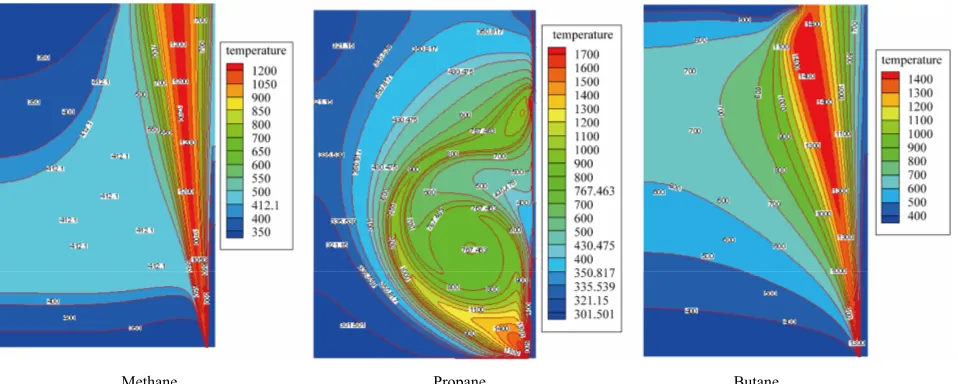
The effect of N2 dilution level, in the fuel stream, on the flame temperature is quite substantial with a drop from 1700 K in the case propane flame, to 1400 K in case of butane flame. The temperature at the centerline is 420
K and is the same for all cases. The mean temperature in the jet vicinity of the flow is 1200 K and is also consis- tent between all flames Figure 2 this result is compared
with the experimental data in references [16-19] for the same authors. When we look in Figure 3 we observe that
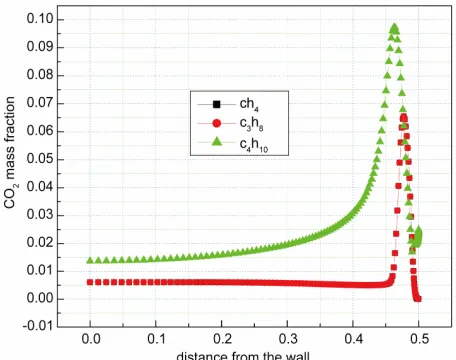
the mass fraction of CO2 is maximal for the butane jet flame. The same results are obtained in Figure 4.
Figures 7 and 9 show how the calculated NO and CO2 concentrations vary with the three jet fuels for the same simulation conditions.
Figures 7-10 show radial profiles of temperature and
[image:4.595.60.539.305.497.2]mass fractions of OH and CO and NO and turbulent in- tensity for turbulent flames C4H10, C3H8, and CH4 at an axial position of 100 mm above the jet exit.
Figure 7 shows radial profiles of mean NO mole frac-
tions for the same flames and positions as those in Fig- ure 10 the NO distribution for flame C4H10 is different
[image:4.595.63.540.523.716.2]Methane Propa
Figure 2. Contours of temperatur
ne Butane
e for different hydrocarbon fuels.
Methane Propane Butane
Me
Fi s.
thane Propane Butane
gure 4. Contours of OH mass fraction for different hydrocarbon fuel
[image:5.595.61.539.84.280.2]Methane Propane Butane
Figure 5. Contours of fraction variance production rate for different hydrocarbon fuels.
Methane utane
Figure 6. Contours of NO mass fraction for different hydrocarbon fuels.
[image:5.595.62.534.312.588.2] [image:5.595.68.528.552.719.2]Figure 10. Concentrations of fuels mass fraction for meth-ane, propane and butane flames.
axial position (100 e and the mean peak NO is almost three times that of other flames.
The NO formation rate is significantly higher in the case of butane fuel compared with methane and propane fuels Figure 9 due to the higher O atom and CH con-
centrations promoted by the fuel oxidation.
Also shown in Figures 11-13 is the concentration of
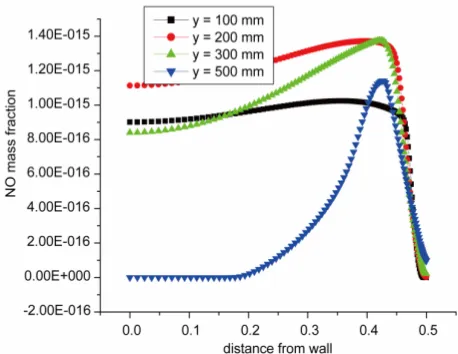
the NO production in the three flames zone on the same horizontal positions calculated from the turbulent flames modeling for the propane and butane flames more NO concentration near the impinging wall due to the effect of molecular weight on the mixing with the surrounding air. The mean NO mole fractions for flame CH4 at the po- sitions of 100 and 200 and 300 mm and 500 mm have the same peak of 2.5 ppm. For flames C H8 and C4H10 the of CH4 flame. A n zone location appears for both flames. At locations 100 and 200 mm, flame
el for flame C4H10, while at location 200 m, the peak level for both flames is similar. It is worth noting that the peak temperature is roughly the same for all locations and that the peak NO levels reported here for all flames are very small when compared with stan- dard diffusion flames with similar Reynolds numbers. This indicates that dilution effects are presented in Fig- ures 12 and 13.
4. Conclusions
[image:6.595.312.535.88.265.2]In this study, we investigated the characteristics of three hydrocarbons methane, propane and butane fuel flames. The temperature and species and NO production of tur- bulent jet flames under non-premixed conditions are in- vestigated.
Figure 7. Dioxide mass fraction for methane, propane and butane flames.
from the other two flames. At the first mm), the NO distribution is quite wid
[image:6.595.58.288.309.496.2]3 NO distribution is different from that Figure 8. Turbulent intens
nd butane flames.
ity profiles for methane, propane
distinct peak close to the reactio a
C3H8 has a mean NO peak level which is almost half that of the peak lev
[image:6.595.58.285.535.708.2]m
Figure 11. Radial profiles of mean NO mass fraction at dif- ferent radial locations for methane flame.
Figure 12. Radial profiles of meanNO mass fraction at dif-ferent radial locations for propane flame.
igure 13. Radial profiles of mean NO mass f F
fe
raction at dif-rent radial locations for butane flame.
sults
d the chang- - The flame temperature varied with the fuel type with the increasing of CH atom. We obtain an increase in flame temperature level. From the numerical re of simultaneous Methane Propane Butane calcula- tions,
- We concluded that the turbulent flame propagation velocity varied from a fuel to another an
ing in the fuel type will influence on the NO masse fraction produced. The same conclusion is obtained for the other species CO, CO2.
REFERENCES
[1] S. P. Burke and T. E. W. Schumann, “Diffusion Flames,”
Proceedings of the Symposium Combustion, Vol. 1-2, No. 1, 1948, pp. 2-11.
[2] R. S. Barlow, and C. D. Carter, “Raman/Rayleigh/LIF
Measurements of Nitric Oxide Formation in Turbulent Hydrogen Jet Flames,” 1993.
[3] L. L. Dong, C. S. Cheung and C. W. Leung,
“Characteri-zation of Impingement Region from an Impinging Inverse
Diffusion Flame Jet,” International Journal Heat and
Mass Transfer, Vol. 56, No. 1-2, 2013, pp. 360-369. doi:10.1016/j.ijheatmasstransfer.2012.08.064
[4] B. G. Sarnacki, G. Esposito, R. H. Krauss and H. K.
Chelliah, “Extinction Limits and Associated Uncertainties of Nonpremixed Counter Flow Flames of Methane
Eth-ylene, Propylene and n-Butane in Air,” Combustion and
Flame, Vol. 159, No. 3, 2012, pp. 1026-1043. doi:10.1016/j.combustflame.2011.09.007
[5] H. S. Zhen, C. S. Cheung, C. W. Leung and H. B. Li,
eat Transfer Behaviors of an Inverse
Dif-th Induced Swirl,”2012.
aid, J. Zhou and Y. Zhang, “Experimental of Com- ted at Different Locations of an Impingement Configuration,” 2012.
[8] S. Chander and A. Ray, “Experimental and Numerical
Study on the Occurrence of Off-Stagnation Peak in Heat Flux for Laminar Methane/Air Flame Impinging on a Flat
Surface,” International Journal of Heat and Mass Trans-
fer, Vol. 54, No. 5-6, 2011, pp. 1179-1186. doi:10.1016/j.ijheatmasstransfer.2010.10.035 “Thermal and H
fusion Flame wi
[6] D. Mira Martinez, X. Jiang, C. Moulinec and D. R.
Em-erson, “Numerical Investigation of the Effects of Fuel Variability on the Dynamics of Syngas Impinging Jet Flames,” 2012.
[7] C. McD
plex Flame Propagations Initia
[9] J. E. Jaramillo, F. X. Trias, A. Gorobets, C. D. Pérez-Se-
garra and A. Olia, “DNS and RANS Modelling of a
Tur-bulent Plane Impinging Jet,” International Journal of Heat
and Mass Transfer, Vol. 55, No. 4, 2012, pp. 789-801. doi:10.1016/j.ijheatmasstransfer.2011.10.031
[10] N. Uddin, S. O. Neumann and B. Weigand, “LES Simu-
lation of Impinging Jet: On the Origin of the Second Peak
in the Nusselt Number Distribution,” International
Jour-nal of Heat and Mass Transfer, Vol. 57, No. 1, 2013, pp
Impinging Swirling and Non-Swirling Inverse Diffusion . 356-368.
[image:7.595.59.285.298.480.2]Flames,” Applied Energy, Vol. 88, No. 5, 2011, pp.
1629-1634.doi:10.1016/j.apenergy.2010.11.036
[12] M. Kuang, Q. Y. Zhu, Z. Q. Li and X. Zhang, “Numerical
Investigation on Combustion and NOx Emission of down
Fired 350 MWe Utility Boiler with Multiple Injection and
Multiple Staging: Effect of the Air Stoichiometric Ratio
in the Primary Combustion Zone,” Fuel Processing
nology, Vol. 109, 2013, pp. 32-42.
[13] H. S. Zhen, Y. S. Choy, C. W. Leung and C. S. Cheung
“Effects of Nozzle on Flame and Emission Behaviors of
Multi Fuel Jet Inverse Diffusion Flame Burner,” Applied
Energy, Vol. 88, No. 9, 2011, pp. 2917-2924. doi:10.1016/j.apenergy.2011.02.040
Tech-
,
[14] H. S. Zhen, C. S. Cheung, C. W. Leung and Y. S. Choy
“A Comparison of the Emission and Impingement Heat
Transfer of LPG-H2 and CH4-H2 Premixed Flames,”
In-,
,
ternational Journal of Hydrogen Energy, Vol. 37, No. 14 2012, pp. 10947-10955.
doi:10.1016/j.ijhydene.2012.04.055
[15] G. Singh, S. Chander and A. Ray, “Heat Transfer Ch
acteristics of Naturel Gas/Air Swirling Flame Impinging
on a Flat Surface,” Experimental Thermal and Fluid
Sci-ence, Vol. 41, 2012, pp. 165-176. doi:10.1016/j.expthermflusci.2012.04.013
ar-
d R. Boulkourne, “Nitrogen
[16] N. Ghiti, A. A. Bentebbiche an
Dilution and Extinction Effects for Methane Impinging
Diffusion Flame,” IERI Procedia 1, No. 1, 2012, pp. 39-
46. doi:10.1016/j.ieri.2012.06.008
[17] N. Ghiti, A. A. Bentebbiche, S. Hanchi and R. Bo
kroune, “A Study of the Interaction between a Jet Flame ul-
ernational
ol. 40, No. 1,
on Flame with
and a Lateral Wall,” Canadian Journal on Mechanical
Sciences & Engineering, Vol. 3, No. 2, 2012, pp. 30-35.
[18] N. Ghiti, A. A. Bentebbiche and R. Boulkroune, “Ex-
perimental Investigation of the Interaction between Tur-
bulent Impinging Flame and Radiation,” Int
Journal of Fluid Mechanics Research, V
2013, pp. 1-8.
[19] N. Ghiti, A. A. Bentebbiche and R. Boulkroune, “Dilution
Effect on the Extinction of Impinging Diffusi
a Lateral Wall,” American Journal of Mechanical Engi-
neering, Vol. 1, No. 2, 2013, pp. 30-33. doi:10.12691/ajme-1-2-2
[20] Guide Fluent, Vol. 4, 1997.
0-1521.
[21] V. Yakhot, et al., “Development of Turbulence Models
for Shear Flow by Double Expansion Technique,”