Combined Frequency and Spatial Domain Algorithm
for the Removal of Blocking Artifacts
George A. Triantafyllidis
Information Processing Laboratory, Electrical and Computer Engineering Department, Aristotle University of Thessaloniki, Thessaloniki 54006, Greece
Email: [email protected]
Dimitrios Tzovaras
Informatics and Telematics Institute, 1st Km Thermi-Panorama Road, Thermi-Thessaloniki 57001, Greece Email: [email protected]
Demetrios Sampson
Informatics and Telematics Institute, 1st Km Thermi-Panorama Road, Thermi-Thessaloniki 57001, Greece Email: [email protected]
Michael G. Strintzis
Information Processing Laboratory, Electrical and Computer Engineering Department, Aristotle University of Thessaloniki, Thessaloniki 54006, Greece
Informatics and Telematics Institute, 1st Km Thermi-Panorama Road, Thermi-Thessaloniki 57001, Greece Email: [email protected]
Received 31 July 2001 and in revised form 7 February 2002
A novel combined frequency and spatial domain method is presented in this paper for blockiness reduction for low bit rate com-pressed images. The method consists of two stages: in the first, better estimates of the reconstructed DCT coefficients are obtained based on their observed probability distribution. In the second, an efficient postprocessing scheme consisting of a region classifi-cation algorithm and a spatial adaptive filtering is applied for blockiness removal. The type of filtering is decided on the basis of an estimation of the local characteristics of the coded image. The main advantage of the proposed method is the efficient combination and design of these two stages which are acting complementarily for the reduction of blocking artifacts. This approach is shown to produce excellent results in removing blocking artifacts. The efficient performance of the proposed algorithm is due, firstly, to the proposition that the shape and the position of the filter kernel are adjusted according to the characteristics of the local image region and secondly, to the employment of the modified improved DCT coefficients by the postprocessing filter. Experimental results illustrating the performance of the proposed method are presented and evaluated.
Keywords and phrases:blocking artifacts, DCT coefficient restoration, spatial adaptive filtering.
1. INTRODUCTION
The block based discrete cosine transform (B-DCT) scheme is a fundamental component of many image and video com-pression standards. Due to its performance on highly corre-lated signals which is close to that of the (optimal) Karhunen-Loeve transform (KLT), and the availability of fast software and hardware implementations, the B-DCT is highly popu-lar in application to image compression. In particupopu-lar, the B-DCT is used in most of current image and video compression standards, such as JPEG [1, 2] and MPEG [3].
A major problem related to the DCT techniques is that
the decoded images, especially at low bit rates, exhibit vi-sually annoying gray-level discontinuities along the block boundaries, commonly referred to as blocking artifacts. This is due to the fact that transform coefficient blocks are quan-tized independently.
solutions, and with the fast increase of available computing power, more sophisticated methods can be implemented.
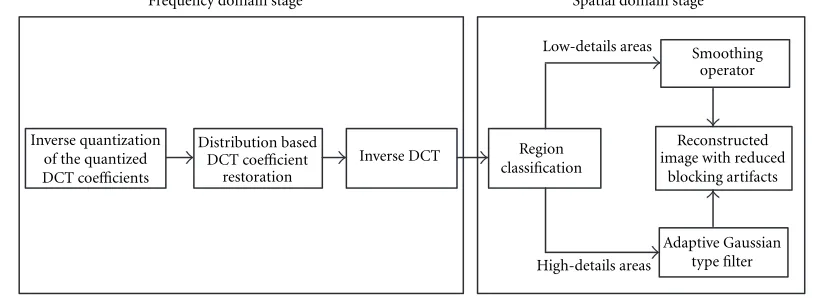
In the present paper, a new method is presented which acts both in the frequency and the spatial domains, in or-der to enhance the visual result of the reconstructed image and reduce the blocking artifacts. The proposed algorithm consists of two stages: in the first, better estimates of the AC coefficients are obtained based on observations about their probability distribution. In the second, a region classifica-tion is performed, classifying the areas of the image into areas of high detail (textures-edges) and areas of low de-tail. Then, depending on the classification, a novel efficient adaptive Gaussian-type filtering follows. These two stages are acting complementarily for blockiness removal. In the frequency domain, the modified improved DCT coefficients contributes to blockiness reduction and in the spatial do-main, the spatial adaptive filtering furthers the reduction of the blocking artifacts.
In B-DCT the quantization noise is highly correlated with the characteristics of the original signals, so that ferent areas of the coded image suffer from distinctly dif-ferent impairments. In particular, the artifacts create two kinds of visual distortions (i) blurring of sharp edges and changes in the texture patterns, and (ii) formation of false edges at interblock boundaries. The first kind of distortion is generally due to near elimination or improper trunca-tion of the high- and mid-frequency DCT coefficients and is efficiently reduced by the proposed AC distribution-based restoration. The other kind is due to severe reductions in the low-frequency DCT coefficients (especially in the DC coeffi -cient) and is tackled with the proposed adaptive spatial filter-ing. Hence, the two stages are acting complementarily for the removal of blocking artifacts.
Many techniques have been proposed in the literature for the distribution-based estimation of the DCT coefficients. Most of them are based on the fact that there should be a bias in the reconstructed DCT coefficients, since the stan-dard, bin center reconstruction is suboptimal. Particularly, the standard method of restoring a DCT coefficient is equiv-alent to replacing each coefficient by the center of the quan-tization interval in which the original coefficient falls. How-ever, the distribution of the AC coefficients for a given fre-quency peaks at zero and decreases monotonically. Thus, for quantization intervals not including zero, the distribution of the original coefficients is denser at the end of the interval closer to zero making the selection of the center of the inter-val suboptimal. In this context, the optimal reconstruction (minimum mean squared error) lies in the centroid of the distribution for the interval and such an estimation is em-ployed in this paper.
The novel postprocessing method, described in this pa-per, exploits the properties of smoothed image gradient data to identify the high- and low-detail regions of the decoded image. The filtering process is then based on the region clas-sification. For the high image detail regions, which include edges and texture, a fully adaptive Gaussian type filter is em-ployed. The shape and the position of the Gaussian kernel is chosen according to the characteristics of each local region.
For the low image detail regions, which include areas of con-stant or slowly varying intensity, a simple Gaussian smooth-ing operator is used.
The rest of this paper is organized as follows: Section 2 contains a review and discussion of various techniques that have been proposed in the past for the removal of block-ing artifacts. In Section 3, the mathematical analysis under-lying the concept for the distribution-based restoration of the DCT coefficients is described. Section 4 presents in de-tail the blocking artifact reduction algorithm by the spa-tial adaptive filtering procedure. Experimental results, given in Section 5, evaluate visually and quantitatively the perfor-mance of the proposed methods. Finally, conclusions are drawn in Section 6.
2. BACKGROUND
Many approaches have been proposed in the literature aim-ing to alleviate the blockaim-ing artifacts in the B-DCT image coding technique. The earliest attempts in enhancing block-encoded images involved space-invariant filtering. Jarske et al. [4] test several filters to conclude that the Gaussian low pass filter with a high pass frequency emphasis gives the best performance. Reeves and Lim [5] apply the 3×3 Gaussian filter only to those pixels along block boundaries. A similar technique by Tzou [6] applies a separable anisotropic Gaus-sian filter, such that the primary axis of the filter is always perpendicular to the block boundary. It was quickly discov-ered, however, that space-invariant filters are generally not very effective for this application; they either do not remove enough of the artifacts, or oversmooth the image. Space-varying filters provide a more flexible framework for the re-duction of compression artifacts. A space-variant filter that adapts to local characteristics of the signal is proposed by Ramamurthi and Gersho in [7]. The algorithm distinguishes edge pixels from nonedge pixels via a neighborhood testing and then switches between a 1D filter and a 2D filter accord-ingly to reduce blocking effects. In [8], an adaptive filtering scheme is reported, progressively transforming a median fil-ter within blocks to a low pass filfil-ter when it approaches the block boundaries. A region-based method is presented in [9], where the degraded image is segmented by a region growing algorithm, and each region obtained by the segmentation is enhanced separately by a Gaussian low pass filter. Lee et al. in [10] propose a two-dimensional signal adaptive filtering and Chou et al. [11] remove blockiness by performing a sim-ple nonlinear smoothing of pixels. In [12], Apostolopoulos and Jayant propose to identify the blocks that potentially ex-hibit blockiness by calculating the number of nonzero DCT coefficients in a coded block and comparing it to a threshold. Then, a filter is applied along the boundaries updating the pixels within the distorted block.
sets are iteratively computed to recover the original image from the coded image. POCS are effective in eliminating blocking artifacts but less practical for real-time applications, since the iterative procedure adopted increases the computa-tion complexity.
Constrained optimization is the basis of another family of JPEG postprocessors. A subset of this family is known as regularization, a method to solve ill-posed inverse problems. Yang et al. and Zakhor [16, 17] proposed a regularization scheme for a constrained least squares solution, which aims to reconstruct the image by minimizing an objective func-tion reflecting a smoothness property. The constrained least squares approach arises from the desire to remain within the quantization convex set (constraint) but at the same time minimize the highpass energy of the signal (expressed as least squares). Hong et al. [18] also applied regularization methods in the subband domain to reduce DCT artifacts in images.
Another family of postprocessors are based on sophis-ticated stochastic modeling of the image. All postproces-sors use a priori knowledge of the image properties. How-ever, in the model-based approach, the a priori assump-tions and their introduction into the algorithm are more ex-plicit. Markov random fields (MRF) are among the more successful models applied to image enhancement. O’Rourke and Stevenson [19] propose a postprocessor that can re-move blockiness by maximizing the a posteriori probabil-ity (MAP) of the unknown image. The probabilprobabil-ity func-tion of the decompressed image is modeled by an MRF, and the Huber minimax function is chosen as a poten-tial function. A similar approach is followed by Luo et al. [20]. Li and Kuo [21] developed a multiscale MAP tech-nique, again under the MRF prior. Because of the itera-tive procedure necessary for the generation of Markov ran-dom fields, MRF techniques suffer from high computational complexity.
Among the most simple and effective denoising algo-rithms are those using the wavelet representation. Gopinath et al. [22] proposed an enhancement method involving the oversampled wavelet transform, in conjunction with a soft thresholding motivated by the minimax arguments of Donoho [23]. Another version of oversampled wavelet de-noising was employed by Xiong et al. [24]. Xiong uses an overcomplete wavelet representation to reduce the quanti-zation effects of block-based DCT. Other approaches using wavelet representation are presented in [25, 26]. In [26] the wavelet transform modulus maxima (WTMM) representa-tion is used for image deblocking.
Finally, there are some approaches in the literature which have tackled the problem of blocking artifact reduction com-pletely in the transform domain [27, 28, 29, 30]. In the JPEG standard [1] a method for suppressing the block-to-block discontinuities in smooth areas of the image is in-troduced. It uses DC values from current and neighboring blocks for interpolating the first few AC coefficients into each block. In [27], Minami and Zakhor present a new approach to reduce the blocking effect, which is applied in the fre-quency domain. This approach removes the blocking effect
by minimizing a new criterion called mean squared diff er-ence of slope (MSDS), while imposing linear constraints cor-responding to quantization bounds. To minimize the MSDS, a quadratic programming (QP) problem is formulated and solved using a gradient projection method. The solution is obtained in the form of the optimized value of the three lowest DCT coefficients. In [28], Lakhani and Zhong fol-low the approach proposed in [27] for reducing blocking effects, using however a different solution of the optimiza-tion problem, minimizing the MSDS globally and predict-ing the four lowest DCT coefficients. In [29, 30] a closed form representation of the optimal (in terms of blockiness removal) correction of the DCT coefficients is produced by minimizing a novel enhanced form of MSDS, for every frequency separately. This correction of each DCT coeffi-cient depends on the eight neighboring coefficients in the subband-like representation of the DCT transform and is constrained by the upper and lower bound of the quantized DCT coefficients.
The method proposed in this paper for the reduction of blocking artifacts combines techniques acting in both the fre-quency and spatial domain. In the DCT domain, new im-proved and modified DCT coefficients are produced, and in the spatial domain, an adaptive filtering is performed after classification in high- and low-detail areas. The type of fil-tering is decided on the basis of an estimation of the local characteristics of the coded image. The algorithm of the AC coefficient adjustment is elaborated in the next section while the analysis of the postprocessing spatial filtering is presented in Section 4.
3. DCT COEFFICIENT ADJUSTMENT
In the classical B-DCT formulation, the input image is first divided into 8×8 blocks, and the 2D DCT of each block is determined. The 2D DCT can be obtained by performing a 1D DCT on the columns and a 1D DCT on the rows. The 64 DCT coefficients of the spatial blockBi, jare then determined by the following formula: are the dimensions of the image.
p(F)
x y a b
Figure 1: Example of DCT coefficient distribution. The interval (ab) is the quantization interval. The bin center is indicated by thex (i.e., standard reconstruction) and the center of the mass of the dis-tribution over the shaded region is indicated by they(i.e., optimal reconstruction).
on their distance from the DC coefficient. The higher verti-cal frequencies are represented by higher row numbers, and higher horizontal frequencies are represented by higher col-umn numbers.
A typical quantization-reconstruction process of the DCT coefficients, as described in JPEG [1], is given by
Fi jQ(u, v)=round
where Q(u, v) indicates the quantization width bin for the given coefficient,Fi jQ(u, v) indicates the bin index in which the coefficientFi j(u, v) falls, andFi jR(u, v) represents the re-constructed quantized coefficient. Then, the rere-constructed pixel intensity is obtained from the inverse DCT.
As it has been mentioned in the introduction, B-DCT de-coders may be improved by making use of the observation that the distributions of the DCT coefficients peak at zero and decrease algebraically or exponentially with rather heavy tails [31]. An efficient DCT coefficient restoration based on this observation, is made in [32, 33]. Both propose that the unquantized AC coefficientsFi j(u, v) are best described by the Laplacian distribution. Considering this distribution of the AC (i=0 or j =0) coefficients, the standard bin center reconstruction is suboptimal (except for the zero bin). Refer-ring to standard JPEG, any unquantized coefficientFi j(u, v) in the bin denoted by the shaded region (see Figure 1) will be reconstructed to the bin center. However, the minimum MSE is achieved by reconstructing the coefficient to the centroid of the distribution over the given bin.
The Laplacian probability density function (pdf), which models the AC coefficients, is (see [34])
f(x)=a 2e
−a|x|, (5)
and is characterized by the single parameter a. If the Laplacian-modeled variable is quantized using uniform step sizes, the only information available to the receiver is that the
original DCT coefficient is in the interval
γ−t≤Fi j(u, v)≤γ+t, (6) whereγ = Fi jQ(u, v)Q(u, v),t = Q(u, v)/2. The trivial solu-tion suggested in JPEG is to reconstruct the coefficient in the center of the interval asFR
i j(u, v) = γ, which simplifies im-plementation. As mentioned, the optimal reconstructionγ
(minimum mean squared error) lies in the centroid of the distribution for the interval (γ−t, γ+t), thus, under the as-sumption of Laplacian statistics [35],
γ=
Note that this implies a biasδtoward the origin,
δ=γ−γ =tcoth(at)−1
a. (8)
For different coefficients we have different step size and pa-rametera[32]. Therefore, considering the DCT coefficient of
blockBi, j at frequency (u, v), we have quantization step size
Q(u, v) and parameterai j(u, v). Then, the biasδi juvtoward the origin can be found from (8) and (6):
δuv constructed AC coefficient,
ˆ
where the sign function is appropriately used to handle both positive and negative values and sign[0]=0.
The parametera, which characterizes the Laplacian dis-tribution and which is needed for the coefficient estimation in (10), can be estimated through two different methods.
In [32], an estimate of a is found by simply comput-ing the variance σ2
F, of the dequantized coefficients recon-structed to bin center and then settinga =√2/σF, which is a well-known relation between the Laplacian parameter and the variance of the distribution.
Price [33] suggests a more rigorous, ML estimate for the parameter a. Assuming the Laplacian distribution, suppose that we have a series ofNobservations of a given coefficient
FR
i j(u, v), prior to any quantization. Referring to these obser-vations asFkfork =1, . . . , N, it is easily shown that the ML estimate ofais given by
aML= NN k=1|Fk|
, (11)
have access to the original, unquantized coefficients. There-fore, the parameter a must be estimated from the recon-structed coefficients. Referring to the quantized coefficients byFkQ, and the Laplacian parameter byaQML, it can be shown
and whereN0is the number of observations that are zero,N1 is the number of observations that are not zero,Nis the total number of observations (N=N0+N1), andS=Nk=1|F
Q k|. Although the Laplacian distribution model remains a popular choice balancing simplicity and fidelity to the em-pirical data, researchers have tried a variety of other fitting methods for the DCT coefficients, such asχ2, Kurtosis and Watson tests [36, 37]. Many other possible distribution mod-els have also been proposed including generalized Gaussian and even a sum of Gaussian distributions [37]. Generalized Gaussian densities describe the AC coefficients quite accu-rately [38], since they have heavy tails [39]. However, these coefficients can be described even more accurately by theα -stable pdf [40], which is a rich and flexible modeling tool. Theα-stable density can be best described by its characteris-tic function, which is
This density is completely described by the following four pa-rameters: the location parameterδ(−∞< δ <∞), the scale parameterg(g >0), the index of skewnessβ(−1 ≤β ≤1), and the characteristic exponent α(0 < α ≤ 2). The sym-metricα-stableSaSfamily (in whichβ=0) is often used to describe non-Gaussian signals characterized by heavy-tailed distributions, like the low frequency DCT coefficients. The characteristic exponent adetermines the shape of the den-sity as it measures the “thickness” of the tails of the denden-sity. For smaller values ofathe tails of the density are heavier and the corresponding random process displays high impulsive-ness. TheSaSdensity witha=1 corresponds to the Cauchy density [40]. Thus, the Cauchy density can be considered as a better distribution model for the AC coefficients, since it is a more heavy-tailed than the Laplacian and the generalized Gaussian densities.
The pdf of the Cauchy model is the following:
f(x)= 1
π g
g2+ (x−δ)2. (16)
Recall that the optimal solution for the DCT coefficient is achieved by reconstructing the coefficient to the centroid of the distribution for the intervalγ−t, γ+t. Then, we obtain, similarly to (7), the following result based on the assumption of a Cauchy distribution of the AC coefficients:
γ=
δare computed using the ML method.
4. POSTPROCESSING USING SPATIAL ADAPTIVE FILTERING
Following the description of the main picture quality impair-ments due to low bit rate B-DCT compression scheme and after the biased reconstruction of the DCT coefficients, the design requirements of the proposed efficient postprocess-ing method can be outlined as follows. The compressed im-age is initially segmented into different regions, which corre-spond to areas that suffer from different types of degradation. Hence, a classifier, which distinguishes the smooth regions from the detailed ones, needs to be employed.
Provided that the above step has been implemented suc-cessfully, an adaptive filtering technique takes into consider-ation the characteristics of the quantizconsider-ation noise in different areas of the coded image. More specifically:
• staircase noise along the edges must be removed, so that edges appear continuous and sharp. This requires smoothing along, but not across, the edge direction to avoid blurring;
• false contours visible in the areas of slowly-varying in-tensity should be eliminated. This requires smoothing of the intensity changes that occur between adjacent blocks;
• the disturbing blocking effect should also be removed from textured areas, while any high-detail that sur-vived during the coding process should be preserved.
The proposed method employs a useful tool in the de-scription of local image features, known as windowed sec-ond moment matrix (WSMM) [41], whose elements are the locally-smoothed functions of the image derivatives. Infor-mation provided by the WSMM has been utilized for a num-ber of computer vision tasks, such as the detection of feature points and the extraction of shape information from texture areas [41].
The WSMM is then defined as (see [42])
whereM×Mis the analysis block, that is, the area from where information is obtained for the calculation of the WSMM componentsA,B, andC. The functionwb(x, y) is a symmet-ric and normalized window function which is used for local smoothing of the image features. This is necessary due to the sensitivity of the first order derivatives of image intensity to noise. A natural choice forwb(x, y) is a Gaussian function of the formwb(x, y)=e−(x
2+y2)/2τ2 .
The WSMM coefficients are then employed to perform the tasks required for the removal of annoying artifacts from the compressed images, namely, region classification and fil-tering.
4.1. Region classification
A simple algorithm based on the values of the WSMM co-efficients is used to distinguish low-detail areas from the high-detail ones in the coded image. The quantities Aand
B, defined in (19), contain information about the local edge strength [41, 43]. It is expected that a large value of either of them will be due to the presence of a jagged edge or im-age texture. This is especially true when the area of smooth-ing defined by parameterMis chosen to have size similar to the coding block. Thus, region classification is performed by comparing the values of AandB against a predetermined threshold T [43]. If at least one of them exceeds T then the corresponding picture element is assumed to belong to a high-detail area of the image; otherwise, it is assumed to lie in a uniform low-detail area. The filtering strategy is then decided according to the outcome of the classification.
4.2. Filtering
4.2.1 Filtering of high-detail areas
The purpose of the postprocessing in high-detail areas is twofold: to eliminate the visible noise from the edges and to preserve any detail that remains in the texture blocks. A new adaptive filtering operation which satisfies both require-ments is employed in this paper. The process computes for a pixel a Gaussian-type kernel, which is shaped and displaced according to locally smoothed image gradient functions [44]. The filter kernelK(x, y) is then defined as follows:
K(x, y)=1
Se
−( ˆA(x+Dx)2+2 ˆC(x+Dx)(y+Dy)+ ˆB(y+Dy)2)/2σ2, (21)
whereSis a normalization factor defined [43] as
S= (u,v)∈(N×N)
e−( ˆA(u+Du)2+2 ˆC(u+Du)(v+Dv)+ ˆB(v+Dv)2)/2σ2, (22)
andN is the side length of the square truncation mask that contains the kernel,σ is the standard deviation of the vari-able Gaussian kernel, ˆA, ˆB, and ˆC are the coefficients of the
WSMM normalized by division byA+Bto reduce image dependency problems [44], andDx,Dydetermine the mag-nitude of the kernel displacement along each of the principal axes and are defined as follows [45]:
Dx= N
whereµis an attenuation constant and
Vx=
The three terms in the exponent adapt the shape of the kernel in such a way that its longest axis is parallel to the edge direction locally dominant in the image [45]. The function of the displacement components, which are also obtained from gradient calculations, is to displace the main weights of the kernel away from edges. The effect is that, when the centre is close to an intensity edge, the main contribution to the convolution comes from the region the centre is in, not from the other side of the boundary, and hence the sharpness of the edge is preserved.
This filter satisfies all the requirements for processing de-tailed areas of the reconstructed image. First, near an inten-sity edge the filter kernel is oriented along the edge, which is important in order to avoid blurring. Secondly, the fact that the main weights of the kernel are displaced in or out of the edge (depending on the relative position of the point which is filtered) ensures the continuity and the sharpness of the edge. Finally, the presence of strong intensity discontinuities in different directions has the effect of a reduction in weights away from the centre of the filter kernel, which means that the image details are preserved in textured areas.
4.2.2 Filtering of low-detail areas
5. EXPERIMENTAL RESULTS
Experiments were carried out to evaluate the performance of the proposed method. In order to show its robustness, a number of known standard 256 gray-level test images were encoded with the block discrete cosine transform-based (DCT-based) JPEG compression algorithm, and then re-stored using the AC coefficient restoration algorithms pre-sented in Section 3 and the postprocessing spatial adaptive filtering presented in Section 4.
The most appropriate type of distortion measure is based on human perception. The human observer is the end user of most image information. Therefore, a distortion measure that is based on human perception is more appropriate for picture quality evaluation. This type of distortion measure gives a numeric value that will quantify the dissatisfaction of the viewer in observing the reproduced image in place of the original. One method for finding such a measure is subjec-tive testing. In these tests, subjects view a series of reproduced images and rate them based on the visibility of artifacts. Sub-jective tests are tedious and time-consuming, and the results depend on various other factors such as the observer’s back-ground, sensitivity, and so forth.
Therefore, an objective measure that accurately predicts the subjective rating would be a useful guide when optimiz-ing image compression algorithms. There have been several attempts in the past to derive visual models to predict pic-ture quality by means of such objective measures. Most of these models use visual criteria such as the frequency sensi-tivity and frequency masking properties of the eye.
Such a measure of blocking artifacts is used in this paper in order to evaluate the reduction of the blocking artifacts. Specifically, the HVS-based measure of blocking artifacts is adopted, originally presented in [46]. In [46], Bovik and Liu prove that this metric is very efficient and stable for the blind measurement of blocking artifacts in DCT-coded im-ages. According to this metric, brightness (luminance) mask-ing and activity (texture) maskmask-ing are the two most signifi-cant effects when evaluating the visual perception of block-ing artifacts. Maskblock-ing also depends on the relative orienta-tion [47]. In the following, the blockiness measure of [46] is outlined.
Consider two vertically adjacent 8×8 blocksx1,x2. An overlap block is formed composed of the bottom half ofx1, and the top half ofx2to constitute a new 8×8 blockx. A 2D step function in the blockxis then defined as follows:
u=
2 bottom half of the blockx.
(25)
We also defineS=a¯−b¯where ¯ais the average value of the bottom four rows ofx1, and ¯bis the average value of the top four rows ofx2. Since blocking artifacts have two particular directions in the image, vertical and horizontal, an edge dis-tortion will be more masked if the activity in the background has the same orientation. To account for this property, two distinct oriented activities are defined, vertical activity Av
and horizontal activityAh, as follows:
Av=
For vertical blocking artifacts (vertically adjacent blocks), the vertical activity will be dominant, hence
Atotalv =Av+qAh. (27) Similarly, for the horizontal artifacts (horizontally adjacent blocks), the activity may be written as
Atotal
h =Ah+qAv, (28)
whereq=0.8 according to [47].
The masking of artifacts due to activity should vary as a decreasing function of the local activity. Although some more accurate yet complicated models have been advanced [47, 48], in [46] a simple model is proposed to facilitate some real-time applications:
Sa= |S|
1 +Atotal, (29) where |S|is the amplitude of 2D step function in block x,
Sa is the visibility of the artifact after activity masking, and
Atotal can be eitherAtotal
v orAtotalh , depending on the direc-tion of the blocking artifact being considered (in our case it isAtotal
v , since we considered the vertically adjacent blocks
x1,x2). The visibility of the blocking artifact also depends on the brightness of the local background [47, 48]. To account for this phenomenon, we adopt the model proposed in [48], which is
These values may be combined to give a numerical metric of the image quality regarding the vertical blocking effect, as follows:
whereNis the total number of interblock boundaries in the image,Stis the global measure of the blocking artifacts in the image, and the usual value of the exponent isp=4 [47].
Inverse quantization of the quantized DCT coefficients
Distribution based DCT coefficient
restoration
Inverse DCT Region classification
Low-details areas Smoothing operator
Reconstructed image with reduced
blocking artifacts
High-details areas
Adaptive Gaussian type filter
Frequency domain stage Spatial domain stage
Figure2: A flow graph of the proposed scheme for blockiness reduction.
Table1: Blocking artifact measurement in terms ofSt(as defined in [46]) comparing among the standard JPEG compression, the adaptive POCS method of [13], the postprocessing method proposed in [10], our algorithm A (which uses the Laplacian distribution), and our algorithm B (which uses the Cauchy distribution).
Original Bit per pixel JPEG Algorithm Algorithm Our algorithm Our algorithm
image in [13] in [10] A B
Lena 0.3 bpp 5.9 5.9 5.7 5.2 5.1
512×512 0.4 bpp 3.1 3.0 2.8 2.6 2.6
Peppers 0.3 bpp 6.1 6.0 5.5 5.4 5.4
512×512 0.4 bpp 3.3 3.1 2.9 2.8 2.7
Tower 0.3 bpp 2.2 2.1 2.1 2.0 1.9
512×512 0.4 bpp 1.3 1.3 1.3 1.1 1.0
Barbara 0.3 bpp 7.9 7.7 7.4 7.1 7.1
512×512 0.4 bpp 6.0 5.8 5.8 5.6 5.5
Cameraman 0.3 bpp 7.4 7.4 7.3 7.0 6.9
256×256 0.4 bpp 2.9 2.7 2.7 2.2 2.2
In our experiments, the encoded images were decoded using the standard JPEG bin center reconstruction as well as biased reconstruction, as described in Section 3. For biased reconstruction, the three algorithms presented in Section 4 were tested. The first algorithm [32] assumes Laplacian pdf and employs the estimatea = √2/σF, which uses the vari-ances of the reconstructed DCT coefficients, when the sec-ond algorithm [33] employs an ML estimation of the Lapla-cian parameter. Finally, the last algorithm assumes a Cauchy pdf for the AC coefficients.
Experiments show that the best results among these algo-rithms assuming Laplacian pdf are obtained from the tech-nique [33] which uses the ML estimation of the a param-eter, since this seems to be a more efficient estimation of the Laplacian parameter compared to the simple estimation,
a =√2/σF. The results obtained under the assumption that the AC coefficients follow a Cauchy distribution are also very promising.
Figure 2 shows the proposed two-fold scheme which was used for our experiments. We compared our method us-ing the metricSt described above. Table 1 shows the results
obtained ifStis calculated for various images at different bit rates. We compared our algorithm to the method of adaptive POCS in [13] and to the method of [10]. The latter also em-ploys a signal adaptive filtering. Our approach, using either Laplacian distribution or Cauchy distribution, shows a sig-nificant reduction ofStand clearly outperforms the methods in [10, 13] (see Table 1). Comparing the results after apply-ing our algorithm, we infer that results based on the assump-tion of a Cauchy distribuassump-tion are better (approximately 3%– 10% better) than those based on the assumption of a Lapla-cian distribution, which was expected, since the Cauchy pdf is a better model for the AC coefficients of the DCT trans-form. Hence, in our experiments we chose to use the Cauchy pdf coefficient estimation algorithm before applying spatial adaptive filtering.
(a) (b)
Figure 3: (a) The JPEG coded Lena image at 0.28 bpp. (b) The Lena image after applying the proposed method for blockiness reduction.
(a) (b)
Figure4: (a) A low-texture portion of JPEG coded Lena image at 0.32 bpp. (b) The same portion of the Lena image after applying the proposed method for blockiness reduction.
(a) (b)
Figure5: (a) A high-texture portion of JPEG coded Lena image at 0.32 bpp. (b) The same portion of the Lena image after applying the proposed method for blockiness reduction.
respectively. It can be seen that blockiness has been reduced in the slowly changing areas of the face. In Figure 5, a part near the hat in the Lena image is magnified. This example illustrates that the noise has been reduced in the edges.
Finally, a visual illustration of the performance of our
(a) (b)
Figure6: (a) A portion of JPEG coded Barbara image at 0.43 bpp. (b) The same portion of the Barbara image after applying the pro-posed method for blockiness reduction.
(a) (b)
Figure7: (a) A portion of JPEG coded Boat image at 0.40 bpp. (b) The same portion of the Boat image after applying the proposed method for blockiness reduction.
(a) (b)
Figure8: (a) A portion of JPEG coded Peppers image at 0.35 bpp. (b) The same portion of the Peppers image after applying the pro-posed method from blockiness reduction.
(a) (b)
Figure9: (a) A portion of JPEG coded Crowd image at 0.45 bpp. (b) The same portion of the Crowd image after applying the proposed method from blockiness reduction.
(a) (b)
Figure10: (a) A portion of JPEG coded Tower image at 0.31 bpp. (b) The same portion of the Tower image after applying the pro-posed method from blockiness reduction.
6. CONCLUSIONS
When images are compressed using B-DCT transforms, the decompressed images often contain bothersome blocking ar-tifacts which constitute a serious bottleneck for many im-portant visual communication applications. This paper pre-sented a novel algorithm applied in both compressed and spatial domains, in order to reduce these blocking artifacts. In our approach, the Cauchy statistical model is adopted for the AC coefficients and a satisfactory estimation of the DCT reconstructed coefficients is produced. Then, a novel post-processing procedure consisting of high- and low-detail re-gions classification and a spatial adaptive filtering is applied for the removal of blocking artifacts. The type of filtering is decided based on an estimation of the local characteristics of the coded image. Experimental results show that the spatial adaptive filter along with the distribution based DCT coeffi -cient restoration is efficient in reducing the annoying block-ing artifacts in B-DCT compressed images. In conclusion, the proposed processing algorithm is effective and stable across different images for the reduction of the blocking effects, and thus, enhances JPEG images without the need for any bit rate increase.
(a) (b)
Figure 11: (a) A portion of JPEG coded Cameraman image at 0.51 bpp. (b) The same portion of the Cameraman image after ap-plying the proposed method from blockiness reduction.
REFERENCES
[1] W. B. Pennebaker and J. L. Mitchel, JPEG Still Image Data Compression Standard, Van Nostrand Reinhold, New York, NY, USA, 1993.
[2] G. K. Wallace, “The JPEG still picture compression standard,” Communications of the ACM, vol. 34, no. 4, pp. 30–44, 1991. [3] K. R. Rao and J. J. Hwang,Techniques and Standards for Image,
Video, and Audio Coding, Prentice-Hall, Upper Saddle River, NJ, USA, 1996.
[4] T. Jarske, P. Haavisto, and I. Defee, “Post-filtering methods for reducing blocking effects from coded images,”IEEE Trans. Consumer Electronics, vol. 40, no. 3, pp. 521–526, 1994. [5] H. C. Reeve and J. S. Lim, “Reduction of blocking artifacts in
image coding,”Opt. Eng., vol. 23, no. 1, pp. 34–37, 1984. [6] K. H. Tzou, “Post-filtering of transform-coded images,” in
Proc. SPIE Applications of Digital Image Processing XI, San Diego, Calif, USA, August 1988.
[7] B. Ramamurthi and A. Gersho, “Nonlinear space-variant postprocessing of block coded images,”IEEE Trans. Acoustics, Speech, and Signal Processing, vol. 34, no. 5, pp. 1258–1268, 1986.
[8] Y.-F. Hsu and Y.-C. Chen, “A new adaptive separable median filter for removing blocking effects,” IEEE Trans. Consumer Electronics, vol. 39, no. 3, pp. 510–513, 1993.
[9] T. Meier, K. N. Ngan, and G. Crebbin, “A region-based al-gorithm for enhancement of images degraded by blocking ef-fects,” inProc. IEEE Tencon ’96, vol. 1, pp. 405–408, Perth, Australia, November 1996.
[10] Y. L. Lee, H. C. Kim, and H. W. Park, “Blocking effect reduc-tion of JPEG images by signal adaptive filtering,” IEEE Trans. Image Processing, vol. 7, no. 2, pp. 229–234, 1998.
[11] J. Chou, M. Crouse, and K. Ramchadran, “A simple algorithm for removing blocking artifacts in block transform coded im-ages,” IEEE Signal Processing Letters, vol. 5, no. 2, pp. 33–35, 1998.
[12] J. G. Apostolopoulos and N. S. Jayant, “Postprocessing for low bit-rate video compression,”IEEE Trans. Image Processing, vol. 8, no. 8, pp. 1125–1129, 1999.
[13] Y. Yang, N. P. Galatsanos, and A. K. Katsaggelos, “Projection-based spatially adaptive reconstruction of block-transform compressed images,”IEEE Trans. Image Processing, vol. 4, no. 7, pp. 896–908, 1995.
[15] H. Paek, R.-C. Kim, and S.-U. Lee, “A DCT-based spatially adaptive postprocessing technique to reduce the blocking ar-tifacts in transform coded images,” IEEE Trans. Circuits and Systems for Video Technology, vol. 10, no. 1, pp. 36–41, 2000. [16] Y. Yang, N. P. Galatsanos, and A. K. Katsaggelos, “Regularized
reconstruction to reduce blocking artifacts of block discrete cosine transform compressed images,” IEEE Trans. Circuits and Systems for Video Technology, vol. 3, no. 6, pp. 421–423, 1993.
[17] A. Zakhor, “Iterative procedures for reduction of block-ing effects in transform image coding,” IEEE Trans. Circuits and Systems for Video Technology, vol. 2, no. 1, pp. 91–95, 1992.
[18] S.-W. Hong, Y.-H. Chan, and W.-C. Siu, “Subband adap-tive regularization method for removing blocking effect,” in Proc. 1995 IEEE International Conference on Image Processing, vol. II, pp. 523 –526, Washington, DC, USA, October 1995. [19] T. P. O’Rourke and R. L. Stevenson, “Improved image
de-compression for reduced transform coding artifacts,” IEEE Trans. Circuits and Systems for Video Technology, vol. 5, no. 6, pp. 490–499, 1995.
[20] J. Luo, C. W. Chen, K. J. Parker, and T. S. Huang, “Artifact re-duction in low bit rate DCT-based image compression,”IEEE Trans. Image Processing, vol. 5, no. 9, pp. 1363–1368, 1996. [21] J. Li and C.-C. J. Kuo, “Coding artifact removal with
multi-scale postprocessing,” inProc. 1997 IEEE International Confer-ence on Image Processing, vol. 2, pp. 529–532, Santa Barbara, Calif, USA, October 1997.
[22] R. A. Gopinath, M. Lang, H. Guo, and J. E. Odegard, “Wavelet-based postprocessing of low bit rate transform coded images,” inProc. 1994 IEEE International Conference on Image Processing, vol. 2, pp. 913–917, Austin, Tex, USA, 1994. [23] D. Donoho, “Denoising by soft thresholding,” IEEE Transac-tions on Information Theory, vol. 41, no. 3, pp. 613–627, 1995. [24] Z. Xiong, M. T. Orchard, and Y. Q. Zhang, “A deblocking algorithm for JPEG compressed images using overcomplete wavelet representations,”IEEE Trans. Circuits and Systems for Video Technology, vol. 7, no. 2, pp. 433–437, 1999.
[25] R. Molina, A. K. Katsaggelos, and J. Abad, “Bayesian image restoration using a wavelet-based subband decomposition,” inProc. 1999 Int. Conf. Acoustics, Speech, Signal Processing, Phoenix, Ariz, USA, March 1999.
[26] T.-C. Hsung, D. P. K. Lun, and W.-C. Siu, “A deblocking tech-nique for block-transform compressed image using wavelet transform modulus maxima,” IEEE Trans. Image Processing, vol. 7, no. 10, pp. 1488–1496, 1998.
[27] S. Minami and A. Zakhor, “An optimization approach for removing blocking effects in transform coding,” IEEE Trans. Circuits and Systems for Video Technology, vol. 5, no. 3, pp. 74–82, 1995.
[28] G. Lakhani and N. Zhong, “Derivation of prediction equa-tions for blocking effect reduction,” IEEE Trans. Circuits and Systems for Video Technology, vol. 9, no. 3, pp. 415–418, 1999. [29] G. A. Triantafyllidis, D. Tzovaras, and M. G. Strintzis, “Block-ing artifact reduction in frequency domain,” inProc. 2001 IEEE International Conference on Image Processing, Thessa-loniki, Greece, October 2001.
[30] G. A. Triantafyllidis, D. Tzovaras, and M. G. Strintzis, “A novel algorithm for blockiness reduction,” inEURASIP Conference on Digital Signal Processing for Multimedia Communications and Services, Budapest, Hungary, September 2001.
[31] A. J. Ahumada and R. Horng, “Smoothing DCT compression artifacts,”SID Digest, vol. 25, pp. 708–711, 1994.
[32] R. L. de Queiroz, “Processing JPEG-compressed images and documents,” IEEE Trans. Image Processing, vol. 7, no. 12, pp. 1661–1672, 1998.
[33] J. R. Price, “Biased reconstruction for JPEG decoding,”IEEE Signal Processing Letters, vol. 6, no. 12, pp. 297–299, 1999. [34] K. R. Rao and P. Yip, Discrete Cosine Transform: Algorithms,
Advantages, Applications, Academic Press, New York, NY, USA, 1990.
[35] A. Gersho and R. M. Gray,Vector quantization and signal com-pression, Kluwer Academic, Boston, Mass, USA, 1992. [36] R. C. Reinninger and J. D. Gibson, “Distribution of the
two-dimensional DCT coefficients,”IEEE Trans. Communications, vol. 31, no. 6, pp. 835–839, 1983.
[37] E. Y. Lam and J. W. Goodman, “A mathematical analysis of the DCT coefficient distributions for images,” IEEE Trans. Image Processing, vol. 9, no. 10, pp. 1661–1666, 2000.
[38] F. M¨uller, “Distribution shape of two-dimensional DCT co-efficients of natural images,”Electronic Letters, vol. 29, no. 22, pp. 1935–1936, 1993.
[39] K. A. Birney and T. R. Fischer, “On the modeling of DCT and subband image data for compression,”IEEE Trans. Image Processing, vol. 4, no. 2, pp. 186–193, 1998.
[40] C. L. Nikias and M. Shao,Signal Processing with Alpha-Stable Distributions and Applications, John Wiley & Sons, New York, NY, USA, 1995.
[41] T. Lindeberg and J. Garding, “Shape from texture from a multi-scale perspective,” inProc. 4th International Conference on Computer Vision, pp. 683–691, Berlin, Germany, May 1993. [42] W. Forstner and E. Gulch, “A fast operator for detection and precise location of distinct points, corners and centres of cir-cular features,” inProc. ISPRS Intercommission Workshop, pp. 281–304, Interlaken, Switzerland, June 1987.
[43] D. Sampson, D. Papadimitriou, and C. Chamzas, “Postpro-cessing of block-coded images at low bitrates,” inProc. 1996 IEEE International Conference on Image Processing, Lausanne, Switzerland, September 1996.
[44] D. Sampson, D. Papadimitriou, M. Ghanbari, and T. Dennis, “A method for enhancing the picture quality for low bit rate block coded images,” inProc. 1995 IEEE International Con-ference on Image Processing and Its Applications, pp. 40–44, Heriot-Watt University, Edinburgh, Scotland, July 1995. [45] M. Nitzberg and T. Shiota, “Non-linear image filtering with
edge and corner enhancement,”IEEE Trans. on Pattern Analy-sis and Machine Intelligence, vol. 14, no. 8, pp. 826–833, 1992. [46] A. C. Bovik and S. Liu, “DCT domain blind measurement of blocking artifacts in DCT-coded images,” inProc. IEEE Int. Conf. Acoustics, Speech, Signal Processing, Salt Lake City, Utah, USA, May 2001.
[47] F. X. Coudoux, M. Gzalet, and P. Corlay, “Reduction of block-ing effect in DCT-coded images based on a visual perception criterion,” Signal Processing: Image Communication, vol. 11, no. 3, pp. 179–186, 1998.
[48] S. A. Karunasekera and N. G. Kingsbury, “A distortion mea-sure for blocking artifacts in images based on human visual sensitivity,” IEEE Trans. Image Processing, vol. 4, no. 6, pp. 713–724, 1995.
George A. Triantafyllidiswas born in Thes-saloniki, Greece, in 1975. He received the diploma degree from the Electrical Engi-neering Department of Aristotle Univer-sity of Thessaloniki, Greece in 1997. He is currently associated with the Information Processing Laboratory of Aristotle Univer-sity of Thessaloniki, where he is pursuing the Ph.D. degree, and the Informatics and Telematics Institute, Thessaloniki, Greece
projects funded by EU and the Greek Secretariat of research and technology. Since 2000, he serves as a teaching assistant in Aristotle University. His research interests include image compression and analysis as well as monoscopic and stereoscopic image sequence coding and processing.
Dimitrios Tzovaras received the diploma degree in electrical engineering and the Ph.D. degree in 2D and 3D image com-pression from Aristotle University of Thes-saloniki, ThesThes-saloniki, Greece, in 1992 and 1997, respectively. He is a Senior Researcher in the Informatics and Telematics Institute of Thessaloniki. Prior to his current posi-tion, he was a Leading Researcher on 3D imaging at the Aristotle University of
Thes-saloniki. His main research interests include image compression, 3D data processing, virtual reality, medical image communication, 3D motion estimation, and stereo and multiview image sequence coding. His involvement with those research areas has led to the coauthoring of more than 20 papers in refereed journals and more than 50 papers in international conferences. He has served as a reg-ular reviewer for a number of international journals and confer-ences. Since 1992, he has been involved in more than 20 projects in Greece, funded by the EC, and the Greek Ministry of Research and Technology. Dr. Tzovaras is a member of the Technical Chamber of Greece.
Demetrios Sampson holds a diploma in electrical engineering (1989) from the Department of Electrical Engineering, University of Thrace, Greece, a postgraduate diploma in telecommunication and information systems (1990) and a Ph.D. in electronic systems engineering (1995) from the Department of Electronic Systems En-gineering, University of Essex, United Kingdom. He has 12-year professional experience in the design, development, and manage-ment of international and national projects in the areas of infor-matics and teleinfor-matics. Since 1990, he has participated in thirty-two R&D projects being project leader in twenty of them. He has pub-lished more than eighty-five papers in scientific books, journals, and conferences. Dr. Sampson is senior researcher and the head of the Advanced e-Services for the Knowledge Society Research Unit (ASK), at ITI/CERTH and a visiting assistant professor at the Uni-versity of Peiraias, Greece.
Michael G. Strintzisreceived the diploma in electrical engineering from the National Technical University of Athens, Athens, Greece in 1967, and the M.S. and Ph.D. de-grees in electrical engineering from Prince-ton University, PrincePrince-ton, NJ, USA in 1969 and 1970, respectively. He then joined the Electrical Engineering Department at the University of Pittsburgh, Pittsburgh, PA, USA where he served as Assistant (1970–