Copyright © 2002, American Society for Microbiology. All Rights Reserved.
Usefulness of Multilocus Sequence Typing for Characterization of
Clinical Isolates of
Candida albicans
M.-E. Bougnoux,
1,2* S. Morand,
3and C. d’Enfert
1Unité Microbiologie et Environnement, Institut Pasteur, Paris,1Laboratoire de Parasitologie-Mycologie, Service de Microbiologie,
Hôpital Ambroise-Paré, Université Paris V, Boulogne-Billancourt,2and Centre d’Ecologie et de Biologie Tropicale et
Méditerranéenne, UMR5555, CNRS, Université de Perpignan, Perpignan,3France
Received 24 October 2001/Returned for modification 18 December 2001/Accepted 20 January 2002
Molecular characterization ofCandida albicansisolates is essential for understanding the epidemiology of nosocomial infections caused by this yeast. Here, we investigated the potential value of multilocus sequence typing (MLST) for characterizing epidemiologically related or unrelatedC. albicansstrains of various clinical origins. Accordingly, we sequenced the internal regions (loci) of six selected housekeeping genes of 40 C.
albicansclinical isolates and 2 reference strains. In all, 68 polymorphic nucleotide sites were identified, of which
65 were found to be heterozygous in at least one isolate. Ten to 24 different genotypes were observed at the different loci, resulting, when combined, in 39 unique genotype combinations or diploid sequence types (DSTs). When MLST was applied to 26 epidemiologically unrelated isolates and the 2 reference strains, it allowed the identification of 27 independent DSTs, thus demonstrating a discriminatory power of 99.7. Using multidimen-sional scaling together with the minimum spanning tree method to analyze interstrain relationships, we identified six groups of genetically related isolates on the basis of bootstrap values of greater than 900. Application of MLST to 14 epidemiologically related isolates showed that those recovered from patients in the same hospital ward during the same 3 months had specific DSTs, although 73% of these isolates were genetically very close. This suggests that MLST can trace minute variations in the sequences of related isolates. Overall, MLST proved to be a highly discriminatory and stable method for unambiguous characterization of
C. albicans.
Candida albicansis a commensal yeast which is also a lead-ing cause of nosocomial infections. The number of patients infected by C. albicans has risen sharply over the last two decades, and these infections are associated with high mortal-ity rates despite of the introduction of novel antifungal agents. Prevention of nosocomial infections caused byC. albicansand related species is difficult, because little is yet known about either the dynamics of transmission among hospitalized pa-tients or the characteristics of the infecting strains. During the last 10 years, the sources of theC. albicansisolates responsible for infecting hospital patients have been identified in epidemi-ological studies by using molecular typing techniques. It is now well accepted that strains which colonize patients prior to the occurrence of a systemic infection are usually those that are at the origin of the infection (17, 20, 29). Colonized patients are the main reservoir ofC. albicansin hospitals, and the cross-contamination that occurs between patients (21, 22, 24, 28) suggests that the source of colonization can be either a com-mensal strain belonging to the patient’s microflora prior to hospitalization or a strain acquired through cross-contamina-tion within the hospital. Longitudinal surveillance studies have shown that several endemic strains were sometimes carried by patients from different wards (17, 21).
However, the typing methods used to characterize C. albi-cansisolates in epidemiological studies are very diverse. They
include restriction fragment length polymorphism analysis (20, 28), Southern blot hybridization with discriminating probes (17, 21, 24), electrophoretic karyotyping (29), and randomly amplified polymorphic DNA analysis (22). Results are labora-tory dependent, which precludes interlaboralabora-tory comparison of infecting isolates. As no consensual typing method is pres-ently available to characterizeC. albicansisolates circulating within or between hospitals, it is not clear whether some strains have a particular ability to cause nosocomial infections or have a local or international distribution. Thus, no global view of the population dynamics and epidemiology of the C. albicans
strains that cause nosocomial infections has yet emerged. These questions are common to the study of nosocomial infections caused by other microorganisms, including bacteria. For bacteria, the multilocus sequence typing (MLST) method has been recently proposed to overcome these flaws (16). MLST is a highly resolutive method based on the analysis of nucleotide polymorphisms of the sequences of approximately 450- to 500-bp internal fragments (loci) of housekeeping genes. For each housekeeping locus, the different sequences present within a bacterial species are assigned as distinct alleles, and for each isolate, the alleles at each of the sequenced loci define an allelic profile or sequence type. Each isolate of a species is therefore unambiguously characterized by a series of integers which correspond to the alleles at the housekeeping loci stud-ied. A major advantage of MLST over other typing methods is that sequence data can be easily compared between laborato-ries, thus permitting the exchange of molecular typing data via the internet for global epidemiology (16). MLST has been used to characterize many bacterial pathogens, includingNeisseria
* Corresponding author. Mailing address: Laboratoire de Parasi-tologie-Mycologie, Service de Microbiologie, Hôpital Ambroise-Paré, 9, Avenue du Général de Gaulle, 92100 Boulogne-Billancourt, France. Phone: 33 1 49 09 55 45. Fax: 33 1 49 09 59 21. E-mail: marie-elisabeth [email protected].
1290
on May 15, 2020 by guest
http://jcm.asm.org/
meningitidis,Streptococcus pneumoniae,Streptococcus pyogenes,
Staphylococcus aureus, andCampylobacter jejuni(4, 6–8). Although MLST was originally developed for haploid organ-isms, a similar sequence typing methodology has been de-scribed forC. albicans, which is an asexual diploid organism. It is based on the sequencing of 12 anonymous loci and has been successfully used for genetic population analysis (9). However, this method has not been evaluated for analysis of isolates from the standpoint of understanding nosocomial infections.
In the present investigation, we developed an MLST scheme that appeared to be highly resolutive, in order to clarify the relationships between C. albicans isolates with well-defined clinical and epidemiological links.
MATERIALS AND METHODS
Strains.Two groups ofC. albicansstrains were selected for MLST analysis. The first group included 26 epidemiologically unrelated clinical isolates recov-ered between 1993 and 2000 from 26 patients in 10 different hospitals located in four French regions and also the two reference strainsC. albicansATCC 36232 and SC5314. The genome sequence of strain SC5314 is currently being deter-mined at the Stanford Genome Technology Center (27). The second group of strains studied comprised 14 epidemiologically related clinical isolates, including 11 which came from 11 patients hospitalized in the same intensive care unit and were isolated during the same 3-month period and 3 isolated from a pregnant woman and her fetus during an episode of systemic candidiasis which ended in abortion. Clinical isolates ofCandida glabrata,Candida tropicalis,Candida dub-liniensis,Candida krusei,Candida parapsilosis,Candida lusitaniae, and Saccharo-myces cerevisiaewere also tested. Strains were stored at⫺80°C in Cryo-bille tubes (Laboratoire AES, Combourg, France).
DNA extraction.After subculture on Sabouraud agar, two colonies of each isolate were inoculated into 10 ml of YPD broth (2% glucose, 2% Bacto Pep-tone, and 1% yeast extract) in a sterile tube and grown overnight at 37°C with shaking. Two milliliters of the culture was centrifuged, the pellet was resus-pended in 200l of buffer (50 mM Tris-HCl [pH 8], 25 mM EDTA [pH 8], and 1% [vol/vol]-mercaptoethanol) containing 0.5 mg of Zymolyase (25,000 U; ICN Pharmaceuticals, Costa Mesa, Calif.), and the mixture was incubated for 1 h at 37°C. After centrifugation, the pellet was resuspended in 200l of lysis buffer (200 mM diethanolamine, 80 mM EDTA [pH 9], and 1% [wt/vol] sodium do-decyl sulfate) and incubated for 30 min at 65°C. Following addition of 100l of 5 M potassium acetate, incubation was continued for 45 min on ice. DNA was precipitated with 3.5 volumes of ethanol–7.5 M ammonium acetate (6:1), rinsed with 70% ethanol, dried, and dissolved in 50l of sterile water.
Choice of loci.Murad et al. (18) reported the identification of 3,313 putative open reading frames (ORFs) from assembly 3 of theC. albicansgenome se-quence carried at the Stanford DNA Sequencing and Genome Technology Center (27). Comparison of these ORFs to theS. cerevisiaeproteome revealed a set ofC. albicansORFs with very high similarity toS. cerevisiaeORFs, all of them encoding housekeeping functions. The amino acid sequences correspond-ing to theseC. albicansORFs and their homologues inS. cerevisiaesequences were aligned, and the most variable regions were identified. Among these re-gions, those of roughly 150 to 200 amino acids in length and flanked by highly conserved regions were selected. Primers were designed by using the nucleotide sequences of the conserved regions in theC. albicansORF. Each pair of primers was designed to amplify a 500- to 700-bp fragment.
Amplification and nucleotide sequence determination.PCRs were carried out in 100-l reaction volumes containing about 0.1g of extracted DNA, 100 pmol of each primer, 2.5 U ofTaqDNA polymerase (Amersham Pharmacia Biotech, Orsay, France), 10l of 10⫻buffer (supplied with theTaqpolymerase), and a 200M concentration of each deoxynucleoside triphosphate (Boehringer Mann-heim, Meylan, France). PCRs were performed with an initial 5-min denaturation step at 93°C, followed by 30 cycles of 93°C for 30 s, 55°C for 1 min, and 72°C for 1 min, with a final extension step of 4 min at 72°C. The amplified fragments were purified using a PCR purification kit (Qiagen, Courtaboeuf, France). Purified fragments were sequenced on both strands by using the same primers as those used in the initial amplification. Sequencing reactions were prepared using the ABI PRISM Big Dye Terminator Cycle Sequencing Ready Reaction Kit (PE Applied Biosystems) according to the manufacturer’s recommendations for cycle sequencing on the GeneAmp PCR 9700 system. The reactions were analyzed on an ABI PRISM 3700 Genetic Analyzer (PE Applied Biosystems).
Sequences and computations.Sequence analysis was performed using pro-grams of the Staden package (26). Defined regions in all sequences obtained from a single locus were aligned using Gap4. This program automatically high-lights disagreements between sequences that exhibit potential polymorphisms. All such sites were visually inspected, and the polymorphic nucleotide sites within these sequences were identified. Each polymorphic site could be either homozygous or heterozygous. For each site, the nature of the two bases resulting from the coamplification and simultaneous sequencing of the two complemen-tary loci was recorded by inspection of the sequence chromatogram, peak by peak. Heterozygosity was identified by the presence of two peaks showing incor-poration of the two bases resulting from their coamplification. The one-letter code for nucleotides from the International Union of Pure and Applied Chem-istry nomenclature was used to designate homozygous and heterozygous poly-morphic sites.
A matrix of distances between pairwise sequences was constructed using the following distances: 0 for identical homozygous or heterozygous sites, 0.5 for homozygous or heterozygous sites sharing one nucleotide, and 1 otherwise. Relationships among isolates were then assessed by cluster analysis, using the unweighted pair-group method with arithmetic averages and the percent dis-agreement distance measure (Statistica version 4.1; StatSoft).
To obtain a two-dimensional representation of the links between isolates, the matrix of distances was also computed by using the multidimensional scaling (MDS) method (14). Relationships between isolates were then calculated by the minimum spanning tree (MST) method (14, 19), which also determines the lengths of MST connections. The statistical robustness of MST connections was evaluated by bootstrap resamplings (1,000 iterations).
Reproducibility and stability of the MLST method.To evaluate the stability of the MLST method, the reference strain ATCC 36232 was subcultured daily for 30 days (approximately 400 generations) in YPD broth. The last subculture was plated on Sabouraud agar, and six subclones were subjected to MLST. To test for reproducibility, the DNAs from nine different isolates were extracted from two independent cultures and used for MLST.
RESULTS
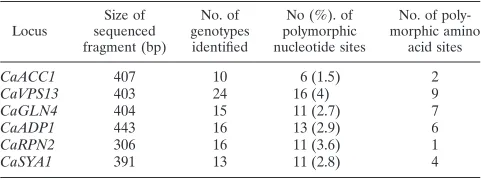
Sequence diversity inC. albicansMLST.Using the genome sequence of theC. albicansreference strain SC5314 available at the Stanford DNA Sequencing and Genome Technology Center (27), we identified regions in sixC. albicans housekeep-ing genes showhousekeep-ing relatively high divergence from the corre-sponding regions in theS. cerevisiaeortholog and flanked by regions that are highly conserved betweenC. albicansandS. cerevisiae(Table 1). Table 2 lists the oligonucleotides used to amplify these regions (loci) from all 42 C. albicans isolates tested. Analysis of the sequences obtained from all strains and loci showed that all of the sequences obtained from a single locus could be aligned without gaps or insertions. In all, 2,354 nucleotides from six loci were studied for each isolate. Sixty-eight polymorphic nucleotide sites (2.9%) were detected among the 42C. albicansisolates. The number of polymorphic sites for each locus ranged from 6 in locusCaACC1 to 16 in locusCaVPS13(Table 3). The number of nucleotide substitu-tions from theC. albicansSC5314 genome sequence that were not conservative at the amino acid level ranged from one at locusCaRPN2to nine at locusCaVPS13(Table 3).
C. albicansis almost always diploid as isolated, and evidence has been obtained for heterozygosity of complementary chro-mosomes (23). Therefore, amplification of genomic DNA is expected to result in PCR products that arise from both chro-mosomes and that upon direct sequencing yield profiles that correspond to the superimposition of the two heterozygous alleles. In the six loci investigated here, polymorphic nucleo-tide sites were indeed either homozygous or heterozygous, confirming that the oligonucleotides used in this study could amplify both chromosomal alleles. None of the isolates was 100% homozygous. The presently available genome sequence
on May 15, 2020 by guest
http://jcm.asm.org/
forC. albicansstrain SC5314 is composed mostly of homozy-gous nucleotide sequences derived from the two complemen-tary chromosomes. However, in the present study, we found one heterozygosity at position 35 in locusCaADP1. Thus, al-together, and including reference strain SC5314, at least one heterozygosity was observed among the 68 polymorphic sites in the 42 isolates investigated. These results underline the fact that local heterozygosity is frequent in the sequences of the six housekeeping loci studied.
Each of the different sequences in a locus defined a distinct genotype, even if it differed from the others by only a single nucleotide. The different genotypes were numbered in the or-der of their identification. The number of genotypes identified for each of the six loci investigated ranged from 10 for
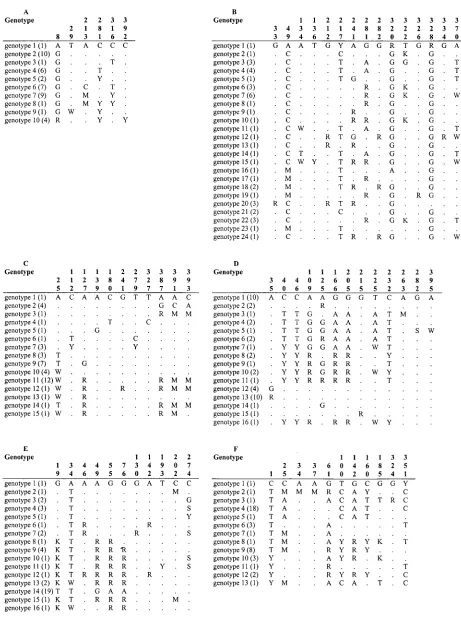
CaACC1to 24 for CaVPS13(Table 3). The positions of the polymorphic nucleotide sites, the different genotypes identified at each of the six loci, and their frequency of detection among the 42C. albicansisolates are shown in Fig. 1. We noted with interest that at each locus except CaVPS13 some genotypes were more frequent than others and that at least one was found in 20% or more of the isolates.
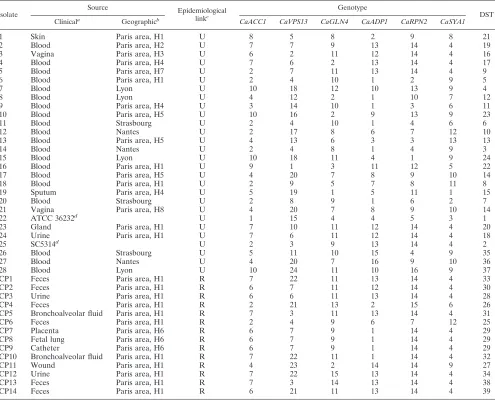
For eachC. albicansisolate, we defined a diploid sequence type (DST) as the unique combination of the genotypes of the six loci studied. Thirty-nine DSTs were found among the 42
C. albicansisolates (Table 4). One was shared by three isolates (DST 29; isolates CP7, CP8, and CP9), and one was shared by two isolates (DST 14; isolates 17 and 21). The remaining 37 DSTs (95%) were each found in a single isolate only. Among
these 37 DSTs, 7 pairs differed at only one locus (DSTs 18 and 20, 31 and 33, 32 and 33, 31 and 38, 33 and 34, 14 and 36, and 16 and 30). The other DSTs differed at two to six loci. When MLST analysis of our 42C. albicans isolates was performed using the data from only the three lociCaVPS13, CaGLN4, andCaADP1, 38 unique combinations of genotypes could be identified instead of the 39 DSTs identified using the data from the six loci.
Species specificity of primers of loci.No amplification was obtained with the CaACC1 and CaGLN4 oligonucleotides when the DNAs of the sixCandidanon-C.albicansspecies, or ofS. cerevisiae, were used as templates. When oligonucleotides for lociCaVPS13,CaADP1, andCaRPN2 were used, an am-plicon was generated fromC. dubliniensisDNA but not from the DNA of any of the six other species tested. When the oligonucleotides for CaSYA1 were used, an amplicon was generated from all of the species tested except C. krusei.
These results demonstrated that the oligonucleotides used for
CaACC1andCaGLN4were specific forC. albicans; that those used for CaVPS13, CaADP1, andCaRPN2 were specific for both C. albicansand C. dubliniensis; but that those used for
CaSYA1were not species specific. The sequences of the PCR products obtained from theC. dubliniensis CdVPS13,CdADP1, andCdSYA1loci were compared to those of the corresponding loci inC. albicans. CdSAY1displayed polymorphic nucleotide sites similar to those observed inC. albicans. In contrast, com-parison of theCdVPS13andCdADP1sequences with the cor-responding ones in C. albicansshowed 41 and 35 divergent nucleotides, respectively. These divergent nucleotides were not at sites associated with polymorphism inC. albicans(data not shown). These results are in agreement with the close relation-ship betweenC. albicansandC. dubliniensis, which were nev-ertheless recently demonstrated to be separate species (5).
[image:3.587.41.541.85.164.2]Stability and reproducibility ofC. albicansMLST. The se-quence stability of the six loci was evaluated by sequencing the
TABLE 3. Characteristics of the six housekeeping loci studied
Locus sequencedSize of fragment (bp)
No. of genotypes identified
No (%). of polymorphic nucleotide sites
No. of poly-morphic amino
acid sites
CaACC1 407 10 6 (1.5) 2
CaVPS13 403 24 16 (4) 9
CaGLN4 404 15 11 (2.7) 7
CaADP1 443 16 13 (2.9) 6
CaRPN2 306 16 11 (3.6) 1
[image:3.587.42.282.560.728.2]CaSYA1 391 13 11 (2.8) 4
TABLE 1. Housekeeping loci used
Locus C. albicansORF no.a Size ofORF (bp)C. albicans positionLocus S. cerevisiaeortholog no.ORFb Putative function ofgene product
CaACC1 6-8718 6,816 3251–3769 YNR016c Acetyl-coenzyme A carboxylase
CaVPS13 6-4223 9,252 5151–5891 YLL040c Vacuolar protein sorting protein
CaGLN4 6-8489 2,400 109–591 YOR168w Glutaminyl-tRNA synthetase
CaADP1 6-2855 3,117 918–454 YCR011c ATP-dependent permease
CaRPN2 6-7682 2,859 1083–1529 YIL075c 26S proteasome regulatory subunit
CaSYA1c 6-2925 2,910 2400–2942 YOR335c Alanyl-RNA synthetase
aORF numbers refer to the genome sequence ofC. albicansSC5314 published by Stanford University (http://sequence-www.stanford.edu/group/candida). bORF numbers refer to the genome sequence ofS. cerevisiae(http://genome- www.stanford.edu/Saccharomyces).
cCaSYA1is the ortholog of theScALA1gene encoding alanyl-tRNA synthetase; however, the designationCaALA1could not be used because it corresponds to a
gene encoding an agglutinin-like adhesin (11).
TABLE 2. Oligonucleotide primers used forC. albicansMLST
Locus Primer Sequence (5⬘33⬘) Ampliconsize (bp) CaACC1 466 forward GCAAGAGAAATTTTAATTCAATG
466 reverse TTCATCAACATCATCCAAGTG 519
CaVPS13 552 forward TCGTTGAGAGATATTCGACTT 741 552 reverse ACGGATGGATCTCCAGTCC
CaGLN4 598 forward GAGATAGTCAAGAATAAAAAAGT 483 598 reverse ATCTCTTTCATCTTTTGGACC
CaADP1 904 forward GAGCCAAGTATGAATGATTTG 537 904 reverse TTGATCAACAAACCCGATAAT
CaRPN2 1041 forward TTCATGCATGCTGGTACTAC 447 1041 reverse TAATCCCATACCCAAAGCAG
CaSYA1 1369 forward AGAAGAATTGTTGCTGTTACTG 543 1369 reverse GTTACCTTTACCACCAGCTTT
on May 15, 2020 by guest
http://jcm.asm.org/
[image:3.587.301.542.639.729.2]FIG. 1. Positions of the polymorphic nucleotide sites and genotypes identified at lociCaACC1(A),CaVPS13(B),CaGLN4(C),CaADP1(D), CaRPN2(E), andCaSYA1(F). The nucleotides present at each variable site among the 42 C. albicansstrains tested are shown for genotype 1. For the other genotypes, only sites that differ from those in genotype 1 are shown; sites that are the same as those in genotype 1 are shown by dots. The numbers of isolates with the same genotype are indicated in parentheses. The position of each polymorphic site relative to the fragment sequenced is shown at the top in vertical format. Y, C or T; R, A or G; K, G or T; M, A or C; S, G or C; W, A or T.
on May 15, 2020 by guest
http://jcm.asm.org/
PCR products obtained using DNAs from six subclones of
C. albicans strain ATCC 36232 that were obtained after 30 successive subcultures (about 400 generations). No difference was observed between the subclones and the original isolate. Reproducibility was tested with nine separate isolates by using DNAs from two independent extractions. Again, the sequences obtained from the two extractions were strictly identical, thus confirming the high reproducibility of the method.
MLST analysis of related and unrelatedC. albicansisolates.
In all, 27 DSTs were found among the 28 epidemiologically unrelated isolates investigated (26 clinical isolates and 2 refer-ence strains). Only two isolates (isolates 17 and 21) had iden-tical DSTs. All of the other 26 had a unique DST and could be separated from each other (Table 4). The DSTs of 16 of these 26 isolates (61%) differed from each other at 3 loci or more. For the present sample of 28 epidemiologically unrelated iso-lates, the discriminatory power of the MLST scheme for typing
C. albicans,calculated using a numerical index as previously described (13), was 99.7. The results of MDS and MST anal-yses showed that six groups of genetically related isolates were identifiable on the basis of bootstrap values of greater than 900 (Fig. 2). Isolates 8 and 13 were separated, respectively, from groups III and V on the basis of low bootstrap values, which ranged from 554 to 896. Within groups, the lengths of the branches linking the strains were variable, suggesting that some isolates were genetically very close whereas others were more distant. Contrasting patterns were observed. In groups I, II, and V, the isolates were connected by short branches, whereas in group VI, the branches were longer. These results provided a measure of the genetic diversity at multiple loci within a set of epidemiologically unrelated clinical isolates.
[image:5.587.46.541.84.485.2]We observed that among the 14 epidemiologically related clinical isolates, isolates CP7, CP8, and CP9, which were re-covered from a single episode of infection (mother and fetus)
TABLE 4. Characteristics and genotypes of the 42C. albicansisolates tested
Isolate Source Epidemiologicallinkc
Genotype
DST Clinicala Geographicb CaACC1 CaVPS13 CaGLN4 CaADP1 CaRPN2 CaSYA1
1 Skin Paris area, H1 U 8 5 8 2 9 8 21
2 Blood Paris area, H2 U 7 7 9 13 14 4 19
3 Vagina Paris area, H3 U 6 2 11 12 14 4 16
4 Blood Paris area, H4 U 7 6 2 13 14 4 17
5 Blood Paris area, H7 U 2 7 11 13 14 4 9
6 Blood Paris area, H1 U 2 4 10 1 2 9 5
7 Blood Lyon U 10 18 12 10 13 9 4
8 Blood Lyon U 4 12 2 1 10 7 12
9 Blood Paris area, H4 U 3 14 10 1 3 6 11
10 Blood Paris area, H5 U 10 16 2 9 13 9 23
11 Blood Strasbourg U 2 4 10 1 4 6 6
12 Blood Nantes U 2 17 8 6 7 12 10
13 Blood Paris area, H5 U 4 13 6 3 3 13 13
14 Blood Nantes U 2 4 8 1 4 9 3
15 Blood Lyon U 10 18 11 4 1 9 24
16 Blood Paris area, H1 U 9 1 3 11 12 5 22
17 Blood Paris area, H5 U 4 20 7 8 9 10 14
18 Blood Paris area, H1 U 2 9 5 7 8 11 8
19 Sputum Paris area, H4 U 5 19 1 5 11 1 15
20 Blood Strasbourg U 2 8 9 1 6 2 7
21 Vagina Paris area, H8 U 4 20 7 8 9 10 14
22 ATCC 36232d U 1 15 4 4 5 3 1
23 Gland Paris area, H1 U 7 10 11 12 14 4 20
24 Urine Paris area, H1 U 7 6 11 12 14 4 18
25 SC5314d U 2 3 9 13 14 4 2
26 Blood Strasbourg U 5 11 10 15 4 9 35
27 Blood Nantes U 4 20 7 16 9 10 36
28 Blood Lyon U 10 24 11 10 16 9 37
CP1 Feces Paris area, H1 R 7 22 11 13 14 4 33
CP2 Feces Paris area, H1 R 6 7 11 12 14 4 30
CP3 Urine Paris area, H1 R 6 6 11 13 14 4 28
CP4 Feces Paris area, H1 R 2 21 13 2 15 6 26
CP5 Bronchoalveolar fluid Paris area, H1 R 7 3 11 13 14 4 31
CP6 Feces Paris area, H1 R 2 4 9 6 7 12 25
CP7 Placenta Paris area, H6 R 6 7 9 1 14 4 29
CP8 Fetal lung Paris area, H6 R 6 7 9 1 14 4 29
CP9 Catheter Paris area, H6 R 6 7 9 1 14 4 29
CP10 Bronchoalveolar fluid Paris area, H1 R 7 22 11 1 14 4 32
CP11 Wound Paris area, H1 R 4 23 2 14 14 9 27
CP12 Urine Paris area, H1 R 7 22 15 13 14 4 34
CP13 Feces Paris area, H1 R 7 3 14 13 14 4 38
CP14 Feces Paris area, H1 R 6 21 11 13 14 4 39
aPrimary clinical sample from which the isolate was recovered.
bAll geographic sources were located in France. H1, Ambroise-Paré Hospital; H2, Tenon Hospital; H3, Saint Louis Hospital; H4, Broussais Hospital; H5,
Saint-Antoine Hospital; H6, Necker Hospital; H7, Versailles Hospital; H8, Villejuif Hospital.
cU, epidemiologically unrelated; R, epidemiologically related. dReference strain.
on May 15, 2020 by guest
http://jcm.asm.org/
shared the same DST (Table 4). The 11 other isolates, which were isolated during the same 3-month period from patients hospitalized in the same intensive care unit, had different DSTs. In 8 of these 11 isolates, the DSTs differed by only one or two of the six genotypes.
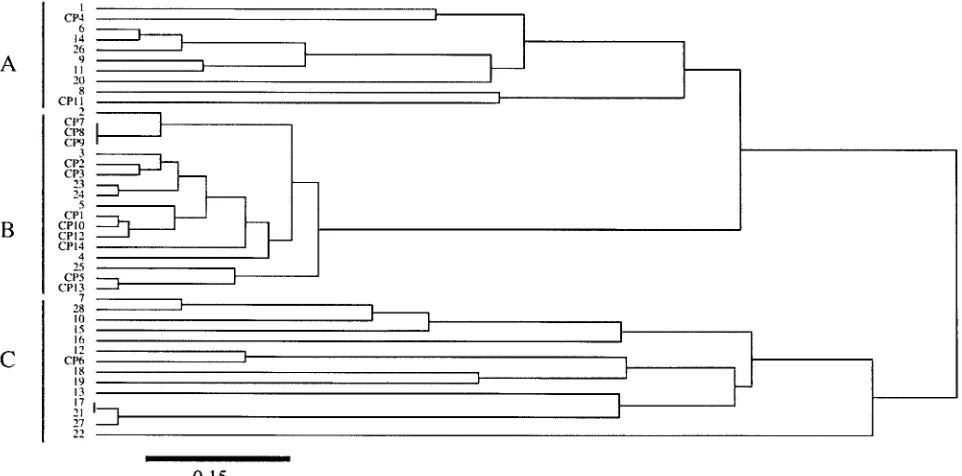
A dendrogram depicting the relationships between the 42 isolates studied showed that 8 of the 11 isolates from the patients hospitalized in the same unit (CP1, CP2, CP3, CP5, CP10, CP12, CP13, and CP14) were grouped in a cluster, whereas the 28 unrelated isolates were not distributed in a specific cluster (Fig. 3).
DISCUSSION
In this study we showed that from an epidemiological stand-point, MLST provides valuable information for the character-ization of C. albicans isolates. MLST is a highly resolutive method based on analysis of the nucleotide polymorphism of internal fragments from several housekeeping genes present in all isolates within a given species (16). It has been used to characterize several bacterial pathogens which are strictly hap-loid microorganisms (4, 6–8). By contrast, the possible occur-rence of heterozygosity in the sequences of diploid organisms makes MLST analysis more difficult. However, sequence typ-ing of randomly amplified DNA fragments fromC. albicans
anonymous DNA regions has been used to investigate the genetic structures of typical and atypical populations of C. albicansfrom different geographic origins (9). This analysis has demonstrated that the structure of these populations was pre-dominantly clonal but that there was also evidence for recom-bination and very low levels of gene flow between them (9, 12). In the present study, we characterized six loci, each corre-sponding to an internal fragment of a distinct C. albicans
[image:6.587.45.284.73.305.2]housekeeping gene. At each locus, we observed a wide variety of genotypes among the isolates studied, although the number of polymorphic nucleotide sites was relatively limited. This was the consequence, at least in part, of a high frequency of het-erozygosity, which increased sequence diversity at each locus,
FIG. 2. MDS of 28 epidemiologically unrelated isolates ofC. albi-cans. Each isolate is represented by a circle. Connections between isolates and the lengths of the branches linking them were obtained by the MST method as described in Materials and Methods. The groups of genetically related isolates are numbered I to VI. Bootstrap values of greater than 900 are indicated by thick lines.
FIG. 3. Dendrogram of the genetic relationships between 42 isolates ofC. albicans, based on the six housekeeping loci investigated. The dendrogram was constructed by using the unweighted pair-group method with arithmetic averages and the matrix of distances, as described in Materials and Methods. The linkage distance is indicated at the bottom.
on May 15, 2020 by guest
http://jcm.asm.org/
[image:6.587.53.534.456.694.2]and thus allowed the identification of a greater number of genotypes. Indeed, heterozygosity was detected at all polymor-phic nucleotide sites except three (positions 139, 180, and 327 at locusCaGLN4), and eachC. albicansisolate had at least one heterozygous site within the 68 polymorphic sites studied. The presence of heterozygosity at the DNA level has been previ-ously reported forC. albicans(2, 3, 12). When using 13 anon-ymous DNA regions to analyze the genetic structure of popu-lations of typicalC. albicansisolates, Forche et al. found that the frequency of polymorphic nucleotide sites in these regions was 1.1% and that there was evidence for heterozygosity at 35 of the 56 polymorphic nucleotide sites that they identified (9). The presence of heterozygosity has also been reported in the sequence of the CaERG11 gene, which encodes lanosterol 14-␣-demethylase (10). However, the overall sequence diver-sity and levels of heterozygodiver-sity previously reported for these DNA regions were lower than those we observed at the six loci which we investigated and which included 68 polymorphic sites (2.9%). Of these, 65 were heterozygous.
In this study, we confirmed the reproducibility of the MLST method and the genomic stability of the loci studied. The fact that neither a loss nor a gain in the heterozygosity was detected at any polymorphic nucleotide site when the subclones ob-tained after successive subcultures were compared also con-firmed that heterozygosity was stable in our isolates. These results agree with previous observations, based on an experi-mentalC. albicanspopulation, that over 330 generations, no change occurred in five DNA regions known to be heterozy-gous in the progenitor genotype (2).
The MLST method proved to be highly resolutive for C. albicansstrain differentiation. The number of theoretically dif-ferent DSTs resulting from the combination of the 10 to 24 genotypes present at each of the six loci is in the range of 107,
and this should increase as new genotypes are described after the use of MLST with additional C. albicansisolates. The discriminatory power of the method, measured with a sample of 28 epidemiologically unrelated strains, was 99.7. Two iso-lates (isoiso-lates 17 and 21) had the same DST, which was unex-pected because they were epidemiologically unrelated. How-ever, due to the diploid nature ofC. albicans, strains with the same DST may be different if they are heterozygous at several sites, and these two isolates were indeed heterozygous at 21 of the 68 polymorphic sites. Sequencing did not allow us to de-termine which allele is associated with which nucleotide at heterozygous positions, a limit common to all methods using nucleotide polymorphism analysis at several heterozygous loci in diploid organisms. Despite this limitation, the discrimina-tory power of our MLST method was greater than that of the other methods previously proposed for typing ofC. albicansby using DNA sequence data. The discriminatory power of a method using analysis of the polymorphism of one microsat-ellite region was only 88 (1). A multilocus genotyping system using oligonucleotide probes for identification of the nucleo-tide state at only one of the polymorphic nucleonucleo-tide sites of each of 16 distinct loci distinguished only 64 genotypes in a sample of 84C. albicansisolates (3). Recently, it was shown by this method that the ability to invade the bloodstream is wide-spread among C. albicans isolates (15). The discriminatory power of our MLST method was similar to that of fingerprint-ing with the moderately repetitive sequence Ca3, which
pro-vided the highest resolution reported so far for typing ofC. albicansisolates (25). However, MLST has several advantages over fingerprinting. First, the technology used, based on PCR amplification followed by the sequencing of six well-character-ized loci, is easy to perform and can be done quickly as auto-matic sequencing becomes more widely available. The PCR conditions used in this study were very robust, as judged by the 100% success rate obtained in more than 700 assays. Second, the results of MLST are unambiguous, and sequence data can be shared and compared between different laboratories.
TheC. albicans isolates that we studied in this work were specifically chosen to constitute a sampling of strains, with some having specific epidemiological links and some being unrelated. We have described the genetic relationships within a set of epidemiologically unrelated isolates ofC. albicans by using a two-dimensional representation (Fig. 2). This repre-sentation allowed to identify groups of strains which are ge-netically close. We have observed that within the 28 isolates investigated, 26 were associated within six different groups. This method appears to be suitable for identification of the presence or absence of specific groups of strains among C. albicans isolates and could be useful for understanding the transmission and population dynamics in hospitalized patients or in healthy carriers. We showed that MLST can distinguish not only between epidemiologically unrelated strains but also between epidemiologically related strains and can identify a unique strain represented by different isolates. The dendro-gram depicting the relationships between all of the isolates studied (Fig. 3) showed that as high a proportion as 73% of the related isolates were grouped in a cluster, whereas the unre-lated isolates were not. This suggests that the epidemiologi-cally related isolates, which had been recovered within a short period of time from patients hospitalized in the same intensive care unit, were genetically very close, although they were not strictly identical. These results agreed with those reported by others, who found that the isolates from patients in the same ward were genetically closer than other isolates (17, 24). By contrast, the three isolates recovered from a mother and her fetus were strictly identical. Thus, together our results empha-size that MLST can detect minute variations in the genomes of related isolates ofC. albicansand can be used by epidemiolo-gists to trace strain transmission. During epidemiological in-vestigations, a large number of isolates often have to be typed. The fact that MLST was highly discriminatory even when only three loci were studied should make the method highly suitable for such settings.
Taken together, our results showed that MLST is highly reproducible and discriminatory with C. albicans. The se-quence data obtained with this method can be used to con-struct an online global database which should allow laborato-ries to compare their local isolates and should prove useful both for global epidemiology and for investigating the trans-mission ofC. albicansinfections.
ACKNOWLEDGMENTS
We are grateful to C. Bouchiez and S. Sibuet, Genopole, Institut Pasteur, Paris, France, for providing sequencing facilities and to C. Hennequin for helpful discussions. We are also indebted to S. Bre-tagne for constructive comments on the manuscript. We thank S. Challier, O. Eloy, G. Kac, O. Morin, H. Kening, M. Feuilhade de
on May 15, 2020 by guest
http://jcm.asm.org/
Chauvin, V. Lavarde, J.-L. Poirot, M.-A. Piens, and F. Robert for providing isolates.
This work was supported by a grant from the Ministère de la Re-cherche et de la Technologie (Programme de ReRe-cherche Fondamen-tale en Microbiologie, Maladies Infectieuses et Parasitaires-Réseau Infections Fongiques).
REFERENCES
1.Bretagne, S., J. M. Costa, C. Besmond, R. Carsique, and R. Calderone.1997. Microsatellite polymorphism in the promoter sequence of the elongation factor 3 gene ofCandida albicansas the basis for a typing system. J. Clin. Microbiol.35:1777–1780.
2.Cowen, L. E., D. Sanglard, D. Calabrese, C. Sirjusingh, J. B. Anderson, and L. M. Kohn.2000. Evolution of drug resistance in experimental populations ofCandida albicans. J. Bacteriol.182:1515–1522.
3.Cowen, L. E., C. Sirjusingh, R. C. Summerbell, S. Walmsley, S. Richardson, L. M. Kohn, and J. B. Anderson.1999. Multilocus genotypes and DNA fingerprints do not predict variation in azole resistance among clinical iso-lates ofCandida albicans. Antimicrob. Agents Chemother.43:2930–2938. 4.Dingle, K. E., F. M. Colles, D. R. Wareing, R. Ure, A. J. Fox, F. E. Bolton,
H. J. Bootsma, R. J. Willems, R. Urwin, and M. C. Maiden.2001. Multilocus sequence typing system forCampylobacter jejuni. J. Clin. Microbiol.39:14– 23.
5.Donnelly, S. M., D. J. Sullivan, D. B. Shanley, and D. C. Coleman.1999. Phylogenetic analysis and rapid identification ofCandida dubliniensisbased on analysis of ACT1 intron and exon sequences. Microbiology145:1871– 1882.
6.Enright, M. C., N. P. Day, C. E. Davies, S. J. Peacock, and B. G. Spratt.2000. Multilocus sequence typing for characterization of methicillin-resistant and methicillin-susceptible clones ofStaphylococcus aureus. J. Clin. Microbiol.
38:1008–1015.
7.Enright, M. C., and B. G. Spratt.1998. A multilocus sequence typing scheme forStreptococcus pneumoniae: identification of clones associated with serious invasive disease. Microbiology144:3049–3060.
8.Feil, E. J., M. C. Enright, and B. G. Spratt.2000. Estimating the relative contributions of mutation and recombination to clonal diversification: a comparison betweenNeisseria meningitidisandStreptococcus pneumoniae. Res. Microbiol.151:465–469.
9.Forche, A., G. Schonian, Y. Graser, R. Vilgalys, and T. G. Mitchell.1999. Genetic structure of typical and atypical populations ofCandida albicans from Africa. Fungal Genet. Biol.28:107–125.
10.Franz, R., S. L. Kelly, D. C. Lamb, D. E. Kelly, M. Ruhnke, and J. Morsch-hauser.1998. Multiple molecular mechanisms contribute to a stepwise de-velopment of fluconazole resistance in clinical Candida albicansstrains. Antimicrob. Agents Chemother.42:3065–3072.
11.Gaur, N. K., and S. A. Klotz.1997. Expression, cloning, and characterization of aCandida albicansgene,ALA1, that confers adherence properties upon Saccharomyces cerevisiaefor extracellular matrix proteins. Infect. Immun.
65:5289–5294.
12.Gräser, Y., M. Volovsek, J. Arrington, G. Schönian, W. Presber, T. G. Mitchell, and R. Vilgalys.1996. Molecular markers reveal that population structure of the human pathogenCandida albicansexhibits both clonality and recombination. Proc. Natl. Acad. Sci. USA93:12473–12477. 13.Hunter, P. R., and C. A. Fraser.1989. Application of a numerical index of
discriminatory power to a comparison of four physiochemical typing meth-ods forCandida albicans. J. Clin. Microbiol.27:2156–2160.
14.Legendre, P., and L. Legendre.1998. Numerical ecology, 2nd ed., p. 381–385. Elsevier, New York, N.Y.
15.Luu, L. N., L. E. Cowen, C. Sirjusingh, L. M. Kohn, and J. B. Anderson.
2001. Multilocus genotyping indicates that the ability to invade the blood-stream is widespread amongCandida albicansisolates. J. Clin. Microbiol.
39:1657–1660.
16.Maiden, M. C., J. A. Bygraves, E. Feil, G. Morelli, J. E. Russell, R. Urwin, Q. Zhang, J. Zhou, K. Zurth, D. A. Caugant, I. M. Feavers, M. Achtman, and B. G. Spratt.1998. Multilocus sequence typing: a portable approach to the identification of clones within populations of pathogenic microorganisms. Proc. Natl. Acad. Sci. USA95:3140–3145.
17.Marco, F., S. R. Lockhart, M. A. Pfaller, C. Pujol, M. S. Rangel-Frausto, T. Wiblin, H. M. Blumberg, J. E. Edwards, W. Jarvis, L. Saiman, J. E. Patter-son, M. G. Rinaldi, R. P. Wenzel, and D. R. Soll.1999. Elucidating the origins of nosocomial infections withCandida albicansby DNA fingerprint-ing with the complex probe Ca3. J. Clin. Microbiol.37:2817–2828. 18.Murad, A. M., P. Leng, M. Straffon, J. Wishart, S. Macaskill, D. MacCallum,
N. Schnell, D. Talibi, D. Marechal, F. Tekaia, C. d’Enfert, C. Gaillardin, F. C. Odds, and A. J. Brown.2001. NRG1 represses yeast-hypha morpho-genesis and hypha-specific gene expression inCandida albicans. EMBO J.
20:4742–4752.
19.Prim, R. C.1957. Shortest connection networks and some generalizations. Bell System Tech. J.36:1389–1401.
20.Reagan, D. R., M. A. Pfaller, R. J. Hollis, and R. P. Wenzel.1990. Charac-terization of the sequence of colonization and nosocomial candidemia using DNA fingerprinting and a DNA probe. J. Clin. Microbiol.28:2733–2738. 21.Reagan, D. R., M. A. Pfaller, R. J. Hollis, and R. P. Wenzel.1995. Evidence
of nosocomial spread ofCandida albicanscausing bloodstream infection in a neonatal intensive care unit. Diagn. Microbiol. Infect. Dis.21:191–194. 22.Robert, F., F. Lebreton, M. E. Bougnoux, A. Paugam, D. Wassermann, M.
Schlotterer, C. Tourte-Schaefer, and J. Dupouy-Camet.1995. Use of random amplified polymorphic DNA as a typing method forCandida albicansin epidemiological surveillance of a burn unit. J. Clin. Microbiol.33:2366–2371. 23.Scherer, S., and P. T. Magee.1990. Genetics ofCandida albicans. Microbiol.
Rev.54:226–241.
24.Schmid, J., Y. P. Tay, L. Wan, M. Carr, D. Parr, and W. McKinney.1995. Evidence for nosocomial transmission ofCandida albicansobtained by Ca3 fingerprinting. J. Clin. Microbiol.33:1223–1230.
25.Schmid, J., E. Voss, and D. R. Soll.1990. Computer-assisted methods for assessing strain relatedness inCandida albicansby fingerprinting with the moderately repetitive sequence Ca3. J. Clin. Microbiol.28:1236–1243. 26.Staden, R., K. F. Beal, and J. K. Bonfield.2000. The Staden package, 1998.
Methods Mol. Biol.132:115–130.
27.Tzung, K. W., R. M. Williams, S. Scherer, N. Federspiel, T. Jones, N. Hansen, V. Bivolarevic, L. Huizar, C. Komp, R. Surzycki, R. Tamse, R. W. Davis, and N. Agabian.2001. Genomic evidence for a complete sexual cycle inCandida albicans. Proc. Natl. Acad. Sci. USA98:3249–3253.
28.Vazquez, J. A., V. Sanchez, C. Dmuchowski, L. M. Dembry, J. D. Sobel, and M. J. Zervos.1993. Nosocomial acquisition ofCandida albicans: an epide-miologic study. J. Infect. Dis.168:195–201.
29.Voss, A., R. J. Hollis, M. A. Pfaller, R. P. Wenzel, and B. N. Doebbeling.
1994. Investigation of the sequence of colonization and candidemia in non-neutropenic patients. J. Clin. Microbiol.32:975–980.