comm
en
t
re
v
ie
w
s
re
ports
de
p
o
si
te
d r
e
se
a
rch
refer
e
e
d
re
sear
ch
interacti
o
ns
inf
o
rmation
Open Access
2007Toulza et al.
Volume 8, Issue 6, Article R107
Research
Large-scale identification of human genes implicated in epidermal
barrier function
Eve Toulza
*
, Nicolas R Mattiuzzo
*
, Marie-Florence Galliano
*
,
Nathalie Jonca
*
, Carole Dossat
†
, Daniel Jacob
‡
, Antoine de Daruvar
‡
,
Patrick Wincker
†
, Guy Serre
*
and Marina Guerrin
*
Addresses: *UMR 5165 "Epidermis Differentiation and Rheumatoid Autoimmunity", CNRS - Toulouse III University (IFR 30, INSERM - CNRS - Toulouse III University - CHU), allées Jules Guesde, 31073 Toulouse, France. †Genoscope and CNRS UMR 8030, rue Gaston Crémieux, 91057 Evry, France. ‡Centre de Bioinformatique Bordeaux, Université V. Segalen Bordeaux 2, rue Léo Saignat, 33076 Bordeaux Cedex, France.
Correspondence: Marina Guerrin. Email: [email protected]
© 2007 Toulza et al.; licensee BioMed Central Ltd.
This is an open access article distributed under the terms of the Creative Commons Attribution License (http://creativecommons.org/licenses/by/2.0), which permits unrestricted use, distribution, and reproduction in any medium, provided the original work is properly cited.
The transcriptome of granular keratinocytes
<p>Identification of genes expressed in epidermal granular keratinocytes by ORESTES, including a number that are highly specific for these cells.</p>
Abstract
Background: During epidermal differentiation, keratinocytes progressing through the suprabasal layers undergo complex and tightly regulated biochemical modifications leading to cornification and desquamation. The last living cells, the granular keratinocytes (GKs), produce almost all of the proteins and lipids required for the protective barrier function before their programmed cell death gives rise to corneocytes. We present here the first analysis of the transcriptome of human GKs, purified from healthy epidermis by an original approach.
Results: Using the ORESTES method, 22,585 expressed sequence tags (ESTs) were produced that matched 3,387 genes. Despite normalization provided by this method (mean 4.6 ORESTES per gene), some highly transcribed genes, including that encoding dermokine, were overrepresented. About 330 expressed genes displayed less than 100 ESTs in UniGene clusters and are most likely to be specific for GKs and potentially involved in barrier function. This hypothesis was tested by comparing the relative expression of 73 genes in the basal and granular layers of epidermis by quantitative RT-PCR. Among these, 33 were identified as new, highly specific markers of GKs, including those encoding a protease, protease inhibitors and proteins involved in lipid metabolism and transport. We identified filaggrin 2 (also called ifapsoriasin), a poorly characterized member of the epidermal differentiation complex, as well as three new lipase genes clustered with paralogous genes on chromosome 10q23.31. A new gene of unknown function, C1orf81, is specifically disrupted in the human genome by a frameshift mutation.
Conclusion: These data increase the present knowledge of genes responsible for the formation of the skin barrier and suggest new candidates for genodermatoses of unknown origin.
Published: 11 June 2007
Genome Biology 2007, 8:R107 (doi:10.1186/gb-2007-8-6-r107)
Received: 1 March 2007 Revised: 24 May 2007 Accepted: 11 June 2007 The electronic version of this article is the complete one and can be
Background
High-throughput genomic projects focusing on the identifica-tion of cell- and tissue-specific transcriptomes are expected to uncover fundamental insights into biological processes. Par-ticularly intriguing are genes in sequenced genomes that remain hypothetical and/or poorly represented in expressed sequence databases, and whose functions in health and dis-ease remain unknown. Some of these are most probably implicated in organ-specific functions. Their characterization is essential to complete the annotation of sequenced genomes and is expected to contribute to advances in physiology and pathology. In order to achieve such goals, transcriptome stud-ies on tissues rather than cultured cells, and eventually on a single cell type at a precise differentiation step are more likely to provide new information.
The epidermis is a highly specialized tissue mainly dedicated to the establishment of a barrier that restricts both water loss from the body and ingress of pathogens. The barrier function of the epidermis is known to involve the expression of numer-ous tissue-specific genes, most of which are specifically expressed in the late steps of keratinocyte differentiation. In order to establish and constantly maintain this barrier, kerat-inocytes undergo a complex, highly organized and tightly controlled differentiation program leading to cornification and finally to desquamation. During this process, cells migrate from the basal, proliferative layer to the surface, where they form the cornified layer (stratum corneum). According to the current model of skin epithelial mainte-nance, basal keratinocytes encompass a heterogeneous cell population that includes slow-cycling stem cells [1]. These stem cells give rise to transiently amplifying keratinocytes that constitute most of the basal layer. They divide only a few times and finally move upward while differentiating to form the spinous layer. The proliferating compartment is charac-terized by the specific expression of cell cycle regulators and integrin family members responsible for the attachment of the epidermis to the basement membrane. Growth arrested keratinocytes undergo differentiation, mainly characterized by a shift in cytokeratin expression from KRT5 (keratin 5) and KRT14 in the basal layer to KRT1 and KRT10 in suprabasal layers. As differentiation progresses, keratinocytes from the spinous layers progressively express a small number of spe-cific differentiation markers, like involucrin. However, the differentiation program culminates in the granular layer, where keratinocytes express more than 30 epidermis-specific proteins, including proteins that are stored in cytosolic gran-ules characteristic of granular keratinocytes (GKs). These proteins include well known components of the cornified layer, like loricrin and elafin, but also recently identified ones, such as keratinocyte differentiation associated protein (KDAP), hornerin, suprabasin, keratinocyte proline rich pro-tein (hKPRP), and so on [2-5].
GKs undergo a special programmed cell death, called cornifi-cation, which gives rise to corneocytes that no longer exhibit
organelles. Rather, their intracellullar content consists of a homogeneous matrix composed mainly of covalently linked keratins. The cornified envelope, a highly specialized insolu-ble structure, encapsulates corneocytes in place of their plasma membrane (see Kalinin et al. [6] for a recent review). The lipid-enriched extracellular matrix, which subserves the barrier, is produced by a highly active lipid factory mainly operative in the granular layer and comprises secretory organelles named the epidermal lamellar bodies [7]. In addi-tion to the provision of lipids for the barrier, lamellar bodies deliver a large number of proteins, including lipid-processing enzymes, proteases and anti-proteases that regulate desqua-mation, antimicrobial peptides and corneodesmosin, an adhesive protein secondarily located in the external face of the desmosomes, as they turn into corneodesmosomes [8]. Therefore, the components of the stratum corneum, respon-sible for most of the protective cutaneous functions, are pro-duced by GKs.
Transcriptome studies of selected cell types of the human epi-dermis are expected to contribute to the elucidation of the mechanisms responsible for barrier function. They will also shed further light on the causes of monogenic genoderma-toses and the pathomechanisms of common complex skin disorders like psoriasis. However, present knowledge on the gene repertoire expressed by keratinocytes remains largely fragmentary. Among the approximately eight million human expressed sequence tags (ESTs) from the dbEST division of the GenBank database, only 1,210 are annotated as originat-ing from the epidermis, although these are, in fact, derived from cultured keratinocytes, which do not fully recapitulate the complex in vivo differentiation program. In this article, we describe the results of a large-scale cDNA sequencing project on GKs of healthy human skin, purified by a new method. In order to characterize genes expressed at a low level and to avoid the repetitive sequencing of highly expressed ones, we used the ORESTES (open reading frame EST) method to prepare a large series of small size cDNA libraries using arbitrarily chosen primers for reverse tran-scription (RT) and PCR amplification [9]. The sequencing of about 25,000 clones has produced a list of 3,387 genes expressed by GKs. Some of them, analyzed by quantitative RT-PCR, were shown to be expressed in a cell-specific man-ner. This effort resulted in a large number of novel candidate genes of importance for the epidermis barrier function and the etiology of genodermatoses.
Results
Purification of human granular keratinocytes
http://genomebiology.com/2007/8/6/R107 Genome Biology 2007, Volume 8, Issue 6, Article R107 Toulza et al. R107.3
comm
en
t
re
v
ie
w
s
re
ports
refer
e
e
d
re
sear
ch
de
p
o
si
te
d r
e
se
a
rch
interacti
o
ns
inf
o
rmation
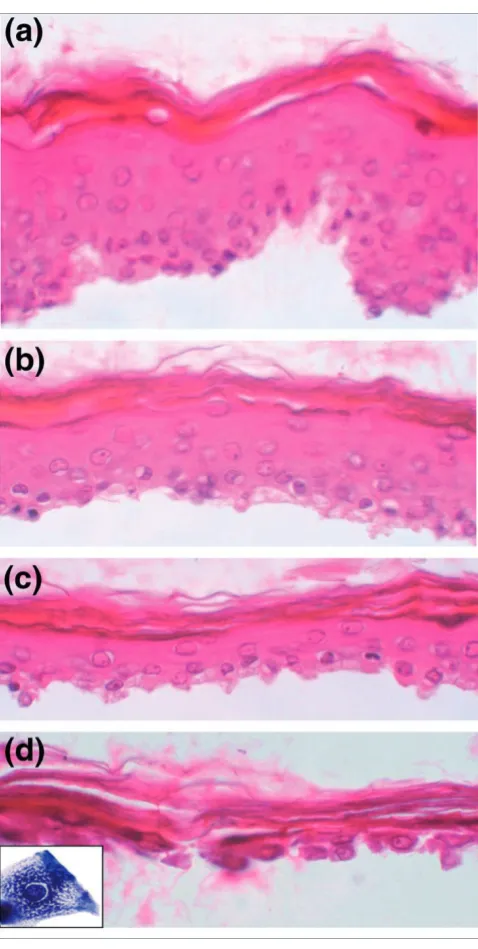
Morphological analyses revealed that after three treatments, residual epidermal fragments were mostly composed of cor-neocytes and GKs (Figure 1). Quantitative real-time PCR was performed to quantify the enrichment in GKs. To first select a reference gene for normalization, the relative expression of eight housekeeping genes (GAPDH, SOD1, ACTB, B2M, HPRT1, HMBS, TBP and UBC) in each cell fraction (T1-T4) was analyzed using GeNorm [10]. In agreement with previous data [11], beta-2-microglobulin (B2M) appeared to be stably expressed during epidermis differentiation, and was thus chosen for normalization. In addition, we used the lectin Galectin-7 (LSGAL7), which was previously shown by in situ hybridization to be equally expressed in all epidermal layers [12]. BPAG2 (bullous pemphigoid antigen 2) or KRT14, and KLK7 (kallikrein 7, also called stratum corneum chymotryptic enzyme (SCCE)) were selected as specific for the basal layer or the GKs, respectively [13,14]. For four cell fractionations from different individuals, the mean T1/T4 expression ratio of KRT14 was 13, whereas the mean T4/T1 expression ratio of SCCE was approximately 130 (Table 1). The KRT14 ratio might be indicative of a slight contamination of the T4 frac-tion with basal keratinocytes. Nevertheless, the large SCCE ratio indicates that very few, if any, GKs were present in the T1 fraction. From this, we concluded that the T4 fraction was highly enriched in GKs and thus suitable for a large-scale study of their transcriptome.
An ORESTES dataset from human granular keratinocytes
PolyA+ RNA was extracted from the T4 fraction from individ-ual 3 (Table 1) and used to generate cDNA mini-libraries using the ORESTES method [9]. This sample was chosen as it presents the highest T1/T4 expression ratio for the KRT14 gene, suggesting a low contamination of the T4 fraction by basal keratinocytes. This method uses arbitrarily chosen primers for reverse transcription and PCR amplification. The successful amplification of a mRNA thus depends primarily on partial sequence homology with the primer, rather than on its abundance. This, and the elimination of cDNA prepara-tions that display prominent bands on gels (indicative of the selective amplification of particular mRNAs), results in a nor-malization process and allows the detection of rare tran-scripts. We constructed 150 cDNA libraries with different primers, the analysis of 100-200 clones from each leading to the production of 22,585 sequences (Figure 2a). Among
these, 1,453 (approximately 6%) corresponded to empty plas-mids or uninformative sequences, 377 (1.7%) were of bacterial origin, and 2,303 (10%) matched the human mitochondrial genome. Despite two rounds of polyA+ RNA purification, 1,859 sequences (8.2%) arose from ribosomal RNA. In addi-tion, 187 sequences corresponded to unspliced intergenic DNA and may reflect spurious transcriptional activity. The remaining 16,591 sequences (73%) matched known or pre-dicted transcribed regions, of which 62% aligned with the human genome in several blocks, and thus corresponded to spliced transcripts. After clustering, we observed the tran-scription of 3,387 genes by GKs. Additionally, 23 sequences matched overlapping exons belonging to two genes tran-scribed in opposite orientations and thus could not be attrib-uted to a single gene.
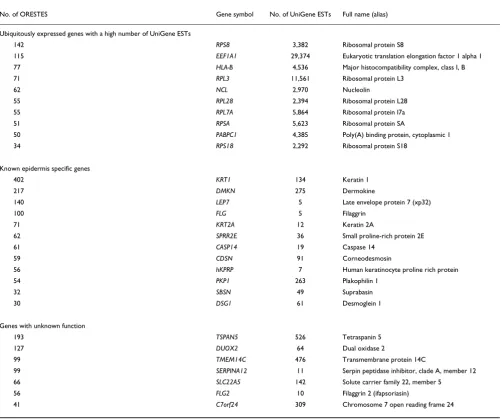
[image:3.612.54.555.121.193.2]The normalization ability of the ORESTES method was exam-ined by classifying genes according to the number of match-ing sequences in the dataset (Figure 2b). Half of the genes were represented by a unique sequence and 76.3% by three or less sequences, thus showing an acceptable level of normali-zation, with a mean of 4.6 ORESTES per gene. However, the ORESTES method only partially compensates for transcript abundance, as several genes were represented by a large ORESTES number. In these cases, we examined the number of sequences in the corresponding UniGene clusters, a rough measure of gene expression level. This revealed two situa-tions: first, the gene is strongly expressed in many cell types including GKs (a high number of both ORESTES and Uni-Gene entries); and second, the gene is particularly expressed in GKs (a high number of ORESTES, but low number of Uni-Gene entries). The first category mainly includes housekeep-ing genes from the translation machinery (for example, RPS8, EEF1A1, RPL3, RPL7A, RPL28; Table 2). The second category contains genes previously described as implicated in epider-mis barrier function (for example, KRT1, DMKN, LEP7, FLG, KRT2A, SPRR2E, CASP14, CDSN, hKRP, SBSN) and, inter-estingly, new candidates for this function (TSPAN5, DUOX2, TMEM14C, SERPINA12, SLC22A5, FLG2, C7orf24). Dermokine (DMKN), represented by 217 ORESTES, was shown to be selectively transcribed in mouse GKs by high-throughput in situ hybridization [15] and signal sequence trap [16] screens. The present ORESTES dataset allowed us to describe 13 novel human DMKN splicing isoforms with dis-tinct subcellular locations and expression patterns [17]. Table 1
Expression ratios for KRT14 and KLK7 as measured by real-time PCR from four independent samples
Sample no.
Expression ratio 1 2 3 4
KRT14 (T1/T4) 7.5 5.9 25 13.6
The ORESTES dataset was aligned with the human genome using BLAT [18]. The BLAT results were used to write a cus-tom track that allows the visualization of the position of a par-ticular ORESTE relative to other annotations such as RefSeq genes, vertebrate orthologues, single nucleotide polymor-phisms, microarray expression data, and so on, and is freely available online [19]. A screen copy of a UCSC Genome
C1orf81 gene is presented as an example (Additional data file 1). Indeed, this gene was characterized and a cDNA (DQ983818) was cloned for the first time in this study (see below). Our dataset includes the 16,591 ESTs matching known or predicted transcribed regions. These sequences have also been deposited in public databases (Gen-Bank:EL593304-EL595248, GenBank:CU442764-CU457374).
Poorly represented genes in expressed sequence databases
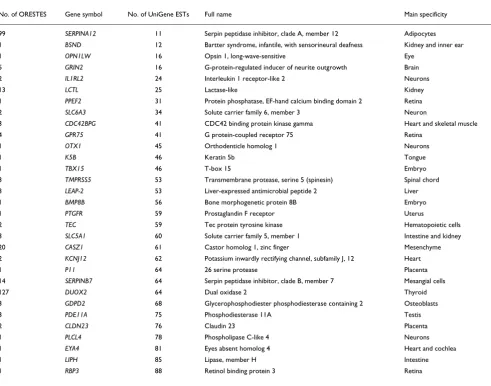
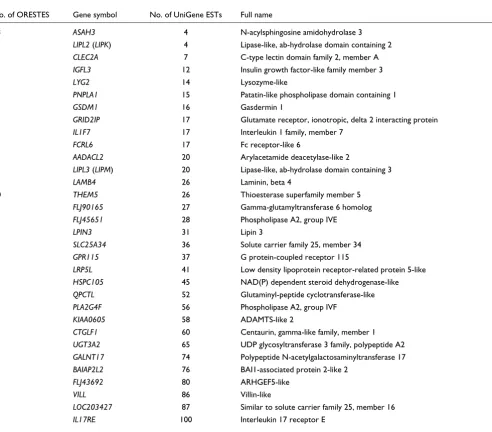
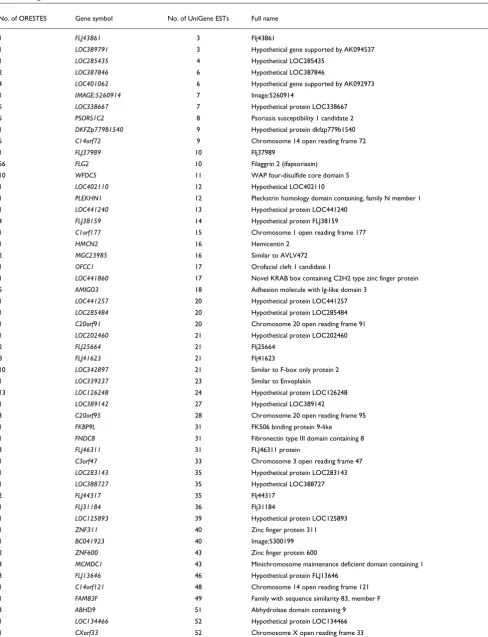
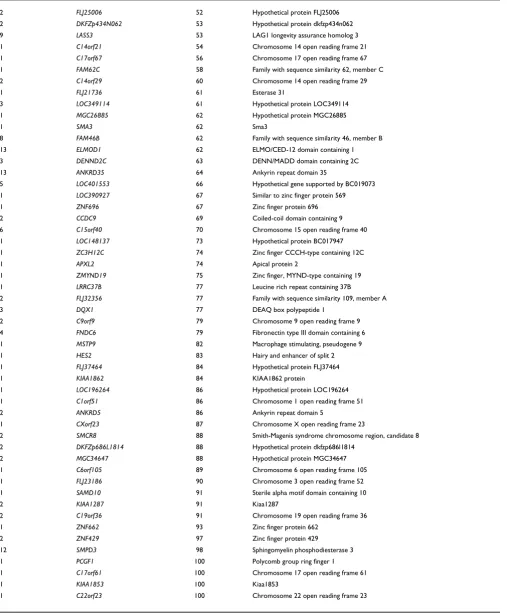
As few sequencing projects from human epidermis have been performed so far (relative to other organs), genes expressed during the late steps of epidermis differentiation are poorly represented in sequence databases. Among the 3,375 genes from our set, 330 (10%) corresponded to UniGene clusters containing less than 100 mRNA/EST sequences, and were thus good candidates for epidermis late-expressed genes. These were subdivided into five classes. The first one contains all the genes (50) already known to be specifically expressed in the suprabasal layers (Table 3). This confirms that late-expressed genes are poorly represented in EST databases. The second class consisted of 31 genes with known or inferred functions that were previously known as mainly expressed in a specific tissue different from epidermis (Table 4). We sug-gest that some of them might play a specific role in epidermal differentiation. This could be the case for SERPINA12, DUOX2, and, to a lesser extent, CASZ1, which are represented by a large ORESTES number. We also suspect that CLDN23 might play an important role in GKs, since claudin-based tight junctions in the granular layer contribute to barrier function of the epidermis [20]. Accordingly, claudin-1-defi-cient mice display a lethal defect in skin permeability [21]. The third class gathered 32 uncharacterized paralogues of known genes (Table 5). The fourth class was composed of 105 genes that remain hypothetical and about which nothing is known regarding their normal function or disease relevance (Table 6). The fifth class contained genes that are expressed, most probably at low levels, in numerous tissues, but whose epidermal expression is, to the best of our knowledge, described here for the first time (Additional data file 2). Sev-eral genes from these five classes were selected to quantify their expression in the course of epidermal differentiation by real-time PCR (see below).
Expressed retrogenes and pseudogenes
[image:4.612.58.297.81.556.2]Pseudogenes generally correspond to retrocopies with many disruptions in their open reading frame (ORF). However, it is now recognized that a large number of retrocopies are tran-scribed and can encode functional proteins [22]. Among the top 50 transcribed retrocopies reported by these authors, 11 were detected in GKs by the ORESTES method. Among these, calmodulin-like 3 (CALML3) was previously shown to be spe-cific for keratinocyte terminal differentiation [23]. We identi-fied two other expressed retrogenes corresponding to the Histological analysis of epidermis samples
Figure 1
http://genomebiology.com/2007/8/6/R107 Genome Biology 2007, Volume 8, Issue 6, Article R107 Toulza et al. R107.5
comm
en
t
re
v
ie
w
s
re
ports
refer
e
e
d
re
sear
ch
de
p
o
si
te
d r
e
se
a
rch
interacti
o
ns
inf
o
rmation
retrotransposition of the cutaneous T-cell lymphoma associated antigen 5 (CTAGE5), and CCR4-NOT transcrip-tion complex, subunit 6-like (CNOT6L). These genes can be considered as 'intact', that is, they show no disablements such as premature stop codons or frameshift mutations when com-pared to the ORF of their parental genes. Of note, the CNOT6L retrogene is specific for hominoids (Additional data file 3), while the CTAGE5 retrogene is specific for primates (data not shown).
Moreover, six unspliced ORESTES correspond to a part of intron 8 of the PPP2R5A gene, and include the small nucleo-lar RNA (snoRNA) U98b sequence. The snoRNAs are non-protein-coding RNAs that guide the 2'O-ribose methylation (C/D box snoRNAs) or the pseudouridylation (H/ACA box snoRNAs) of ribosomal RNAs, and are generally processed
from introns of RNA polymerase II transcripts [24]. Interest-ingly, the U98b snoRNA is a primate-specific retroposon of the ACA16 snoRNA hosted by the PNAS-123 gene [25]. We thus suggest that the ORESTES from the PPP2R5A gene cor-respond to a precursor form of the U98b snoRNA, and that snoRNA retroposons can indeed be expressed when located in an intron of a new host gene in the sense orientation. Therefore, our ORESTES dataset included transcripts from retrogenes, originating either from spliced pre-mRNAs or from an intron-encoded snoRNA gene.
Non-protein-coding genes
[image:5.612.57.552.86.479.2]We obtained two long spliced ORESTES highly similar to the BC070486 mRNA form of the GAS5 gene, a non-protein-cod-ing gene that belongs to the 'growth arrest specific' family but is disrupted in its ORF by a premature stop codon. The GAS5 Analysis of the ORESTES dataset from GKs
Figure 2
Analysis of the ORESTES dataset from GKs. (a) Pie graph of the 22,585 sequences obtained from the T4 fraction enriched in GKs. The treatment of the mRNA samples with DNAse resulted in minimal contamination with genomic sequences. Despite two rounds of polyA+ mRNA purification, rRNA sequences still represent approximately 8% of the dataset. (b) Histogram showing the number of ORESTES at each level of redundancy. The vast majority of genes are represented by less than five ORESTES, illustrating the normalization capability of that method. However, a small number of genes are represented by a large number of ORESTES (up to 402).
72,7%
10,2%
8,2%
6,4%
1,7%
0,8%
26,5%
mRNA
Genomic
Mitochondrial
Ribosomal
Uninformative
Bacterial
0
200
400
600
800
1,800
1 2 3 4 5 6 7 8 9 10 11 12 13 14 16 17 18 19 20 21 22 23 24 25 26 27 28 29 30 100 115127137 140142169193217402
//
//
(a)
(b)
Number of ORESTES per gene
Number
of
gene is the host gene for 10 C/D box snoRNAs [26]. Other snoRNA host genes included in our ORESTES dataset are RPS11, RPS12, RPL10 and EIF4A1. In certain cases, ORESTES contain the snoRNA sequence (U39B in RPS11, mgU6-77 in EIF4A1, U70 in RPL10), and probably corre-spond to alternative splicing forms of the host gene mRNA, with intron retention.
We furthermore obtained sequences for long, non-protein-coding transcripts. Metastasis associated lung adenocarci-noma transcript 1, (MALAT-1, 22 ORESTES) is a conserved long non-protein-coding RNA (>8,000 nucleotides (nt)) of unknown function that is highly expressed in numerous healthy organs and overexpressed in metastatic non-small cell lung carcinomas [27]. Close to MALAT-1 on 11q13.1, trophoblast-derived noncoding RNA (TncRNA, 44
ORESTES) is a 481 nucleotide (nt), non-protein-coding RNA involved in trophoblastic major histocompatibility complex suppression by inhibiting class II transactivator (CIITA) tran-scription [28]. H19 is a non-protein-coding, maternally imprinted mRNA (two spliced ORESTES) [29] that is highly transcribed in extraembryonic and fetal tissues, as well as in adult skeletal muscle. It has been shown that H19 is involved in the genomic imprinting of the insulin-like growth factor 2 (IGF2) gene [30]. Moreover, IGF2 is expressed throughout the epidermis [31] and its overexpression increases the thick-ness of the epidermis and the proportion of dividing cells in the basal layer [32]. We suggest that H19 could participate in the regulation of IGF2 transcription by maintaining the genomic imprinting of its promoter in adult epidermis. In addition to numerous protein-coding genes, we thus detected several non-protein-coding RNAs whose expression in the Representative sample of genes with the highest number of ORESTES
No. of ORESTES Gene symbol No. of UniGene ESTs Full name (alias)
Ubiquitously expressed genes with a high number of UniGene ESTs
142 RPS8 3,382 Ribosomal protein S8
115 EEF1A1 29,374 Eukaryotic translation elongation factor 1 alpha 1
77 HLA-B 4,536 Major histocompatibility complex, class I, B
71 RPL3 11,561 Ribosomal protein L3
62 NCL 2,970 Nucleolin
55 RPL28 2,394 Ribosomal protein L28
55 RPL7A 5,864 Ribosomal protein l7a
51 RPSA 5,623 Ribosomal protein SA
50 PABPC1 4,385 Poly(A) binding protein, cytoplasmic 1
34 RPS18 2,292 Ribosomal protein S18
Known epidermis specific genes
402 KRT1 134 Keratin 1
217 DMKN 275 Dermokine
140 LEP7 5 Late envelope protein 7 (xp32)
100 FLG 5 Filaggrin
71 KRT2A 12 Keratin 2A
62 SPRR2E 36 Small proline-rich protein 2E
61 CASP14 19 Caspase 14
59 CDSN 91 Corneodesmosin
56 hKPRP 7 Human keratinocyte proline rich protein
54 PKP1 263 Plakophilin 1
32 SBSN 49 Suprabasin
30 DSG1 61 Desmoglein 1
Genes with unknown function
193 TSPAN5 526 Tetraspanin 5
127 DUOX2 64 Dual oxidase 2
99 TMEM14C 476 Transmembrane protein 14C
99 SERPINA12 11 Serpin peptidase inhibitor, clade A, member 12
66 SLC22A5 142 Solute carrier family 22, member 5
56 FLG2 10 Filaggrin 2 (ifapsoriasin)
[image:6.612.58.560.117.536.2]http://genomebiology.com/2007/8/6/R107 Genome Biology 2007, Volume 8, Issue 6, Article R107 Toulza et al. R107.7
comm
en
t
re
v
ie
w
s
re
ports
refer
e
e
d
re
sear
ch
de
p
o
si
te
d r
e
se
a
rch
interacti
o
ns
inf
o
[image:7.612.52.541.83.742.2]rmation
Table 3
Genes with less than 100 UniGene ESTs encoding known GK expressed proteins
No. of ORESTES Gene symbol No. of UniGene ESTs Full name (alias)
2 LCE1F 1 Late cornified envelope 1F
4 LCE2C 1 Late cornified envelope 2C
1 C1orf46 2 Chromosome 1 open reading frame 46 (xp 33)
1 LCE2A 3 Late cornified envelope 2A
6 LCE5A 3 Late cornified envelope 5A
11 LCE1A 3 Late cornified envelope 1A
2 PGLYRP3 5 Peptidoglycan recognition protein 3
5 LCE1C 5 Late cornified envelope 1C
100 FLG 5 Filaggrin
140 LEP7 5 Late envelope protein 7
2 RPTN 6 Repetin
1 LCE2B 7 Late cornified envelope 2B
56 hKPRP 7 Human keratinocyte proline rich protein
9 LOR 11 Loricrin
71 KRT2A 12 Keratin 2A
2 C1orf42 15 Chromosome 1 open reading frame 42 (NICE-1)
5 TGM5 15 Transglutaminase 5
13 DSC1 17 Desmocollin 1
16 KRT1B 18 Keratin 1B
61 CASP14 19 Caspase 14
1 CNFN 20 Cornifelin
4 CALML5 25 Calmodulin-like 5
1 ALOXE3 28 Arachidonate lipoxygenase 3
8 ALOX12B 30 Arachidonate 12-lipoxygenase, 12R type
62 SPRR2E 36 Small proline-rich protein 2E
17 IVL 38 Involucrin
2 EPPK1 42 Epiplakin 1
5 POU2F3 45 POU domain, class 2, transcription factor 3 (oct-11)
4 ICHTHYIN 48 Ichthyin
32 SBSN 49 Suprabasin
2 KLK8 53 Kallikrein 8 (neuropsin/ovasin)
4 TGM3 54 Transglutaminase 3
1 ABCA12 55 ATP-binding cassette, sub-family A (ABC1), member 12
3 PADI1 56 Peptidylarginine deiminase, type I
30 DSG1 61 Desmoglein 1
2 GJB3 65 Gap junction protein, beta 3 (connexin 31)
1 CALML3 68 Calmodulin-like 3
13 SASpase 69 Skin aspartic protease
15 KLK7/SCCE 69 Kallikrein 7 (Stratum corneum chymotrypticenzyme)
6 A2ML1 76 Alpha-2-macroglobulin-like 1
1 CST6 78 Cystatin E/M
1 SULT2B1 80 Sulfotransferase family, cytosolic, 2B, member 1
2 KLK11 83 Kallikrein 11
3 HAL 86 Histidine ammonia-lyase (histidase)
14 EVPL 91 Envoplakin
59 CDSN 91 Corneodesmosin
3 PDZK1IP1 92 PDZK1 interacting protein 1
4 TGM1 92 Transglutaminase 1
2 SERPINB8 99 Serpin peptidase inhibitor, clade B, member 8
epidermis had not been previously assessed, evoking the pos-sibility that they might play a specific role in this tissue.
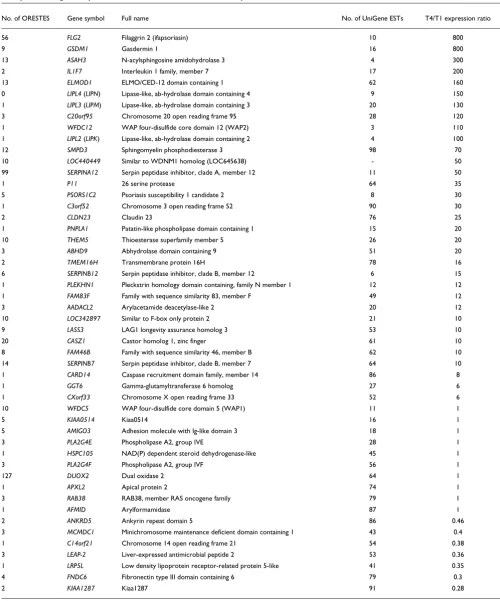
Real-time PCR expression profiling of selected genes Genes involved in the establishment of the skin barrier are expected to be specifically overexpressed by granular keratinocytes. To compare the expression levels of candidate genes between the basal layer and GKs, quantitative real-time PCR experiments were performed with the T4 and T1 cell fractions. Based on predicted domains and homologies, 73 genes represented by less than 100 ESTs were selected (Table 7). The relative T4/T1 ratio could not be calculated for 20 of them due to very low expression levels. Ten genes were equally expressed in the two layers, and nine were overex-pressed in the basal layer, even if exoverex-pressed at a low level in the granular layer. Interestingly, 33 were overexpressed in the granular layer with T4/T1 ratios ranging from 6 to 800. For several genes, the T4/T1 expression ratio was thus much larger than that observed for the KLK7 gene, used as a specific marker of the GKs in our cell purification experiments (Table
1). Therefore, these data emphasize the high degree of purity of the GKs we have purified from healthy human skin. They also provide one with new, highly specific markers for this cell type.
Identification of new genes FLG2
The epidermal differentiation complex (EDC) spans 1.62 megabases on 1q21.3 and contains approximately 50 genes specifically involved in the barrier function, such as those encoding involucrin, loricrin, filaggrin, small proline rich proteins (SPRR1-4) or late cornified envelope proteins (LCE1-5) (Figure 3a). We cloned many sequences corresponding to known genes of this locus (Figure 3b), but also a large number of sequences for a previously poorly characterized transcript encoding filaggrin 2 (FLG2; also called ifapsoriasin (IFPS); (GenBank:AY827490)). FLG2 dis-plays features of the fused-family genes (encoding filaggrin, trichohyalin, or repetin), with three exons and a large pre-dicted protein sequence (2,391 amino acids) containing two Genes with 100 or less UniGene ESTs, known as mainly expressed in a specific tissue different from epidermis
No. of ORESTES Gene symbol No. of UniGene ESTs Full name Main specificity
99 SERPINA12 11 Serpin peptidase inhibitor, clade A, member 12 Adipocytes
1 BSND 12 Bartter syndrome, infantile, with sensorineural deafness Kidney and inner ear
1 OPN1LW 16 Opsin 1, long-wave-sensitive Eye
5 GRIN2 16 G-protein-regulated inducer of neurite outgrowth Brain
2 IL1RL2 24 Interleukin 1 receptor-like 2 Neurons
13 LCTL 25 Lactase-like Kidney
1 PPEF2 31 Protein phosphatase, EF-hand calcium binding domain 2 Retina
2 SLC6A3 34 Solute carrier family 6, member 3 Neuron
3 CDC42BPG 41 CDC42 binding protein kinase gamma Heart and skeletal muscle
4 GPR75 41 G protein-coupled receptor 75 Retina
1 OTX1 45 Orthodenticle homolog 1 Neurons
1 K5B 46 Keratin 5b Tongue
1 TBX15 46 T-box 15 Embryo
3 TMPRSS5 53 Transmembrane protease, serine 5 (spinesin) Spinal chord
3 LEAP-2 53 Liver-expressed antimicrobial peptide 2 Liver
1 BMP8B 56 Bone morphogenetic protein 8B Embryo
1 PTGFR 59 Prostaglandin F receptor Uterus
2 TEC 59 Tec protein tyrosine kinase Hematopoietic cells
3 SLC5A1 60 Solute carrier family 5, member 1 Intestine and kidney
20 CASZ1 61 Castor homolog 1, zinc finger Mesenchyme
2 KCNJ12 62 Potassium inwardly rectifying channel, subfamily J, 12 Heart
1 P11 64 26 serine protease Placenta
14 SERPINB7 64 Serpin peptidase inhibitor, clade B, member 7 Mesangial cells
127 DUOX2 64 Dual oxidase 2 Thyroid
3 GDPD2 68 Glycerophosphodiester phosphodiesterase containing 2 Osteoblasts
3 PDE11A 75 Phosphodiesterase 11A Testis
2 CLDN23 76 Claudin 23 Placenta
1 PLCL4 78 Phospholipase C-like 4 Neurons
1 EYA4 81 Eyes absent homolog 4 Heart and cochlea
1 LIPH 85 Lipase, member H Intestine
[image:8.612.59.550.117.503.2]http://genomebiology.com/2007/8/6/R107 Genome Biology 2007, Volume 8, Issue 6, Article R107 Toulza et al. R107.9
comm
en
t
re
v
ie
w
s
re
ports
refer
e
e
d
re
sear
ch
de
p
o
si
te
d r
e
se
a
rch
interacti
o
ns
inf
o
rmation
calcium binding EF-hand domains and a large domain made of repeated segments of about 25 amino acids. The amino acid composition of FLG2 is very similar to that of filaggrin, with a high content of serine (22%), glycine (20%), histidine (10%) and glutamine (10%). The expression of this gene is likely restricted to the epidermis, as shown by PCR on a panel of cDNAs from 16 healthy human tissues and organs (Figure 4). Real-time PCR also showed a strong overexpression of the FLG2 gene in GKs, with a T4/T1 ratio of 800 (Table 7). These results thus suggest that this gene is a new functional member of the EDC complex, in agreement with its similarity to the filaggrin gene, whose function in the epidermal barrier is well established.
Lipase-like genes
[image:9.612.62.554.117.549.2]Two ORESTES were identified as the human orthologues of the murine lipases Lipl2 (NM_172837) and Lipl3 (BC031933), previously identified by large-scale mouse cDNA sequencing by the Riken Institute [33] and the Mam-malian Gene Collection program [34], respectively. The cor-responding human genes LIPL2 and LIPL3 were clustered in a 665 kB interval on chromosome 10q23.31 with genes encod-ing two experimentally characterized lipases, LIPA (lyso-somal acid lipase, MIM +27,8000) and LIPF (gastric lipase, MIM #601980) and two hypothetical lipase-like proteins, LIPL1 and LIPL4 (Figure 5a). Therefore, our study contrib-uted to the elucidation of a specialized human genomic locus that includes six lipase genes and four other genes (ANKRD22, STAMBPL1, ACT2 and FAS) of apparently unre-lated function (Figure 5a). In accordance with the Hugo Gene Table 5
Genes with 100 or less UniGene ESTs, corresponding to uncharacterized paralogues of known genes
No. of ORESTES Gene symbol No. of UniGene ESTs Full name
13 ASAH3 4 N-acylsphingosine amidohydrolase 3
1 LIPL2 (LIPK) 4 Lipase-like, ab-hydrolase domain containing 2
11 CLEC2A 7 C-type lectin domain family 2, member A
2 IGFL3 12 Insulin growth factor-like family member 3
3 LYG2 14 Lysozyme-like
1 PNPLA1 15 Patatin-like phospholipase domain containing 1
9 GSDM1 16 Gasdermin 1
1 GRID2IP 17 Glutamate receptor, ionotropic, delta 2 interacting protein
2 IL1F7 17 Interleukin 1 family, member 7
2 FCRL6 17 Fc receptor-like 6
3 AADACL2 20 Arylacetamide deacetylase-like 2
1 LIPL3 (LIPM) 20 Lipase-like, ab-hydrolase domain containing 3
1 LAMB4 26 Laminin, beta 4
10 THEM5 26 Thioesterase superfamily member 5
1 FLJ90165 27 Gamma-glutamyltransferase 6 homolog
3 FLJ45651 28 Phospholipase A2, group IVE
1 LPIN3 31 Lipin 3
1 SLC25A34 36 Solute carrier family 25, member 34
1 GPR115 37 G protein-coupled receptor 115
1 LRP5L 41 Low density lipoprotein receptor-related protein 5-like
1 HSPC105 45 NAD(P) dependent steroid dehydrogenase-like
1 QPCTL 52 Glutaminyl-peptide cyclotransferase-like
3 PLA2G4F 56 Phospholipase A2, group IVF
1 KIAA0605 58 ADAMTS-like 2
1 CTGLF1 60 Centaurin, gamma-like family, member 1
2 UGT3A2 65 UDP glycosyltransferase 3 family, polypeptide A2
1 GALNT17 74 Polypeptide N-acetylgalactosaminyltransferase 17
1 BAIAP2L2 76 BAI1-associated protein 2-like 2
1 FLJ43692 80 ARHGEF5-like
1 VILL 86 Villin-like
1 LOC203427 87 Similar to solute carrier family 25, member 16
Unknown genes with 100 or less UniGene ESTs
No. of ORESTES Gene symbol No. of UniGene ESTs Full name
1 FLJ43861 3 Flj43861
1 LOC389791 3 Hypothetical gene supported by AK094537
1 LOC285435 4 Hypothetical LOC285435
2 LOC387846 6 Hypothetical LOC387846
4 LOC401062 6 Hypothetical gene supported by AK092973
1 IMAGE:5260914 7 Image:5260914
5 LOC338667 7 Hypothetical protein LOC338667
5 PSORS1C2 8 Psoriasis susceptibility 1 candidate 2
1 DKFZp779B1540 9 Hypothetical protein dkfzp779b1540
5 C14orf72 9 Chromosome 14 open reading frame 72
1 FLJ37989 10 Flj37989
56 FLG2 10 Filaggrin 2 (ifapsoriasin)
10 WFDC5 11 WAP four-disulfide core domain 5
1 LOC402110 12 Hypothetical LOC402110
1 PLEKHN1 12 Pleckstrin homology domain containing, family N member 1
1 LOC441240 13 Hypothetical protein LOC441240
4 FLJ38159 14 Hypothetical protein FLJ38159
1 C1orf177 15 Chromosome 1 open reading frame 177
1 HMCN2 16 Hemicentin 2
2 MGC23985 16 Similar to AVLV472
1 OFCC1 17 Orofacial cleft 1 candidate 1
1 LOC441860 17 Novel KRAB box containing C2H2 type zinc finger protein
5 AMIGO3 18 Adhesion molecule with Ig-like domain 3
1 LOC441257 20 Hypothetical protein LOC441257
1 LOC285484 20 Hypothetical protein LOC285484
1 C20orf91 20 Chromosome 20 open reading frame 91
1 LOC202460 21 Hypothetical protein LOC202460
2 FLJ25664 21 Flj25664
8 FLJ41623 21 Flj41623
10 LOC342897 21 Similar to F-box only protein 2
1 LOC339237 23 Similar to Envoplakin
13 LOC126248 24 Hypothetical protein LOC126248
1 LOC389142 27 Hypothetical LOC389142
3 C20orf95 28 Chromosome 20 open reading frame 95
1 FKBP9L 31 FK506 binding protein 9-like
1 FNDC8 31 Fibronectin type III domain containing 8
3 FLJ46311 31 FLJ46311 protein
1 C3orf47 33 Chromosome 3 open reading frame 47
1 LOC283143 35 Hypothetical protein LOC283143
1 LOC388727 35 Hypothetical LOC388727
2 FLJ44317 35 Flj44317
1 FLJ31184 36 Flj31184
1 LOC125893 39 Hypothetical protein LOC125893
1 ZNF311 40 Zinc finger protein 311
1 BC041923 40 Image:5300199
2 ZNF600 43 Zinc finger protein 600
3 MCMDC1 43 Minichromosome maintenance deficient domain containing 1
3 FLJ13646 46 Hypothetical protein FLJ13646
1 C14orf121 48 Chromosome 14 open reading frame 121
1 FAM83F 49 Family with sequence similarity 83, member F
3 ABHD9 51 Abhydrolase domain containing 9
1 LOC134466 52 Hypothetical protein LOC134466
[image:10.612.59.547.113.750.2]http://genomebiology.com/2007/8/6/R107 Genome Biology 2007, Volume 8, Issue 6, Article R107 Toulza et al. R107.11
comm
en
t
re
v
ie
w
s
re
ports
refer
e
e
d
re
sear
ch
de
p
o
si
te
d r
e
se
a
rch
interacti
o
ns
inf
o
rmation
2 FLJ25006 52 Hypothetical protein FLJ25006
2 DKFZp434N062 53 Hypothetical protein dkfzp434n062
9 LASS3 53 LAG1 longevity assurance homolog 3
1 C14orf21 54 Chromosome 14 open reading frame 21
1 C17orf67 56 Chromosome 17 open reading frame 67
1 FAM62C 58 Family with sequence similarity 62, member C
2 C14orf29 60 Chromosome 14 open reading frame 29
1 FLJ21736 61 Esterase 31
3 LOC349114 61 Hypothetical protein LOC349114
1 MGC26885 62 Hypothetical protein MGC26885
1 SMA3 62 Sma3
8 FAM46B 62 Family with sequence similarity 46, member B
13 ELMOD1 62 ELMO/CED-12 domain containing 1
3 DENND2C 63 DENN/MADD domain containing 2C
13 ANKRD35 64 Ankyrin repeat domain 35
5 LOC401553 66 Hypothetical gene supported by BC019073
1 LOC390927 67 Similar to zinc finger protein 569
1 ZNF696 67 Zinc finger protein 696
2 CCDC9 69 Coiled-coil domain containing 9
6 C15orf40 70 Chromosome 15 open reading frame 40
1 LOC148137 73 Hypothetical protein BC017947
1 ZC3H12C 74 Zinc finger CCCH-type containing 12C
1 APXL2 74 Apical protein 2
1 ZMYND19 75 Zinc finger, MYND-type containing 19
1 LRRC37B 77 Leucine rich repeat containing 37B
2 FLJ32356 77 Family with sequence similarity 109, member A
3 DQX1 77 DEAQ box polypeptide 1
2 C9orf9 79 Chromosome 9 open reading frame 9
4 FNDC6 79 Fibronectin type III domain containing 6
1 MSTP9 82 Macrophage stimulating, pseudogene 9
1 HES2 83 Hairy and enhancer of split 2
1 FLJ37464 84 Hypothetical protein FLJ37464
1 KIAA1862 84 KIAA1862 protein
1 LOC196264 86 Hypothetical protein LOC196264
1 C1orf51 86 Chromosome 1 open reading frame 51
2 ANKRD5 86 Ankyrin repeat domain 5
1 CXorf23 87 Chromosome X open reading frame 23
2 SMCR8 88 Smith-Magenis syndrome chromosome region, candidate 8
2 DKFZp686L1814 88 Hypothetical protein dkfzp686l1814
2 MGC34647 88 Hypothetical protein MGC34647
1 C6orf105 89 Chromosome 6 open reading frame 105
1 FLJ23186 90 Chromosome 3 open reading frame 52
1 SAMD10 91 Sterile alpha motif domain containing 10
2 KIAA1287 91 Kiaa1287
2 C19orf36 91 Chromosome 19 open reading frame 36
1 ZNF662 93 Zinc finger protein 662
2 ZNF429 97 Zinc finger protein 429
12 SMPD3 98 Sphingomyelin phosphodiesterase 3
1 PCGF1 100 Polycomb group ring finger 1
1 C17orf61 100 Chromosome 17 open reading frame 61
1 KIAA1853 100 Kiaa1853
[image:11.612.55.562.116.729.2]1 C22orf23 100 Chromosome 22 open reading frame 23
Table 6 (Continued)
Comparison of gene expression in the T4 and T1 cell fractions by real-time PCR
No. of ORESTES Gene symbol Full name No. of UniGene ESTs T4/T1 expression ratio
56 FLG2 Filaggrin 2 (ifapsoriasin) 10 800
9 GSDM1 Gasdermin 1 16 800
13 ASAH3 N-acylsphingosine amidohydrolase 3 4 300
2 IL1F7 Interleukin 1 family, member 7 17 200
13 ELMOD1 ELMO/CED-12 domain containing 1 62 160
0 LIPL4 (LIPN) Lipase-like, ab-hydrolase domain containing 4 9 150
1 LIPL3 (LIPM) Lipase-like, ab-hydrolase domain containing 3 20 130
3 C20orf95 Chromosome 20 open reading frame 95 28 120
1 WFDC12 WAP four-disulfide core domain 12 (WAP2) 3 110
1 LIPL2 (LIPK) Lipase-like, ab-hydrolase domain containing 2 4 100
12 SMPD3 Sphingomyelin phosphodiesterase 3 98 70
10 LOC440449 Similar to WDNM1 homolog (LOC645638) - 50
99 SERPINA12 Serpin peptidase inhibitor, clade A, member 12 11 50
1 P11 26 serine protease 64 35
5 PSORS1C2 Psoriasis susceptibility 1 candidate 2 8 30
1 C3orf52 Chromosome 3 open reading frame 52 90 30
2 CLDN23 Claudin 23 76 25
1 PNPLA1 Patatin-like phospholipase domain containing 1 15 20
10 THEM5 Thioesterase superfamily member 5 26 20
3 ABHD9 Abhydrolase domain containing 9 51 20
2 TMEM16H Transmembrane protein 16H 78 16
6 SERPINB12 Serpin peptidase inhibitor, clade B, member 12 6 15
1 PLEKHN1 Pleckstrin homology domain containing, family N member 1 12 12
1 FAM83F Family with sequence similarity 83, member F 49 12
3 AADACL2 Arylacetamide deacetylase-like 2 20 12
10 LOC342897 Similar to F-box only protein 2 21 10
9 LASS3 LAG1 longevity assurance homolog 3 53 10
20 CASZ1 Castor homolog 1, zinc finger 61 10
8 FAM46B Family with sequence similarity 46, member B 62 10
14 SERPINB7 Serpin peptidase inhibitor, clade B, member 7 64 10
1 CARD14 Caspase recruitment domain family, member 14 86 8
1 GGT6 Gamma-glutamyltransferase 6 homolog 27 6
1 CXorf33 Chromosome X open reading frame 33 52 6
10 WFDC5 WAP four-disulfide core domain 5 (WAP1) 11 1
5 KIAA0514 Kiaa0514 16 1
5 AMIGO3 Adhesion molecule with Ig-like domain 3 18 1
3 PLA2G4E Phospholipase A2, group IVE 28 1
1 HSPC105 NAD(P) dependent steroid dehydrogenase-like 45 1
3 PLA2G4F Phospholipase A2, group IVF 56 1
127 DUOX2 Dual oxidase 2 64 1
1 APXL2 Apical protein 2 74 1
3 RAB38 RAB38, member RAS oncogene family 79 1
1 AFMID Arylformamidase 87 1
2 ANKRD5 Ankyrin repeat domain 5 86 0.46
3 MCMDC1 Minichromosome maintenance deficient domain containing 1 43 0.4
1 C14orf21 Chromosome 14 open reading frame 21 54 0.38
3 LEAP-2 Liver-expressed antimicrobial peptide 2 53 0.36
1 LRP5L Low density lipoprotein receptor-related protein 5-like 41 0.35
4 FNDC6 Fibronectin type III domain containing 6 79 0.3
2 KIAA1287 Kiaa1287 91 0.28
Not determined: FLJ21736, HES2, ZNF696, LYG2, MGC34829, KIAA0963, ALKBH, ADAMTSL2, c6orf105, AW367250, KCNJ12, LOC338667, TMPRSS5, CLEC2A, FLJ21736,
[image:12.612.56.556.113.714.2]http://genomebiology.com/2007/8/6/R107 Genome Biology 2007, Volume 8, Issue 6, Article R107 Toulza et al. R107.13
comm
en
t
re
v
ie
w
s
re
ports
refer
e
e
d
re
sear
ch
de
p
o
si
te
d r
e
se
a
rch
interacti
o
ns
inf
o
rmation
Nomenclature Committee (HGNC), these new hypothetical lipase genes, LIPL1, LIPL2, LIPL3 and LIPL4, have been renamed LIPJ, LIPK, LIPM, and LIPN, respectively.
Rapid amplification of cDNA ends (RACE) cloning experi-ments of the human LIPK mRNA localized the cap site 165 nt upstream of the conceptual ATG initiation codon. For the LIPM and LIPN mRNAs, the entire coding sequences have been cloned using primers deduced from alignments with the mouse cDNAs (GenBank:EF426482, GenBank:EF426484 and GenBank:EF426483).
The conceptual translation of LIPJ, LIPK, LIPM, and LIPN ORFs led to proteins of 366, 399, 423 and 398 amino acids, respectively. As is the case for LIPA and LIPF, these proteins contain an abhydrolase associated lipase region (PFAM PF04083) with an alpha/beta hydrolase fold domain (PFAM PF00561). More precisely, they display the characteristic Ser-Asp-His catalytic triad (Figure 5b) also present in various hydrolases, such as serine proteases [35,36]. Surprisingly, LIPJ (NM_001010939) appeared as the only member in this family to lack a cleavable signal peptide (Figure 5b) and might thus play a distinct role in human physiology.
The clustering of six lipase genes on the human 10q23.31 locus led us to examine in detail the syntenic mouse locus (19qC1), where the orthologous genes except for LIPN and LIPJ had already been identified or predicted,. Sequence
analysis showed that the AK154333 cDNA clearly corre-sponds to the LIPN orthologue (89% homology). As in the human genome, this gene resides between the Lipl2 and Lipl3 genes. Intriguingly, we could not precisely identify a single orthologue of LIPJ. Instead, we found upstream of the Lipf gene a cluster of five predicted genes encoding secreted alpha/beta hydrolases as well as at least three pseudogenes containing premature stop codons (Figure 5a). A syntenic cluster, albeit of smaller size, resides in the rat genome. These five hypothetical functional mouse lipases form by them-selves a separate group in the phylogenic tree (Figure 5c; Additional data file 4). Their genomic localization suggests that they could have arisen from a large expansion by tandem duplications well after the separation of the rodents from the primate ancestors, or from a lipase gene lost in the human genome. These five new genes have thus been renamed Lipdc1-5 for lipase domain containing1-5 in accordance with the Mouse Gene Nomenclature Committee (MGNC) (Addi-tional data file 5).
[image:13.612.55.556.88.352.2]The human LIPK, LIPM and LIPN genes appear to be exclu-sively expressed in the epidermis, as shown by PCR on a panel of 16 cDNAs (Figure 4). Their expression was highly specific for GKs, with real-time PCR T4/T1 ratios of 100-150 (Table 7). LIPJ expression was also detected in the epidermis by PCR, but was too weak to allow real-time PCR experiments to be performed. These results strongly suggest that the LIPK, LIPM and LIPN genes play a highly specific role in the last Genes of the EDC present in the ORESTES dataset
Figure 3
Genes of the EDC present in the ORESTES dataset. (a) Screen copy of a UCSC Genome Browser window (chr1:150,300,000-151,590,000; hg17, May 2004) showing the RefSeq genes from the EDC, and the ORESTE custom track. (b) Number of ORESTES for each gene of the locus. The genes for which at least one ORESTE was sequenced are in red bold characters.
0 20 40 60 80 100 120 140 160
THHL1 THH RPTN HRNR FLG FLG2 CRNN LCE5A NICE-1 LCE3(A-E) LCE2D LCE2C LCE2B LCE2A LCE4A LEP7 hKPRP LCE1F LCE1(D-E) LCE1C LCE1B LCE1A SMCP IVL SPRR4 SPRR1A SPRR3 SPRR1B SPRR2D SPRR2A-B SPRR2E SPRR2F SPRR2G LELP1 LOR PGLYRP3 PGLYRP4
Number
of
ORESTES
RPTN
(a)
step of keratinocyte differentiation. Although highly related, the LIPJ protein might play a different role, as previously sug-gested by its lack of a signal peptide.
C1orf81
Six spliced ORESTES corresponded to a totally unknown gene without mRNA sequences in the databases. We per-formed RACE experiments and identified 16 exons and 15 introns with canonical splice sites and a consensus polyadenylation signal (GenBank:DQ983818). In agreement with the HGNC, we named this gene C1orf81. To date, only 16 ESTs are present in the databases, one from testis and the
[image:14.612.59.561.83.521.2]others from pooled tissues (Additional data file 1). PCR on a panel of cDNAs from 16 healthy human tissues and organs showed that spliced transcripts for this gene are detectable in most samples (Figure 6a). From its conceptual translation, the C1orf81 mRNA might encode a 373 amino acid protein. However, a second ORF was present in another frame that overlapped the first one by 87 amino acids. This suggested that a longer protein might be produced by a ribosomal frameshift mechanism. We explored the C1orf81 gene ortho-logues in vertebrate genomes, and particularly the region cor-responding to the ORF overlap (exons 7-9). Compared with the C1orf81 gene from 10 other mammals, exon 8 of the Expression profile of newly identified genes
Figure 4
Expression profile of newly identified genes. PCR experiments were performed with a commercial panel of cDNAs from 16 human tissues (PBL, peripheral blood leukocytes) and with cDNAs prepared from the T4 fraction enriched in GKs. For each gene, PCR primers were chosen to amplify a cDNA fragment encompassing at least two exons. Note the highly specific expression pattern of FLG2, LIPK, M, N, and, to a lesser extent, SERPINA12 genes. The apparent size variation of the CLDN23 fragment results from an artifactual gel distortion. Expression of GAPDH, assessed with the primers provided by the manufacturer, was used as a control.
Heart
Brain
Placenta
Lung
Liver
Muscle
Kidney
Pancreas
MW
Spleen
Thymus
Prostate
Testis
Ovary
Small intestine
Colon
PBL
T4
GAPDH
CLDN23
SERPA12
FLG2
LIPM
LIPN
http://genomebiology.com/2007/8/6/R107 Genome Biology 2007, Volume 8, Issue 6, Article R107 Toulza et al. R107.15
comm
en
t
re
v
ie
w
s
re
ports
refer
e
e
d
re
sear
ch
de
p
o
si
te
d r
e
se
a
rch
interacti
o
ns
inf
o
rmation
human gene contained a 1 base-pair insertion that creates the frameshift (Figure 6b). The possibility of a sequence error in the present human genome assembly was excluded by sequencing the exon 8 region from two individuals. Accordingly, the human C1orf81 gene product would be 373 amino acids long, but 762 and 714 amino acids long in the chimpanzee and rhesus monkey, respectively. In all cases, the analysis of the peptide sequence did not reveal known domains or signal peptide. Further studies are needed to uncover the role of this new gene in mammalian physiology, and evaluate the consequences of its possible inactivation in human.
Discussion
We have described here the first large-scale study of the tran-scriptome of human epidermal cells. As we are interested in genes that participate in the barrier function of the skin, we focused on GKs. They correspond to the ultimate step in the course of keratinocyte differentiation, and are the last epider-mal cells to display gene expression activity before undergoing a particular programmed cell death leading to cornification. Because these cells represent less than 10% of the epidermis population, a preliminary step was to design an efficient purification method starting from healthy human skin fragments. After unsuccessful attempts using size filtra-tion, Ficoll gradients, and fluorescence-activated cell sorting, we used successive short-term enzyme incubations to pro-gressively detach cells from the deep layers, and purify the cells that remain attached to the cornified layer. These incu-bations were performed at 4°C to stop cellular metabolic activity and preserve the mRNA pool from degradation. This point is highly relevant as many growth factors, cell cycle reg-ulators and transcription factors are encoded by short-lived mRNA. Quantitative PCR experiments were used to assess the relative expression levels of several genes in the succes-sive cell fractions.
ORESTE technique
In the present transcriptome project, the ORESTE methodol-ogy was selected because it produces sequences that are dis-tributed predominantly within the central part of the corresponding transcripts and is biased towards less-abun-dant mRNAs [9]. When using arbitrarily chosen primers for reverse transcription and PCR, the amplification of a given transcript is proportional to its length and to the probability for the primer to anneal at low stringency (37°C). This con-ceptual normalization was secondarily strengthened by removing cDNA libraries with highly abundant amplification products. After the elimination of irrelevant sequences, we produced 16,591 ORESTES representing 3,387 genes. The distribution of the ORESTE number per gene (Figure 2) and the low number of ESTs in the corresponding UniGene entries fully confirmed that the transcript normalization obtained with this method is at least comparable to that of
hybridization-subtraction techniques (for an example, see [37]).
Overrepresented genes
Nevertheless, a few genes were represented by more than 100 sequences obtained from different mini-libraries. These include ubiquitous, highly expressed genes like RPS8 and EEF1A1, and genes already known to be highly transcribed in GKs (those encoding keratin 1, late envelope protein 7 or pro-filaggrin). Other members of this class, DMKN (formerly ZD52F10), SERPINA12 and FLG2 were not previously known to be overexpressed in the skin, and were thus studied in more detail. Two isoforms of transcripts for the dermokine gene were previously reported [15,16] and we describe 13 novel mRNA isoforms that are either ubiquitous or epider-mis-specific depending upon alternative promoter usage. The epidermis-specific forms encode secreted proteins of still unclear function, and are abundantly transcribed in this tis-sue [17].
SERPINA12, also named Vaspin (visceral adipose tissue-derived serine protease inhibitor), is an extracellular serine protease inhibitor that displays insulin-sensitizing effects [38]. In addition to the previously documented expression in the liver, we observed that the SERPINA12 gene is highly expressed in the human epidermis (Figure 4). Moreover, real-time PCR showed that it is specifically expressed by GKs (T4/ T1 ratio of 50). The Serpin A12 protein might thus play a role in the regulation of the complex balance between various proteases and their inhibitors operative in the desquamation process.
The filaggrin 2 (FLG2; or ifapsoriasin (IFPS)) gene is a new member of the EDC (chromosome 1q21.3), a cluster of approximately 50 genes involved in cornification. Our real-time RT-PCR experiments revealed that FLG2 expression dis-plays strong specificity for GK. Interestingly, its composition is very close to that of filaggrin. The degradation of filaggrin is considered to be at the origin of the free amino acid pool of the natural moisturizing factor, which is capable of attracting and retaining water in the cornified layer to achieve skin soft-ness and flexibility. We suggest that FLG2 might have a simi-lar function.
C1orf81 might have lost its function during hominization
that the human C1orf81 gene encodes a truncated protein relative to other mammalian species, including the rhesus monkey. Nevertheless, we do not exclude the possibility that the translation of the human C1orf81 mRNA might produce a full-length protein by a +1 ribosomal frameshift mechanism. To our knowledge, such a phenomenon has been uniquely described in human for the ornithine decarboxylase antizyme gene family [40]. This would thus constitute a further exam-ple of a (partial) loss of gene function during hominoid evolu-tion. The systematic comparison of the human and chimpanzee genomes has revealed nine other human-specific frameshift mutations (pseudogenization) leading to the mRNA decay or carboxy-terminal protein truncation [41]. Gene losses that occurred after human-chimpanzee divergence could play a role in adaptive evolution, as shown for caspase 12 inactivation during hominization [42]. In this framework, it is intriguing that a member of the hair keratin gene complex, KRTHAP1, and a serine protease inhibitor gene, SERPINA13, are also among the few genes specifically inactivated in human by a mutation [43,44].
In addition, we sequenced ORESTES for CTAGE5 and CNOT6L functional retrogenes, which are specific for primate and hominoid lineages, respectively. Moreover, the CTAGE5 retrogene is included in a larger, human-specific insertion (data not shown). It is indeed known that new genes have emerged after a burst of retroposition in primates [45]. Not surprisingly, this suggests that modifications of genes expressed in the skin participate in obvious differences between human and chimpanzee.
Real-time PCR experiments
Real-time PCR experiments were used to measure the relative expression ratio of selected genes in the T4 (mainly GKs) and T1 (basal layer) fractions. In initial experiments using the SCCE/KLK7 gene as a GK specific marker, the T4/T1 ratios (54-189; Table 1) indicated that the T4 fraction was indeed highly enriched in GKs. However, subsequent experiments led to even higher ratios (for example, 800 for FLG2 and GSDM). Our approach thus led to the discovery of new, exqui-sitely specific gene markers for GKs that constitute valuable tools for detailed studies of epidermis architecture by histo-chemistry and in situ hybridization methods. Moreover, such highly specific expression strongly suggests that the corre-sponding genes play key roles in barrier function. The
real-genes in the T4 and T1 fractions, suggesting that they are transcribed during all steps of keratinocyte differentiation. In addition to providing one with a highly purified GK fraction, our human skin fractionation method thus constitutes a new tool for the characterization of genes involved in the succes-sive steps of terminal differentiation in the epidermis.
GK-specific candidate genes
To further characterize genes poorly represented in data-bases, the 330 genes with the lowest EST number in the Uni-Gene database (≤100 ESTs) were analyzed in more detail. Among these, the known specific genes involved in keratinocyte terminal differentiation account for only 15% of the panel, whereas 42% (139) encode hypothetical proteins. This shows that genes expressed specifically in the uppermost layers of the epidermis are poorly represented in the sequence databases, and suggests that some genes encoding hypotheti-cal proteins may play a functional role in the late steps of epi-dermal differentiation. We specially focused on genes potentially involved in desquamation regulation as well as lipid metabolism and transport, considering their importance for barrier function establishment. Thus, 73 candidate genes were chosen for a quantitative study of their expression in the course of epidermal differentiation by real-time RT-PCR. The T4/T1 ratio for 20 of them could not be calculated by quanti-tative RT-PCR using the SYBR Green method, due to a very low expression level. This underlines the sensitivity of the ORESTES method in detecting rare transcripts. Among the 52 remaining genes, real-time RT-PCR experiments revealed that 33 are upregulated during late epidermis differentiation, and hypotheses on the function of some of them are presented below. Moreover, the expression pattern of 6 of these genes is mostly restricted to epidermis as shown by PCR on a panel of 16 human cDNAs prepared from various organs (Figure 4). Among the 330 genes poorly represented in EST databases that we identified, a significant proportion of granular kerat-inocyte specific genes are thus suspected to be present.
Expression of proteases and protease inhibitors in the human epidermis
The balance between proteases and protease inhibitors is essential to desquamation [46]. The inactivation of the pro-tease inhibitor cystatin M/E gene in mice causes lethality and defects in epidermal cornification [47]. Mutations in the SPINK5 gene (encoding another protease inhibitor) are
Analysis of new human lipase genes Figure 5 (see following page)
http://genomebiology.com/2007/8/6/R107 Genome Biology 2007, Volume 8, Issue 6, Article R107 Toulza et al. R107.17
comm
en
t
re
v
ie
w
s
re
ports
refer
e
e
d
re
sear
ch
de
p
o
si
te
d r
e
se
a
rch
interacti
o
ns
inf
o
[image:17.612.57.550.80.714.2]rmation
Figure 5 (see legend on previous page)
50 kb LIPL1 LIPF LIPL2 LIPL4 LIPL3 ANKRD22 STAMBPL1 ACTA2 FAS LIPA
Human 10q23.31
50 kb Ψ Ψ Lipdc5 Lipdc4 Lipdc3 Ψ Lipdc2 Lipdc1 Lipf Lipl2 Lipl4 Lipl3 Ankrd22 Stambpl1 Acta2 Fas Lipa
Mouse 19qC1