Quantification of outdoor mobility by use
of accelerometermeasured physical
behaviour
Taraldsen, K, Granat, MH and Helbostad, JL
http://dx.doi.org/10.1155/2015/910259
Title
Quantification of outdoor mobility by use of accelerometermeasured
physical behaviour
Authors
Taraldsen, K, Granat, MH and Helbostad, JL
Type
Article
URL
This version is available at: http://usir.salford.ac.uk/37242/
Published Date
2015
USIR is a digital collection of the research output of the University of Salford. Where copyright
permits, full text material held in the repository is made freely available online and can be read,
downloaded and copied for noncommercial private study or research purposes. Please check the
manuscript for any further copyright restrictions.
Research Article
Quantification of Outdoor Mobility by Use of
Accelerometer-Measured Physical Behaviour
Kristin Taraldsen,
1Malcolm H. Granat,
2and Jorunn L. Helbostad
1,31Department of Neuroscience, Faculty of Medicine, Norwegian University of Science and Technology,
Postboks 8905, 7491 Trondheim, Norway
2School of Health Sciences, University of Salford, Manchester M6 6PU, UK
3Clinic for Clinical Services, St. Olav Hospital, University Hospital of Trondheim, Postboks 3250 Sluppen, 7006 Trondheim, Norway
Correspondence should be addressed to Kristin Taraldsen; [email protected]
Received 19 August 2015; Accepted 16 November 2015
Academic Editor: Maurizio Gallucci
Copyright © 2015 Kristin Taraldsen et al. This is an open access article distributed under the Creative Commons Attribution License, which permits unrestricted use, distribution, and reproduction in any medium, provided the original work is properly cited.
Hip fractures in older persons are associated with both low levels of daily physical activity and loss of outdoor mobility. The aim was to investigate if accelerometer-based measures of physical behaviour can be used to determine if people undertake outdoor walking and to provide reference values for physical behaviour outcomes related to outdoor mobility. Older persons (𝑛 = 245), ≥70 years, one year after hip fracture, participated. Six objective measures of physical behaviour collected by an activity monitor were compared with self-reported outdoor mobility assessed with the Nottingham Extended ADL scale. All measures of time and length in upright periods were significantly lower in participants who reported not walking outdoors (𝑝 < 0.001). A set of cut-off points for the different physical behaviour variables was generated. Maximum length of upright events discriminated best between groups, with 31 minutes as a threshold to determine if a person is more likely to report that they walk outdoors (sensitivity: 0.805, specificity: 0.704, and AUC: 0.871) or 41 minutes or more to determine if a person is more likely to report outdoor walking on their own (AUC: 0.891). Physical behaviour variables from activity monitoring can provide information about patterns of physical behaviour related to outdoor activity performance.
1. Introduction
The ultimate aim for many older people is to preserve mobil-ity and stay independent and particularly maintain the abilmobil-ity to walk outdoors. Mobility limitations are however common and have often serious consequences for daily life. Activities of daily living (ADL) instruments often assess if people feel capable of performing activities, for example, outdoor walking [1]. However, for prevention of mobility decline early detection of changes in amount and patterns of actually performed physical activities during daily life is essential.
Low levels of physical activity are common following hip fracture [2, 3] and affect mobility in the short and long run [4]. Few older people return to their prefracture mobility levels after a hip fracture, and many will not be able to walk independently or go out of the house alone [5]. To regain walking ability after hip fracture sufficient mobilisation and physical activity is needed [6].
Activity monitoring using small, body-worn accelerome-ters enables continuous recording of physical behaviour and can inform on what people actually do during daily life. Thus, such instruments and methods have become important supplements to measures of health and function. Several variables derived from activity monitoring could potentially provide details also on outdoor mobility.
There is little known about the relationship between the monitored free-living physical behaviour and self-reported outdoor mobility. We hypothesised that measures of time and length of upright periods could be used to determine if people walk outdoors. If contextual information about outdoor versus not outdoor walking could be derived directly from the activity monitoring data, this could contribute to early detection of changes in daily life that could be important for prevention of mobility decline in older people in general and hip fracture patients in particular. The aim of this study was therefore twofold: to investigate if accelerometer-based Volume 2015, Article ID 910259, 7 pages
2 BioMed Research International
measures of physical behaviour can be used to determine if people undertake outdoor walking and to determine reference values for measures of physical behaviour related to outdoor mobility in this population.
2. Methods
2.1. Study Design and Recruitment. This was a cross-sectional study using data from the Trondheim Hip Fracture Trial which included 397 community-dwelling subjects with hip fracture aged 70+ years with the ability to walk 10 meters prior to the fracture. In total 245 participants completed the activity monitoring recordings one year after the hip fracture. The study protocol, the intervention, and the main results have been published previously [3, 7–9]. For this paper all partici-pants with a minimum of three complete continuous days of activity monitoring (range 3–7 days) one year following the hip fracture were included. The Trondheim Hip Fracture Trial was approved by the Regional Committee of Ethics in Medical Research (REK 4.2008.335), the Norwegian Social Service Data Services (NSD19109), and the Norwegian Directorate of Health (08/5814). ClinicalTrials.gov registry number was NCT00667914.
2.2. Measures. Prefracture function was assessed retrospec-tively using the Nottingham Extended Activities of Daily Living scale (NADL, 0–66) [10] and the Barthel Index (BI, 0– 20) [11]. Other demographic variables included age, sex, and fracture type (intracapsular or extracapsular). Background information one year following the fracture included NADL, BI, cognitive function by the Mini Mental State Examination (MMSE, 0–30) [12], mobility by the Timed Up-and-Go (TUG) (sec) [13] and the Short Physical Performance Battery (SPPB) (0–12) [14], Gait Speed over 4 meters assessed as part of SPPB (m/s), depression by the geriatric depression scale (GDS) (0–15) [15], Grip Strength using a Jamar Hydraulic Hand Dynamometer (kg), and self-reported Fear of Falling by the 7-item Fall Efficacy Scale International (FES-I) (7–28) [16].
Physical behaviourwas assessed using thigh-worn, single-axis accelerometer-based activPAL monitors (PAL Technolo-gies Ltd., Glasgow, United Kingdom). The monitor is 7 mm
(depth)×53 mm (length)×35 mm (width) and weighs 20
grams, sampling at 10 Hz, and the battery capacity allows monitoring for more than 7 days. The inertial sensor produces a signal related to thigh inclination and can thus identify posture (sitting/lying from standing) from the position of the thigh [17]. The activity monitors were attached to the front of the participants’ nonaffected lower thigh with waterproof tape and worn continuously during the recording period. From the software output of the activPAL information on all upright (standing plus walking) events can be derived for the entire recording period. For this study individual number of upright events and the duration of each of these upright events were used in the analysis. Classification of number of upright events and duration of upright events has previously been shown to be 100% accurate in hip fracture patients [18]. In this study we derived outcomes over each
participant’s recording period, which varied from three to seven recording days. The six physical behaviour outcomes of interest were mean upright time per day, mean number of upright events per day, mean and median length of upright events, maximum length of all upright events, and variability in upright event lengths (the interquartile range (IQR) measured in minutes).
Outdoor mobility 12 months after the fracture was assessed by use of one of the NADL items, where participants, or their next of kin, were asked if they had been walking outdoors during the past 14 days. The possible responses to this item were as follows: not walking outdoors, walked outdoors with personal assistance, walked outdoors alone with difficulty, or did walk outdoors alone.
From the sample, 81 participants reported that they had not been outdoors, 33 did go outdoors with personal assistance, 36 did go outdoors alone with difficulty, and 95 did go outdoors alone. Those reporting not to have walked outdoors (𝑛 = 81) during the past 14 days were classified as “not outdoors,” and those who reported that they had walked outdoors either alone, alone with difficulty, or with assistance (𝑛 = 164) were classified as “outdoors.” We also divided the sample into “not outdoors alone,” those reporting that they had not been walking outdoors or had been walking outdoors with assistance (𝑛 = 114), and “outdoors alone” if reporting walking outdoors alone or alone with difficulty (𝑛 = 131).
2.3. Statistical Analysis. Data were checked for normality by visual inspection of Q-Q plots and the Kolmogorov-Smirnov test. Results are reported as means and standard deviations (SD). The association between physical behaviour and outdoor mobility was assessed by Spearman’s correla-tion coefficients. Differences in physical behaviour between groups were analysed using independent samplest-tests and Mann-WhitneyUtests, and𝑝values<0.05 were considered statistically significant.
The Receiver Operating Characteristic (ROC) curves for all six measures of physical behaviour were plotted to discriminate both “outdoors” from “not outdoors” and “outdoors alone” from “not outdoors alone.” Sensitivity was defined as the probability of correctly classifying “outdoors” and “outdoors alone” and specificity was defined as the probability of correctly classifying “not outdoors” and “not outdoors alone.” The area under the ROC curves (AUC) is the product of sensitivity and specificity, where 1.0 represents perfect classification of the outdoor mobility question, and values of ≥0.90 are considered excellent, 0.80–0.89 good, 0.70–0.79 fair, and <0.70 poor [19]. The AUC was used to evaluate overall performance of each physical behaviour outcome measure. For each measure a cut-off point with sensitivity as close to 80% as possible was selected and used as the optimal cut-off point for that measure. All analyses were performed using IBM SPPS statistics 19.0.
3. Results
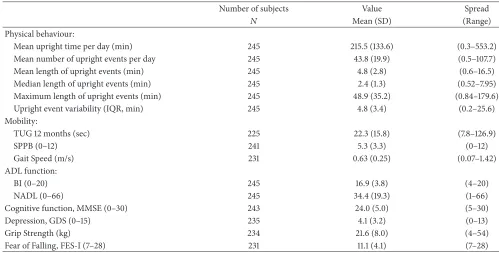
Table 1: Sample characteristics 12 months after hip fracture surgery.
Number of subjects Value Spread
𝑁 Mean (SD) (Range)
Physical behaviour:
Mean upright time per day (min) 245 215.5 (133.6) (0.3–553.2)
Mean number of upright events per day 245 43.8 (19.9) (0.5–107.7)
Mean length of upright events (min) 245 4.8 (2.8) (0.6–16.5)
Median length of upright events (min) 245 2.4 (1.3) (0.52–7.95)
Maximum length of upright events (min) 245 48.9 (35.2) (0.84–179.6)
Upright event variability (IQR, min) 245 4.8 (3.4) (0.2–25.6)
Mobility:
TUG 12 months (sec) 225 22.3 (15.8) (7.8–126.9)
SPPB (0–12) 241 5.3 (3.3) (0–12)
Gait Speed (m/s) 231 0.63 (0.25) (0.07–1.42)
ADL function:
BI (0–20) 245 16.9 (3.8) (4–20)
NADL (0–66) 245 34.4 (19.3) (1–66)
Cognitive function, MMSE (0–30) 243 24.0 (5.0) (5–30)
Depression, GDS (0–15) 235 4.1 (3.2) (0–13)
Grip Strength (kg) 234 21.6 (8.0) (4–54)
Fear of Falling, FES-I (7–28) 231 11.1 (4.1) (7–28)
∗Mean upright time per day (min): total minutes of all upright events/number of recording days; mean number of upright events per day: average number of
upright events per day; mean length of upright events: average length in minutes based on all upright events during the recording period; maximum length of upright events: maximum length in minutes for the longest upright event during the recording period; median length of upright events: median length in minutes based on all upright events during the recording period; upright event variability: the interquartile range (IQR) of upright events lengths in minutes during the recording period; TUG: Timed Up-and-Go; SPPB: Short Physical Performance Battery; Gait Speed: based on the 4-meter gait test from SPPB; BI: Barthel Index; NADL: Nottingham Extended Activities of Daily Living scale; MMSE: Mini Mental State Examination; GDS: geriatric depression scale; Grip Strength: measured by the JAMAR dynamometer in kg; FES-I: the 7-item Fall Efficacy Scale International FES-I.
(62.4%). Their prefracture BADL score was 18.6 (SD 2.2) and NADL score was 45.7 (SD 16.9). Detailed information about participants’ physical behaviour and characteristics 12 months after surgery are presented in Table 1.
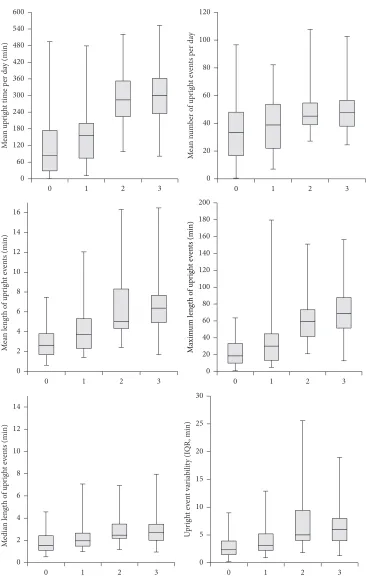
The results for the six measures of physical behaviour for the four subgroups based on level of self-reported outdoor mobility are shown in Figure 1. Scores on the outdoor mobility scale and outcome measures of physical behaviour showed positive correlation: mean upright time (𝑟 = 0.61, 𝑝 < 0.001), number of upright events (𝑟 = 0.36,𝑝 < 0.001), mean length of upright events (𝑟 = 0.58,𝑝 < 0.001), median length of upright events (𝑟 = 0.37, 𝑝 < 0.001), maximum length of upright events (𝑟 = 0.67,𝑝 < 0.001), and upright event variability (𝑟 = 0.52,𝑝 < 0.001).
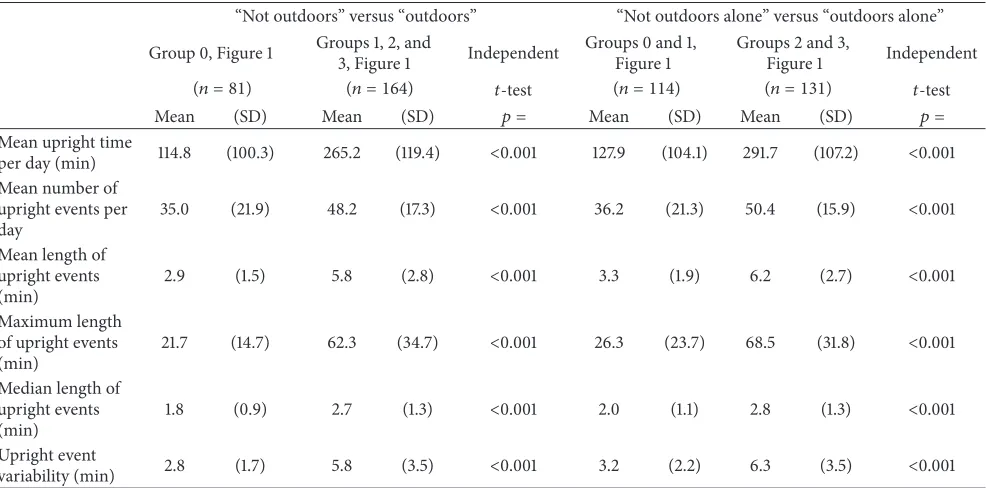
Furthermore, the six measures of physical behaviour were all significantly different between groups regardless of the classification used, “outdoors” versus “not outdoors” and “outdoors alone” versus “not outdoors alone” (𝑝 < 0.001); for details see Table 2(a). Figure 2 shows the distribution of the length of upright events in the total sample and in the “outdoors” versus “not outdoors” and the “outdoors alone” versus “not outdoors alone.”
Cut-off points of outdoors mobility for mean upright time per day, mean number of upright events per day, mean length of upright events, median length of upright events, maximum length of upright events, and upright event variability are reported in Table 2(b). Maximum length of
upright events provided the best cut-off points for both “outdoors” and “outdoors alone” (AUC = 0.87 and 0.89, resp.). If the maximum length of upright events was above 31 minutes it was more likely that subjects reported that they walked outdoors, with a sensitivity of 80.5% and specificity of 70.4%. For those with independence in outdoor walking, levels above 41 minutes for maximum length of upright events showed a sensitivity of 80.2% and specificity of 83.3%. Good classification accuracy was also shown for mean upright time per day, mean length of upright events, and upright event variability, with sensitivity of>0.80 and specificity of>0.60 for correct classification of outdoor mobility. Number of upright events per day and median length of upright events showed fair classification accuracy (AUC>0.70, 95% CI from 0.62).
4. Discussion
This study investigated the relation between self-reported outdoor mobility and monitored physical behaviour in older people one year after hip fracture in order to see how well physical activity monitoring can be used to estimate outdoor walking.
4 BioMed Research International
0 1 2 3 0 1 2 3
0 60 120 180 240 300 360 420 480 540 600 M ea n u p rig h
t time p
er da y (min) 0 20 40 60 80 100 120 M ea n n u m b er o f u p rig h t e ven ts p er da y
0 1 2 3 0 1 2 3
0 2 4 6 8 10 12 14 M edia n len gt h o f u p rig h t e ven ts (min) 0 5 10 15 20 25 30 U p ri gh t e ven t va ri ab il it y (I Q R , min)
0 1 2 3 0 1 2 3
[image:5.600.116.482.83.660.2]0 2 4 6 8 10 12 14 16 M ea n len gt h o f u p rig h t e ven ts (min) 0 20 40 60 80 100 120 140 160 180 200 M axim um len gt h o f u p rig h t e ven ts (min)
Table 2: (a) Group differences in physical behavior. (b) Results of receiver operating characteristic curve between measures of physical behaviour and reports on outdoor mobility (𝑛 = 245).
(a)
“Not outdoors” versus “outdoors” “Not outdoors alone” versus “outdoors alone”
Group 0, Figure 1 Groups 1, 2, and3, Figure 1 Independent Groups 0 and 1,Figure 1 Groups 2 and 3,Figure 1 Independent
(𝑛 = 81) (𝑛 = 164) 𝑡-test (𝑛 = 114) (𝑛 = 131) 𝑡-test
Mean (SD) Mean (SD) 𝑝 = Mean (SD) Mean (SD) 𝑝 =
Mean upright time
per day (min) 114.8 (100.3) 265.2 (119.4) <0.001 127.9 (104.1) 291.7 (107.2) <0.001
Mean number of upright events per day
35.0 (21.9) 48.2 (17.3) <0.001 36.2 (21.3) 50.4 (15.9) <0.001
Mean length of upright events (min)
2.9 (1.5) 5.8 (2.8) <0.001 3.3 (1.9) 6.2 (2.7) <0.001
Maximum length of upright events (min)
21.7 (14.7) 62.3 (34.7) <0.001 26.3 (23.7) 68.5 (31.8) <0.001
Median length of upright events (min)
1.8 (0.9) 2.7 (1.3) <0.001 2.0 (1.1) 2.8 (1.3) <0.001
Upright event
variability (min) 2.8 (1.7) 5.8 (3.5) <0.001 3.2 (2.2) 6.3 (3.5) <0.001
∗The NADL question used was if the participants had been walking outdoors the past 14 days. “Not outdoors”: participants who had not walked outdoors;
“outdoors”: participants who had walked outdoors either alone, alone with difficulty, or with assistance; “not outdoors alone”: participants who had not walked outdoors or walked outdoors with assistance; “outdoors alone”: participants who reported walking outdoors alone or alone with difficulty. Mean upright time per day (min): total minutes of all upright events/number of recording days; mean number of upright events per day: average number of upright events per day; mean length of upright events: average length in minutes based on all upright events during the recording period; maximum length of upright events: maximum length in minutes for the longest upright event during the recording period; median length of upright events: median length in minutes based on all upright events during the recording period; upright event variability: the interquartile range (IQR) of upright events lengths in minutes during the recording period.
(b)
Measure of PB Outdoor mobility Independent outdoor mobility
AUC 95% CI SENS SPEC CP AUC 95% CI SENS SPEC CP
Mean upright time per day 0.836 0.78–0.89 0.805 0.716 157.7 0.865 0.82–0.91 0.802 0.754 198.9
Mean number of upright events per day 0.697 0.62–0.77 0.805 0.531 34.8 0.707 0.64–0.77 0.802 0.526 36.8
Mean length of upright events 0.834 0.78–0.89 0.811 0.679 3.4 0.838 0.79–0.89 0.802 0.719 4.0
Maximum length of upright events 0.871 0.83–0.91 0.805 0.704 30.8 0.891 0.85–0.93 0.802 0.833 41.2 Median length of upright events 0.732 0.66–0.80 0.805 0.519 1.7 0.719 0.66–0.78 0.802 0.535 1.8
Upright event variability 0.804 0.75–0.86 0.805 0.605 3.2 0.810 0.76–0.86 0.802 0.640 3.5
∗AUC: area under receiver operating characteristic curve; CP: cut-off point for predictors above which subject is more likely to report that they are outdoor
walking;𝑛: sample; SENS: sensitivity; SPEC: specificity; PB: physical behaviour; mean upright time per day: total minutes of all upright events/number of recording days; mean number of upright events per day: average number of upright events per day; mean length of upright events: average length in minutes based on all upright events during the recording period; maximum length of upright events: maximum length in minutes for the longest upright event during the recording period; median length of upright events: median length in minutes based on all upright events during the recording period; upright event variability: the interquartile range (IQR) of upright events lengths in minutes during the recording period.
upright per day, and only half of them reporting that they had been outdoors alone (53%) one year following the hip fracture. On average participants’ longest upright event was almost 50 minutes. However, the mean length of upright events was just below five minutes with a variability of almost 5 minutes. For this relatively inactive sample the ability to walk outdoors would represent an important function in their daily life of great importance for independence in activities of daily living.
[image:6.600.56.549.117.361.2]6 BioMed Research International
Upright time distribution after 12 months
Outdoors Not outdoors Average 0
10 20 30 40 50 60 70 80 90 100
20 40 60 80 100 120 140 160 180
0
Duration of events (min)
U
p
ri
gh
t time (
%
)
(a)
Upright time distribution after 12 months
Outdoors Not outdoors alone Average
20 40 60 80 100 120 140 160 180
0
Duration of events (min) 0
10 20 30 40 50 60 70 80 90 100
U
p
ri
gh
t time (
%
)
[image:7.600.63.536.70.319.2](b)
Figure 2: Plot of distributions of time according to lengths of upright event, where outdoors versus not outdoors (a) and outdoors alone versus not outdoors alone (b) are shown. The distribution for the average participant is shown in both figures (black dots in the middle). The percentage of upright time (𝑦-axis) by lengths of upright events from shortest to longest (𝑥-axis) shows that more of the total upright time was spent in longer upright events for the outdoors/outdoors alone versus not outdoors/not outdoors alone.
length of an upright event might be more closely related to outdoor walking episodes as compared to the other measures of physical behaviour included in this study.
Walking time was not included as a separate outcome in this study, because the monitor’s ability to detect steps for older persons walking at very slow gait speeds has been shown to be inaccurate [18]. We therefore used upright time, includ-ing both standinclud-ing and walkinclud-ing. Upright time is a commonly used measure of physical behaviour reported in studies of older persons [3, 20], and results from this study showed that this outcome was a good discriminant of self-reported out-door mobility in this population. Walking related outcomes from activity monitoring could possibly be even more rele-vant measures, especially when outdoor walking is of interest. This study has several limitations. First, we did not consider use of walking aids in the analyses. The single question from NADL only included three answers for those walking outdoors, distinguishing walking alone from walking with difficulty from walking with assistance [10]. In groups 2 and 3 (Figure 1), it would have been interesting to identify those using walking aids, knowing that walking aids could be marker for impairment in older persons who report no difficulty when walking [21]. We also only used six measures of physical behaviour all related to upright periods and therefore consider this paper as an initial first step. Furthermore, we assessed outdoor walking as self-report, which may be affected with recall bias when assessed over a period of 14 days in this old and relatively frail population.
Further work should look into the different measures of physical behaviour and how levels and patterns of these measures are associated with physical function. This will
allow clinicians to quantify patterns of physical behaviour important for prevention of functional decline in older populations.
This study confirmed that self-reported outdoor mobility and monitored physical behaviour are related. This study is however the first step in demonstrating that activity monitoring can be used to indicate if a person walks outdoors or not. Based on the data we cannot detect the exact periods of outdoor activity and cannot thus quantify the amount and pattern of the outdoor activity.
Activity monitoring provides information that is valuable because it is different from what can be obtained using assessment of physical function by self-report. Future studies should explore measures of physical behaviour more in detail, especially related to amount or level of activity needed to maintain outdoor mobility in older age.
5. Conclusion
related to outdoor mobility that may be useful for clinicians aiming at maintaining outdoor mobility in older people.
Conflict of Interests
Malcolm H. Granat is a coinventor of the activPAL physical activity monitor and a Director of PAL Technologies Ltd.
Authors’ Contribution
Kristin Taraldsen, Malcolm H. Granat, and Jorunn L. Hel-bostad were responsible for the design, interpretation of results, writing the paper, and approving of the final paper.
Acknowledgments
This work was supported by the Norwegian Women’s Health Association and the Norwegian Extra Foundation for Health and Rehabilitation through the EXTRA funds, the Norwegian Fund for Postgraduate Training in Physiotherapy, and the Liaison Committee between the Central Norway Regional Health Authority (RHA) and the Norwegian University of Science and Technology (NTNU).
References
[1] P. S. Baker, E. V. Bodner, and R. M. Allman, “Measuring life-space mobility in community-dwelling older adults,”Journal of
the American Geriatrics Society, vol. 51, no. 11, pp. 1610–1614,
2003.
[2] B. Resnick, E. Galik, M. Boltz et al., “Physical activity in the post-hip-fracture period,”Journal of Aging and Physical Activity, vol. 19, no. 4, pp. 373–387, 2011.
[3] K. Taraldsen, O. Sletvold, P. Thingstad et al., “Physical behavior and function early after hip fracture surgery in patients receiv-ing comprehensive geriatric care or orthopedic care—a ran-domized controlled trial,”Journals of Gerontology A Biological
Sciences and Medical Sciences, vol. 69, no. 3, pp. 338–345, 2014.
[4] M. Bertram, R. Norman, L. Kemp, and T. Vos, “Review of the long-term disability associated with hip fractures,”Injury
Prevention, vol. 17, no. 6, pp. 365–370, 2011.
[5] J. A. Pasco, K. M. Sanders, F. M. Hoekstra, M. J. Henry, G. C. Nicholson, and M. A. Kotowicz, “The human cost of fracture,”
Osteoporosis International, vol. 16, no. 12, pp. 2046–2052, 2005.
[6] M. A. Fiatarone Singh, N. A. Singh, R. D. Hansen et al., “Methodology and baseline characteristics for the sarcopenia and hip fracture study: a 5-year prospective study,”Journals of
Gerontology A Biological Sciences and Medical Sciences, vol. 64,
no. 5, pp. 568–574, 2009.
[7] O. Sletvold, J. L. Helbostad, P. Thingstad et al., “Effect of in-hospital comprehensive geriatric assessment (CGA) in older people with hip fracture. The protocol of the Trondheim Hip Fracture Trial,”BMC Geriatrics, vol. 11, article 18, 2011. [8] I. Saltvedt, A. Prestmo, E. Einarsen, L. G. Johnsen, J. L.
Hel-bostad, and O. Sletvold, “Development and delivery of patient treatment in the Trondheim Hip Fracture Trial. A new geriatric in-hospital pathway for elderly patients with hip fracture,”BMC
Research Notes, vol. 5, no. 1, article 355, 2012.
[9] A. Prestmo, G. Hagen, O. Sletvold et al., “Comprehensive geriatric care for patients with hip fractures: a prospective,
randomised, controlled trial,”The Lancet, vol. 385, no. 9978, pp. 1623–1633, 2015.
[10] J. R. F. Gladman, N. B. Lincoln, and S. A. Adams, “Use of the extended ADL scale with stroke patients,”Age and Ageing, vol. 22, no. 6, pp. 419–424, 1993.
[11] F. I. Mahoney and D. W. Barthel, “Functional evaluation: the barthel index,”Maryland State Medical Journal, vol. 14, pp. 61– 65, 1965.
[12] M. F. Folstein, S. E. Folstein, and P. R. McHugh, “‘Mini-mental state’. A practical method for grading the cognitive state of patients for the clinician,”Journal of Psychiatric Research, vol. 12, no. 3, pp. 189–198, 1975.
[13] D. Podsiadlo and S. Richardson, “The timed ‘Up & Go’: a test of basic functional mobility for frail elderly persons,”Journal of
the American Geriatrics Society, vol. 39, no. 2, pp. 142–148, 1991.
[14] J. M. Guralnik, E. M. Simonsick, L. Ferrucci et al., “A short physical performance battery assessing lower extremity func-tion: association with self-reported disability and prediction of mortality and nursing home admission,” The Journals of
Gerontology, vol. 49, no. 2, pp. M85–M94, 1994.
[15] S. Morghen, G. Bellelli, S. Manuele, F. Guerini, G. B. Frisoni, and M. Trabucchi, “Moderate to severe depressive symptoms and rehabilitation outcome in older adults with hip fracture,”
International Journal of Geriatric Psychiatry, vol. 26, no. 11, pp.
1136–1143, 2011.
[16] G. I. J. M. Kempen, L. Yardley, J. C. M. van Haastregt et al., “The short FES-I: a shortened version of the falls efficacy scale-international to assess fear of falling,”Age and Ageing, vol. 37, no. 1, pp. 45–50, 2008.
[17] P. M. Grant, C. G. Ryan, W. W. Tigbe, and M. H. Granat, “The validation of a novel activity monitor in the measurement of posture and motion during everyday activities,”British Journal
of Sports Medicine, vol. 40, no. 12, pp. 992–997, 2006.
[18] K. Taraldsen, T. Askim, O. Sletvold et al., “Evaluation of a body-worn sensor system to measure physical activity in older people with impaired function,”Physical Therapy, vol. 91, no. 2, pp. 277– 285, 2011.
[19] C. E. Metz, “Basic principles of ROC analysis,”Seminars in
Nuclear Medicine, vol. 8, no. 4, pp. 283–298, 1978.
[20] P. M. Grant, M. H. Granat, M. K. Thow, and W. M. Maclaren, “Analyzing free-living physical activity of older adults in differ-ent environmdiffer-ents using body-worn activity monitors,”Journal
of Aging and Physical Activity, vol. 18, no. 2, pp. 171–184, 2010.
[21] Z. M. Pine, B. Gurland, and M.-M. Chren, “Use of a cane for ambulation: marker and mitigator of impairment in older peo-ple who report no difficulty walking,”Journal of the American
Submit your manuscripts at
http://www.hindawi.com
Stem Cells
International
Hindawi Publishing Corporationhttp://www.hindawi.com Volume 2014
Hindawi Publishing Corporation
http://www.hindawi.com Volume 2014
MEDIATORS
INFLAMMATIONofHindawi Publishing Corporation
http://www.hindawi.com Volume 2014
Behavioural
Neurology
Endocrinology
International Journal of Hindawi Publishing Corporationhttp://www.hindawi.com Volume 2014
Hindawi Publishing Corporation
http://www.hindawi.com Volume 2014
Disease Markers
Hindawi Publishing Corporation
http://www.hindawi.com Volume 2014
BioMed
Research International
Oncology
Journal of Hindawi Publishing Corporationhttp://www.hindawi.com Volume 2014
Hindawi Publishing Corporation
http://www.hindawi.com Volume 2014
Oxidative Medicine and Cellular Longevity
Hindawi Publishing Corporation
http://www.hindawi.com Volume 2014
PPAR Research
The Scientific
World Journal
Hindawi Publishing Corporationhttp://www.hindawi.com Volume 2014
Immunology Research
Hindawi Publishing Corporation
http://www.hindawi.com Volume 2014
Journal of
Obesity
Journal ofHindawi Publishing Corporation
http://www.hindawi.com Volume 2014
Hindawi Publishing Corporation
http://www.hindawi.com Volume 2014
Computational and Mathematical Methods in Medicine
Ophthalmology
Journal ofHindawi Publishing Corporation
http://www.hindawi.com Volume 2014
Diabetes Research
Journal ofHindawi Publishing Corporation
http://www.hindawi.com Volume 2014
Hindawi Publishing Corporation
http://www.hindawi.com Volume 2014
Research and Treatment
AIDS
Hindawi Publishing Corporation
http://www.hindawi.com Volume 2014
Gastroenterology Research and Practice
Hindawi Publishing Corporation
http://www.hindawi.com Volume 2014
Parkinson’s
Disease
Evidence-Based Complementary and Alternative Medicine
Volume 2014 Hindawi Publishing Corporation