International Journal of Emerging Technology and Advanced Engineering
Website: www.ijetae.com (ISSN 2250-2459, ISO 9001:2008 Certified Journal, Volume 7, Issue 12, December 2017)
105
Phase and Resource Scheduling in MapReduce
Snehal S. Kapade
1, Prof. J. V. Shinde
21PG Student, 2Asst. Professor, Affiliated to Late G.N. Sapkal College of Engineering, Savitribai Phule, Pune University, Nasik,
Maharashtra, India
Abstract—MapReduce is a framework using which we can write applications to process huge amounts of data, in parallel, on large clusters of commodity hardware in a reliable manner. MapReduce is a model for the data intensive computation. However, despite recent efforts towards designing efficient scheduler to perform MapReduce, the available solutions focus on scheduling at the task-level offers suboptimal performance in executing jobs. This is because tasks can have highly varying resource requirements during their lifetime, which makes it difficult for schedulers to effectively utilize the available resources to reduce job execution time. PRISM-a fine grained phase and resource aware scheduler was introduced which mainly focuses on designing task level scheduler. The phase-based resource aware scheduler offers high resource utilization and provides improvement in job running time. But in multiresource system if fails to improve both fairness and the performance at the same time. In my proposed system, I have used the preemption to overcome the limitation of PRISM and improve the fairness in each of the job at the time of scheduling. In this the resource will able to use getting fair chance to each of the job. Thus, instead to just finding utility function using performance and fairness we are improving the fairness of each job in every phase.
Keywords— Scheduling, resource allocation, execution time.
I. INTRODUCTION
In recent years, the industry and research community have witnessed an extraordinary growth in research and development of data analytic technologies. Pivotal to this phenomenon is the adoption of the MapReduce programming paradigm and its open-source implementation Hadoop. Pioneer implementations of MapReduce have been designed to provide overall system goals (e.g., job throughput). Thus, support for user-specified goals and resource utilization management have been left as secondary considerations at best. We believe that both capabilities are crucial for the further development and adoption of large-scale data processing. On one hand, more users wish for ad-hoc processing in order to perform short-term tasks. Therefore, providing consistency between price and the quality of service obtained is key to the business model. The main objective is to speed and capabilities of electronic computers.
International Journal of Emerging Technology and Advanced Engineering
Website: www.ijetae.com (ISSN 2250-2459, ISO 9001:2008 Certified Journal, Volume 7, Issue 12, December 2017)
106
‗Slots‘ are bound to a particular type of task, either reduces or map and one task of the appropriate type are executed in each slot. The main drawback of this approach is that slots are fungible across jobs: a task (of the appropriate type) can execute in any slot, regardless of the job of which that task forms a part. This loose coupling between scheduling and resource management limits the opportunity to efficiently control the utilization of resources in the system. Providing support for user-specified ‗goals‘ in MapReduce clusters is also challenging, due to high variability induced by the presence of outlier tasks (tasks that take much longer than other tasks). Solutions to mitigate the detrimental impact of such outliers typically rely on scheduling techniques such as speculative scheduling, and killing and restarting of tasks. These approaches, however, may result in wasted resources and reduced throughput. More importantly, all existing techniques are based on the typed-slot model and therefore suffer from the aforementioned limitations. MapReduce is a well-known programming framework used to process the ever-growing amount of data collected by modern instruments, such as Large Hadron Collider and next-generation gene sequencers. Although MapReduce has been widely adopted in a number of data centers, more improvements are still needed to meet the huge demands of big data computing. In the current MapReduce framework, each job consists of three dependent phases: map, shuffle, and reduce. The map and reduce phases typically deal with a large amount of data computations, while the shuffle phase handles the data transfer among different MapReduce workers. In terms of the resource demand, the map and reduce phases are CPU-intensive, while the shuffle phase is I/O-intensive. PRISM, a fine-grained resource-aware MapReduce scheduler in PRISM divides the tasks into phases, where each of the phases has a constant resource usage profile, and performs scheduling at the phase level. The importance of the Phase-level scheduling is demonstrated by showing the resource usage variability within the lifetime of a task using a wide range of MapReduce jobs. The phase-level scheduling algorithm improves execution time and resource utilization without introducing any stragglers with the help of preemption. The main objective of the phase-level scheduling along with the preemption is to improve the fairness and the performance between the jobs during each of the phase. PIRSM uses the phase scheduling algorithm in which it works on finding the utility function. But scheduling on this basis faces problem in multisource scenario.In our proposed system we have introduced preemption which improves the fairness which in results improve the performance of the jobs at running time. Thus, the average job running time will be improved when compared with the phase-based scheduling algorithm.
II. RELATED WORK
It shows existing system and the work done in Mapreduce. The original MapReduce work is to schedule the task in different levels.
A. Existing Work
In a MapReduce technique, it is a collection of jobs and can be scheduled concurrently on multiple machines, resulting in reduction in job running time. Many companies such as Google, Facebook, and Yahoo, they refer MapReduce to process large volume of data. But they refer at task level to perform these data. At the task level, performance and effectiveness become critical to day-today life. Initially the task level performs two phases one is mapper phase and other is reducer phase. In mapper phase, it takes data blocks Hadoop distributed file system and it maps, merge the data and stored in the multiple files. Then the second, reducer phase will fetch data from mapper output and shuffle, sort the data in a serialized manner.
B. Previous Papers
International Journal of Emerging Technology and Advanced Engineering
Website: www.ijetae.com (ISSN 2250-2459, ISO 9001:2008 Certified Journal, Volume 7, Issue 12, December 2017)
107
In [6] new abstraction that allows us to express the simple computations where given which tries to perform but hides the messy details of parallelization, fault tolerance, data distribution and load balancing in a library was introduced. Still the operation is applicable at task level only that can be further divided into phases and the further parallelization in phases can cause the overhead problem. Than the PIRSM was introduced which the importance of phase-level. In a phase-level, phase-level scheduling algorithm which improves execution parallelism and performance of task. Phase and Resource Information Aware Scheduler for MapReduce at the phase-level refers at the phase-level divides the task into further phases like map, merge, sort, shuffle and reduce to improve resource utilization and performance.III. PROPOSED SYSTEM
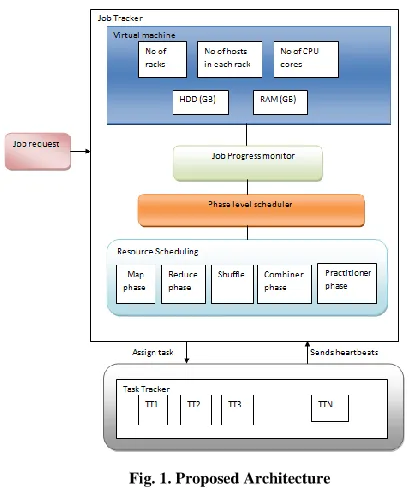
[image:3.612.329.536.138.383.2]This is our complete experimental setup; Job progress monitor is the web GUI where the statistics of all the nodes are displays. It contains one container at one slave and all resources are virtually allocated in that container. This container will hold all the resources for each and every phase. When map phase starts it will hold resources for map phase than for shuffle, reduce etc. It will then discuss with master and allow more if requires for the task to execute. When you start something then map phase starts first follows by reduce and all phases. Task tracker actually performs all the phases that are slaves. We can have multiple task tracker. In our case we have 2 slave nodes so 2 task trackers. Job request is sent by the client and here master is acting as the client.
Fig. 1. Proposed Architecture
International Journal of Emerging Technology and Advanced Engineering
Website: www.ijetae.com (ISSN 2250-2459, ISO 9001:2008 Certified Journal, Volume 7, Issue 12, December 2017)
108
If there is the job to be schedule from longer time, in PRISM it will wait for long time until it gets the utility function to get schedule but preemption will find the time interval between the jobs and will give fair chance to schedule this big job. Preemption is done on the basis of size of the job. If the job is tiny it assigns it with final value i.e. Sf, if not tiny than it assigns it with initial value. All the jobs with initial value are kept in virtual cluster given virtual size Si. When the training stage of these virtual cluster if over it is again assign with final value Sf. Job virtual size is set as final value and is being scheduled until virtual size becomes zero. Finally, the job is removed and the report is submitted to the job tracker. This helps in improving the fairness of each job in each of the phases and in result improves the performance of each job in the phase. In the previous phase level scheduling every time the task to be scheduled the node manager sends the heartbeat to the resource manager and task was scheduled, but improving performance and the fairness was the bottleneck in multiresource system. In order to improve the fairness of the jobs in multi resource system it is necessary to use resource in efficient manner. Preemption helps in improving the fairness of each job in every phase in scheduling. Preemption gives the fair chance to each of the job in the each of the scheduling phase. Preemption helps to schedule the job is not being scheduled for a long time.IV. SYSTEM ANALYSIS
This section describes in detail the design and working of Phase-base scheduling algorithm with virtual space.
A. Algorithm Description
Following are the steps for phase base scheduling algorithm
a)User uploads the File to the system b)Proposed scheduler starts.
c)Virtual Completion Time is calculated for every job that how much processing time it will take to get executed.
d)Shortest Remaining Processing Time is calculated that how much processing time is remaining to get the job finished.
e)Job with least remaining processing time is first executed with Data Locality which improves performance and execution time
f) Preemption calculate if any job is not getting scheduled for long time.
g)Increase the priority of such jobs and schedule them for processing.
h)Send heart beat and report to Job Tracker.
In the scheduling algorithm node manager is responsible for reporting the resource availability on the node and it must select the next phase to should be scheduled on the node. There are J number of jobs, specifically j ∈ J and consists of two tasks called Map M and Reduce R. Resource r(t) ∈ {M,R}. The utility function is
U (i, n) = U fairness(i, n) + α . Uper f(i, n)
The fairness of each phase is calculated as:
U fairness(i,n) = U bfairness(i,n) – Uafairness(i,n)
Ufairness and Uperf represent the utilities for improving fairness and job performance, respectively, and a is an adjustable weight factor. If we set a close to zero, then the algorithm would greedily schedule phases according to the improvement in fairness.
V. EXPERIMENTS
International Journal of Emerging Technology and Advanced Engineering
Website: www.ijetae.com (ISSN 2250-2459, ISO 9001:2008 Certified Journal, Volume 7, Issue 12, December 2017)
[image:5.612.66.273.410.704.2]109
TABLE IRESULT ANALYSIS
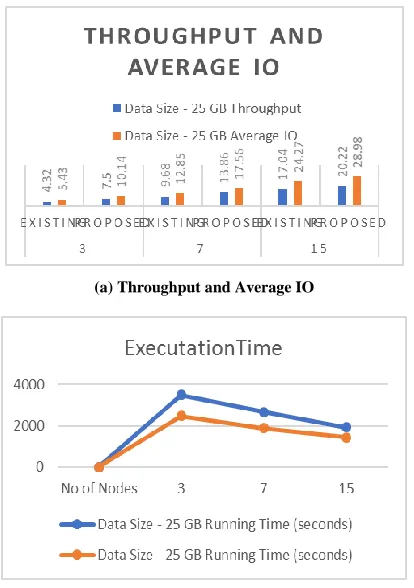
To provide accurate evaluate again we tested the performance on fully distributed mode on 7 and 15 nodes Hadoop.
(a) Throughput and Average IO
(b) Execution time
(c) Memory utilization
(d) CPU time
VI. CONCLUSION
MapReduce is programming model for cluster to perform a data-intensive computing. In this work we mainly demonstrate that, the scheduler allocates the resources dynamically at the run time and schedule the jobs on basis of the utility function. The use of preemption allows fair chance to each of the job to be scheduled which results in better outcomes compare to PRISM. PRISM demonstrates that, how run-time resources can be used and also how it varies over the long-life time. Thus, our system improves job execution time and performance of resources improving both fairness and performance simultaneously in multiresource system.
REFERENCES
[1] Qi Zhang, Mohamed Faten Zhani, Yuke Yang, Raouf Boutabai, and Bernard Wong, ‖PRISM: Fine-Grained resource Aware Scheduling for MapReduce,‖ in IEEE Transactions on Cloud Computing, Vol. 3, no.
[2] Clustering on Big Data Using Hadoop MapReduce,International Conference on Computational Intelligence and Communication Networks,2015
[3] H. Herodotou, H. Lim, G. Luo, N. Borisov, L. Dong, F. Cetin, and S. Babu, Starfish: A self-tuning system for big data analytics, in Proc. Conf. Innovative Data Syst. Res., 2011, pp. 261272.
International Journal of Emerging Technology and Advanced Engineering
Website: www.ijetae.com (ISSN 2250-2459, ISO 9001:2008 Certified Journal, Volume 7, Issue 12, December 2017)
110
[5] J. Polo, C. Castillo, D. Carrera, Y. Becerra, I. Whalley, M. Steinder,J. Torres, and E. Ayguade, Resource-aware adaptive scheduling for MapReduce clusters, in Proc. ACM/IFIP/USENIX Int. Conf.Middleware, 2011, pp. 187207
[6] J. Dean and S. Ghemawat, Mapreduce: Simpli_ed data processing on large clusters, Commun. ACM, vol. 51, no. 1, pp. 107113, 2008. [7] A. Verma, L. Cherkasova, and R. H. Campbell, Resource
provisioning framework for mapreduce jobs with performance goals, in ACM/USENIX Middleware 2011, pp. 165186.
[8] Hadoop Distributed File System [Online]. Available: hadoop.apache.org/docs/hdfs/current/, 2015
[9] R. Boutaba, L. Cheng, and Q. Zhang, On cloud computational models and the heterogeneity challenge, J. Internet Serv. Appl.,vol. 3, no. 1, pp. 110, 2012.
[10] T. Condie, N. Conway, P. Alvaro, J. Hellerstein, K. Elmeleegy, and R. Sears, "MapReduce online," in Proc. USENIX Symp. Netw. Syst. Des. Implementation, 2010, p.21.
[11] Savitri D.H, Narayana H.M, "PRISM: Allocation of Resources in Phase-level using MapReduce in Hadoop," in International Journal of Research in Science and Engineering Vol. 1, Special Issue: 2. [12] The Next Generation of Apache Hadoop MapReduce[Online].