production management system with web
services
Dave, B, Boddy, SC and Koskela, LJ
Title Improving information flow within the production management system with web services
Authors Dave, B, Boddy, SC and Koskela, LJ
Type Conference or Workshop Item
URL This version is available at: http://usir.salford.ac.uk/9581/
Published Date 2010
USIR is a digital collection of the research output of the University of Salford. Where copyright permits, full text material held in the repository is made freely available online and can be read, downloaded and copied for noncommercial private study or research purposes. Please check the manuscript for any further copyright restrictions.
IMPROVING INFORMATION FLOW WITHIN
THE PRODUCTION MANAGEMENT SYSTEM
WITH WEB SERVICES
Bhargav Dave1, Stefan Boddy2, Lauri Koskela3
ABSTRACT:
The efficiency of the production planning and control process in construction depends significantly on the reliability and timely availability of resource information. The Last Planner system for production control mandates that a construction task should not be started unless all the seven resource prerequisites are in satisfactory condition. Failure to do so results in wasteful processes. However, this information is not readily available due to the lack of systems integration that prevails within the industry. Current implementations of the last planner system mostly rely on the team leaders‘ and foreman‘s ability to gather the required information for the weekly planning meetings and also for the look-ahead planning. However, much time is wasted chasing relevant information due to the above-mentioned problems. Also, the reliability of planning could be much improved if there is a system available, which aggregates resource information from various project stakeholders in one place.
In such a situation, web services could provide an ideal platform for integration as they provide a flexible way to integrate disparate systems, with choreography based on identified business processes drawn from Last Planner and implemented using BPMN/BPEL. With the improvement in connectivity as a result of better availability of high speed Internet through mobile and fixed networks, there is a better opportunity for information integration through web services. A conceptual framework based on web services is put forward which aims to improve the information flow within the industry and provide the right information at the right time to enable better planning and control within the production system.
KEY WORDS
Construction process integration, ICT in construction, Construction efficiency
INTRODUCTION
Koskela (2000) has discussed the importance of TFV (Transformation, Flow and Value) in construction. The flow aspect in traditional production management has generally been neglected and this also applied to the flow of information. The flow of information is one that affects all other resource flows significantly.
In the Last Planner process of production planning, the site team needs accurate resource information about the construction tasks in order to effectively conduct
1 Research Fellow, School of the Built Environment, University of Salford; UK. Phone +44 161
2953431; [email protected]
2 Research Fellow, School of the Built Environment, University of Salford; UK. Phone +44 161
2953204; [email protected]
3
Lookahead and weekly planning activities. However, this information often lies in disparate systems, which are not always synchronized and available to the site team. This affects the reliability of the planning process and in turn the overall production management system.
Traditionally, this problem of disintegration has been addressed by explicit, one-to-one connections between stakeholder‘s information systems. This requires significant development work for each connection, and due to the time and costs associated they are seldom created. Most projects have to work with manual processes and traditional methods of communication such as phone calls, faxes and emails to obtain such information. Even though this problem has been discussed extensively over the last two decades, the issue still remains unsolved as the information systems are still disintegrated.
Here, a framework of an information management system is proposed, which is flexible, and dynamic uses web services, one that tries to overcome the problem of integration and improves the flow of information within the production system. A system is under development, which will implement this framework. This system will then be implemented in an industrial setting and results will be analysed and disseminated. The proposed framework and the system are based on the hypotheses that information integration on construction projects can be improved by using web services, especially where last planner system is being implemented.
To begin with, we define the importance of information flow within the production management system in construction and its current state in the industry. Following this, we describe what web services are and their prior use in construction and other industries. Subsequently, the proposed information management system and its implementation in construction is discussed followed by the concluding remarks.
INFORMATION INTEGRATION IN CONSTRUCTION
Researchers have widely discussed the problem of disparate systems within the construction firms which results in islands of information (Hannus, 1996). Various departments across the construction team use their own software system which results in duplication of efforts and less efficient processes. This coupled with fragmented nature of construction supply chain adds to the problem of information integration across the industry (Alshawi and Ingirige, 2003).
PROBLEM OF FRAGMENTATION:
integration of process and information systems takes a significant amount of time and resources. This in turn affects the decision making process and the overall efficiency of the project suffers. Even though this problem has been discussed extensively over the last two decades, the issue still remains unsolved.
According to a 2006 survey carried out by ebusiness-Watch (2006) on ICT adoption level by several industry sectors, construction came low compared to other industry sectors in several categories. Especially to note are the process innovation and supply chain management categories where only 33% and 7% participants indicated the adoption of ICT respectively.
CURRENT STATE OF INFORMATION INTEGRATION:
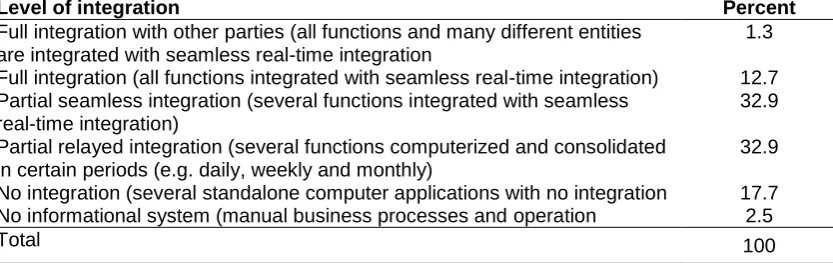
[image:4.595.92.509.572.703.2]The earlier consensus amongst researchers has been that implementing enterprise resource planning (ERP) systems results in a well-integrated system which will reduce duplication of work and increase efficiency in general. This belief has led to a significant proportion of construction companies implementing some form of Enterprise Information System in the last 15 years in the hope of integrating several internal and external functions such as Procurement, Accounting, Human Resources, Asset Management, etc. These are quite large pieces of software, which require a significant amount of resource for implementation and maintenance. It is also believed that a significant amount of business process integration is required during the initial stages to ensure a ―proper fit‖ with the organisational processes where such a software system is being implemented. However, in a study carried out by Tatari et al (2007) in the current state of construction enterprise information systems (CEIS), findings, which are contrary to this belief, are reported. The survey has shown that only 16% of participants were satisfied with their current level of integration from their CEIS implementation. In the table 1 below it can be seen that most construction companies don‘t realise full integration with only 1.3 % claiming full integration across the whole supply chain and only 12.7 claiming full integration internally. Also, out of 101 firms studied, only 4% had actually implemented project management modules, leaving the actual core production processes unchanged. This reinforces the view that the majority of ICT solutions within the construction industry are applied to the peripheral processes, neglecting improvement of the core production processes.
Table 1 Level of functional integration in the construction industry (source: Tatari et al, 2007)
Level of integration Percent
Full integration with other parties (all functions and many different entities are integrated with seamless real-time integration
1.3
Full integration (all functions integrated with seamless real-time integration) 12.7 Partial seamless integration (several functions integrated with seamless
real-time integration)
32.9
Partial relayed integration (several functions computerized and consolidated in certain periods (e.g. daily, weekly and monthly)
32.9
No integration (several standalone computer applications with no integration 17.7
No informational system (manual business processes and operation 2.5
Total 100
benefits. In reality the companies who start with a vision of integrated system where all elements of business processes are streamlined, end up with a patchwork of systems where a large number of software programmes are installed over the years. As a consequence, companies end up spending enormous amounts of money behind their IT investment which in fact take them towards rigidity rather than innovative, efficient and responsive business processes. In a study carried out at MIT (Ross, et.al, 2006) where 400 companies were studied, it was reported that IT departments are seen as cost sinks and liabilities rather than centres for innovation.
It can be concluded from the above discussion that organisations have yet to realise the full potential from their ICT initiatives. Also, from a construction perspective ICT is not yet addressing the core production processes, and full integration between systems is not yet present. The initial view of - more ICT spending brings more benefit has been challenged, and research now shows that ICT implementations must take into account people and process issues and undergo equal amount of scrutiny as other investment opportunities.
WEB SERVICES AND INFORMATION INTEGRATION
WHAT ARE WEB SERVICES:
World Wide Web Consortium Definition: A Web service is a software system designed to support interoperable machine-to-machine interaction over a network. It has an interface described in a machine-processable format (specifically WSDL (Web Services Description Language)). Other systems interact with the Web service in a manner prescribed by its description using SOAP (Simple Object Access Protocol) messages, typically conveyed using HTTP (Hypertext Transfer Protocol) with an XML (Extensible Markup Language) serialization in conjunction with other Web-related standards.
In more simple terms, a web service is any service that is available on the Internet, uses a standardized XML messaging system, and is not tied to a particular programming language or operating system (Cerami, 2002). Web services also have two additional characteristics:
A web service should be self-describing
A web service should be discoverable
Web services represent a move from the ―human centric‖ web to an ―application centric‖ web. Traditionally it has been human beings who initiate the majority of the requests on the web. However with Web Services, applications and agents initiate requests on the fly and seamlessly communicate with each other. The advantage of deployment of web services is that the systems, which had to be explicitly connected with each other in order to communicate, can now be integrated in a more agile manner.
DEVELOPMENT OF WEB SERVICES:
binding to the already ubiquitous hypertext transfer protocol [HTTP]. Since those early days, things have developed both slowly and quickly; slowly in the sense that the heavy weight standards orientated SOAP/WSDL/UDDI version of web services has matured at a relatively lowly pace; quickly in that other alternatives such as REST (Fielding 2000) have developed and in some contexts overtaken the standards-based approach. Simple interoperability however was only the beginning of the vision, which sees its ultimate incarnation in semantic web services (McIlraith & Zeng 2001)(Hendler et al. 2002) where services are discovered and integrated entirely automatically to fulfil some process need. This vision has not yet been realised on a web wide scale due mostly it seems to the general lack of interest in semantic annotation of web resources, though many smaller experimental implementations do exist (Feier et al. 2005)(Domingue et al. 2004). The standards-based approach to semantic web services has been evolving steadily over the last decade to the point now where Web Services Modelling Ontology [WSMO] and Semantic Web Services Ontology [SWSO] are converging under the auspices of the World Wide Web Consortium [W3C] to become their adopted standard for the complete semantic description of web services.
CURRENT STATE OF WEB SERVICES:
Web services in their basic form have matured to the point where most vendor implementations are now interoperable without issue, and they have seen wide deployment within and between organisations. As such the Simple SOAP and WSDL are now well entrenched and understood in corporate IT departments the world over. Web service composition into workflows is supported by a number of platforms and languages, the current leading one being Business Process Execution Language [BPEL] (Barreto et al. 2007) taken to standards level by OASIS. BPEL allows the input and output messages of various services to be mapped onto each other so as to provide a flow of data through those services to meet some broader goal. These mappings typically also correlate with the information flows in a business process, so providing some level of process automation. BPEL incorporates branching and looping instructions for flow control and decision making based on service inputs and outputs and the composed service description itself becomes an executable web service. A graphical notation aimed at the business user, Business Process Modelling Notation [BPMN], has been defined such that non-technical personnel can define business processes which are translated into BPEL descriptions, albeit with some limitations and with output that still requires human intervention to form a complete executable service.
STATUS OF WEB SERVICES IN CONSTRUCTION:
seems to be a general lack of in exploration of this technology to enable a lean production system.
PROPOSED FRAMEWORK FOR INFORMATION INTEGRATION IN A PRODUCTION MANAGEMENT SYSTEM
[image:7.595.111.517.232.512.2]THE INFORMATION MODEL OF THE LAST PLANNER PRODUCTION SYSTEM:
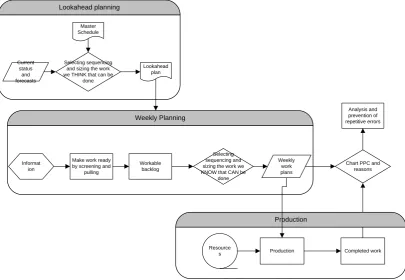
Figure 1 below shows a conceptual diagram for the Last Planner System (Ballard, 2000).
Current status
and forecasts
Master Schedule
Lookahead plan
Informat ion
Make work ready by screening and
pulling Selecting sequencing
and sizing the work we THINK that can be
done
Workable backlog
Selecting sequencing and sizing the work we KNOW that CAN be
done
Weekly work plans
Chart PPC and reasons
Production Resource
s Completed work
Lookahead planning
Weekly Planning
Production
Analysis and prevention of repetitive errors
Figure 1 - Conceptual model of the LPS
INFORMATION ARCHITECTURE OF THE PROPOSED SYSTEM:
to site rather than the ability to electronically reconcile delivery notes against invoices for example.
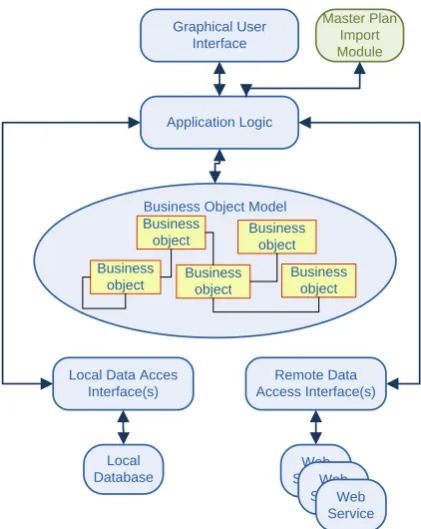
To this end we do not propose to adopt existing heavy-weight electronic business messaging standards for our needs. Rather, we intend to create our own interfaces for the information we need to feed our application, published as web service descriptions to be implemented against provider applications as necessary. The descriptions together will form an API [Application Programming Interface] for the application‘s data needs from third parties. Web services afford the language and platform independence, something of a necessity if the data is to be pulled from an unknown number and variety of sources, which would change from project to project. We can however discover what some of the more popular applications in the sector are such that we can implement the logic behind our web service API to extract the relevant data from those applications thus making it available to our system. These common applications might include Microsoft Project and Primavera for project master planning, Coins and Red Sky ERP software etc. Implementation of these APIs would take the form of lightweight web service wrappers around the various applications, using their integration facilities if they expose them. Figure 2 describes the top-level architecture of the proposed system.
PROPOSAL TO DEVELOP SYSTEM BASED ON THE ABOVE FRAMEWORK
Business Object Model Graphical User
Interface
Local Data Acces Interface(s)
Application Logic
Business object
Remote Data Access Interface(s)
Web ServiceWeb
ServiceWeb Service Local
Database
Business object Business
object Business object Business object Master Plan
[image:9.595.193.404.87.352.2]Import Module
Figure 2 - High Level System Architecture
In the figure 2 we see an architecture employing the Model/View/Controller [MVC] pattern first introduced in the Small Talk language in the late 1970s (Burbeck 1992). The architecture is divided into functional layers as described below.
LOCAL/REMOTE DATA
Here we have the application‘s own database (local data) accessed through an interface defining methods retrieving the objects required by the application. This interface exists to abstract data requirements away from the implementation of those requirements. Currently the application is being implemented using an object database back end, but the access interface allows for its replacement with another data store implementation. The only changes to the application to achieve this should be in its configuration rather than its code. The application will also rely heavily on the
integration of data from third parties via web services. As we have mentioned we plan to achieve this through the definition of interfaces (as WSDL service descriptions) of the data we require. This functionality is represented here by the ‗Remote Data Access Interface‘ element. Web services will be used to retrieve status data from project partners such as projected delivery dates for materials and components, the availability of approved information from the design team etc.
BUSINESS OBJECT MODEL
within the model) when properties of business objects change such that they may respond accordingly. This layer corresponds to the model in the MVC pattern.
APPLICATION LOGIC
The ‗Application Logic‘ layer would represent the controller in the MVC pattern and is responsible for managing requests from the view and translating them into method invocations on the model objects. In our architecture this layer is also responsible for interaction with the data sources, both local and remote, in order to retrieve model objects from persistent storage and to source status data from third parties when the model doesn‘t have it stored locally. This layer defines methods for manipulating the object model which abstract these responsibilities away from user interface classes thereby allowing for the use of a number of different user interface types.
GRAPHICAL USER INTERFACE [GUI]
The GUI layer is that which provides the user‘s view of the system and its current state, that is to say it represents the view in the MVC pattern. The GUI layer also provides controls that allow the user to manipulate the model through the application logic layer and subscribes to events published by the model such that the results of those manipulations are automatically reflected back to the user. The GUI currently under development is a classical forms based GUI designed for initial population of the model and for reverse phase scheduling operations at the start of detailed project planning. It is intended however that another interface should be developed for touch enabled devices to be used in the look-ahead and weekly planning meetings. Our implementation of the MVC pattern makes this possible with little or no alteration to the other layers of the application.
The application architecture also shows a ‗Master Plan Import Module‘, which is a catch-all description for any number of concrete implementations of an interface that allows for the import of master project plan elements from other applications or file formats. We envisage the first implementation to be one that uses Microsoft‘s automation technologies to import plan elements from their Project product. Further implementations could do the same for the raw Project file format or data from other applications such as Primavera.
Arrows in the diagram indicate the general paths of communication between the constituent parts of the application and as can be seen the ‗Application Logic‘ layer is the primary coordinating layer of the system. While this may be the case, the domain ‗intelligence‘ is all contained within the object model layer and as such this is being implemented as an independent library that can be reused in other applications where appropriate.
CONCLUSION
The framework presented in this paper demonstrates the capabilities of a web services based platform, which can bridge this gap. Also, the emergence of Building Information Modelling offers an opportunity to synchronise the process related information (the production system) with the product information, i.e. the building model to present a coherent view of the project.
Further work is under way to test this framework on a construction project to identify the potential benefits and the feasibility of implementing this framework in the industry.
REFERENCES:
Aziz Z, Anumba C, Ruikar D, Carrillo P and Bouchlaghem D (2004) Semantic web based services for intelligent mobile construction collaboration, ITcon Vol. 9, Special Issue Mobile Computing in Construction, pg. 367-379, http://www.itcon.org/2004/26
Ballard (2000). The Last Planner System of Production Control, PhD dissertation, School of Civil Engineering, The University of Birmingham, UK.
Burbeck, S. (1992) Applications Programming in Smalltalk-80: How to use Model-View-Controller (MVC) available at http://www.tbrouard.fr/IMG/pdf/burbeck-mvc.pdf, accessed 20/03/2010
Cerami E. (2002). Web Services Essential. O‘Reilly press.
Charlton B et al., 2007. Web Services Business Process Execution Language Version 2.0 - Primer. Available at: http://docs.oasis-open.org/wsbpel/2.0/Primer/wsbpel-v2.0-Primer.pdf.
Cheng, J. C. P., K. H. Law, et al. "A service oriented framework for construction supply chain integration." Automation in Construction 19(2): 245-260.
Domingue, J. et al., 2004. IRS-III: A platform and infrastructure for creating WSMO-based semantic web services. In Workshop on WSMO Implementations.
Feier, C. et al., 2005. Towards intelligent web services: The web service modeling ontology (WSMO). In International Conference on Intelligent Computing (ICIC). pp. 23–26.
Fielding, R.T., 2000. Architectural styles and the design of network-based software
architectures. Citeseer.
Hannus, M., (1996), Islands of automation in construction. In: Construction on the information highway, Ed. by Žiga Turk, number 198 in CIB publication, page 20. University of Ljubljana
Hendler, J., Berners-Lee, T. & Miller, E., 2002. Integrating Applications on the Semantic Web. Journal of the Institute of Electrical Engineers of Japan, 122(10), 676-680.
http://www.ebusiness-watch.org/statistics/documents/pocketbook-2006.pdf (accessed 22/03/2010)
Ingirige, B. and Aouad, G. (2001) Awareness and usage of information standards in the UK construction industry: A survey by the SIENE network. Proceedings CIB W78-17, South Africa
Koskela, L. (2000), An Exploration Towards a Production Theory and its Application to Construction, PhD Dissertation, VTT Building Technology, Espoo, Finland. 296 p., VTT Publications: 408, ISBN 951-38-5565-1; 951-38-5566-X
industry in the Single European Information Space." Automation in Construction 19(4): 388-397
Lima, C., Stephens, J. & Böhms, M., 2003. The bcXML: supporting eCommerce and knowledge management in the construction industry. Journal of Information
Technology in Construction (ITCon), 8(Special issue - eWork and eBusiness),
293-308.
McIlraith, S.A. & Zeng, T.C., 2001. Semantic web services. IEEE Intelligent Systems, 16(2), 46–53.
Rettig, C. (2007). The Trouble with Enterprise Software. MIT Sloan Management Review. 49 no 1, pp 21-27
Ross, J.W., Weill, P., and Robertson, D.C., (2006) Enterprise Architecture as Strategy: Creating a Foundation for Business Execution (Boston: Harvard Business School Press, 2006)
Tatari, O., Castro-Lacouture, D. and Skibniewski, M. J. (2007). Current state of construction enterprise information systems: survey research. Construction Innovation, 7 (2007) 310-319