International Journal of Emerging Technology and Advanced Engineering
Website: www.ijetae.com
(ISSN 2250-2459, ISO 9001:2008 Certified Journal
, Volume 6, Issue 8, August 2016)
189
Security System in Armed Forces
Savita Kumari1, Sonal Beniwal21
M. Tech Scholar, 2Assistant Professor, Department of Computer Science Engineering and Information Technology, Bhagat Phool Singh MahilaVisvidyalya, KhanpurKalan, Sonipat, India
Abstract-- There are several ways of intercepting the information while communicating. Any intruder can intentionally intercept through any cable, wire, oral, radio or electronic communication and intercept the information. Physical security, intelligent video surveillance system, alarms and their management, artificial intelligence video surveillance system, computer security, door security, information security, logical security are used by Indian armed forces. Security is important for many sensor network applications in remote area like at army station.A particularly harmful attack against sensor and ad hocnetworks on base station of army/airforce/navy, is known as the Sybil attack [6], where a node as base station in defense area illegitimately claims multiple identities. This paper systematically analyzes the threat posed by the Sybil attack towireless sensor networks in army based area. We demonstrate that the attack can be exceedingly detrimental to many important functions of the sensor network such as routing, resource allocation, misbehavior detection, etc. We establish a classification ofdifferent types of the Sybil attack, which enables us to better understand the threats posed by each type, and better design counter measures against each type. We improve the throughput of leach protocol by removing Sybil attack in defense areas. Leach protocol is used by each node of army base to route the packet in network.
Keyword-- WSN, Attack, Sybil Attack, Leach
I. INTRODUCTION
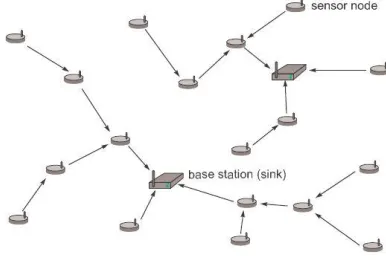
[image:1.612.351.544.215.345.2]Rapid development in technologies realizations of electronic components, and in particular, of microprocessors, make possible to develop equipment with low cost and low power, of size and weights increasingly reduced that is mostly used by armed force in remote area. WSNs are a particular type of ad hoc networks, comprised mainly of large number (hundred or thousand) deployed sensor nodes with limited resources and one or more base stations (BSs) or sink (Figure 1), typically serves as the access point for the user or as a gateway to another network. At army base resources are available in limit so wsn perform very well. Nodes can collect and transmit (with wireless links) environmental data (temperature, pressure, humidity, noise levels, etc) in autonomous manner like at hills, in bays and valleys. The node in WSN plays tow roles: collect data and route data back to the base station.
Figure 1: A network at army base
Sensor networks are a promising new technology to enable economically viable solutions to a variety of applications, for example pollution sensing, structural integrity monitoring, and traffic monitoring. A large subset of sensor network applications requires security, especially if the sensor network protects or monitors critical infrastructures.
Security in sensor networks is complicated by the broadcast nature of the wireless communication and the lack of tamper-resistant hardware (to keep per-node costs low). In addition, sensor nodes have limited storage and computational resources, rendering public key cryptography impractical.
In this research, we investigate the Sybil attack at army base, a particularly harmful attack in sensor networks. In the Sybil attack, a malicious node behaves as if it were a larger number of nodes, for example by impersonating other nodes or simply by claiming false identities. In the worst case, an attacker may generate an arbitrary number of additional node identities, using only one physical device. So a node from attacker side is behaves like a base station of army base.
II. SECURITY GOALS
International Journal of Emerging Technology and Advanced Engineering
Website: www.ijetae.com
(ISSN 2250-2459, ISO 9001:2008 Certified Journal
, Volume 6, Issue 8, August 2016)
190
Availability: the availability gives insurance over the reactivity and time of response of the system to transmit information of one source to the good destination. It also means that the services of network are available to the authorized parts if necessary and ensures the services of network in spite of denies of service attack (DoS).
Integrity: it is a service which guarantees that data are not be modified during the transmission. Integrity protects the network against the injection or the modification of messages. Confidentiality: is the guarantee that the information of a node is not available or revealed only with its recipient.
Freshness: WSNs provide some measurements in time; we must ensure that each message is fresh. The freshness of data implies that the data are recent, and it ensures that no adversary replay the old messages.
Authentication: an adversary is not simply limited to modify the message. He can inject additional messages. Thus the receiver must make sure that the data used come from the correct source. In addition, by constructing WSNs, the authentication is necessary for many tasks.
Access control: gives to the legitimate participants a means to detect the messages coming from external sources (node of enemy base) of the network.
Non-repudiation: ensures that the origin of a message cannot deny having sent the message [7].
III. WINDOWS FIREWALL
A variety of attacks against WSNs is documented in the literature. To face these attacks, various against measurements were proposed. We present in the continuation the principal types of attacks. We assign these attacks to the layers concerned of the OSI model.
A classification of the attacks consists in distinguishing the passive attacks from the active attacks. The passive attack (eavesdropping) is limited to listening and analyses exchanged traffic. This type of attacks is easier to realize (it is enough to have the adequate receiver), and it is difficult to detect. Since, the attacker does not make any modification on exchanged information. The intention of the attacker can be the knowledge of confidential information or the knowledge of the significant nodes in the network (cluster head node), by analyzing routing information, to prepare an active attack.
In the active attacks, an attacker tries to remove or modify the messages transmitted on the network.
He can also inject his own traffic or replay of old messages to disturb the operation of the network or to cause a denial of service. Among the most known active attacks, we can quote:
Tampering: it is the result of physical access to the node by an attacker; the purpose will be to recover cryptographic material like the keys used for ciphering [8].
Black hole: a node falsifies routing information to force the passage of the data by itself, later on; its only mission is then, nothing to transfer, creating a sink or black hole in the network [6].
Selective forwarding: as mentioned above, a node play the role of router, in a selective forwarding attack, malicious nodes may refuse to forward certain messages and simply drop them.
Sybil attack: Newsome et al. [9] definite this attack by: "malevolent device, taking multiple identities in an illegitimate way", attacker can use the identities of the others nodes in order to take part in distributed algorithms such as the election. HELLO flood attack: many routing protocols use "HELLO" packet to discover neighboring nodes and thus to establish a topology of the network. The simplest attack for an attacker consists in sending a flood of such messages to flood the network and to prevent other messages from being exchanged.
Jamming: a well-known attack on wireless communication, it consists in disturbing the radio channel by sending useless information on the frequency band used. This jamming can be temporary, intermittent or permanent [10].
Blackmail attack: a malicious node makes announce that another legitimate node is malicious to eliminate this last from the network. If the malicious node manages to tackle a significant number of nodes, it will be able to disturb the operation of the network.
Exhaustion: is to consume all the resources energy of the victim node, by obliging it to do calculations or to receive or transmit unnecessarily data [11].
Wormhole attack: attackers here are strategically placed at different ends of a network. They can receive messages and replays them in different parts by means of a tunnel [12].
International Journal of Emerging Technology and Advanced Engineering
Website: www.ijetae.com
(ISSN 2250-2459, ISO 9001:2008 Certified Journal
, Volume 6, Issue 8, August 2016)
191
IV. PROBLEM STATEMENTConstraints that make traditional security impractical in network of army base are:
1. Low energy power: The energy of the nodes is limited (limited battery lifetime), and generally irreplaceable and no recharging battery. Protocols of WSNs must concentrate mainly on the conservation of energy.
2. Limited memory and computation capacity: In the majority of WSNs, nodes are not able to memorize keys of significant size, or to carry out complex protocols cryptographic.
3. A node behave as like multiple identity to forge the important data.
Therefore, new security measures are needed to address constraints of WSNs
V. OBJECTIVE
Step1: we use MATLAB software (MATLAB is an abbreviation of MATrixLABoratory. MATLAB is an interactive matrix-based system for scientific and engineering calculations) to simulate a random deployment of 100 sensor nodes in 100m x 100m area.
Step2: we randomly compromise sensor nodes to evaluate the effect of compromised links.
Step3: In Sybil attack, a sensor node use identity of other sensor node.
Step5: We use polynomial encryption for node to secure its private
Step6: Expected results provide by polynomial encryption on a node of network.
VI. IMPLEMENTATION
[image:3.612.335.561.117.267.2]In this section we discuss about the performance of proposed work.
[image:3.612.338.547.301.426.2]Figure 2: Generate approach
Figure 3: Generate Network
[image:3.612.343.546.497.611.2]A network is generated at army base. In this network army post is behave like node of network.
Figure 4: Enter ‘Hello’ message
We try to send a simple message from one army base station to another army base station. That message is „Hello‟. If this message is successful to reach at destination then it is clear that important message be success in reaching.
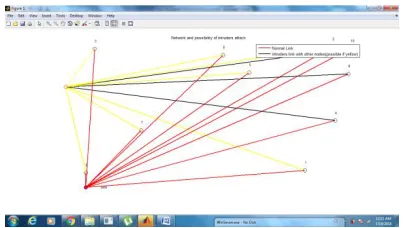
Figure 5: Intruder Link shown by yellow line
[image:3.612.66.272.581.698.2]International Journal of Emerging Technology and Advanced Engineering
Website: www.ijetae.com
(ISSN 2250-2459, ISO 9001:2008 Certified Journal
, Volume 6, Issue 8, August 2016)
[image:4.612.331.559.112.260.2]192
Figure 6: Stolen identity of 8
[image:4.612.60.279.133.269.2]Now we identify the node which is represented by big black spot in snapshot. This identity is 8 by number.
Figure 7: Enter captcha for connection inialization
Now we need to create a secure connection between nodes. We use captcha to check that the ping request to server is done by any device or a person. If captcha not match then the connection terminate otherwise it initiated.
Figure 8: Create a sink link
[image:4.612.64.273.302.419.2]Now we put a sink link between that two node which used for data transmission from one army base station to other base station.
Figure 9: Calculate dead node for LEACH protocol
[image:4.612.334.551.327.462.2]Leach protocol used by army for routing packet from node to other node in a network. The graph represents the number of dead nodes increasing in respect of rounds increasing.
Figure 10: Percentage of ALIVE node
As graph of dead nodes increases then graph of alive nodes goes in down fall.
Figure 11: Energy Consumption graph
[image:4.612.61.276.488.623.2] [image:4.612.331.558.494.638.2]International Journal of Emerging Technology and Advanced Engineering
Website: www.ijetae.com
(ISSN 2250-2459, ISO 9001:2008 Certified Journal
, Volume 6, Issue 8, August 2016)
[image:5.612.58.277.130.256.2]193
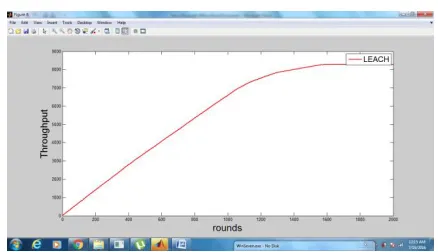
Figure 12: Increment in Throughput of Leach graph
VII. CONCLUSION
There are a variety of attacks that hinge on the issue of identity. This dissertation presents an overview of work related to analyzing or solving the Sybil attack, in which one entity appears as many different identities. A number of existing methodologies for the detection of Sybil attack have been studied and respective algorithms are proposed for detection of Sybil attack in wireless sensor network. Different defense assumptions, features and shortcomings are discussed with a mere comparison between the mechanisms.
REFERENCES
[1] S. Ratnasamy, B. Karp, L. Yin, F. Yu, D. Estrin, R. Govindan, and S. Shenker. GHT: a geographic hash table for data-centric storage. In WSNA 2002, Sept.
[2] H. Chan, A. Perrig, and D. Song.Random key predistribution schemes for sensor networks.In IEEE Symposium on Security and Privacy, May 2003.
[3] S. Madden, M. J. Franklin, J. M. Hellerstein, and W. Hong. TAG: a tiny aggregation service for ad hoc sensor networks. In Symposium on Operating Systems Design and Implementation, Nov. 2002. [4] J. R. Douceur. The Sybil attack. In First International Workshop on
Peer-to-Peer Systems (IPTPS ‟02), Mar. 2002.
[5] C. Karlof and D. Wagner. Secure routing in wireless sensor networks: Attacks and countermeasures. In First IEEE International Workshop on Sensor Network Protocols and Applications, pages 113–127, May 2003.
[6] Fei Hu and Neeraj K. Sharma, “Security considerations in ad hoc sensor networks”, Ad Hoc Networks, Published by Elsevier Science, 2005, pp. 69–89.
[7] Rajeev Shorey, Akkihebbal L. Ananda, MunChoon Chan, and Wei Tsang Ooi, “Mobile, Wireless, and Sensor Networks: Technology, Applications, and Future Directions”,John Wiley & Sons, Inc, 2006. [8] David Boyle, Thomas Newe. “Securing Wireless Sensor Networks:
Security Architectures”, Journal of networks, Volume 3, No. 1, 2008.
[9] John Paul Walters, Zhengqiang Liang, Weisong Shi, and VipinChaudhary, “Wireless Sensor Network Security: A Survey”, Security in Distributed, Grid, and Pervasive Computing, Auerbach Publications, CRC Press 2006.
[10] Farooq ANJUM and Saswati SARKAR, “Mobile, Wireless, And Sensor Networks Technology, Applications, And Future Directions”, IEEE Press 2006
[11] Perrig, Adrian, John Stankovic, and David Wagner. “Security in Wireless Sensor Networks”, Communications of the ACM, Volume 47, 2004, pp. 53-57.