International Journal of Emerging Technology and Advanced Engineering
Website: www.ijetae.com (ISSN 2250-2459, ISO 9001:2008 Certified Journal, Volume 7, Issue 6, June 2017)
427
Enhance Network Lifetime Using MGEAR Protocol
Seema Devi
1, Dr Mukesh Kumar Rana
21M. Tech Scholar, 2Assistant Professor, CSE Department, HCTM College, Haryana, India
Abstract— in most bunch based conventions Cluster Head is chosen on the base of likelihood. By and large Cluster Heads are dispersed consistently all through the field of sensor. We can say that chose of cluster heads arrested in one block of the system. A part of that block does not find any other cluster head near about in its surroundings. Also a few conventions utilized unequal bunching and attempt to use recourses capably. Sensor hubs have detected information for BS to process. Therefore, a programmed technique for joining or amassing the information into a little arrangement of pivotal data is required. Information combination is the process of knowledge translation. Upgrading of system lifetime and throughput, there is needed to use a best performance algorithm, so in this research work, M-GEAR protocol implemented with neural network concept and compare with LEACH protocol performance.
Keywords— WSN, Leach, M-Gear, Neural Network, Energy Efficient
I. INTRODUCTION
The wireless communication had made a revolution in the field of communication and data transmission. A wireless sensor network (WSN) consists of three main components nodes, gateways, and software. It has unique feature that it is self-configuring system of trivial sensor nodes communicating among themselves using radio signals, and installed in quantity to sense, observe as well as in understanding the physical world [1]. It monitors spatially distributed self-sufficient sensors to observe the bodily or environmental conditions, like temperature, sound, pressure, etc. and enthusiastically permits their data through the network to the main location. The additional popular network monitors the bi-directional, additionally enabling management of sensing the element activity. The event of wireless sensor networks was projected by military for field surveillance, nowadays such networks monitors utilized in several industrial and shopper applications, like process surveillance and
management, machine health watching, remote
monitoring and so on [3]. While typically mentioned as wireless sensor networks (WSNs), they will conjointly manage the actuators that extend management from Internet or cyberspace into the physical world [4].
The WSN (wireless sensor network) is constructed of "nodes" from few to thousands of nodes and each and every node is connected to at least one sensor [1].
Every sensor network node has usually many parts like a radio transceiver with an internal, energy source in the form of batteries, a microcontroller and an electronic circuit for interfacing with the sensors. The values of sensor nodes are equally variable and vary from dollars to dollars, depending on the complexity of an individual sensor node [3]. Size and value constraints on sensor nodes end in corresponding constraints on resources like
memory, and machine speed, energy and
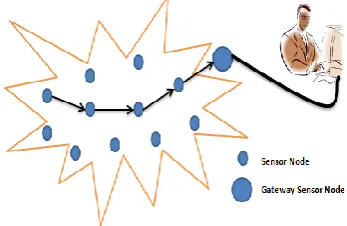
[image:1.595.343.517.372.485.2]communications data measure [4]. The topology of the WSNs (wireless sensor network) will vary from a modest star network to a sophisticated multi-hop wireless mesh network. The broadcast procedure between the hops of the network are flooding or routing [5].
Figure 1 wireless sensor network architecture
In computing and telecommunications, wireless sensor networks is an active research area with various workshops and conferences organized every year, for instance IPSN, SenSys, and EWSN [4].
II. ENERGY CONSUMPTION WITHOUT LOSING ACCURACY
International Journal of Emerging Technology and Advanced Engineering
Website: www.ijetae.com (ISSN 2250-2459, ISO 9001:2008 Certified Journal, Volume 7, Issue 6, June 2017)
428
To keep this imparity and enhance the lifetime of WSN LEACH was proposed by Wendi Rabiner Heinzelman et al in 2000 [6]. Drain is a bunching based steering convention for WSNs. The sensor hubs are made to structure a few bunches in the detecting locale. Filter is a self-arranging, versatile grouping convention that employments randomization to disseminate the vitality stacks equally among the sensors in the system [6]. A bunch head (CH) is picked at each round in a bunch. All sensor hubs in a bunch transmit information specifically to the neighborhood CH. At that point CH assembles all information from sensor hubs in the group and sends the information to BS. After each cycle another bunch head is chosen. In this work two directing conventions M-gear and LEACH have been broke down and thought about. M-gear [7] was proposed by Q. Nadeem et al is LEACH based directing convention for WSNs. MODLEACH [8] was proposed by D. Mahmood et al is additionally a LEACH based convention for WSNs.III. ENERGY EFFICIENT ROUTING ALGORITHMS PROTOCOL
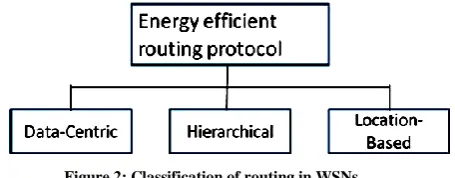
[image:2.595.58.286.558.647.2]Energy efficient routing algorithm can be categorized as follows: data centric routing algorithm, location based routing algorithm and hierarchical routing algorithm. Data centric routing algorithm uses Meta data to and the route from source to destination before any actual data transmission to eliminate redundant data transmission Location based routing algorithm requires actual location information for every sensor node [9, 10]. Hierarchical routing algorithm divides the network into clusters. Cluster head (CH) is elected in each cluster. CH collects data from its members, aggregates the data and sends to sink. This approach is energy efficient but relatively complex than other approaches.
Figure 2: Classification of routing in WSNs
Hierarchical
Hierarchical routing is used to perform energy efficient routing, i.e., higher energy nodes can be used to process and send the information; low energy nodes are used to perform the sensing in the area of interest. E.g. LEACH, TEEN, APTEEN.
Location Based
Location based routing protocols need some location information of the sensor nodes.
Location information can be obtained from GPS (Global Positioning System) signals, received radio signal strength, etc. Using location information, an optimal path can be formed without using coding techniques. E.g. Geographic and Energy-Aware Routing (GEAR)
IV. PROBLEM STATEMENT
In multiple level schemes, one CH forward data to other CHs which relay data to BS. If relay CH is far away than it is necessary for forwarder CHs to transmit with a bit higher power level .In clustering protocols, a member node decides itself whether to a CH or not. It is possible that some distant nodes are selected as CHs. Therefore, these nodes consume lot of energy to forward data to BS hence, they will die early. In this article, our goal is to design a gateway based energy aware multi hop routing protocol. This approach meets the following points. Network is divided into regions and aid of gateway node reduces the average transmission distance. Hence, it saves network energy and prolong network lifetime. As network is divided into four logical regions, CH selection in each region independent of other regions so there is definitely a CH exists in each region.
V. INTRODUCTION TO M-GEAR PROTOCOL
In M-GEAR, we use homogenous sensor nodes that are dispersed randomly in network area. After employment of nodes, every node forwards its location to the BS. The BS calculates the distance of each node and save all information of the sensor nodes into the node data table. The node data table consists of distinctive node ID, Residual energy of node, and its distance to the BS and gateway node. In this segment, we divide the network field into logical regions on the basis of node’s distance from gateway node and BS. BS divides the nodes into four logical regions. Nodes in region-one use direct communication and send their data directly to BS as the distance of these nodes from BS is very short. Similarly nodes near gateway form region-two and send their data directly to gateway. Gateway node aggregates data and forward to BS. These two regions are referred to as non-clustered regions. All the nodes away from the gate way node and base station are divided into two equal half regions based on their distance from gate-way node, we call them clustered regions. Sensor nodes in each clustered region organize themselves into small groups known as clusters.
International Journal of Emerging Technology and Advanced Engineering
Website: www.ijetae.com (ISSN 2250-2459, ISO 9001:2008 Certified Journal, Volume 7, Issue 6, June 2017)
429
Other nodes are divided in two regions and use clustering topology. CHs are elected in each region separately. Let ri represent the number of rounds to be a CH for the node S i, we call it epoch. Each node elect itself as a CH once every r i = 1/p rounds. At the start of first round all nodes in both regions has equal energy level and has equal chance to become CH. After that CH is selected on the basis of the remaining energy of sensor node and with a probability p like LEACH. In each round, it is required to have n x p CHs. A node can become CH only once in a epoch and the nodes not elected as CH in the current round feel right to the set C. The probability of a node to (belong to set C) elect as CH increases in each round. It is required to uphold balanced number of CHs. At the start of each round, a node Si belongs to set C autonomously choose a random number between 0 to 1. If the generated random number for node Si is less than a predefined threshold T(s) value then the node is becomes CH in the current round. The threshold value can be found as:( )
( ( )
If s2 C otherwise
Where p=the desired of nodes not elected as CH in current round. After electing CHs in each region, CHs inform their role to neighbor’s nodes. CHs broadcast a control packet using a CSMA MAC protocol. Upon received control packet from CH each node transmit acknowledge packet. Nodes finds near CH, becomes member of that CH.
VI. ARTIFICIAL NEURAL NETWORK
An Artificial Neuron is known as a technical method of biological neuron. ANN consists of a number of nodes, called neurons. Neural networks are typically organized in layers. In neural network all the neurons in the input layer transmit signal to each neuron of hidden layer. Weights and constants are used to represent the strength of each signal, which are calculated through the training phase. After the inputs are weighted and added, transfer function is used to get the result which transform it into the output. The transfer functions used are Sigmoid, hyperbolic tangent functions or a step. Back propagation is a neural network learning algorithm is used in layered feed-forward ANN. Supervised training is back propagation [11]. Originally, a single neuron exists in starting of ANN, proposed in the McCulloch and Pitt’s model in the 1940s. In 1958, frank Rosenblatt proposed Perceptron, is the simplest single layer networks whose weights and biases are so trained due to which target vector is produced. This network made up of only input neurons and output neurons. It can solve only linear problems.
[image:3.595.306.555.416.733.2]Multi-Layer perceptron (MLP) is one of the feed-forward neural networks use many layers to define connection between I/O layer. Feed-forward means that data flows in one direction from input to output layer (forward). Multiple layers of neurons with nonlinear transfer functions allow the network to learn relationships between I/O vectors in nonlinear and linear way. Multilayer perceptions (MLPs), which can be trained using a back-propagation algorithm is a very popular choice for many researchers.
Figure 3 Structure of ANN
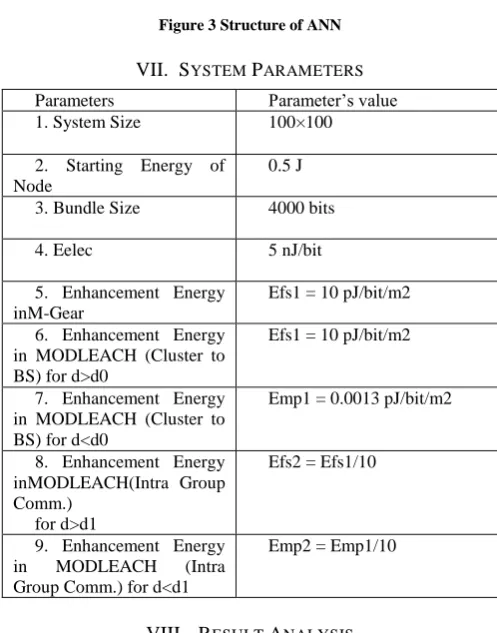
VII. SYSTEM PARAMETERS
Parameters Parameter’s value 1. System Size 100×100 2. Starting Energy of
Node
0.5 J 3. Bundle Size 4000 bits 4. Eelec 5 nJ/bit 5. Enhancement Energy
inM-Gear
Efs1 = 10 pJ/bit/m2 6. Enhancement Energy
in MODLEACH (Cluster to BS) for d>d0
Efs1 = 10 pJ/bit/m2
7. Enhancement Energy in MODLEACH (Cluster to BS) for d<d0
Emp1 = 0.0013 pJ/bit/m2
8. Enhancement Energy inMODLEACH(Intra Group Comm.)
for d>d1
Efs2 = Efs1/10
9. Enhancement Energy in MODLEACH (Intra Group Comm.) for d<d1
Emp2 = Emp1/10
VIII. RESULT ANALYSIS
International Journal of Emerging Technology and Advanced Engineering
Website: www.ijetae.com (ISSN 2250-2459, ISO 9001:2008 Certified Journal, Volume 7, Issue 6, June 2017)
[image:4.595.312.557.114.299.2]430
Main concept for improve life time is to make a balance in energy consumption among sensor nodes. This depends on the election of new node.Figure 4: Interval plot- Analysis of network lifetime
[image:4.595.48.285.173.346.2]The alive node is a base of life for network. So we measure the alive nodes for both the techniques up to maximum steps.
Figure 5: Interval plot- Analysis of No of alive Nodes
[image:4.595.313.553.373.487.2]The topology used for network creation is multi hop topology in which each farthest node transmits its packet and we measure the consumption of energy.
Figure 6: Interval plot- Analysis of Energy
As we see figure 7 in two parts that the throughput of Neural M-GEAR and M-Gear is more noteworthy than that of Neural LEACH with Leach. This is on the grounds that M-GEAR keeps up remaining vitality of sensor hubs to keep going long utilizing the passage hub.
Figure 8: Interval plot- Throughput
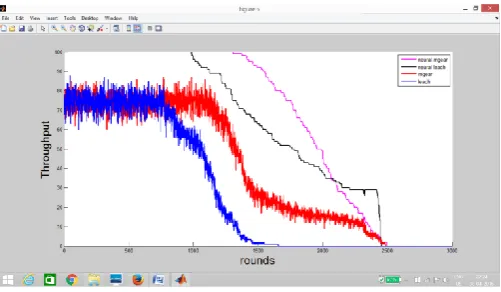
Finally we compare the throughput of each protocol and represents in graph with different color as shown following. This throughput is measured on packet transmission of a particular network with same rounds.
[image:4.595.48.286.402.585.2] [image:4.595.316.567.545.691.2]International Journal of Emerging Technology and Advanced Engineering
Website: www.ijetae.com (ISSN 2250-2459, ISO 9001:2008 Certified Journal, Volume 7, Issue 6, June 2017)
431
As indicated by the investigation in view of MATLAB reenactment we unmistakably see that passage hub which is conveyed on account of M-GEAR enhances the system lifetime and in addition the throughput of the system.IX. CONCLUSIONS
Initially the design challenges for routing protocols in WSNs are discussed. Furthermore, the design trade-offs between energy and communication overhead savings in every routing paradigm. MATLAB is used for simulation and results prove that the improved routing protocol is effective to issue of non-uniform energy consumption in nodes which is due to random cluster head selection strategy in LEACH. Here network lifetime is considered as a function of the communication and data aggregation energy consumption and analyze it with different transmission schemes in the same scenario. This technique implies better distribution of CHs in the network. Simulation and result evaluation section shows that our proposed protocol performs well compared to LEACH. Overhead energy has been reduced to 4% of the total network energy consumed in data transmissions. This has consequently affected the network lifetime which has been augmented by 20%.
REFERENCES
[1] C. Karlof and D. Wagner, ―Secure Routing in Sensor Networks: Attacks and countermeasures,‖ in Proc. 1st IEEE International Workshop on Sensor Network Protocols and Applications, (SNPA 2003), pp. 113-127.
[2] P. Walters, "Wireless sensor network security: A survey", Security in distributed, grid, mobile, and pervasive computing, 2007, p. 367.
[3] Halawani, S., Khan, ―Sensors Lifetime Enhancement Techniques in Wireless Sensor Networks - A Survey‖, Journal of Computing, vol. 2, issue 5, 2010
[4] L. Abusalah, A. Khokhar, M. Guizani, ―A survey of secure mobile Ad Hoc routing protocols,‖ Communications Surveys & Tutorials, IEEE, vol 10, issue 4, 2008, pp. 78-93.
[5] Bhaskar Krishnamachari, ―An Introduction to Wireless Sensor Networks‖, Proc. Of Second International Conference on Intelligent Sensing and Information Processing (ICISIP), Chennai, India, 2005, pp. 4-10.
[6] Akkaya, K.; Younis, M. ―A Survey on Routing Protocols forWireless Sensor Networks‖ Ad Hoc Netw. J. 2005, 3, 325–349. [7] A. Manjeshwar and D. P. Agarwal, ―TEEN : A Protocol forEnhanced Efficiency in Wireless Sensor Networks‖, in theProceedings of the 1 st International Workshop on Parallel andDistributed Computing Issues in Wireless Networks and MobileComputing, San Francisco, CA, April 2001.
[8] D. Mahmood, N. Javaid, S. Mahmood, S. Qureshi, A. M. Memon and T. Zaman, MODLEACH: A Varient of LEACH for WSNs, Eighth International Conference on Broadband and Wireless Communication and Applications, pp. 158-163, 2013.
[9] Ms. V. Muthu Lakshmi ―Advanced LEACH Protocol in Large scale Wireless Sensor Networks‖ Volume 4, Issue 5, May-2013. [10] Beibei Wang & Chong Shen& Jing Li ―Study and Improvement
on LEACH protocol in WSN’S‖ International Journal of Wireless Communication and Networking ISSN: 0975-7163.
[11] VishakhaMetre,JayshreeGhorpade, ―An Overview of the Research on Texture Based Plant Leaf Classification‖, IJCSN International Journal of Computer Science and Network, Vol 2, Issue 3, 2013ISSN (Online): 2277-5420