International Journal of Emerging Technology and Advanced Engineering
Website: www.ijetae.com (ISSN 2250-2459, ISO 9001:2008 Certified Journal, Volume 7, Issue 6, June 2017)
Review: Analysis, Design and Working Performance of
Scheduling Algorithms in Cloud Network
Vinod Kumar Saroha
1, Dr. Sanjeev Rana
21Assistant Professor, Department of Computer Science and Information Technology, BPSMV, Khanpur Kalan 2Professor, Department of Computer Science, MMCE, MMU, Mullana
Abstract- In current day’s the large quantity of data is processed by various business and scientific applications. The cloud computing is one of the most famous technology. It improves the performance of efficiency of cloud structure. The cloud computing is a structure of transferring information technology service, where properties are saved from the internet through webbing based tools and applications instead of a direct association with to a server. The ability to establish and statement cloud computing resources with insignificant management effort / service provider inter-action led to the speed increase of the use of cloud computing. Although, managing cloud computing properties to provide better services to end to end users is most significant. Job scheduling defines an assign certain job at a particular interval time and resources. The major aim of job scheduling to divide the system load, enhance system performance, properlymanage the available properties minimize the cost and interval execution of time. It has played significant role in cloud computing. It optimizes the energy consumption necessary at minimum power. In this survey paper, various job scheduling algorithms and comparison between several algorithms. In existing study, the researcher has functional various meta-heuristic algorithms to resolve the issue in job scheduling algorithm over the cloud. An appropriate job scheduling algorithm must study priority of jobs. In this paper, the various job scheduling algorithm has been analyzed to indicate the current developments for using meta heuristic methods over cloud computing.
Index Terms – Cloud Computing, Job scheduling , Meta heuristic techniques and services of cloud computing.
I. INTRODUCTION
Information Technologies are developing day by day, the essential of storage resources and computing are growing at very high speed. Implementing more and more devices isn’t a commercial technique or for an industrial use to fulfil the always increasing demand of computation and required storage [1]. The cloud computing has become an extension paradigm for high-performance computing.
Since, in cloud computing all types of information technology facilities are provided to the consumers as-a-services [2].
Cloud Computing is the process of assigning the capabilities to the servers which are remotely located on the Internet to manage data, process data, store data in contrast to any system done for personal usage. It represents the various ways to designing, accessing and management of the computing resources. The individual has only to implement an account with MICROSOFT /AMAZON /GOOGLE to start constructing and organizing application networks into a cloud[3].
The benefits of cloud computing over new era add low entry cost, device independence and scalability.Cloud models use the data-center as the normal unit in its environment. Cloud model could be observed as a grouped of immensely divided data centers. In other words, it is a set of cloud service clients that gives services via their data centers positioned around the world[4].
The server farm is a huge, center source for the storage, management of data and computation. A server is a large for hosting a number of data centers for processing elements, considerable quality of storage to serve clients’ requests and clusters[5].
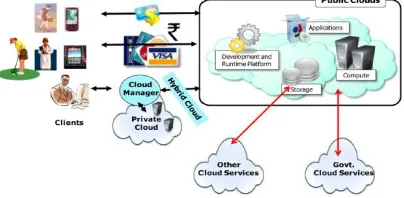
Cloud computing is well known ability that proceeds the usage of the center remote located servers and network based applications in order to handle the information. It gives consumers economical usage requests without linking and entering their normal records placed while accessing of internet on any computing. This technique, hence gives; for reliable and consistent computing by storing data, management, task processing and bandwidth. Illustration in fig. 1 depicts Architecture of cloud computing;
(i) Platform based services
International Journal of Emerging Technology and Advanced Engineering
[image:2.612.205.407.147.246.2]Website: www.ijetae.com (ISSN 2250-2459, ISO 9001:2008 Certified Journal, Volume 7, Issue 6, June 2017)
Fig 1. Architecture of Cloud Computing
Table 1. Comparison Among Models
MODELS SERVICES AVAILABLE USED BY WHY USE IT
I A A S
Create platforms for repair also function analysis, progress addition also exploitation.
System manager.[8] Make platformon behalf of service alsofunctional analysis, Progress,addition.
P A A S
Services, Functions tests,
Development,addition also
Deployment.
Developers andDeplorers.
Create or
Deploy functions and services for
Users.[9]
S A A S
Email, workplace
Mechanization, website taxing, wiki, practical desktop, Blog, CRM.
Business Users.
To complete Business jobs.[10]
II. JOB SCHEDULING
Basically, it is a method that handles the execution of self-determining jobs on divided resources. It defines allocating proper resources to work flow jobs so that the performance could be completed to accomplish task aim scenarios which is led by consumers. An activity shall initialize and exit depending on its [7];
- Process time - Initialize time - Exit time
- Duration and
- The expected run time period.
International Journal of Emerging Technology and Advanced Engineering
Website: www.ijetae.com (ISSN 2250-2459, ISO 9001:2008 Certified Journal, Volume 7, Issue 6, June 2017) Here, greater than the one individual procedure is to be
loaded into the run-able memory at a time. The loaded procedure uses the processor (CPU) efficiently using interval multiplexing. The process is executed with the help of the operating system and the process manages to allocate ask queues which are in wait for the interval processing of central processing unit. It must observe which job is to be allocated from what queue name and huge amount of interval time is used in assigning for the job. Scheduling types,promises that every task are performed completely and on time interval period. Many programs which include addition to the management system of the database, its backup, commercial and enterprise resource management features detailed job scheduling abilities as well.
It conveniently generates every job by adding expected reliability of the Appropriate system[31]. It offers a means of field down costs through perfect use of consumers and clients. The benefit of scheduling fields below explains:
- Increase throughput - Client dead-line met
- Improved Communication with Users
- Less interval time within appropriate system facility. - Enhanced use of Multi-Programming features [32]
III. RELATED WORK
Rajveer Kaur et al.,(2014) [18] In this paper, the authors have described job scheduling is the most important procedure for responses to the problems of heavy load and traffic congestion. The procedure of task mapping of presented resources is performed. Author discussed about scheduling, cloud networking and described previous methods for job scheduling taking help of detailed comparative analysis. Cao Fei et al.,(2014) [19] examined in this paper growing demand to implement the main centers of information and CPUs, servers around the globe which have been escalated by the high electricity emissions and energy cost. The reason behind is the execution of the computing operations, cooling and message flow together with quantity of carbon dioxide emissions which have risen alarmingly. In order to achieve sustainable cloud computing and satisfying the ever increasing problem complexity and huge information size in coming years; They designed and implement energy known scientific process flow scheduling technique to minimize energy utilization and Carbon dioxide productions while theycontinue to comply certain quality-of-services that is a response based time described in Services level Agreements. Wei Tang, et al.,(2010) [20] here the authors analyzed the influencesof inaccurate back fillings and varied job scheduling procedures; it is determined which process is very significantly sensitive.
The results, have been developed and implemented on different estimation,managing techniques that is dependent on the historical data. They have assembled these techniques by taking use of work lead portions. The results described that continuous changes in handling job execution time estimated can improve task scheduling performance evaluation by up to (20%). Mansouri, et al.,(2011) [21] has searched the main problems in the information grid schedule for data and task management. Generally, task scheduling in grid has been studied from the ideas emerged of computational grids. An efficient scheduling process ought to reflect both store information resources and computation.Malarvizhi et al.,(2009) [22] has discussed the scheduling techniques for minimizing time to release for larger spread over resources with scientific problems in computational grids. These have been addressed by efficient job scheduling algorithms having a scalable grid architecture and better resource utilization. The designed scheduling techniques has better performance evaluation and when compared with different scheduling techniques such as FCFS (First Come First Serve) and min-min. These existing techniques didn’t perform the transmission of interval duration when jobs are scheduled for the resource. The approach has been cross verified with the help of the GRIDSIM simulator tool kit and simulation results when the interval response duration of execution of various requests is minimized. V. Karthick et al.,(2014) [23] has aimed at discussing that the scheduler located globally was sharing the features at higher levels. Researchers most imperatively tried to build the job scheduling techniques that are aptly suited and also performed in cloud computing condition. This research work purposely promotes actions in the cloud network because the clients have to give expenses for the services utilized in use that time interval. The major impetus of this paper is some existing scheduling techniques and issues related to them in cloud server network.
IV. JOB SCHEDULING ALGORITHMS
In this part, we have been studying numerous scheduling methods [11]:
4.1 Heuristic Algorithm
International Journal of Emerging Technology and Advanced Engineering
Website: www.ijetae.com (ISSN 2250-2459, ISO 9001:2008 Certified Journal, Volume 7, Issue 6, June 2017)
4.2 Task Scheduling in Job scheduling
An improved task scheduling method using the triangle model operator to integrate quality-of-services of consumer with network based evaluation of the computations[12].
4.3 Multi-level Queue Scheduling Algorithm
It gives the preemptive and non-preemptive methods can be used both in multilevel queue scheduling. It separates the initialized queue into no. of queues with varied tasks in multi-level scheduling [13], with the help of a simulator for numerous the collections of tasks and scheduling strategies.
4.4 First-come-first-serve Algorithm
In this approach, tasks are completed on first come and then firstly executed. Here generally the jobs are allocated in proposed studies of CPU processors assigned in multiple computers. In this approach jobs are finished on FC, FS basis [14]. This algorithm is conveniently understandable, implement and designed in FIFO queue. But, the evaluation is very poor as AVG (average) waiting time is high.
4.5 Shortest Job First Algorithm
This algorithm uses non-preemptive scheduling approach. Here this procedure uses optimization of the wait time. It is conveniently used in the Batch type systems in which it is known about the CPU time from the beginning. Its development is the easiest way in batch systems, while difficult to be implemented in interactive systems with no knowledge of CPU time [15].
4.6 Priority Based Algorithm
Every CPU is assigned a priority (even/odd). The process with higher priority needs to be executed first and proceeding in a similar way. The process with equal priority are executed on the basis which has arrived earlier. Priority could be certain based on time interval, memory requirements and resources [16].
4.7 Round Robin Algorithm
[image:4.612.336.552.158.374.2]It uses the pre-emptive job scheduling procedure. The process is allocated to the task neighbors to accept, but it could be pre-empted by a fresh executable task which has less finishing time. It is seldom used in batch structures were less jobs are given preference [17]. The executable process uses a definite time unit called quantum.
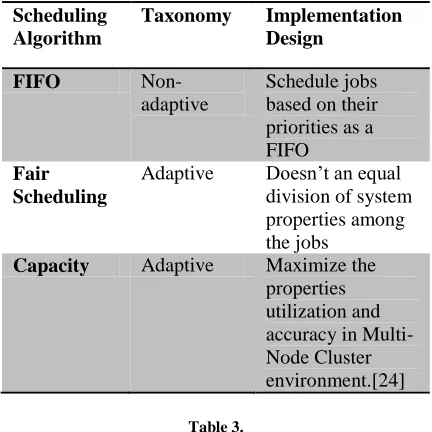
Table 2.
Comparative Study of the various algorithms
Scheduling Algorithm
Taxonomy Implementation Design
FIFO Non-
adaptive
Schedule jobs based on their priorities as a FIFO Fair
Scheduling
Adaptive Doesn’t an equal division of system properties among the jobs
Capacity Adaptive Maximize the properties utilization and accuracy in Multi-Node Cluster environment.[24]
Table 3.
Advantages and Disadvantages in job Scheduling Algorithms
Scheduling Algorithm
Advantages Disadvantages
FIFO Cost of full cluster , scheduling process is less.
Implement easy and efficient [25]
Single type of job Less performance although running multiple kinds of jobs
Poor response time
Fair Scheduling
Less Complex, Both small and larger cluster Quick response
Doesn’t consider the job weight for every node[26]
Capacity Prioritize jobs within queues the huge cluster.
More complex
among other
[image:4.612.336.551.389.651.2]International Journal of Emerging Technology and Advanced Engineering
[image:5.612.53.285.169.532.2]Website: www.ijetae.com (ISSN 2250-2459, ISO 9001:2008 Certified Journal, Volume 7, Issue 6, June 2017) Table 4.
Power consumption Percentage in existing energy efficient scheduling Algorithm [27]
Algorithm Power save % ge
DVFS DNS
DENS algorithm
50% T T
e-STAB algorithm
47% T T
Task Scheduling and Server Povisioning
40% T T
Less Completion
Tmes algorithm
50% T T
EE algorithm
using DVFS
25% T T
Power Best-fit /
Load Balancer
12-13% F F
Green scheduler
53% T T
Dynamic Resource allocation
15%-20% F F
Adaptive EE Scheduling
Algorithm
31.7% T F
In table 1 described that the comparative study of the job scheduling algorithm. Table 2. Described that the advantage and disadvantages in the job scheduling algorithm. Analysis of the EE scheduling Algorithms, the power saving %ge among all algorithms were compared as shows in table 3. The Scheduling methods defined an optimization in power consumption in the cloud environment. Through, all scheduling methods give a different percentage in power consumption in cloud structure [28].
V. PROBLEM MODEL
In data center is the main key component for the energy consumption in the cloud computing method. In data centers works on the upper of the heterogeneous servers.
In terms of dissimilar in context to servers refers to dissimilar to the hardware i.e type of memory,disk, processor and some other resource etc. [29]
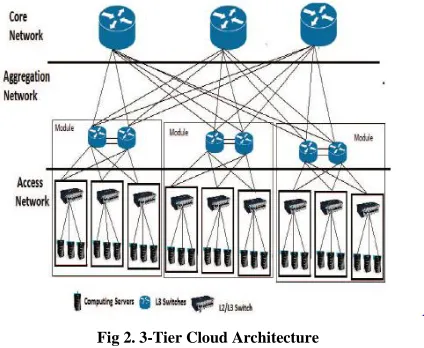
[image:5.612.340.552.212.386.2]Data centers are 3-tie architecture consists of hosts and switches. The 3-layers in the structure correspond to main core network, aggregation and access network[30].
Fig 2. 3-Tier Cloud Architecture
The core network resembles to the main root of the architecture. The intermediate layer that is combination network corresponds to parts accountable for rules and the end layer of the architecture, the accessible network assigns of several servers / hosts.3-tier architecture is manageable when the second layer switches grow in the access network. It standardization a weighted combination metric , MM of server –level Fss,Rack Level Frr , and Module level Fmm functions.
Where are the weighted co-efficients, which corresponds to servers, racks and modules respectively.
, must be equality to unity.
VI. CONCLUSION
International Journal of Emerging Technology and Advanced Engineering
Website: www.ijetae.com (ISSN 2250-2459, ISO 9001:2008 Certified Journal, Volume 7, Issue 6, June 2017) REFERENCES
[1] Adamuthe, Amol C., Vikram D. Salunkhe, Seema H. Patil, and Gopakumaran T. Thampi. "Cloud Computing–A market Perspective and Research Directions." International Journal of Information Technology and Computer Science (IJITCS) 7, no. 10 (2015): 42. [2] Hashem, Ibrahim Abaker Targio, Ibrar Yaqoob, Nor Badrul Anuar,
Salimah Mokhtar, Abdullah Gani, and Samee Ullah Khan. "The rise of “big data” on cloud computing: Review and open research issues." Information Systems47 (2015): 98-115.
[3] Kaufman, Lori M. "Data security in the world of cloud computing." IEEE Security & Privacy 7, no. 4 (2009): 61-64. [4] Pallis, George. "Cloud computing: the new frontier of internet
computing."IEEE Internet Computing 14, no. 5 (2010): 70. [5] Ali, Mazhar, Samee U. Khan, and Athanasios V. Vasilakos.
"Security in cloud computing: Opportunities and challenges." Information Sciences 305 (2015): 357-383.
[6] Wei, Lifei, Haojin Zhu, Zhenfu Cao, Xiaolei Dong, Weiwei Jia, Yunlu Chen, and Athanasios V. Vasilakos. "Security and privacy for storage and computation in cloud computing." Information Sciences 258 (2014): 371-386.
[7] Jiang, Congfeng, Cheng Wang, Xiaohu Liu, and Yinghui Zhao. "A survey of job scheduling in grids." In Advances in Data and Web Management, pp. 419-427. Springer Berlin Heidelberg, 2007. [8] Yang, Bo, Xiaofei Xu, Feng Tan, and Dong Ho Park. "An
utility-based job scheduling algorithm for cloud computing considering reliability factor." InCloud and Service Computing (CSC), 2011 International Conference on, pp. 95-102. IEEE, 2011.
[9] Rodero, Ivan, Francesc Guim, and Julita Corbalan. "Evaluation of coordinated Grid scheduling strategies." In High Performance Computing and Communications, 2009. HPCC'09. 11th IEEE International Conference on, pp. 1-10. IEEE, 2009.
[10] Aparnaa, S. K., and K. Kousalya. "An Enhanced Adaptive Scoring Job Scheduling algorithm for minimizing job failure in heterogeneous grid network." In Recent Trends in Information Technology (ICRTIT), 2014 International Conference on, pp. 1-6. IEEE, 2014.
[11] Li, Keqin. "Experimental performance evaluation of job scheduling and processor allocation algorithms for grid computing on metacomputers." InParallel and Distributed Processing Symposium, 2004. Proceedings. 18th International, p. 170. IEEE, 2004.
[12] Bani-Mohammad, Saad. "On the performance of job scheduling for noncontiguous allocation in 2D mesh-connected multicomputers." In 2012 16th IEEE Mediterranean Electrotechnical Conference, pp. 92-96. IEEE, 2012.
[13] Babbar, Davender, and Phillip Krueger. "A performance comparison of processor allocation and job scheduling algorithms for mesh-connected multiprocessors." In Parallel and Distributed Processing, 1994. Proceedings. Sixth IEEE Symposium on, pp. 46-53. IEEE, 1994.
[14] Min, Dugki, and Matt W. Mutka. "Efficient job scheduling in a mesh multicomputer without discrimination against large jobs." In Parallel and Distributed Processing, 1995. Proceedings. Seventh IEEE Symposium on, pp. 52-59. IEEE, 1995.
[15] Kaur, Harmeet, and Rama Krishna Challa. "A new hybrid virtual machine scheduling scheme for public cloud." In 2015 Fifth International Conference on Advanced Computing & Communication Technologies, pp. 495-500. IEEE, 2015.
[16] Hummel, Karin Anna, and Gerda Jelleschitz. "A robust decentralized job scheduling approach for mobile peers in ad-hoc grids." In Seventh IEEE International Symposium on Cluster Computing and the Grid (CCGrid'07), pp. 461-470. IEEE, 2007.
[17] Pesch, Erwin. "The Job Shop Scheduling Problem: Conventional and new Solution Techniques." In Operations Research Proceedings 1993, pp. 138-138. Springer Berlin Heidelberg, 1994.
[18] Kaur, Rajveer, and Supriya Kinger. "Analysis of Job Scheduling Algorithms in Cloud Computing." International Journal of Computer Trends and Technology (IJCTT)–volume 9 (2014).
[19] Cao, Fei, Michelle M. Zhu, and Chase Q. Wu. "Energy-efficient resource management for scientific workflows in clouds." In 2014 IEEE World Congress on Services, pp. 402-409. IEEE, 2014. [20] Tang, Wei, Narayan Desai, Daniel Buettner, and Zhiling Lan.
"Analyzing and adjusting user runtime estimates to improve job scheduling on the Blue Gene/P." In Parallel & Distributed Processing (IPDPS), 2010 IEEE International Symposium on, pp. 1-11. IEEE, 2010.
[21] Mansouri, Najme, Gh Dastghaibyfard, and Abbas Horri. "A Novel Job Scheduling Algorithm for Improving Data Grid's Performance." In P2P, Parallel, Grid, Cloud and Internet Computing (3PGCIC), 2011 International Conference on, pp. 142-147. IEEE, 2011. [22] Malarvizhi, Nandagopal, and V. Rhymend Uthariaraj. "A minimum
time to release job scheduling algorithm in computational grid environment." In INC, IMS and IDC, 2009. NCM'09. Fifth International Joint Conference on, pp. 13-18. IEEE, 2009.
[23] Karthick, A. V., E. Ramaraj, and R. Ganapathy Subramanian. "An efficient multi queue job scheduling for cloud computing." In Computing and Communication Technologies (WCCCT), 2014 World Congress on, pp. 164-166. IEEE, 2014.
[24] Jian, Zhang, Fang Jie, Parker T. Steven, Li Wenquan, and Ran Bin. "Fixed Job Scheduling Model for Single Depot Transit Vehicle Assignment." InIntelligent Computation Technology and Automation (ICICTA), 2011 International Conference on, vol. 1, pp. 803-806. IEEE, 2011.
[25] Dwivedi, Sanjay K., and Ritesh Gupta. "A simulator based performance analysis of multilevel feedback queue scheduling." In6Computer and Communication Technology (ICCCT), 2014 International Conference on, pp. 341-346. IEEE, 2014.
[26] Bansal, Sunita, and Chittaranjan Hota. "Priority-based Job Scheduling in Distributed Systems." In International Conference on Information Systems, Technology and Management, pp. 110-118. Springer Berlin Heidelberg, 2009.
[27] Al-Najjar, Hazem, and Moath Jarrah. "Smart job scheduling with backup system in grid environment." In 2012 18th IEEE International Conference on Networks (ICON), pp. 210-215. IEEE, 2012.
[28] Edwin, A. Chinnu, and A. Neela Madheswari. "Job Scheduling and VM Provisioning in Clouds." In Advances in Computing and Communications (ICACC), 2013 Third International Conference on, pp. 261-264. IEEE, 2013.
[29] Tarandeep Kaur, Inderveer Chana “Energy aware scheduling of deadline-constrained tasks in cloud computing’’; Volume 19, Issue 2, pp 679–698; In Springer; June 2016.
International Journal of Emerging Technology and Advanced Engineering
Website: www.ijetae.com (ISSN 2250-2459, ISO 9001:2008 Certified Journal, Volume 7, Issue 6, June 2017)
[31] Daljinder Singh, Madeep Devgan“Multilayer Hybrid Energy Efficient Approach in Green Cloud Computing” in International Journal of Computer Applications (0975 – 8887) Volume 147 – No.6, 12th August 2016.