R E S E A R C H
Open Access
Quasilinearization for nonlinear boundary
value problems for delay-type difference
equations with maxima
Snezhana Hristova
*and Angel Golev
*Correspondence:
[email protected] Plovdiv University, Tzar Asen 24, Plovdiv, 4000, Bulgaria
Abstract
The paper deals with an approximate method for solving a mixed boundary value problem for nonlinear difference equations containing a maximum of the unknown function over a past time interval. Every successive approximation to the unknown solution is the unique solution of an appropriately constructed initial value problem for a linear difference equation with maxima, and an algorithm for its explicit obtaining is suggested. Also, each approximation is a lower/upper solution of the given mixed problem. The rapid convergence of the successive approximations is proved. The suggested algorithm is realized as a computer program and it is applied to an example.
MSC: 39A23; 39A99; 65Q10
Keywords: delay-difference equations with maxima; boundary value problem; approximate solution; computer realization
1 Introduction
In the last few decades great attention has been paid to automatic control systems and their applications to computational mathematics and modeling. Many problems in the control theory correspond to the maximal deviation of the regulated quantity. Discrete modeling of such kind of problems is done adequately by difference equations with max-ima over a past time discrete interval. These difference equations are a part of the set of difference equations with delays. Meanwhile, the delays have recently been found crucial in many areas such as neuronal dynamics. For example, the effects of periodic subthresh-old pacemaker activity and time-delayed coupling on stochastic resonance over scale-free neuronal networks are studied in []; the effects of spatiotemporal additive noise on the spatial dynamics of excitable neuronal media that is locally modeled by a two-dimensional map are considered in []; the discrete model of the movement of eukaryotic cells regu-lated by a process of phase separation of two competing enzymes on the cell membrane is studied in []; front propagation and synchronization transitions in dependence on the information transmission delay and coupling strength over scale-free neuronal networks with different average degrees and scaling exponents are investigated in [].
The presence of the maximum function over a discrete past time interval in the dis-crete equation requires not only more complicated calculations but also a development of new methods for qualitative investigations of the behavior of their solutions as well as
approximate methods for their solving. The character of the maximum function leads to a variety of different types of difference equations. The properties of solutions of some special types of difference equations with maxima are studied in [–]. In several papers various types of boundary value problems for difference equations have been studied and the monotone iterative method has been applied. For example, in [, ] first-order differ-ence equations are studied; in [] some criteria for existdiffer-ence and uniqueness results for nth order anti-periodic difference equations are developed; in [] a generalized delay dif-ference equation is studied by lower and upper solutions, but the problem consists only of a boundary condition, which does not get uniqueness of the solution; the global boundary value problem for difference equations without any kind of delay is well studied in []; in [] a nonlinear boundary value problem for a delay difference equation with one delay is studied by the monotone iterative method; in [] an approximate method with a rapid convergence is applied to an initial value problem for difference equations with maxima. Also, in [], the monotone iterative technique is applied to a periodic boundary value problem for difference equations with maxima, but the successive approximation is solu-tions of periodic boundary value problems, which are practically difficult to be obtained. Approximate methods for various problems for differential equations with maxima are proved and applied in [–].
In the paper a nonlinear difference equation of delayed type is considered. The studied equation generalizes the well-known problems in several ways:
- at each current time the value of unknown function is included in both parts of the equation, so the equation could not be solved recursively;
- the delays are without any restrictions;
- the boundary condition is set up in a very general way and it involves many other cases, which are studied in the literature (see, for example, the above-mentioned papers).
The main purpose of the paper is to establish comparison results which allow us to use upper and lower solutions in order to build two convergent monotonic sequences of func-tions with discrete domains. Each term of these sequences is a solution of an appropriately constructed initial value problem for a linear difference equation with maxima. An algo-rithm for solving these initial value problems is given. Also, each term of both sequences is a lower/upper solution of the given nonlinear boundary value problem. The limits of both sequences coincide to the solution of a given problem and the rapid convergence of both sequences is proved. Also, the algorithm is computerized and it is applied to a particular example to show the advantages of the suggested approximate method.
2 Statement of the problem
LetR+= [,∞),Zbe the set of all integers. For anyc,b∈Z:c<b, we denoteZ[c,b] ={z∈
Z:c≤z≤b}.
Leta,T∈Z:T>a+ ,r,p∈Z[,T–a] andh∈Z:h> be fixed.
Consider the following mixed boundary value problem for a nonlinear delay-difference equation with ‘maxima’ (MBVP):
u(k– ) =f
k,u(k),uτ(k)
,uτ(k)
, . . . ,uτr(k)
, max s∈Z[k–h,k]u(s)
u(k) =ϕ(k) fork∈Z[a–h+ ,a– ], () u(a) =gu(T–λ),u(T–λ), . . . ,u(T–λp),u(T)
, ()
whereu∈R,u(k– ) =u(k) –u(k– ),f :Z[a+ ,T]×Rr+→R,g:Rp+→R,τ m(k) :
Z[a+ ,T]→Z[a+ –h,T]:k–h≤τm(k)≤k,m= , , . . . ,r,λj∈Z[,T–a],j= , , . . . ,p,
andϕ:Z[a–h+ ,a– ]→R.
Any solution of MBVP ()-() is a finite sequence ofT–a+hreal numbers, and we consider it as a real-valued function with a discrete domain.
The presence of delaysτm generalizes the type of the considered difference equation
since the function f could depend on different delays at any pointk. In the caser=h andτj(k) =k–j,j= , . . . ,r, the right-hand side of () is reduced tof(k,u(k–h),u(k–h+
), . . . ,u(k– ),u(k),maxs∈Z[k–h,k]u(s)). For some other particular cases, see equation ()
of the paper.
The presence of both delays and the maximum function in the equation leads to a new statement of the problem, which involves both the boundary condition and the initial con-dition. Problem ()-() covers many different problems for difference equations with delays and maxima such as the initial value problem, the periodic boundary value problem, the linear boundary value problem.
3 Preliminary notes, basic notations and definitions Notemi=nai= and
m
i=nai= , wherem<n<∞andaj∈R,j∈Z[m,n].
For any functionF∈C(I,R),I⊂Rr+,V= (v
,v, . . . ,vr+), we denote byFvj(V) the first
derivative ofF(V) with respect to itsjth argument, and byFvjvk(V) the second derivative
ofF(V) with respect to itsjth andkth arguments. We introduce the following notations:
χu(T)=u(T–λ),u(T–λ), . . . ,u(T–λp),u(T)
,
Uuτ(k)=uτ(k)
,uτ(k)
, . . . ,uτr(k)
,
uτ(k)=u(k),Uuτ(k), max s∈Z[k–h,k]u(s)
, k∈Z[a+ ,T].
Using the above notations, the right-hand sides of equation () and boundary condition () could be written in a simpler way:f(k,(u(τ(k)))) andg(χ(u(T))).
We will use the normu=max{|u(k)|:k∈Z[a–h+ ,T]}.
Letα,β:Z[a+ –h,T]→Rbe given functions such thatα(k)≤β(k). We introduce the following sets:
S(α,β) =u:Z[a–h+ ,T]→R:α(k)≤u(k)≤β(k),k∈Z[a–h+ ,T] , W(α,β) =x∈Rp+:χα(T)≤x≤χβ(T) ,
k(α,β) =
V∈Rr+:ατ(k)≤V≤βτ(k) , k∈Z[a+ ,T].
Definition [] The functionα:Z[a–h+ ,T]→Ris called a lower (upper) solution of MBVP ()-() if
α(k– )≤(≥)fk,α(k),ατ(k)
,ατ(k)
, . . . ,ατr(k)
, max s∈Z[k–h,k]α(s)
fork∈Z[a+ ,T],
α(k)≤(≥)ϕ(k) fork∈Z[a–h+ ,a– ],
α(a)≤(≥)gα(T–λ),α(T–λ), . . . ,α(T–λp),α(T)
.
4 Linear delay difference inequalities with maxima
We will consider the following linear difference inequality with ‘maxima’:
u(k– )≤K+Q(k)u(k) +
r
j=
Cj(k)u
τj(k)
+q(k) max
s∈Z[k–h,k]u(s), k∈Z[a+ ,T],
u(k)≤K, k∈Z[a–h+ ,a],
()
whereKis a nonnegative constant.
The inequalities () are the base of the main proof, and we will obtain a solution of () in an explicit form.
Lemma Let the following conditions be fulfilled:
. The delaysτj:Z[a+ ,T]→Z[a+ –h,T],j∈Z[,r]are such thatk–h≤τj(k)≤k, k∈Z[a+ ,T].
. The functionsq,Q,Cj:Z[a+ ,T]→R+,j∈Z[,r],and
˜
S(k)≡q(k) +Q(k) +
r
j=
Cj(k) < fork∈Z[a+ ,T]. ()
. The functionu:Z[a+ –h,T]→R+satisfies inequalities().
Then for k∈Z[a+ ,T]the inequality u(k)≤Kθ(k)holds,where
θ(k) = k
j=a+ –S˜(j)
+
k
j=a+
k
ξ=j –S˜(ξ)
. ()
Proof From inequality () we obtain
u(k)≤
k
j=a+
K+Q(j)u(j) +
r
i=
Ci(j)u
τi(j)
+q(j) max s∈Z[j–h,j]u(s)
,
Define a functionz:Z[a+ –h,T]→R+by the equalities
z(k) =
⎧ ⎪ ⎪ ⎨ ⎪ ⎪ ⎩
k
j=a+{K+u(j– ) +Q(j)u(j)
+ri=Ci(k)u(τi(j)) +q(j)maxs∈Z[j–h,j]u(s)}, k∈Z[a+ ,T],
K, k∈Z[a+ –h,a].
The function z(k) is nondecreasing and u(k) ≤ z(k), u(τj(k)) ≤ z(τj(k)) ≤ z(k), maxs∈Z[k–h,k]u(s)≤maxs∈Z[k–h,k]z(s) =z(k) fork∈Z[a+ ,T],j= , , . . . ,r.
From the definition ofz(k) and the first inequality in (), we obtain
–q(k) –Q(k) –
r
j=
Cj(k)
z(k)≤K+z(k– ), k∈Z[a+ ,T]. ()
By mathematical induction from (), condition and the definition ofz(k), we prove the
claim.
In the case when all delaysτj(k) <kfork∈Z[a+ ,T], condition of Lemma could be
changed by a simpler one.
Lemma Let the following conditions be fulfilled:
. The delaysτj:k–h≤τj(k) <kfor allj∈Z[,r]andk∈Z[a+ ,T].
. The functionsq,Q,Cj:Z[a+ ,T]→R+,j= , , . . . ,r,and
S(k)≡q(k) +Q(k) < fork∈Z[a+ ,T]. () . The functionu:Z[a+ –h,T]→R+satisfies inequalities().
Then for k∈Z[a+ ,T]the inequality u(k)≤Kξ˜(k)holds,where
˜
ξ(k) =
k
s=a+
+rj=Cj(s)
–S(s) +
k
s=a+
k
ξ=s+
+rj=Cj(ξ)
–S(ξ)
–S(s). ()
Corollary Let conditionsandof Lemma/Lemmabe fulfilled,and let the function u:Z[a+ –h,T]→R+satisfy inequalities()for K= .
Then u(k)≤for all k∈Z[a–h+ ,T].
5 Linear delay difference equations with maxima
In connection with the computer realization of the suggested method, we will give an al-gorithm for exact solution of the initial value problem for the scalar linear delay-difference equation with ‘maxima’:
u(k– ) =Q(k)u(k) +q(k) max s∈Z[k–h,k]u(s)
+
r
j=
Cj(k)u
τj(k)
+P(k), k∈Z[a+ ,T], ()
whereQ,P:Z[a+,T]→R,q,Cj:Z[a+,T]→R+forj= , , . . . ,r,ψ:Z[a+–h,a]→R
andτm(k) :Z[a+ ,T]→Z[a+ –h,T]:k–h≤τm(k)≤kform= , , . . . ,r.
We will consider two cases with respect to the type of delaysτj.
Case : Let the inequalityτj(k) <khold for allj∈Z[,r],k∈Z[a+ ,T]. Additionally, we
assume that inequality () is satisfied for allk∈Z[a+ ,T].
Assume that the valuesu(k) of the unknown solution are obtained for allk∈Z[a–h+ ,m], wherem<T. Now letk=m+ .
Case .: Let the following inequality be satisfied:
P(k) +rj=Cj(k)u(τj(k)) +u(k– )
–Q(k) –q(k) ≥max
u(k–l) :l= , , . . . ,h . ()
Thus,maxs∈Z[k–h,k]u(s) =u(k). Then the unique solution of IVP (), () is
u(k) =P(k) +
r
j=Cj(k)u(τj(k)) +u(k– )
–Q(k) –q(k) . ()
Case .: Let inequality () be not satisfied for alll∈Z[,h]. Therefore, there exists m∈Z[,h] such thatmaxs∈Z[k–h,k]u(s) =u(k–m). ThenQ(k)≤Q(k) +q(k) < and the unique solution of IVP (), () is
u(k) =P(k) +
r
j=Cj(k)u(τj(k)) +u(k– ) +q(k)u(k–m)
–Q(k) . ()
Case : Let there exist at least one j∈Z[,r] andk∈Z[a+ ,T] such that τj(k) =k.
Additionally, we assume that inequality () is satisfied for allk∈Z[a+ ,T].
Assume that the valuesu(k) of the unknown solution are obtained for allk∈Z[a–h+ ,m], wherem<T. Now letk=m+ .
Let there exist integersjs∈Z[,r] :τjs(k) =kfors∈Z[,m] andτj(k) <kforj=js,s∈
Z[,m]. Equation () is reduced to
–Q(k) –
m
s=
Cjs(k)
u(k)
=u(k– ) +
r
i=,i=js,s∈Z[,m]
Ci(k)u
τi(k)
+q(k) max
s∈Z[k–h,k]u(s) +P(k). ()
Case .: Let the following inequality be satisfied:
P(k) +ri=,i=js,s∈Z[,m]Ci(k)u(τi(k)) +u(k– )
–Q(k) –ms=Cjs(k) –q(k)
≥u(k–s), s∈Z[,h]. ()
Therefore,maxs∈Z[k–h,k]u(s) =u(k), and from () we obtain the solution
u(k) =P(k) +
r
i=,i=js,s∈Z[,m]Ci(k)u(τi(k)) +u(k– )
–Q(k) –ms=Cjs(k) –q(k)
. ()
Therefore, there existsm∈Z[,h] such thatmaxs∈Z[k–h,k]u(s) =u(k–m).
Then the unique solution of problem (), () is given by
u(k) =P(k) +
r
i=,i=js,s∈Z[,m]Ci(k)u(τi(k)) +u(k– ) +q(k)u(k–m)
–Q(k) –ms=Cjs(k)
. ()
6 Method of quasilinearization
We will apply the method of quasilinearization to obtain the approximate solution of MBVP ()-().
Theorem Let the following conditions be fulfilled:
. The delaysτj(k) :k–h≤τj(k)≤kfor allj∈Z[,r]andk∈Z[a+ ,T].
. The functionf:Z[a+ ,T]×Rr+→Rand for anyk∈Z[a+ ,T]and
V∈k(α,β),the equalityf(k,V) =F(k,V) –G(k,V)holds,where the functions
F(k,V),G(k,V)are twice continuously differentiable with respect to any component ofVand the following inequalities are valid fork∈Z[a+ ,T],V∈k(α,β):
Fvivj(k,V)≥, Gvivj(k,V)≥, fori,j∈Z[,r+ ], ()
Fvj
k,α(k)
≥Gvj
k,β(k)
, j= , , . . . ,r+ , ()
r+
j=
Fvj
k,β(k)
–Gvj
k,α(k)
< . ()
. The functiong∈C(W(α
,β),R)is nondecreasing with respect to all its arguments.
. The functionsα,β:Z[a+ –h,T]→R,αis a lower solution,βis an upper solution of MBVP()-(),andα(k)≤β(k)fork∈Z[a+ –h,T].
Then there exist two sequences of functions{αn}∞n=,{βn}∞n=such that
(a) αn:Z[a+ –h,T]→R(n= , , . . .)are lower solutions of MBVP()-().
(b) βn:Z[a+ –h,T]→R(n= , , . . .)are upper solutions of MBVP()-().
(c) α(k)≤α(k)≤ · · · ≤αn(k)≤ · · · ≤βn(k)≤ · · · ≤β(k)≤β(k).
(d) Both sequences are convergent onZ[a+ –h,T]and their limits
u(k) =limn→∞αn(k)andv(k) =limn→∞βn(k)are solutions of MBVP()-()in S(α,β).In the case of uniqueness,both limits coincide with this solution.
(e) The convergence is semi-quadratic,i.e.,there existλi(k),μi(k),νi(k) > ,i= , ,such that
x(k) –αn(k)≤λ(k)x–αn+μ(k)x–αn+ν(k)x–βn, βn(k) –x(k)≤λ(k)x–βn+μ(k)x–αn+ν(k)x–βn.
Proof We will give an algorithm for construction of successive approximations to the exact unknown solution of MBVP ()-().
Assume that the functionsαj(k),βj(k) :Z[a+ –h,T]→R,j= , , . . . ,n, are constructed
so that the following conditions are satisfied:
(H) αj(k)≥αj–(k)andβj(k)≤βj–(k)fork∈Z[a+ –h,T];
(H) αj(k)≤βj(k)fork∈Z[a+ –h,T];
(H) functionsαj,βjare lower and upper solutions of MBVP ()-(), respectively.
Consider both initial value problems (IVP) for the linear difference equations with ‘max-ima’:
x(k– ) =Qn(k)x(k) + r
m=
Cm(n)(k)xτm(k)
+qn(k) max s∈Z[k–h,k]x(s)
+Pn
k,αn(k)
, k∈Z[a+ ,T], () x(k) =ϕ(k) –knLn, k∈Z[a+ –h,a– ],
x(a) =gχαn(T)
,
()
and
x(k– ) =Qn(k)x(k) + r
m=
C(n)
m (k)x
τm(k)
+qn(k) max s∈Z[k–h,k]x(s)
+Pn
k,βn(k)
, k∈Z[a+ ,T], () x(k) =ϕ(k) +pnMn, k∈Z[a+ –h,a– ],
x(a) =gχβn(T)
,
()
where
Ln= min s∈Z[a–h+,a–]
ϕ(s) –αn(s)
, Mn= min s∈Z[a–h+,a–]
βn(s) –ϕ(s)
,
kn=min
Ln,
n
, pn=min
Mn,
n
,
andPn,Qn,qn,Cm:Z[a+ ,T]→R,m= , , . . . ,r, are defined by
Pn
k,u(k)=fk,u(k)–Qn(k)u(k) – r
m=
Cm(n)(k)uτm(k)
–qn(k) max s∈Z[k–h,k]u(s),
Qn(k) =Fv
k,αn(k)
–Gv
k,βn(k)
≥, qn(k) =Fvr+
k,αn(k)
–Gvr+
k,βn(k)
≥, Cm(n–) (k) =Fvm
k,αn(k)
–Gvm
k,βn(k)
, m= , , . . . ,r+ .
From inequalities () andαn(k)≥α(k),βn(k)≤β(k),k∈Z[a+ –h,T], it follows that
qn(k)≥. From inequalities (), () we get that the functionsQn,qn,Cm(n–) satisfy () for
k∈Z[a+ ,T]. IVPs (), () and (), () have unique solutionsαn+(k) andβn+(k),
respectively, which are defined on the intervalZ[a+ –h,T].
From condition (H), forj=n, the constantsLn,Mn,kn,pn≥ follow.
Define a functionp:Z[a+ –h,T]→Rbyp(k) =αn(k) –αn+(k).
Letk∈Z[a+ –h,a– ]. From () we getϕ(k) –αn(k)≥Lnand
Now, letk=a. Then from (H) forj=nwe get
p(a) =αn(a) –g
χαn(T)
≤. ()
Letk∈Z[a+ ,T]. From the choice of the functionαnand equation () for the function αn+, we get
p(k– )≤Qn(k)p(k) + r
j=
C(jn)(k)p
τj(k)
+qn(k) max
s∈Z[k–h,k]p(s). ()
According to Corollary , from inequalities ()-() it follows thatp(k)≤ fork∈
Z[a+ –h,T],i.e.,αn(k)≤αn+(k) fork∈Z[a+ –h,T].
Similarly, we proveβn(k)≥βn+(k) fork∈Z[a+ –h,T],i.e., condition (H) is satisfied
forj=n+ .
Now, we will prove that the functionαn+is a lower solution of MBVP ()-().
Letk∈Z[a+ –h,a– ]. From () we getαn+(k) =ϕ(k) –knLn≤ϕ(k).
Letk=a. From the proved above and condition of Theorem , the inequalityαn+(a) =
g(χ(αn(T)))≤g(χ(αn+(T))) holds.
Letk∈Z[a+ ,T]. Then we obtain
αn+(k– ) = (Fv
k,αn(k)
–Gv
k,βn(k)
αn+(k) –αn(k)
+
r
j=
C(jn)(k)αn+
τj(k)
–αn
τj(k)
+Fvr+
k,αn(k)
–Gvr+
k,βn(k)
× max
s∈Z[k–h,k]αn+(s) –s∈Zmax[k–h,k]αn(s)
+fk,αn(k)
–fk,αn+(k)
–fk,αn+(k)
≤fk,αn+(k)
.
Similarly, we prove thatβn+(k) is an upper solution of MBVP ()-().
Now, we will prove (H) forj=n+ . Define a functionp:Z[a+ –h,T]→Rby the
equalityp(k) =αn+(k) –βn+(k).
Letk∈Z[a+ –h,a– ]. Thenp(k) =ϕ(k) –knLn–ϕ(k) –pnMn≤.
Also, from condition of Theorem and (H) forj=n, we getp(a) =g(χ(αn(T))) – g(χ(βn(T)))≤.
Now, letk∈Z[a+ ,T]. Then for the functionp(k) we get
p(k– ) =f
k,αn(k)
–fk,βn(k)
–Qn(k)
βn+(k) –βn(k)
+
r
j=
C(jn)(k)αn+
τj(k)
–αn
τj(k)
+Qn(k)
αn+(k) –αn(k)
–
r
j=
Cj(n)(k)βn+
τj(k)
–βn
+qn(k)
max
s∈Z[k–h,k]αn+(s) –s∈Zmax[k–h,k]αn(s)
–qn(k)
max
s∈Z[k–h,k]βn+(s) –s∈Zmax[k–h,k]βn(s)
≤Qn(k)p(k) + r
j=
Cj(n)(k)p
τj(k)
+qn(k) max
s∈Z[k–h,k]p(s). ()
According to Corollary , the inequality p(k)≤ holds fork∈Z[a+ –h,T],i.e., αn+(k)≤βn+(k) fork∈Z[a+ –h,T].
Therefore,αn+,βn+∈S(α,β).
For any fixedk∈Z[a+ –h,T], the sequences{αn}∞n=and{βn}∞n=are monotone
non-decreasing and monotone nonincreasing, respectively, and they are bounded by the func-tionsαandβ. Therefore, both sequences are convergent onZ[a+ –h,T],i.e., there
exist functionsV,W:Z[a+ –h,T]→Rsuch that
lim
n→∞αn(k) =V(k) and nlim→∞βn(k) =W(k) fork∈Z[a+ –h,T].
From claim (c) of Theorem it follows thatV,W∈S(α,β). Taking limits asn→ ∞in
IVPs (), () and (), (), we obtain thatV andW are solutions of MBVP ()-() in S(α,β).
Now, we will study the power of convergence of the sequences of functions{αn}∞n=and
{βn}∞n=.
Define the functionsA˜n+,B˜n+:Z[a+ –h,T]→R+,n= , , . . . , by
˜
An+(k) =x(k) –αn+(k), B˜n+(k) =βn+(k) –x(k).
Letk∈Z[a+ –h,a– ]. From () and the choice ofαnwe get
˜
An+(k) =knLn≤Ln≤ ˜An. ()
Also, from condition it follows that there exists a constantC> such that
˜
An+(a) =g
χx(T)–gχαn(T)
≤gvp+
χx(T)x(T) –αn(T)
+
p
j=
gvj
χx(T)x(T–λj) –αn(T–λj)
≤C ˜An. ()
Letk∈Z[a+ ,T]. According to the definitions of the functionsA˜n+(k),αn+(k) and
condition of Theorem , we get
A˜n+(k– )
≤Qn(k)A˜n+(k) +qn(k) max s∈Z[k–h,k]
˜
An+(s) + r
m=
C(n) m(k)A˜n+
τm(k)
+Fv
k,x(k)–Gv
k,αn(k)
–Qn(k) ˜
+Fvr+
k,x(k)–Gvr+
k,αn(k)
–qn(k)
× max
s∈Z[k–h,k]x(s) –s∈Zmax[k–h,k]αn(s)
–
r
m=
Cm(n)(k)A˜n
τm(k)
. ()
Also, the following inequalities are valid:
˜
An(k)
βn(k) –αn(k)
≤ ˜An(k) ˜
An(k) +B˜n(k)
≤
A˜
n(k) +
B˜
n(k),
˜
An(k)
max
s∈Z[k–h,k]βn(s) –s∈Zmax[k–h,k]αn(s)
≤
˜An
+
˜Bn
,
˜
An(k)
max
s∈Z[k–h,k]βn(s) –s∈Zmax[k–h,k]αn(s)
≤
˜An
+
˜Bn
,
max s∈Z[k–h,k]
˜
An(s)
βn(k) –αn(k)
≤
˜An
+
˜Bn
,
max s∈Z[k–h,k]
˜
An(s)
max
s∈Z[k–h,k]βn(s) –s∈Zmax[k–h,k]αn(s)
≤
˜An
+
˜Bn
.
()
Applying the mean value theorem, condition of Theorem , inequalities (), () and some simple calculations, we obtain that there exist constantsMk,Sk> such that
A˜n+(k– )≤Qn(k)A˜n+(k) +qn(k) max s∈Z[k–h,k]
˜
An+(s)
+
r
j=
C(jn)(k)A˜n+
τj(k)
+Mk ˜An+Sk ˜Bn. ()
LetM=max{,maxk∈Z[a+,T]Mk}andS=max{,maxk∈Z[a+,T]Sk}.
According to Lemma , foru=A˜n+,K=C ˜An+M ˜An+S ˜Bnfrom inequalities
(), (), () it follows that
˜
An+(k)≤
C ˜An+M ˜An+S ˜Bn
θ(k), ()
whereθ(k) is defined by () forS˜(k) =Qn(k) + r
j=C
(n)
j (k) +qn(k),i.e., the sequence{αn}∞n=
semi-quadratically converges to the exact solution of ()-().
Similarly, we prove the semi-quadratic convergence of{βn}∞n=.
Theorem Let the delaysτj(k) :k–h≤τj(k) <k for all j∈Z[,r]and k∈Z[a+ ,T]and conditions, , of Theorembe satisfied,where the inequalities()and()are replaced by
Fvj
k,α(k)
≥Gvj
k,β(k)
for j= and j=r+ , ()
Fv
k,β(k)
+Fvr+
k,β(k)
–Gv
k,α(k)
–Gvr+
k,α(k)
< . ()
7 Application
Now we will give an example of a generalized difference equation to illustrate the advan-tage of both the introducing delay functionsτrin the equation and the suggested above
scheme for approximate obtaining of a solution.
Consider the MBVP for the nonlinear difference equation with ‘maxima’
u(k– ) =
k–
k+–u(k)+
k–
k+–max
s∈Z[k–,k]u(s)
+
k–
k+–u(τ(k)),
fork∈Z[, ],
u() = , u() = ., u() = (.).u(),
()
whereτ(k) =k– [√k],k∈Z[, ], and [s] denotes the integer part of the real numbers, i.e.,
τ(k) =
⎧ ⎪ ⎪ ⎨ ⎪ ⎪ ⎩
k– , k= ,
k– , k= , , , , ,
k– , k= , , , , , , .
MBVP () is of type ()-(), whereh= ,a= ,T= ,g(u) = (.).u,ϕ() = ,ϕ() = ., f ≡F,G≡,F(k,v,v,v) =
k–
k+–v +
k– k+–v
+ k– k+–v
.
The functionsα(k) = –kandβ(k) =k,k∈Z[, ] are lower and upper solutions of
(). Inequalities (), () and condition of Theorem are satisfied. According to The-orem , MBVP () has a solution, and we will obtain it as a limit of two sequences of successive approximations.
The approximationαnis a solution of IVP (), () which is reduced to
αn(k– ) =
k–α n(k)
(k+–α n–(k))
+
k–
(k+–α
n–(τ(k))) αn
τ(k)
+
k–
(k+–max
s∈Z[k–,k]αn–(s)) max
s∈Z[k–,k]αn(s) +P(k,αn–),
k∈Z[, ]
αn() = –kn–Ln–, αn() = . –kn–Ln–, αn() = (.).αn–(),
()
and the approximationβnis a solution of IVP (), () which is reduced to
βn(k– ) =
k–β n(k)
(k+–β n–(k))
+
k–
(k+–β
n–(τ(k))) βn
τ(k)
+
k–
(k+–max
s∈Z[k–,k]βn–(s)) max
s∈Z[k–,k]βn(s) +P(k,βn–),
k∈Z[, ],
βn() =pn–Mn–, βn() = . +pn–Mn–, βn() = (.).βn–(),
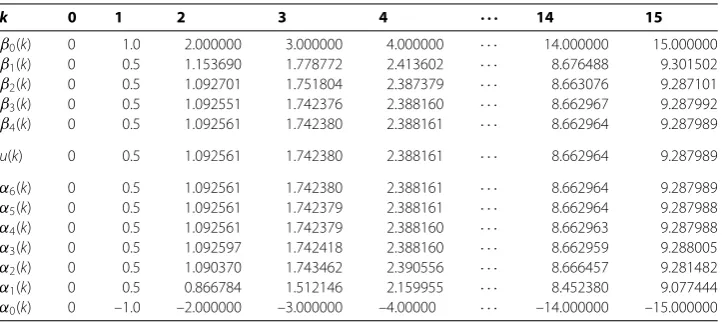
Table 1 Values of successive lower approximationsαn(k) and upper approximationsβn(k), n= 0, 1, 2, 3, 4, 5, 6
k 0 1 2 3 4 ··· 14 15
β0(k) 0 1.0 2.000000 3.000000 4.000000 · · · 14.000000 15.000000
β1(k) 0 0.5 1.153690 1.778772 2.413602 · · · 8.676488 9.301502
β2(k) 0 0.5 1.092701 1.751804 2.387379 · · · 8.663076 9.287101
β3(k) 0 0.5 1.092551 1.742376 2.388160 · · · 8.662967 9.287992
β4(k) 0 0.5 1.092561 1.742380 2.388161 · · · 8.662964 9.287989
u(k) 0 0.5 1.092561 1.742380 2.388161 · · · 8.662964 9.287989
α6(k) 0 0.5 1.092561 1.742380 2.388161 · · · 8.662964 9.287989
α5(k) 0 0.5 1.092561 1.742379 2.388161 · · · 8.662964 9.287988
α4(k) 0 0.5 1.092561 1.742379 2.388160 · · · 8.662963 9.287988
α3(k) 0 0.5 1.092597 1.742418 2.388160 · · · 8.662959 9.288005
α2(k) 0 0.5 1.090370 1.743462 2.390556 · · · 8.666457 9.281482
α1(k) 0 0.5 0.866784 1.512146 2.159955 · · · 8.452380 9.077444
α0(k) 0 –1.0 –2.000000 –3.000000 –4.00000 · · · –14.000000 –15.000000
where Ln– = min{–αn–(), . – αn–()}, Mn– = min{βn–(),βn–() – .}, kn– = min{Ln–,n–},pn–=min{Mn–,n–}and
P(k,u) =
k–
k+–max
s∈Z[k–,k]u(s)
– maxs∈Z[k–,k]u(s) k+–max
s∈Z[k–,k]u(s)
+
k–
k+–u(k)
– u(k) k+–u(k)
+
k–
k+–u(τ(k))
– u(τ(k)) k+–u(τ(k))
.
IVPs () and () are solved by a computer realization of the algorithm given in Sec-tion , and the results are given in Table . The obtained numerical results demonstrate the rapid monotonic convergence of both sequences.
Competing interests
The authors declare that they have no competing interests.
Authors’ contributions
All authors contributed equally in the preparation of this article. Both authors read and approved the final manuscript.
Acknowledgements
Research was partially supported by Fund Scientific Research MU13FMI002, Plovdiv University.
Received: 29 October 2013 Accepted: 27 January 2014 Published:31 Mar 2014
References
1. Wang, Q, Perc, M, Duan, Z, Chen, G: Delay-induced multiple stochastic resonances on scale-free neuronal networks. Chaos19, 023112 (2009). doi:10.1063/1.3133126
2. Perc, M: Spatial coherence resonance in neuronal media with discrete local dynamics. Chaos Solitons Fractals31, 64-69 (2007)
3. Ferraro, T, de Candia, A, Gamba, A, Coniglio, A: Synchronization transitions on small-world neuronal networks: effects of information transmission delay and rewiring probability. EPL83, 50008 (2008). doi:10.1209/0295-5075/83/50009 4. Wang, Q, Perc, M, Duan, Z, Chen, G: Synchronization transitions on scale-free neuronal networks due to finite
information transmission delays. Phys. Rev. E80, 026206 (2009)
5. Gelisken, A, Sinar, G, Kurbanli, A: On the asymptotic behavior and periodic nature of a difference equation with maximum. Comput. Math. Appl.59(2), 898-902 (2010)
6. Touafek, N, Halim, Y: On max type difference equations: expressions of solutions. Int. J. Nonlinear Sci.11(4), 396-402 (2011)
7. Yang, X, Liao, X, Li, C: On a difference equation with maximum. Appl. Math. Comput.181(1), 1-5 (2006) 8. Atici, FM, Cabada, A, Ferreiro, J: First order difference equations with maxima and nonlinear functional boundary
value conditions. J. Differ. Equ. Appl.12(6), 565-576 (2006)
9. Tisdell, C: On first-order discrete boundary value problems. J. Differ. Equ. Appl.12, 1213-1223 (2006) 10. Agarwal, R, Cabada, A, Otero-Espinar, V: Existence and uniqueness results forn-th order nonlinear difference
11. Jankowski, T: First-order functional difference equations with nonlinear boundary value problems. Comput. Math. Appl.59, 1937-1943 (2010)
12. Cabada, A: The method of lower and upper solutions for periodic and anti periodic difference equations. Electron. Trans. Numer. Anal.27, 13-25 (2007)
13. Cabada, A, Otero-Espinar, V, Pouso, V: Existence and approximations of solutions of first order discontinuous difference equations with nonlinear global conditions in the presence of lower and upper solutions. Comput. Math. Appl.39, 21-33 (2000)
14. Hristova, S, Golev, A, Stefanova, K: Quasilinearization of the initial value problem for difference equations with maxima. J. Appl. Math.2012, Article ID 159031 (2012). doi:10.1155/2012/159031
15. Atici, FM, Cabada, A, Ferreiro, J: Existence and comparison results for first order periodic implicit difference equations with maxima. J. Differ. Equ. Appl.8(4), 357-369 (2002)
16. Agarwal, R, Hristova, S: Quasilinearization for initial value problems involving differential equations with “maxima”. Math. Comput. Model.55(9-10), 2096-2105 (2012)
17. Bainov, D, Hristova, S: Differential Equations with Maxima. Taylor & Francis, CRC Press, London (2011) 18. Golev, A, Hrisova, S, Rahnev, A: An algorithm for approximate solving of differential equations with “maxima”.
Comput. Math. Appl.60, 2771-2778 (2010)
10.1186/1029-242X-2014-132