© 2016, IRJET | Impact Factor value: 4.45 | ISO 9001:2008 Certified Journal
| Page 581
Title: Improvements in Digital Watermarking Compression Techniques
Using Hybrid Transform
Name:Rashmi Chhabra (Contact Author)
M.Tech student at CSE Department, DCRUST, Murthal, Sonepat, Haryana, India.
Email: [email protected]
Dr. Anita Singhrova,
Professor at CSE Department, DCRUST, Murthal, Sonepat, Haryana, India.
Email: [email protected]
Abstract: Nowadays with the help or advantage of internet, large number of images is transmitted. Space of memory and capacity of channel are the main issues in the time of image broadcast. Therefore, image density (compression) shows a key part during transmission of image. As we know image compression is the procedure of removing the terminated data from the image so that individual important data can be put away to decrease the storage size, bandwidth transmission and time transmission. The important data is removed through numerous changes methods which can be restored without misplacing excellence and data of the input image. In this paper, the projected technique is associated with the level-1, level-2 and n level DWT-based image watermarking methods, through arithmetical constraints or parameter such as mean square error (MSE) and peak signal to noise ratio (PSNR). The simulation outcomes validate the watermark image removed using the projected method is invisible and the excellence of watermarked image and the improved image are recovered.
Keywords: Digital watermarking, DCT, DWT, Hybrid.
1. Introduction
The image compression reports the difficulty of decreasing the quantity of data compulsory to signify a digital image. It is a procedure that is proposed to produce a compressed illustration of an image, so dropping the image storing/broadcast necessities. Compression or Density is attained through the elimination of data redundancies. The foremost persistence of image compression is to decrease the termination and irrelevancy existent in the image, thus it can be deposited and removed powerfully. The compressed image is represented by less no. of bits compared to original. Hence, the compulsory storing dimension will be condensed, therefore determined images can be deposited and it can moved in nearer
technique to except the time, broadcast bandwidth. On behalf of this determination several compression methods i.e. scalar/vector quantization, difference encoding, analytical image coding, transform coding have been presented. Between all these, transform coding is maximum effective specifically at small bit rate [1].
2. Working of Digital Watermarking
Once mutual and numeral watermarking produces whole copyright communication and image tracking scheme for digital images. This scheme offers the tools and abilities to: embed digital watermarks into images, detect and read digital watermarks, link to comprehensive interaction specifics or a web site for the image maker or provider (for inquiring about practice rights, certifying, etc.) and track examples of numerically watermarked images on the web.
3. Discrete Cosine Transform (DCT)
DCT is applied separately on R, G and B mechanisms of the digital image. Discrete cosine transform is functional on the compressed image to further compress the image by choosing the DCT threshold value to 200. We have static (fixed) this value then we can also vary this value to change the results. Then DCT is useful on every module of the image.
Fig.1: Image compression model
© 2016, IRJET | Impact Factor value: 4.45 | ISO 9001:2008 Certified Journal
| Page 582
to superiority of rebuilt image, better mean square errorand better compression ratio. In a lossy compression method, during a step called Quantization, the less significant incidences are cast-off, and then the most significant frequencies that continue are used to recover the image in breakdown procedure [2]. After quantization, quantized coefficients are relocated in a zigzag instruction for more compressed by a well-organized lossy coding algorithm.
4. Discrete wavelet transform (DWT)
This method is a precise tool for hierarchically decomposing an image [3]. It is very valuable way for processing of non-stationary indications. The transformation is founded on small waves, called wavelets, of changing frequency and incomplete period. Wavelet transform delivers both frequency and spatial explanation of an image. Dissimilar conservative Fourier transform, temporal information is taken in this transformation procedure. Wavelets are produced by changes and openings of a secure function called mother wavelet.
DWT is the multi determination explanation of an image the decoding can be treated consecutively from a low-resolution to the higher low-resolution [4]. The DWT separations signal into high and low frequency fragments. The high frequency quantity covers information about the edge mechanisms, while the low frequency portion is fragmented over into high and low frequency parts. The great frequency components are typically used for watermarking since the human eye is less delicate to vagaries in edges [5].
5. Hybrid transform
The aim of image compression is to decrease the loading size with high compression and less loss of information. In section II and III we presented two different ways of achieving the goals of image compression, which have some advantages and disadvantages, in this section we are proposing a renovate method that will advantages of DCT and DWT, to become dense image. Hybrid DCT-DWT conversion gives extra compression proportion associated to JPEG and JPEG2000, preservative maximum of the image info and make good excellence of reassembled image. Hybrid (DCT+DWT) Transform decreases blocking artifacts, false contouring and pleasant result [6].
5.1 Coding scheme
It involves compression and decompression techniques described below in subsections.
5.1.1 Compression procedure
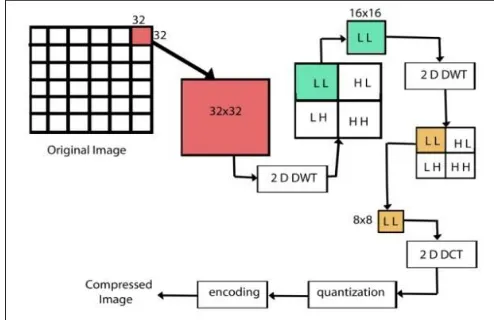
[image:2.612.323.570.322.482.2]The input image is first converted to gray image from color image, after this whole image is divided into size of 32x32 pixels blocks. Then 2D-DWT applied on each block of 32x32 blocks, by applying 2D-DWT, 4 specifics are created. Ready of four sub band particulars; estimate part/sub band is more distorted over by 2 D-DWT which provides added four sub-bands of 16x16 blocks. Beyond stage is monitored to decompose the 16x16 block of approached part to acquire novel set of four sub band/ specifics of size 8x8. The level of decomposition is depend on size processing block obtained initially, i.e. here we are dividing image initially into size of 32x32, hence the level of decomposition is 2. Subsequently getting four blocks of size 8x8, we use the approached particulars for calculation of discrete cosine transform constants. These coefficients are then quantize and send for coding.
Fig.2: Compression technique using Hybrid transform
5.1.2 Decompression procedure
© 2016, IRJET | Impact Factor value: 4.45 | ISO 9001:2008 Certified Journal
| Page 583
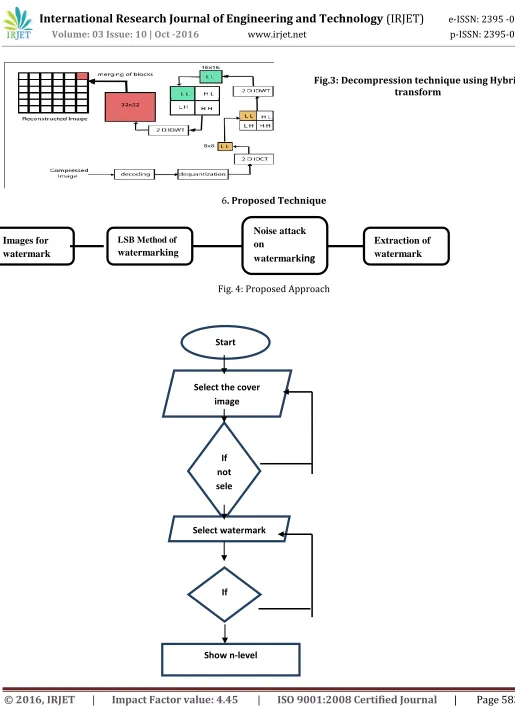
Fig.3: Decompression technique using Hybrid transform
6. Proposed Technique
[image:3.612.28.549.58.400.2]
Fig. 4: Proposed Approach
Images for watermark
LSB Method of
watermarking
Noise attack on
watermark
ing
Extraction of watermark
Start
Select the cover image
If not sele
Select watermark
If not
© 2016, IRJET | Impact Factor value: 4.45 | ISO 9001:2008 Certified Journal
| Page 584
[image:4.612.70.547.414.638.2]Fig. 5: Flow chart for the proposed approach
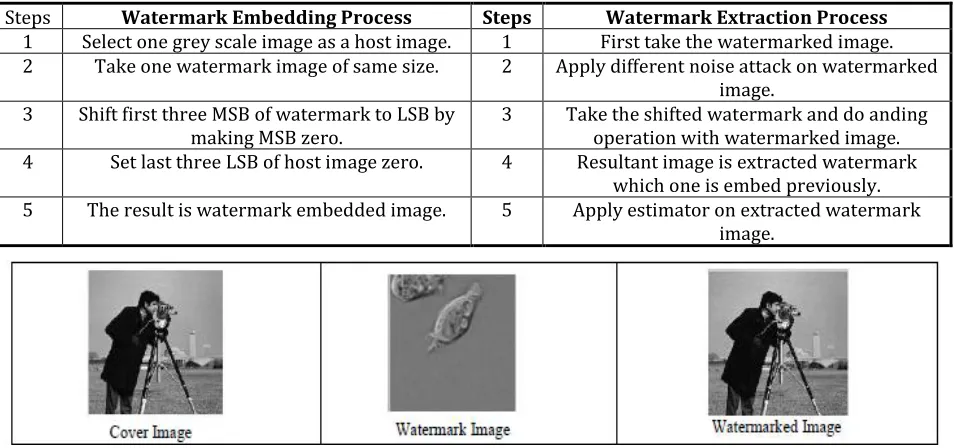
Table 1: Process of embedding and extraction
Steps Watermark Embedding Process Steps Watermark Extraction Process
1 Select one grey scale image as a host image. 1 First take the watermarked image. 2 Take one watermark image of same size. 2 Apply different noise attack on watermarked
image. 3 Shift first three MSB of watermark to LSB by
making MSB zero. 3 Take the shifted watermark and do anding operation with watermarked image. 4 Set last three LSB of host image zero. 4 Resultant image is extracted watermark
which one is embed previously. 5 The result is watermark embedded image. 5 Apply estimator on extracted watermark
image.
Fig 6: Cover, watermark and watermarked images
Show n-level watermarking image
Show watermarked image
Transmission
Extracted image
Finally extract
watermark
© 2016, IRJET | Impact Factor value: 4.45 | ISO 9001:2008 Certified Journal
| Page 585
7. Simulation results
In this section the simulation results for the proposed technique are presented. For demonstration purposes, , firstly a cover image thereafter a watermark image is considered, then cover image is removed at level-n, thereafter watermarked image at level n is extracted and at last watermark is extracted. After that image is mined using spatial density. PSNR and MSE is calculated at the time of extraction and embedding with their respective levels.
Peak Signal to Noise Ratio (PSNR) [5] is defined by the equation given below:
Where, I is allowable image pixel intensity level. For 8 bit per pixel image,
Mean Square Error (MSE) [5] is defined by the equation given below:
[image:5.612.324.604.201.416.2]Where, A = Original image of size M× N, B = Reconstructed image of size M× N
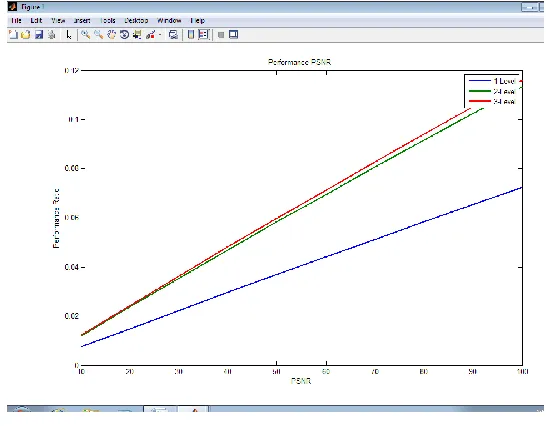
Fig. 7: Performance PSNR
In Fig. 7, PSNR is taken on x-axis and performance ratio on y-axis. The graph shows that PSNR increases at maximum
level of decomposition. Due to this, PSNR at level-3 is the highest.
[image:5.612.34.307.452.665.2]In Fig.8, MSE is taken on x-axis and performance ratio on on y-axis. As is noticeable, performance ratio is decreasing at maximum level of decomposition. So, MSE level decreases and due to that MSE is low at level-3.
Fig. 8: Performance MSE
8. Conclusion and future scope
In this paper we have examined an improvement of digital watermarking compression techniques using hybrid transform. The proposed method is successfully to improve image quality, security and embedding capacity by hiding text and extracting it again from the cover image by extraction and embedding method. The results obtained for the proposed technique are quite encouraging as PSNR, MSE level wise improved. The proposed algorithm can be used for real time applications such as video conferencing, telemedicine, where fast transmission is desired.
REFERENCES
[1] Muhammad AzharIqbal, Dr Muhammad Younus Javed, Usman Qayyum, “Curvelet-based Image Compression with SPIHT”, IEEE Computer society, International Conference on Convergence Information Technology, 2007.
© 2016, IRJET | Impact Factor value: 4.45 | ISO 9001:2008 Certified Journal
| Page 586
Scheme for Copy Right Protection”, IEEE Trans. SignalProcess, vo.l2, pp. 1- 8, 2006.
[4] X. Xia, C. Boncelet, and G. Arce, “A Multiresolution Watermark for Digital Images”, Proc. IEEE Int. Conf. on Image Processing, Oct.1997.
[5] D. Kundur and D. Hatzinakos, Digital Watermarking using Multiresolution Wavelet Decomposition, Proceedings, IEEE International Conference Acoustic, Speech, Signal Processing, 1998.
[6] Sriram.B, Thiyagarajans.S, “Hybrid Transformation technique for image compression”, Journal of theoretical and applied information technology, 31st July 2012 Vol. 41 No.2