© 2018, IRJET | Impact Factor value: 7.211 | ISO 9001:2008 Certified Journal | Page 2829 Abstract –In recent years, safety and eco-friendliness have
gained more of the attention of the automotive industries. These characteristics are important for the mass transportation vehicles, such as buses and coaches and also the economic aspects come to picture which try to reduce the operational costs of the fleet, by using vehicles with reduced fuel consumption.
The paper presents an attempt of enhancing the strength of the Volvo b9r bus frame structure with simultaneous reduction in structural weight by the use of Docol material considering Rollover. The present material Low Carbon steel is used as well as the Docol material is used and results are compared, where LS-Dyna is used as a FE solver.
Key Words: Weight reduction, bus structure, bus Rollover, LS-Dyna, ECE R66, Hypermesh.
1. INTRODUCTION
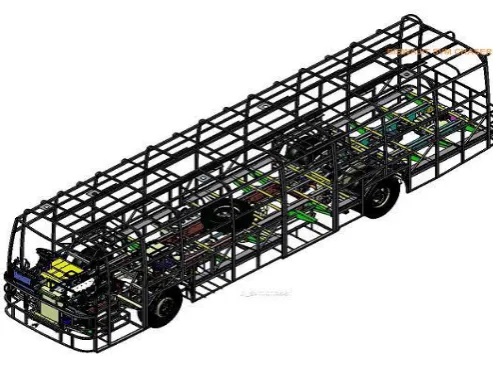
[image:1.595.309.556.208.391.2]The stakeholders on the nowadays automotive market have started to tackle with a design process that takes advantage of various non-ferrous materials available on the market, exploiting their specific properties. The main outcome of a multi-material design is a significant mass reduction and enhancements in structural mechanical properties. The figures, Fig 1.1 and Fig 1.2 show the Volvo B9R bus model and the Bus frame structure respectively.
[image:1.595.39.283.547.729.2]Fig 1.1: Volvo b9r bus model
Fig 1.2: Volvo bus frame structure
1.2 Problem Statement
The transit bus is an important part of public transportation, while in a bus rollover accident the deforming superstructure seriously threatens the lives of the passengers and the crew in the bus. Thus, bus rollover safety and how to design a bus superstructure with a good stiffness of vehicle frame is an important task for bus manufacturers. The legislation regulation number 66 of the Economic Commission for Europe (ECE R66) of bus rollover protection has been enforced for bus rollover protection. Strengthening the bus frame to maintain survivor space and reduce occupant injury is necessary following the issue of ECE R66, whilst lightweight structures in bus body design have also been highlighted.
© 2018, IRJET | Impact Factor value: 7.211 | ISO 9001:2008 Certified Journal | Page 2830 Fig 1.3: Rollover and fire failure of the bus structure
1.3 Material Information
Nowadays, products are manufactured for certain applications such as to overcome the corrosive conditions, Following are the materials used.
1.3.1 Low Carbon Steel
Low carbon steel is most regular type of steel because of moderately low cost and also gives good material properties. It has low tensile strength, however is cheap and can be easily formed. Carburizing can help increase its surface hardness. In cold-forming process, low carbon steels can be easily formed because of the less amount of carbon that is present in it compared to the steels. Low carbon steels are a better choice when it comes to larger cross sections utilized to reduce the deflection, where failure by yield is not a threat.
1.3.2 Docol
Metal coated Docol AHSS steels are advanced high-strength steels that are hot-plunge metal covered for corrosion assurance. Utilizing this material in structural and security components gives vehicles with reduced weight without ignoring people’s safety and corrosion resistance.
1.4 Objective of the project
The main objective of this project is to protect the Volvo B9R bus frame structure against the damage caused during the rollover; this can be achieved by introducing Docol material for the bus frame structure. The Docol material should take sufficient amount of load so that no potential damage is seen in any structural parts and at the same time it should be passing the safety standard criteria ECE R66/AIS 031.
Fig1.4: Considered points on the bus frame for ECE R66 test
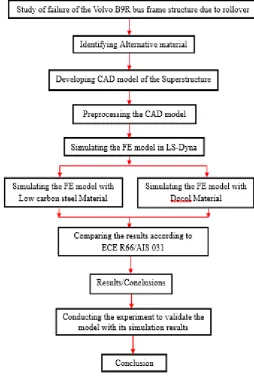
1.4 Methodology
© 2018, IRJET | Impact Factor value: 7.211 | ISO 9001:2008 Certified Journal | Page 2831 Fig 2.1: Overall dimensional view of Volvo b9r bus model
Design engineers have the great challenge of providing safety and economy with automotive design. Good roof
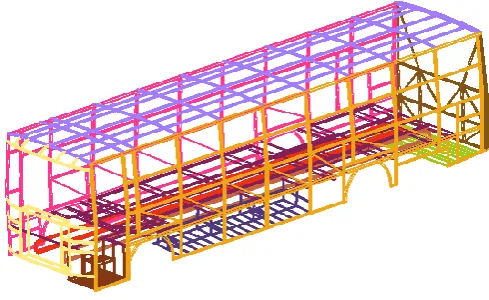
Fig 2.2: CAD model of the Bus frame/Superstructure
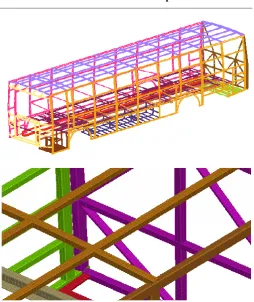
[image:3.595.49.286.174.713.2]The Side Frame, Top frame, Front frame, Rear frame and Bottom frame of the Bus superstructure are shown in below figures 2.3, 2.4, 2.5, 2.6 and 2.7 respectively.
Fig 2.3: Side frame of the bus superstructure
[image:3.595.311.556.626.726.2]© 2018, IRJET | Impact Factor value: 7.211 | ISO 9001:2008 Certified Journal | Page 2832 Fig 2.5: Front frame of the bus superstructure
Fig 2.6: Rear frame of the bus superstructure
Fig 2.7: Bottom frame of the bus superstructure
3. Finite Element Modelling
The development of the FE-model starts by importing the CAD model of the car from SOLID WORK to Hyper mesh. The assembled SOLID WORK model is exported to Hypermesh in .igs format. Meshing of CAD model is carried out. Fig 3.1 shows the complete meshed model of the superstructure. And it also shows the meshed rigid plate placed the bus roof, used for crushing the super structure.
Fig 3.1: Meshed Model of the Superstructure
4. Simulation & Results
Simulation is the process of product validation where the product is tested with defined boundary conditions and assumed parameters. The act of simulating something first requires that a model be developed; this model represents the key characteristics or behaviors/functions of the selected physical or abstract system or process. The model represents the system itself, whereas the simulation represents the operation of the system over time.
[image:4.595.42.285.449.575.2]Following figure 4.1 and 4.2 shows the standard global statistic data (GLSTAT) v/s time graph of different types of energy and their behavior.
[image:4.595.308.567.565.719.2]© 2018, IRJET | Impact Factor value: 7.211 | ISO 9001:2008 Certified Journal | Page 2833 Fig 4.2: Global energy curve plot for Modified Model
4.1 Simulation Results – Baseline Model (LOW CARBON STEEL)
[image:5.595.38.290.77.254.2]The below Fig 4.3 & 4.4 shows the behavior of super structure & strain percentage analysis carried out for baseline model in rollover conditions.
Fig 4.3: Baseline Model – Roll over Behavior
Impact @ Time 60 sec
[image:5.595.309.559.151.281.2]Fig 4.4: Baseline Model - Displacement
Fig 4.5: Modified Model – Roll over Behavior
[image:5.595.310.553.327.459.2]Impact @ Time 60 sec
Fig 4.6: Modified Model - Displacement
4.3 Comparison of Results
4.3.1 Superstructure Section Force
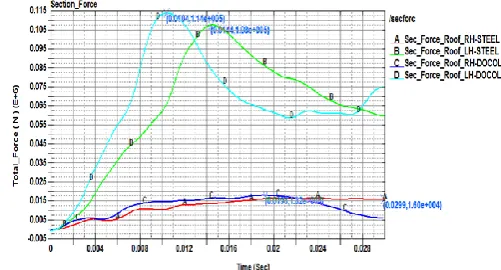
Model with Docol as material contributes force of 115 KN and 18.4 KN in superstructure during impact which shows it is having high resistance than the model with low carbon steel which contributing force of 108 KN and 16 KN.
[image:5.595.35.288.364.521.2] [image:5.595.306.557.596.731.2]© 2018, IRJET | Impact Factor value: 7.211 | ISO 9001:2008 Certified Journal | Page 2834 4.3.2 Internal Energy – Super structure of Bus
[image:6.595.313.558.116.258.2]Internal energy induced in the super structure of modified model is 28.5 KJ which is more than the baseline model which contributes 20.0 KJ. Indicating that modified model has high strength compared to baseline model.
Fig 4.8: Internal Energy Induced in the Bus Roof Structure
4.4 Validation
In this segment endeavor has been made to accept the outcomes acquired from reenactment by looking at the consequences of standard model.
4.4.1 Quality to Weight Ratio
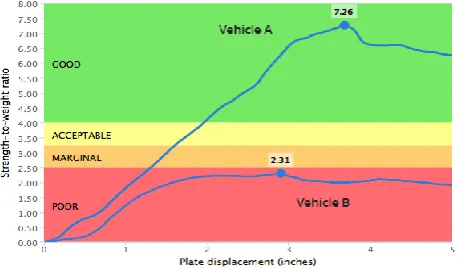
Quality to-weight proportion of no less than 4 is great rating. The rooftop must withstand a power of no less than 4 times weight of the vehicle.
The figure 4.9 shows sample results for two vehicles — one rated well and one rated poor. The Vehicle A is rated good, since that number is higher than 4 with its Strength-to-weight ratio of 7.26. The vehicle B is rated poor, since that number is lower than 2.5 with Strength-to-weight ratio of 2.31.
Fig 4.9: Standard SWR Force Chart – In Roll over Conditions
In the test of the 2010 Buick Lacrosse, the peak force is 19,571 pounds (84.5 KN) for a SWR of 4.90 which is a good rating (which is experimentally tested). Therefore comparing this result with the modified and baseline models,
[image:6.595.40.285.159.288.2]the SWR of both models is obtained. Fig 4.10 shows the calculation of SWR for roll over behavior.
Fig 4.10: Calculation of SWR – Roll over Behavior
The below table 4.1 shows the comparison of SWR of models. From the table, it is confirmed that baseline and modified models have good Strength-to-weight ratio rating. And modified model has more SWR compared to baseline model.
Table 4.1: Comparison of SWR of Models
Standard
model Baseline model Modified model
Strength to
weight ratio 4.90 6.26 6.80
4.4.2 Automotive Standard – ECE R66
Requirements for Approval:
1. The superstructure of the vehicle shall have the sufficient strength to ensure that the residual space during and after the rollover test on complete vehicle is unharmed.
- Superstructure of the vehicle for modified model with SWR is 6.80 which is satisfying the above standard requirement.
2. No part of the vehicle which is outside the residual space at the start of the test (e.g. pillars, safety rings, luggage racks) shall intrude into the residual space during the test. Any structural parts, which are originally in the residual space (e.g. vertical handholds, partitions, kitchenettes, toilets) shall be ignored when evaluating the intrusion into the residual space.
- Satisfying the above standard requirement. (Residual space has been maintained and not intruded by any other objects during impact.)
[image:6.595.305.555.369.447.2] [image:6.595.47.279.539.675.2]© 2018, IRJET | Impact Factor value: 7.211 | ISO 9001:2008 Certified Journal | Page 2835 Hypermesh v11 tool was used for meshing the complete
model and passed the quality criteria’s such as Quality Index, Skewness, warpage, Jacobian etc. The FE model is successfully analyzed using LS dyna software. And the results are plotted using LS Pre-post software.
By comparing the results of simulation with baseline and modified model it can be concluded that.
The intrusion of super structure is lower by 15.27 % due to use DOCOL material in super structure of bus.
Model with Docol as material contributes force of 115 KN and 18.4 KN in superstructure during impact which shows it is having high resistance than the model with low carbon steel which contributing force of 108 KN and 16 KN.
Internal energy induced in the super structure of modified model is 28.5 KJ which is more than the baseline model which contributes 20.0 KJ. Indicating that modified model has high strength compared to baseline model.
Modified model has increased SWR ratio by 8.63% that of base line model which concludes to have good strength to weight ratio rating.
By these conclusions we can say that the modified model with material HSS DS 16 DP (DOCOL) is more crashworthy compared to baseline model with Low Carbon Steel.
Future Scope / Recommendations:
The following are the future recommendations which can improve the crashworthiness of super structure in impact/ roll over load cases.
Reinforcement Optimization:
We can study & optimize the roof member, cant rail, window rail, waist rail & floor member to improve the crashworthiness of bus superstructure.
Number and Position of Pillars:
As the structural pillars absorb energy during roll over impact, it is necessary to optimize the no of pillars. More no of pillars will add unnecessary weight and less no of pillars will fail in roll over simulation.
Tubes Cross Section:
The strength of the structure is mostly depending on the cross section of the tubes used in the structure. If the bus is failing in rollover analysis, the strength of the structure can be increased by increasing cross section (Breadth, width or thickness) of crucial members in rollover analysis.
ACKNOWLEDGEMENT
I would like to thank Honorable Principal Dr. Basavaraj Katageri, Head of Department, Dr. S. F. Patil and my guide Asst. Prof. Ramesh H Katti, who have encouraged me and guided me and given valuable technical information.
REFERENCES
[1] Kyoung-Tak Kang, Heoung-Jae Chun, Jong-Chan Park, Wook-Jin Na, Hyoung-Taek Hong, In-Han Hwang, “Design of a composite roll bar for the improvement of bus rollover crashworthiness”, Composites: Part B 43 (2012) 1705–1713.
[2] Yuan Ren, Yongchang Yu, Binbin Zhao, Chuanhui Fan, He Li, “Finite Element Analysis and Optimal Design for the Frame of SX360 Dump Trucks”, Procedia Engineering 174 (2017) 638 – 647.
[3] D. Senthil Kumar, “Rollover Analysis of Bus Body Structure as Per AIS 031/ECE R66”, Volvo Group Trucks Analysis.
© 2018, IRJET | Impact Factor value: 7.211 | ISO 9001:2008 Certified Journal | Page 2836 [5] Javier Páez, Arturo Furones, Francisco Aparicio, Enrique
Alcalá, “Spanish frontal accidents of buses & coaches. Injury mechanism Analysis”, Social and Behavioral Sciences 160 (2014) 314 – 322.
[6] Ajinkya Patil, Prof. S.R. Pawar, “Rollover Analysis of Sleeper Coach Bus by Virtual Simulation in LS-DYNA”, ISSN: 2278 – 7798 International Journal of Science, Engineering and Technology Research (IJSETR) Volume 5, Issue 5, May 2016.
[7] A. Subic, J. He and S. Preston, “Modal Analysis of Bus Roll Cage structure for optimum rollover design”, Proceedings of SPIE - The International Society for Optical Engineering · January 1997.
[8] Patrizio Pelliccione et al. “ Automotive Architecture Framework: The experience of Volvo Cars”, Journal of Systems Architecture 0 0 0 (2017) 1–18. [9] Su-Jin Park, Wan-Suk Yoo, Yuen-Ju Kwon, “Rollover Analysis of a Bus Using Beam and Nonlinear Spring Elements”, Proceedings of the 9th WSEAS International Conference on Applied Mathematics, Istanbul, Turkey, May 27-29, 2006 (pp128-133).
[10] G. Gruben, O.S.Hopperstad, T.Børvik, “Evaluation of uncoupled ductile fracture criteria for the dual-phase steel Docol 600DL”, International Journal of Mechanical Sciences 62 (2012) 133–146.
[11] Dongun Kim, MyungHwan Cha, Yeon Sik Kang, “Development of the Bus Frame by Flexible Roll Forming”, Procedia Engineering 183 (2017) 11 – 16.
[12] Jakub Korta, Tadeusz Uhl, “Multi-material Design Optimization of a Bus Body Structure”, Journal of KONES Powertrain and Transport, Vol. 20, No. 1 2013.
[13] C. C. Liang & G. N. Le, “Lightweight optimization of bus frame structure considering rollover safety”, WIT Transactions on Ecology and The Environment, Vol 155, © 2012 ISSN 1743-3541.