© 2016, IRJET | Impact Factor value: 4.45 | ISO 9001:2008 Certified Journal | Page 909
Security Issues in Web Services
1
P.Dinesh,
2P.Joseph Charles,
3Dr.S.BrittoRameshKumar
1
M.Phil. Scholar, Dept. of Computer Science, St. Joseph’s college, Trichy Tamilnadu, India.
2
Assistant Professor, Dept. of Information Technology, St.Joseph’s college, Trichy Tamilnadu, India.
3
Research Advisor,Dept. of Computer Science, St. Joseph’s college, Trichy Tamilnadu, India.
Abstract:
Web service based on a set of Extensible markup language (XML) Standards such as Universal Description Discovery and Integration (UDDI), Web service Description Language (WSDL) and Simple Object Access Protocol (SOAP).Those techniques used to sharing information to people and business. Web services lies on internet application and it makes relationship among more resources with enterprises around the world. Making more data accessible with in the serious risk condition web services helps to exposed security issues of web services in a distributed environment are primary concern of this paper. Security risk are associated with manageable tasks focus on the privacy on data sharing.Keywords: Web Service, Authorization, Authentication, Security Issues.
I.
Introduction
Web services is a self-contained, self-describing and modular applications than can be described, published, location and invoked over a network.Web Services provide platform and written in programming language and it is newest incarnation of middleware for distributed. Computing SOA plays moves roles in web services. Service provider, Service requestor and service broker. Web Service form by technologies are XML, SOAP, WSDL, UDDI.
XML:Extensible Markup language was created as a structured self-describing data independent of application, protocol, XML overcome the limitations of HTML and is poor at what data to be presented and good at how to be presented.
SOAP:Simple object Access protocol used to communication among different web services. SOAP was created to transport XML via a number of standard transport protocol.SOAP message having three parts
SOAP envelop is used to encapsulate SOAP message. SOAP header is optional part of SOAP protocol. Body has message authentication and routine.
WSDL:Web Service definition language is used to describe the function able of service. XML Language defines input and output of web services. WSDL is explains service to interact and invoking it. It describe validate and simple method provide digital signature for requester to use. Requester cannot connect form of provider authentication.
UDDI: Universal description discovery and integration is used as requesting of information for web services. It used to publish and discover information UDDI bring to discover available and interact dynamically.Web Services provides interoperability across security policy domains. Web services so challenging in business to business (B2B) and business to consumer (B2C) security encompassed equipment deployment, authenticating users, guarding data so that users only see what they should see, tracking user activity.
II.
Review on literature
Anjali Nair et al[1] prosed system single sign on has security and user benefits. SSO allows a user to use single account to access multiple functions provided within that website. Many web technology companies are using this technique it helps user memorize only one password and reduce the cost too. Authentication help user to access multiple services by using user profile details of user.
In SSO authentication protocol three characters plays vital role.
User agents: end user (or) user browser Relying party: Destination website
© 2016, IRJET | Impact Factor value: 4.45 | ISO 9001:2008 Certified Journal | Page 910
Author follows eight logic flaws in SSO system RP developer carelessness Due to the API
Communication problem
Integrated services in a single website. Simplified web developing platform. Platform used for execution.
Weak authentication User session expire
BRM Analyzer: discuss the logic flaws using an automatic tool namely the BRM analyzer. These tools depend upon black box testing the analyzer messages it modifies http request and responses. For decoding, deciphering using Firefox debugging tool firebug and fiddler are used.
This analyzer works on 3 stages:
I stage: Syntactic Labeling stage
II stage: Semantic Labeling stage
III stage: Adversary accessibility labeling stage
Author also compares with other tools and protocols some models are Millen’s model; NRL analyzer & BAN logic using SSO mechanism is helpful as memorize only one password and can be able to access many account.
Wuhuichen et al[2] proposed system on privacy issues in SOAP Message Exchange Pattern for Social Services. The World Wide Web consortium (WSE) published a document called Web Service Architecture (WSA) Requirements. It describe mathematical model to construct the privacy policies in SOAP Message Exchange Patterns (MEP) for social services.
Enterprise Privacy Authentication Language(EPAL) technical specification is used to formalize privacy authentication for actual enforcement within an intra or inter enterprise for peer-to-peer privacy control. SOAP services handle privacy between data objects and data collections. Author describe a scenario based on services on WSA is the first important step to develop a technical framework for supporting web services privacy policies. P3P specifications are designed for internet use of personal information on websites.
Referring to the SOAP message framework forwarding intermediaries and active intermediaries. The security tokens represent a collection of claims like name, identify, privilege and capability. They are used for the security
services such as authentication (or) authorization. In web services DASIS propose an XML Language called security servers for requesting authorization decisions. It provides quality of protection through message integrity, message confidentiality & single message authentication. Author discusses different privacy policies in the research issues in WSA context of social service and with SOAP privacy policies in security tokens.
Sundeukkim et al[3] proposed approach that share certificates securely without modification of the existing standard certificates study that implemented the certificate share system(CSS) in a Virtual Private Network(VPN).
CSS provides strong end-to-end data security for certificate with a key size of 192 bits. It provides data security on physical devices. CSS provides flexible and extensible system for sharing certificates in enterprise environments. To provide secure remote access to business services, secure authentication system need to be activated. Two-factor authentication (TFA or 2FA) used for security sensitive system.
TFA requires two means of certification, one of which is typically a physical token. Some two factor authentication such as public key infrastructure (PKI), certificates, X.509, X316 chameleon, SMS.
CSS proposed in this paper provide security and focus on the certificate authentication. It allows user to share X.509 certificate on PC. Sharing certificate between a smart phone and a PC in operable at single store.
Fengming Liuet al[4] evaluate model based on trust on small-world networks based on trust relationship of service entities, and this model with service logic. In web service architecture host web service and application. Web service broker (SB) make the services accessible globally and a web service requestor (SR) associates web service operations. Trust is relates to a web service measurement based on its perceived trust and reliability in given period. It provide services are protected control access to authorized users in restricted fields and events.
Trust framework proposed by following attributes.
(1) Improve logic on simple world by adapting time value.
(2) A centralized framework, invoked trust values and stored by SP or SR.
© 2016, IRJET | Impact Factor value: 4.45 | ISO 9001:2008 Certified Journal | Page 911
Trust provide security protection for service fromprevent against malicious service. In subjective logic contains some operations proposed in TARS model. Trust computation and trust usage is used to improve application security. It can handle future security issues in web services. A high quality service provider yields higher trust scores and aware of quality of services increase trust values finally it improves performance by detection capability and scalability.
Simone one cirani et al[5] proposed a system OAuth- based authorization service architecture for secure services.It is based on the representational state transfer (REST) web architecture.An architecture targeting HTTP/COAP services.Oauth-based authorization services. (OAS) IoT -OAS architecture meant to be flexible highly configurable and easy to integrate with previous services.
Some benefit of IoT are a lower processing load,where access control implemented on the smart object,remote customization of access policies and scalability.Open authorization(OAuth)is an open protocol to allow secure authorization from the third party application in a simple and standardize way.OAuth protocol impact on processing and scalability.it provide for message authentication,integrity checks and digital signature.
Security mechanism IoT including symmetric and asymmetric cryptographic algorithms,hashing function,security protocol at network transport/transport layer/application layer.
Some work focused on accessed control strategies:
Discretionary access control(DAC) Role based access control(RBAC) Attribute based access control(ABAC)
IoT-OAS architecture invoke smart object raise security issues.A trust relationship between a smart object and the IoT-OAS.
Some action on security issues:
Make the handshake to minimize packet fragmentation.
Define OAuth protocol in a contained manner. Define cryptography suites for the security
protocol by integrating lightweight cryptographic algorithms.
Other security aspects in small object are
Denial of service(DOS) Man in the middle(MITM)
Physical/threats in public are remote areas
Benefits on OAuth services:
1. Reducing the time required by service developers.
2. Support OAuth application on client side seamlessly.
3. Limited device complexity
Joseph.Hernandoz-Ramos et al[6] proposes a set of light weight authentication and authorization mechanism in order to support smart objects. A Framework for Security with ARM (ArchitecturalReference Model). Internet protocol to mere officials, interoperable and light weight versions: current security mechanism satisfy interoperability, lightness and end-to-end satisfy Authentication and Authorization for constrained Environment) ACEWG is used to develop authentication and authorization. An Authentication and key implemented based on Datagram Transport Layer Security (DTLS).
3 bootstrapping security protocols are
(1) Protocols for carrying Authentication for Network Access(PANA)
(2) HIP Diet Exchange(HIP-DEX). (3) 802.1X
ARM Framework includes authentication and access control provide cryptographic elements and security credentials. This project focused on Architectural Reference Model (ARM) to optimize interoperability. Authentication keys are Master Session Key (MSK) and an ExtendedMaster Session Key (WMSK).
1) ACE WG environments:
Client device(C). Server device(RS).
2) EAP Authentication.
3) EAP Server
4) Authorization Server (AS)
© 2016, IRJET | Impact Factor value: 4.45 | ISO 9001:2008 Certified Journal | Page 912
In Future work is focused on proposed work into the IETCACE WG standard-based alternative mechanisms called PANA.
Alex Q.Chen et al [7] Proposed technique to enhance Security called 2FA(Two Factor Authentication). This authentication factor that reduce user a device interactions and improving integrity of the security and usability of 2FA.
2FA used for improving security in service providers with minimum cost. CAPTCHA is model improving integrate and reduce the system firewalls.
Authentication Model describes the information by
(1) What the user knows (2) What the user possesses (3) What the user inherently
2FA model initiate factor to requesting one time password OTP algorithm published by informed and internet standard RFCs
2FA implementation was developed by collecting phantom application. An evaluation made using mobile phone there 3 procedures.
1) The OTP is sent sms.
2) OTP is generated by token device.
3) Using approach to automate 2FA via a wearable device.
This system investigation focus primary and usability using 2FA technniques.2FA model namely possess to use of wearable, to remove users need and interaction. It benefitting is adopt to security on mobile devices and enable in group of users.
Jan Vossaert et al[8]present a solution to handle both password management problem and protect from malware running on environment from stealing user’s credentials. From these mechanism username and password stored in other device and provide authenticated session to the workstation. This service provide two factor authentication(2FA) the password protected by encrypted key and it generated from master password and it also having cryptographic hash on a combination of sets.
Requirements for thus design of system:
R1: User process the web service with username/password without a credentials.
R2: No modification required in password based authentication.
R3: No particular solution for authentication in workstation.
These system provide protocol for the authentication to access through remote users. An Authentication protocol access via user request.
The user can start the authentication protocol by selecting in the login HTML page of service provider by the default plugin. A plugin as input fields for a login page.
An Evaluation carried towards the services provider to satisfy the requirement of the prototype. Some security evaluation are formed to identify the level of security mechanism.It prevents that users credentials are submitted to an untrusted party. Main aim to provide standard password based authentication system and implemented protocol to found the compatible service.
Do van Thanhe et al [9] Proposed system to delivering strong authentication for services with mobile universal identity. Mobile network proposed many protection mechanism Subscriber Identity Module (SIM) host the International Mobile Subscribe Identity (IMSI) and uses advanced cryptographic function for authentication in mobile network.
IMSI is private identifier standard in every mobile network used in authentication of the subscriber for protection SIM and IMSI uses credentials secret key ki,
PIN and PUK (Personal unblock code) are stored in UICC (Universal Integrated Circuit Card).
GSM authentication uses of a challenge –response mechanism UMTS authentication allows the scheme to enables AUTN verification of the authenticity of mobile network and response time.
There 2 different cases subscriber is not the user’s
One subscriber may have multiple subscription distributed to multiple users.
One user can have multiple subscription and appear like multiple subscribers.
© 2016, IRJET | Impact Factor value: 4.45 | ISO 9001:2008 Certified Journal | Page 913
In mobile phone enrollment process follows a requestorprocedure to register phone with secure authentication system. Using the password (e.g.) One Time Password(OTP) at mobile can be enrolled as authentication token.
In Mobile universal Identity components are
Identity Provider (IDP): In charge for authentication and authorization.
Radius Server: Standard server
MAP gateway: Used to interface two ends to communication.
WAP gateway: Allows access to internet to mobile devices.
Universal identity authentication proposed to ensure feasibility and usability tested by performing connecting devices.
William R.Simpson et al [10]: Proposed authentication uses TLS protocols above transport layer on the internet protocol such WS-Security, WS-Federation and WS-Trust uses public key infrastructure credential for authentication based on Enterprise Level Security (ELS).
Passive entities: Information packages, static files and data structure
Active entities: Change (or) Modify passive entities provide users, hardware and services.
Communication requires bi-lateral, public key infrastructure (PKI), end to end authentication.
Credential are used in enterprise in order to preform authentication. It includes certificates, Kerberos tickets and hardware tokens. Authentication established by receiving, validating and verifying the identity credential.
The two way authentication (The requestor authenticates the provider and the provider authenticates the requestor).
In certificate credential the enterprise issued X.509 certificates used to authentication and authorization services. The certificate credential for an entity contain enterprise- unique and persistent identifier service called Universally Unique Identifier (UUID) standard.
For registration maintains 3 main issues
Kerberos tickets
Authentication and attributes assertion token Interoperability of credentials
Authentication on enterprise supports: Kerberos based and Direct PKI
Device and Services Authentication PKI
User initial Authentication to services authentication
Service to service Authentication
TLS checked for certification exchange and encryption OSSP (Online certificate Status protocol) obtaining x.509 digital certificate.
In federated authentication PKI certification present to meet the authority.The authentication claim- based process includes SAML for authorization for identity verification.
[image:5.612.316.582.403.703.2]III.
Comparison of Security Techniques
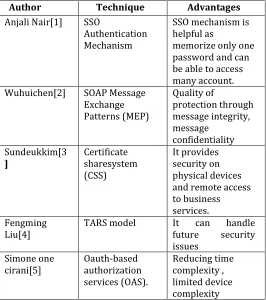
Table 1: Comparison of security techniques
Author Technique Advantages
Anjali Nair[1] SSO
Authentication Mechanism
SSO mechanism is helpful as
memorize only one password and can be able to access many account. Wuhuichen[2] SOAP Message
Exchange Patterns (MEP)
Quality of
protection through message integrity, message
confidentiality Sundeukkim[3
] Certificate sharesystem (CSS)
It provides security on physical devices and remote access to business services. Fengming
Liu[4] TARS model It future can security handle issues
Simone one
cirani[5] Oauth-based authorization services (OAS).
© 2016, IRJET | Impact Factor value: 4.45 | ISO 9001:2008 Certified Journal | Page 914
Joseph.Hernandoz-Ramos[6] Framework for Security with ARM
(Architectural Reference Model)
Low power, interoperability
Alex Q.Chen[7] 2FA (Two Factor Authentication)
Reduce user device interaction and improving integrity of the security, minimal cost. Jan
Vossaert[8] 2FA (Two Factor Authentication)
Provide compatible web service, recover password mechanism Do van
Thanhe [9] Advanced cryptographic function for authentication in mobile network
Provide strong authentication in mobile network.
William
R.Simpson[10] Uses public key infrastructure credential for authentication based on Enterprise Level Security (ELS).
Provide secure mechanism in device and service authentication, interoperability.
IV.
Conclusion and future work
In this review takes security issues like authentication in web services and its techniques. Security mechanism is essential environment for protecting the user data. Privacy awareness is most important factor in authentication and authorization helps to secure the information form the unauthorized users. It focus on the privacy and access control. In distributed world it’s hard to secure data in sharing. This review some authentication principles are discussed furthermore it has to enhance in future works are implement with more authentication mechanisms, mechanisms based on evolutionary algorithms, universal authentication framework with suitable protocol and elaborate model in international network.
References
[1] Anjali Nair, ArunMadhu, Dr.Jublian J kizhakkathottam “
Security issues of Single sign on web services” 2015 International Conference on SoftComputing and Network Security (ICSNS -2015), Feb. 25 – 27, 2015, Coimbatore,india.
[2] Wehuichen, Incheon paik, Patrick C.K hung
“Privacy issues in SOAP Message Exchange pattern for Social services” FundamentaInformaticae 137 (2015) 253–271.
[3] Sundeunkim, Hyum-taek oh, Young-Gabhim “Certificate sharing System for secure certificate distribution in mobile environment” pp.67-77 (2015)
[4] Fengmingliu, li wang,lei gao,Haixiali, Haifenzhao,soakkhim men “A web Service trust evaluation model based on small world network” pp.161-167(jan 2014)
[5] Simone cironi, Marcovicone, Pietro gonizzl, Luca veltri and Gianluigi Ferrari “IoT-OAS:An OAuth-Based Authorization service Architecture for Secure services in IoT scenarios“ IEEE Sensors jornal,Vol 15 feb 2015.
[6]JoseL.hernandez-Ramos,MarcinP.Pawlowski,AntonioJ.jara,AntonioI.Skermeta and Latif Ladid “Toward a light weigh Authentication and Authorization Framework for smart object” IEEE journal on selected Areas in communication 2015
[7]Alex Q.chen and wihen Goh “Two Factor Authentication Made easy” ICWE 2015, pp 449-458
[8] Jan vossaert,Jornlapon and Vincent Naessens “Out of Band Password Based Authentication toward web services” pp 181-191 Springer International Publishing Switzerland 2014
[9] Do van Thanhe, Ivar Jorstad and Do van thuan “Strong Authentication for web Srvice with Mobile Universal identity” mobiwifi 2015, LNCS 9228, pp 27-36, 2015.