© 2016, IRJET | Impact Factor value: 4.45 | ISO 9001:2008 Certified Journal
| Page 1501
PAPR Reduction for MIMO-OFDM Systems using SLM without SI
P.Srutha Keerthi
M.Tech Student (wireless and mobile communications),
Department of ETM,
GNITS, Hyderabad, Telangana,
India.
[email protected]
---***---Abstract -
Selected mapping (SLM) is an effectivetechnique for addressing high peak-to-average power ratio (PAPR) issues in orthogonal frequency division multiplexing (OFDM) systems. However, the standard SLM approach introduces additional data decoding challenges in the form of side information (SI) transmission and estimation. In general, SI transmission reduces data throughput and SI estimation normally involves computationally complex procedures, which can increase design costs. To eliminate the need for both SI transmission and SI estimation, this paper presents an investigation into the PAPR reduction and BER performance of a new technique based on a modified SLM approach and also implementing with MIMO technology. It is shown that the proposed method simplifies data decoding through SI cancellation without SI transmission and by using MIMO channel capacity and spectral efficiency is improved. Results show that the proposed method produces similar PAPR reduction performance and BER performance as standard SLM based OFDM system, which presumes perfect SI estimation.
Key Words: orthogonal frequency division multiplexing (OFDM), selected mapping (SLM), side information (SI) estimation,peak-to-average power ratio (PAPR),multiple input multiple output(MIMO).
1. INTRODUCTION
Orthogonal Frequency Division Multiplexing (OFDM) is a digital multi-carrier modulation scheme that extends the concept of single subcarrier modulation by using multiple subcarriers within the same single channel. Rather than transmit a high-rate stream of data with a single subcarrier, OFDM makes use of a large number of closely spaced orthogonal subcarriers that are transmitted in parallel. Each subcarrier is modulated with a conventional digital modulation scheme (such as QPSK, 16QAM, etc.) at low symbol rate. However, the combination of many subcarriers enables data rates similar to conventional single-carrier modulation schemes within equivalent bandwidths. OFDM is based on the well-known technique of Frequency Division Multiplexing (FDM).
The OFDM scheme differs from traditional FDM in the following interrelated ways:
1. Multiple carriers (called subcarriers) carry the information stream,
2. The subcarriers are orthogonal to each other, and
3. A guard interval is added to each symbol to minimize the channel delay spread and inter symbol interference.
Orthogonal frequency division multiplexing (OFDM) is the adopted technology in high speed wireless broadband communication systems including Long Term Evolution (LTE), Digital Video Broadcast (DVB), Wi-Fi and IEEE 802.16 d/e standards, because it offers high data transmission, but unfortunately, it suffers from the problem of high peak-to-average power ratio (PAPR) [1]– [3]. This high PAPR signals often occur at some time instants when there is coherent summation of phases of individual OFDM subcarriers, resulting in peak amplitude signals [4].
High PAPR levels introduce signal distortion by forcing non-linear operation of power amplifiers (PA) in OFDM transmitters; this increases the bit-error-rate (BER) and thus degrades system performance [5]-[7]. In theory, this PA induced distortion may be eliminated by designing a PA with a large linear region [8]. However, this is impractical because PA’s with a large linear region are expensive and often result in poor PA efficiency [9]. This leads to increased power consumption and increased heat dissipation, which reduces battery life of user equipment (UE) terminals. In addition, high PAPR levels require higher resolution specifications of digital-to-analogue (D/A) and analogue-to-digital (A/D) devices, which further increases design costs, and may also put additional constraints on system design [10].
© 2016, IRJET | Impact Factor value: 4.45 | ISO 9001:2008 Certified Journal
| Page 1502
requires additional system resources and also introducesadditional implementation challenges. In general, SI estimation are prone to errors, particularly in the presence of severe fading channel conditions, and also require highly computationally complex procedures.
To eliminate these two challenges i.e. SI transmission and SI estimation, this paper presents a modified SLM approach that facilitate joint PAPR reduction and data decoding without the need for both SI transmission and SI estimation, in a pilot-assisted OFDM system. Simulations will show that the proposed method produces comparable PAPR reduction and BER performance as the conventional SLM-OFDM method, which presumes perfect SI estimation at the receiver.
The rest of this paper is structured as follows. The slm with and without si based on the pilot-assisted ofdm system are described in Section 2. Section 3 explains the proposed approach and Section 4 shows the simulation results. Finally, a conclusion along with future scope draws in Section 5.
2. SLM WITH AND WITHOUT SI BASED ON THE
PILOT-ASSISTED OFDM SYSTEM
In this section the outline structure of the standard SLM based on the pilot assisted OFDM system. In pilot-assisted OFDM, the pilot symbol phase is coded with that of the data symbols and the data recovered through reverse operation at the receiver side. In this section the comparison between standard SLM and SLM without SI is mentioned to eliminate the need for SI transmission and SI estimation. At the transmitter side, consider an OFDM sequence X consisting of Nv subcarriers. Assuming a pilot-assisted OFDM, this OFDM sequence X may consists of Nd data and Np pilot components such that Nv = Nd + Np. For 0 ≤ n ≤ N − 1 where N represents the length of a time-domain OFDM signal x[n], expressed by
x[n] ∑Nv X[k]exp j NnK
k (1)
By using length of a time-domain OFDM signal calculate PAPR by using equation 3.
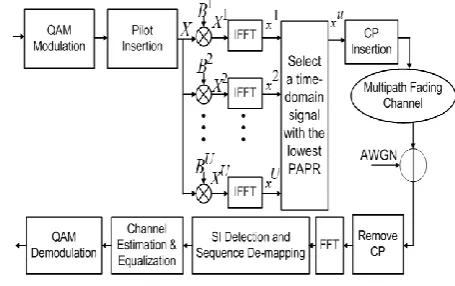
Fig -1: SLM in Pilot-assisted OFDM
Fig. 1 shows a block diagram representation of an SLM based pilot-assisted OFDM (SLMOFDM) system. Let Buc[l] = Bu[k] represent a set of SLM phase rotation sequences for u = 1, 2, . . . U where U is the number of SLM sequence vectors and ‘l’ and ‘c’ represent the arbitrary phase indices and ‘k’ is the subcarrier symbol . SLM creates U alternative OFDM signals from which one of the modified signals with the lowest PAPR value is selected for transmission [13].
At the receiver side, consider an OFDM transmission over a multipath fading channel with frequency response H[k]. After the implementation of SLM, the received OFDM sequence isY [k] and V [k] represent a complex-valued additive white Gaussian noise (AWGN) component. Let ˆu represent an SI estimate, then in the case of perfect SI estimation i.e. ˆu = ¯u. The initial stage of the data decoding process in an SLM based OFDM receiver normally involves using the value of ˆu for sequence de-mapping. Assuming a true flat (frequency non-selective) fading channel condition where
Hc[ld] ≈ Hc[lp] ≈ Hc (2) In the SI detection, the difference between the two blocks is calculated. Channel estimation is mainly used for improving channel capacity. Channel equalization can be achieved through a subcarrier level (i.e. element by element) division procedure. This division process cancels out the phase term, without the need for the receiver to know its value. Therefore, SI cancellation is possible because the modulating phase component is common to all subcarriers in each cluster; thus successful data recovery is achieved without SI estimation at the receiver or separate SI transmission Therefore, Even though channel estimation (through interpolation) is not required since the considered channel is frequency non-selective, SI estimation is however still necessary, to enable successful data reception in this channel condition.
3. PROPOSED METHOD
[image:2.595.344.572.105.248.2]© 2016, IRJET | Impact Factor value: 4.45 | ISO 9001:2008 Certified Journal
| Page 1503
proposed technique, we propose that the peak bit rate isfurther improved by smart antenna arrays for multiple-input multiple-output (MIMO) communications Multiple-input multiple-output (MIMO) wireless technology. In MIMO-OFDM system, a number of antennas are placed at the transmitting and receiving ends and the distances are separated far enough.
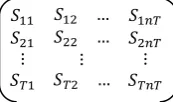
The idea is to use spatial multiplexing and data pipes by developing space dimensions which are created by multi transmitting and receiving antennas. The bandwidth of the transmitted signal is so narrow that its frequency response can be assumed as being flat. The signaling schemes used in MIMO systems can be roughly grouped into spatial multiplexed, which realizes the capacity gain and space time coding which improves link reliability through diversity gain. An STBC is usually represented by a matrix. Each row represents a time slot and each column represents one antenna's transmissions over time.
Fig -2: code matrix of STBC coding
Here, sij the modulated symbol to be transmitted in time slot ‘i’ from antenna ‘j’. There are to be ‘T’ time slots and ‘nT’ transmit antennas as well as ‘nR’ receive antennas. This block is usually considered to be of 'length' T. The code rate of an STBC measures how many symbols per time slot it transmits on average over the course of one block. If a block encodes ‘k’ symbols, the code-rate is r = .
The main advantage of using MIMO-OFDM system include high power spectral efficiency, robustness to channel fading, immunity to impulse interference, uniform average spectral density, capability of handling very strong echoes, lesser nonlinear distortion and use of small guard intervals.
A.PEAK-TO-AVERAGE POWER RATIO
Sometimes, the peak power exceeds the system average power value is termed as Peak To Average Power Ratio. Mathematically PAPR can be given as:
| [| |]| (3)
Where | |
the peak is signal power and
[|
|]
is the average signal power. The averagepower is calculated using the formula:
Average power= (4)
The Complementary Cumulative Distribution Function (CCDF) of the PAPR is one of the most frequently used method to check how often the PAPR exceed the threshold values. Graph is plotted among threshold and CCDF values. The CCDF can be calculated by the relation
P (PAPR>X) =1-P (PAPR<X).
The formula for calculating the threshold value is:
(5)
Reducing the peaks in the OFDM signal also helps to reduce the transmitted average power. High PAPR implies that except when some form of transformation is applied, it will be impossible to contain all the signal within the dynamic range of the transmitter, without lower/upper level clipping. On the other hand, operating the transmitter into its saturation region to accommodate all the signal swing is highly undesirable. This will result in spectral growth in the form of intermodulation among subcarriers and consequently, error performance degradation. The pilot-assisted PAPR reduction technique results in higher reduction in PAPR for high order constellations than the classical SLM [14].
4. SIMULATION RESULTS
In this section, results are compared between standard SLM and SLM without SI in OFDM system for PAPR reduction and BER, MIMO-OFDM system for PAPR reduction. MATLAB simulation was performed. The simulation parameters are:
Input is a randomly generated and also randomly generated phase sequence, and modulation technique is 16-psk modulation. The PAPR is measured by evaluating the well-known complementary cumulative distribution function (CCDF).
[image:3.595.118.205.333.384.2]© 2016, IRJET | Impact Factor value: 4.45 | ISO 9001:2008 Certified Journal
| Page 1504
Chart-1: Plot for comparison between SLM ,SLM withoutSI and OFDM system.
Chart-2: BER comparison between the SLM and SLM without SI.
Chart-3: PAPR comparison for the proposed method.
5. CONCLUSIONS AND FUTURE SCOPE
In this paper, we introduced a modified SLM-OFDM approach, which facilitates joint PAPR reduction and data decoding (over a flat fading channel), without the need for SI estimation or SI transmission, thereby resulting in a significant reduction in the complexity of OFDM receivers. By implementing in the MIMO method, the channel capacity is increased. The proposed method achieves comparable PAPR reduction performance as SLM. In addition, the proposed method produces similar BER performance when compared to standard SLM based OFDM system, which presumes perfect SI.
The future work may be, the proposed can be extended to the receiver side, BER can be analysed by using different modulation techniques. Though proposed approach assumed a flat fading channel condition, it may be extended to enable data decoding in the presence of frequency selective fading channel.
REFERENCES
[1] T. Jiang, C. Ni, and L. Guan, “A Novel Phase Offset SLM
Scheme for PAPR Reduction in Alamouti MIMO-OFDM Systems Without Side Information,” Signal Processing Letters, IEEE, vol. 20, no. 4, pp. 383–386, April 2013.M. Young, The Technical Writer’s Handbook. Mill Valley, CA: University Science, 1989.
[2] S. Adegbite, B. G. Stewart, and S. G. McMeekin, “Least
Squares Interpolation Methods for LTE System Channel Estimation over Extended ITU Channels,” International
Journal of Information and ElectronicsEngineering, vol.
3, no. 4, pp. 414–418, July 2013.
[3] J. Armstrong, “OFDM for Optical Communications,”
Lightwave Technology, Journal of, vol. 27, no. 3, pp. 189–204, Feb 2009.
[4] [4] N. I. Miridakis and D. D. Vergados, “A Survey on the
Successive Interference Cancellation Performance for Single-Antenna and Multiple-Antenna OFDM Systems,” Communications Surveys Tutorials, IEEE, vol. 15, no. 1, pp. 312–335, 2013.
[5] [5] S. A. Adegbite, S. G. McMeekin, and B. G. Stewart,
“Performance of Fibonacci-Binary Sequences for SLM based OFDM Systems,” WSEAS Trans. on Communications, vol. 13, pp. 486–496, July 2014.
[6] [6] T. Jiang, M. Guizani, H.-H. Chen, W. Xiang, and Y.
Wu, “Derivation of PAPR Distribution for OFDM Wireless Systems Based on Extreme Value Theory,” Wireless Communications, IEEE Transactions on, vol. 7,no. 4, pp. 1298–1305, April 2008.
[7] [7] S. Dimitrov, S. Sinanovic, and H. Haas, “Clipping
Noise in OFDMBased Optical Wireless Communication Systems,” Communications, IEEE Transactions on, vol. 60, no. 4, pp. 1072–1081, April 2012.
[8] [8] H. Ochiai and H. Imai, “On the distribution of the
© 2016, IRJET | Impact Factor value: 4.45 | ISO 9001:2008 Certified Journal
| Page 1505
Communications, IEEE Transactions on, vol. 49, no. 2,pp. 282–289, Feb 2001.
[9] [9] “Performance analysis of deliberately clipped
OFDM signals,”Communications, IEEE Transactions on, vol. 50, no. 1, pp. 89–101, 2002.
[10] [ ] C. E. Shin, K. S. Rim, and Y. Kim, “A Weighted
OFDM Signal Scheme for Peak-to-Average Power Ratio Reduction of OFDM Signals,” Vehicular Technology, IEEE Transactions on, vol. 62, no. 3, pp. 1406–1409, March 2013.
[11] [11] J. Park, E. Hong, and D. Har, “Low Complexity
Data Decoding for SLM-Based OFDM Systems without Side Information,” Communications Letters, IEEE, vol. 15, no. 6, pp. 611–613, 2011.
[12] [12] E. Hong, H. Kim, K. Yang, and D. Har, “Pilot-Aided
Side Information Detection in SLM-Based OFDM Systems,” Wireless Communications, IEEE Transactions on, vol. 12, no. 7, pp. 3140–3147, 2013.
[13] [13] R. W. Bauml, R. F. H. Fischer, and J. B. Huber,
“Reducing the peak-toaverage power ratio of multicarrier modulation by selected mapping,” Electronics Letters, vol. 32, no. 22, pp. 2056 –2057, Oct. 1996.
[14] [14] W. O. Popoola, Z. Ghassemlooy, and B. G. Stewart,