Effectiveness of Educational Program on Nurses'
Knowledge RegardingPartographin Al-Najaf City
ZainabNeamatJumaah Al-Taee, M.Sc.*, Kafi Mohammed Nasir Al-Asadi, Ph.D. **
*
M.Sc.Maternal and Newborn Health Nursing, Faculty of Nursing, University of Kufa.
**
Assistant Professor, Community Nursing Branch / MCH, Faculty of Nursing, University of Kufa.
Abstract- Objective:this study aimedtoevaluating the nurse’s knowledge regarding partographand to determine the effectiveness of nursing educational program by comparing the pre-test and post-test score on nurse's knowledge regarding
partograph.Methodology: A quasi-experimental (pre and
post-test) study had been used through the present study with application of pre and post-test approach for both studied and
controlled groups during the period fromNovember1st, 2015 to
July1st, 2016.In this study the target population was consisted of all nurses who working in delivery room ofAl-Zahra Maternity and Pediatric Teaching Hospital and Al-Furat Al-Awsat Hospitalat Al Najaf city.Purposive sample was selected which consist of (80) nurses. The sample is divided in to two groups; (40) nurses as a study group are exposed to the nursing education program, and the other (40) nurses are not exposed to the program considered as the control group. The measurement effectiveness of the educational program through the knowledge assessment includes (56) items. Data was analyzed by usingdescriptive data analysis and inferentialdata
analysis.Results: the results show that the educational program
was effective on nurses' knowledge regarding partograph. It also shows that there is good improvement with highly significant differences in study group between pre and post-test, in overall
items.Conclusion:The study concludes that partograph
educational program is the effective and appropriate method to
increase nurse’s knowledge. Recommendation: This study
recommends Asserting on Ministry Of Health to offer in service training programs for nurses and midwives in order to improve their knowledge.
Index Terms- effectiveness, educational program, Partograph, nurses, knowledge.
I. INTRODUCTION
aternal deaths are preventable with access antenatal care in pregnancy, skilled care during childbirth, and support in the postnatal weeks after childbirth. Maternal health is closely related to newborn health, approximately 2.7 million newborn babies die every year, and an additional 2.6 million are stillborn. Time management and treatment for all births are attended by skilled health professionals that make the difference
between life and death for both mothers and the babies(1).WHO
reported that of the estimated 211 million pregnancies occur each year, 46 million end with abortion. Maternal mortality due to pregnancy complications is 830 women around the world every day and roughly 303 000 women will have died by the end of
2015from preventable causes related to pregnancy and childbirth. (2).Obstructed labor remains not only the important cause of maternal death but also short- and long-term disability. Obstructed labor comprises one of the five major causes (obstructed labor, postpartum, hemorrhage, puerperal sepsis, eclampsia, and abortion) of maternal morbidity and mortality in developing countries.(3,4).Initial detection of unusual progress of labor and the avoidance of prolonged labor would considerably reduce the risk of postnatal hemorrhage, sepsis, reduce obstructed labor, uterine rupture and its squeal. A partograph is a detailed record of development of labor and noticeable conditions for mothers and fetus(5).The first graphic assessment of progress of labor was designed by Friedman in 1954 and further improved by Philpott and Castle in1972(6).Rapid increase in rate of cesarean births without evidence of associated decreases in maternal or neonatal morbidity or mortality raises noteworthy concern that cesarean delivery is overworked. uterine rupture, anesthetic problems, shock, cardiac arrest, acute renal failure, mechanical ventilation, venous thromboembolism, major infection, or nosocomial wound infection or hematoma have increased threefold for cesarean delivery as compared with vaginal delivery(7,8,9).Partograph is a useful graphical record of labor course for optimum results in labor management. Its usefulness and efficiency cut across developed and undeveloped countries. Acquisition of knowledge of its use and guaranteeing proper application of that knowledge would reach a peak in reduction of the incidence and outcomes of prolonged and
obstructed labor, related with 8%–10% of maternal mortality(10,
11).
Using partograph for labor management reveals to be beneficial in distinguishing normal from abnormal progress in labor and recognizes women probably who are in need for intervention.A Modified WHO Partograph with a simple management protocol improves childbirth outcome for mothers
and neonates prospectively(12).Partograph requires skill-nurse
plotting information regarding normal labor and childbirth, performing Leopold’s maneuver to determine fetal descent and vaginal examination to define cervical dilation on a
graph(13).Nursing and midwifery services are a vital source for
attaining well-being and developmental goals. They create the mainstay of health systems in any country and provide a policy for supporting efforts to reduce illnesses that cause infirmity and disease. Iraq needs experienced health team of nurses & midwives who are able to convey quality care of nursing services in a favorable well measured environment are crucial health
services(8,14). Training nurses on partograph can help in
behavioral reinforcement and early decision making about augmentation of childbirth, enabling practicing nurse-midwives to identify approaching problems during management of labor in
mother and fetus. Knowledge, and practice of nurses is important in improving labor results and to maintain mother’s condition in the labor ward and the delivery rooms(15).
II. METHODOLOGY
Design of the Study:A quasi-experimental (pre-post test)
study had been used through the present study with application of pre-post test approach for both studied and controlled group during the period of 1st November, 2015 to 1st July, 2016.Purposive sample consist of (80) nurses. The sample is divided in two groups; (40) nurses as study group are exposed to the nursing education program, and the other (40) nurses are not exposed to the program considered as the control group. The two groups have proximately the same demographic characteristics.Those who met the criteria for selection were nurses who were working at the maternity units and delivery rooms.
The educational program is designed to provide the nurses
with information to partograph, Fetal condition, Membranes and liquor, Fetal head molding and caput formation, Uterine Contraction, Cervix dilation and effacement, Decent of fetal head, The Alert and Action lines in partograph, Obstructed labor and labor dystocia, Oxytocin Administration, Fetal distress during labor, Maternal condition, Recording and interpreting the progress of labor on partograph.
The study instrument was constructed by the researcherin
order to reached aims of the study. It is consists of (2) parts:
I. Self-administered questionnaire sheet related to
(demographic characteristic of the nurses).
This part is concerned with the collection of basic
socio-demographic data, this part is filled by the nurses (age, level of education, duration of nursing experiences at the hospitals, duration of nursing experiences at the Maternity unit, number
and duration of participation in partograph training sessions in the hospital).
II. Self-administered questionnaire sheet related to (nurses
knowledge regarding Partograph.
It was constructed to assess nurse's knowledge about
partograph in maternity units and labor rooms. The questionnaire sheet is also filled by the nurses, purpose of the study is explained prior to get questionnaire sheet. The participants are requested to answer the questionnaire within 60 minutes.
This knowledge test was composed of (53) multiple choice
question. The test is covered with the relevant points from the major content area of educational program. For the purpose of this study, the number of correct responses of the knowledge questionnaire is used as the measure of the level of knowledge. Each question is scored as the correct answer get (2) score and the wrong answer get (1) score.
Statistical Analysis
Data was analyzed through the use of SPSS (Statistical
Package for Social Science) version (19) application statistical analysis system and Excel application. Data analyzed through the
application of two statisticalapproaches. Adescriptive data
analysis includes a-Tables (Frequencies, Percentages, and Mean
of scores), b- Cutoff point (0.66), c- Statistical figure (Bar Charts) and d- Pearson's Correlation Coefficients (Reliability),
and Inferential Data Analysis includes a- Chi-Square, b- t-test
independent sample between study and control group and finally c- t-test paired t-test between pre and post-test.
Objective of the study:
This study aimed to assess the nurses' knowledge regarding
partograph and to determine the effect of nursing educational program by comparing the pre-test and post-test score on nurse's knowledge regarding partograph.
III. RESULTS
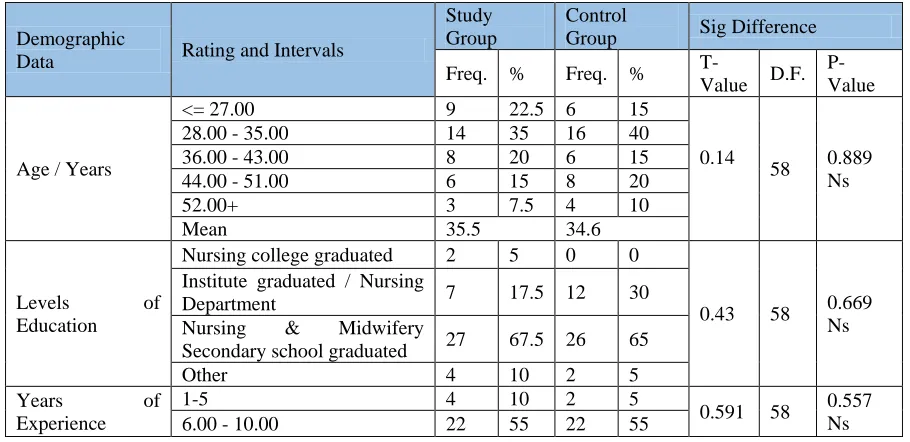
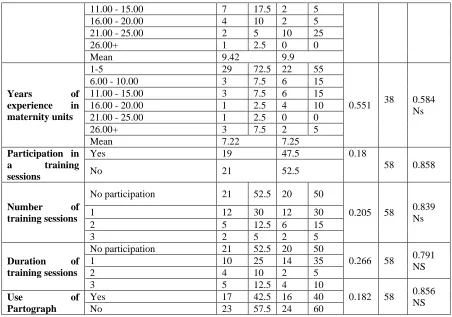
Table (1): Statistical Distribution of the Study and Control Groups Demographic Data with Statistical Difference
Demographic
Data Rating and Intervals
Study Group
Control
Group Sig Difference
Freq. % Freq. %
T-Value D.F.
P-Value
Age / Years
<= 27.00 9 22.5 6 15
0.14
58 0.889
Ns
28.00 - 35.00 14 35 16 40
36.00 - 43.00 8 20 6 15
44.00 - 51.00 6 15 8 20
52.00+ 3 7.5 4 10
Mean 35.5 34.6
Levels of Education
Nursing college graduated 2 5 0 0
0.43 58 0.669
Ns Institute graduated / Nursing
Department 7 17.5 12 30
Nursing & Midwifery
Secondary school graduated 27 67.5 26 65
Other 4 10 2 5
Years of Experience
1-5 4 10 2 5
0.591 58 0.557
Ns
[image:2.612.79.534.517.738.2]11.00 - 15.00 7 17.5 2 5
16.00 - 20.00 4 10 2 5
21.00 - 25.00 2 5 10 25
26.00+ 1 2.5 0 0
Mean 9.42 9.9
Years of experience in maternity units
1-5 29 72.5 22 55
0.551 38 0.584
Ns
6.00 - 10.00 3 7.5 6 15
11.00 - 15.00 3 7.5 6 15
16.00 - 20.00 1 2.5 4 10
21.00 - 25.00 1 2.5 0 0
26.00+ 3 7.5 2 5
Mean 7.22 7.25
Participation in a training sessions
Yes 19 47.5 0.18
58 0.858
No 21 52.5
Number of training sessions
No participation 21 52.5 20 50
0.205 58 0.839
Ns
1 12 30 12 30
2 5 12.5 6 15
3 2 5 2 5
Duration of training sessions
No participation 21 52.5 20 50
0.266 58 0.791
NS
1 10 25 14 35
2 4 10 2 5
3 5 12.5 4 10
0.182 58 0.856
NS Use of
Partograph
Yes 17 42.5 16 40
No 23 57.5 24 60
Sig: Significant; No.: Number %: percentage; Freq.: Frequency; Ns: Non-significant P Value: probability value; Df: degree of freedom;T value: t-test
This table shows that the mean of study sample age is (35.5
years) at the study group and (34.6 years) at the control group. Regarding the level of education in both study and control groups the highest percentage of participants were nursing and midwifery secondary graduates (67.5% and 32.5%) respectively. Concerning year of employment, the study results indicate that the mean of the nurses’ years of experience is (9.4 and 9.9 years) at the study and control groups respectively. In addition, the
study results indicate that the mean of years of experience in maternity units is (7.2 years) at both study and control groups. Furthermore, the study results indicate that (57.5% and 60%) of the nurses at study and control groups respectively had never used a Partograph form before. Finally in this table, the study results indicate that there is a non-significant difference between the study and control group demographic data at p-value more than 0.05.
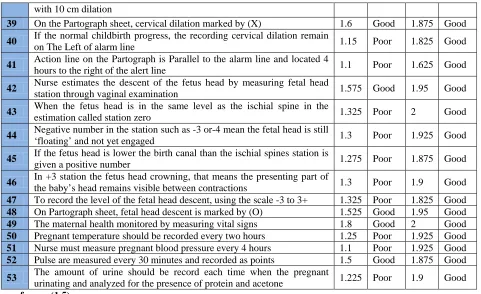
Table (2): Distribution of the Study group by their Responses to Pre-Test and Post-Test Items
List Items Pre-Test Post - Test
M.s. Assess M.s. Assess
1 Partograph is a valuable tool to help nurse to detect the unusual progress
in birth 1.575 Good 1.95 Good
2 Partograph has been designed to record information on fetus health
condition, birth progress And mother health status 1.4 Poor 2 Good
3 Partograph helps the nurse to identify and avoid prolonged birth and
dystocia, fetal distress and maternal bleeding and infection 1.575 Good 1.95 Good
4
The most appropriate definition of the Partograph is an official record composite of key data of the mother and fetus health condition during labor that recorded in especial intervals on one page of sheet
1.65 Good 1.95 Good
5 In the identification sections of the Partograph ,Gravida stand for number
of the previous pregnancies 1.425 Poor 1.975 Good
6 Multipara is a medical term for woman who has given birth more than
once to live babies 1.8 Good 1.85 Good
[image:3.612.80.532.55.372.2]Partograph
8 fetal heart rate is Recorded at first and then every30 minutes 1.55 Good 2 Good
9 Partograph covers fetal heart rate in the range of 60-190 beats per minute 1.525 Good 2 Good
10 The normal heart rate for the term fetus with gestational age of 37 weeks
and more is 120-160 beats / minute 1.7 Good 1.875 Good
11
The reasons for the fatal heart rate deviation is placental aging or damage, decreased blood volume in pregnant woman and oligohydramnios
1.6 Good 1.85 Good
12 Fetal Heart rate less than 120 and more than 160 beats / min indicate
fetus distress 1.6 Good 1.925 Good
13
When the nurse detects any abnormalities in the fetal heart rate, Should repeat counting and if the condition persists for more than 10 minutes must report to medical staff
1.125 Poor 1.95 Good
14 Fetal heart rate deviation is immediate indicator on fetus distress during
childbirth 1.25 Poor 1.7 Good
15 Liquor is the term for amniotic fluid that surrounds the fetus in
Partograph 1.5 Good 1.875 Good
16 Amniotic fluid color must be recorded at least every 4 hours in
Partograph 1.175 Poor 1.9 Good
17 Stained liquor accompanied with fetal heart rate deviation is an indicator
to fetus distress 1.55 Good 1.975 Good
18 If amniotic sack is ruptured but amniotic fluid not comes out "A"
(Absent) should record on Partograph 1.65 Good 1.8 Good
19 The extent of overlapping of fetal skull bones is Definition of molding 1.7 Good 1.925 Good
20
Nurse should identify and record the molding degree on the Partograph By palpating the suture lines and fontanels of the fetal head during a vaginal examination
1.55 Good 2 Good
21 +4 Bones are overlapping and fused completely is not within the
Moulding degrees recorded on Partograph 1.275 Poor 1.925 Good
22
The molding degree +3 with the very slow progress in the birth, refers to blockage or disproportion between the fetus head and the mother pelvis, which leads to dystocia
1.7 Good 1.775 Good
23 Nurse must assess the degree of Moulding at first and then every 2 hours 1.175 Poor 1.8 Good
24
Caput is the swelling on one side of the newborn’s head due to blood or other fluid accumulation in the skin where pressing on the cervix during labor
1.825 Good 1.925 Good
25 Caput or swelling in the fetus head is normal if develops centrally 1.425 Poor 1.9 Good
26 Good and effective uterine contractions necessary for the progress of
birth are Strong contractions and last for more than 40 seconds 1.425 Poor 1.8 Good
27 Uterine contractions assessed by putting hand on the abdomen and feel
the contraction 1.575 Good 1.95 Good
28 In Partograph sheet, contractions recorded every 30 minutes and scaled
from 1 to 5 squares, Each square represents a contraction 1.3 Poor 1.875 Good
29 To stimulate effective uterine contractions physician may prescribe
oxytocin 1.8 Good 1.875 Good
30
During oxytocin administration, nurse should Note and record the number, duration and severity of contractions on the Partograph every half hour
1.275 Poor 1.85 Good
31 At the beginning of labor the cervix is thick and long 1.225 Poor 1.925 Good
32 Cervical Effacement is the softening and thinning of the cervix 1.55 Good 1.85 Good
33 The complete effacement known as100% effaced 1.375 Poor 1.95 Good
34 The measurement of cervical dilatation is from 0 to 10 cm 1.475 Poor 1.775 Good
35 cervical dilation is the result of uterine contractions 1.475 Poor 1.925 Good
36 Partograph recording begins at which labor stage first of labor 1.2 Poor 1.875 Poor
37 The nurse perform vaginal examination to assess Cervical dilation and
effacement, fetal membranes status and fetus molding and presentation 1.55 Good 1.875 Good
with 10 cm dilation
39 On the Partograph sheet, cervical dilation marked by (X) 1.6 Good 1.875 Good
40 If the normal childbirth progress, the recording cervical dilation remain
on The Left of alarm line 1.15 Poor 1.825 Good
41 Action line on the Partograph is Parallel to the alarm line and located 4
hours to the right of the alert line 1.1 Poor 1.625 Good
42 Nurse estimates the descent of the fetus head by measuring fetal head
station through vaginal examination 1.575 Good 1.95 Good
43 When the fetus head is in the same level as the ischial spine in the
estimation called station zero 1.325 Poor 2 Good
44 Negative number in the station such as -3 or-4 mean the fetal head is still
‘floating’ and not yet engaged 1.3 Poor 1.925 Good
45 If the fetus head is lower the birth canal than the ischial spines station is
given a positive number 1.275 Poor 1.875 Good
46 In +3 station the fetus head crowning, that means the presenting part of
the baby’s head remains visible between contractions 1.3 Poor 1.9 Good
47 To record the level of the fetal head descent, using the scale -3 to 3+ 1.325 Poor 1.825 Good
48 On Partograph sheet, fetal head descent is marked by (O) 1.525 Good 1.95 Good
49 The maternal health monitored by measuring vital signs 1.8 Good 2 Good
50 Pregnant temperature should be recorded every two hours 1.25 Poor 1.925 Good
51 Nurse must measure pregnant blood pressure every 4 hours 1.1 Poor 1.925 Good
52 Pulse are measured every 30 minutes and recorded as points 1.5 Good 1.875 Good
53 The amount of urine should be record each time when the pregnant
urinating and analyzed for the presence of protein and acetone 1.225 Poor 1.9 Good
Ms: Mean of score (1.5)
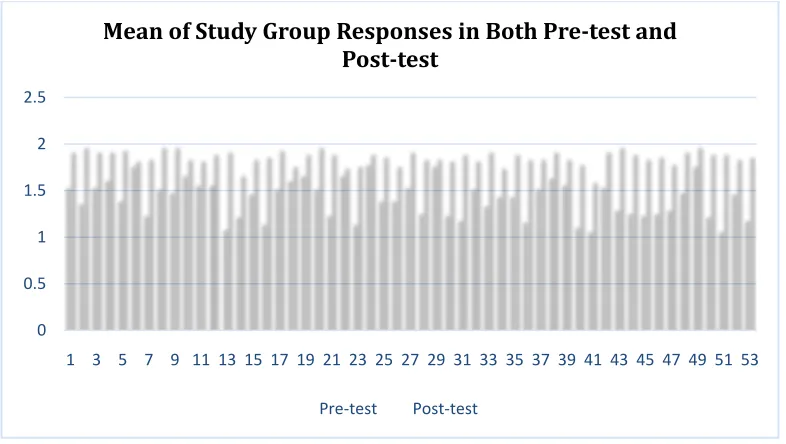
This table shows that most the study group have been poor
in (78%) of the items in pre-test, while they knowledge level become (98%) of the items in post-test after exposed to
educational program. Furthermore the residual (22%) of items which was good in pre-test shows progress in their mean of score in post-test.
Table (3): Statistical distribution of the study group by their overall responses with Significant Difference between Pre-Test and Post-Test Scores
Overall assessment for study group
Pre-test Post-test
Freq. % M.s. Assessment Freq. % M.s. Assessment
Good 8 22 1.44
Poor 39 98 1.89 Good
Poor 32 78 1 2
t-value (20.843), d.f.( 39), p-value (0.001)HS
%: percentage; Freq.: Frequency HS: High significant; P Value: probability value; Df: degree of freedom T value: t-test
The results of this table shows that high Significant Difference between pre-test and post-test scores of study group members at
[image:5.612.67.548.55.349.2]Figure (1): Assessment of study group knowledge in pre-test and post-test.
Table (4):Distribution of the Control Group by their Responses to the Pre-Test and Post-Test Items
List Items Pre-Test Post - Test
M.s. Assess M.s. Assess
1 Partograph is a valuable tool to help nurse to detect the unusual progress in
birth 1.55 Good 1.55 good
2 Partograph has been designed to record information on fetus health
condition, birth progress And mother health status 1.2 Poor 1.2 Poor
3 Partograph helps the nurse to identify and avoid prolonged birth and
dystocia, fetal distress and maternal bleeding and infection 1.45 Poor 1.25 Poor
4
The most appropriate definition of the Partograph is an official record composite of key data of the mother and fetus health condition during labor that recorded in especial intervals on one page of sheet
1.4 Poor 1.45 Poor
5 In the identification sections of the Partograph ,Gravida stand for number of
the previous pregnancies 1.3 Poor 1.4 Poor
6 Multipara is a medical term for woman who has given birth more than once
to live babies 1.45 Poor 1.45 Poor
7 gestational age should be recorded in the identification section of
Partograph 1.4 Poor 1.35 Poor
8 fetal heart rate is Recorded at first and then every30 minutes 1.4 Poor 1.4 Poor
9 Partograph covers fetal heart rate in the range of 60-190 beats per minute 1.2 Poor 1.25 Poor
10 The normal heart rate for the term fetus with gestational age of 37 weeks
and more is 120-160 beats / minute 1.55 Good 1.4 Poor
11 The reasons for the fatal heart rate deviation is placental aging or damage,
decreased blood volume in pregnant woman and oligohydramnios 1.35 Poor 1.35 Poor
12 Fetal Heart rate less than 120 and more than 160 beats / min indicate fetus
distress 1.6 Good 1.55 Good
13
When the nurse detects any abnormalities in the fetal heart rate, Should repeat counting and if the condition persists for more than 10 minutes must report to medical staff
1.15 Poor 1.05 Poor
14 Fetal heart rate deviation is immediate indicator on fetus distress during
childbirth 1.3 Poor 1.25 Poor
15 Liquor is the term for amniotic fluid that surrounds the fetus in Partograph 1.4 Poor 1.4 Poor
16 Amniotic fluid color must be recorded at least every 4 hours in Partograph 1.1 Poor 1.05 Poor
17 Stained liquor accompanied with fetal heart rate deviation is an indicator to
fetus distress 1.45 Poor 1.55 Good
18 If amniotic sack is ruptured but amniotic fluid not comes out "A" (Absent) 1.3 Poor 1.35 Poor
0 0.5 1 1.5 2 2.5
1 3 5 7 9 11 13 15 17 19 21 23 25 27 29 31 33 35 37 39 41 43 45 47 49 51 53
Mean of Study Group Responses in Both Pre-test and
Post-test
[image:6.612.111.504.57.279.2] [image:6.612.71.552.317.736.2]should record on Partograph
19 The extent of overlapping of fetal skull bones is Definition of molding 1.65 Good 1.5 Good
20
Nurse should identify and record the molding degree on the Partograph By palpating the suture lines and fontanels of the fetal head during a vaginal examination
1.25 Poor 1.35 Poor
21 +4 Bones are overlapping and fused completely is not within the Moulding
degrees recorded on Partograph 1.35 Poor 1.25 Poor
22
The molding degree +3 with the very slow progress in the birth, refers to blockage or disproportion between the fetus head and the mother pelvis, which leads to dystocia
1.45 Poor 1.5 Good
23 Nurse must assess the degree of Moulding at first and then every 2 hours 1.15 Poor 1.1 Poor
24
Caput is the swelling on one side of the newborn’s head due to blood or other fluid accumulation in the skin where pressing on the cervix during labor
1.5 Good 1.65 Good
25 Caput or swelling in the fetus head is normal if develops centrally 1.25 Poor 1.2 Poor
26 Good and effective uterine contractions necessary for the progress of birth
are Strong contractions and last for more than 40 seconds 1.5 Good 1.45 Poor
27 Uterine contractions assessed by putting hand on the abdomen and feel the
contraction 1.15 Poor 1.3 Poor
28 In Partograph sheet, contractions recorded every 30 minutes and scaled
from 1 to 5 squares, Each square represents a contraction 1.25 Poor 1.15 Poor
29 To stimulate effective uterine contractions physician may prescribe oxytocin 1.55 Good 1.65 Good
30 During oxytocin administration, nurse should Note and record the number,
duration and severity of contractions on the Partograph every half hour 1.2 Poor 1.15 Poor
31 At the beginning of labor the cervix is thick and long 1.25 Poor 1.2 Poor
32 Cervical Effacement is the softening and thinning of the cervix 1.35 Poor 1.25 Poor
33 The complete effacement known as100% effaced 1.15 Poor 1.2 Poor
34 The measurement of cervical dilatation is from 0 to 10 cm 1.25 Poor 1.15 Poor
35 cervical dilation is the result of uterine contractions 1.3 Poor 1.35 Poor
36 Partograph recording begins at which labor stage first of labor 1.25 Poor 1.2 Poor
37 The nurse perform vaginal examination to assess Cervical dilation and
effacement, fetal membranes status and fetus molding and presentation 1.25 Poor 1.25 Poor
38 Active phase of labor begins when the cervical dilation is 4 cm and ends
with 10 cm dilation 1.1 Poor 1.25 Poor
39 On the Partograph sheet, cervical dilation marked by (X) 1.45 Poor 1.45 Poor
40 If the normal childbirth progress, the recording cervical dilation remain on
The Left of alarm line 1.15 Poor 1.1 Poor
41 Action line on the Partograph is Parallel to the alarm line and located 4
hours to the right of the alert line 1.3 Poor 1 Poor
42 Nurse estimates the descent of the fetus head by measuring fetal head
station through vaginal examination 1.25 Poor 1.3 Poor
43 When the fetus head is in the same level as the ischial spine in the
estimation called station zero 1.3 Poor 1.2 Poor
44 Negative number in the station such as -3 or-4 mean the fetal head is still
‘floating’ and not yet engaged 1.3 Poor 1.15 Poor
45 If the fetus head is lower the birth canal than the ischial spines station is
given a positive number 1.25 Poor 1.15 Poor
46 In +3 station the fetus head crowning, that means the presenting part of the
baby’s head remains visible between contractions 1.15 Poor 1.25 Poor
47 To record the level of the fetal head descent, using the scale -3 to 3+ 1.3 Poor 1.1 Poor
48 On Partograph sheet, fetal head descent is marked by (O) 1.35 Poor 1.35 Poor
49 The maternal health monitored by measuring vital signs 1.5 Good 1.6 Good
50 Pregnant temperature should be recorded every two hours 1.2 Poor 1.2 Poor
51 Nurse must measure pregnant blood pressure every 4 hours 1.05 Poor 1.05 Poor
52 Pulse are measured every 30 minutes and recorded as points 1.2 Poor 1.15 Poor
53 The amount of urine should be record each time when the pregnant
Ms: Mean of score (1.5)
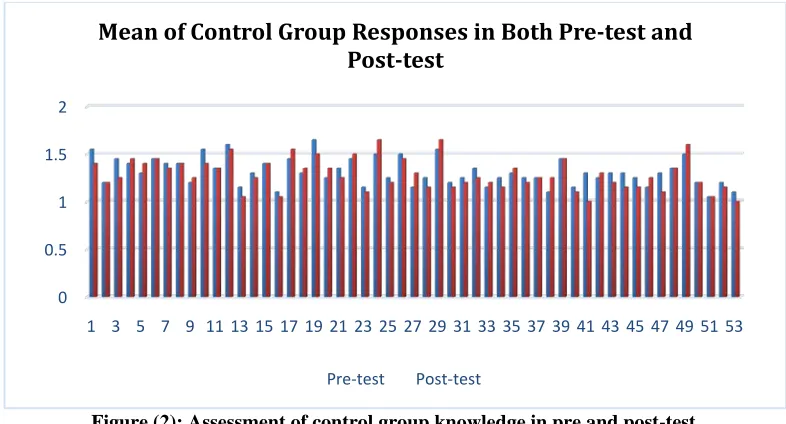
This table shows that knowledge level of control group
have been poor in (95%) of the items in pre-test, While in the post-test the same group pass only (10%) of the items, and there
were unobservable progress in good items among control group post-test because they did not exposed to any intervention related to knowledge.
Table (5):Statistical distribution of the Control group by their overall responses with Significant Difference between Pre-Test and Post-Test Scores
Overall assessment for control group
Pre-test Post-test
Freq. % M.s. Assessment Freq. % M.s. Assessment
good 2 5
1.31 Poor 4 10 1.28 Poor
poor 38 95 36 90
t-value (0.56) ;d.f.(19) ;p-value (0.57) ;significance:NS
%: percentage; Freq.: Frequency; NS: non-significant; P Value: probability value;Df: degree offreedom T value: t-test; Ms: Mean of score
The results of above table shows that no Significant Difference between Pre-Test and Post-Test Scores of control group members at p-value (0.577).
Figure (2): Assessment of control group knowledge in pre and post-test.
Table (6):Significant Difference between Study and Control Groups regarding Pre-Test Scores
Pre-test Study group Control group
Freq. % M.s. Assessment Freq. % M.s. Assessment
Good 8 22
1.44 Poor 2 5 1.31 Poor
Poor 32 78 38 95
t-value (0.676); d.f.( 58); p-value (0.502); significant: NS
%: percentage ; Freq.: Frequency; NS: non-significant; P Value: probability value; Df: degree of freedom T value: t-test; Ms: Mean of score
Table (6) shows that there is no significant differences between study and control groups in pre-test at p-value (0.502) which
clearly indicated poor knowledge of both groups in pre-test.
0 0.5 1 1.5 2
1 3 5 7 9 11 13 15 17 19 21 23 25 27 29 31 33 35 37 39 41 43 45 47 49 51 53
Mean of Control Group Responses in Both Pre-test and
Post-test
[image:8.612.49.556.162.224.2] [image:8.612.108.501.304.516.2]Table (7): Significant Difference between Study and Control Groups regarding Post-Test Scores
Post-test Study group Control group
Freq. % M.s. Assessment Freq. % M.s. Assessment
Good 39 98
1.89 Good 4 10 1.28 Poor
Poor 1 2 36 90
t-value (14.607); d.f.( 58); p-value (0.001); significant: HS
%: percentage; Freq.: Frequency; HS: High significant; P Value: probability value;Df: degree of freedom T value:t-test;Ms: Mean of score
The results of table (7) shows that a highly significant
difference found between the post-test of the study group members at p-value (0.001) who were participated in the educational program and the control group who did not exposed to any intervention related to knowledge.
IV. DISCUSSION
According to (Table 1) in the results, the study shows no
significant difference between both study and control groups regarding all demographic data.In regards to age, the majority of study and control groups were at age group of (28-35) years. Age of nurses in this study is in agreement with other study done by Oladapo and others (2011) in Nigeria that studied the Knowledge and utilization of partograph among healthcare providers at maternity centres.(16).besides that, the present results are similar to the conducted study Salama & Heeba, (2010) in Cairo who found the majority of nurse’s age-group (28.5- 36.5) years was (69.6%).(17).
Regarding the level of education, the majority of the
sample in both study and control groups the highest percentage of participants were nursing and midwifery secondary graduates (67.5% and 65%) respectively.Other studies are in consistent with this study which shows that the nursing and midwifery secondary school graduates with Diploma degree are the main health care staffs in health facilities and with more educational level more practical care can be delivered. Many previous studies were in agreement with this result they found that the majority of study subjects in maternity units were graduate from nursing and midwifery secondary school(12,18).
Concerning years of experience, this study illustrates that
the majority (55%) in the study and control groups had been working in maternity units between (1-5) years of nursing experience.This result is in agreement with Clarke & others (2012) who stated that the mean of experience level was less than 5 years among the employed nurses indicates mainstream of low average nurse’s experience in American hospitals but nurses remain the largest human resources of health care providers(19). Regarding to the years of experience in maternity units,the present study shows thatthe majority (72.5%, 55%) in the study and control groups had been working in maternity units between (1-5) years of nursing experience.these findings are in the same line with the study conducted by Mohamed, Abd Elati and Zaki in Egypt (2015), on Knowledge and attitude of maternity nurses about partograph, they discoveredthat the mean of experience level was less than 5 years among the employed nurses and there is a significant association between nurse’s
knowledge with years of experience and attendance in maternity units(20).
About training sessions regarding partograph, the study
result reveals that the majority (52.5%, 60%) in the study and control groups respectively have no a chance to attend training sessions or unable to participate the continuous teaching programs. This result come along with Khomeiran andothers, (2010) their study reveals that (48.0%) were able to participating in training programs(21).
Regarding use of partograph the study indicated that the
majority of (57.5%) in the study and (60%) control groups had never used or applied Partograph before. This finding is consistent with that of Toppo (2010) and Lavender (2013) who stated that majority of the study subjects never used partograph during labor(22, 23).
According to the results shows in tables 2; 3; 4 and 5. The
present study indicated that the study sample knowledge was poor that less than fourth of study group had passed the pre-test, and 5% of control group had almost passed the pre-test. Many studies found that there is a non-significant difference between study and control groups for pre-test related to nurses’ knowledge at P>0.05(20,23).Elbashir,et al., (2015) concluded in their study they that there is a deficit in nurse’s knowledge and skills regarding partograph prior to participation in the
educational Training Program(24).In Toppo(2010)study
mentioned that there were obvious difference between pretest and posttest as the study sample nurses answering questions showing that the mean percent in pretest was 34.3% and it became 92.5% in posttest which shows an increase about 58.2% in most questions in posttest(22).
In regards to the result in tables 3; 5; 6 and 7, these tables
[image:9.612.65.548.80.144.2]successful in increasing their knowledge(2). Therefore, the implemented educational program was effective and has an impact on nurse's knowledge about partograph. Present study was supported by many studies which mentioned that there are highly significant difference about nurses' knowledge in post-test between study and control groups(2, 22, 24).
V. CONCLUSIONS
The study concluded that majority of nurses are young age
and had few years of experience in nursing field with lack of educational training sessions regarding partograph, whichmakes most of the nurses in maternity units and labor room had knowledge deficiency concerning partograph usage.
Educational program was found to be an appropriate and effective way to improve the nurses' knowledge regarding partograph.
VI. RECOMMENDATIONS
Based on the study results discussion and conclusions the study recommended that:
1. Asserting on Ministry of Health to offer in service
training programs for nurses and midwife,also encouraging nurses to be enrolled in educational sessions and programs to improve their knowledge and keep their knowledge up to date about partograph.
2. Developing of follow up system in maternity units to
evaluate the performance of nurses who had previously attended the partograph teaching program and encourage peer mentoring for nurses to learn from other.
3. Emphasize on the importance of using partograph in
delivery rooms in all Iraqi governorates.
REFERENCES
[1] Neilson J.: Obstructed labor Reducing maternal death and disability during pregnancy. Br Med Bull (2003) 67 (1): 191-204.
[2] Jaber, E.; Ali R.: Impact of an Education Training program upon Nurse-Midwives Practices Concerning First Stage of Labor. Kufa Journal for Nursing Sciences, 2014, 2(3).
[3] Say, L.; Chou, D.; Gemmill, A.; Tunçalp, Ö.; Moller, A.; Daniels, J.: Global Causes of Maternal Death: A WHO Systematic Analysis. Lancet Global Health. 2014, 2(6), P.P.323-333.
[4] UNICEF, WHO, the World Bank, United Nations Population Division. The Inter-agency Group for Child Mortality Estimation (UN IGME). Levels and Trends in Child Mortality. Report 2015. New York, USA, UNICEF, 2015. [5] Kwast, B.; Poovan, P.; Vera, E.; Kohls, E.: The Modified WHO Partograph:
Do We Need A Latent Phase? British Journal of Midwifery. 2008,16(8),P.527
[6] Yisma, E.; Dessalegn, B.; Astatkie A.; Fesseha N.: Knowledge and Utilization Of Partograph Among Obstetric Care Givers In Public Health Institutions Of Addis Ababa, Ethiopia. BMC Pregnancy and Childbirth.2013, 13(1), P.P.101-109.
[7] Aaron, R.: Safe Prevention of the Primary Cesarean Delivery. Obstetric Care Consensusno. The American College of Obstetricians and Gynecologists. Obstet Gynecol. 2014, 23(1), P.P.693_711.
[8] Liu, S.; Liston, R.; Joseph, K.; Heaman, M.; Sauve, R.; Kramer, M.: Maternal mortality and severe morbidity associated with low-risk planned cesarean delivery versus planned vaginal delivery at term. Maternal Health Study Group of the Canadian Perinatal Surveillance System. CMAJ, 2007, 17(2), P.P.455–60.
[9] Spong, C.; Berghella, V.; Wenstrom, K.; Mercer, B.; Saade, G.: Preventing The First Cesarean Delivery: Summary Of A Joint Eunice Kennedy Shriver National Institute Of Child Health And Human Development, Society For Maternal-Fetal Medicine, And American College Of Obstetricians And Gynecologists Workshop. Obstetrics and Gynecology. 2012, 120(5), P. 81. [10] Taukuheke, L.: Midwives knowledge of the use of the Partograph in the
regional training Hospital in Namibia. Common wealth nurses conference Journal, 2014, 2(1), P.8.
[11] Tayade, S.; Jadhao, P.: The impact of use of modified who partograph on maternal and perinatal outcome. International Journal of Biomedical and Advance Research, 2012, 3(4), P.P.256-262.
[12] World Health Organization, Preventing Prolonged Labor: a practical guide. The partograph. Part I: Principles and Strategy, 2014.
[13] Daniel, G.: The Partograph: An Essential Tool for Decision-Making during Labor. Nutrition and Maternal Health, U.S. 2012, 12(2), P.38.
[14] MOH, Iraq: National strategy and plan of action for nursing and midwifery development in Iraq 2003–2008, P.5.
[15] Neal, J.; Lowe, N.; Patrick, T.; Cabbage, L.; Corwin, E.: What is the Slowest‐Yet‐Normal Cervical Dilation Rate among Nulliparous Women with Spontaneous Labor Onset. Journal of Obstetric, Gynecologic, & Neonatal Nursing. 2010, 39(4),P.P.361-369.
[16] Oladapo, O.; Daniel, O.; Olatunji, A.: Knowledge And Use Of The Partograph Among Healthcare Personnel At The Peripheral Maternity Centres In Nigeria. Journal Of Obstetrics And Gynaecology. 2011, 26(6),P.P.538-541.
[17] Lindelow, M.; Kanchanachitra, C.; Johnston, T.; Hanvoravongchai, P.; Lorenzo, F.; Huong, N.; Wilopo, S.; Rosa J.: Human Resources For Health In Southeast Asia: Shortages, Distributional Challenges, And International Trade In Health Services. The Lancet. 2011 377(9767), P.P.769-781. [18] Thompson, J.; Fullerton, J.; Sawyer, A.: The International Confederation Of
Midwives: Global Standards For Midwifery Education (2011) With Companion Guidelines. Midwifery. 2011, 27(4), P.P.409-416.
[19] Clarke, S.; Rockett, J.; Sloane, D.; Aiken, L.: Organizational Climate, Staffing, And Safety Equipment As Predictors Of Needlestick Injuries And Near-Misses In Hospital Nurses. American Journal of Infection Control. 2012 Jun 30;30(4):207-16.
[20] Mohamed, A.; Abd Elati, I.; Zaki, M.: Knowledge And Attitude Of Maternity Nurses Regarding Perinatal Care. Journal of Nursing Education and Practice, 2015, 5(2).P. 141.
[21] Khomeiran, T.; Yekta, P.; Kiger, A.; Ahmadi, F.: Professional Competence: Factors Described By Nurses As Influencing Their Development. International Nursing Review. 2010 ,53(1),P.P.66-72.
[22] Toppo, N.: Planned Teaching Programme On The Use Of Partograph Among Trained Midwives. Indian Journal Of Nursing Studies; 2010, 01(2), P.13.
[23] Lavender, D.; Omoni, G.; Lee, K.; Wakasiaki, S.; Campbell, M.; Watiti, J.; Mathai, M.: A Pilot Quasi-Experimental Study To Determine The Feasibility Of Implementing A Partograph E-Learning Tool For Student Midwife Training In Nairobi. Midwifery. 2013, 29(8), P.P.876-884. [24] Elbashir, A.: Effect Of Partogram Training Program On Village
Midwives’ Knowledge And Skills For Normal And Abnormal Labor. European Journal Of Pharmaceutical And Medical Research. 2015, 2(3),65-72.
AUTHORS
First Author – ZainabNeamatJumaah Al-Taee, M.Sc,
M.Sc.Maternal and Newborn Health Nursing, Faculty of Nursing, University of Kufa.
Second Author – Kafi Mohammed Nasir Al-Asadi, Ph.D,